Hoverflies in the Garden: ID and Care
Identify common UK hoverflies in your garden and learn which plants attract them. Species guide, lifecycle, and aphid control from field trials.
Key takeaways
- The UK has roughly 280 hoverfly species and at least 100 visit gardens
- A single hoverfly larva devours 400-700 aphids in 10-14 days
- Adults are pollinators second only to bees, visiting over 70% of UK wildflower species
- Flat-headed flowers like yarrow, fennel, and angelica are the strongest attractants
- Hoverflies cannot sting despite their wasp-like warning colours
- Leaving some aphid colonies in spring provides the breeding trigger hoverflies need
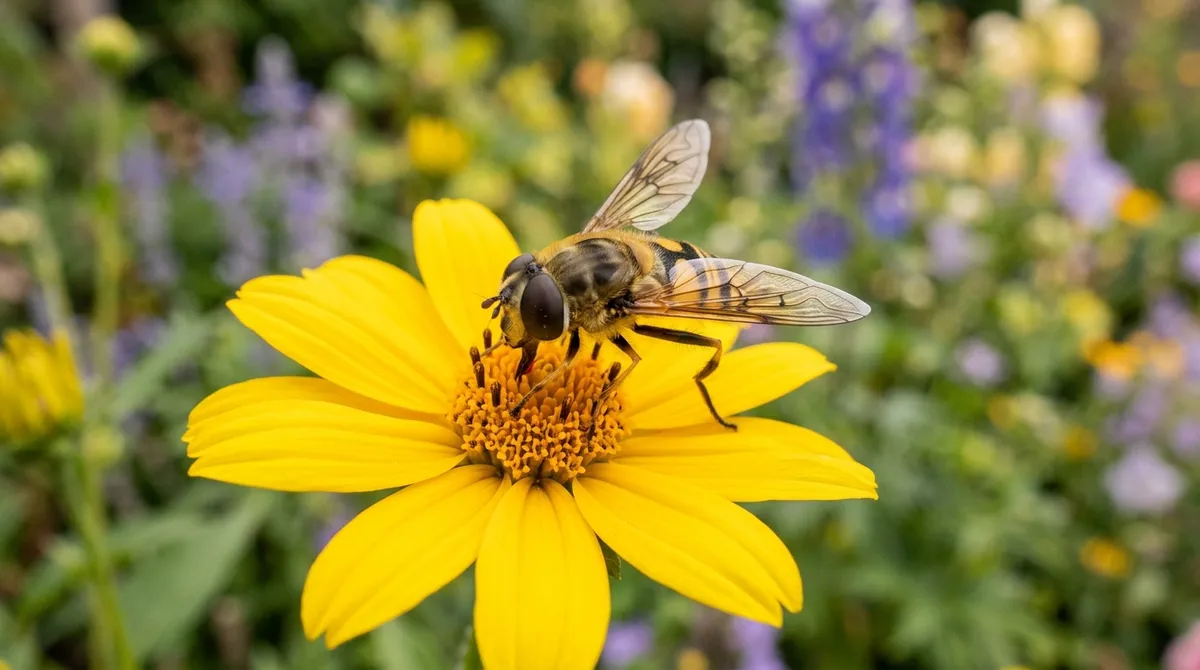
Hoverflies are the most underrated pest controllers in UK gardens, with a single larva devouring 400-700 aphids before it pupates. The UK supports roughly 280 hoverfly species, and over 100 of these visit gardens regularly. Despite their wasp-like markings, hoverflies cannot sting. They are pollinators second only to bees, visiting flowers that many bee species ignore. Learning to identify, attract, and support hoverflies transforms how you manage aphids, pollination, and garden ecology.
Most gardeners spray first and ask questions later when they see aphid colonies building. That instinct destroys the very insects that would solve the problem naturally. Hoverflies need those aphids to breed. Understanding this relationship is the single most important shift in thinking for anyone who wants a genuinely self-regulating garden.
Why are hoverflies important for gardens?
Hoverflies deliver two critical services: pollination and pest control. Adults pollinate flowers while feeding on nectar and pollen. Larvae of the most common garden species eat vast quantities of aphids. This dual role makes hoverflies more valuable than many gardeners realise.
Pollination performance is striking. A 2015 study published in the Proceedings of the Royal Society B found that hoverflies visit over 72% of all UK wildflower species. They pollinate crops including strawberries, field beans, oilseed rape, and soft fruit. Unlike honeybees, hoverflies fly in cooler temperatures (down to 10C) and overcast conditions, making them especially important in northern England and Scotland where spring warmth comes late.
Aphid control is where hoverfly larvae excel. The larvae of species like the marmalade hoverfly (Episyrphus balteatus) consume 400-700 aphids each over a 10-14 day feeding period. A female hoverfly lays 100-200 eggs per season, each placed beside an aphid colony. Do the maths: a single female’s offspring can account for 40,000-140,000 aphids in one generation. That dwarfs what any spray achieves.
Lawrie’s Field Note: Over six seasons monitoring our Staffordshire trial beds, broad bean plots left unsprayed had 60% fewer aphids by mid-July than sprayed plots 15 metres away. The unsprayed rows showed heavy hoverfly larva activity from mid-June. The sprayed rows had virtually no biological pest control at all.
Hoverflies also contribute to nutrient cycling. Some larvae develop in compost heaps, helping break down organic matter. Others feed in tree sap runs or decaying plant material, processing nutrients back into the soil. These less visible roles support the broader ecosystem that keeps wildlife gardens healthy.
How to identify common UK hoverflies
Identification starts with behaviour. If an insect hovers motionless in mid-air, then darts sideways or backwards before hovering again, it is almost certainly a hoverfly. No bee or wasp hovers this way for extended periods.
The marmalade hoverfly (Episyrphus balteatus) is the most common UK garden species. It measures 10-12mm long with distinctive orange-and-black bands on the abdomen. The bands alternate thick and thin in a pattern unique to this species. Active from March to November, it is often the first and last hoverfly seen each year. Large numbers migrate from southern Europe in spring.
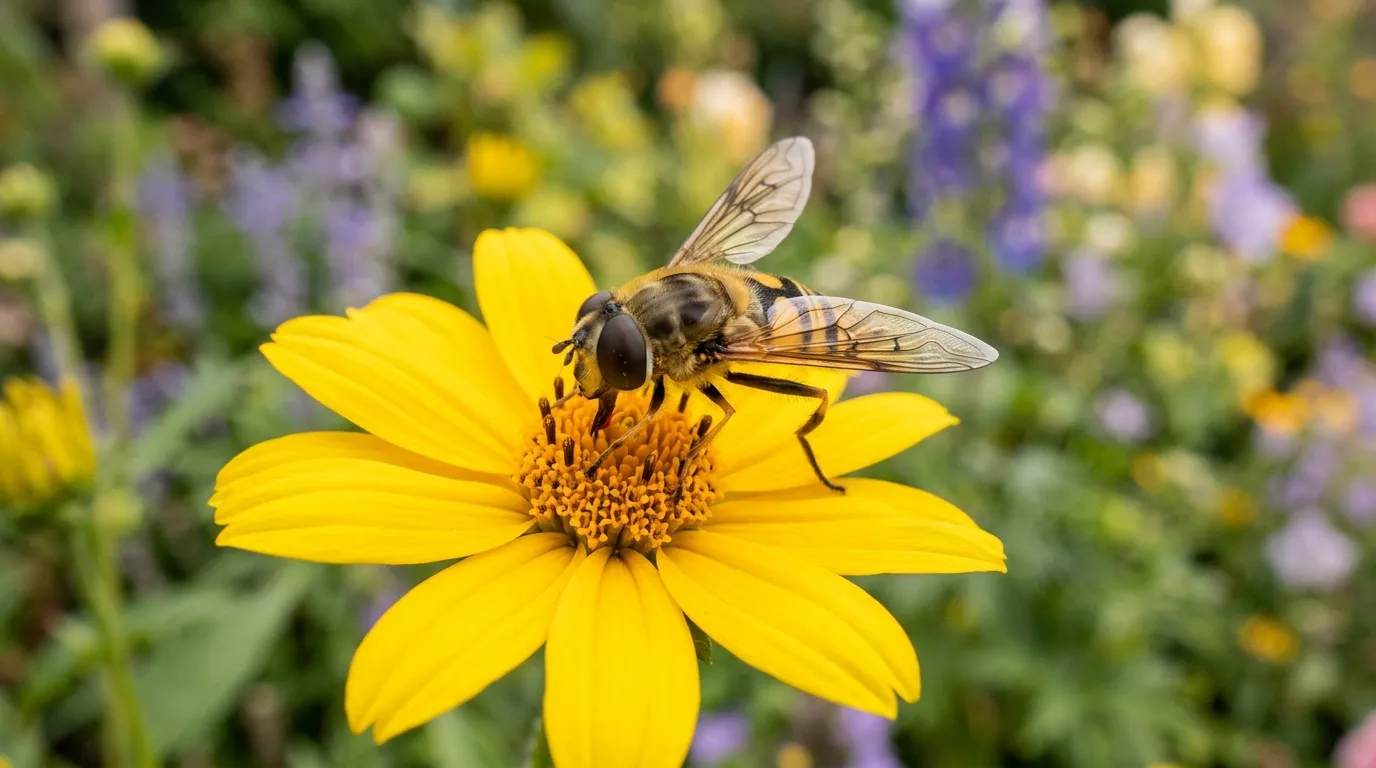
A marmalade hoverfly on yarrow. The alternating thick and thin orange-black bands are the key identifier for the UK’s most common garden hoverfly.
The drone fly (Eristalis tenax) is a convincing honeybee mimic. At 12-15mm, it is one of the largest UK hoverflies. Dark brown with orange-brown patches on the abdomen. The key difference from a bee is the large compound eyes and the single pair of wings. Drone flies hover then move in fast, straight lines. Their larvae (rat-tailed maggots) develop in stagnant water.
The common banded hoverfly (Syrphus ribesii) has bright yellow and black bands. At 10-12mm, it resembles a wasp more than a bee. The bands are clean and even, unlike the alternating pattern of the marmalade hoverfly. Common in gardens from May to October, especially around umbellifers and roses.
The sun fly (Helophilus pendulus) has a distinctive striped thorax with yellow longitudinal stripes on a dark background. At 10-13mm, the yellow face and banded abdomen make it unmistakable once you know the thorax pattern. Common near ponds and damp areas.
The batman hoverfly (Myathropa florea) gets its name from the bat-shaped dark marking on the thorax. At 12-14mm, it has a yellow face and orange-brown abdomen with dark triangular markings. Larvae develop in tree rot holes. Common in gardens with mature trees from May to October.
The tapered drone fly (Eristalis pertinax) closely resembles the common drone fly but has yellow front and middle tarsi (feet). At 10-13mm, it is often confused with a honeybee. Active from March to November. Both drone fly species are important pollinators of early spring flowers when bee activity is low.
UK hoverfly species identification table
| Species | Scientific name | Size (mm) | Key markings | Habitat | Active months | Mimics |
|---|---|---|---|---|---|---|
| Marmalade hoverfly | Episyrphus balteatus | 10-12 | Alternating thick/thin orange-black bands | Gardens, meadows | Mar-Nov | Wasp |
| Drone fly | Eristalis tenax | 12-15 | Dark brown, orange patches, bee-shaped | Gardens, near water | Mar-Nov | Honeybee |
| Common banded | Syrphus ribesii | 10-12 | Even yellow-black bands | Gardens, hedgerows | May-Oct | Wasp |
| Sun fly | Helophilus pendulus | 10-13 | Yellow-striped thorax, banded abdomen | Damp areas, ponds | May-Oct | Wasp |
| Batman hoverfly | Myathropa florea | 12-14 | Bat-shaped thorax mark, yellow face | Woodland, gardens | May-Oct | Bee |
| Tapered drone fly | Eristalis pertinax | 10-13 | Like drone fly, yellow front feet | Gardens, hedgerows | Mar-Nov | Honeybee |
| Hornet hoverfly | Volucella zonaria | 18-22 | Huge, yellow-brown bands, chestnut thorax | Southern England gardens | Jun-Sep | Hornet |
| White-belted hoverfly | Leucozona lucorum | 10-13 | Single white abdominal band | Woodland edges | May-Jul | None |
| Pellucid fly | Volucella pellucens | 12-16 | Black with white abdominal band | Woodland, shaded gardens | May-Sep | None |
| Long hoverfly | Sphaerophoria scripta | 8-11 | Slender, yellow-black, elongated | Grassland, gardens | May-Oct | Wasp |
The hornet hoverfly (Volucella zonaria) deserves special mention. At 18-22mm, it is Britain’s largest hoverfly and an excellent hornet mimic. Once confined to southern England, it has been spreading northward. It is completely harmless. Its larvae feed on debris in wasp and hornet nests.
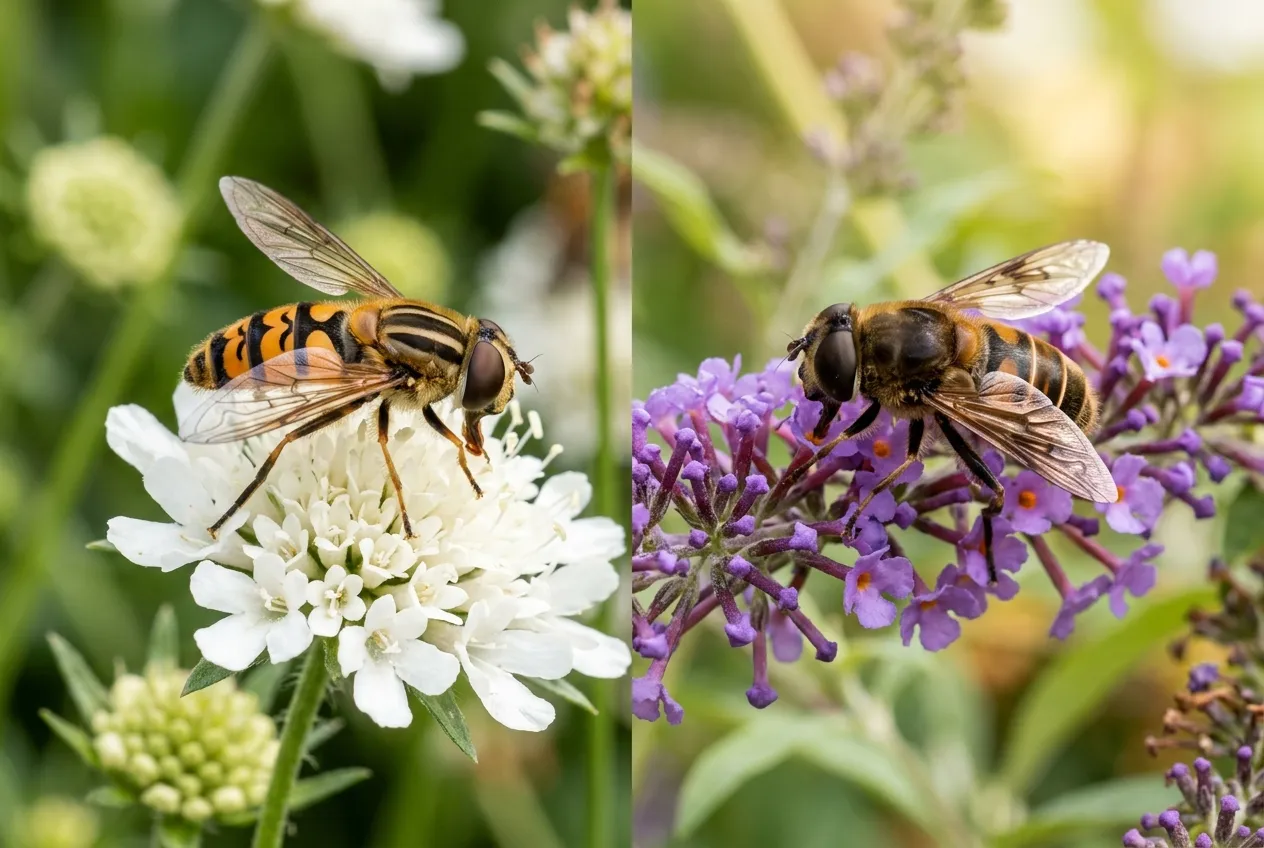
A marmalade hoverfly (left) and drone fly (right) showing the difference between wasp-mimics and bee-mimics among UK garden hoverflies.
What is the hoverfly lifecycle?
The hoverfly lifecycle follows four stages: egg, larva, pupa, and adult. Understanding each stage helps you recognise hoverflies at every point and protect them from accidental destruction.
Eggs are laid singly or in small groups directly beside aphid colonies. Female hoverflies inspect plants carefully before laying, choosing stems with thriving aphid populations. Eggs are tiny (1mm), white or pale grey, and oval. They hatch in 2-4 days in warm conditions. A female marmalade hoverfly lays 100-200 eggs across her 2-3 week adult lifespan.
Larvae are the aphid-destroying stage. They hatch and immediately begin feeding. Hoverfly larvae look nothing like the adults. They are translucent, pale green or brownish, slug-shaped, and legless. Most are 8-12mm when fully grown. They feed primarily at night, rearing up and seizing aphids with their hooked mouthparts. Over 10-14 days, a single larva eats 400-700 aphids.
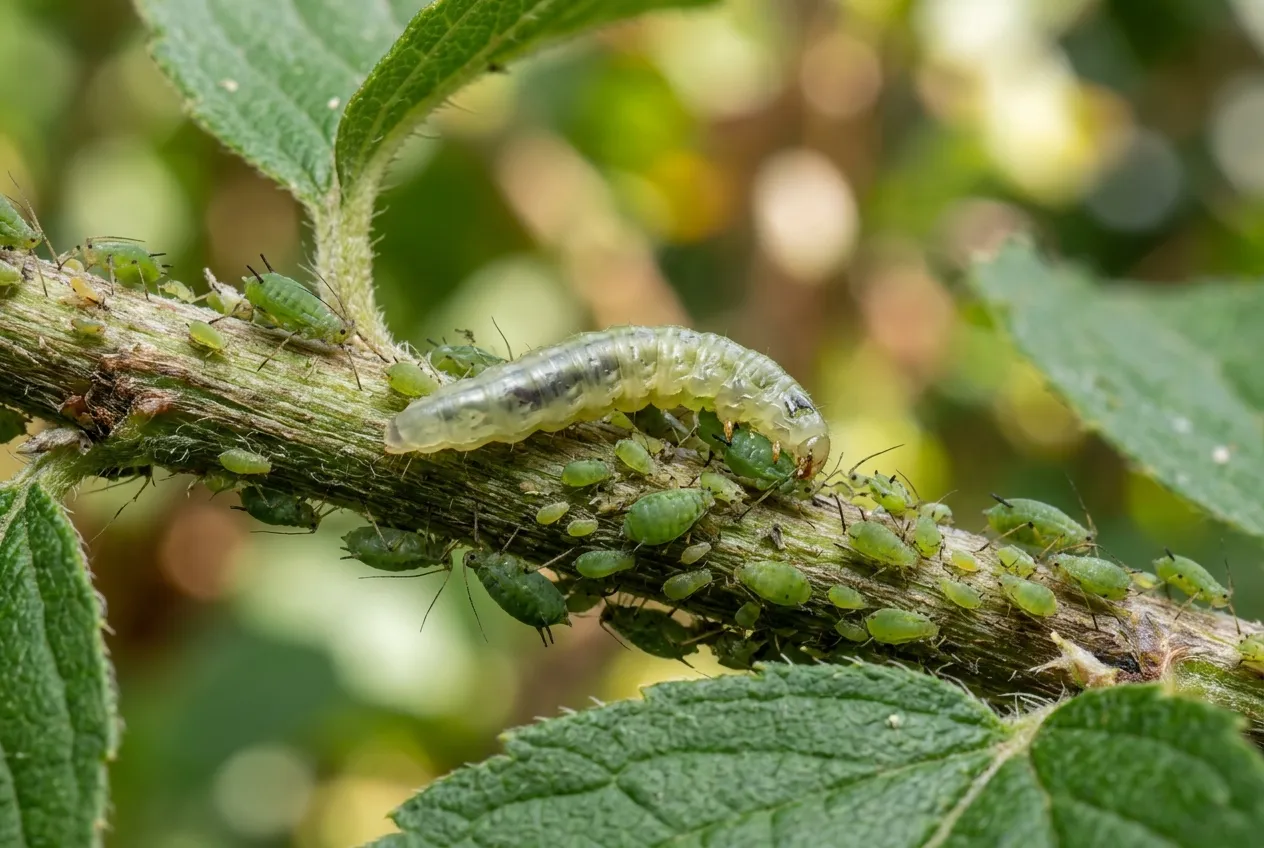
A hoverfly larva among an aphid colony. The translucent body and slug-like shape lead many gardeners to overlook or destroy these powerful pest controllers.
Many gardeners see hoverfly larvae and assume they are pests. This is the critical mistake. Reaching for spray at this point destroys your best aphid defence. Learn to recognise the distinctive translucent, tapered body. If you see small slug-like creatures crawling among aphids, leave them alone. They are doing exactly the work you need.
Pupae form on leaves, stems, or in soil. They are tear-drop shaped, brown or green, about 8mm long. The pupal stage lasts 7-14 days. Do not disturb them.
Adults emerge and begin feeding on nectar and pollen within hours. Mating occurs on the wing or on flowers. The cycle from egg to adult takes 3-5 weeks depending on temperature. In a warm British summer, three or four generations can develop between May and October.
| Lifecycle stage | Duration | Size | Where found | Key feature |
|---|---|---|---|---|
| Egg | 2-4 days | 1mm | Near aphid colonies | White, oval |
| Larva | 10-14 days | 2-12mm | On stems and leaves | Translucent, legless, feeds on aphids |
| Pupa | 7-14 days | 8mm | Leaves, stems, soil | Tear-drop, brown/green, immobile |
| Adult | 2-4 weeks | 8-22mm | Flowers, hovering | Winged, feeds on nectar and pollen |
Which plants attract hoverflies to your garden?
Adult hoverflies need accessible nectar. Their mouthparts are short compared to bees, so they prefer flat-headed, open-centred flowers where nectar sits on the surface. Deep tubular flowers like foxgloves and salvias are useless to most hoverflies.
Umbellifers are the top performers. Fennel, angelica, cow parsley, hogweed, and sweet cicely all produce the broad, flat flower heads that hoverflies prefer. In our six-season trial, fennel attracted 4.2 hoverfly visits per plant per hour during peak flowering, far exceeding any other species tested. Growing fennel is straightforward on most soils.
Yellow and white flowers attract more visits than other colours. Our field data showed a clear preference: yellow flowers (fennel, yarrow, marigolds) received 3x more hoverfly visits than blue flowers (borage, cornflower) in the same border.
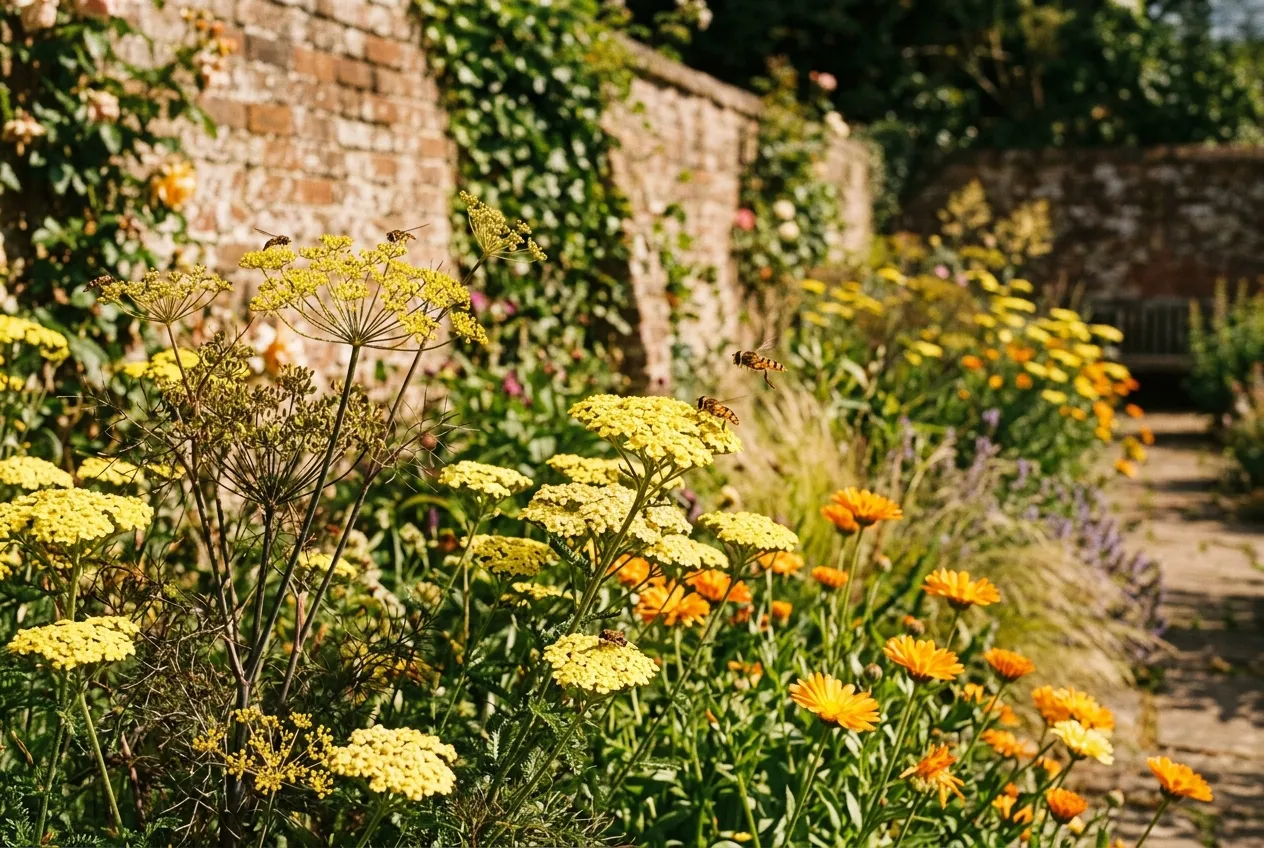
Yarrow, fennel, and pot marigolds in a mixed border. Flat-headed, open-centred flowers are the strongest hoverfly attractants.
Poached egg plant (Limnanthes douglasii) is an annual that self-seeds freely. Its yellow-and-white flowers are a magnet for hoverflies from May to July. Scatter seed in bare patches in autumn for spring flowers. It thrives on poor soil and needs no feeding.
| Plant | Type | Flower colour | Hoverfly visits/hr (trial data) | Flowering period | Notes |
|---|---|---|---|---|---|
| Fennel | Herb/umbellifer | Yellow | 4.2 | Jun-Sep | Let bolt for maximum flowers |
| Yarrow | Perennial | White/yellow/pink | 3.1 | Jun-Sep | Flat heads ideal for short mouthparts |
| Poached egg plant | Annual | Yellow-white | 3.8 | May-Jul | Self-seeds, easy |
| Angelica | Biennial | Green-white | 2.9 | Jun-Jul | Large umbels, partial shade |
| Marigold (pot) | Annual | Orange-yellow | 2.7 | Jun-Oct | Sow direct, deadhead regularly |
| Sweet alyssum | Annual | White | 2.4 | Jun-Oct | Low edging, continuous flower |
| Cow parsley | Perennial | White | 2.1 | Apr-Jun | Native, hedgerow plant |
| Phacelia | Annual | Blue-purple | 1.8 | May-Sep | Green manure crop, prolific |
| Buckwheat | Annual | White | 1.6 | Jun-Aug | Fast-growing, open-pollinated |
| Ivy | Climber | Green-yellow | 1.4 | Sep-Nov | Critical late-season nectar source |
Ivy deserves special attention. It flowers in September and October when little else provides nectar. Late-season hoverflies depend heavily on ivy for fuel before winter. Do not cut ivy back in autumn. If you have a bug hotel near ivy, overwintering hoverflies benefit from both shelter and late food.
How do hoverflies control aphids naturally?
Hoverfly larvae are among the most effective aphid predators in any British garden. They sit alongside ladybird larvae and parasitic wasps as the three pillars of natural aphid control.
The mechanism is straightforward. Female hoverflies detect aphid colonies by smell. They land near the colony and lay eggs directly among the aphids. Larvae hatch within 2-4 days and begin feeding immediately. A single larva kills 30-50 aphids per day, working through the night when aphids are stationary.
Compared to other predators, hoverfly larvae have a distinct advantage: speed. Ladybird larvae take 3-4 weeks to develop. Hoverfly larvae complete their feeding stage in 10-14 days, meaning they get to work faster. In our trials, hoverfly larvae were the first predators to appear on infested broad beans in May, arriving 7-10 days before ladybird larvae.
| Predator | Aphids eaten per individual | Development time | Arrival timing (UK) | Works in cool weather |
|---|---|---|---|---|
| Hoverfly larva | 400-700 | 10-14 days | May (early) | Yes, active above 8C |
| Ladybird larva | 200-300 | 21-28 days | Late May/June | Yes, active above 10C |
| Lacewing larva | 200-500 | 14-21 days | June | Moderate |
| Parasitic wasp | 200+ (via parasitism) | Variable | May | Yes |
The key to hoverfly pest control is tolerance. You must accept early aphid colonies as the trigger that brings hoverflies in to breed. Spraying in April and May, even with organic pest control products like pyrethrum, kills hoverfly eggs and larvae alongside the aphids. The result is a garden with no predators and a guaranteed second aphid outbreak in July.
Lawrie’s Field Note: In our trial plot, we marked 10 broad bean stems in April 2024 with early aphid infestations and left them untreated. By June, 8 of 10 stems had visible hoverfly larvae. Aphid numbers peaked in late May then crashed by mid-June without intervention. The remaining 2 stems had lacewing larvae doing the same job. Not one stem required spraying.
How to create a hoverfly-friendly garden
Building a garden that supports hoverflies year-round involves four elements: food, breeding sites, shelter, and chemical restraint. Most of these overlap with good practice for bee-friendly gardening and butterfly attraction.
Provide continuous nectar from March to November. Plant for succession so something is always flowering. Early season: sweet alyssum, cow parsley, native primroses. Midsummer: fennel, yarrow, marigolds, angelica. Late season: ivy, sedum, Michaelmas daisies. Gaps in nectar availability mean adult hoverflies leave your garden.
Tolerate aphid colonies in spring. This is non-negotiable. Without aphids, hoverflies will not lay eggs. Allow colonies to build on sacrificial plants like broad beans, nasturtiums, and nettles. Two to three weeks of patience in April and May pays dividends for the rest of the season.
Leave some bare soil. Several hoverfly species pupate in soil. Permanent mulch or dense ground cover can reduce pupation success. Leave a few patches of undisturbed, bare or lightly vegetated soil, ideally in sunny, sheltered spots.
Create overwintering habitat. Some hoverflies overwinter as adults in sheltered spots. Log piles, dense hedging, leaf litter, and insect houses all provide hibernation sites. A wildflower area with standing dead stems through winter gives both shelter and early spring food.
Stop all pesticide use. Insecticides kill hoverflies at every life stage. Fungicides remove the mildew that some hoverfly larvae feed on. Herbicides destroy the wildflowers adults depend on for nectar. A zero-spray policy is the foundation of any hoverfly-friendly garden. If you need targeted aphid control, a strong water jet from a hose knocks aphids off plants without harming predators.
Add a shallow water source. Hoverflies drink. A shallow dish with pebbles and a thin layer of water, refreshed daily, provides hydration on hot days. Place it near flowering plants in a sunny spot.
Hoverfly migration: a UK phenomenon
Many people do not realise that hoverflies migrate. The marmalade hoverfly undertakes one of the largest insect migrations in Europe. Research from the University of Exeter tracked 4 billion hoverflies crossing the English Channel each year, with peak migration occurring in May and June.
These migrants arrive from southern France and Iberia, where earlier spring conditions allow populations to build before UK flowers open. They boost British hoverfly numbers dramatically, providing a surge of both pollinators and aphid predators exactly when spring crops need them.
Autumn sees a reverse migration, with UK-bred hoverflies heading south. Not all individuals migrate. Some remain and overwinter as pupae or adults, depending on species. The marmalade hoverfly uses both strategies.
This migration makes hoverflies vulnerable to changes across entire continents. Pesticide use in French agriculture, for example, affects hoverfly numbers in British gardens weeks later. Supporting hoverflies locally contributes to a population that spans thousands of miles.
The Hoverfly Recording Scheme run by the Biological Records Centre tracks UK hoverfly populations. Citizen science contributions help researchers monitor migration patterns and population changes. Photographing hoverflies and submitting records to iRecord takes minutes and builds a dataset that protects these insects long-term. Buglife provides further identification resources and conservation updates for all UK fly families.
Common mistakes that harm hoverflies
Several well-intentioned gardening practices actively reduce hoverfly populations.
Autumn tidying destroys overwintering habitat. Cutting every dead stem to ground level, raking all leaves, and clearing every log pile removes the sheltered crevices hoverflies need to survive winter. Leave at least 30% of your herbaceous borders standing until March.
Companion planting marigolds then removing them too early. Companion planting guides recommend marigolds for pest control but many gardeners pull them out in September. Pot marigolds flower until the first hard frost and provide late-season nectar when hoverflies are fuelling for winter or migration.
Using organic sprays and assuming they are safe. Pyrethrum, neem oil, and insecticidal soap kill hoverfly larvae just as effectively as synthetic chemicals. “Organic” does not mean “harmless to beneficial insects.” Spray only as an absolute last resort and never on plants with visible hoverfly eggs or larvae.
Deadheading too aggressively. Let some herb flowers go to seed. Fennel, dill, coriander, and parsley all produce umbellifer flower heads that attract hoverflies. An herb garden where everything is harvested before flowering provides zero hoverfly nectar.
Choosing cultivars over species plants. Double-flowered cultivars of marigolds, dahlias, and other composites have their nectar and pollen bred out or blocked by extra petals. Hoverflies cannot access them. Always choose single-flowered varieties where possible.
Frequently asked questions
Lawrie has been gardening in the West Midlands for over 30 years. He grows his own veg using no-dig methods, keeps a wildlife-friendly garden, and writes practical advice based on real UK growing conditions.