Lacewings for Garden Pest Control UK
Use lacewings for natural pest control in UK gardens. Covers green and brown lacewing ID, lifecycle, attracting them, and their aphid-eating effectiveness.
Key takeaways
- A single lacewing larva devours 200-300 aphids in just two weeks of feeding
- The UK has 43 lacewing species: 14 green (Chrysopidae) and 29 brown (Hemerobiidae)
- Green lacewing adults are 12-20mm long with distinctive translucent veined wings
- Lacewing larvae also eat whitefly, mealybugs, thrips, spider mites, and small caterpillars
- Attract them with fennel, dill, yarrow, and other umbelliferous plants that provide nectar
- A lacewing hotel with rolled corrugated cardboard provides winter shelter for adults
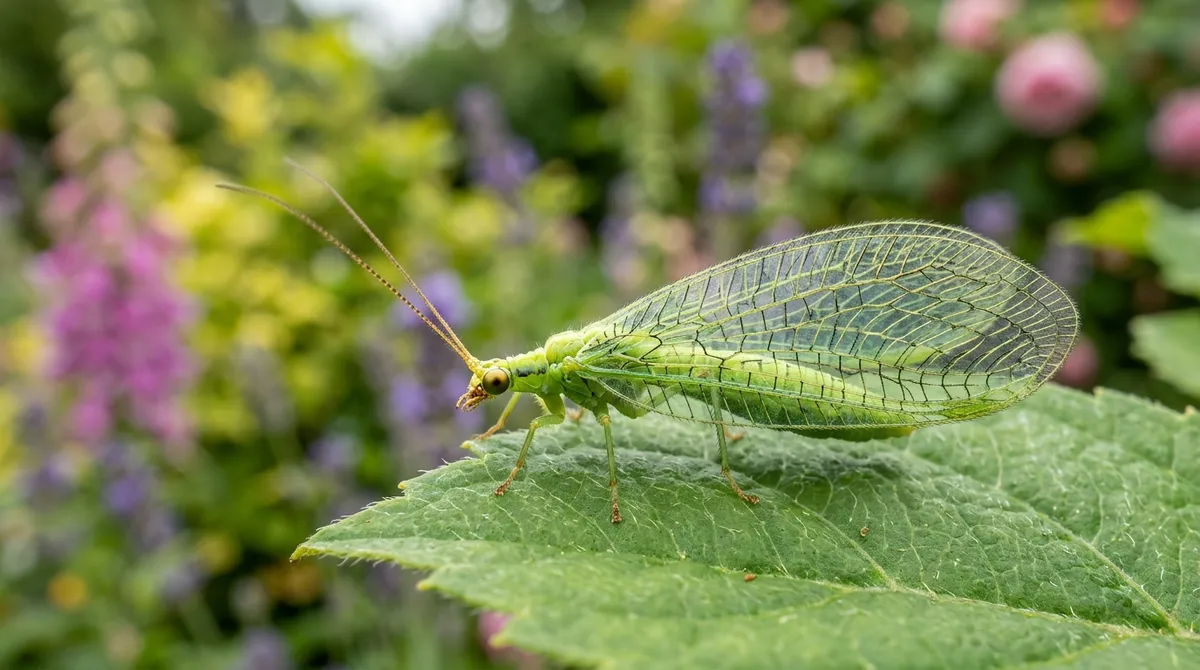
Lacewings are the most effective native aphid predators in UK gardens. A single larva of the common green lacewing (Chrysoperla carnea) devours 200-300 aphids during its two-week development, earning the nickname “aphid lion.” The UK has 43 lacewing species, and they collectively prey on aphids, whitefly, mealybugs, thrips, spider mites, and small caterpillars. Understanding how to identify, attract, and support lacewings is one of the most practical steps any gardener can take towards chemical-free pest control.
This guide covers both green and brown lacewing identification, their lifecycle, what they eat, how to attract them with the right plants, and how to build overwintering habitat. For a wider look at using living organisms to manage pests, see our guide to biological pest control with nematodes.
How do you identify lacewings in UK gardens?
The UK has 43 lacewing species split into two families: 14 green lacewings (Chrysopidae) and 29 brown lacewings (Hemerobiidae). Only a handful are common garden visitors.
Green lacewings
Green lacewings are 12-20mm long with bright lime-green bodies and prominent golden eyes. Their most distinctive feature is their wings: large, translucent, and covered in a fine network of veins that gives the insect its name. They hold their wings tent-like over their body at rest. When disturbed, they release a foul smell from glands on their thorax.
Chrysoperla carnea (the common green lacewing) is by far the most frequent species in gardens. It flies from April to October and is strongly attracted to lights at night. Adults feed on nectar, pollen, and aphid honeydew. They do not eat aphids themselves. It is the larvae that are the predators.
In autumn, green lacewing adults seek sheltered hibernation sites. They often enter houses, sheds, and garages. During hibernation, their green colour fades to a pinkish-brown. This colour change reverses in spring.
Brown lacewings
Brown lacewings are smaller (6-12mm) with grey-brown or dark brown colouring. Their wings are narrower and less conspicuously veined than green lacewings. They are harder to spot because they blend into bark and leaf litter.
The key difference: both adults and larvae of brown lacewings eat aphids. Green lacewing adults do not. This makes brown lacewings useful predators throughout their entire lifecycle, not just the larval stage.
| Feature | Green lacewing | Brown lacewing |
|---|---|---|
| Size | 12-20mm | 6-12mm |
| Colour | Bright green, golden eyes | Brown or grey-brown |
| Wing shape | Large, broad, tent-like at rest | Narrower, held flatter |
| Adult diet | Nectar, pollen, honeydew only | Aphids and small insects |
| Larva diet | Aphids, whitefly, thrips, mites | Aphids, small insects |
| Species in UK | 14 | 29 |
| Garden frequency | Very common | Common but less noticed |
| Flight period | April-October | March-October |
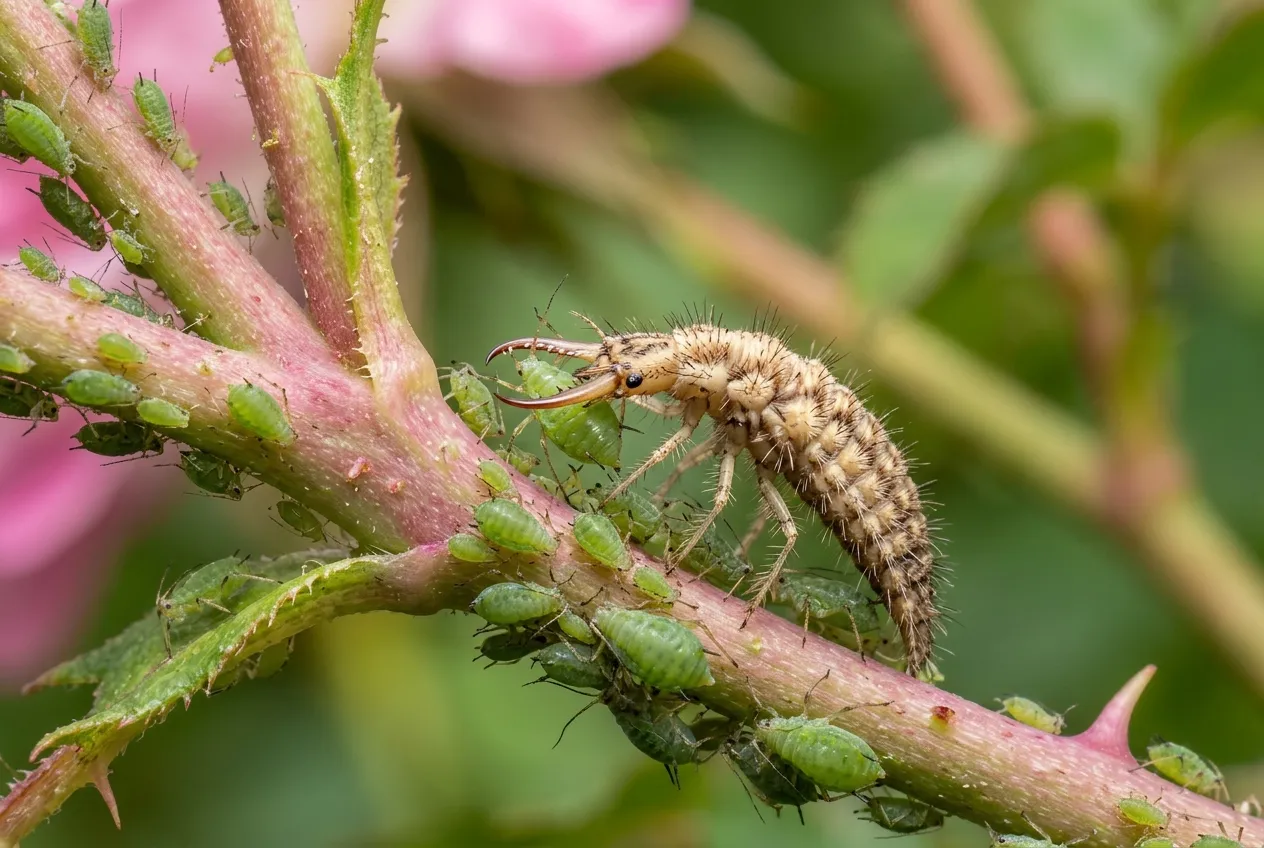
A lacewing larva (aphid lion) gripping an aphid on a rose stem. The sickle-shaped jaws pierce the prey and drain its body fluids within minutes.
What is the lacewing lifecycle?
Understanding the lifecycle helps you time pest control and habitat management correctly.
Eggs
Lacewing eggs are one of the easiest insect eggs to identify in any garden. Green lacewings lay each egg on the tip of a thin, hair-like stalk (pedicel) 5-10mm long, attached to the underside of a leaf. This stalk protects the eggs from predation by ants and other lacewing larvae. A single female lays 100-200 eggs over her lifetime, depositing them near aphid colonies so the larvae have immediate prey.
Brown lacewing eggs are laid directly on leaves without stalks.
Larvae
The larval stage is where all the pest control happens. Green lacewing larvae are 1-8mm long, grey-brown, bristly, and alligator-shaped with prominent curved jaws. They look nothing like the delicate adults. Some species camouflage themselves by piling the drained husks of their aphid victims onto their backs.
Larvae pass through three instars (growth stages) over 2-3 weeks. During this time, each larva consumes 200-300 aphids. They also eat:
- Whitefly (all stages)
- Thrips
- Spider mites
- Mealybugs
- Small caterpillars (up to 5mm)
- Insect eggs (including moth and butterfly eggs)
Feeding is continuous. Larvae hunt by touch, waving their heads from side to side until their jaws contact prey. They inject digestive enzymes through their hollow jaws, then suck out the liquefied contents. A single aphid is drained in 2-3 minutes.
Pupae
After the third instar, the larva spins a spherical silk cocoon, usually on the underside of a leaf or in a sheltered crevice. Pupation takes 5-7 days in summer. The adult emerges by cutting a circular lid from the cocoon.
Adults
Green lacewing adults live 4-6 weeks in summer. They are primarily active at dusk and through the night. Their diet switches entirely to nectar, pollen, and honeydew. Males attract females with low-frequency vibrations transmitted through plant stems. Adults of the final generation in autumn (September-October) enter hibernation, surviving until the following April.
| Stage | Duration | Size | Activity |
|---|---|---|---|
| Egg | 3-6 days | 0.5mm on 5-10mm stalk | Attached near aphid colonies |
| Larva (1st instar) | 4-5 days | 1-3mm | Feeding, 50-80 aphids consumed |
| Larva (2nd instar) | 4-5 days | 3-5mm | Feeding, 80-120 aphids consumed |
| Larva (3rd instar) | 4-5 days | 5-8mm | Feeding, 70-100 aphids consumed |
| Pupa | 5-7 days | 4mm cocoon | Metamorphosis in silk cocoon |
| Adult | 4-6 weeks | 12-20mm | Mating, egg-laying, nectar feeding |
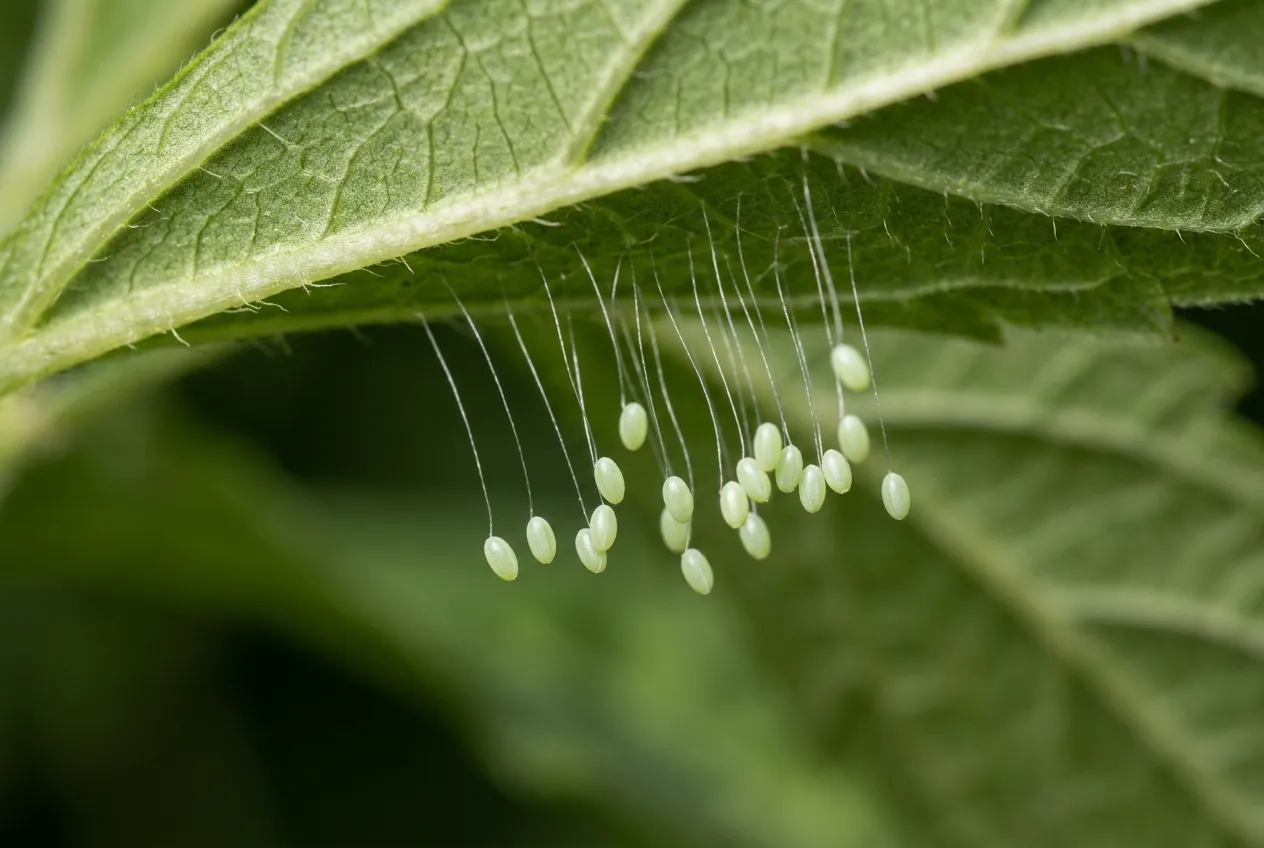
Lacewing eggs suspended on hair-like stalks beneath a leaf. Each stalk is 5-10mm long, protecting eggs from ants and other predators. This is one of the easiest beneficial insect signs to spot in any garden.
How effective are lacewings at controlling garden pests?
Lacewings are more effective per individual than any other common garden predator. The data is clear when you compare predation rates.
| Predator | Aphids eaten per larva | Development period | Prey range |
|---|---|---|---|
| Green lacewing larva | 200-300 | 2-3 weeks | Aphids, whitefly, thrips, mites, mealybugs |
| 7-spot ladybird larva | 100-150 | 3-4 weeks | Aphids primarily |
| Hoverfly larva | 100-200 | 2-3 weeks | Aphids primarily |
| Parasitic wasp (Aphidius) | 200-300 (parasitised) | 2-3 weeks | Aphids only (host-specific) |
Lacewings have a wider prey range than ladybirds or hoverflies. This matters in mixed gardens where greenhouse pest control requires tackling whitefly and thrips alongside aphids.
Field observations from Staffordshire
Over four growing seasons (2022-2025), I tracked aphid colonies on roses, broad beans, and apple trees in my Staffordshire garden (heavy clay soil, semi-rural). Lacewing larvae consistently cleared aphid infestations within 7-14 days of appearing. The pattern was reliable:
- Days 1-5: Aphid colony builds on new growth
- Days 5-10: Green lacewing female lays eggs near the colony
- Days 8-14: Eggs hatch, larvae begin feeding
- Days 14-21: Colony reduced by 80-95%
- Days 21-28: Remaining aphids mopped up by ladybirds and hoverflies
The key finding: spraying aphids with even a soap solution during the first week disrupted this cycle. Lacewing females laid fewer eggs near treated plants. Patience is the most effective pest control tool.
Lawrie’s Field Report: In July 2024, I counted 14 lacewing egg stalks on a single broad bean plant that had a blackfly colony of roughly 500 individuals. Within 12 days, the colony was gone. The 14 larvae consumed an estimated 3,500-4,200 aphids between them. I have never achieved results that fast with any spray, organic or otherwise. That one observation changed how I manage every aphid problem in my garden.
How do you attract lacewings to your garden?
Getting lacewings to colonise your garden requires four things: food for adults, prey for larvae, shelter, and an absence of pesticides.
Plants that attract adult lacewings
Adult green lacewings feed on nectar and pollen. Umbelliferous plants (those with flat-topped flower clusters) are the most attractive because the small, shallow flowers are accessible to lacewings’ short mouthparts.
| Plant | Flowers | Height | Flowering period | Notes |
|---|---|---|---|---|
| Fennel (Foeniculum vulgare) | Yellow umbels | 1.5-2m | July-October | Self-seeds freely, bronze form is ornamental |
| Dill (Anethum graveolens) | Yellow umbels | 60-90cm | June-August | Hardy annual, sow direct in April |
| Yarrow (Achillea millefolium) | White/pink flat heads | 30-60cm | June-September | Native wildflower, tough on any soil |
| Angelica (Angelica archangelica) | Green-white umbels | 1.5-2.5m | June-July | Biennial, dramatic architectural plant |
| Sweet cicely (Myrrhis odorata) | White umbels | 60-90cm | May-June | Shade-tolerant, anise-flavoured leaves |
| Coriander (Coriandrum sativum) | White/pink umbels | 30-60cm | June-August | Let some bolt to flower for lacewings |
| Tansy (Tanacetum vulgare) | Yellow button heads | 60-120cm | July-September | Native, vigorous spreader |
For a full guide to plants that support beneficial insects alongside edibles, see our companion planting guide. Many companion planting combinations work precisely because they attract lacewings and other predators that protect the crop.
Allow some aphid colonies to persist
This is counterintuitive but essential. Lacewings need aphids to complete their lifecycle. A garden with zero aphids has no food for larvae and no incentive for adults to lay eggs. Leave early-season aphid colonies on sacrificial plants (nettles, nasturtiums, and broad bean tips are ideal). These colonies attract egg-laying lacewings that then spread to protect nearby crops.
Stop using pesticides
Broad-spectrum insecticides kill lacewings as efficiently as they kill aphids. Even organic sprays (pyrethrum, insecticidal soap) are lethal to lacewing larvae on contact. The only safe approach for lacewing conservation is to spray nothing, or to spot-treat individual plants only as a last resort while keeping the rest of the garden chemical-free.
Bee-friendly gardening and lacewing-friendly gardening overlap almost entirely. The same pesticide-free, nectar-rich approach benefits both.
How do you build a lacewing hotel?
A lacewing hotel provides overwintering shelter for adult green lacewings. In the wild, they hibernate in loose bark, leaf litter, and evergreen foliage. A purpose-built hotel concentrates them and increases spring populations.
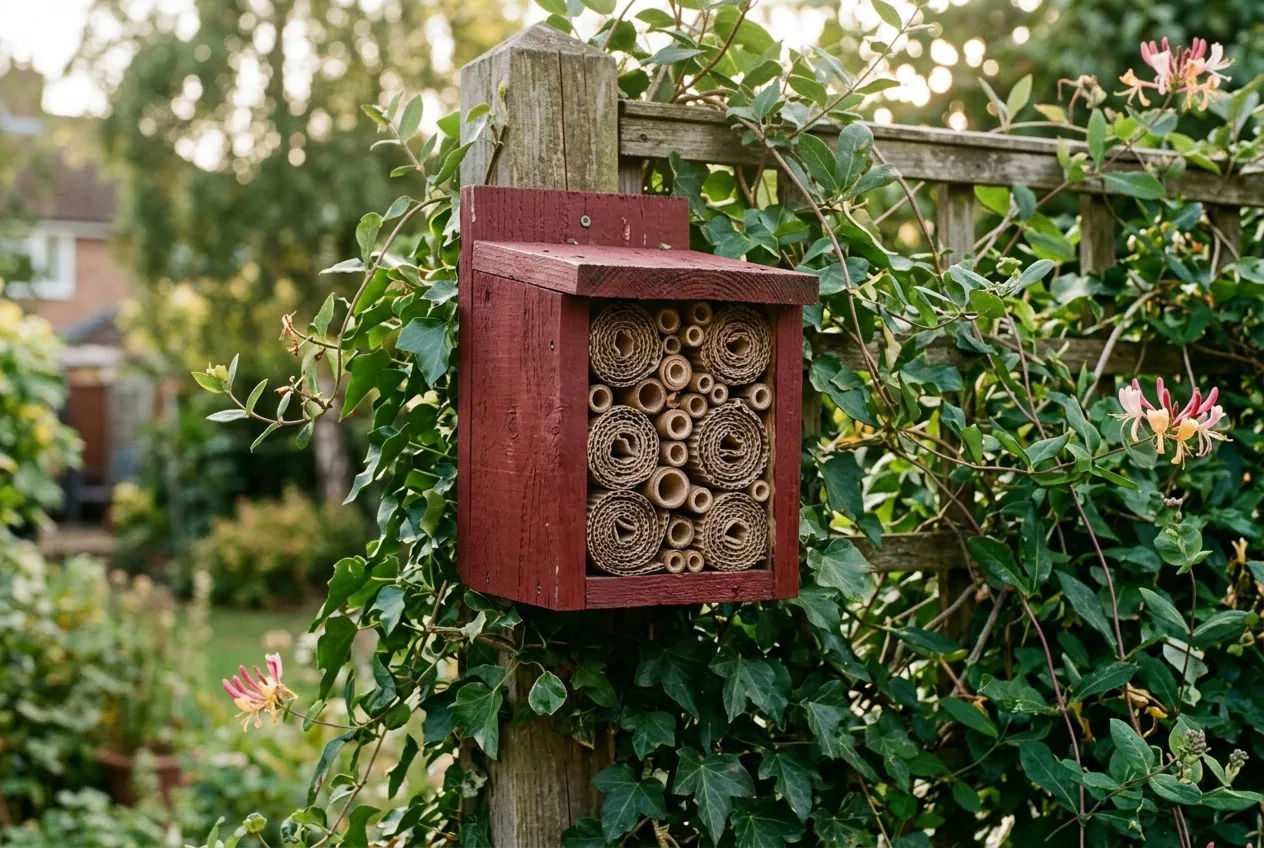
A lacewing hotel mounted on a garden fence. The rolled corrugated cardboard inside provides hundreds of tiny crevices where adult lacewings shelter through winter.
Construction
- Get a wooden box approximately 15cm x 15cm x 20cm deep. An old wooden wine box works well. Drill a few 10mm drainage holes in the base
- Roll corrugated cardboard into tight tubes that fit snugly inside the box. The corrugations must face inward so the tiny channels are accessible
- Pack the box tightly with rolls. No gaps. Lacewings squeeze into the corrugation channels
- Paint the exterior dark red. Research by the UK Centre for Ecology & Hydrology found lacewings are attracted to dark red surfaces for hibernation
- Mount 1.5-2 metres high on a south-facing wall or fence, sheltered from prevailing rain
Positioning
Face the opening south or south-west for warmth. Mount near hedgerows or borders where lacewings are active in summer. Avoid positions directly under roof lines where rain drips onto the box. Replace the corrugated cardboard annually in early autumn (September) before lacewings begin entering.
When to expect results
Lacewings typically find hotels within the first winter of installation. Check for occupancy by looking for adults inside the corrugation channels in November or December. Do not disturb them once settled. A well-sited hotel can shelter 20-50 adults through a single winter.
For a broader approach to insect habitat, see our guide to building a bug hotel. A combined structure housing lacewings, solitary bees, and beetles provides year-round pest control.
Can you buy lacewings for biological control?
Yes, and it works well in specific situations. UK suppliers sell Chrysoperla carnea eggs and larvae for garden and greenhouse use.
What is available
| Product | Quantity | Coverage | Cost | Best for |
|---|---|---|---|---|
| Lacewing eggs on cards | 500 eggs | 10-20 sq m | 8-12 pounds | Greenhouses, polytunnels |
| Lacewing larvae (loose) | 500 larvae | 20-30 sq m | 12-20 pounds | Outdoor beds, allotments |
| Lacewing larvae (sachets) | 50 per sachet | 2-5 sq m | 5-8 pounds | Individual plants, containers |
How to release them
Release lacewing larvae in the evening when temperatures are above 10 degrees Celsius. Place them directly on or near aphid-infested plants. In greenhouses, distribute evenly across the canopy. Outdoors, calm and dry conditions are essential. Rain washes larvae off foliage, and wind scatters them.
For greenhouse use, lacewing larvae are most effective when combined with other biological controls. Use Encarsia formosa for whitefly and Phytoseiulus persimilis for spider mites alongside lacewings for aphids. This layered approach matches how professional growers manage protected crops.
Limitations
Bought-in lacewings provide short-term control. They do not establish permanent populations unless the garden also offers the adult food sources (umbelliferous plants), overwintering shelter, and pesticide-free conditions described above. Think of purchased lacewings as a rescue treatment and garden habitat as the long-term solution.
How do lacewings fit into a wildlife garden?
Lacewings sit at a critical point in the garden food web. Their larvae control herbivorous pests. Adults provide food for bats, birds, and spiders. The plants that attract them also support hoverflies, parasitic wasps, and solitary bees.
A garden designed for lacewings automatically supports a wider web of beneficial wildlife. The wildlife pond you build for frogs also provides the humid habitat that lacewing larvae need near ground level. The fennel and yarrow you plant for lacewings also feeds hoverflies, whose larvae are the second-most effective aphid predator after lacewings.
Building a wildlife garden and supporting lacewings are the same project. Every action that helps one helps the other.
Lacewing conservation status
None of the UK’s 43 lacewing species are currently endangered. However, populations fluctuate with pesticide use and habitat availability. The giant lacewing (Osmylus fulvicephalus), at 25-30mm wingspan, is scarce and restricted to clean streams in western Britain. Most garden species remain common where habitat exists.
Buglife, the invertebrate conservation charity, monitors lacewing populations across the UK and provides identification resources. Their garden survey data shows that gardens with diverse planting and no pesticide use support 3-5 times more lacewing species than chemically managed gardens.
Month-by-month lacewing calendar
| Month | Lacewing activity | What to do |
|---|---|---|
| January-February | Adults hibernating in shelters | Leave lacewing hotels undisturbed |
| March | First adults emerge on mild days | Avoid tidying hibernation sites too early |
| April | Adults active, first eggs laid | Check underside of leaves near aphid colonies for egg stalks |
| May | Larvae feeding, second generation eggs | Allow aphid colonies to persist on nettles and broad beans |
| June | Peak larval activity | Avoid all spraying. Maximum pest control happening naturally |
| July | Second generation larvae active | Plant late-flowering umbellifers for adult food |
| August | Third generation possible in warm years | Monitor aphid levels on fruit trees and roses |
| September | Final adults preparing for hibernation | Install or refresh lacewing hotels with new cardboard |
| October | Adults entering hibernation sites | Leave garden debris and leaf litter where it falls |
| November-December | Full hibernation | Do not disturb lacewing hotels or sheltered areas |
Frequently asked questions
How many aphids does a lacewing larva eat?
A single larva eats 200-300 aphids over its two-week development. Some studies report up to 500 when prey is highly abundant. Larvae feed continuously, using hollow sickle-shaped jaws to pierce aphids and drain their body fluids. This makes lacewing larvae more voracious than ladybird larvae, which consume around 100-150 aphids over the same period.
What is the difference between green and brown lacewings?
Green lacewings are 12-20mm with bright green bodies and golden eyes. Brown lacewings are smaller at 6-12mm with grey-brown colouring. Both are useful predators, but they differ in one important way. Only green lacewing larvae eat aphids. Brown lacewing adults and larvae both eat aphids, making them active predators throughout their entire life.
How do I attract lacewings to my garden?
Plant umbelliferous flowers like fennel, dill, yarrow, and angelica. These provide the nectar and pollen that adult green lacewings need. Allow some aphid colonies to persist in spring as larval prey. Avoid broad-spectrum insecticides. Install a lacewing hotel with corrugated cardboard for overwintering shelter. These four steps create a self-sustaining lacewing population within one to two seasons.
Can I buy lacewings for pest control?
Yes, UK suppliers sell lacewing eggs and larvae for 8-20 pounds per pack. Release larvae in the evening near aphid colonies. They work best in enclosed environments like greenhouses but are effective outdoors in calm, dry weather. Purchased lacewings provide short-term control. Long-term populations depend on suitable habitat in the garden.
Do lacewings bite humans?
Lacewing adults do not bite. Larvae can deliver a mild nip if handled directly, but they cannot pierce human skin deeply enough to cause harm. The sensation is comparable to a tiny pinch. It requires no treatment. Lacewings carry no diseases and are completely safe around children and pets.
When are lacewings active in the UK?
Lacewings are active outdoors from April to October. Green lacewing adults hibernate from November to March in buildings, sheds, and sheltered garden spots. They often turn pinkish-brown during hibernation. Activity resumes when night temperatures consistently exceed 10 degrees Celsius. Peak larval activity occurs June to August.
Are lacewings better than ladybirds for pest control?
Lacewing larvae consume roughly twice as many aphids as ladybird larvae. They also eat a wider range of pests including whitefly, thrips, and spider mites. However, both predators are valuable. The most effective approach is to support populations of lacewings, ladybirds, hoverflies, and parasitic wasps together. A diverse predator community provides more reliable pest control than any single species.
For further reading on insect identification and conservation, visit the Royal Horticultural Society’s guide to lacewings.
Lawrie has been gardening in the West Midlands for over 30 years. He grows his own veg using no-dig methods, keeps a wildlife-friendly garden, and writes practical advice based on real UK growing conditions.