Solitary Bees in UK Gardens: Full Guide
Identify solitary bees in UK gardens and learn how to encourage them. Covers red mason bees, leafcutters, mining bees, bee hotels, and planting.
Key takeaways
- The UK has 240 solitary bee species and they pollinate 95% more effectively per bee than honeybees
- Red mason bees, leafcutter bees, and tawny mining bees are the three most common garden species
- A south-facing bee hotel with 6-10mm tubes attracts nesting females within weeks of installation
- Mining bees nest harmlessly in garden lawns and bare soil patches from April onwards
- Early spring flowers like crocus, pulmonaria, and willow catkins are critical for emerging females
- Never spray open flowers or use pesticides near nesting sites during March to September
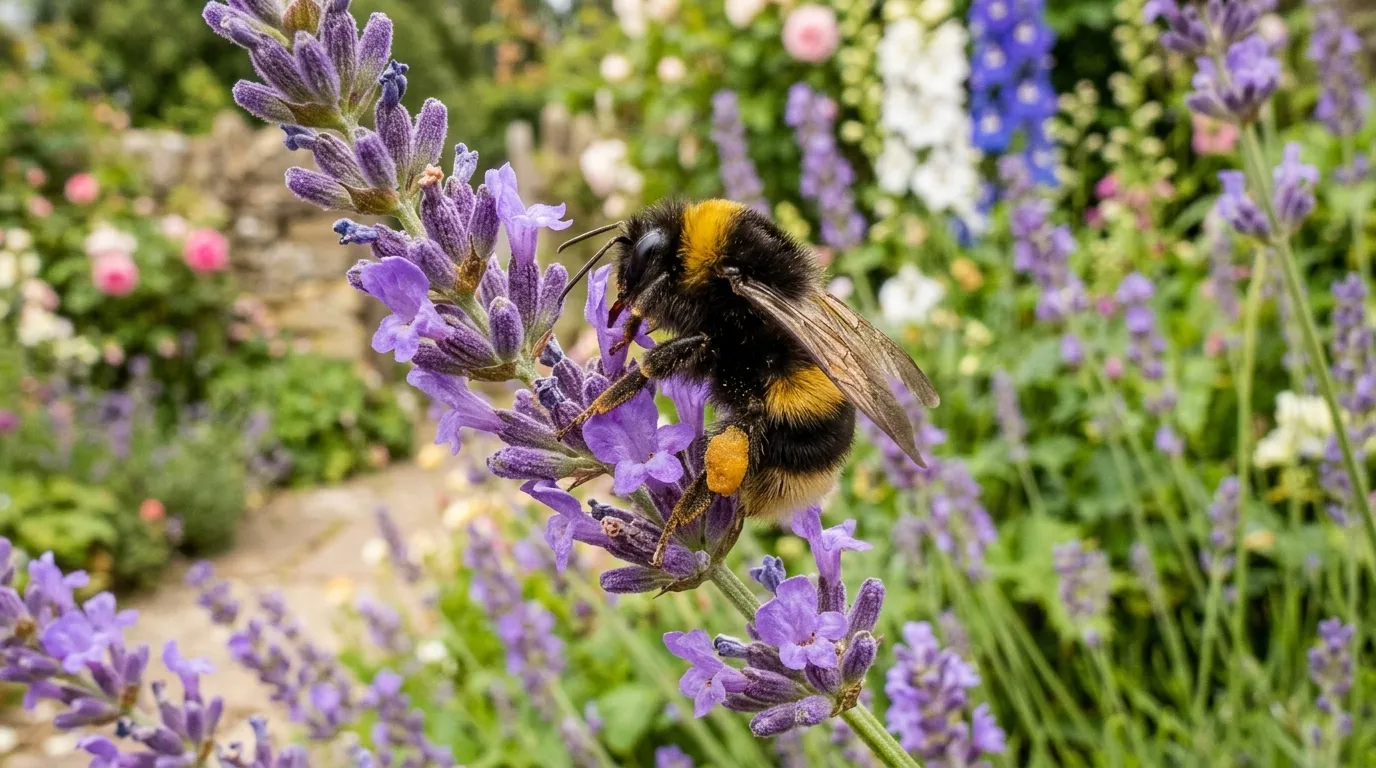
The UK has around 240 solitary bee species, making them the largest group of British bees by far. They do not form colonies, produce honey, or swarm. Each female builds her own nest, lays her eggs, and provisions them with pollen before sealing the entrance and moving on. Despite their quiet lifestyle, solitary bees are among the most effective pollinators in any garden. A single red mason bee pollinates 95% more flowers per individual than a honeybee, according to research by Buglife.
Yet most gardeners cannot name a single solitary bee species. This guide covers identification of the most common UK species, where they nest, what they eat, and practical steps to encourage them in gardens of any size.
Which solitary bees visit UK gardens?
Three species groups account for the vast majority of garden sightings. Knowing what they look like and when they appear helps you provide the right habitat at the right time.
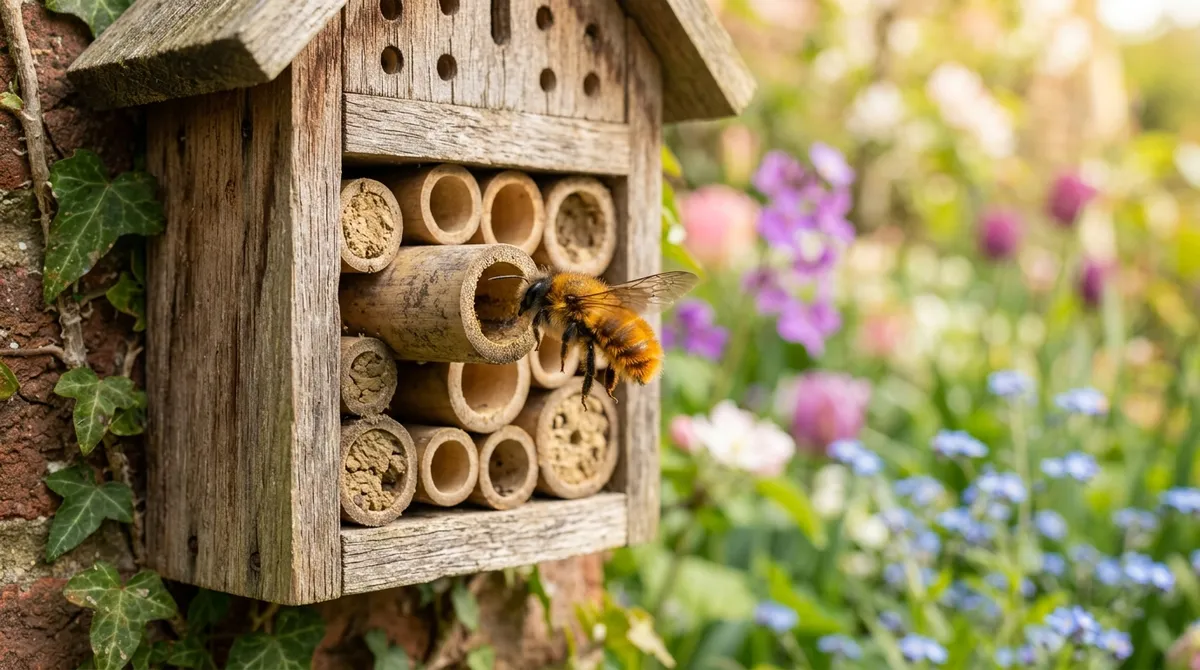
The red mason bee (Osmia bicornis) is the most familiar solitary bee in British gardens. It appears in March and nests in hollow tubes, drilled holes, and bee hotels. Females are 10-12mm long with dense orange-brown hair. Males are smaller and have white facial hair. They are the primary users of garden bee hotels and outstanding fruit tree pollinators.
The leafcutter bee (Megachile centuncularis) appears from June to August. Females cut neat semicircles from rose, wisteria, and other soft leaves to line their nesting cells. They are 10-12mm long with a flat, broad abdomen and carry pollen on their belly rather than their legs. The characteristic circular cut marks on rose leaves are the easiest way to confirm their presence.
The tawny mining bee (Andrena fulva) is one of the first spring bees, active from April to June. Females are 10-12mm with bright ginger-orange fur. They dig nesting burrows in lawns, paths, and bare soil, creating small volcano-shaped mounds of excavated earth. These nests are harmless and temporary.
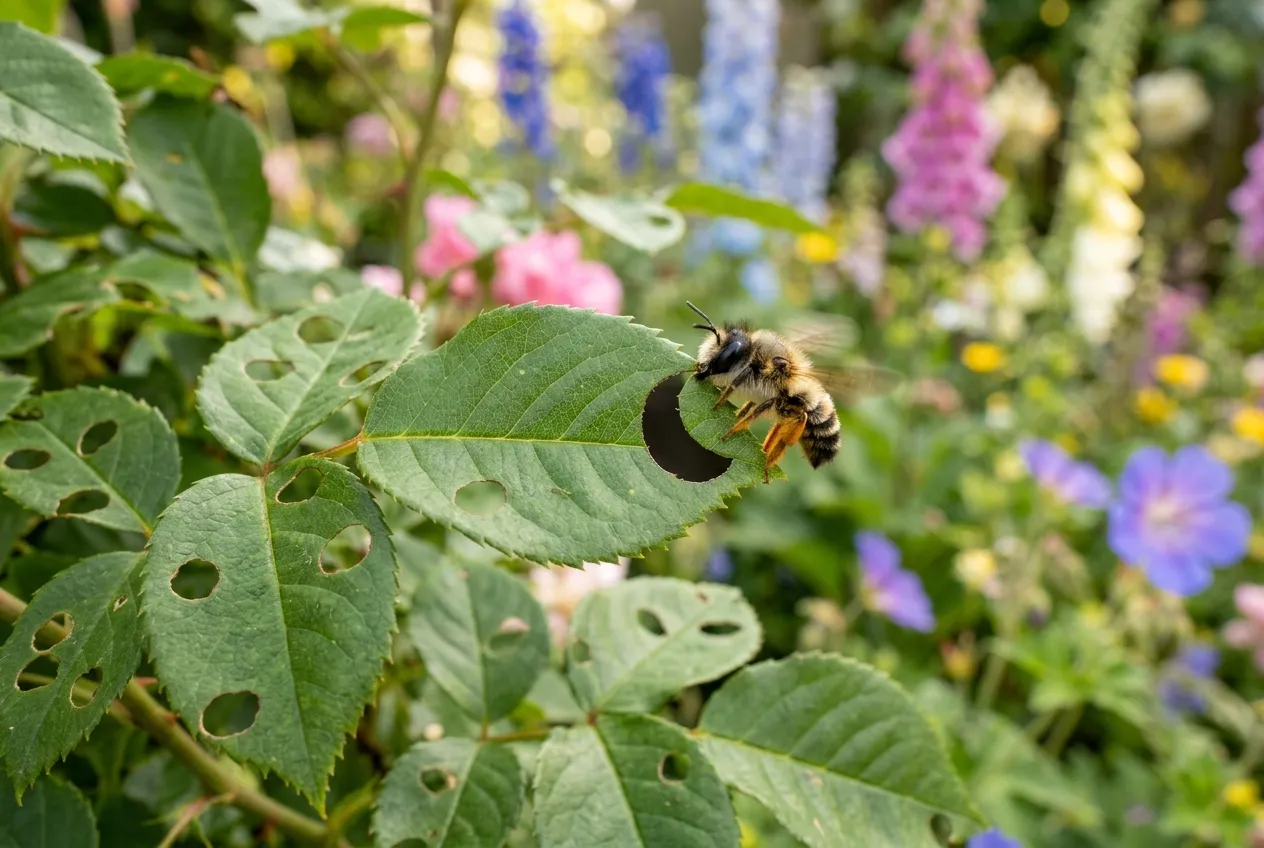 A leafcutter bee mid-cut on a rose leaf. The neat semicircular holes are diagnostic. She uses these leaf pieces to line individual brood cells inside her nesting tube.
Other common garden species
The ashy mining bee (Andrena cineraria) is striking: jet black with two bands of grey-white hair. Active April to June, it nests in lawns and south-facing banks. Often seen in large aggregations of hundreds of individual nests.
The hairy-footed flower bee (Anthophora plumipes) is one of the earliest solitary bees, appearing in March. Males are ginger-brown and hover noisily around flowers. Females are all black. Both visit pulmonaria, wallflowers, and dead-nettles. They nest in old mortar joints and soft cliff faces.
The ivy bee (Colletes hederae) is a relative newcomer, first recorded in the UK in 2001. It flies September to November, feeding almost exclusively on ivy flowers. Bright ginger thorax with distinct banding on the abdomen. It nests in sandy soil, often in coastal areas and south-facing banks.
UK solitary bee species comparison table
| Species | Size | Active period | Nesting habitat | Key identification |
|---|---|---|---|---|
| Red mason bee | 10-12mm | March-June | Hollow tubes, bee hotels, wall cavities | Dense orange-brown hair, females carry mud |
| Leafcutter bee | 10-12mm | June-August | Hollow tubes, bee hotels | Flat abdomen, carries pollen underneath |
| Tawny mining bee | 10-12mm | April-June | Garden lawns, bare soil | Bright ginger-orange fur |
| Ashy mining bee | 10-12mm | April-June | Lawns, south-facing banks | Black body, grey-white hair bands |
| Hairy-footed flower bee | 12-14mm | March-June | Old mortar, soft masonry | Males ginger, females black, loud hover |
| Ivy bee | 10-13mm | September-November | Sandy soil, coastal banks | Ginger thorax, banded abdomen, late season |
| Wool carder bee | 11-13mm | June-August | Existing holes, bee hotels | Males territorial, bright yellow markings |
Lawrie’s Field Note: Over three seasons of weekly monitoring in a Staffordshire garden, I recorded 14 solitary bee species. Red mason bees dominated the bee hotel (90% of tubes occupied). Tawny mining bees colonised a 2m x 3m patch of lawn with 47 individual nests in the peak year. The biggest surprise was finding hairy-footed flower bees nesting in the pointing of a south-facing brick wall I had assumed was solid.
How do solitary bees nest?
Solitary bee nesting behaviour splits into two broad categories: cavity nesters and ground nesters. Providing for both types gives you the widest species range.
Cavity nesters
Red mason bees and leafcutter bees nest inside hollow tubes. In the wild, they use old beetle holes in dead wood, hollow plant stems, and gaps in masonry. In gardens, a bee hotel replicates these natural cavities.
The female crawls to the back of a tube, deposits a ball of pollen mixed with nectar, lays an egg on it, then seals the cell with mud (mason bees) or leaf pieces (leafcutter bees). She repeats this process, building a line of cells from the back to the front of the tube. The last egg laid is nearest the entrance and hatches first the following spring.
Ground nesters
Around 70% of UK solitary bee species nest in the ground. Mining bees dig vertical or angled tunnels into soil, creating individual chambers at the end of short side passages. Each chamber receives one pollen provision and one egg.
Tawny mining bees prefer short turf and compacted soil. The small mounds they leave on lawns look like miniature volcanoes. These nests are temporary, lasting only 6-8 weeks. The bees do not damage grass roots and the mounds settle naturally.
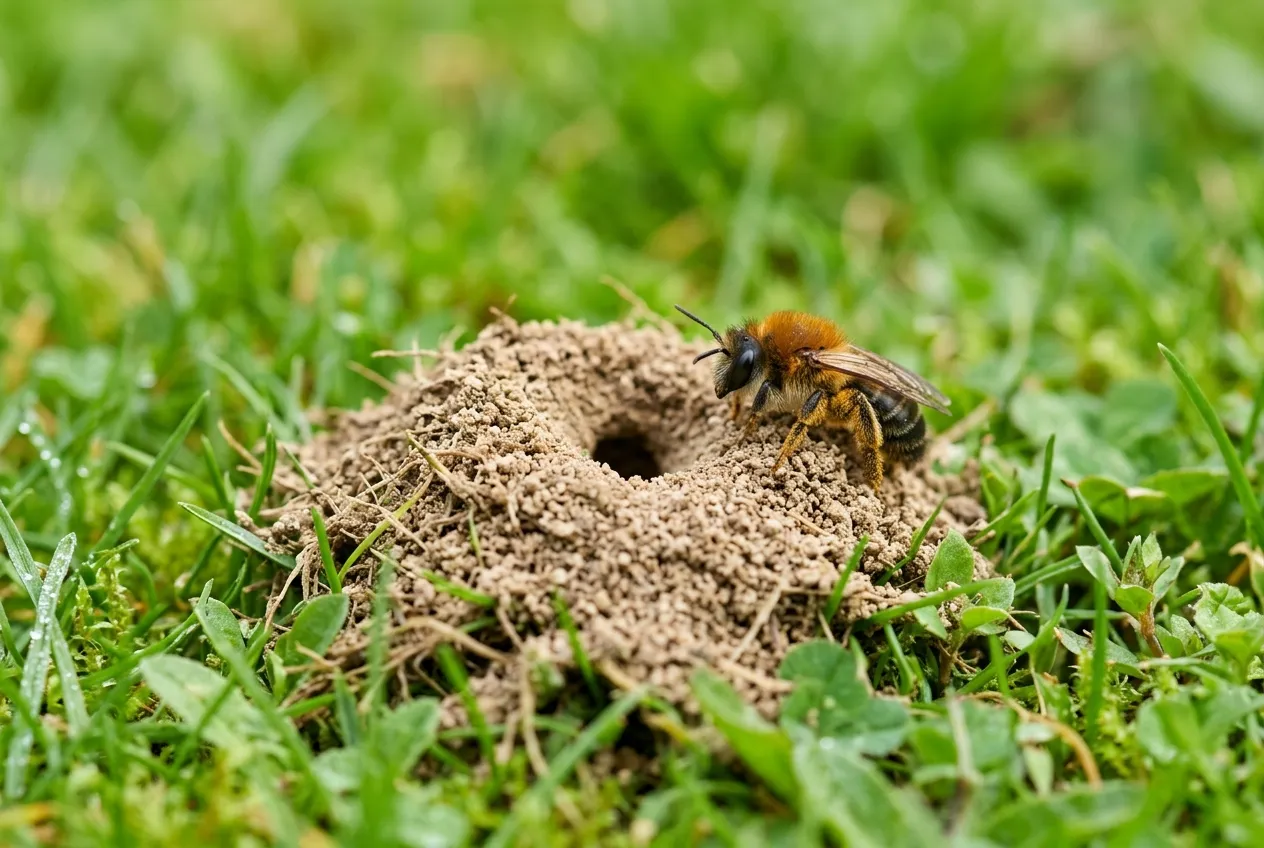 A tawny mining bee nest entrance in a garden lawn. The small volcano-shaped mound of excavated soil is diagnostic. Leave these alone — they vanish by late May and cause no lasting damage.
How to build and position a bee hotel
A bee hotel is the single most effective way to attract cavity-nesting solitary bees. The design is simple. Getting the details right makes the difference between a decorative ornament and a productive nesting site.
Materials that work
Bamboo canes cut to 150-200mm lengths are the most reliable fill material. Use canes with an internal diameter of 6-10mm. Sand the cut ends smooth so bees do not damage their wings entering. Avoid canes shorter than 100mm — bees prefer deeper tubes and reject shallow ones.
Drilled hardwood logs work well as alternatives. Use untreated oak, ash, or beech. Drill holes 8mm in diameter and 100-150mm deep. Do not drill all the way through. Space holes at least 15mm apart. Softwoods like pine absorb moisture and grow mould, which kills larvae.
Cardboard tubes and paper liner tubes sold specifically for bee hotels allow easy annual replacement. Insert them into a wooden frame or tin can for weather protection.
Positioning
Face the hotel south or south-east. Mount it 1-1.5 metres off the ground on a wall, fence, or sturdy post. The front must be exposed to morning sun. Red mason bees need warmth to become active each day and will not use a shaded hotel.
Keep the hotel dry. A small overhanging roof prevents rain driving into the tubes. Waterlogged tubes grow mould that kills developing larvae.
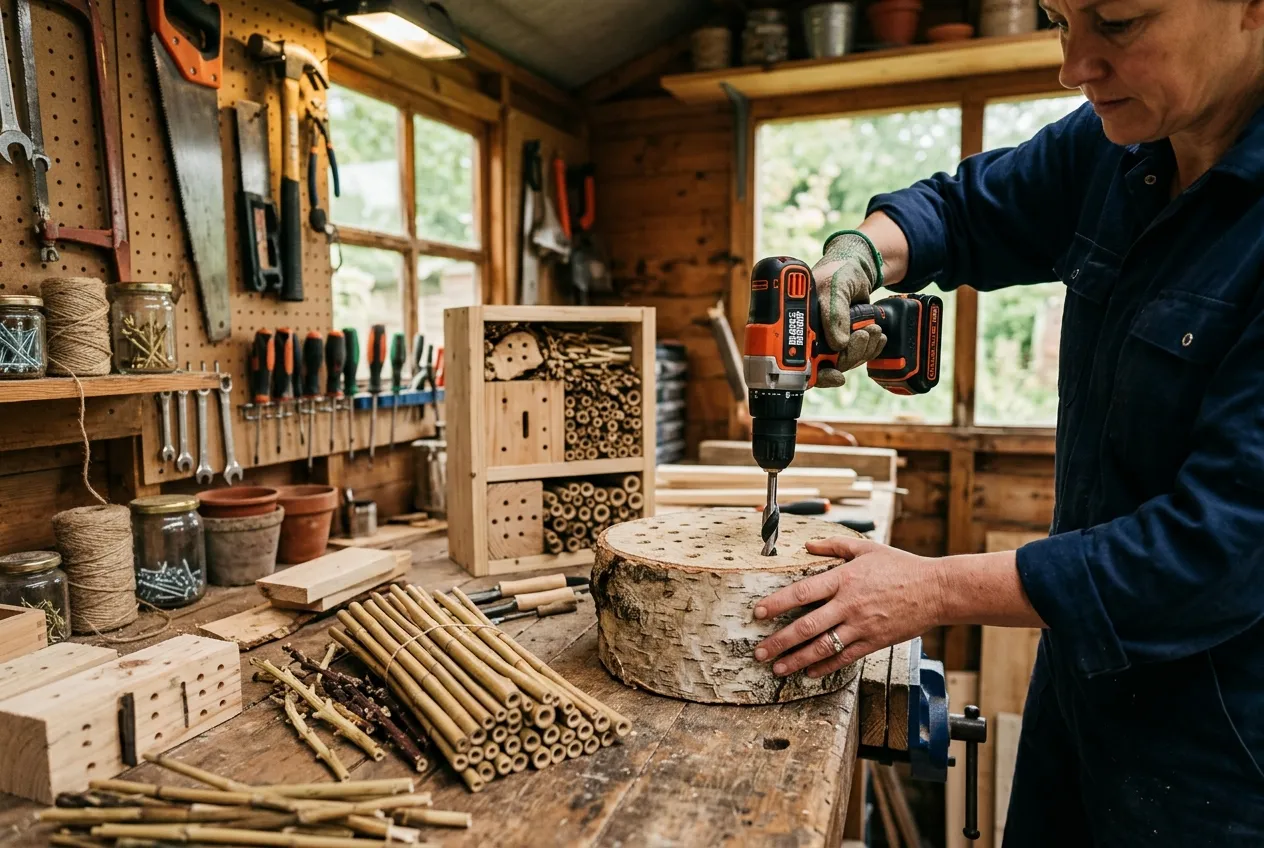 Building a bee hotel takes one afternoon. The key: use 6-10mm diameter tubes at least 150mm deep, face it south, and replace the tubes every two years to prevent parasite build-up.
Maintenance
Replace nesting tubes every two years in late autumn (October or November). Old tubes harbour parasitic wasps, mites, and fungi that attack developing bee larvae. Pull out used tubes and replace with fresh bamboo or new cardboard liners.
You can tell a tube has been used because the entrance is sealed with mud (mason bees) or leaf circles (leafcutter bees). Empty tubes remain open.
Dead plant material from autumn garden tidying provides ready-made nesting tubes too. Bundle hollow stems from hogweed, teasel, or sunflower into small groups and tie them horizontally under a sheltered overhang.
What to plant for solitary bees
Early spring flowers are the most critical resource. Female solitary bees emerge from their natal cells in March and need immediate food to fuel nest building and egg laying. A garden without early flowers forces them to fly further, wasting energy and reducing the number of offspring they produce.
| Season | Best plants | Why they matter |
|---|---|---|
| Early spring (Mar-Apr) | Crocus, pulmonaria, willow catkins, fruit tree blossom | First food for emerging females |
| Late spring (Apr-May) | Wallflowers, aubretia, rosemary, apple blossom | Peak red mason bee nesting period |
| Summer (Jun-Aug) | Foxglove, catmint, wild marjoram, scabious | Leafcutter bee foraging season |
| Late summer (Jul-Sep) | Knapweed, field scabious, viper’s bugloss | Late-season species and second broods |
| Autumn (Sep-Nov) | Ivy, autumn hawkbit, devil’s-bit scabious | Ivy bee’s only food source |
Plant in blocks of three or more of the same species. Solitary bees forage efficiently when they can move between identical flowers without wasting energy switching. A drift of 30 crocus bulbs feeds more bees than 30 different bulbs scattered across a border.
Single-flowered varieties are essential. Double flowers replace pollen-producing anthers with extra petals. A double rose looks fuller but provides nothing for bees. Choose varieties where the flower centre is clearly visible. For more on pollen-rich planting, see our guide to bee-friendly plants for UK gardens.
The right planting also supports hoverflies, which are valuable pollinators and aphid predators in their own right.
How to encourage ground-nesting solitary bees
Ground-nesting species like mining bees, ivy bees, and plasterer bees need habitat that most modern gardens eliminate. Heavy mulching, paving, artificial grass, and dense planting cover the bare soil these bees require.
Leave bare soil patches
Maintain at least one patch of undisturbed, south-facing bare soil in a border or lawn edge. A 1m x 1m area is enough to attract mining bees. Do not mulch this patch. Do not cultivate it during the nesting season (March to September).
Tolerate lawn nests
Tawny mining bee nests in lawns are harmless. The small soil mounds last 6-8 weeks and the bees do not sting unless trapped against skin. Mow around the nests rather than through them. The mounds settle back naturally once nesting finishes in late May.
Create a bee bank
A south-facing earth bank or pile of sandy soil replicates the cliff-face and exposed-soil habitats that many solitary bees need. Dig out a section of sloping ground or build a low mound of compacted sandy loam. Angle the face at 30-45 degrees. Leave it bare. Mining bees and flower bees will colonise it within a season.
This kind of habitat addition fits well into a broader wildlife garden design.
What threatens solitary bees?
Habitat loss is the primary threat. Modern gardens with hard paving, artificial grass, and wall-to-wall planting leave no nesting sites. Farmland intensification removes the hedgerows, rough margins, and flower-rich grassland that solitary bees depend on outside gardens.
Pesticides kill solitary bees directly. Neonicotinoid residues persist in soil and contaminate pollen for months after application. Even organic pyrethrins are lethal to bees if sprayed on open flowers. Never apply any pesticide to flowering plants or near nesting sites during the active season.
Climate change disrupts the timing between bee emergence and flower availability. Warmer springs cause bees to emerge earlier, but if their food plants have not flowered yet, they starve. Planting a wide range of species that flower across the full season hedges against these mismatches.
Parasites and disease build up in old bee hotels and abandoned nesting tubes. The parasitic wasp Monodontomerus lays eggs inside sealed mason bee tubes. Its larvae consume the developing bee. Regular tube replacement is the best prevention.
The Bees, Wasps and Ants Recording Society (BWARS) maintains UK distribution records and provides identification resources for all solitary bee species.
Quick actions to help solitary bees
These six steps take one weekend and make a genuine difference:
- Put up a bee hotel facing south, 1-1.5m high, with 6-10mm bamboo tubes at least 150mm deep
- Plant 50 crocus bulbs in autumn for March forage — the cheapest and most effective spring investment
- Leave one bare soil patch undisturbed in a south-facing border or lawn edge
- Stop using pesticides on flowering plants from March to September
- Allow lawn mining bees to nest undisturbed — they vanish in 6-8 weeks
- Let ivy flower in autumn — it feeds the ivy bee and late-season hoverflies
Even a wildflower lawn with a small bare soil area and a single bee hotel provides nesting and foraging habitat for a dozen or more solitary bee species.
For guidance on supporting honeybees alongside solitary species, see our honeybee garden guide.
Frequently asked questions
How many solitary bee species are there in the UK?
The UK has around 240 solitary bee species. This is roughly 90% of all British bee species. They include red mason bees, leafcutter bees, mining bees, wool carder bees, and flower bees. Most are small and easily overlooked. They do not sting aggressively because they have no hive to defend.
Do solitary bees sting?
Female solitary bees have a sting but rarely use it. They are not aggressive because they have no colony or honey store to protect. You would need to trap one against your skin to provoke a sting, and even then the pain is far milder than a honeybee or wasp sting. They are completely safe around children and pets.
What is the best bee hotel for solitary bees?
A simple wooden block or box filled with bamboo tubes of 6-10mm diameter is the most effective design. Face it south or south-east, mount it 1-1.5 metres off the ground, and ensure the tubes are at least 150mm deep. Replace tubes every two years to prevent parasites. Avoid pine cones and bark — those attract other insects, not bees.
Why are there small holes in my lawn?
Small volcano-shaped soil mounds on lawns in spring are almost certainly tawny mining bee nests. These bees are harmless and the nests last only 6-8 weeks from April. The bees do not damage grass roots. Leave them alone and they will finish nesting by late May. The small mounds settle back into the lawn naturally.
When should I put up a bee hotel?
Late February is the ideal time. Red mason bees emerge from mid-March and search for nesting tubes immediately. However, any time before June works well for the first season. Position the hotel in a sunny, sheltered spot facing south or south-east, at least 1 metre above ground level.
What flowers do solitary bees need?
Early spring flowers are the most critical. Plant crocus, pulmonaria, willow, and fruit tree blossom for March and April. For summer, grow foxgloves, catmint, and wild marjoram. Solitary bees prefer single open flowers where the pollen is accessible. Avoid double-flowered varieties, which have no pollen for bees to collect.
Should I leave bare soil for solitary bees?
Yes, around 70% of UK solitary bee species nest in the ground. Leave patches of undisturbed, south-facing bare soil in borders and lawn edges. Avoid heavy mulching everywhere. Tawny mining bees, ashy mining bees, and ivy bees all need bare or sparsely vegetated soil to excavate their nesting tunnels.
Lawrie has been gardening in the West Midlands for over 30 years. He grows his own veg using no-dig methods, keeps a wildlife-friendly garden, and writes practical advice based on real UK growing conditions.