Front Garden Ideas UK
Improve your UK front garden with practical ideas for kerb appeal. Covers planting, paving, paths, boundaries, bins, and low-maintenance designs.
Key takeaways
- A well-designed front garden adds 5-10% to property value and creates a strong first impression
- Evergreen structure is essential — front gardens must look good twelve months a year, not just summer
- Permeable surfaces and planting reduce flooding — many councils now restrict full front garden paving
- Screening bins, meters, and recycling boxes with low hedging or trellis turns the streetside view
- Symmetry works in formal front gardens — matched pots, identical planting, and a central path
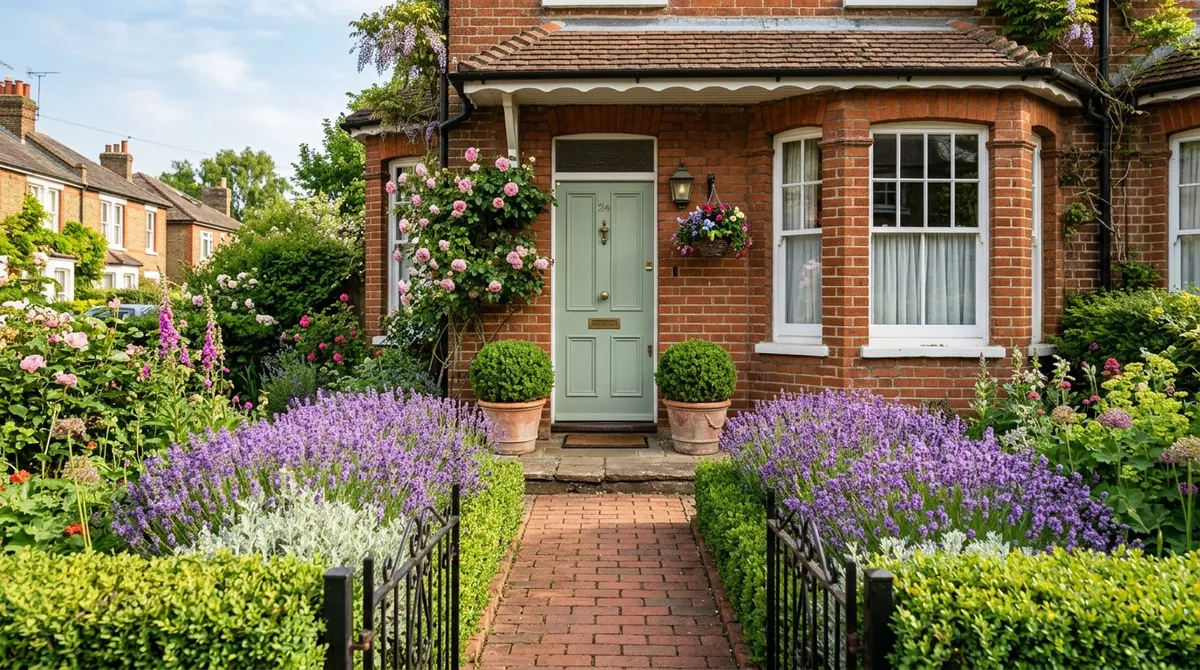
The front garden is the most public part of your property and the most neglected. While back gardens get decks, borders, and lighting, most front gardens get a wheelie bin and a concrete path. This is a missed opportunity. A well-designed front garden creates kerb appeal, adds property value, and makes coming home a pleasure rather than an apology.
Front gardens present specific challenges — they are small, public, utilitarian, and must look good all year. This guide covers practical ideas that work within those constraints for typical UK homes. The Royal Horticultural Society has additional front garden design advice.
Front garden design principles
Evergreen first, flowers second
Back gardens can get away with a winter gap. Front gardens cannot. Every visitor, delivery driver, and estate agent sees your front garden twelve months a year. Build the design around evergreen structure — plants that look good in January as well as July.
Essential evergreens for front gardens:
- Box (Buxus sempervirens) — hedging, topiary balls, and edging. Clip twice a year.
- Euonymus ‘Emerald Gaiety’ — variegated foliage, compact, works in shade.
- Skimmia japonica — glossy leaves, red berries in winter, tolerates shade.
- Viburnum tinus — flowers November to March, berries, dense screen.
- Lavender — evergreen silver foliage, summer flowers, suits sunny spots. See our full lavender growing guide.
Add seasonal colour with bulbs (spring), bedding or perennials (summer), and berries (autumn-winter). Our flower planting calendar covers exact timing for bulbs, annuals, and perennials across all UK regions. But the evergreen skeleton must work on its own.
Why we recommend lavender as the first plant for a new front garden border: After 30 years of designing and planting front gardens, lavender ‘Hidcote’ consistently outperforms all other options as the anchor evergreen. It looks silver-green in January, purple in July, and attracts more bees per metre than any other front garden plant I have counted. A 1-metre run of lavender planted 30cm apart in free-draining soil establishes fully within two seasons and needs only one annual clip to stay compact.
Create a clear route to the door
The path from pavement to front door is the most used route on your property. Make it obvious, direct, and wide enough for two people side by side (at least 90cm, ideally 1.2m). A meandering path in a front garden just frustrates visitors.
Path materials for front gardens:
| Material | Cost per sq m | Durability | Style |
|---|---|---|---|
| Block paving | Twenty to forty pounds | 25+ years | Traditional, formal |
| Natural stone | Forty to eighty pounds | 50+ years | Premium, timeless |
| Gravel on membrane | Eight to fifteen pounds | Top up every 3 years | Informal, permeable |
| Brick | Thirty to sixty pounds | 50+ years | Cottage, heritage |
| Porcelain pavers | Thirty to fifty pounds | 30+ years | Contemporary, clean |
Edge paths with brick or metal strip to keep materials contained. For more path ideas, see our guide to garden path ideas.
Symmetry and formality
Front gardens suit formal design more than back gardens. Symmetry — matched pots either side of the door, identical planting on both sides of the path, a centred path leading to the entrance — creates order and intent.
This does not mean sterile. A formal structure with informal planting (lavender billowing over path edges, climbing roses scrambling up the wall) combines the best of both approaches.
Ideas by front garden type
Terraced house front garden (2m x 4m)
The smallest front gardens need the simplest treatment. With just 8 square metres, every element earns its place.
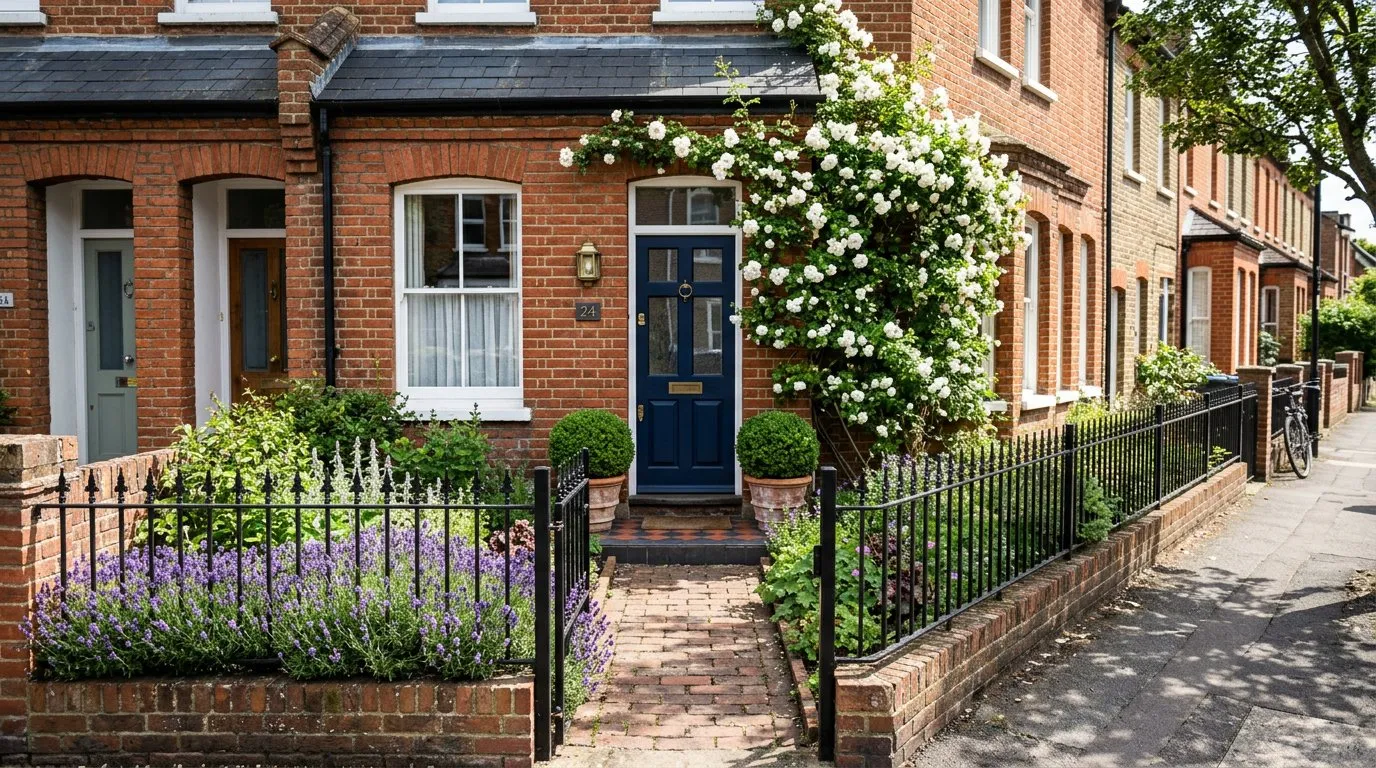 A terraced front garden with box balls, climbing rose, and lavender hedge creates maximum impact in minimum space
Layout: a straight path from gate to door flanked by low planting. No lawn — it is too small to mow neatly.
Planting: two box balls or lavender plants flanking the door. A climbing rose or jasmine on the house wall. Ground cover (Geranium macrorrhizum, Ajuga) filling the beds. Bulbs (crocus, tulips, daffodils) pushed through the ground cover for spring colour.
Surface: paving slabs on the path, gravel in the beds. Or the whole area in gravel with stepping stones to the door.
Semi-detached front garden (4m x 6m)
Room for more structure and a small feature. The challenge is separating your garden from the neighbour’s without creating a barrier.
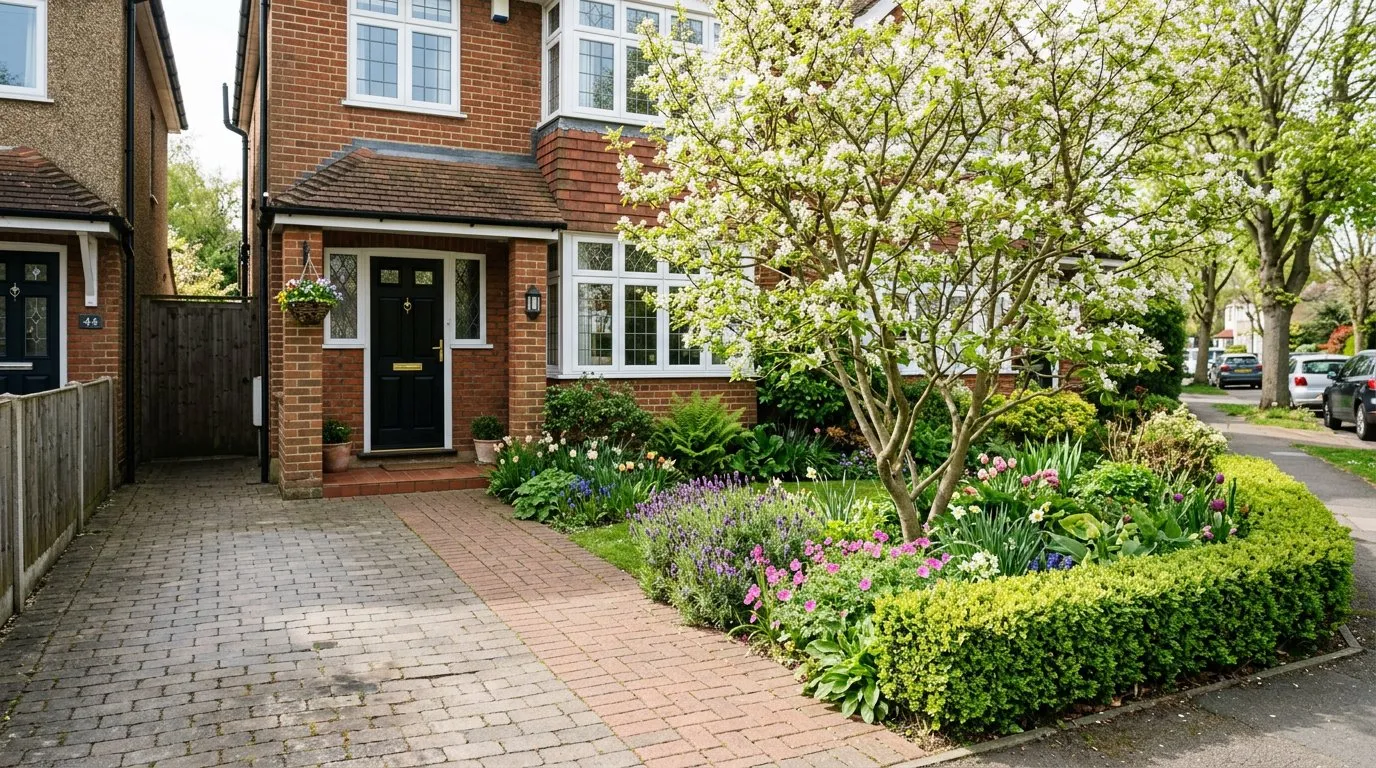 A multi-stem tree and low boundary hedge give a semi-detached front garden structure and year-round interest
Layout: angled path creating two triangular beds. One bed for structural planting, one for seasonal colour. A low hedge or border along the boundary.
Planting: a small multi-stem tree (Amelanchier, birch, or Japanese maple) as a focal point. An evergreen hedge (box, lavender, or Euonymus) along the front boundary at 60-80cm height. Mixed perennial planting in the beds — low-maintenance plants suit front gardens that get less attention than back gardens.
Driveway: if you need car parking, use permeable block paving or gravel with plastic grid. The sub-base preparation is similar to laying a patio but with heavier aggregate for vehicle loads. Keep at least one planted bed between the driveway and the house to soften the look.
Detached house front garden (6m+ deep)
Larger front gardens can include features that smaller plots cannot: a hedge, a tree, a seating area, even a small lawn.
Layout: curved or straight path to the door with generous borders either side. A specimen tree positioned off-centre. A low boundary hedge for privacy without fortress.
Planting: a layered border with shrubs at the back, perennials in the middle, and ground cover at the front. A tree (Amelanchier, crab apple, or birch) for height and seasonal interest. Climbers on the house wall — Wisteria, climbing hydrangea, or star jasmine.
Screening bins, meters, and utilities
Every front garden battles the visual impact of wheelie bins, recycling boxes, gas meters, and electricity boxes. Screening these is the single most effective improvement.
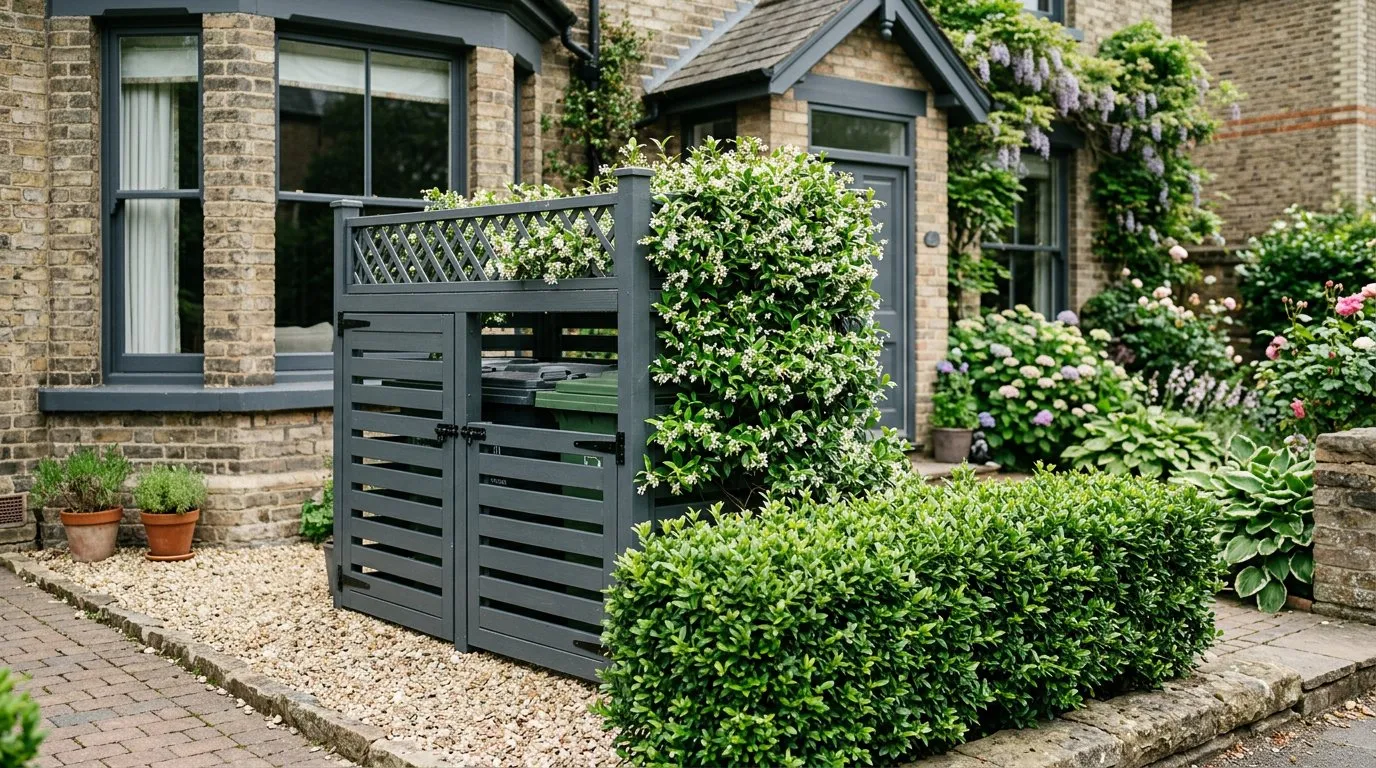 A painted bin store with climber-covered trellis screens bins while adding greenery to the front garden
Bin stores — purpose-built timber or metal stores hold 2-3 wheelie bins. Cost: eighty to two hundred and fifty pounds. Paint to match the house. Our garden storage solutions guide covers bin stores, bike shelters, and other front garden options.
Trellis screens — a 1.5m trellis panel with an evergreen climber (ivy, star jasmine, or Trachelospermum) hides bins and meters. Cost: thirty to sixty pounds. See our vertical gardening ideas guide for more ways to use wall and fence space productively.
Low hedge — a 60cm box or Euonymus hedge in front of bins screens them at eye level while allowing access from above.
Tip: Position bin storage near the pavement boundary, not next to the front door. This keeps the smell and visual impact away from the entrance while making collection day easier.
Front garden boundaries
Low walls
Brick or stone walls up to 1 metre do not need planning permission adjacent to a highway. A low wall with a coping stone provides a clean boundary, deters dogs, and adds heritage character. Cost: one hundred and fifty to four hundred pounds per metre run.
Hedging
The most beautiful front garden boundaries are hedges. A 60-80cm hedge of box, lavender, or beech defines the space without blocking light or views. Box hedging costs fifteen to twenty-five pounds per metre. Lavender costs similar and adds fragrance and pollinator value.
Railings
Original Victorian or Edwardian railings add period charm. Replacement railings cost one hundred to two hundred pounds per metre. Paint in black, dark grey, or heritage green.
Open plan
Some front gardens work best without a boundary, especially on modern estates where the open-plan streetscape is part of the design. Low ground cover planting (lavender, Nepeta, ornamental grasses) defines the edge without a physical barrier.
Planting for year-round interest
A front garden must earn its keep every month.
| Season | Plants | Effect |
|---|---|---|
| Winter | Viburnum tinus, Skimmia, Sarcococca | Flowers, berries, evergreen structure |
| Spring | Tulips, daffodils, Amelanchier blossom | Bold colour above evergreen ground |
| Summer | Lavender, roses, geraniums, Nepeta | Fragrance, colour, pollinator activity |
| Autumn | Japanese anemones, Euonymus berries, Cyclamen | Late flowers, foliage colour |
Plant evergreen shrubs as the permanent framework. Add bulbs and perennials for seasonal highlights. Clip box and lavender twice a year for tidy structure. This approach means the garden never has a bad month.
Now you’ve mastered front garden design, read our guide on garden path ideas for the next step.
Frequently asked questions
How do I make my front garden look nice?
Focus on three elements: a clear path to the front door, evergreen planting that looks good year-round, and screening for bins and utilities. Paint the front door a bold colour, add matching pots either side, and plant a low hedge or border along the boundary for definition.
What plants look good in a front garden?
Evergreen structure plants are essential — lavender, box hedging, Euonymus, Skimmia, and Viburnum tinus all look good twelve months a year. Add seasonal colour with tulips and daffodils in spring, geraniums and roses in summer, and cyclamen and berries in autumn and winter.
Can I pave over my front garden?
You can pave up to 5 square metres of front garden without planning permission. Larger areas need permeable materials (block paving with gaps, gravel, permeable resin) or drainage directed to a lawn or planted area. Many councils now restrict front garden paving to reduce flood risk.
How do I hide bins in a front garden?
Use a purpose-built bin store (eighty to two hundred and fifty pounds), a trellis screen with an evergreen climber (thirty to sixty pounds), or a low hedge planted in front. Position storage near the pavement for easy collection access and paint stores to match the house exterior.
What is the best low-maintenance front garden?
Combine permeable paving or gravel with evergreen shrubs and ground cover plants. An annual patio clean keeps paving looking fresh. Box balls, lavender, and Vinca minor need almost no attention beyond an annual trim. Avoid front garden lawns — they need weekly mowing and edging in a space visitors see every day.
Do I need planning permission for a front garden wall?
Walls and fences in front gardens next to a highway are restricted to 1 metre in height without planning permission. Walls up to 2 metres are permitted at the side and rear. Check with your local planning authority before building, as conservation areas may have stricter rules.
Lawrie has been gardening in the West Midlands for over 30 years. He grows his own veg using no-dig methods, keeps a wildlife-friendly garden, and writes practical advice based on real UK growing conditions.