Key takeaways
- March to May is the busiest sowing period, but the seed packet remains the final guide
- Hardy annuals can be direct-sown outdoors in spring or autumn
- Half-hardy annuals move outside only after the local frost risk has passed
- Plant most spring bulbs in September-October and tulips in October-November
- Sow biennials such as foxgloves and wallflowers in summer for next year's flowers
Most UK flower seeds are sown between spring and early summer. Hardy annuals also have an autumn window, while bulbs follow separate seasonal timings. Sow too early into cold, wet soil and seed can fail. Sow too late and some plants may not reach flowering size.
The UK growing season stretches longer than many gardeners realise. Sweet peas go in during February. Tulip bulbs plant in November. Every month has something to sow or prepare. This calendar covers annuals, perennials, biennials, and bulbs with sowing times tailored to British conditions. For vegetable sowing times, see our separate seed sowing calendar.
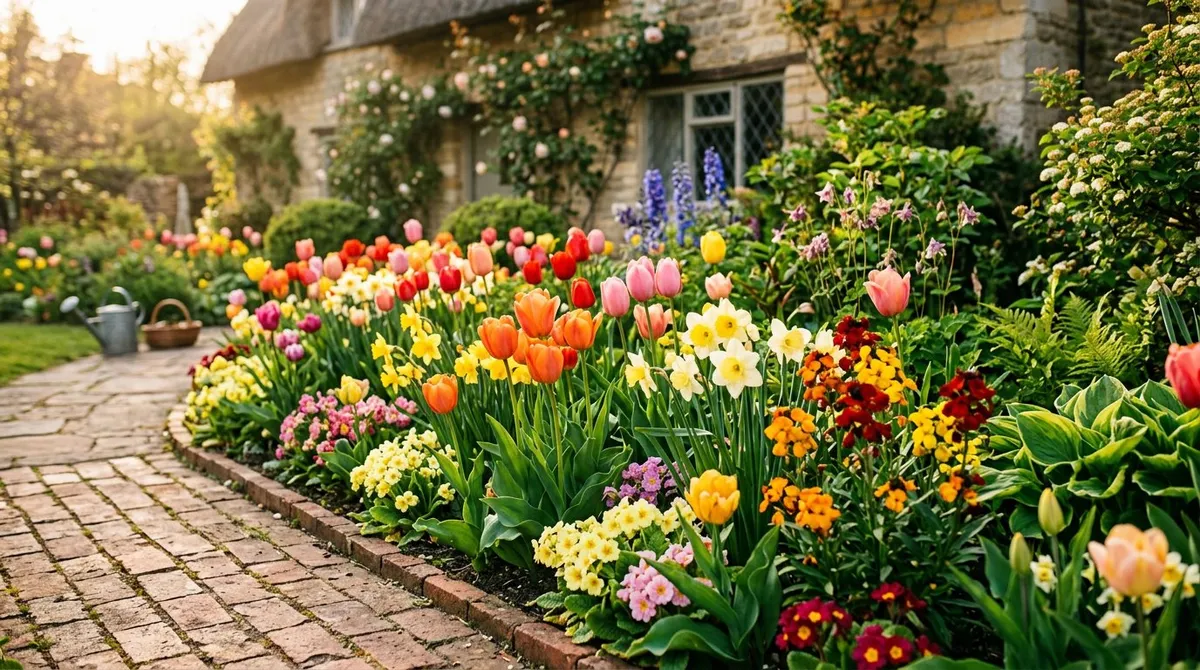
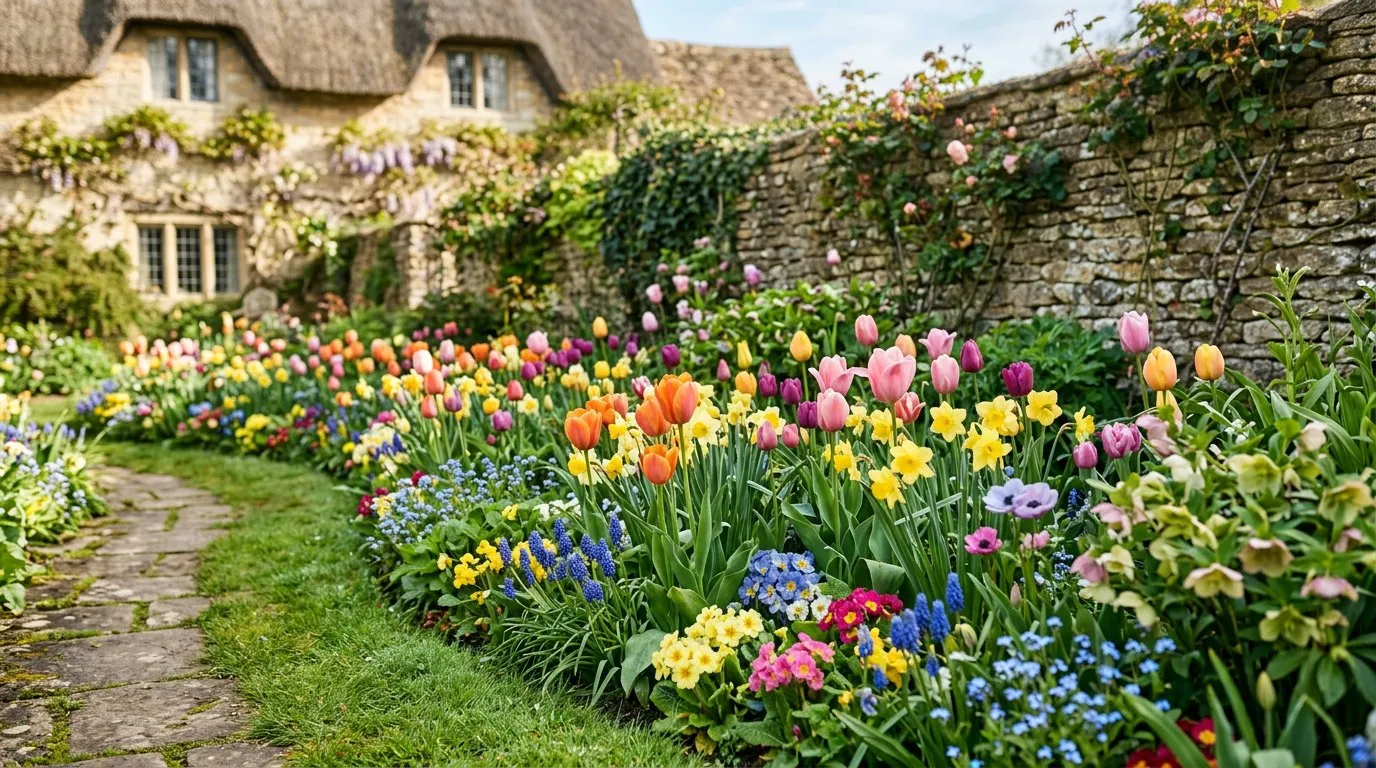 A spring border in full bloom, tulips, daffodils, and primroses peak in April
Understanding flower types
Before working through the calendar, it helps to understand the four main categories. Each type has different sowing windows and lifecycle patterns. Hardy annuals complete their lifecycle in one season and tolerate frost. Sow them outdoors in spring or autumn, following the packet. Examples include cornflowers, calendula, nigella and poppies. The RHS seed sowing guide covers soil preparation in more detail. Half-hardy annuals also complete their lifecycle in one season but are damaged by frost. Start them under cover in spring. Move them outside after local frost risk passes. Examples include cosmos, zinnias, marigolds and nicotiana. Biennials take two years to flower. Sow in summer of year one, they overwinter as foliage, then flower and set seed in year two before dying. Examples: foxgloves, wallflowers, sweet William, and honesty. A cottage-style garden relies heavily on biennials, as our cottage garden planting plan explains. Perennials live for several years, although many die back in winter. Sowing times vary widely by species. Check the packet before sowing delphiniums, lupins, echinacea or lavender.
How to judge the last frost at home
Local frost risk decides when half-hardy plants can move outside. A national date is unreliable because altitude, exposure and nearby buildings change conditions.
| Garden condition | What it means for planting out |
|---|---|
| Sheltered urban or coastal site | Frost risk may pass earlier, but check the forecast |
| Open rural garden | Keep tender plants protected through late cold snaps |
| Northern or upland site | Expect a later planting window than mild southern areas |
| Cold hollow or valley bottom | Cold air collects, so use extra caution |
Harden plants off gradually and keep fleece ready if a cold night is forecast. Record the final frost in your own garden. Several seasons of notes give a more useful local guide than a broad regional date.
Winter: January and February
The garden is quiet but there is useful sowing to do indoors. These early starts give slow-growing flowers a head start on the season.
January
Indoors: Sow sweet peas in root trainers if the cultivar packet recommends a winter start. Keep them in a cool, bright, frost-free place. Outdoors: Nothing to sow. Prepare beds for spring by clearing debris and adding organic matter. Order seeds from catalogues while choice is widest.
February
Indoors: Continue sowing sweet peas if their packet allows it. Start slow-growing flowers under cover at the stated temperature. Outdoors: In mild areas, prepare seed beds and watch for weed seedlings. The RHS uses their appearance as a sign that soil is warming.
Spring: March to May
This is the peak sowing season. More flowers start in these three months than in the rest of the year combined.
March
March often opens the direct-sowing season for hardy annuals. Use workable soil and the packet date rather than a national temperature claim.
Outdoors: Sow cornflowers, calendula, nigella (love-in-a-mist), annual poppies, larkspur, and sweet peas directly where they are to flower. Rake the soil to a fine tilth, scatter seed thinly, and cover lightly. These hardy annuals tolerate frost and produce flowers by June.
Indoors: Sow cosmos, marigolds, nicotiana and antirrhinums in seed compost. Follow the packet for heat, depth and timing. You can also start dahlia tubers in pots under cover.
Bulbs to plant: Tender summer-flowering bulbs, including gladioli, go in during early spring. The RHS bulb guide gives species-specific depth and timing.
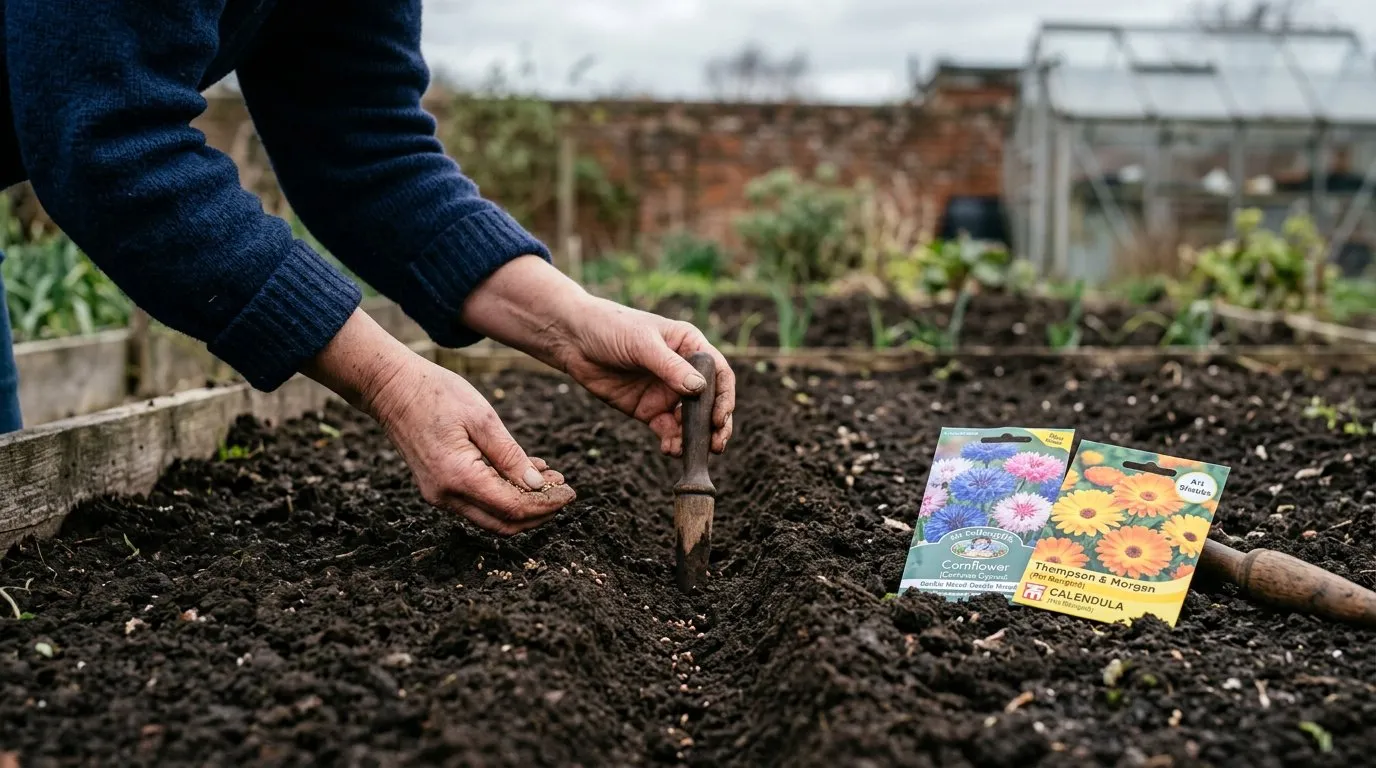 March sowing, cornflowers and calendula go directly into prepared soil
April
The busiest sowing month. Almost everything can start now, and early March sowings begin to show strong growth. Outdoors: Continue sowing hardy annuals. Add clarkia, godetia, candytuft, and Virginian stock to the list. Sow wildflower seed mixes on prepared ground. Direct-sow sunflower seeds from mid-April when soil reaches 10C. Indoors: Sow zinnias, ageratum, and rudbeckia (annual types) at 18-21C. Start statice and strawflowers for drying. Prick out March-sown seedlings into larger pots. Begin hardening off the earliest indoor sowings by placing them outside for increasing periods each day. Perennials from seed: Sow achillea, echinops, echinacea, scabious, and salvia at 15-18C. These germinate within 14-21 days and can flower in their first year from an April sowing.
May
May bridges indoor and outdoor growing. Half-hardy flowers move outside after the last frost. Outdoors from late May: Plant out all half-hardy annuals once the last frost has passed. Cosmos, zinnias, marigolds, nicotiana, and bedding dahlias can finally go into borders. Harden off for 10-14 days first to prevent transplant shock. Direct-sow nasturtiums and morning glory where they are to flower. Successional sowing: Sow a second batch of cornflowers, calendula, and nigella outdoors. This extends the flowering season by 3-4 weeks, so colour right through to September. Successional sowing is the simplest trick for a longer display. Late May tasks: Plant out dahlia tubers that were started in pots, and sunflower seedlings raised indoors.
Summer: June to August
Summer shifts from sowing to maintaining. Deadhead spent flowers to encourage repeat blooming, and sow biennials for next year’s display.
June
Biennials to sow now: Sow foxgloves, wallflowers, sweet William and honesty in trays or a nursery bed. They grow through summer, overwinter as rosettes and flower the following year.
Outdoors: Last chance to direct-sow hardy annuals for late-summer flowers. Sow calendula, cornflowers, and candytuft by mid-June. Sow biennials like hollyhocks in pots for next year.
Maintenance: Deadhead roses after their first flush for repeat flowering. Stake tall-growing plants like delphiniums and dahlias before they flop. Begin liquid feeding container-grown flowers fortnightly with a high-potash tomato feed.
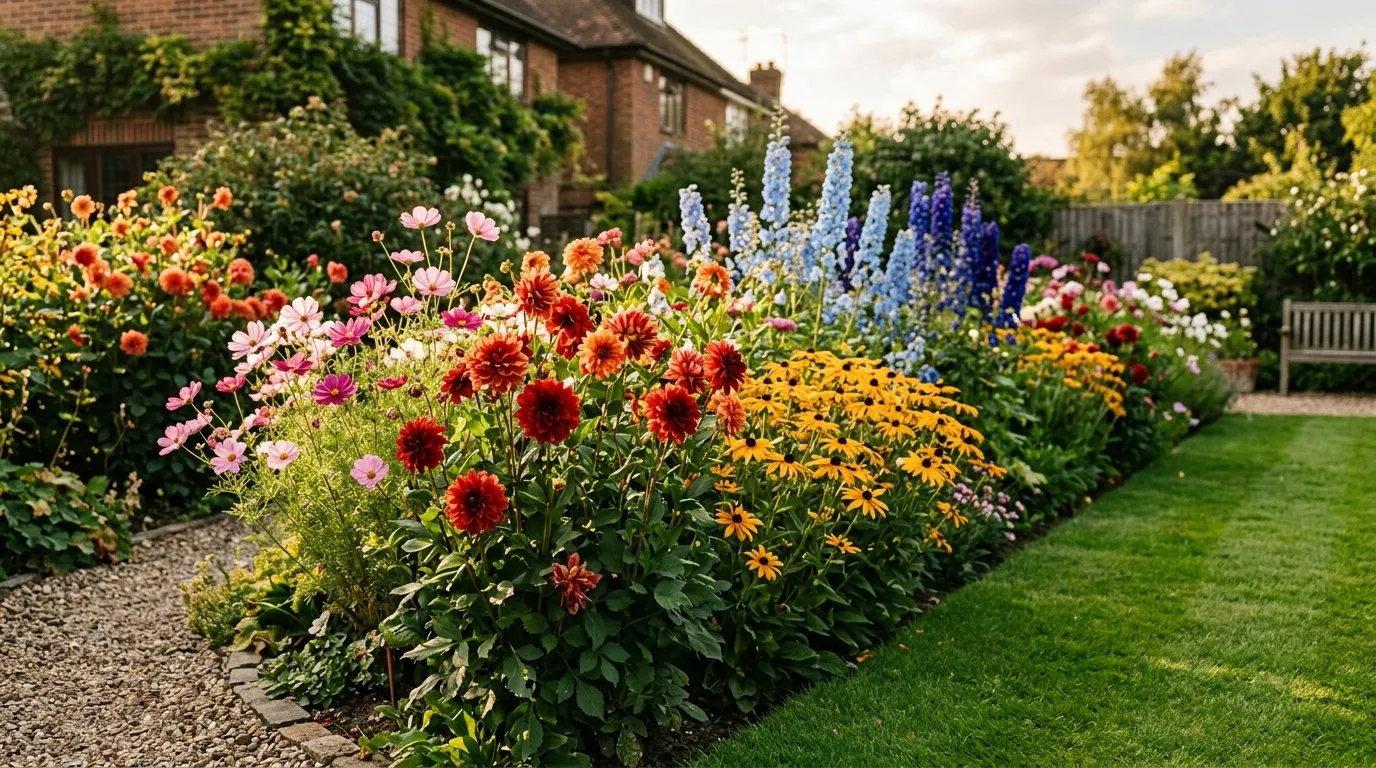 A July border at peak bloom, dahlias, cosmos, and rudbeckia reward careful spring planning
July
The maintenance month. Focus on deadheading, watering, and enjoying the display. Deadhead rigorously. Removing spent flowers redirects the plant’s energy from seed production to new blooms. Cosmos, dahlias, sweet peas, and roses all respond strongly to deadheading. Cut sweet peas every 2-3 days and they will flower until October. Sow for autumn colour: Start autumn-flowering wallflowers and winter pansies in pots. Sow spring-flowering forget-me-nots and primroses for naturalising under trees. Water newly planted perennials deeply during dry spells. Established perennials rarely need watering if they have a good layer of mulch. For plants that handle drought well, see our guide to drought-tolerant plants.
August
The pivot month. Summer flowers are at their peak, but autumn preparation begins. Collect seed: Gather ripe seed from annuals and perennials for free plants next year. Calendula, nigella, cosmos, and honesty all produce easy-to-collect seed. Dry seed in paper bags for 2 weeks before storing in a cool, dry place. Sow hardy annuals for early spring flowers: Sow cornflowers, calendula, and sweet peas outdoors in late August. Autumn-sown hardy annuals develop strong root systems over winter and flower 4-6 weeks earlier than spring-sown plants the following year. Prune lavender after flowering finishes, cutting back one-third of growth. This maintains shape and prevents the woody, leggy growth that shortens a lavender plant’s life.
Autumn: September to November
The focus shifts to bulb planting and preparing for next year’s display.
September
Hardy annuals: Continue autumn sowing of cornflowers, calendula, and sweet peas where winters are mild. In exposed or northern gardens, wait until March. Bulb planting begins. September is ideal for daffodils, crocuses, alliums, and muscari (grape hyacinths). The RHS bulb planting guide covers depth and spacing for all common species. Plant at a depth of 2-3 times the bulb height. Group bulbs in clusters of 7-15 for natural-looking drifts. Daffodil bulbs need to go in before the end of October for reliable root development. Divide perennials: Split congested clumps of geraniums, asters, heleniums, and hydrangeas. Dividing perennials in early autumn gives roots time to establish before winter dormancy. Replant divisions immediately and water well.
October
Peak bulb planting month. Get daffodils, hyacinths, alliums, and crocuses in by the end of October. Tulips are the exception, plant them from mid-October to late November. Late planting reduces the risk of tulip fire disease. Lift tender bulbs: Dig up dahlia tubers, gladioli corms, and cannas after the first frost blackens foliage. Dry for two weeks and store in barely damp compost at 5-10C in a frost-free location. Plant bare-root perennials and shrubs from October onwards while the soil is still warm. Bare-root roses, in particular, establish faster than container-grown plants when planted between now and March.
November
Last chance for tulip bulbs. Tulips planted in November often perform better than those planted earlier because soil temperatures have cooled sufficiently. Plant 15-20cm deep in free-draining soil. Prepare next year’s beds: Clear spent annuals and add compost. Mark spring bulb positions to avoid disturbing them. Outdoors: Nothing to sow. The sowing year is effectively over until January.
December
No sowing and very little planting. December is for planning. Browse seed catalogues, order early, and sketch out next year’s planting scheme. Clean and store seed trays and pots. Review what flowered well and what to change. If the ground is not frozen, you can still plant tulip bulbs in early December as a last resort. They will flower, though slightly later than those planted in October or November.
Quick-reference planting table
This table summarises the key sowing and planting windows for the most popular UK flowers. Indoor sowing assumes a warm windowsill or heated propagator at 15-21C.
| Flower | Type | Indoor sowing | Outdoor sowing | Flowering period |
|---|---|---|---|---|
| Sweet pea | Hardy annual | Jan-Feb | Mar-Apr | Jun-Oct |
| Cornflower | Hardy annual | , | Mar-Apr, Aug-Sep | Jun-Aug |
| Calendula | Hardy annual | , | Mar-May, Aug-Sep | Jun-Oct |
| Nigella | Hardy annual | , | Mar-Apr, Sep | Jun-Aug |
| Poppy (annual) | Hardy annual | , | Mar-Apr, Sep | Jun-Aug |
| Cosmos | Half-hardy annual | Mar-Apr | Late May | Jul-Oct |
| Zinnia | Half-hardy annual | Apr | Late May | Jul-Oct |
| Marigold | Half-hardy annual | Mar-Apr | Late May | Jun-Oct |
| Sunflower | Hardy annual | Apr | Apr-Jun | Jul-Sep |
| Nasturtium | Hardy annual | Apr | May | Jun-Oct |
| Foxglove | Biennial | , | Jun-Jul | May-Jul (year 2) |
| Wallflower | Biennial | , | Jun-Jul | Mar-May (year 2) |
| Sweet William | Biennial | , | Jun-Jul | Jun-Jul (year 2) |
| Dahlia | Tender perennial | Mar (tubers) | Late May (tubers) | Jul-Oct |
| Lupin | Perennial | Feb-Mar | Apr-May | Jun-Jul |
| Delphinium | Perennial | Feb-Mar | Apr-May | Jun-Aug |
| Echinacea | Perennial | Mar-Apr | Apr-May | Jul-Sep |
| Lavender | Perennial | Feb-Mar | , | Jun-Aug |
| Rose | Shrub perennial | , | Plant Nov-Mar | Jun-Oct |
| Tulip | Bulb | , | Plant Oct-Nov | Apr-May |
| Daffodil | Bulb | , | Plant Sep-Oct | Mar-Apr |
| Crocus | Bulb | , | Plant Sep-Oct | Feb-Mar |
| Allium | Bulb | , | Plant Sep-Nov | May-Jun |
| Gladiolus | Bulb (corm) | , | Plant Mar-May | Jul-Sep |
Flowers for beginners
If you are new to growing flowers from seed, start with the most forgiving species. These germinate reliably, tolerate mistakes, and produce flowers quickly. Five easiest flowers from seed:
- Nasturtiums, sow directly outdoors in May. Germinate in 10-14 days. Flower within 8 weeks. Thrive in poor soil.
- Calendula, sow outdoors March to May. Tough and fast. Self-seeds for free plants every year.
- Sunflowers, sow April to May. Fast-growing and tall. Children love them. Our guide on when to plant sunflowers covers timing in detail.
- Cornflowers, sow March or September. Drought tolerant once established. Long-lasting as cut flowers.
- Cosmos, sow indoors in April. Flowers non-stop from July to October if deadheaded regularly. The single best cut flower for beginners. All five attract pollinators. For a deeper list of plants that support bees and butterflies, see our wildlife section.
Gardener’s tip: Sow more than you need. Seeds are cheap and germination is never 100%. Thin seedlings to the correct spacing once they are 5-10cm tall. The thinnings of many species (calendula, nigella, cornflowers) can be transplanted elsewhere in the garden.
Extending the flowering season
A garden that flowers from March to November needs three techniques working together.
Successional sowing: Sow the same species every 3-4 weeks from March to June. This produces waves of bloom rather than a single peak. Calendula, cornflowers, and nigella are ideal for this approach.
Deadheading: Removing spent blooms before seed forms can extend flowering in suitable plants. Cosmos, dahlias, sweet peas and repeat-flowering roses respond well.
Autumn sowing of hardy annuals: Autumn sowing can bring earlier flowers than a spring sowing. Success depends on drainage, winter weather and the species.
Combine these methods with spring bulbs and summer perennials for a longer display. For broader spring gardening tasks, our seasonal checklist covers lawn care and pruning.
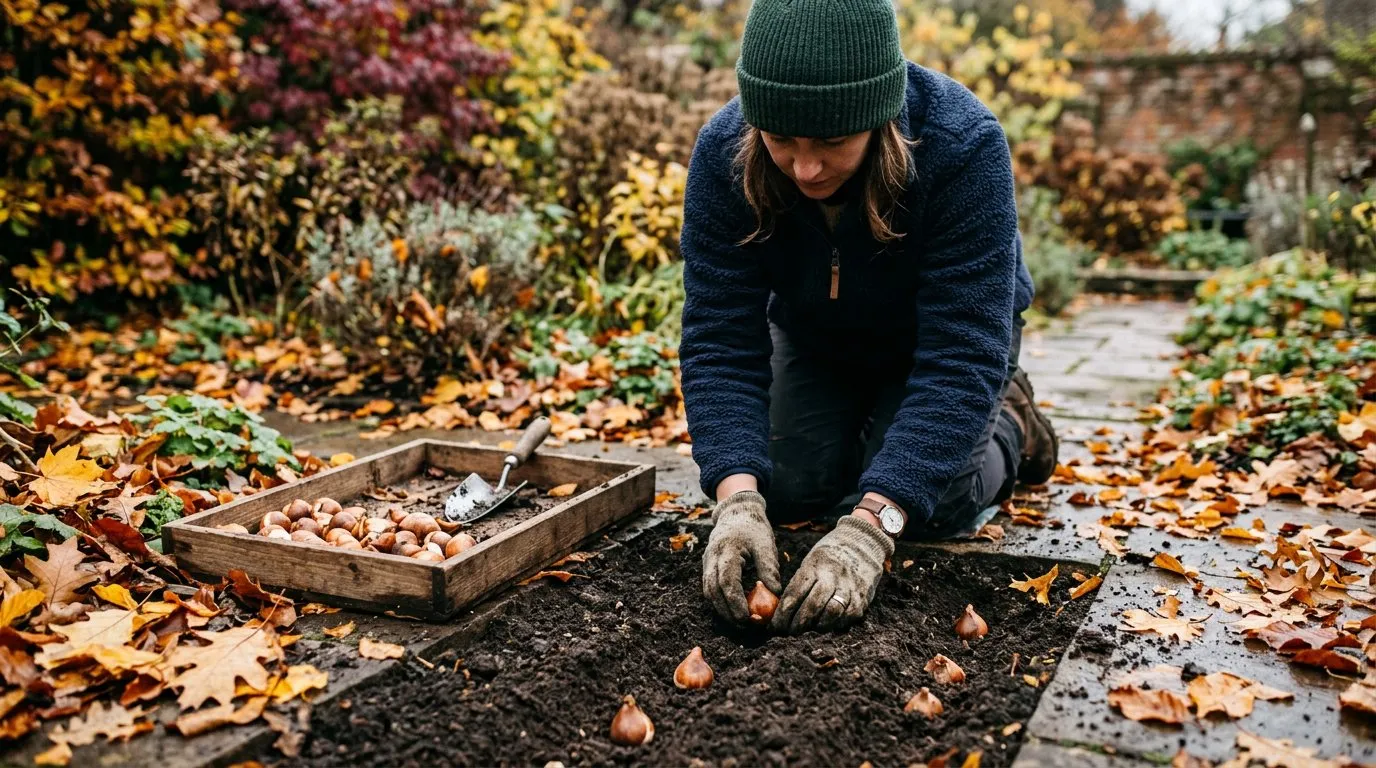 Planting tulip bulbs in November, the work you do now produces next spring’s colour
Frequently asked questions
When should I start planting flowers in the UK?
Start hardy annuals outdoors in spring, once soil is workable. Half-hardy flowers start under cover and move outside after local frost risk passes. Check each packet because species and cultivars differ.
What flowers can I plant in March UK?
March suits many hardy annuals and summer-flowering bulbs. Sow cornflowers, calendula, poppies and nigella when soil is workable. Start tender annuals under cover and follow their packets.
What is the difference between hardy and half-hardy annuals?
Hardy annuals tolerate frost; half-hardy annuals do not. Sow hardy types outdoors in suitable conditions. Keep half-hardy seedlings protected until local frost risk passes.
When should I plant spring-flowering bulbs?
Plant most spring-flowering bulbs in September or October. Plant tulips in October or November. Always follow the supplier’s instructions for the species and cultivar.
Can I sow flower seeds in autumn?
Yes, hardy annuals can be sown in autumn. Cornflowers, calendula and nigella are common choices. Use free-draining soil and delay until spring on cold, exposed sites.
Browse the growing guides or continue with our guide to sowing seeds indoors.
Our team produces practical UK gardening guidance from source research, contributor records and established horticultural practice. Editorial standards are overseen by Matt W.