Permaculture Principles for UK Gardens
Permaculture principles applied to UK gardens. Covers the 12 design ethics, zone planning, companion planting, water harvesting, and soil building.
Key takeaways
- The 12 permaculture principles guide every design decision, from observing your site for a full year to producing zero waste
- Zone planning places herbs at the kitchen door (Zone 1) and wild areas at the far boundary (Zone 5)
- Fruit tree guilds using apple, comfrey, chives, and nasturtiums create self-fertilising, pest-resistant planting
- Hugelkultur beds retain moisture for 3-4 weeks longer than conventional raised beds in UK summers
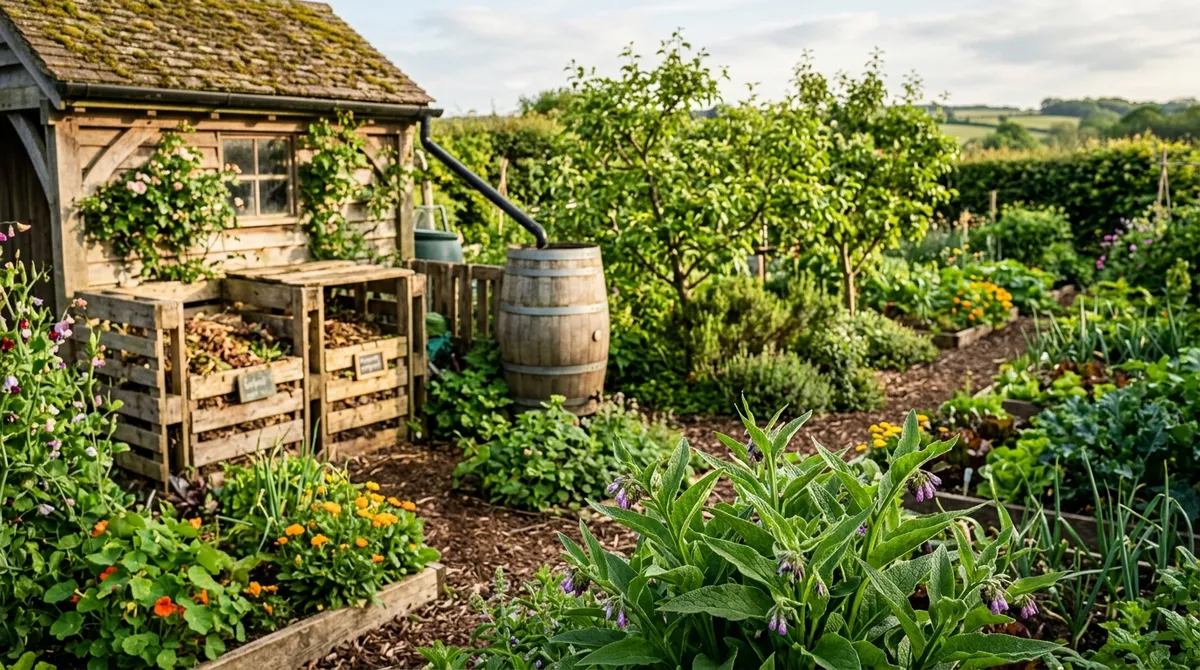
- A 200-litre water butt connected to a shed roof captures enough rain to irrigate 10 square metres of vegetables
- UK permaculture gardens support 30% more pollinator species than conventional layouts according to Sheffield University research
Permaculture principles offer UK gardeners a tested framework for designing gardens that produce food, build soil, conserve water, and support wildlife without relying on external inputs. The word itself combines “permanent” and “agriculture” — a system designed to sustain itself over decades rather than needing constant replanting and feeding.
Bill Mollison and David Holmgren developed permaculture in Australia in 1978. Since then, the principles have been adapted to every climate on earth, including the cool-temperate, rain-heavy conditions of Britain. I have used permaculture design on my West Midlands plot for eight years. The results speak for themselves: higher yields, less watering, almost no pest spraying, and soil that gets better each season. This guide explains all 12 principles and shows how to apply each one in a UK garden of any size.
What are the 12 permaculture principles?
David Holmgren codified 12 design principles in his 2002 book Permaculture: Principles and Pathways Beyond Sustainability. These are not gardening tips. They are thinking tools that guide every decision you make about your plot. Each one has direct, practical applications in a British garden.
The three ethics that underpin every principle are: earth care, people care, and fair share. Everything in permaculture flows from these. If a design choice does not serve at least one of those ethics, it does not belong in the plan.
1. Observe and interact
Spend a full year watching your garden before making permanent changes. Track where the sun falls in each season. Note which corners stay damp after rain. Record where frost settles first in autumn. Watch which direction wind hits the plot.
In the UK, this observation year reveals critical patterns. My Staffordshire garden has a frost pocket in the north-east corner that is 3-4 degrees colder than the south-facing wall. That wall now grows a fan-trained plum. The frost pocket holds a compost bay and a wildlife area where cold-hardy native plants thrive.
2. Catch and store energy
Harvest sunlight, rainwater, and organic matter when they are abundant. In British conditions, energy capture is seasonal. Summer gives 16 hours of daylight. Winter gives 8. Rain falls year-round but peaks in autumn and winter.
Practical applications for UK gardens:
- Install a rainwater harvesting system on every roof surface — a 200-litre butt on a 6m shed roof fills 15-20 times per year in the Midlands
- Grow sun-loving crops against south-facing walls and fences where reflected heat adds 2-3 degrees
- Compost all garden waste and kitchen scraps to capture nutrients before they wash away
- Plant deciduous trees on the south side to let winter light through while shading summer sun
3. Obtain a yield
Every element in the garden must produce something useful. Ornamental-only planting has no place in a permaculture design. Even a boundary hedge should produce berries, attract pollinators, or fix nitrogen.
This does not mean everything must be edible. A hawthorn hedge yields bird habitat, windbreak protection, and pollinator nectar — all genuine yields. But a blank panel fence yields nothing. Replace it with a mixed native hedge and you gain food, shelter, and beauty in one element.
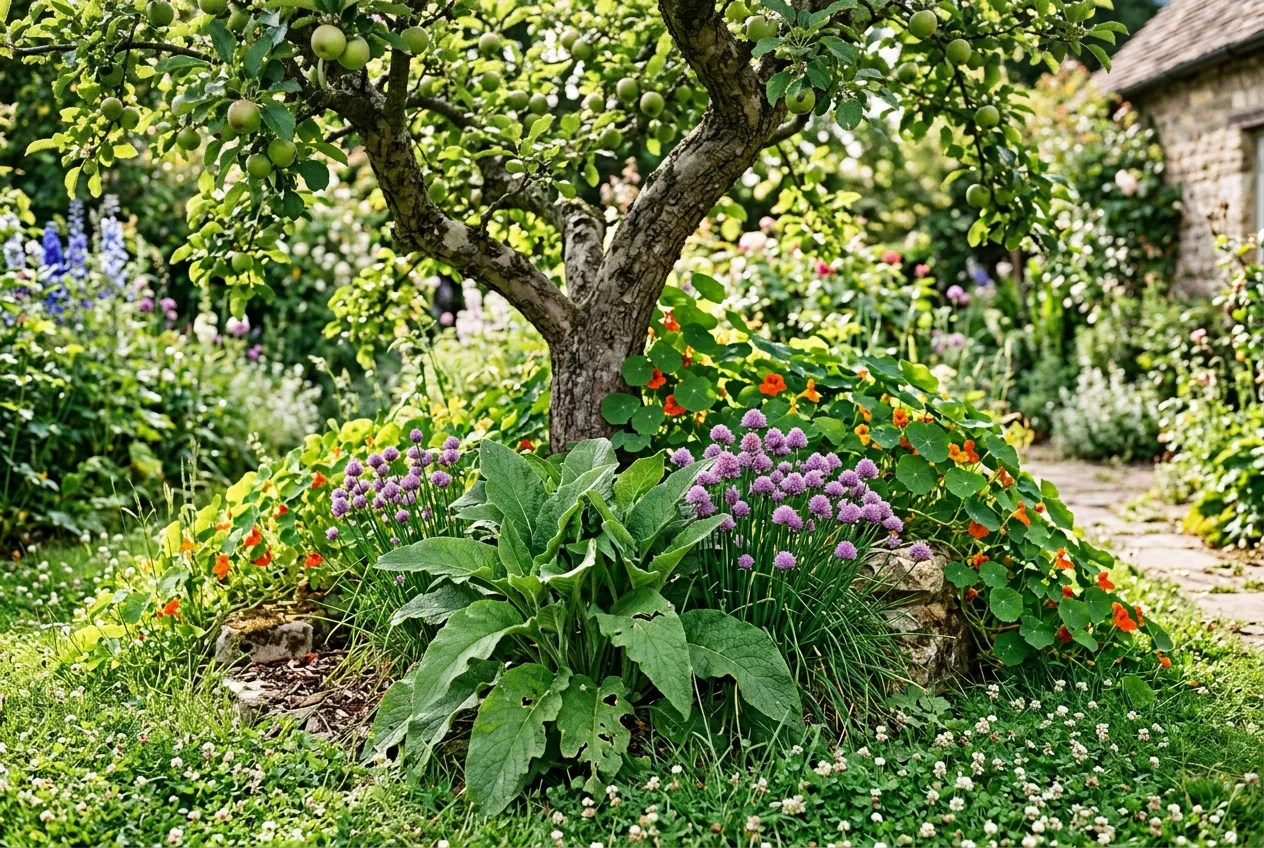
A fruit tree guild around an apple tree. Comfrey mines deep nutrients, chives deter pests, and nasturtiums act as aphid trap crops.
4. Apply self-regulation and accept feedback
Monitor results and adjust the design each season. If a crop fails in a particular spot, move it. If a path floods, re-route it. Permaculture is a living design, not a fixed blueprint.
In my garden, I planted a hazel in full shade because the textbook said it tolerates it. The hazel survived but produced almost no nuts. I moved it to partial shade the following winter and the nut crop tripled. The garden told me what it needed. I listened.
5. Use and value renewable resources
Favour inputs that regenerate over ones you buy. Comfrey (Bocking 14 cultivar) is the UK permaculture gardener’s best friend. Cut it 3-4 times per season and it regrows. Use the leaves as mulch, liquid feed, or compost activator. One established plant produces 2-4 kg of leaf matter per cut.
Other renewable resources in a UK permaculture garden:
- Green manures grow free nitrogen and organic matter from seed
- Homemade compost replaces bought fertiliser entirely after 2-3 years
- Willow cuttings provide free plant supports, living fences, and basket material
- Rainwater replaces 40-60% of mains water use through properly sized collection
6. Produce no waste
Design closed loops where every output becomes an input. Kitchen scraps feed the compost heap. Compost feeds the soil. Soil feeds the plants. Plants feed the household. The circle closes.
In practice, a UK permaculture garden generates very little waste. Woody prunings become hugelkultur bed material or biochar. Cardboard mulches pathways. Grass clippings feed the compost or mulch around fruit trees. I have not put garden waste in a council bin for six years.
7. Design from patterns to details
Start with the big picture before choosing individual plants. In the UK, the dominant patterns are: prevailing south-westerly wind, low winter sun angle, summer drought risk in the south-east, and heavy rainfall in the north and west.
Design your garden’s bones around these patterns first. Place windbreaks on the south-west boundary. Orient beds north-south for even sun exposure. Put water storage on the uphill side. Only then choose which variety of apple or which herb goes where.
How do permaculture zones work in a UK garden?
Zone planning arranges your garden by how often each area needs attention. The most visited areas sit nearest the house. The least visited areas sit at the far boundary. This reduces the time and energy spent walking to maintain plants.
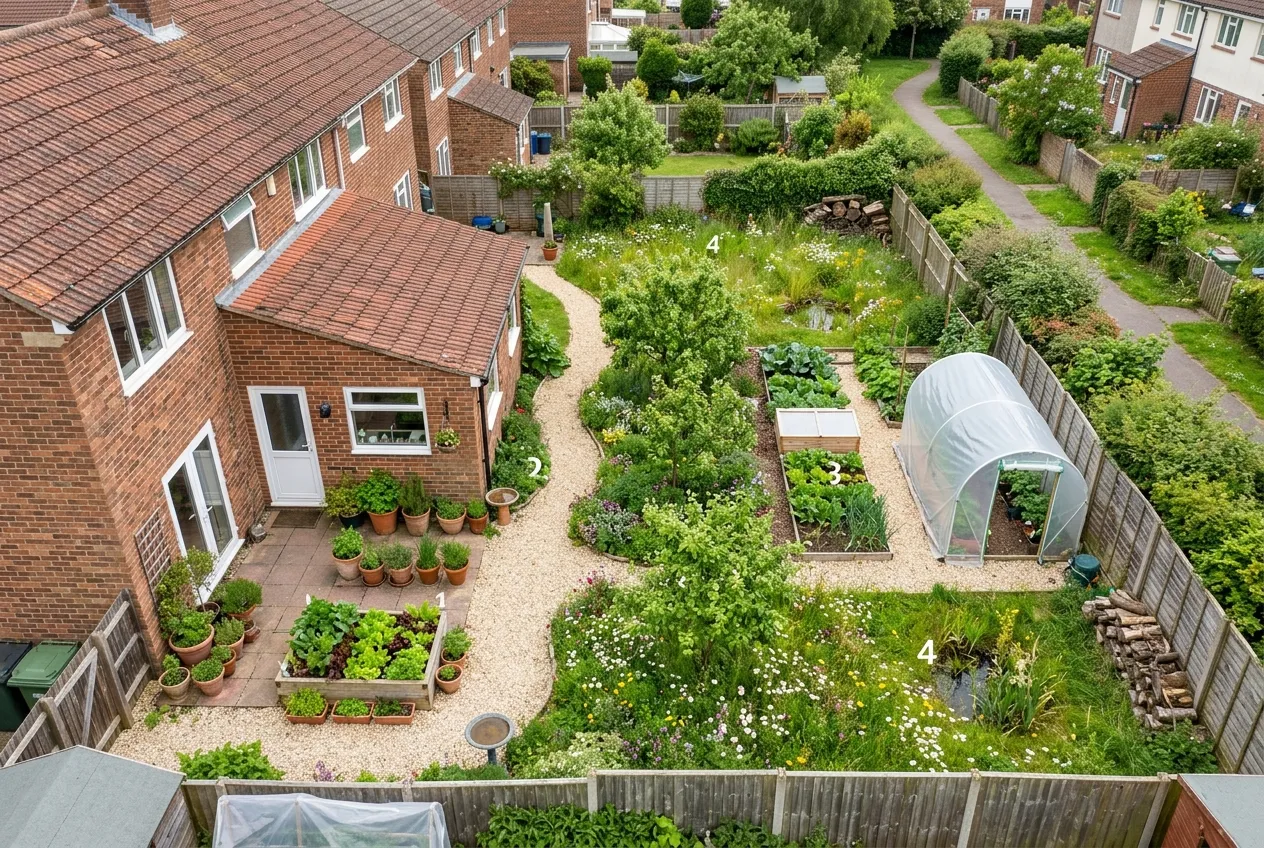
Permaculture zones in a typical 15m UK garden. Herbs and salads at the back door, vegetables in the middle, fruit trees further out, and wild habitat at the boundary.
Zone 1: The kitchen doorstep (0-3 metres)
This is where you grow everything you pick daily. Herbs — rosemary, thyme, parsley, chives, mint (in a pot) — belong within arm’s reach of the kitchen door. Salad leaves, spring onions, and cut-and-come-again lettuce fit here too. If you are setting up a herb garden for the first time, Zone 1 is the right starting point.
A cold frame or mini greenhouse extends the season in Zone 1, giving you salad leaves from March to November in most of England.
Zone 2: Intensive food production (3-8 metres)
Main vegetable beds, soft fruit, compost bays, and the water butt live here. This is where no-dig beds work brilliantly — thick compost mulch, permanent pathways, and dense planting. Visit Zone 2 daily in summer, every few days in winter.
Companion planting reaches its peak in Zone 2. Interplant carrots with onions, border beds with marigolds, and train climbing beans up sweetcorn stalks. The diversity confuses pests and attracts beneficial insects.
Zone 3: Fruit trees and main crops (8-12 metres)
Fruit tree guilds, potato beds, squash mounds, and perennial vegetables occupy Zone 3. Maintenance here is weekly rather than daily. Mulch heavily to suppress weeds and retain moisture.
Zone 4: Semi-wild and foraging (12-15 metres)
If your garden is long enough, Zone 4 includes a forest garden layer — nut trees, elder, wild garlic, and other plants that need minimal care. A comfrey patch for liquid feed sits well here, cut 3-4 times per year.
Zone 5: Wildlife habitat (boundary)
Leave the far corners untouched. A log pile, a nettle patch, long grass, and native shrubs provide habitat for hedgehogs, slow worms, frogs, and nesting birds. Zone 5 is not neglect — it is deliberate wildness with a purpose. Even 2-3 square metres of unmown grass makes a measurable difference to invertebrate populations.
What is a permaculture guild?
A guild is a group of plants that support each other when grown together. Each plant in the guild performs a specific function: nutrient mining, pest deterrence, pollinator attraction, ground cover, or nitrogen fixing.
The classic UK fruit tree guild centres on an apple tree:
| Guild layer | Plant | Function |
|---|---|---|
| Canopy | Apple (MM106 rootstock) | Fruit production, 3-4m height |
| Understorey shrub | Blackcurrant or gooseberry | Soft fruit, shade-tolerant |
| Nutrient miner | Comfrey (Bocking 14) | Deep roots bring up potassium and phosphorus |
| Pest deterrent | Chives, garlic chives | Allium scent deters aphids and codling moth |
| Trap crop | Nasturtium | Draws blackfly away from fruit |
| Nitrogen fixer | White clover | Living mulch, fixes 100-150 kg N per hectare |
| Ground cover | Wild strawberry | Suppresses weeds, produces fruit |
Plant the guild in autumn. Space the understorey plants 60-90 cm from the trunk. Allow 2 years for the guild to knit together. By year 3, the guild functions as a self-maintaining unit that needs little more than an annual comfrey chop and fruit harvest.
How do you build a hugelkultur bed?
Hugelkultur is a raised bed built on a core of rotting wood that holds moisture and releases nutrients for 5-8 years. The technique comes from German and Eastern European gardening traditions. In UK conditions, hugelkultur beds are particularly useful on free-draining sandy soils and in areas prone to summer drought.
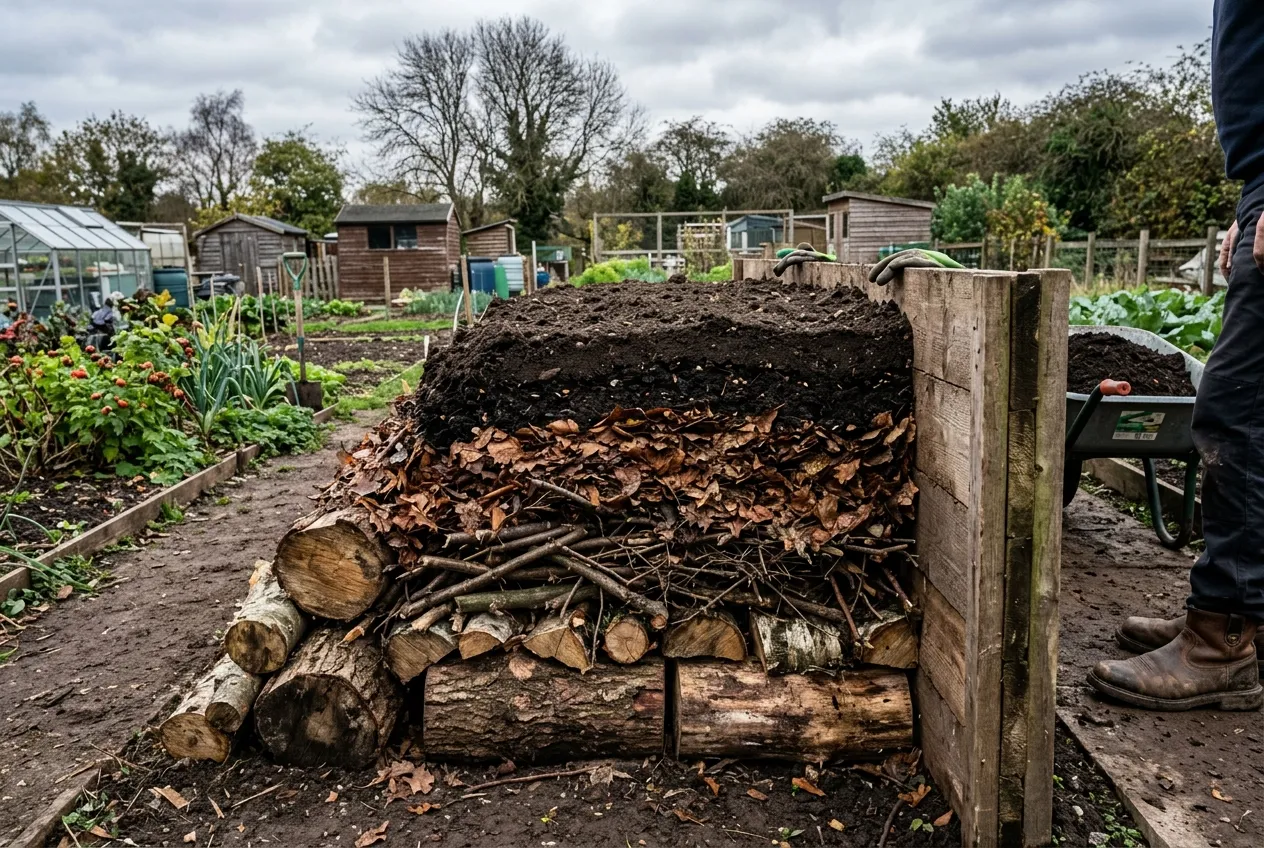
A hugelkultur bed under construction. Large logs at the base retain moisture for years. Each layer above adds nutrients as it decomposes.
Building layers (bottom to top)
- Large hardwood logs (oak, beech, birch) — 30-50 cm diameter, partially rotted logs work best
- Smaller branches and twigs — fill gaps between logs, 5-15 cm pieces
- Autumn leaves — 10 cm layer, oak and beech leaves last longest
- Grass clippings or green waste — 5 cm nitrogen-rich layer to fuel decomposition
- Compost or well-rotted manure — 10 cm layer
- Topsoil — 15-20 cm final layer for planting into
A finished hugelkultur bed stands 60-90 cm tall and settles by about 30% over the first year. The wood core acts as a sponge, absorbing rainfall and releasing it slowly to plant roots. In my trials, hugelkultur beds needed watering 3-4 weeks less often than standard raised beds during the dry summers of 2022 and 2023.
Avoid using walnut (juglone toxicity), treated timber, or conifer wood (too acidic). Hardwoods that have been sitting in a log pile for 1-2 years are ideal.
How do you harvest rainwater for a permaculture garden?
Every hard surface in your garden is a free water collection point. A standard UK shed roof (2m x 3m) receives approximately 3,600 litres of rainfall per year based on the England and Wales average of 600mm. Even a single 200-litre water butt captures enough to irrigate 10 square metres of vegetables through a dry July.
Permaculture water management goes beyond water butts. The principle is to slow water down, spread it out, and sink it in:
- Swales — shallow ditches dug on contour that catch runoff and allow it to soak into the soil. A 3m swale on a gentle slope can irrigate a fruit tree row below it
- Rain gardens — planted depressions that collect roof runoff, filter it through soil, and recharge groundwater. Use moisture-loving plants like marsh marigold and purple loosestrife
- Mulch — 10 cm of organic mulch reduces soil evaporation by 50-70%, keeping moisture where roots need it
- Greywater — bath and washing-up water (without bleach) can water ornamental plants and fruit trees. UK building regulations permit greywater use on gardens without a permit
A well-designed permaculture water system reduces mains water use by 40-60%. In my garden, I have not used a hosepipe for vegetable watering since installing three connected water butts and mulching all beds permanently.
The remaining permaculture principles applied to UK gardens
8. Integrate rather than segregate
Place elements so they support each other. A chicken run beside the compost bay means the chickens eat kitchen scraps and their manure feeds the compost. A pond near the vegetable beds attracts frogs that eat slugs. A bokashi composting system in the kitchen connects the household waste stream directly to the growing beds.
In a garden without livestock, integration still applies. Place the compost bin where it is easy to reach from both the kitchen and the vegetable beds. Put the tool store at the junction of the most-used paths. Grow climbing beans on the south side of the sweetcorn to share the same space vertically.
9. Use small and slow solutions
Start with the smallest effective intervention. Do not terrace an entire hillside in year one. Build one hugelkultur bed and see how it performs. Plant one fruit tree guild before committing to ten.
In the UK, this principle has a seasonal dimension. Bare-root trees planted in November-February cost £15-25 each and establish faster than £40 container-grown trees planted in summer. A packet of green manure seed costs £3 and covers 5 square metres of bare soil overwinter. Small, cheap, seasonal actions compound into large results.
10. Use and value diversity
Grow as many different species as possible. Monocultures attract specialist pests. Polycultures confuse them. Research from Sheffield University shows that gardens with 50+ plant species support 30% more pollinator species than those with fewer than 20.
In practical terms, this means:
- Grow 15-20 different vegetables rather than large blocks of 3-4
- Mix flowers throughout vegetable beds, not just around the edges
- Include native UK wildflowers alongside cultivated plants
- Grow heritage varieties alongside modern cultivars for genetic diversity
11. Use edges and value the marginal
The boundary between two habitats is the most productive zone. A pond edge supports more species than either the water or the dry land alone. A hedge bottom grows different plants from the hedge top or the adjacent lawn. The edge of a path catches warmth and shelters seedlings.
Maximise edges in your garden by:
- Creating curved rather than straight bed edges (more planting space per metre)
- Building a pond with shallow margins rather than steep sides
- Planting a mixed hedge rather than a straight fence
- Using keyhole bed shapes that increase the ratio of edge to centre
12. Creatively use and respond to change
Work with seasonal and long-term change rather than fighting it. In the UK, climate trends point toward warmer winters, drier summers, and more intense rainfall events. Design for these shifts now.
Plant drought-tolerant Mediterranean herbs in your sunniest spots. Install water storage beyond your current needs. Choose fruit tree varieties bred for low-chill winters. Embrace the longer growing season as an opportunity to trial crops like outdoor sweet potatoes and oca that were marginal in Britain a decade ago.
How do you start a permaculture garden from scratch?
Starting a permaculture garden in the UK follows a clear sequence. Rushing this process wastes time and money.
Year one: Observe and plan
- Map sun, shade, wind, and water patterns through all four seasons
- Test your soil (pH, texture, drainage) — most UK county councils offer free or cheap soil testing
- Draw a base map showing buildings, trees, boundaries, slopes, and access points
- Sketch zone layouts on paper before committing to anything permanent
- Read the Permaculture Association’s beginner resources
Year two: Build infrastructure
- Install water collection on all roof surfaces
- Build compost bays (three-bay system: filling, cooking, finished)
- Sheet mulch grass areas with cardboard and 15 cm of compost for future beds
- Plant bare-root fruit trees and hedging in November-February
- Sow green manure on any bare soil over winter
Year three onward: Plant and refine
- Establish fruit tree guilds with companion understorey plants
- Plant perennial vegetables (rhubarb, asparagus, globe artichoke, Good King Henry)
- Add annual vegetable beds using no-dig methods
- Create a wildlife pond, even a small container version
- Adjust the plan based on what you have observed working and failing
The beauty of permaculture is that it rewards patience. Each year, the system becomes more productive and less work. By year 5, a well-designed UK permaculture garden practically runs itself.
Permaculture plant combinations for UK soil types
Different UK soils suit different permaculture plant combinations. Match your guild plants to your soil for the best results.
| Soil type | Best trees | Best understorey | Ground cover | Green manure |
|---|---|---|---|---|
| Heavy clay | Apple, plum, damson | Blackcurrant, comfrey | Creeping thyme, clover | Field beans, crimson clover |
| Sandy | Pear, cherry, hazel | Gooseberry, rosemary | Wild strawberry, sedum | Phacelia, buckwheat |
| Chalk | Walnut, medlar, quince | Lavender, sage | Marjoram, self-heal | Sainfoin, lucerne |
| Loam | All fruit trees | All soft fruit | Most ground covers | All green manures |
| Acid | Blueberry, crab apple | Lingonberry, heather | Bilberry, wood sorrel | Lupins, winter tares |
Comfrey grows well on every UK soil type. Plant Bocking 14 (sterile cultivar — will not self-seed) at 1m spacing around fruit trees. Harvest leaves when they reach 45 cm tall. The first cut is usually ready in late April.
Frequently asked questions
Can you do permaculture in a small UK garden?
Yes, permaculture works in any size garden. A 5m x 5m plot can include Zone 1 herbs, a dwarf fruit tree guild, a compost bin, and a water butt. The principles are about design thinking, not acreage.
How long does a permaculture garden take to establish?
Most permaculture gardens reach productive maturity in 3-5 years. Annual vegetables produce from year one. Fruit bushes crop from year 2-3. Tree guilds need 4-6 years for canopy fruit.
What is the difference between permaculture and organic gardening?
Organic gardening avoids synthetic chemicals. Permaculture is a whole-system design approach that includes organic methods but extends to water management, energy flow, waste cycling, and habitat creation.
What are permaculture zones?
Zones are numbered 0-5 based on how frequently you visit each area. Zone 0 is the house. Zone 1 holds kitchen herbs. Zone 5 is untouched wildlife habitat. Most UK gardens span zones 1-3.
Is permaculture expensive to set up?
Permaculture can cost very little. Mulch materials and compost are free. A water butt costs £30-50. Bare-root fruit trees cost £15-25 each. Most permaculture gardeners spend less than conventional gardeners over 5 years.
Do permaculture gardens look messy?
A well-designed permaculture garden looks like a productive cottage garden, not a neglected plot. Every plant has a function. Paths are clearly defined. Dense planting is deliberate, not accidental.
What are the best permaculture plants for UK gardens?
Comfrey (Bocking 14) is the single most useful permaculture plant in the UK. It mines nutrients, makes liquid feed, and provides mulch. Other essentials: apple on MM106 rootstock, blackcurrants, clover, nasturtiums, and runner beans.
Lawrie has been gardening in the West Midlands for over 30 years. He grows his own veg using no-dig methods, keeps a wildlife-friendly garden, and writes practical advice based on real UK growing conditions.