Key takeaways
- Bokashi ferments ALL kitchen waste including meat, fish, dairy, and cooked food in a sealed bin
- A two-bin rotation produces usable pre-compost every 2 weeks, with full soil breakdown in 4-6 weeks
- Starter kits cost 25-50 pounds; ongoing bran costs 8-15 pounds per kg, lasting 4-8 weeks
- Bokashi liquid diluted 100:1 makes a potent plant feed; used undiluted it clears slow drains
- The sealed system fits under a kitchen sink, making it ideal for flats and homes without gardens
Bokashi composting in the UK is the fastest way to process every type of kitchen waste, including the meat, fish, dairy, and cooked food that traditional compost bins reject. Developed in Japan in the 1980s by Dr Teruo Higa at the University of the Ryukyus, bokashi uses effective microorganisms (EM) to ferment organic waste in a sealed, anaerobic environment. The word “bokashi” translates roughly as “fading away” in Japanese, describing how waste breaks down through lactic acid fermentation rather than aerobic decomposition.
This guide covers the full bokashi process from bin setup to burying the finished pre-compost. Whether you garden on an allotment or manage a balcony in a flat, bokashi works at any scale. For the traditional aerobic method, see our guide to making compost at home.
What is bokashi composting and how does it work?
Bokashi composting is an anaerobic fermentation process, not decomposition. Traditional composting relies on aerobic bacteria breaking down organic matter in the presence of oxygen. Bokashi uses lactic acid bacteria, yeasts, and phototrophic bacteria (collectively called effective microorganisms or EM) to ferment food waste in a sealed, oxygen-free environment.
The microorganisms are cultured onto a carrier material, usually wheat bran, which you sprinkle over food waste in layers. Once sealed, the EM produce lactic acid that lowers the pH to 3.5-4.0. This acidic environment suppresses putrefactive bacteria and pathogens while preserving nutrients. The process is identical in principle to making sauerkraut or kimchi.
The fermented material is not finished compost. It is a pickled pre-compost that must be buried in soil or added to a traditional compost bin to complete breakdown. Soil microbes and earthworms digest the pre-compost within 4-6 weeks in warm weather, incorporating the nutrients directly into the soil food web.
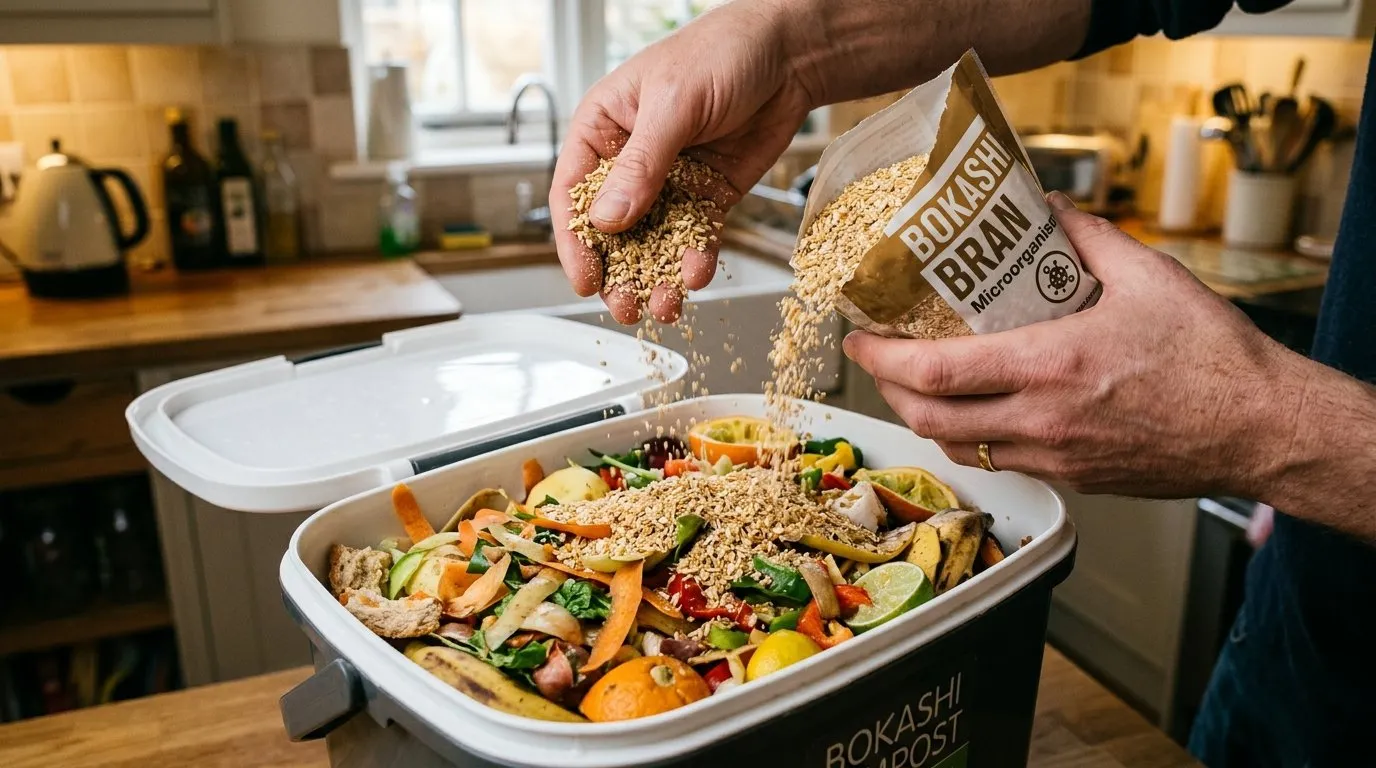
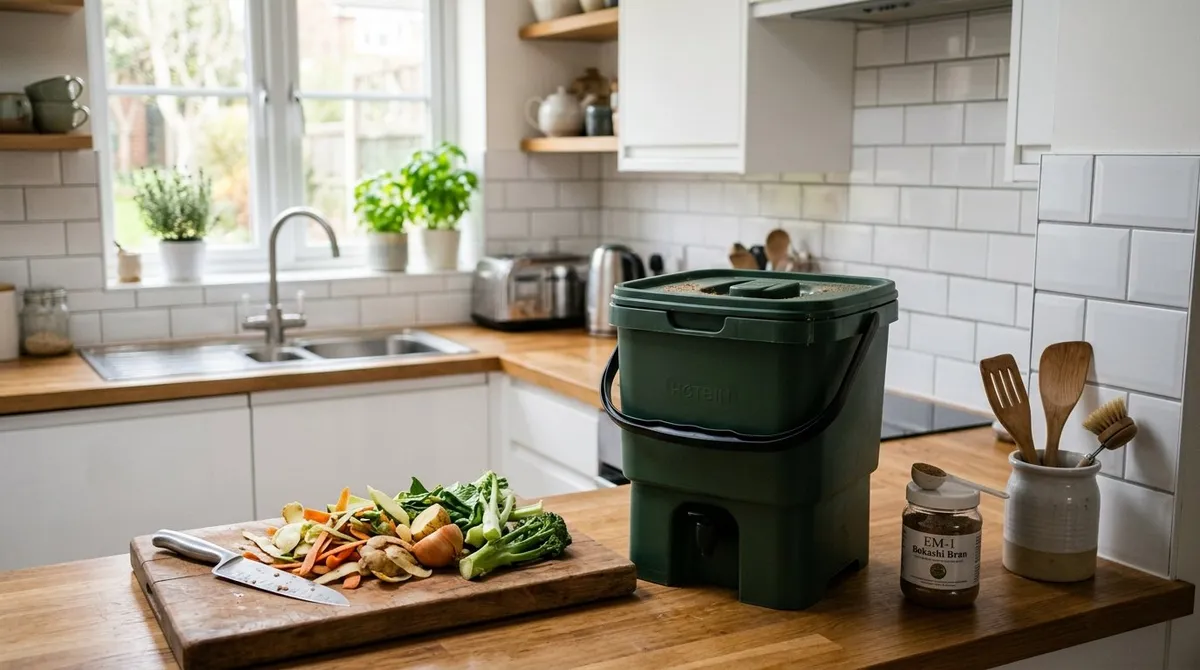
Sprinkle 1-2 tablespoons of EM bokashi bran over each layer of kitchen waste before pressing down firmly
How does bokashi differ from traditional composting?
The differences between bokashi and traditional composting are fundamental. Understanding them helps you decide which system suits your household, or whether to run both in parallel.
| Feature | Bokashi fermentation | Traditional composting |
|---|---|---|
| Process | Anaerobic fermentation (no oxygen) | Aerobic decomposition (needs oxygen) |
| Microbes | Lactic acid bacteria, yeasts, EM | Aerobic bacteria, fungi, actinomycetes |
| Temperature | Ambient (no heat generated) | 40-70C in active phase |
| Time to pre-compost | 2 weeks | 6-12 months |
| Accepts meat/dairy | Yes, all food waste | No, attracts rats and pathogens |
| Smell | Sweet, pickled, vinegar-like | Earthy (or rotten if mismanaged) |
| Space required | Fits under kitchen sink | Needs outdoor garden space |
| pH of output | 3.5-4.0 (highly acidic) | 6.0-8.0 (neutral to alkaline) |
| Nutrient retention | High (fermentation preserves NPK) | Lower (nutrients lost as gases in decomposition) |
| Requires soil burial | Yes, 4-6 weeks in ground | No, finished product usable directly |
The biggest practical advantage is food waste acceptance. WRAP (Waste & Resources Action Programme) data shows the average UK household produces 6.4kg of food waste per week. Traditional composting rejects roughly 40% of that because meat, fish, dairy, cooked food, and bread attract vermin. Bokashi processes 100% of kitchen food waste.
The biggest limitation is that bokashi alone does not produce finished compost. You need soil or a compost bin to complete the process. For gardeners who already run a traditional compost system, bokashi adds the food waste that would otherwise go to landfill.
How to set up a bokashi bin step by step
Setting up a bokashi system takes less than 10 minutes. You need a bin, bran, and a routine.
Equipment you need
A bokashi bin is an airtight container with a tap at the base for draining liquid. Purpose-made bins are 16-20 litres and cost 15-30 pounds each. You need two bins for a continuous rotation. Budget options include any airtight bucket with a fitted lid, though you will need to drill a hole and fit a small tap.
Essential kit:
- 2 bokashi bins (16-20 litres each) with taps and airtight lids
- Bokashi bran (EM-inoculated wheat bran) - 1kg to start
- A plate or plastic disc that fits inside the bin to press waste flat
- A cup or jug for draining bokashi liquid
Starter kit costs:
| Item | Cost range | Lasts |
|---|---|---|
| Two-bin bokashi kit | 25-50 pounds | 5+ years |
| Single replacement bin | 12-25 pounds | 5+ years |
| Bokashi bran (1kg) | 8-15 pounds | 4-8 weeks |
| Bokashi bran (5kg bulk) | 25-35 pounds | 5-10 months |
| DIY bucket conversion | 5-10 pounds | 3+ years |
Step-by-step setup
- Sprinkle a base layer of bokashi bran across the bottom of the empty bin. One tablespoon is sufficient.
- Add kitchen waste in a layer 3-5cm deep. Chop large items to speed fermentation. The smaller the pieces, the larger the surface area for microbes.
- Press down firmly with a plate, masher, or your hands. Remove all air pockets. This is the most critical step. Air causes aerobic rot and bad smells.
- Sprinkle 1-2 tablespoons of bran evenly over the pressed layer.
- Seal the lid tightly after every addition. Minimise the time the lid is open.
- Repeat daily as you generate kitchen waste. Each time: add waste, press, sprinkle bran, seal.
- Drain the liquid from the tap every 2-3 days.
- When full, seal the bin and leave it for 2 weeks. Start filling the second bin immediately.
How to run a two-bin rotation system
The two-bin rotation is what makes bokashi practical for daily kitchen waste. One bin is always collecting waste while the other ferments undisturbed.
Week 1-2: Fill Bin A with daily kitchen waste. Drain liquid every 2-3 days.
Week 2-4: Bin A is full. Seal it and leave for 14 days. Start filling Bin B with daily waste.
Week 4: Bin A has fermented for 2 weeks. Empty it by burying the pre-compost in the garden. Wash Bin A. It becomes the next collecting bin when Bin B fills up.
Week 4-6: Continue filling Bin B. When full, seal and ferment. Switch back to Bin A.
This rotation means you bury one bin of pre-compost roughly every 2-4 weeks, depending on how quickly your household fills a bin. A family of four typically fills an 18-litre bin in 10-14 days.
The fermented waste should look largely unchanged but smell mildly acidic. White mould on the surface is a positive indicator. The pH should be 3.5-4.0. If the waste smells rotten or putrid, the seal failed or you used too little bran.
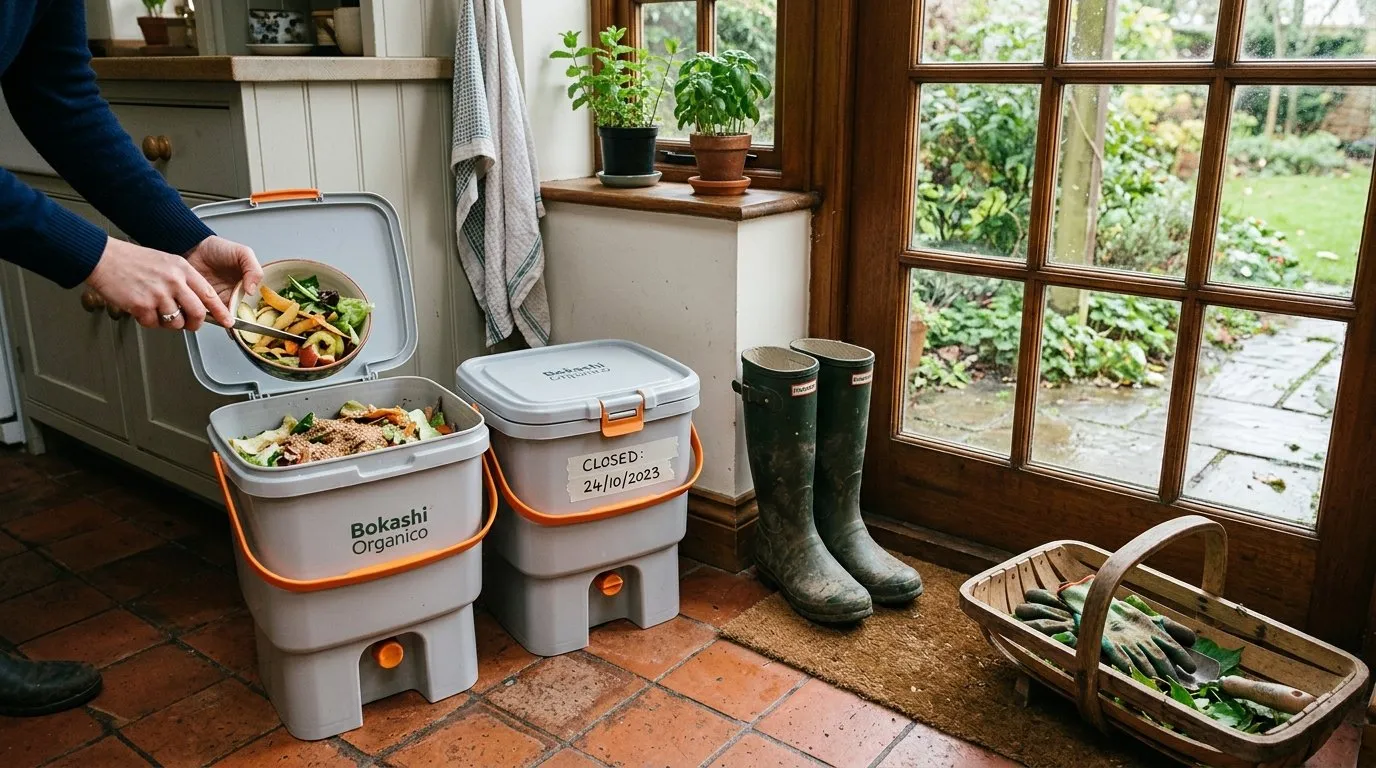
A two-bin rotation keeps one bin collecting waste while the other ferments for 14 days
What can you put in a bokashi bin?
Bokashi accepts a far wider range of materials than traditional composting. The sealed, acidic environment suppresses the pathogens and vermin that make meat and dairy problematic in open compost heaps.
What goes in
- All fruit and vegetable scraps (raw and cooked)
- Meat and fish (raw and cooked, including bones under 3cm)
- Dairy products (cheese, yoghurt, butter, milk)
- Cooked food (rice, pasta, bread, sauces, leftovers)
- Eggs and eggshells
- Tea bags and coffee grounds
- Wilted flowers and small plant trimmings
- Baked goods and pastry
What stays out
- Liquids (water, milk, soup, oil) - these flood the bin and dilute the EM. Drain food before adding.
- Large bones - anything thicker than 3cm will not ferment. Chop smaller or discard.
- Heavily mouldy food - established mould colonies compete with the EM. Small amounts of surface mould are fine.
- Paper and cardboard - these do not ferment. Add to your traditional compost bin instead.
- Garden waste - grass clippings and prunings are better in a standard compost heap or leaf mould bin.
- Pet faeces - hygiene risk even after fermentation.
The ability to process meat, dairy, and cooked food is bokashi’s single greatest advantage. WRAP estimates that meat and dairy account for 28% of UK household food waste by weight. That material currently goes straight to landfill or council food waste collections.
How to bury bokashi pre-compost in soil
The fermented pre-compost is not finished compost. It is acidic (pH 3.5-4.0), pickled organic matter that needs soil microbes and earthworms to complete decomposition. You have three burial options.
Trench method (most common)
Dig a trench 25-30cm deep in a vegetable bed or border. Tip the fermented bokashi along the trench and chop it into the soil with a spade. Cover with at least 15cm of soil. Mark the spot. The pre-compost breaks down in 4-6 weeks during spring and summer, 6-8 weeks in winter.
Rotate trenches around the garden. Each burial enriches the soil with beneficial microbes, organic matter, and nutrients. After 4-6 weeks, plant directly into the area. The decomposed material improves both drainage and water retention, which is particularly useful on heavy clay soils.
Add to an existing compost bin
Mix bokashi pre-compost into the centre of an active compost heap. The heat and aerobic microbes break it down rapidly. This method adds the meat and dairy waste that traditional composting normally rejects. Cover with a thick layer of brown material (cardboard, dried leaves) to prevent smells.
Add to a wormery
Worms digest fermented bokashi but the acidity needs managing. Spread a thin layer (2-3cm maximum) across the wormery surface. Cover with dampened newspaper. Let the worms work through it before adding more. Adding too much at once can harm the worms. See our compost tea guide for related liquid feeding methods.
Soil breakdown timeline:
| Season | Trench burial | Compost bin addition | Wormery processing |
|---|---|---|---|
| Spring (Mar-May) | 4-5 weeks | 3-4 weeks | 2-3 weeks |
| Summer (Jun-Aug) | 3-4 weeks | 2-3 weeks | 2-3 weeks |
| Autumn (Sep-Nov) | 5-6 weeks | 4-5 weeks | 3-4 weeks |
| Winter (Dec-Feb) | 6-8 weeks | 5-7 weeks | 4-6 weeks |
How to use bokashi liquid as plant feed
Bokashi liquid (the leachate drained from the tap) is a concentrated by-product of the fermentation process. It contains organic acids, EM microorganisms, and dissolved nutrients. Drain it every 2-3 days to prevent it pooling at the base and turning anaerobic.
As a plant feed (diluted 100:1)
Mix 10ml of bokashi liquid into 1 litre of water. Apply to soil around plants, not directly onto leaves. The solution feeds soil microbes and provides a mild nutrient boost. Use it within 24 hours of draining because the microorganisms die quickly once exposed to air.
The liquid is particularly effective as a soil drench for container plants and vegetable gardens. Apply weekly during the growing season from April to September alongside your regular plant feeding programme.
As a drain cleaner (undiluted)
Pour neat bokashi liquid down kitchen and bathroom drains. The EM and organic acids digest grease and organic build-up in pipes. Pour it in at night when drains are unused for longest. This is one of the most practical household benefits of the system.
As a septic tank treatment (undiluted)
Pour 250ml of undiluted liquid directly into the toilet monthly. The EM colonise the septic tank and help break down solids. Several Japanese municipal studies report 20-30% reductions in septic sludge volume with regular EM addition.
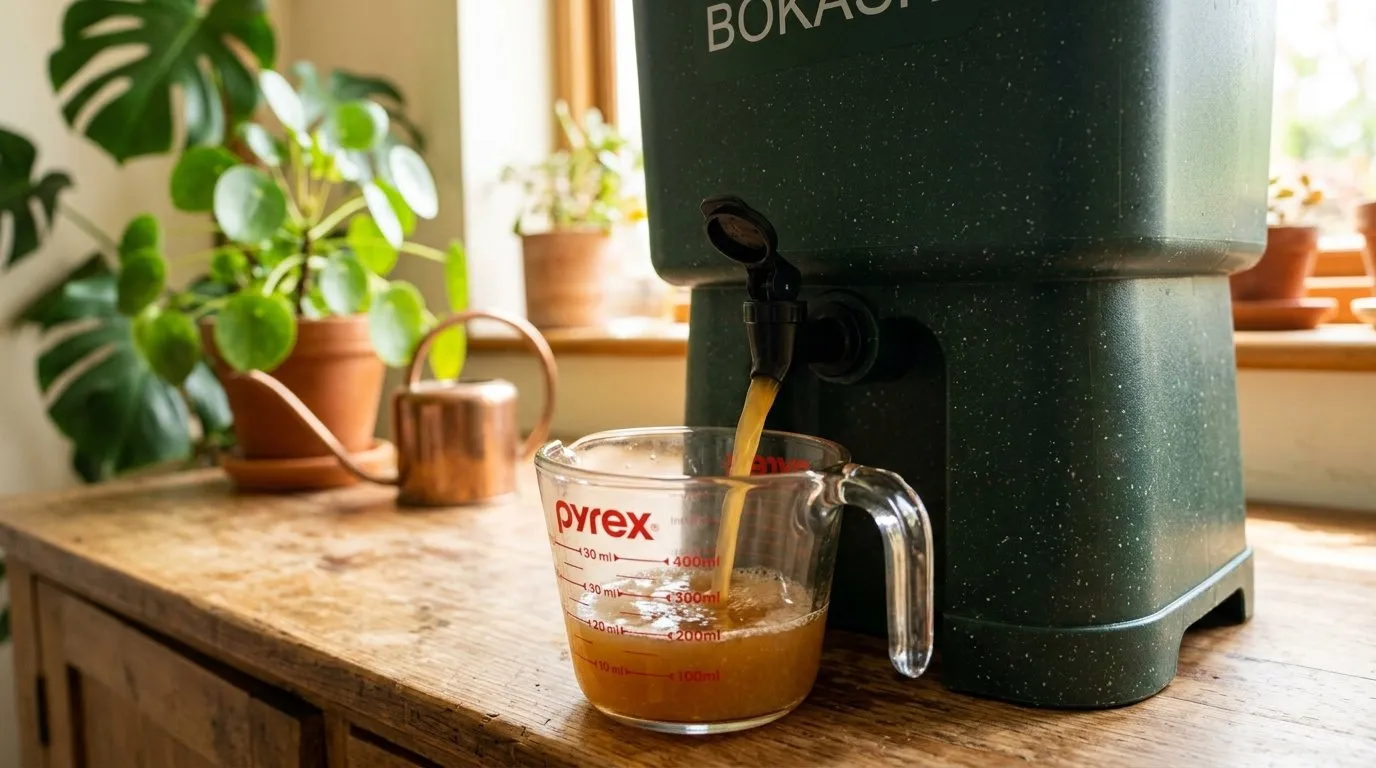
Drain bokashi liquid every 2-3 days and dilute 100:1 for a potent plant feed
How much does bokashi composting cost in the UK?
Bokashi has a higher upfront cost than traditional composting but lower ongoing costs than most gardeners expect. Here is a realistic UK cost breakdown.
First year costs
| Item | Cost | Notes |
|---|---|---|
| Two-bin starter kit | 25-50 pounds | Includes bins, taps, lids, and initial bran |
| Additional bran (5kg) | 25-35 pounds | Lasts 5-10 months for average household |
| Replacement bran (annual) | 50-80 pounds | Based on 1 tablespoon per layer, daily use |
| Year 1 total | 75-130 pounds |
Ongoing annual costs
| Item | Cost | Notes |
|---|---|---|
| Bran (5-8kg per year) | 50-80 pounds | A 2-person household uses less |
| Replacement bin | 0-25 pounds | Bins last 5+ years |
| Annual total | 50-80 pounds |
How to reduce bran costs
Buy bran in bulk (5kg bags are 30-40% cheaper per kilogram than 1kg bags). Some UK suppliers sell EM liquid and dry bran separately so you can inoculate your own bran at home using wheat bran from a feed merchant (roughly 10 pounds for 25kg). Homemade EM bran cuts ongoing costs to under 20 pounds per year.
You can also make your own EM bokashi bran. Mix 1kg of wheat bran with 60ml of EM-1 liquid concentrate (available from specialist suppliers for 8-12 pounds per litre) and 20ml of molasses dissolved in 300ml of warm water. Seal in a bag for 2 weeks to ferment. Once the bran smells sweet and fermented, dry it in the sun and store in an airtight container. One litre of EM-1 makes roughly 15kg of bran.
Is bokashi composting suitable for flats and small spaces?
Bokashi is the most space-efficient composting method available. The sealed bin fits under a kitchen sink, in a utility cupboard, or on a balcony. It produces no odour when sealed correctly and attracts no flies or vermin.
A standard 18-litre bokashi bin measures approximately 27cm x 27cm x 37cm. Two bins stacked require less than 0.08 square metres of floor space. Compare this with a traditional 300-litre compost bin that needs at least 1 square metre of garden.
For flat dwellers without gardens, the burial stage requires creativity. Options include:
- Large planters or containers - dig pre-compost into the bottom third and cover with soil. A 40-litre planter processes roughly 4 litres of pre-compost per cycle.
- Community gardens or allotments - many accept bokashi pre-compost donations.
- Friends or neighbours with gardens - a bag of fermented bokashi is odourless when sealed and easy to transport.
- Council food waste bins - fermented bokashi can go in council food waste collections if soil burial is impossible.
What is the environmental impact of bokashi composting?
Bokashi diverts significantly more household food waste from landfill than traditional composting. The numbers support a strong environmental case.
Key environmental data:
- WRAP reports UK households produce 6.4 million tonnes of food waste annually
- Traditional composting rejects approximately 40% of food waste (meat, dairy, cooked food)
- Bokashi processes 100% of food waste, diverting up to 50% more material from landfill than traditional composting
- Food waste in landfill produces methane, a greenhouse gas 28 times more potent than CO2 over 100 years
- Bokashi fermentation produces lactic acid and CO2 but no methane
- The EM microorganisms in bokashi pre-compost improve soil biodiversity when buried
- Nutrient retention during fermentation is higher than in aerobic composting because nitrogen is not lost as ammonia gas
A household running both a bokashi system and a traditional compost bin can realistically divert 90-95% of all organic waste from general rubbish. Adding a leaf mould system handles autumn tree leaves. Together, these three methods form a closed-loop waste system.
The Royal Horticultural Society and Garden Organic both recognise bokashi as a valid composting method, though neither has published comparative environmental data against traditional methods.
Troubleshooting common bokashi problems
Most bokashi failures come from three causes: air getting into the bin, not enough bran, or forgetting to drain the liquid. Here are the fixes.
| Problem | Cause | Fix |
|---|---|---|
| Rotten, putrid smell | Air entering the bin | Press waste firmly, check lid seal, add extra bran |
| Green or black mould | Contamination from air exposure | Remove mouldy layer, add heavy bran layer, reseal |
| No liquid draining | Dry waste or blocked tap | Add wetter scraps, clear tap with warm water |
| Too much liquid | High-moisture waste (fruit, soup) | Drain waste before adding, drain tap daily |
| Maggots or flies | Lid not sealed, or bin used outdoors uncovered | Replace lid, seal gaps, keep bin indoors |
| Slow fermentation | Cold temperatures (below 15C) | Move bin to warmer location, add extra bran |
| Pre-compost not breaking down in soil | Buried too shallow or soil too cold | Bury at least 25cm deep, wait longer in winter |
A well-managed bokashi bin should smell mildly of pickled vegetables when opened. White mould is a positive sign. If you encounter persistent problems, increase the bran quantity by 50% and ensure every layer is compressed firmly before sealing. Flies only appear when the lid seal fails, and if they reach the kitchen our guide to getting rid of fruit flies organically clears them without sprays.
Bokashi composting month-by-month UK calendar
Bokashi works year-round indoors, but the burial stage is affected by soil temperature and seasonal growing patterns.
| Month | Indoor bin activity | Soil burial notes |
|---|---|---|
| January | Normal collection and fermentation | Slow breakdown (6-8 weeks). Bury in empty beds. |
| February | Normal | Ground may be frozen. Stockpile sealed bins if needed. |
| March | Normal | Soil warming. Good time to bury in beds before planting. |
| April | Normal | 4-5 week breakdown. Bury between rows in vegetable plots. |
| May | Normal | Fast breakdown. Trench bury in borders and beds. |
| June | Drain liquid more often (warmer = more liquid) | 3-4 week breakdown. Use liquid feed on growing crops. |
| July | Same as June | Fastest breakdown. Ideal burying conditions. |
| August | Same as June | Fast breakdown. Prepare autumn burying trenches. |
| September | Return to normal drain schedule | 5-6 week breakdown. Bury in harvested beds. |
| October | Normal | Bury before soil cools further. Good for no-dig beds. |
| November | Normal | Slow breakdown starting. Bury deeper (30cm). |
| December | Normal | Slow breakdown. Bury in empty beds or stockpile bins. |
Frequently asked questions
Does bokashi composting smell bad?
A healthy bokashi bin smells of sweet pickles or cider vinegar. This mild acidic smell is normal and indicates successful fermentation. If the bin smells putrid or rotten, too much air entered during the process. White mould on the surface is a positive sign. Green or black mould means the seal failed or insufficient bran was used.
Can you put meat and dairy in a bokashi bin?
Yes, bokashi accepts all cooked and raw food waste. This includes meat, fish, dairy, cheese, cooked rice, pasta, and bread. Traditional composting cannot process these materials because they attract rats and produce harmful bacteria. Bokashi fermentation creates an acidic, anaerobic environment (pH 3.5-4.0) that suppresses pathogens.
How long does bokashi composting take from start to finish?
The full cycle takes 6-8 weeks. Filling the bin takes 1-2 weeks depending on household waste volume. Sealed fermentation takes 2 weeks. Soil breakdown after burying takes 4-6 weeks in warm weather, 6-8 weeks in winter. A two-bin rotation means you always have one bin collecting waste while the other ferments.
Is bokashi composting worth the cost?
Annual running costs are 50-80 pounds for bran. A starter kit costs 25-50 pounds and bran costs 8-15 pounds per kilogram. WRAP estimates the average UK household throws away 4.5 million tonnes of food waste annually. Bokashi processes 100% of kitchen food waste, reducing landfill contributions by up to 50% more than traditional composting which rejects meat and dairy.
Can you bokashi compost in a flat without a garden?
Yes, the sealed bin fits under a kitchen sink. For the burial stage, use large planters or containers filled with soil. Dig the pre-compost into the bottom third of a 40-litre planter and cover with 15cm of soil. Alternatively, find a community garden or allotment for burying.
What is the white mould in my bokashi bin?
White fuzzy mould is beneficial fungal mycelium. It appears on the food surface after a few days and shows the effective microorganisms are active. Do not scrape it off. Green, blue, or black mould signals contamination from air exposure. Add extra bran, press the contents down firmly, and reseal.
Can you add bokashi pre-compost to a wormery?
Yes, but add small amounts and manage the acidity. Bokashi pre-compost is highly acidic (pH 3.5-4.0) and can harm worms if added in large quantities. Mix no more than 20% of the wormery volume per feed with shredded newspaper. Let the pre-compost air for 24 hours before adding. Worms adapt over several weeks.
Our team produces practical UK gardening guidance from source research, contributor records and established horticultural practice. Editorial standards are overseen by Matt W.