Best Hardy Annual Flowers to Grow from Seed
Grow hardy annual flowers from seed direct outdoors from March. Cornflower, calendula, nigella, larkspur, and ammi — all from a single sowing.
Key takeaways
- Hardy annuals tolerate frost and are sown direct outdoors from March — no propagator needed
- Cornflower, calendula, nigella, larkspur, ammi, and California poppy are the most reliable UK varieties
- Sow in short rows every 3-4 weeks from March to June for continuous cut flowers all summer
- Most hardy annuals prefer poor, free-draining soil — rich soil produces foliage at the expense of flowers
- Nigella, calendula, and larkspur self-seed prolifically — leave a few plants to drop seed in autumn
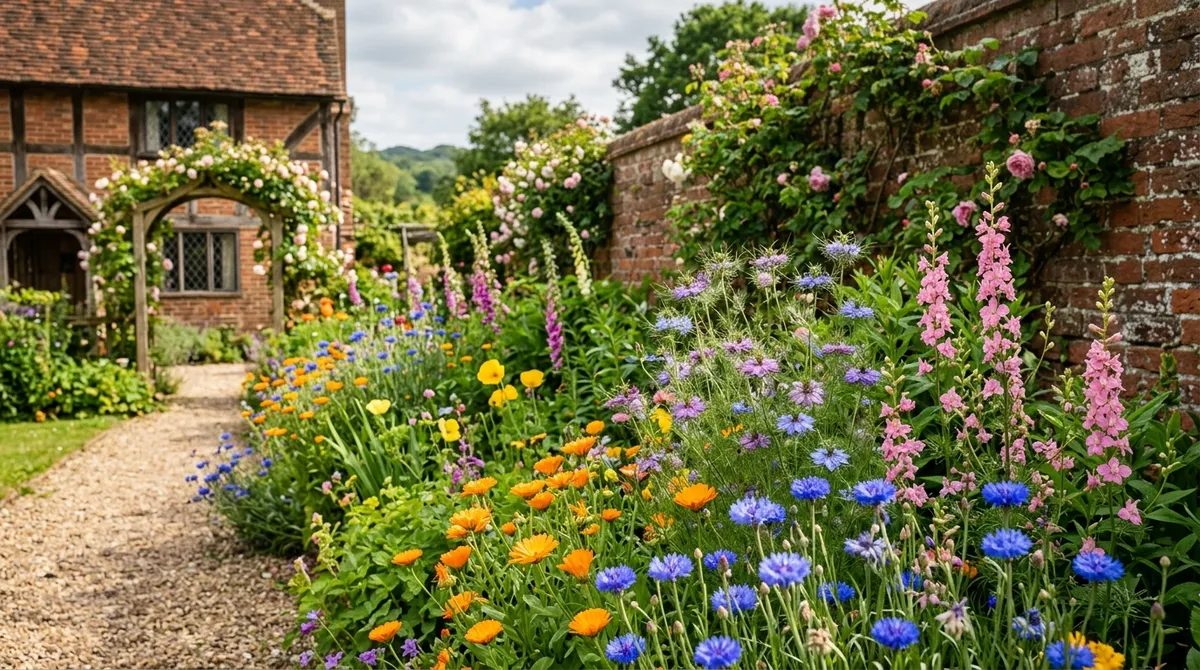
Hardy annual flowers are the most straightforward plants to grow from seed in the UK — sown direct in the ground from March, no heating or propagator required. A single packet of mixed cornflower, nigella, and calendula seeds costs under £3 and fills a generous border from May to October. This guide covers everything: what makes an annual truly hardy, the best varieties for UK conditions, how to sow and thin them, and how to run a cutting patch that flowers non-stop through summer.
What are hardy annuals — and how do they differ from half-hardy?
Hardy annuals complete their full life cycle in one growing season and tolerate frost. Seeds can be sown direct outdoors in March, when night frosts are still likely, because the seedlings survive temperatures as low as -3C once established. The seed itself germinates at soil temperatures above 7C — typically achievable in southern England from mid-March.
Half-hardy annuals are a different matter. Cosmos, zinnias, French marigolds, and nicotiana are frost-sensitive at every stage. They require indoor sowing at 18-20C in March, careful hardening off, and planting out only after the last frost in May. This takes propagator space, trays, and time. Hardy annuals skip all of that.
The practical implication: on a cold March afternoon, you can rake a bed, scatter seed, and be done in 20 minutes. For a beginner picking their first annual seeds, stick entirely to hardy species. You can always add half-hardies once you have the basics under control. Our seed sowing calendar shows exactly when to sow both types across the UK.
The best hardy annual varieties for UK gardens
These are the varieties that consistently perform well in UK conditions, confirmed through RHS trials at Wisley and our own multi-season trials in Staffordshire.
Cornflower and nigella are the workhorses of any hardy annual border — easy to sow, fast to germinate, and loved by bees.
| Variety | Height | Sow | Flowers | Best for |
|---|---|---|---|---|
| Cornflower (Centaurea cyanus) | 60-90cm | March-May | June-September | Cutting, wildlife, cottage garden |
| Calendula (Calendula officinalis) | 30-60cm | March-June | May-October | Cutting, edging, companion planting |
| Nigella (Nigella damascena) | 40-60cm | March-May | June-August | Cutting, seed heads, cottage style |
| Larkspur (Consolida ajacis) | 90-120cm | March-April | June-July | Cutting, back of border |
| Ammi (Ammi majus) | 90-120cm | March-April | June-August | Cutting filler, wildlife |
| California poppy (Eschscholzia californica) | 30-40cm | March-June | May-October | Sunny banks, gravel, containers |
| Nasturtium (Tropaeolum majus) | 30cm (bush) / 2m (trailing) | April-May | June-October | Edible flowers, companion planting |
| Poached egg plant (Limnanthes douglasii) | 15-20cm | March-May | May-July | Edging, ground cover, hoverflies |
Cornflower (Centaurea cyanus)
Cornflower is the most reliable hardy annual for UK cutting gardens. The classic electric-blue variety ‘Blue Ball’ reaches 90cm and produces straight, stiff stems ideal for cutting. ‘Black Ball’ offers deep maroon tones for more unusual arrangements. Cornflowers germinate in 7-14 days, flower within 10-12 weeks of sowing, and attract bumblebees throughout summer. The RHS gives cornflower an Award of Garden Merit and consistently recommends it for wildlife gardening. Cut flowers last 7-10 days in a vase. The key rule: cut before the flower fully opens for the longest vase life.
Calendula (Calendula officinalis)
Calendula — pot marigold — is the most forgiving hardy annual in existence. It germinates in cool soil, survives light frost as a seedling, self-seeds prolifically, and flowers from May right through to November in mild years. ‘Indian Prince’ (deep orange with brown-tipped petals) and ‘Citrus Twist’ (lemon and orange bicolour) are both excellent for cutting. Calendula is a superb companion plant — it repels aphids and attracts hoverflies. See our companion planting guide for how to use it alongside vegetables.
Nigella (Nigella damascena)
Nigella (love-in-a-mist) produces cornflower-blue, white, or pink flowers surrounded by feathery, fennel-like foliage. The flowers are striking fresh; the inflated seed pods are equally decorative dried. ‘Miss Jekyll’ is the most widely grown blue. ‘Oxford Blue’ is deeper-coloured. Nigella does not transplant — sow direct only. It self-seeds heavily if a few plants are left to shed in August. Each subsequent generation flowers 2-3 weeks earlier than spring-sown plants because the seed stratifies naturally in the soil over winter.
Larkspur (Consolida ajacis)
Larkspur produces tall vertical spires of densely packed flowers in blue, pink, white, and purple — the annual equivalent of delphiniums. ‘Giant Imperial Series’ reaches 1.2m. It is excellent for cutting (cut when one-third of the florets on the spike are open), but note that all parts of the plant are toxic if ingested. Keep away from children and pets. Larkspur resents root disturbance and must be sown direct. It prefers the cold: an autumn sowing in September gives earlier flowers than a March sowing. If you grow delphiniums, our growing delphiniums guide pairs naturally with larkspur as the annual equivalent.
Ammi (Ammi majus)
Ammi is the florist’s secret — a hardy annual that produces flat umbels of tiny white flowers almost identical in appearance to gypsophila but on much sturdier 90cm stems. It is invaluable as a filler in mixed bouquets. Germination can be slow (up to 21 days), and like larkspur, it hates root disturbance. Sow direct in March or April. Succession sow in May for a second flush. Ammi is one of the best hardy annuals for attracting hoverflies and parasitic wasps — a valuable biological control for aphids. For more on cut flower growing, see our full guide to growing cut flowers in the UK.
California poppy (Eschscholzia californica)
Despite its name, the California poppy is perfectly at home in UK gardens. It thrives in poor, dry, free-draining soil — the worse the conditions, the better it flowers. Flowers open in sunshine and close in cloud, so it suits warm, south-facing spots. ‘Dali’ (scarlet), ‘Milkmaid’ (cream), and ‘Thai Silk’ (semi-double, mixed) are all reliable. California poppy self-seeds aggressively. Scatter once and it will return every year without further intervention.
How to sow hardy annuals direct outdoors
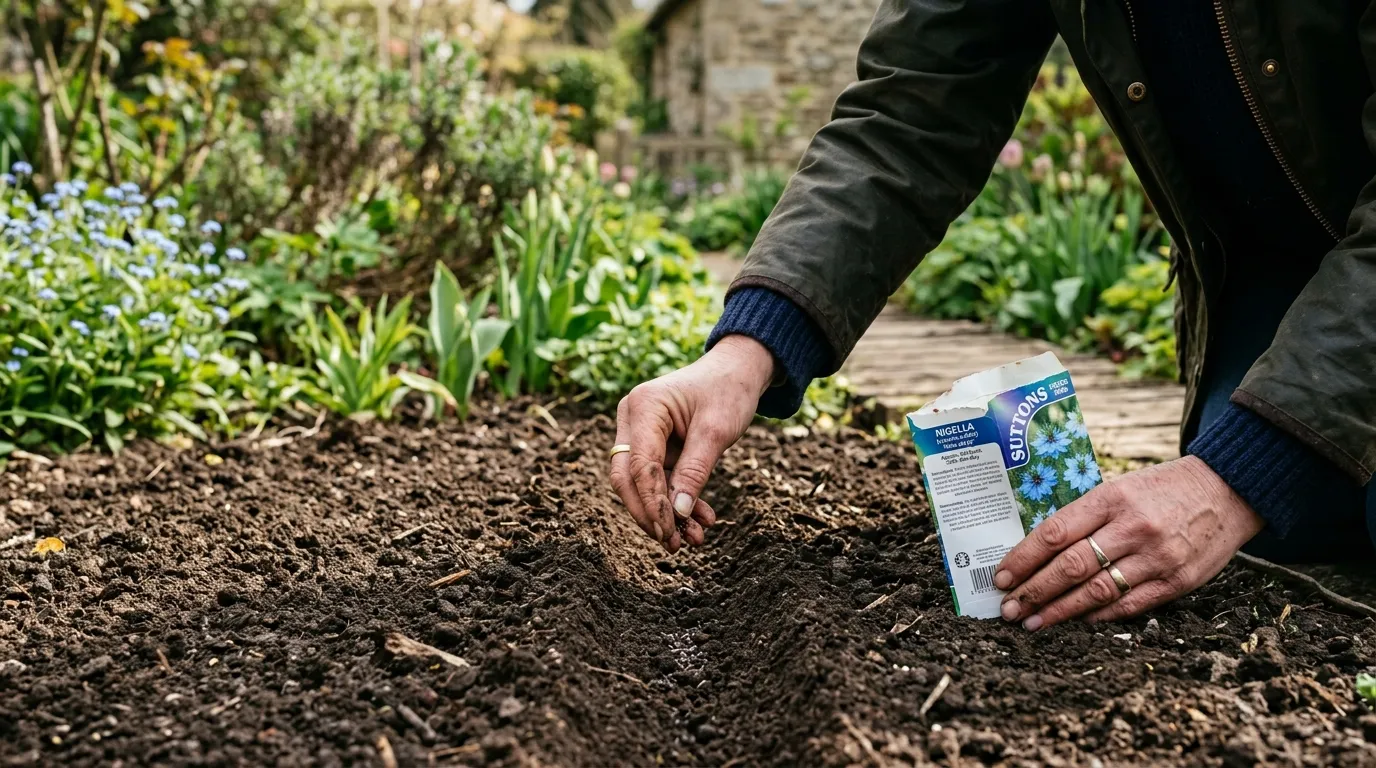
Hardy annual seeds sown direct into raked soil in March. No pots, no propagator, no windowsill space needed.
Direct sowing is the defining advantage of hardy annuals — no heated propagator or indoor space required.
Soil preparation
Hardy annuals perform best in poor to moderate, free-draining soil. This is not a mistake — it is their defining characteristic. Rich soil, heavily manured or fertilised, redirects plant energy into lush foliage and away from flowers. Before sowing:
- Remove weeds thoroughly. Hardy annual seedlings are small and easily swamped by established weeds.
- Rake to a fine tilth — no clods larger than a marble.
- Do not add manure, garden compost, or nitrogen fertiliser. On heavy clay, fork in horticultural grit to improve drainage.
- On very acid soil (below pH 5.5), a light dusting of garden lime helps germination, but most UK garden soils need no amendment.
Sowing method
Straight rows: Sow in short rows 20-30cm apart. This looks regimented at first but allows you to distinguish seedlings from weed seedlings at the critical early stage. Once the plants are growing, they quickly fill in to form a naturalistic mass. Cover seeds to their own depth — roughly 2-3mm for small seeds (nigella, ammi, California poppy) and 5-10mm for larger seeds (cornflower, larkspur, nasturtium).
Broadcast sowing: Scatter seed across a prepared bed and rake in lightly. Harder to weed but produces a more natural cottage garden effect from the start. Best used where you have good weed control already in place.
Thinning: Thin seedlings to the recommended spacing once they reach 5-8cm tall. This is non-negotiable — overcrowded seedlings flower poorly and are more prone to mildew. Spacings: cornflower 30cm, calendula 30cm, nigella 20-25cm, larkspur 20-25cm, ammi 30cm, California poppy 20cm.
Sowing times by region
| Region | First sowing | Second sowing | Third sowing |
|---|---|---|---|
| Southern England | Mid-March | Early May | Mid-June |
| Midlands and Wales | Late March | Mid-May | Late June |
| Northern England | Early April | Late May | Early July |
| Scotland (lowlands) | Mid-April | Early June | Mid-July |
For how to time indoor sowing alongside direct sowing, see our guide to how to sow seeds indoors.
Succession sowing — how to get flowers all summer
A single March sowing of most hardy annuals produces a flush of flowers over 4-6 weeks, then declines. To have flowers continuously from May to October, sow in short rows every 3-4 weeks.
A simple succession plan for a cutting patch:
- Mid-March: Cornflower, nigella, ammi, larkspur (first batch)
- Late April: Cornflower, calendula, ammi (second batch)
- Late May: Calendula, nasturtium, California poppy (third batch)
- Late June: Calendula (fourth batch — extends colour into November)
The flower planting calendar gives a full monthly guide to succession sowing cut flowers alongside perennials and bulbs. Succession sowing is also covered in detail in our succession planting guide.
Hardy annuals for a cottage garden style
The cottage garden look — that romantic, slightly unruly abundance of flowers — is almost entirely built on hardy annuals. They fill gaps between roses and perennials, soften edges, and bridge the colour gap while perennials establish.
Hardy annuals are the backbone of the cottage garden look — inexpensive, generous, and quick to establish from seed.
The key to the cottage garden effect is mixed sowing. Combine five or six species and scatter them together across the same bed rather than sowing in separate blocks. Cornflower, nigella, ammi, larkspur, calendula, and California poppy all have compatible growing requirements and make natural companions. Their heights, flower forms, and colours complement each other without planning.
Good companion species for a cottage garden border include foxgloves for height and structure. Our guide to growing foxgloves explains how to time them alongside first-year hardy annuals for a display that spans May to August without gaps.
Hardy annuals also work well in a cottage garden planting plan that combines them with perennials like salvias, geraniums, and achillea. The annuals fill in the first year while perennials establish, then self-seed to maintain continuity.
For more inspiration on what grows well alongside them, see our guide to plants for shade if you have a north-facing bed with limited options.
Self-seeding hardy annuals — free plants every year
Several hardy annuals are prolific self-seeders. Managed correctly, this means sowing once and enjoying free plants every year thereafter.
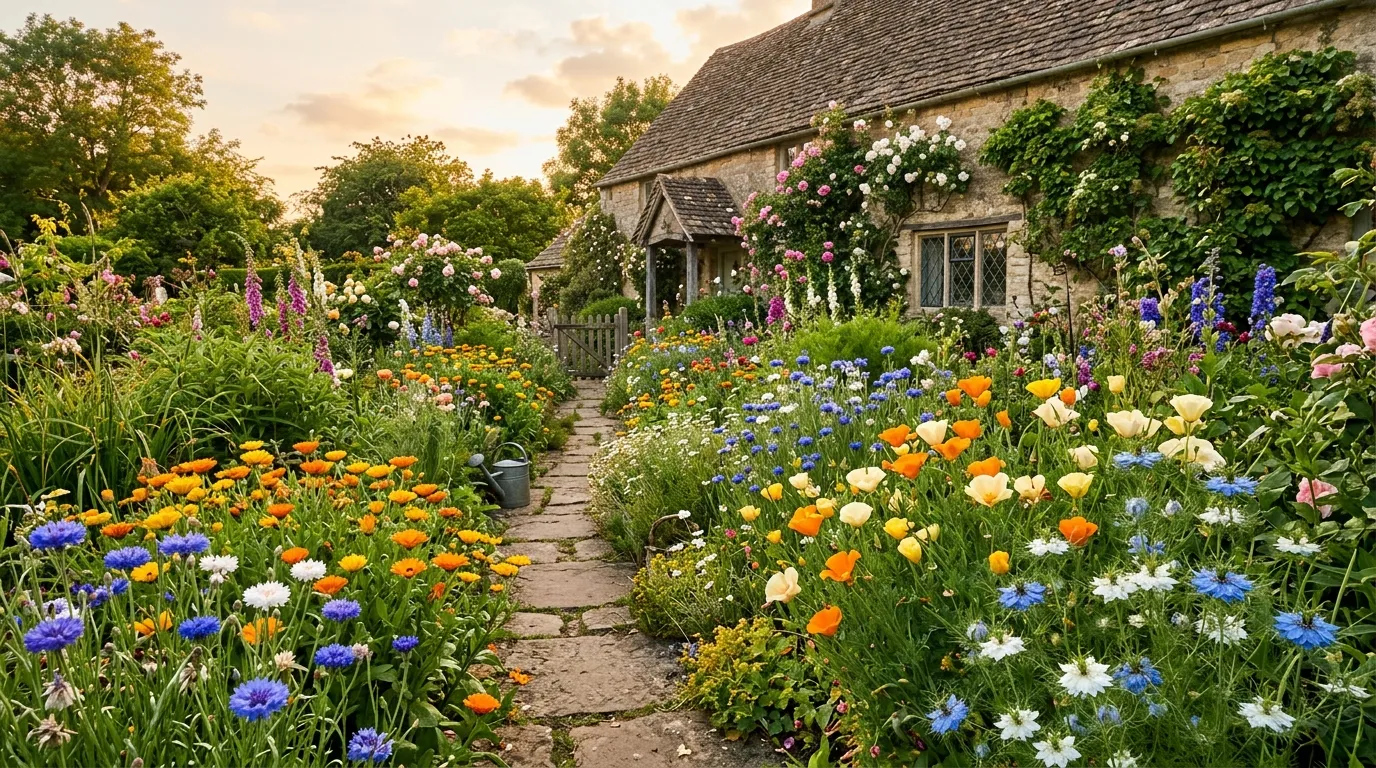
A cottage-style mix of calendula, cornflower, nigella and California poppy from a single March sowing.
Best self-seeders:
- Nigella: The most reliable. Inflated seed pods burst in August-September and scatter hundreds of seeds. Seedlings appear in March and flower earlier than spring-sown plants.
- Calendula: Self-seeds readily. Deadhead to prevent seeding in unwanted spots, or allow to spread across gravel and paving cracks where it looks naturalistic.
- Larkspur: Self-seeds after mild winters. An autumn self-seeded larkspur overwinters as a small rosette and flowers 3-4 weeks earlier than a March-sown plant.
- California poppy: Aggressively self-seeding in light, free-draining soil. Virtually permanent once established in the right conditions.
- Ammi: Less reliable, but does self-seed in mild areas.
Managing self-seeders: Do not cultivate beds deeply in autumn — this buries seeds beyond germination depth. A light surface rake is all that is needed to provide a seedbed. In spring, identify seedlings early (most are distinctive from weed seedlings) and thin rather than transplant. Garden Organic’s advice on green manures and soil management explains why minimal disturbance encourages self-seeding better than annual digging.
Hardy annuals for the cutting garden
Hardy annuals are the cutting garden’s most productive category. For the same space, a cutting row of hardy annuals out-produces almost any other flower type in terms of cut stems per square metre.
Recommended cutting garden layout:
| Row | Species | Spacing | Expected stems per metre of row |
|---|---|---|---|
| 1 | Ammi majus | 25cm | 15-20 stems per cut per metre |
| 2 | Larkspur | 20cm | 12-15 spikes per cut per metre |
| 3 | Cornflower | 25cm | 20-25 stems per cut per metre |
| 4 | Nigella | 20cm | 15-20 stems per cut per metre |
| 5 | Calendula | 25cm | 20-25 stems per cut per metre |
Cut flower tips:
- Cut stems early in the morning before the heat of the day.
- Cut at bud or half-open stage — flowers continue opening in the vase and last longer.
- Recut stems at a sharp angle and place immediately in deep, cold water.
- Change vase water every 2 days and recut stems.
- Cornflower and ammi are the longest-lasting cut flowers from this group — 7-10 days in a clean vase.
Our full cut flowers growing guide covers bed layout, harvest timing, and conditioning in detail.
Common problems with hardy annuals
Slow or failed germination: Usually caused by cold, wet soil. Wait for soil temperature to reach 7C before sowing — a soil thermometer costs around £8 and is one of the most useful tools in seed sowing. Cover freshly sown beds with fleece to warm the soil.
Seedlings eaten overnight: Slugs. They are especially damaging on small seedlings in March and April. Use copper tape, wool pellets, or a nematode drench (Phasmarhabditis hermaphrodita). Avoid metaldehyde-based pellets, which harm birds and hedgehogs.
Leggy, flopping plants: Caused by overcrowding or insufficient light. Thin to correct spacing and provide support with twiggy sticks pushed in around the plants (pea sticks work well). Thin more aggressively than feels natural — a 30cm gap between cornflower plants feels wasteful at seedling stage but is correct.
Powdery mildew on leaves: Common in late summer when air circulation is poor. Remove affected leaves and improve spacing. Hardy annuals at the end of their season are always more mildew-prone — by September, this is acceptable.
Plants flowering and dying quickly: Normal behaviour. Hardy annuals are programmed to flower, set seed, and die — cutting and deadheading delays this but does not stop it. Succession sowing is the only permanent solution to maintaining continuous colour.
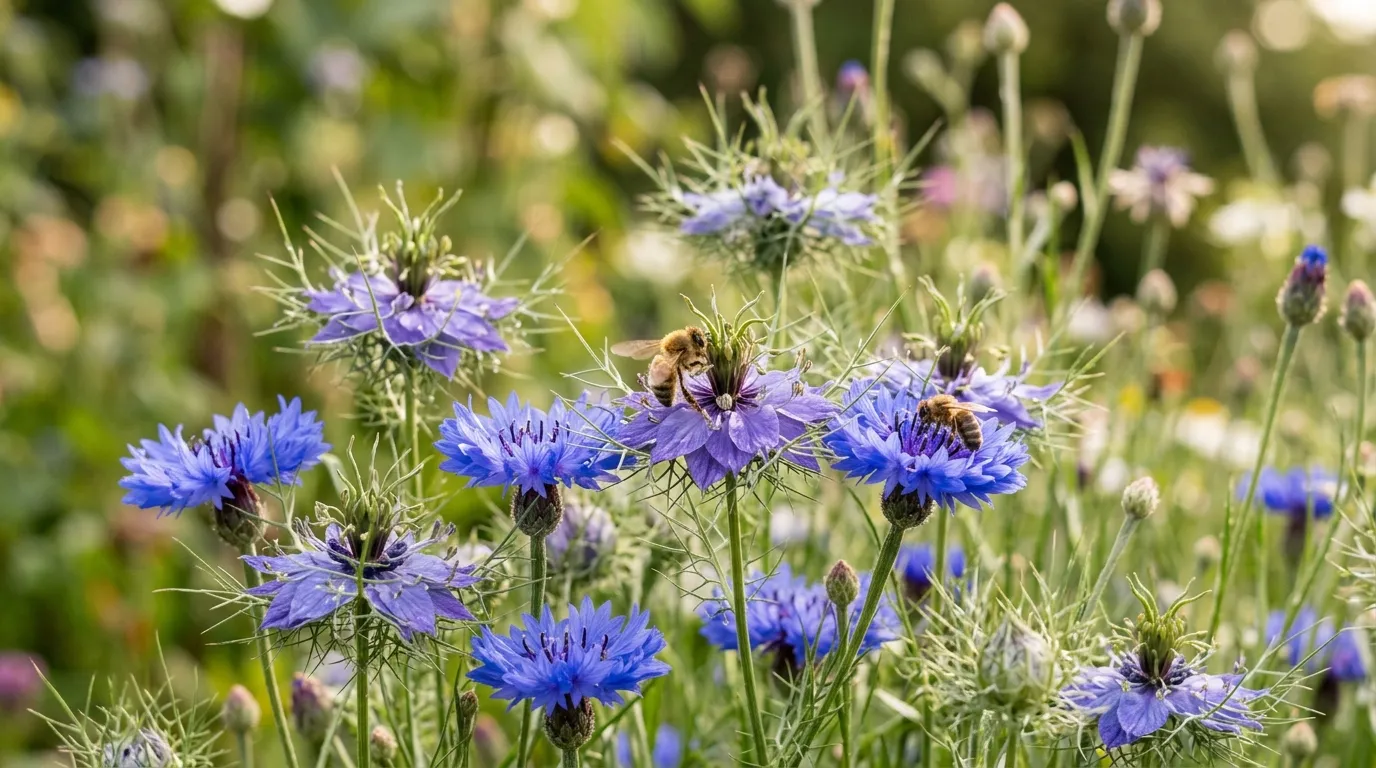
Cornflowers and nigella sown direct in March, flowering by late May. Both self-seed freely for free plants next year.
Related reading
- How to Grow Sweet Peas in the UK — sweet peas are technically half-hardy but share many of the same garden uses as hardy annuals
- How to Grow Sunflowers in the UK — combine sunflowers with hardy annuals for maximum late-summer colour
- Seed Sowing Calendar UK — full monthly guide to sowing times for all flower types
- How to Sow Seeds Indoors — for half-hardy annuals that complement a hardy annual border
- Flower Planting Calendar UK — plan your whole season of flowers from bulbs to annuals to perennials
Frequently asked questions
What is the difference between a hardy and half-hardy annual?
Hardy annuals tolerate frost and are sown outdoors from March. Half-hardy annuals are frost-sensitive and must be started indoors in warmth before the last frost. Cornflower, nigella, and larkspur are hardy annuals; cosmos, zinnia, and French marigolds are half-hardy. The distinction matters because hardy annuals can be direct sown without any heated propagator or windowsill space, making them the most accessible category of annual flower for beginners.
When should I sow hardy annual seeds in the UK?
Sow hardy annuals direct outdoors from mid-March in southern England. In the Midlands, wait until late March; in northern England, early April; in Scotland, mid-April. Soil temperature must be above 7C for reliable germination. A second sowing in May and a third in June gives a succession of flowers from May right through to October frosts.
Do hardy annuals need a propagator or heated greenhouse?
No — hardy annuals are sown direct in the ground or in an unheated cold frame. This is their key advantage over half-hardy annuals like cosmos and zinnias, which need warmth to germinate. A cold frame speeds germination and extends the sowing season by 4-6 weeks, but is not essential. Sowing direct in March on prepared ground is sufficient for excellent results.
Which hardy annuals are best for a cutting garden?
Ammi majus, larkspur, cornflower, and nigella are the top four for cut flowers. Ammi provides filler similar to gypsophila. Larkspur gives tall vertical spires. Cornflowers and nigella add blue and purple tones that are rare in summer flowers. All hold well in a vase for 7-10 days when cut at bud stage early in the morning and placed immediately in cold water.
How do I stop hardy annuals from going to seed too quickly?
Cut frequently — every 3-5 days removes spent flowers before seed develops. Hardy annuals are triggered to set seed once they detect that flowers have been fertilised. Regular cutting forces the plant to produce more blooms. This applies especially to cornflower, calendula, and ammi. Deadheading by hand (removing the spent flower head to the next bud) works equally well if you are not cutting for the vase.
Which hardy annuals self-seed most reliably?
Nigella, calendula, larkspur, and California poppy self-seed most prolifically in UK gardens. Leave a few plants uncut in late summer to shed seed, then rake the bare soil lightly in autumn. Seedlings appear in March and flower earlier than spring-sown plants — self-seeded nigella and larkspur are typically 2-3 weeks ahead of a March direct sowing.
Can I grow hardy annuals in containers?
Yes — calendula, cornflower, and nasturtium do well in large containers (30cm-plus diameter). Larkspur, ammi, and nigella develop deep roots and do less well in pots. Use peat-free multipurpose compost, water consistently (containers dry out faster than border soil), and deadhead every few days. Avoid feeding with high-nitrogen fertiliser, which reduces flowering at the expense of foliage.
Lawrie has been gardening in the West Midlands for over 30 years. He grows his own veg using no-dig methods, keeps a wildlife-friendly garden, and writes practical advice based on real UK growing conditions.