10 Easiest Flowers to Grow from Seed UK
The 10 easiest flowers to grow from seed in the UK — sunflowers to nigella. Sowing times, germination, and spacing from a gardener with 12 years of trials.
Key takeaways
- All 10 flowers can be grown from a single packet costing under £3 — seed is 90% cheaper than plug plants
- Eight of the 10 can be direct sown outdoors from March (cornflowers, calendula, nigella, poppies) or May (nasturtiums, cosmos, marigolds, zinnias)
- Sunflowers and sweet peas need individual pots — they resent root disturbance from module trays
- Nasturtiums and calendula actively prefer poor soil — feeding reduces flower numbers
- Deadheading every 7-10 days extends flowering from June to the first frosts for all 10 species
The easiest flowers to grow from seed in the UK reward you with months of colour from a £2 packet and a patch of bare soil. These are not fussy plants — most actually prefer poor conditions over a cosseted border.
I’ve grown all 10 of these on heavy West Midlands clay since 2014, comparing direct-sown plants against indoor starts, recording germination times and flowering windows across a dozen growing seasons. This guide gives you the numbers that matter: sowing dates, germination times, spacing, and why each one earns its place on the easiest list. For a full month-by-month planting schedule, see our seed sowing calendar.
The 10 easiest flowers to grow from seed: comparison table
| Flower | Sow indoors | Direct sow outdoors | Germination | Flowering period | Height | Difficulty |
|---|---|---|---|---|---|---|
| Sunflowers | Mar–Apr | Apr–Jun | 7–14 days | Jul–Sep | 60cm–3m | Very easy |
| Nasturtiums | Not needed | May–Jun | 7–14 days | Jun–Oct | 20–60cm | Very easy |
| Sweet peas | Jan–Mar | Oct–Nov | 10–21 days | Jun–Sep | 1.5–2.5m | Easy |
| Cosmos | Mar–Apr | May–Jun | 7–14 days | Jun–Oct | 60–120cm | Very easy |
| Calendula | Not needed | Mar–May | 5–10 days | Jun–Oct | 30–60cm | Very easy |
| Nigella | Not needed | Mar–May | 7–14 days | Jun–Aug | 40–60cm | Easy |
| Cornflowers | Not needed | Mar–May | 7–14 days | Jun–Sep | 30–90cm | Very easy |
| Poppies | Not needed | Mar–May | 10–21 days | Jun–Aug | 30–90cm | Easy |
| Marigolds | Feb–Apr | May–Jun | 5–7 days | Jun–Oct | 15–60cm | Very easy |
| Zinnias | Apr–May | May–Jun | 5–7 days | Jul–Oct | 30–90cm | Easy |
1. Sunflowers — the crowd-pleaser
Why they’re easy: Giant seeds that children can handle, fast germination, and visible growth from week one.
Sow sunflowers indoors from late March in individual 7.5cm pots — one seed per pot, 2cm deep. They resent root disturbance, so avoid module trays. Germination takes 7-14 days at 20-25C on a warm windowsill. Outdoors, direct sow from late April once soil reaches 10C, 2cm deep and 45cm apart.
Spacing: 45-60cm for tall varieties, 30-45cm for dwarf types. Dwarf varieties like Teddy Bear (RHS AGM) grow to 60-90cm and suit pots from 30cm diameter. Giant Russian and Mongolian types reach 2-3m and need full sun and a sheltered spot.
Care: Water weekly. Stake tall varieties once they pass 1m — push a cane 30cm into the ground beside the stem. Feed with a balanced liquid fertiliser every two weeks from June. No deadheading needed; leave seed heads in autumn to feed goldfinches.
For a dedicated growing guide including varieties and competitions, see our article on how to grow sunflowers in the UK.
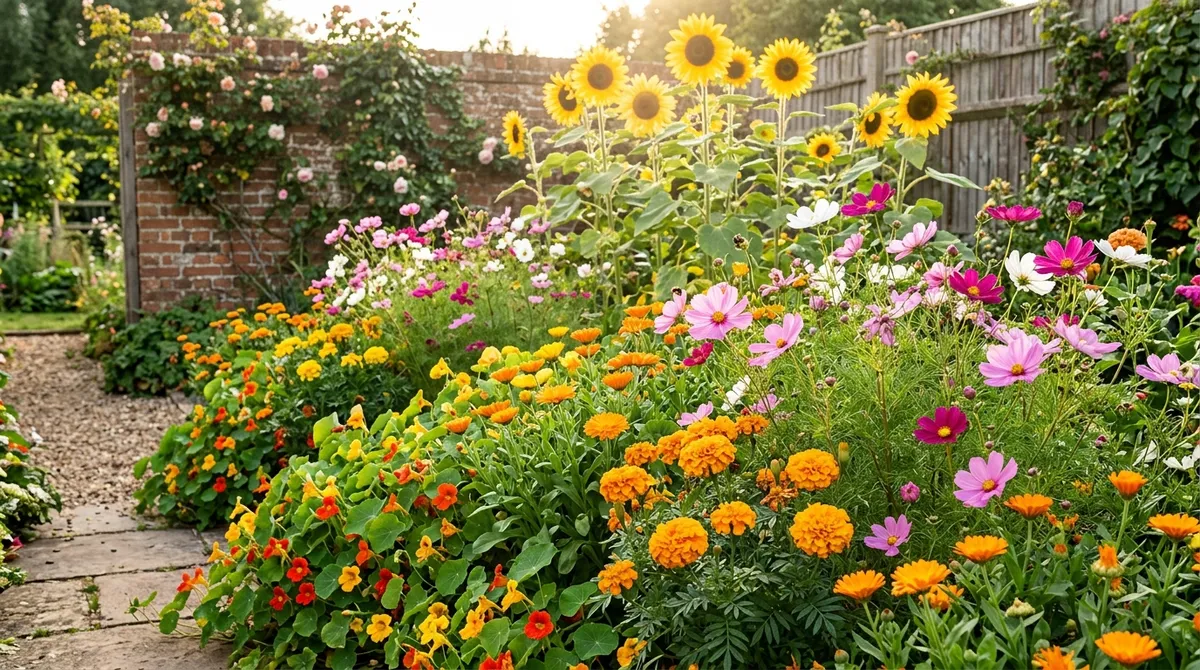
Sunflowers and mixed annuals — all grown from seed sown between March and May
2. Nasturtiums — the true beginner’s flower
Why they’re easy: Large seeds, no heat needed, flowers in 8 weeks, and they actively prefer neglect.
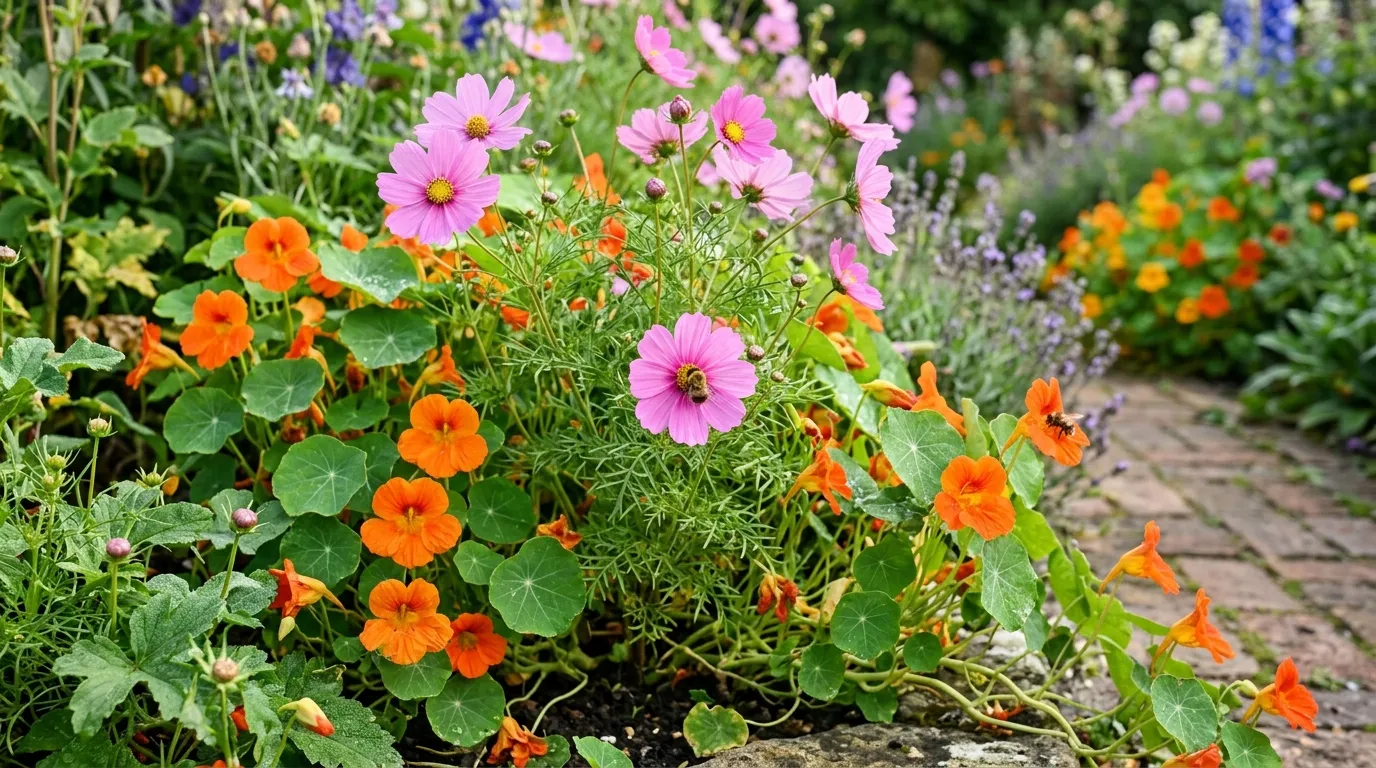
Nasturtiums and cosmos are two of the easiest flowers to grow from seed. Both flower within 8-12 weeks of sowing.
Nasturtiums are the single easiest flower to grow from seed in the UK. Sow direct outdoors from mid-May, 12-15mm deep, once soil has warmed. They do not need starting indoors. Germination takes 7-14 days.
Soil: Poor, free-draining soil gives the most flowers. Rich soil or any feeding produces enormous leaves and very few blooms. If your soil is good, add no compost or fertiliser to the planting spot.
Spacing: 30cm apart for bush types (Alaska, Whirlybird). Climbing and trailing types (Jewel of Africa) need 45cm and something to scramble up — a trellis, fence, or wigwam of canes.
Varieties to try: Alaska Mix (cream and green variegated leaves, very ornamental), Whirlybird (compact, semi-double flowers, good in pots), Black Velvet (deep mahogany, striking).
Edible bonus: Both the flowers and young leaves are edible — peppery, good in salads. The seeds can be pickled as a caper substitute.
Problem to watch: Blackfly loves nasturtiums. They act as a sacrificial trap crop, keeping aphids away from beans and vegetables. Squeeze infested shoots between your fingers or leave them — the plants are tough enough to cope.
3. Sweet peas — fragrant and floriferous
Why they’re easy: Hardy, long-flowering, and the more you pick the more they produce.
Sweet peas are technically more involved than nasturtiums, but the technique is straightforward once you know it. Sow indoors from January to March in individual toilet-roll tubes or 7.5cm pots filled with peat-free seed compost. Sow 12-15mm deep. Keep at 15C — no higher, or germination is erratic. Seeds germinate in 10-21 days.
Pre-soaking: Chip the seed coat lightly with a nail file on one side and soak in water for 24 hours before sowing. This softens the coat and speeds germination by 3-5 days.
Planting out: Harden off in April and plant out in May, 20-25cm apart, at the base of canes, netting, or a wigwam. Sweet peas climb to 1.5-2.5m — provide support from planting day.
Deadheading: This is the key rule. Pick every flower before it sets seed. A single seedpod signals the plant to stop flowering. Pick twice a week in peak season (June to August) and you can have flowers for three months straight.
Soil prep: Dig a deep trench the previous autumn and fill with well-rotted compost. Sweet peas send roots deep and repay soil preparation. Unlike nasturtiums, they appreciate rich conditions.
For full guidance including sowing in autumn for the largest plants, read our guide to how to grow sweet peas in the UK.
4. Cosmos — effortless elegance
Why they’re easy: Sow in May and get daisy-like flowers from July to the first frosts with almost no intervention.
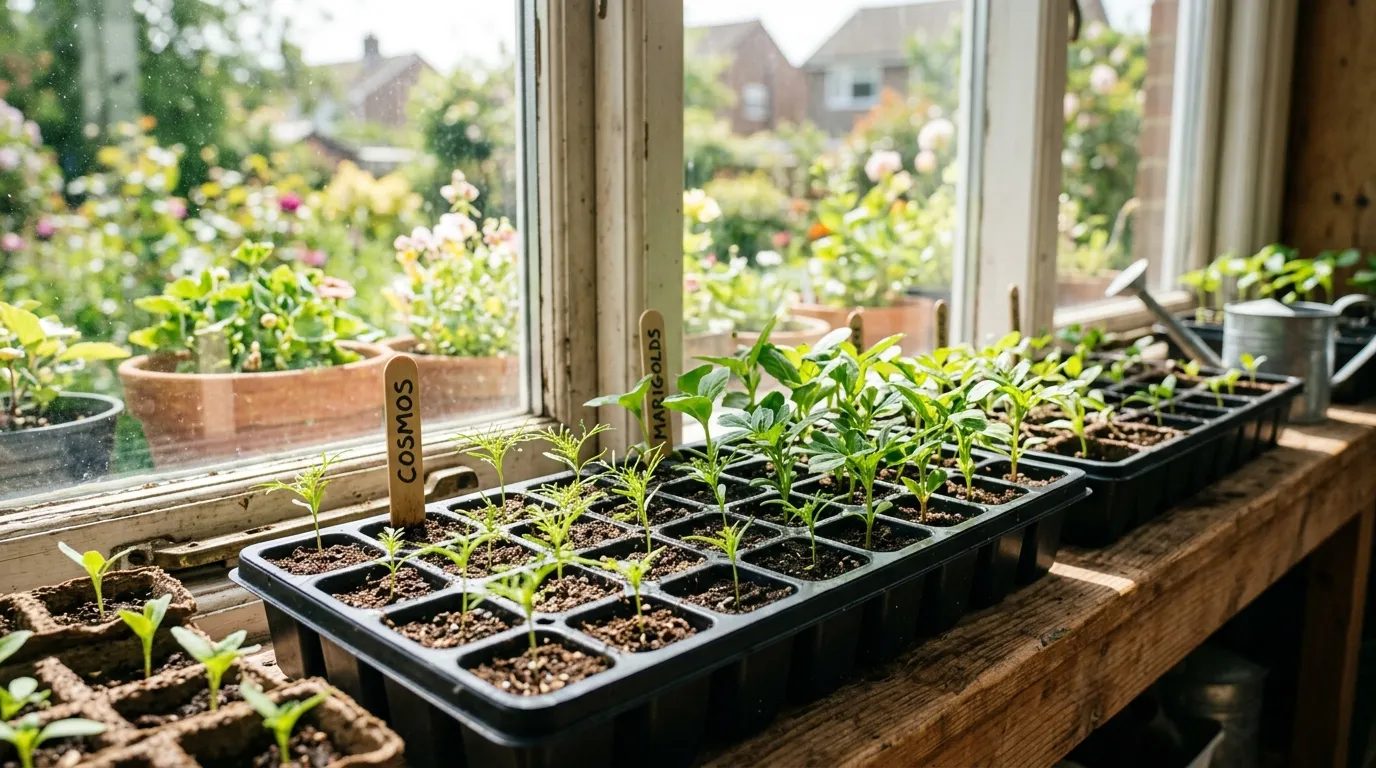
Half-hardy annuals like cosmos and zinnias need starting indoors in April. Use module trays and a bright windowsill.
Cosmos ranks among the most reliable half-hardy annuals for UK gardens. Sow indoors from March in module trays at 18-20C, barely covering seeds with vermiculite. Germination takes 7-14 days. Plant out after the last frost at 30-45cm spacing.
Direct sowing: From mid-May onwards, direct sow in shallow drills outdoors. Thin to 45cm once seedlings reach 10cm.
Soil: The same rule as nasturtiums applies — poor soil gives the most flowers. Avoid feeding with nitrogen-rich fertiliser. On good garden soil, no feeding at all is the right approach.
Deadheading: Snip off spent flowers every 7-10 days to keep new buds coming from June to October.
Varieties: Sensation Mix is the benchmark for cut flowers (90-120cm, pink and white). Purity is pure white and elegant. Cupcakes is compact at 60-75cm and suits large containers.
For a full breakdown of varieties, chocolate cosmos care, and self-seeding tips, see our guide to how to grow cosmos from seed.
5. Calendula (pot marigold) — the unbeatable workhorse
Why they’re easy: Hardy enough to survive light frosts, germinate in 5 days, and flower from June to November without deadheading.
Calendula (Calendula officinalis) is not the same as French or African marigolds — it is fully hardy and can be sown outdoors from March. Scatter seeds across prepared soil, rake in to 6mm depth, and water. Germination takes 5-10 days even in cool conditions.
Spacing: Thin to 30cm apart once seedlings have two true leaves. Calendula self-seeds freely — you may not need to buy seeds again after the first year.
Soil: Tolerates poor, dry soil and light clay. Avoid waterlogged conditions. Full sun gives the best flower production, though partial shade is acceptable.
Varieties: Indian Prince (deep orange with dark centres, striking), Neon (very bright orange), Art Shades (cream, apricot, and orange mix).
Wildlife value: Calendula is excellent for hoverflies and solitary bees. The RHS recommends it as one of the best annual plants for beneficial insects.
Edible: Petals are edible and used to add colour to salads, rice, and baked goods. They were historically used to dye butter and cheese.
Deadheading: Calendula continues flowering without deadheading, but removing spent heads significantly increases flower numbers and extends the season.
6. Nigella (love-in-a-mist) — self-sowing cottage garden staple
Why they’re easy: Direct sow in autumn or spring, germinates reliably, and self-seeds so freely you rarely need to sow again.
Nigella damascena produces intricate blue, white, or pink flowers surrounded by feathery bracts — the “mist” of its common name. Sow direct outdoors from March to May, or in September for earlier spring flowers. Scatter seeds thinly on a prepared surface and rake in lightly. Do not cover deeply — nigella needs light to germinate. Seeds take 7-14 days to germinate.
Spacing: Thin to 25-30cm apart. Nigella resents transplanting so must be direct sown where it will flower.
Soil: Prefers light, free-draining soil in full sun. Tolerates chalk and slightly stony ground. Dislikes heavy clay unless well-amended with grit.
Deadheading vs seed heads: The ornamental seed pods (inflated, striped) are a design feature — many gardeners leave them in place for autumn interest and dried flower arrangements. They also self-seed prolifically, giving free plants year after year.
Varieties: Miss Jekyll Blue is the classic. Miss Jekyll Alba gives white flowers. Persian Jewels Mix covers the full colour range from sky blue to deep pink.
7. Cornflowers — Britain’s beloved blue
Why they’re easy: Hardy annuals that germinate fast in cold soil and produce prolific flowers with minimal attention.
Cornflowers (Centaurea cyanus) are one of the most tolerant flowers on this list. Sow direct outdoors from March onwards — they withstand frosts down to -5C as seedlings and germinate in soil as cold as 7C. Scatter seeds thinly, rake to 6mm, and water. Germination takes 7-14 days.
Spacing: Thin to 30cm apart (dwarf types) or 45cm (tall types). Thinning is important — crowded plants produce fewer flowers and are more prone to mildew.
Height: Dwarf varieties like Blue Boy grow to 30-45cm. Traditional tall types reach 60-90cm and may need light support with brushwood stakes.
Deadheading: Pick flowers every 7-10 days to prolong flowering from June to September. Cornflowers set seed quickly once flowers fade — regular deadheading is the difference between 6 weeks and 16 weeks of colour.
Varieties: Blue Boy is the classic. Black Ball (very dark maroon-burgundy) is striking in arrangements. Frosted Queen gives a soft mix of pale colours.
Wildlife: Cornflowers are excellent for bumblebees and are an RHS-recommended pollinator plant.
8. Poppies (Shirley and California) — scatter and walk away
Why they’re easy: Direct sow in any season, need no thinning to exact spacings, and grow vigorously even in thin soil.
Shirley poppies (Papaver rhoeas) and California poppies (Eschscholzia californica) have different growing requirements but share one key trait — they must be direct sown where they will flower. Both hate root disturbance and transplanting.
Shirley poppies (Papaver rhoeas): Sow outdoors from March to May, or in September for earlier flowers. Mix seeds with sand to help distribute them thinly. Rake in to 3mm — very shallow. Germination takes 10-21 days. Thin to 30cm apart. Flowers from June to August. Self-seeds prolifically.
California poppies (Eschscholzia): Sow from March to May in a sunny, dry spot. These thrive in the poorest, most free-draining soil you have — even gravel. Germination takes 14-21 days. Thin to 15cm. Flowers from June to October in shades of orange, yellow, cream, and red. Extremely drought-tolerant once established.
Deadheading: Shirley poppies flower over a short period — remove spent heads to trigger a second flush. California poppies self-deadhead but benefit from cutting back after first flowering to encourage a second wave.
9. Marigolds (French and African) — reliable and pest-repelling
Why they’re easy: Fast germination, long flowering season, and a natural deterrent to whitefly and aphids.
French marigolds (Tagetes patula) and African marigolds (Tagetes erecta) are among the most widely grown annuals in the UK. Sow indoors from February to April at 18-21C in module trays. Germination takes just 5-7 days — the fastest on this list alongside zinnias.
Outdoor sowing: Direct sow from mid-May once frosts have passed, 6mm deep. Thin to 20-30cm (French types) or 30-45cm (African types).
Height: French marigolds are compact at 15-30cm, ideal for edging. African marigolds are taller at 45-90cm.
Deadheading: Remove spent flowers regularly — marigolds flower continuously from June to the first frosts when deadheaded, but slow significantly if left to set seed.
Companion planting: Plant French marigolds near tomatoes, peppers, or beans. Their roots exude a substance that deters nematodes in the soil, and the flowers attract aphid predators such as hoverflies. This is one of the best-evidenced companion planting relationships in UK vegetable growing.
Varieties: Naughty Marietta (French, yellow with dark centre, RHS AGM), Vanilla (African, cream, unusual), Zenith Orange (African, large double flowers on strong stems).
Starting seeds indoors: module trays of marigolds and cosmos ready to harden off in late April
10. Zinnias — maximum colour for minimum effort
Why they’re easy: Germinate in 5-7 days, flower 8-10 weeks from sowing, and tolerate summer heat that slows other annuals.
Zinnias (Zinnia elegans) are a half-hardy annual that needs warmth to perform well. In UK conditions, start indoors from April to early May at 21-24C. Sow 6mm deep in module trays. Germination is rapid at 5-7 days. Do not sow too early — leggy seedlings produced in cold March light do not catch up with May-sown seedlings.
Planting out: Plant after the last frost, 30-45cm apart, in a sunny, sheltered spot. Zinnias need warmth and dislike cold winds — a south-facing border or sheltered patio works well.
Direct sowing: Possible from late May in warmer parts of the UK. In northern England and Scotland, indoor starts are more reliable.
Deadheading: Cut stems regularly for the vase — the more you cut, the more zinnias flower. Each cut stem produces 2-3 new branches. Zinnias are among the best cut flowers for keeping well in a vase (7-14 days).
Varieties: Benary’s Giant Mix gives the largest flowers in the widest colour range. Zahara Series is more compact and weather-resistant. State Fair Mix is classic and very reliable.
Note on UK climate: Zinnias are the one plant on this list that struggles in a wet summer. They are prone to powdery mildew in cool, damp conditions. If your garden is exposed or in Scotland or northern England, choose weather-resistant varieties and improve air circulation by giving plants more space.
How to sow seeds indoors: equipment you actually need
You do not need expensive equipment to grow flowers from seed. Here is what actually makes a difference:
- Seed compost: Purpose-made seed compost is finer and lower in nutrients than multipurpose. Seeds germinate better in it. A 10-litre bag costs around £4 and does dozens of sowings.
- Module trays: Use modules rather than large flat trays. Each seedling gets its own root space, which reduces transplant shock. Recycled yoghurt pots with drainage holes punched in the base work just as well.
- Warmth: A warm windowsill (18-20C) is sufficient for most of the plants on this list. A propagator lid with bottom heat speeds things up by 3-5 days but is not essential.
- Labels: Always label. Seeds look identical as seedlings. A permanent marker on cut-down plastic milk bottle strips lasts the season.
- Watering can with a fine rose: Overhead watering with a full-flow tap knocks seedlings flat. A fine rose attachment is the single most useful piece of kit for seed sowing.
For a step-by-step method covering compost, depth, temperature, and transplanting, see our full guide to how to sow seeds indoors.
Sowing outdoors: the direct sowing method
Eight of the 10 flowers in this guide can go directly into the ground. The principle is the same for all of them:
- Prepare the soil: Rake to a fine, crumbly tilth. Remove large stones and clods. The seeds are small — they need fine contact with the soil to germinate.
- Make drills or scatter: Hardy annuals (cornflowers, calendula, nigella, poppies) can be scattered broadcast-style for a naturalistic effect, then raked in. For rows, use a cane to make a shallow drill to the correct depth.
- Sow thinly: Overcrowding is the biggest mistake in direct sowing. Thin the seedlings once they have two true leaves — this step is not optional.
- Water gently: Use a watering can with a fine rose. Avoid washing seeds away with a full-flow hosepipe.
- Label: Mark what you have sown with a label and the date.
- Protect from slugs: Seedlings at the two-leaf stage are vulnerable. Scatter organic slug pellets around the area or use copper tape around pot edges.
For beginners starting their first season, our guide to gardening for beginners in the UK walks through the basics of soil preparation and timing.
Getting children involved
All 10 flowers on this list suit children, but some are particularly good. Sunflowers have large seeds easy for small hands to handle, and fast visible growth. Nasturtiums flower fastest and are edible. Marigolds germinate so quickly (5-7 days) they hold a child’s attention.
For height competitions, sunflowers are the obvious choice — see our dedicated guide to growing sunflowers with children. For a broader set of projects, gardening projects for kids covers seed bombs, wildlife corners, and more.
A West Midlands cottage border in July — all grown from seed sown in April and May, at a total seed cost of under £12
Deadheading: the one task that doubles your flower count
Every flower on this list responds to deadheading. Remove spent blooms before they set seed and the plant redirects energy into producing new flowers. This single task is the difference between 6 weeks and 16 weeks of colour.
How to deadhead: Cut the stem back to the next bud or pair of leaves — do not just pull off the petals. The stem and developing seed case must be removed.
How often: Every 7-10 days in peak season. On busy weeks, a 20-minute pass through a border is enough to keep everything flowering.
When to stop: In September, stop deadheading on a few plants of each species and allow seeds to set. Collect dried seed heads for next year. Many of these flowers — calendula, nigella, cornflowers, poppies — self-seed so freely you may not need to buy seed again.
For a month-by-month cut flower growing guide including which varieties give the best vase life, see our article on how to grow cut flowers.
Common problems and how to fix them
Seeds not germinating: Check the soil temperature, not just the air temperature. Soil in March can be 4-5C even on a warm day — too cold for half-hardy annuals. A cheap soil thermometer costs £3 and removes the guesswork.
Seedlings damping off: Caused by overwatering and poor air circulation. Water from below by standing pots in a tray. Use fresh seed compost each year. Remove the propagator lid as soon as seeds germinate.
Leggy seedlings: Caused by insufficient light. Move to a brighter windowsill or use a grow light. Sowing too early (before late February for most of these plants) gives leggy seedlings that never quite catch up with those sown in March.
Slugs destroying seedlings: The biggest pest threat in a UK spring. Protect young plants with copper tape around pots, or delay planting out until plants are 10cm tall. Biological controls (nematodes, applied from March) are effective in warm, moist soil.
Powdery mildew: Most common on zinnias and cosmos in humid summers. Improve air circulation by thinning crowded plants. Remove badly affected leaves. It rarely kills plants at this stage.
For complete UK seasonal timing across all the flowers in this guide, the flower planting calendar gives a month-by-month overview of what to sow, plant, and deadhead.
Frequently asked questions
What is the easiest flower to grow from seed in the UK?
Nasturtiums are the easiest. Large seeds, no heat required, flowers in 8 weeks from a May sowing. Calendula and cornflowers are close — both germinate in cold soil from March and are fully frost-hardy as seedlings.
When should I sow flower seeds in the UK?
Hardy annuals (cornflowers, calendula, nigella, poppies) sow outdoors from March. Half-hardy annuals (cosmos, marigolds, zinnias, nasturtiums) go outside after the last frost — mid-May in the Midlands, late May in Scotland. Sweet peas sow indoors from January to March. See our seed sowing calendar for monthly timings.
Do I need a greenhouse to grow flowers from seed?
No — eight of the 10 flowers here can be direct sown outdoors. A warm windowsill at 18-20C is sufficient for indoor starts. A propagator lid speeds germination by 3-5 days but is not essential.
How long do annual flowers take to bloom from seed?
Most annual flowers bloom 8-14 weeks after sowing. Nasturtiums are fastest at 8 weeks from a May sowing. Sunflowers take 8-18 weeks depending on variety. Sweet peas take 12-16 weeks from a January indoor sow.
Can I direct sow flower seeds or do I need to start them indoors?
Eight of the 10 flowers here can be direct sown outdoors. Cornflowers, calendula, nigella, and poppies prefer direct sowing — they dislike root disturbance. Only sunflowers and sweet peas benefit significantly from individual pots started indoors.
What flowers grow from seed in poor soil?
Nasturtiums, calendula, cornflowers, nigella, poppies, and cosmos all perform best in poor, free-draining soil. Feeding with nitrogen-rich fertiliser produces leaves at the expense of flowers. On average UK garden soil, no feeding is needed for these species.
How do I stop flower seedlings from damping off?
Water from below by standing pots in a tray rather than overhead watering. Sow thinly so seedlings are not crowded. Use fresh seed compost each year. Remove the propagator lid as soon as seeds germinate to improve air circulation.
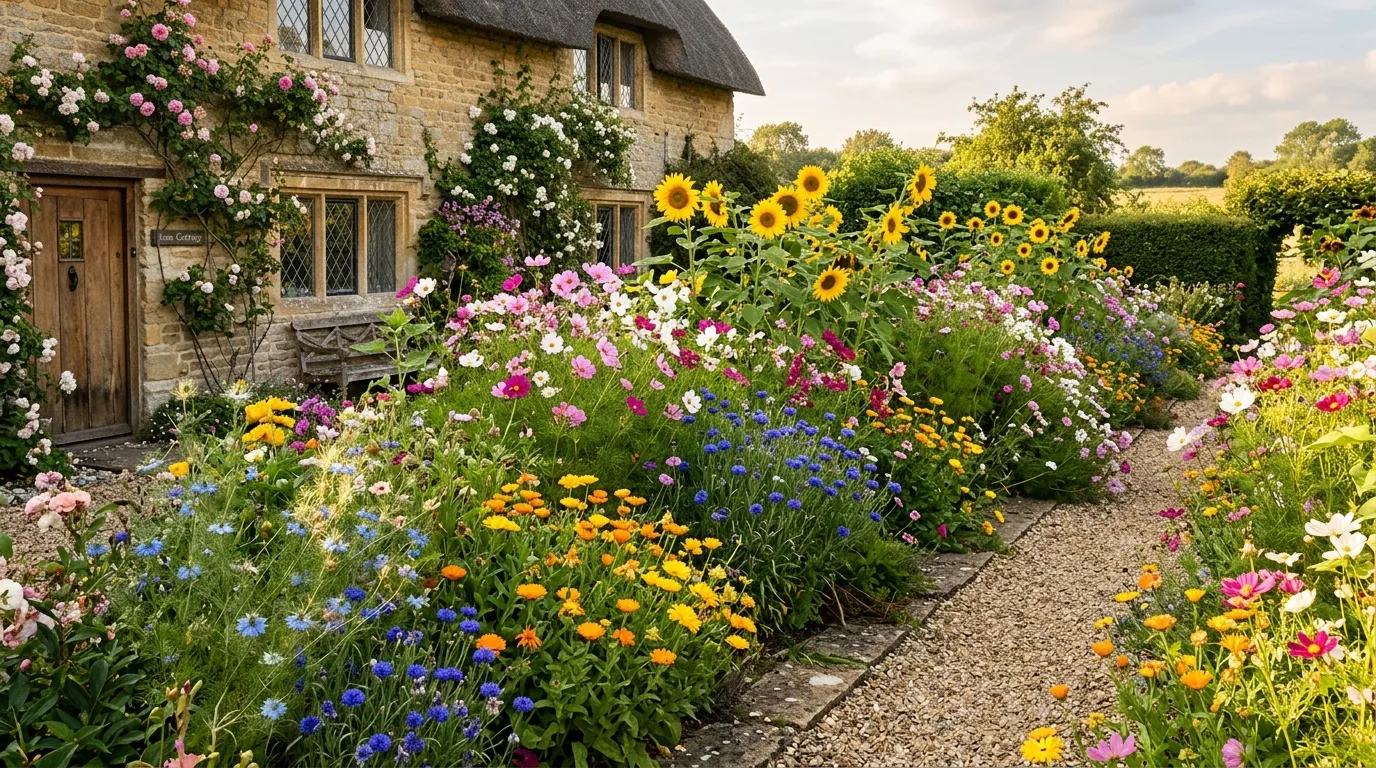
A mix of sunflowers, cosmos, calendula and cornflowers all grown from seed sown in spring. Total cost under five pounds.
Related reading
- Seed sowing calendar UK — month-by-month guide to what to sow from January to December
- How to grow sweet peas — detailed guide to the most fragrant annual climber
- How to grow cosmos from seed — varieties, deadheading, and chocolate cosmos care
- How to grow cut flowers — which of these 10 flowers give the best vase life
- How to sow seeds indoors — step-by-step technique for windowsill and propagator sowing
Lawrie has been gardening in the West Midlands for over 30 years. He grows his own veg using no-dig methods, keeps a wildlife-friendly garden, and writes practical advice based on real UK growing conditions.