Edible Flowers: Growing and Using Them
Grow edible flowers in UK gardens with this hands-on guide. Covers 12 varieties including nasturtiums, violas, calendula, borage and lavender plus recipes.
Key takeaways
- 12 common UK garden flowers are edible, including nasturtiums, violas, calendula, borage, lavender, and roses
- Most edible flowers grow easily from direct-sown seed between March and May
- Never eat flowers treated with pesticides, herbicides, or bought from florists
- Nasturtiums are the easiest edible flower for beginners, producing leaves, flowers, and seed pods
- Crystallised petals, flower ice cubes, and infused vinegars are simple preserving methods
- Edible flowers attract pollinators and add colour, flavour, and nutrition to your garden
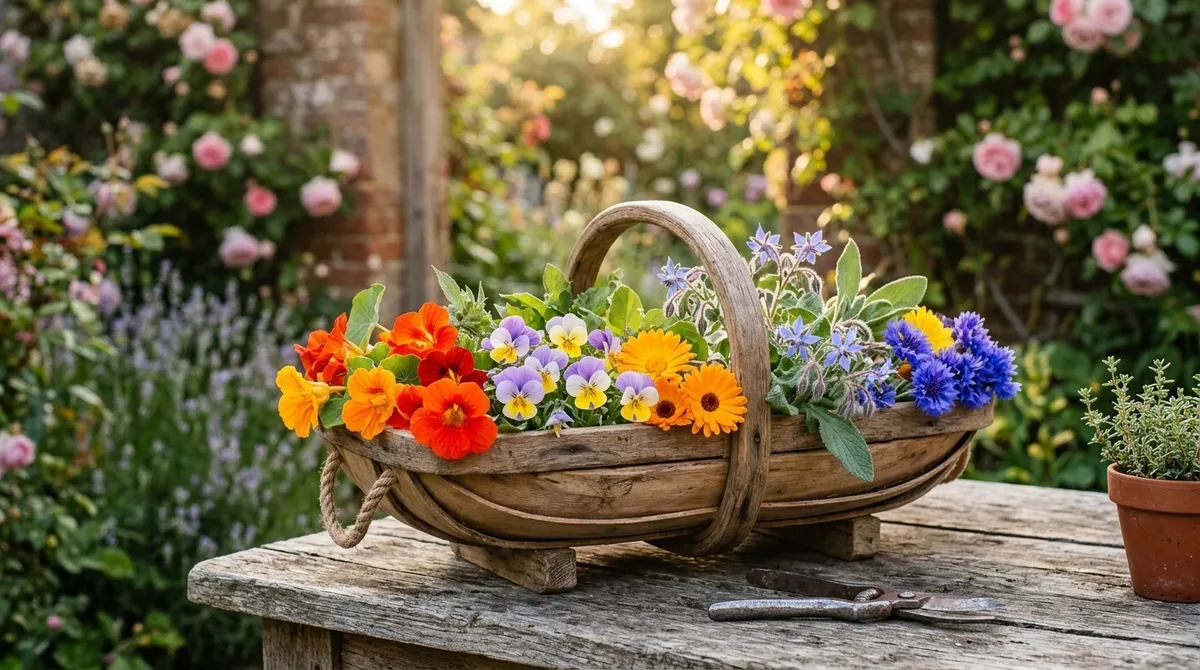
Edible flowers turn an ordinary garden into a source of colour, flavour, and genuine culinary interest. Nasturtium petals add peppery heat to a green salad. Crystallised violas sit on top of a celebration cake. Borage flowers freeze into ice cubes that turn drinks blue. Calendula petals colour rice the way saffron does, at a fraction of the cost.
This is not novelty gardening. Eating flowers has a long history in British cooking, from elderflower cordial to rose petal jam. The Victorians crystallised violets as a matter of course. Modern chefs have revived the practice, and home growers are catching up. This guide covers 12 edible flowers you can grow in a UK garden, how to use them in the kitchen, and the safety rules you need to follow. For more on growing food at home, see our garden-to-table growing guide.
-->Which flowers can you eat?
Not every garden flower is safe. Some are toxic. Others taste of nothing. The list below covers 12 flowers that are genuinely worth growing for the plate as well as the border. All are easy to grow in UK conditions and widely available as seed.
The golden rule: never eat a flower unless you are certain of its identity. Never eat flowers from florists, garden centres, or roadsides. These are treated with pesticides, fungicides, and preservatives not approved for food crops. Grow your own or source from suppliers who sell specifically for eating. The RHS edible flowers guide lists safe species and growing advice.
If you already grow herbs, you may be eating flowers without realising it. Chive blossoms, basil flowers, and coriander flowers are all edible and full of flavour.
Edible flower comparison table
This table compares the 12 best edible flowers for UK gardens by flavour, difficulty, bloom period, and kitchen uses.
| Flower | Flavour | Difficulty | Bloom Period | Best Uses |
|---|---|---|---|---|
| Nasturtium | Peppery, watercress-like | Very easy | June - October | Salads, sandwiches, pickled seeds |
| Viola / Pansy | Mild, slightly sweet | Easy | March - November | Cake decoration, salads, crystallising |
| Calendula | Tangy, slightly bitter | Very easy | June - October | Rice colouring, soups, salads |
| Borage | Cool, cucumber-like | Easy | June - September | Ice cubes, drinks, salads |
| Lavender | Floral, intense, honeyed | Easy | June - August | Baking, sugar, shortbread |
| Rose | Fragrant, floral, sweet | Moderate | June - September | Jam, Turkish delight, rosewater |
| Courgette flower | Mild, delicate, vegetal | Easy | July - September | Stuffed, battered, tempura |
| Chive flower | Mild onion, sweet | Very easy | May - July | Salads, vinegars, garnish |
| Cornflower | Slightly spicy, clove-like | Easy | June - September | Salads, tea, garnish |
| Elderflower | Fragrant, muscat, honeyed | Easy (wild) | May - June | Cordial, fritters, champagne |
| Sweet violet | Sweet, perfumed, floral | Easy | February - April | Crystallising, syrup, salads |
| Primrose | Mild, slightly sweet | Easy | February - April | Salads, crystallising, tea |
How to grow the best edible flowers
Nasturtiums
The single best edible flower for beginners. Sow seeds directly where you want them to grow from late April. Push each seed 2cm deep into the soil, spacing 30cm apart. They germinate in 10 to 14 days and start flowering within 8 weeks.
Nasturtiums thrive in poor soil. Rich ground produces masses of leaves but few flowers. A sunny spot at the edge of a vegetable patch or along a path is ideal. They trail beautifully over raised bed edges and grow well in containers.
Every part of the plant is edible. The flowers have a peppery bite that works in salads and sandwiches. The round leaves taste like watercress. Green seed pods, pickled in spiced vinegar, are an honest substitute for capers.
Violas and pansies
Violas produce small, jewel-like flowers from March right through to the first hard frost. They tolerate partial shade and cope with heavy clay soil. Sow seed indoors in February, prick out into modules, and plant outdoors from April.
The flavour is mild and slightly sweet, making them ideal for decoration. Freeze individual flowers into ice cube trays for summer drinks. Crystallise them with egg white and caster sugar for cake toppers that last weeks. Press them gently into soft cheese for an impressive starter.
Deadhead regularly to keep them flowering. Cut back leggy plants in midsummer and they flush again within three weeks. Violas self-seed generously, so you rarely need to buy seed after the first year.
-->Calendula (pot marigold)
Calendula has been used in British kitchens since the Middle Ages. The petals colour rice, soups, and stews a deep golden yellow. Dried calendula was called “poor man’s saffron” for good reason. The flavour is tangy with a slight bitterness that works well in savoury dishes.
Sow direct from March to May. Calendula germinates quickly, flowers within 10 weeks, and self-seeds so freely you will have it forever. Deadhead spent blooms and they flower continuously from June to the first frost. Pull individual petals from the flower head before use.
Calendula also has a long history in herbal medicine. The petals contain lutein and beta-carotene. In the garden, they attract hoverflies and other beneficial insects that eat aphids, making them a useful companion plant for vegetables.
Borage
Borage produces star-shaped blue flowers that taste of cool cucumber. They are the classic garnish for a glass of Pimm’s. Freeze individual flowers in ice cube trays and they turn any drink into something worth photographing.
Sow seed directly from April to May. Borage grows fast, reaching 60cm to 90cm tall, and flowers within 8 weeks. It self-seeds freely. One planting gives you borage for years. It thrives in any reasonable soil and tolerates partial shade, though full sun produces the most flowers.
Borage is a powerful pollinator plant. Bees are magnetically drawn to the flowers, which refill with nectar every two minutes. Growing borage near courgettes, beans, and tomatoes improves pollination and fruit set.
Lavender
Lavender flowers add a floral, honeyed intensity to baking, sugar, and shortbread. Use sparingly. Too much tastes soapy. Strip the tiny purple flowers from the stems and fold them into shortbread dough, scone mix, or biscuit batter.
English lavender (Lavandula angustifolia) is best for cooking. The varieties ‘Hidcote’ and ‘Munstead’ have the finest flavour. French and Spanish lavenders (L. stoechas) are more bitter and better left for the border.
Lavender needs full sun and sharply drained soil. It hates sitting in wet ground over winter. Plant it in a sunny cottage garden border or along a gravel path where it can bake. Cut back after flowering to keep plants compact and prevent them becoming woody and bare at the base.
Roses
Not all roses are equally edible. Old-fashioned, heavily scented varieties have the best flavour. Rosa damascena, Rosa gallica, and Rosa rugosa are the traditional choices for rosewater, rose petal jam, and Turkish delight. Modern hybrid teas often smell beautiful but taste of very little.
Pick petals in the morning when the scent is strongest. Trim away the white base of each petal, which is bitter. Use fresh petals in salads or dry them for tea. Rose petal jam uses equal weight petals and sugar with lemon juice. It takes 30 minutes and produces a jar worth giving as a gift.
-->Courgette flowers
If you grow courgettes, you already have a supply of edible flowers. Male flowers (the ones on a long thin stem with no swelling behind them) can be picked without affecting fruit production. Each plant produces many more male flowers than it needs.
Pick courgette flowers in the morning when they are fully open. Stuff them with ricotta and herbs, dip in a light batter, and shallow-fry until golden. This is one of the finest things you can eat from a garden. They are also excellent in tempura or torn into pasta.
Harvest male flowers only until you have a good fruit set. Leave at least two males per plant for pollination. Female flowers are edible too, but picking them means fewer courgettes.
Chive flowers
The purple pompom flowers of chives have a mild, sweet onion flavour. Pull the individual florets apart and scatter them over salads, baked potatoes, or cream cheese. They make a beautiful pink vinegar when steeped in white wine vinegar for two weeks.
Chives flower from May to July. Let some plants bloom for the kitchen and cut others back to encourage a second flush of leaves. The flowers attract bees and hoverflies. In a herb garden, they earn their place twice over.
Cornflowers
Cornflowers produce vivid blue petals with a faintly spicy, clove-like flavour. They dry well and hold their colour, making them a popular addition to herbal tea blends. Scatter fresh petals over salads for a striking contrast against green leaves.
Sow cornflower seeds directly in autumn or early spring. They prefer full sun and well-drained soil. Deadhead regularly for continuous flowering from June to September. The traditional variety ‘Blue Boy’ is the best for eating. Avoid double-flowered cultivars, which have less flavour.
Elderflower
Elderflower cordial is one of the great British drinks. Pick the flat, creamy flower heads in late May and June when they are fully open and fragrant. Avoid heads that have started to brown or smell musty.
The classic cordial recipe uses 20 flower heads, 1.5kg sugar, 1.5 litres of boiling water, and the juice of 2 lemons. Steep for 24 hours, strain, and bottle. It keeps for 3 weeks in the fridge or freezes well. Elderflower fritters, dipped in batter and fried, are another traditional treat worth reviving.
Elder trees grow wild in hedgerows across the UK. If you do not have one, they establish quickly from cuttings and tolerate most soils. You can also find edible plants growing wild in many UK gardens.
Sweet violets and primroses
These two spring flowers bridge the hungry gap before the main edible flower season begins. Sweet violets flower from February to April. Primroses overlap, flowering from February through May. Both are native to British woodlands and thrive in dappled shade.
Sweet violets have a perfumed, floral flavour. Crystallised violets are the classic cake decoration. Violet syrup, made by steeping petals in sugar syrup, turns a delicate blue-purple and flavours cocktails and desserts.
Primrose flowers are mild and slightly sweet. Scatter them fresh over spring salads or use them to decorate cakes. Both plants self-seed in suitable conditions and naturalise well under deciduous trees and shrubs.
Safety rules for eating flowers
Getting this wrong has serious consequences. Some garden flowers are genuinely dangerous. Follow these rules without exception.
Never eat a flower you cannot positively identify. Use a reliable field guide or the RHS website. If in doubt, leave it out.
Never eat flowers treated with pesticides, herbicides, or fungicides. This rules out flowers from florists, supermarkets, and most garden centres. Grow your own from untreated seed, or buy from specialist edible flower suppliers.
Never eat flowers growing beside busy roads. Vehicle exhaust deposits heavy metals on petals and leaves.
Know the dangerous species. Foxglove, monkshood, lily of the valley, daffodil, sweet pea, oleander, and delphinium are all toxic. Buttercups cause mouth irritation. Azaleas and rhododendrons are poisonous. Keep a list of toxic plants if you have children.
Introduce new flowers gradually. Some people have allergies to specific flower families, particularly the daisy family (Asteraceae), which includes calendula, cornflowers, and chamomile. Try a small amount first.
-->Recipes and uses for edible flowers
Flower salads
The simplest use. Pick a handful of mixed petals and scatter over dressed green leaves just before serving. Nasturtiums, violas, calendula petals, and borage flowers make the best combination. Add the flowers after dressing the salad, never before, or they wilt and turn soggy.
A good flower salad dressing is light: olive oil, lemon juice, a touch of honey, and a pinch of salt. Nothing heavy. The flowers should be the star.
Crystallised petals
Crystallised petals transform a simple cake into something special. They work best with violas, rose petals, primroses, and sweet violets.
Method: beat one egg white until slightly frothy. Using a small paintbrush, coat each petal on both sides. Sprinkle with caster sugar, shake off the excess, and place on baking parchment. Dry in a warm airing cupboard or a low oven (50 degrees Celsius) for 2 to 3 hours until crisp. Store between layers of parchment in an airtight tin. They keep for 2 to 4 weeks.
Flower ice cubes
Fill ice cube trays half full with water and freeze. Place one flower face-down on each cube, add more water to cover, and freeze again. The two-stage method traps the flower in the centre rather than floating it to the top.
Borage flowers, violas, and small rose petals work best. Use them in gin and tonics, elderflower cordial, or lemonade. They look impressive and cost nothing.
Infused flower vinegar
Chive flower vinegar is the most useful. Fill a clean glass jar loosely with chive blossoms. Pour over white wine vinegar to cover completely. Seal and leave on a sunny windowsill for 2 weeks. Strain into a clean bottle. The vinegar turns a beautiful pale pink and has a subtle onion flavour. Use it in salad dressings and marinades.
Rose petal vinegar works the same way. Use heavily scented red or pink petals. The result is fragrant and works well in fruit salads and dressings.
Lavender sugar and shortbread
Strip lavender flowers from the stems and mix 2 tablespoons of flowers into 200g of caster sugar. Seal in a jar and leave for a week, shaking daily. The sugar absorbs the floral oil. Sift out the flowers before use. Lavender sugar lifts shortbread, scones, and sponge cakes.
For lavender shortbread, fold 1 tablespoon of fresh lavender flowers into a standard shortbread recipe (200g plain flour, 100g butter, 50g lavender sugar). Press into a tin, score, and bake at 160 degrees Celsius for 25 minutes.
Growing edible flowers in containers
Every edible flower on this list grows happily in pots. If you garden on a patio, balcony, or in a small space, you can still have a productive edible flower garden.
Use pots at least 30cm in diameter with drainage holes. Fill with multipurpose compost mixed with a handful of perlite for drainage. Water regularly in summer. Feed fortnightly with a liquid tomato feed once flowering begins.
A single large pot can hold a nasturtium trailing over the edge, a calendula in the centre, and violas around the base. Place it by the kitchen door and you have an edible flower garden in one container. Check our flower planting calendar for the best sowing times.
How to harvest and store edible flowers
Pick in the morning after the dew has dried but before the midday sun. Flowers are at their freshest and most fragrant at this point.
Use immediately for the best flavour and appearance. Most edible flowers do not store well. If you must keep them, place between damp kitchen paper in a sealed container in the fridge. They last 2 to 3 days at most.
Shake gently before use to dislodge small insects. Avoid washing under running water, which damages delicate petals. Float briefly in cold water if needed.
Dry flowers for longer storage. Calendula petals, lavender, and cornflowers dry well. Spread in a single layer on a tray in a warm, dry room. They take 3 to 5 days to dry completely. Store in airtight glass jars away from light.
For those interested in broader food preservation, our guide to drying and storing herbs covers techniques that work equally well for edible flowers.
Making the most of edible flowers in your garden
Growing edible flowers serves three purposes at once. They feed you, they feed pollinators, and they look beautiful. A patch of nasturtiums attracts hoverflies that eat aphids. Borage brings bees that pollinate your vegetables. Calendula deters whitefly from tomatoes.
Plan your edible flower garden to cover the longest possible season. Sweet violets and primroses start in February. Violas follow from March. The main season of nasturtiums, calendula, borage, cornflowers, and lavender runs from June to September. Late-sown calendula and nasturtiums push into October.
Sow a few seeds every three weeks from March to June for continuous flowering. Let some plants self-seed and you will build a self-sustaining edible flower patch that needs less work each year. A wildflower area, as we describe in our wildflower lawn guide, makes a natural companion to an edible flower bed.
Frequently asked questions
Which garden flowers are safe to eat in the UK?
Nasturtiums, violas, calendula, borage, lavender, roses, cornflowers, and chive flowers are all safe. Always confirm identification with a reliable reference before eating. Never eat flowers from roadsides, florists, or garden centres, as these are typically treated with chemicals not approved for food crops.
Can you eat flowers straight from the garden?
Yes, if they are untreated and correctly identified. Pick flowers in the morning after the dew has dried. Shake gently to remove insects and use the same day for the best flavour. Avoid washing delicate petals under running water as they bruise easily. Instead, float them briefly in cold water and pat dry.
Are nasturtium leaves edible?
Yes, the entire nasturtium plant is edible. Leaves have a peppery, watercress-like flavour and work well in salads and sandwiches. Flowers taste milder and make colourful garnishes. Green seed pods can be pickled in vinegar as a substitute for capers.
How do you crystallise flower petals?
Brush each petal lightly with beaten egg white using a small paintbrush. Sprinkle with caster sugar on both sides. Place on baking parchment and dry in a warm spot or low oven at 50 degrees Celsius for 2 to 3 hours. Store in an airtight container between layers of parchment. Crystallised petals last 2 to 4 weeks.
When should I sow edible flower seeds in the UK?
Sow most edible flowers directly outdoors from late March to May. Nasturtiums, calendula, and cornflowers germinate reliably from direct sowing. Violas and pansies do better started indoors in February and planted out in April. Borage self-seeds freely once established and rarely needs resowing.
Are edible flowers nutritious?
Many edible flowers contain useful levels of vitamins and antioxidants. Nasturtium flowers are high in vitamin C. Calendula petals contain lutein and beta-carotene. Borage flowers provide potassium and calcium. However, you eat small quantities, so they supplement rather than replace vegetables in your diet.
Which flowers should you never eat?
Never eat foxglove, monkshood, lily of the valley, daffodil, sweet pea, or delphinium. These are toxic and potentially fatal. Buttercups, azaleas, and oleander are also poisonous. If you cannot positively identify a flower, do not eat it. The RHS lists toxic plants on their website.
Lawrie has been gardening in the West Midlands for over 30 years. He grows his own veg using no-dig methods, keeps a wildlife-friendly garden, and writes practical advice based on real UK growing conditions.