How to Grow Apple Trees in the UK
Complete UK guide to growing apple trees. Covers rootstocks, pollination groups, best dessert and cooking varieties, planting, pruning, and pest control.
Key takeaways
- Choose rootstock to match your space: M27 for pots (1.5m), M9 for small gardens (2.5m), MM106 for larger plots (4m)
- Most apple varieties need a pollination partner from the same or adjacent flowering group (1-7)
- Plant bare-root trees from November to March, staking for the first 2-3 years
- Prune spur-bearing varieties in winter and tip-bearing varieties in summer for best fruit production
- Thin fruitlets in June after the natural June drop to improve size and prevent biennial bearing
- Harvest from August (Discovery) through to November (Bramley) depending on variety
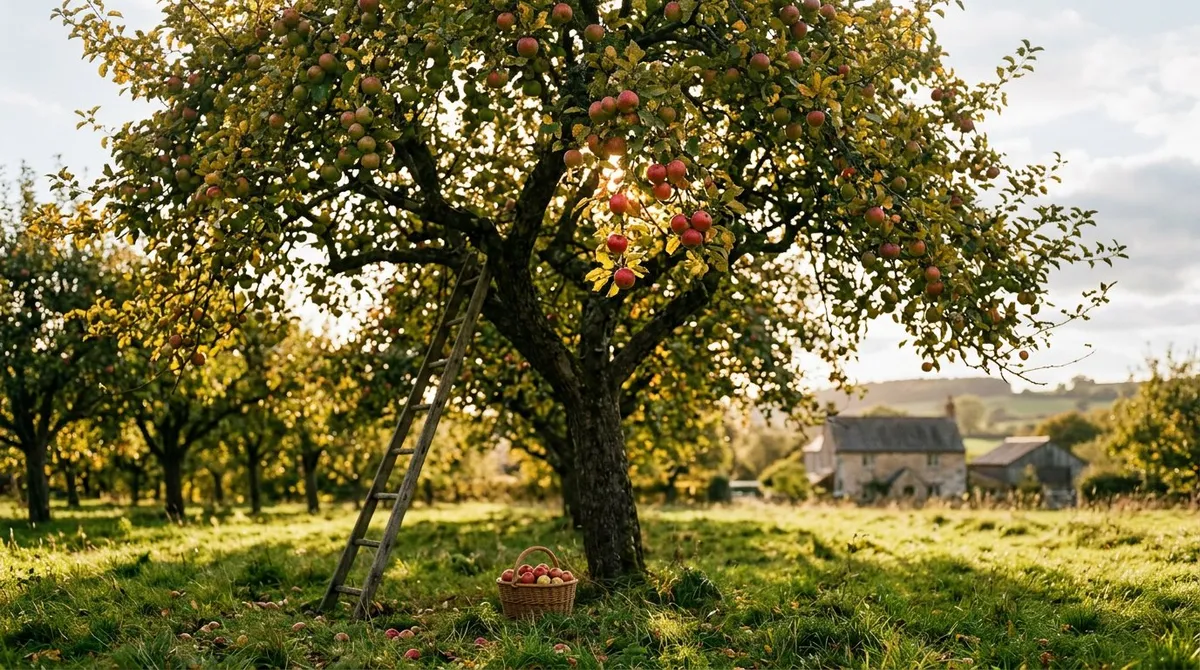
The UK has over 2,000 named apple varieties, more than any other country. From the sharp, aromatic Cox’s Orange Pippin to the giant cooking Bramley’s Seedling, there is an apple tree for every garden, climate, and taste. Even a single dwarf tree on M9 rootstock in a small suburban plot produces 15-20kg of fruit each autumn.
Growing apple trees is simpler than most people expect. Choose the right rootstock for your space, ensure pollination by planting compatible varieties, and give the tree well-drained soil with an annual prune. This guide covers rootstock selection, pollination groups, the best dessert and cooking varieties, planting, pruning, training forms, and dealing with common pests and diseases. If you grow other fruit, see our guides to pear trees, plum trees, and cherry trees.
Which rootstock should I choose?
Rootstock determines the final size of your apple tree. Every apple tree sold in the UK is grafted onto a rootstock that controls height, vigour, and how quickly the tree fruits. The scion (the named variety) sits on top. The rootstock sits below ground. Choosing the wrong rootstock for your space is the most common mistake new fruit growers make.
M27 (very dwarf, 1.5m) produces a tiny tree ideal for large pots and patio containers. Trees fruit within 2 years but yield is small at 5-8kg per tree. They need permanent staking as the root system cannot anchor the tree. Best for small gardens and growing collections of many varieties in limited space.
M9 (dwarf, 2-2.5m) is the most popular rootstock for garden apple trees. It produces a manageable tree that fruits within 2-3 years and yields 15-20kg annually. It needs permanent staking and well-drained, fertile soil. M9 does not tolerate poor, dry, or waterlogged ground.
M26 (semi-dwarf, 3m) suits medium gardens and is more tolerant of average soil than M9. Trees fruit within 3-4 years. Stake for the first 3-4 years, after which the roots establish enough to support the tree. A good compromise between size and yield.
MM106 (semi-vigorous, 3.5-4m) is the standard orchard rootstock. It tolerates a wider range of soils including heavier clay. Trees take 4-5 years to fruit but produce heavy crops of 40-60kg. This is the rootstock for larger gardens and anyone wanting a proper orchard tree.
M25 (vigorous, 5m+) produces a full-size tree suited to orchards, farms, and large rural gardens. Trees take 6-8 years to fruit but live for 50-100+ years and yield over 100kg in maturity. Only choose M25 if you have serious space.
Rootstock comparison table
| Rootstock | Final height | Years to fruit | Annual yield | Staking | Best for |
|---|---|---|---|---|---|
| M27 | 1.5m | 1-2 years | 5-8kg | Permanent | Pots, patios, collections |
| M9 | 2-2.5m | 2-3 years | 15-20kg | Permanent | Small gardens, cordons |
| M26 | 3m | 3-4 years | 20-30kg | First 3-4 years | Medium gardens |
| MM106 | 3.5-4m | 4-5 years | 40-60kg | First 2-3 years | Large gardens, orchards |
| M25 | 5m+ | 6-8 years | 100kg+ | First 2-3 years | Orchards, farms |
Gardener’s tip: Buy a 2-3 year old tree from a specialist nursery rather than a one-year maiden. Older trees are already shaped, crop sooner, and establish faster. The extra cost pays back in earlier harvests.
Why we recommend MM106 as the best all-round rootstock for UK gardens: After 30 years of planting and maintaining apple trees in a range of soil types, MM106 consistently outperforms smaller rootstocks for reliability and long-term yield. It tolerates heavy clay and poorer soils where M9 trees struggle and fail. A Cox on MM106 planted in 2010 in my West Midlands garden now yields 50-60kg annually, needs no permanent staking, and has never suffered the collar rot that kills M9 trees on poorly drained ground.
Understanding pollination groups
Most apple varieties cannot pollinate themselves. They need pollen from a different variety that flowers at the same time. UK apple varieties are sorted into pollination groups numbered 1 to 7, based on when they flower. Group 1 flowers earliest (late April) and Group 7 flowers latest (late May).
For successful pollination, plant at least two varieties from the same group or adjacent groups. A Group 3 variety pollinates well with Groups 2, 3, or 4. Bees carry pollen between the trees, so both must be within 15-20m of each other. In practice, a crab apple or apple tree in a neighbouring garden often does the job.
Triploid varieties have three sets of chromosomes instead of two. They produce heavy crops but their pollen is sterile. A triploid like Bramley’s Seedling cannot pollinate another tree and needs two other compatible varieties nearby to pollinate it. This means planting three trees minimum if one is a triploid.
Self-fertile varieties set fruit with their own pollen. Braeburn, Falstaff, and Greensleeves are the most common self-fertile dessert apples. Even so, they produce 20-30% heavier crops when a partner is present. If you only have room for one tree, choose a self-fertile variety.
The RHS pollination group checker is a useful tool for matching compatible varieties before buying.
Common pollination group pairings
| Group | Example varieties | Flowers |
|---|---|---|
| 1 | Gravenstein, Lord Suffield | Very early (late April) |
| 2 | Beauty of Bath, Egremont Russet, Rev W Wilks | Early (early May) |
| 3 | Cox’s Orange Pippin, Braeburn, Bramley (triploid), James Grieve | Mid-season |
| 4 | Discovery, Greensleeves, Howgate Wonder, Worcester Pearmain | Mid-late |
| 5 | Gascoyne’s Scarlet, King of the Pippins | Late |
| 6-7 | Edward VII, Crawley Beauty | Very late (late May) |
Best dessert apple varieties
Dessert apples are eaten fresh and picked straight from the tree. These five varieties cover the UK season from August to spring storage.
Discovery is the earliest dessert apple, ripening in mid-August. The fruit has bright red skin, crisp white flesh, and a refreshing, slightly strawberry flavour. It does not store well and should be eaten within 2-3 weeks of picking. Pollination Group 4. An excellent variety for children who cannot wait until autumn.
Cox’s Orange Pippin is widely considered the finest-flavoured apple in the world. The complex, aromatic taste develops best in southern and central England where summers are warm enough to ripen the fruit fully. It needs a sheltered spot and is susceptible to scab and mildew. Pollination Group 3. Worth the extra care for flavour unmatched by any supermarket apple.
Braeburn is a modern variety producing large, crisp, sweet-sharp fruit that stores for 3-4 months in a cool garage or shed. It is self-fertile and a heavy, reliable cropper. Pollination Group 3. The closest supermarket apple you can grow at home, but with far better flavour fresh from the tree.
James Grieve is a dual-purpose apple: sharp enough for cooking in August, mellowing to a sweet dessert apple by September. It thrives in Scotland, northern England, and exposed gardens where Cox struggles. Pollination Group 3. One of the most reliable varieties for cooler, wetter climates.
Worcester Pearmain ripens in September with intense strawberry flavour and deep red skin. The fruit does not store long but is excellent eaten fresh. It is a tip-bearing variety, so prune in summer rather than winter. Pollination Group 4. A beautiful tree with blossom that attracts pollinators.
Best cooking apple varieties
Cooking apples are high in acid and break down to a fluffy puree when heated. A single cooking tree provides enough fruit for a year of pies, crumbles, and sauces.
Bramley’s Seedling is the definitive British cooking apple. A mature tree on MM106 produces 100kg or more of large, green fruit that cooks to a sharp, fluffy puree. It is a triploid, so plant two pollination partners alongside it (Groups 2, 3, or 4). The tree is vigorous and long-lived. Bramley accounts for over 90% of UK cooking apple production.
Howgate Wonder produces enormous fruit, often weighing 450g or more. It cooks well and also stores until February. Unlike Bramley, Howgate Wonder is not a triploid, so only one pollination partner is needed. Pollination Group 4. Excellent for baking whole and for autumn harvesting.
Rev W Wilks is a compact cooking apple ideal for smaller gardens. On M26 rootstock, the tree stays under 3m. The fruit cooks to a very sweet puree, needing less added sugar than Bramley. Pollination Group 2. Good disease resistance makes it low-maintenance.
How to plant an apple tree
Plant bare-root apple trees between November and March while the tree is dormant. This gives roots time to establish before spring growth. Container-grown trees can technically go in year-round, but autumn and winter planting gives better results.
Choosing the right spot
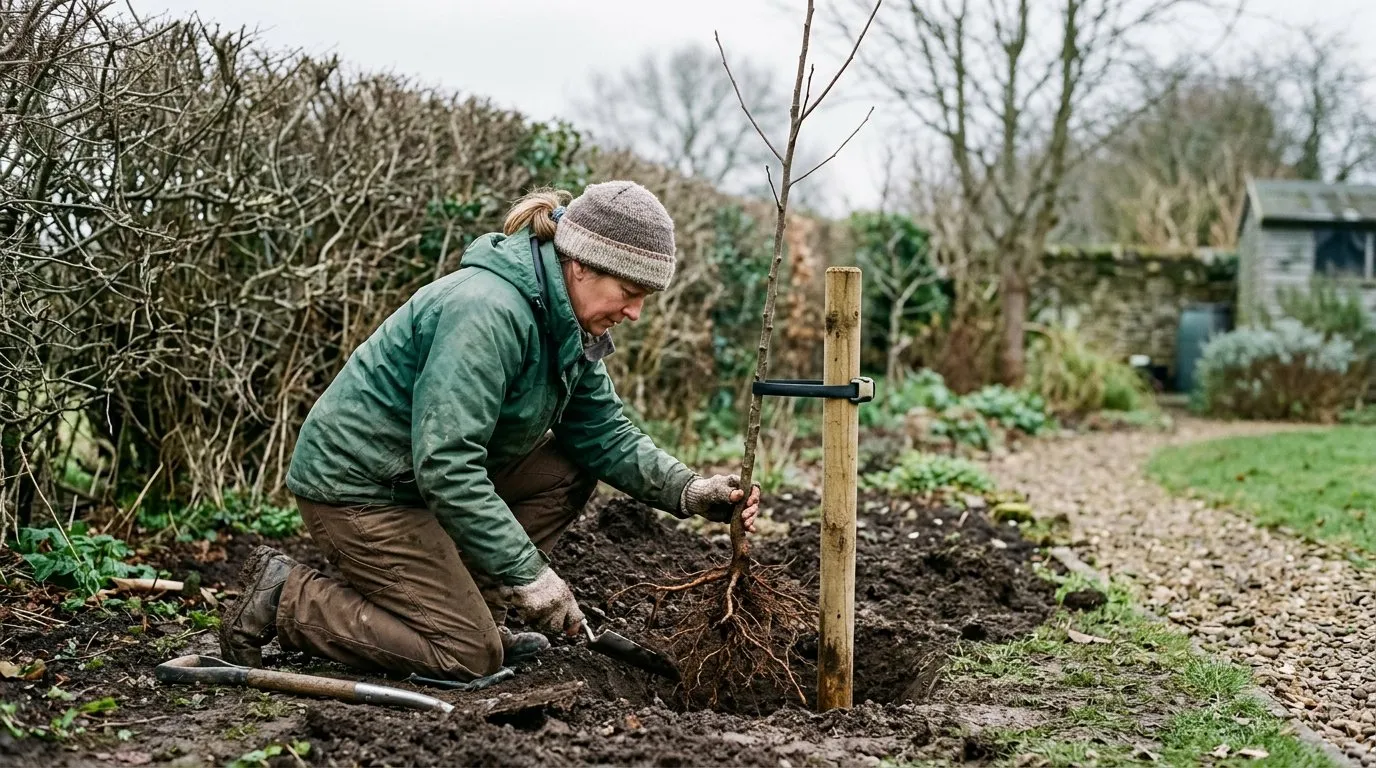 Planting a bare-root apple tree. Stake before backfilling to avoid root damage.
Apple trees need full sun for at least 6 hours daily. They tolerate most soils but grow best in moisture-retentive, well-drained ground with a pH of 6.0-6.5. Avoid frost pockets where cold air collects, as late spring frost kills blossom and prevents fruit set. A sheltered spot away from strong winds protects pollinating bees and prevents fruitlet drop.
Test drainage before planting. Dig a hole 30cm deep, fill with water, and check how quickly it drains. If water sits for more than an hour, the spot is too wet. Improve heavy clay by digging in plenty of organic matter and grit, or consider a raised planting mound.
Planting method
- Dig a hole twice the width of the root spread and the same depth as the nursery soil mark on the trunk
- Drive a stake into the hole before placing the tree, to avoid damaging roots later
- Place the tree in the hole with the graft union 10cm above soil level. Burying the graft allows the scion to root, bypassing the rootstock and producing a full-size tree
- Spread roots evenly in the hole. Do not bend or coil them
- Backfill with the excavated soil mixed with a handful of bone meal
- Firm the soil with your foot, working from the outside in
- Tie the tree to the stake with a rubber tree tie with a spacer to prevent rubbing
- Water thoroughly with 10-15 litres to settle the soil around the roots
- Apply a 5-8cm mulch of garden compost around the base, keeping it 10cm away from the trunk to prevent rot
Staking
Every apple tree needs staking for at least the first 2-3 years. Dwarf trees on M27 and M9 rootstocks need permanent stakes for their entire life, as the small root system never anchors firmly enough. Use a short stake (60cm above ground) angled at 45 degrees into the prevailing wind. Low staking encourages the trunk to thicken and strengthen.
Training forms for apple trees
The way you train your apple tree affects fruit production, ease of picking, and how much space the tree occupies. There are five main training forms used in UK gardens.
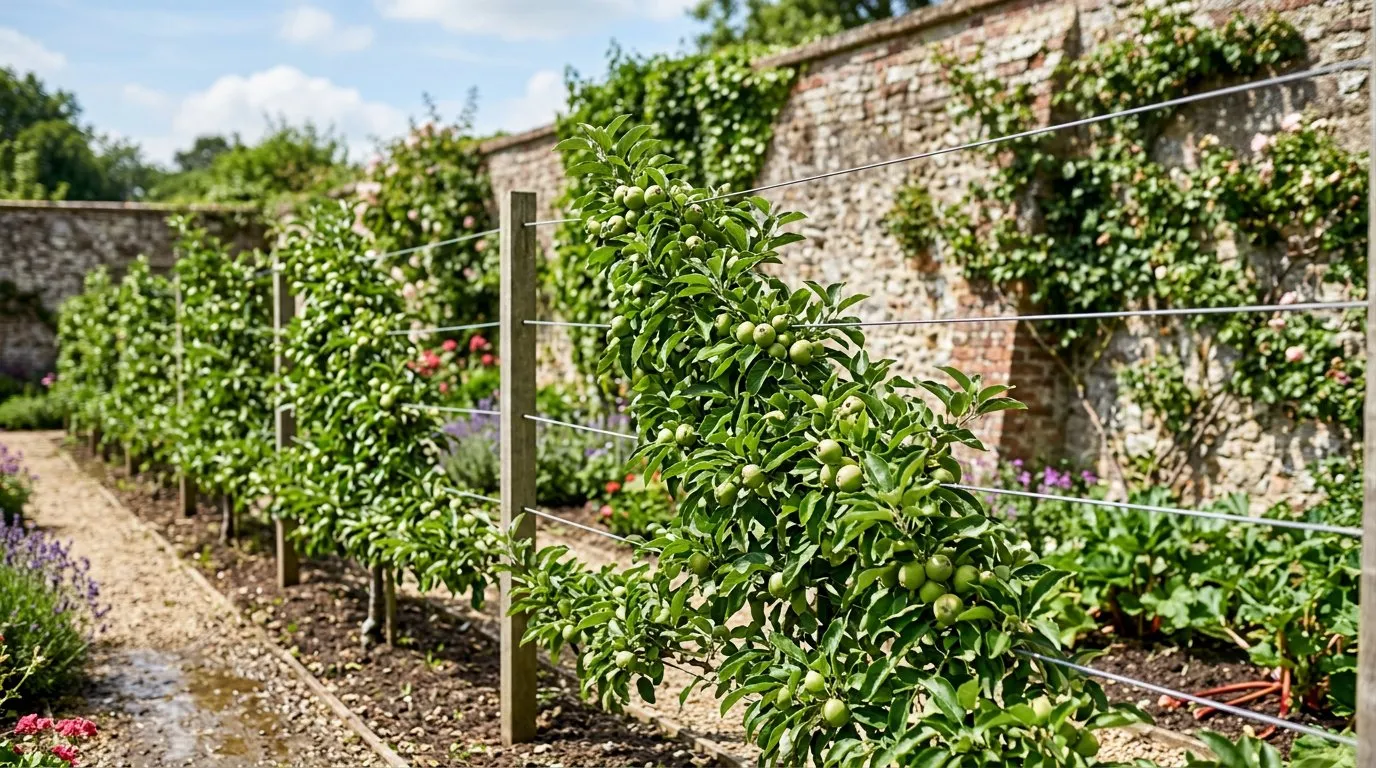 Cordon-trained apple trees maximise fruit production in minimal space.
Bush is the most common garden form. The tree has a short trunk (60-90cm) with an open goblet shape above. Easy to pick and prune. Suits all rootstocks.
Cordon is a single-stem tree grown at a 45-degree angle against a wall or wire framework. Cordons take up very little lateral space, just 75cm between trees. Ideal for small gardens and for growing many varieties in a row. Use M9 or M26 rootstock. See our guide to training fruit trees as espaliers for detailed instructions on wall-trained forms.
Espalier has a central trunk with horizontal tiers of branches spreading left and right. Stunning against a wall or fence. Produces good crops in limited space. Takes 4-5 years to develop the tiered structure. Best on M26 or MM106.
Fan spreads branches in a fan shape against a south or west-facing wall. Less common for apples than for stone fruits like cherries and plums, but works well where wall space is available. Fig trees also suit fan training against warm walls.
Step-over is a single horizontal branch just 30-40cm off the ground, used as a living garden edging. Produces a small crop and looks beautiful along path borders. Use M27 rootstock.
How to prune an apple tree
Pruning keeps the tree healthy, productive, and the right size. The timing and method depend on whether your variety is spur-bearing or tip-bearing.
Spur-bearing varieties (winter pruning)
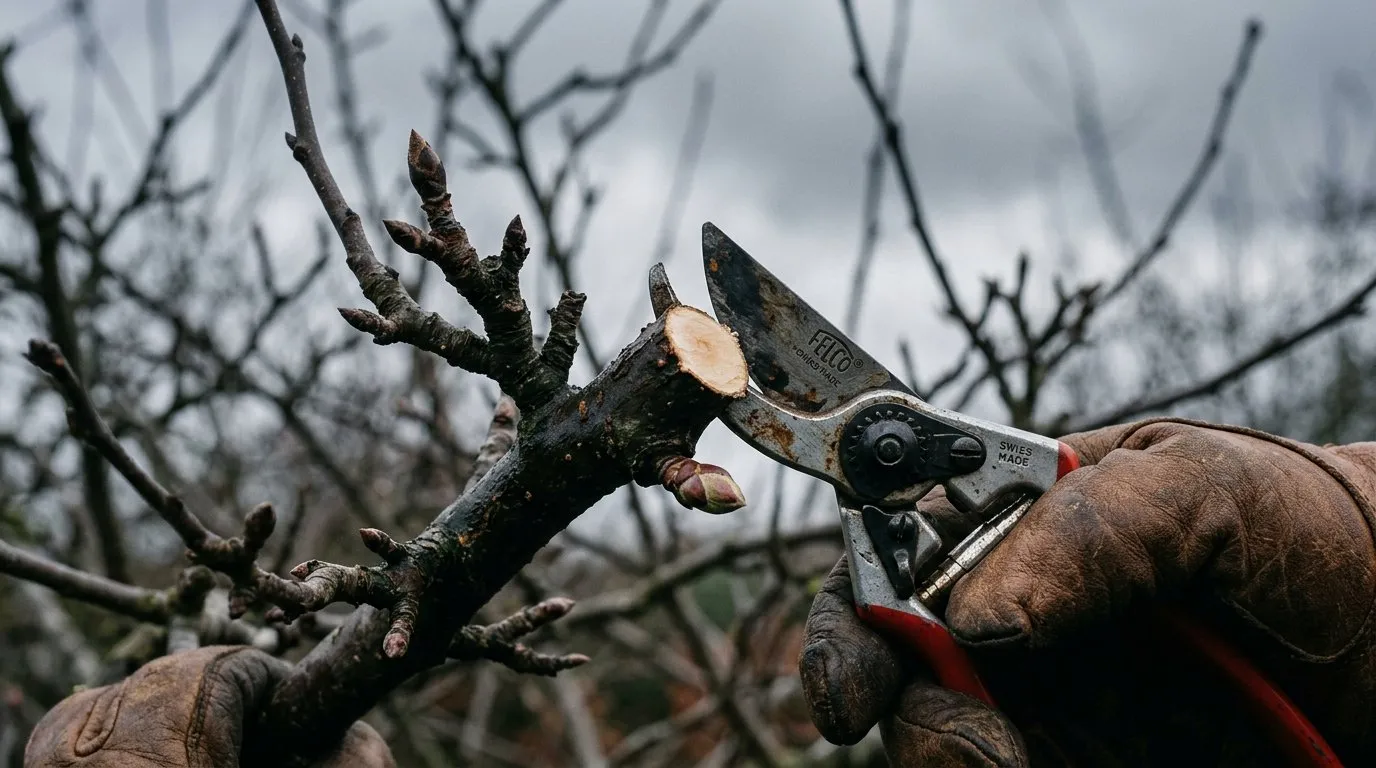 A clean pruning cut above an outward-facing bud on a spur-bearing apple tree.
Most UK apple varieties are spur-bearing. They produce fruit on short spurs along older branches. Prune these trees in winter (November to February) when fully dormant and the branch structure is visible without leaves.
- Remove dead, diseased, and damaged branches first (the three Ds)
- Cut out any branches that cross or rub against each other
- Remove branches growing inward toward the centre of the tree
- Shorten the previous year’s growth by one-third, cutting to an outward-facing bud
- Aim for an open goblet shape that allows light and air into the centre
- Thin overcrowded fruiting spurs by removing the weakest
Use sharp, clean secateurs for shoots up to pencil thickness. Use loppers for branches up to 3cm. Use a pruning saw for anything larger. Disinfect blades between trees to prevent spreading disease.
Tip-bearing varieties (summer pruning)
A few varieties, including Worcester Pearmain and Cornish Gilliflower, produce fruit at the tips of the previous year’s growth. Prune these in late July or August. Remove only the oldest fruiting wood and keep plenty of one-year-old shoot tips intact. Heavy winter pruning on a tip-bearer removes next year’s crop.
Month-by-month apple tree care
| Month | Task |
|---|---|
| January | Winter prune spur-bearing varieties. Check stakes and ties. Apply a winter tree wash to kill overwintering pests. |
| February | Continue winter pruning. Order bare-root trees for late planting. Apply sulphate of potash around the root zone. |
| March | Final month for bare-root planting. Mulch with 5-8cm of compost. Hang pheromone traps for codling moth from late March. |
| April | Blossom appears. Protect from late frost with fleece draped over the canopy. Do not prune. |
| May | Pollination period. Avoid spraying during flowering to protect bees. Water newly planted trees weekly. |
| June | June drop: the tree naturally sheds excess fruitlets. After this, thin remaining clusters to one fruit per 10-15cm of branch. |
| July | Summer prune tip-bearing varieties. Water during dry spells. Apply high-potash feed. Begin training new cordons and espaliers. |
| August | Early varieties ripen (Discovery). Pick when the fruit parts easily from the spur with a gentle upward twist. |
| September | Main harvest month. Pick Cox, Braeburn, Worcester Pearmain. Store sound fruit in single layers in a cool, dark place. |
| October | Late varieties ripen (Bramley, Howgate Wonder). Clear fallen fruit to reduce brown rot. Prepare planting holes for new trees. |
| November | Bare-root planting season begins. Start winter pruning once leaves have fallen. Grease bands around trunks trap winter moth. |
| December | Continue planting and pruning. Inspect stored fruit and remove any showing rot. |
Thinning fruit in June
Apple trees set far more fruitlets than they can ripen to full size. In June, the tree naturally drops a portion of these in a process called the June drop. After this natural thinning, you should thin further by hand.
Remove the smallest, most misshapen, and any damaged fruitlets. Leave one apple per cluster, spaced roughly 10-15cm apart along each branch. Use sharp scissors or simply pinch the stalk between finger and thumb.
Thinning improves the size and flavour of the remaining fruit. It also prevents biennial bearing, where the tree exhausts itself with a massive crop one year and then produces almost nothing the next. Bramley is particularly prone to biennial bearing without proper thinning.
A well-thinned tree on MM106 rootstock produces 40-50 apples of excellent size rather than 200 small, tasteless fruit. Quality beats quantity every time.
Common pests and how to deal with them
Codling moth is the most damaging apple pest. The larvae tunnel into the fruit core, leaving a brown, frass-filled hole. Hang pheromone traps in late March to monitor moth numbers. Apply a biological nematode spray (Steinernema carpocapsae) in September to kill pupating larvae in the soil. Picking up and destroying all fallen fruit reduces the population significantly. Garden Organic’s codling moth guide covers organic control methods in detail.
Apple sawfly larvae bore into fruitlets in June, causing them to drop prematurely. Damage appears as a ribbon-like scar on the skin. Hang white sticky traps at blossom time to catch adult sawflies. Remove and destroy affected fruitlets before larvae pupate in the soil.
Woolly aphid produces white, cotton-like waxy tufts on branches, especially around old pruning cuts and wounds. Colonies cause swollen galls on bark. Paint affected areas with methylated spirit on a stiff brush. Encourage natural predators, especially earwigs and ladybirds. Heavy infestations weaken the tree over several years.
Winter moth caterpillars eat blossom and young leaves in spring. Wrap grease bands around the trunk in October to trap wingless female moths climbing up to lay eggs. This simple, chemical-free method prevents most damage. Replace bands annually.
Common diseases and prevention
Apple scab causes dark, crusty patches on fruit and olive-green spots on leaves. Severely scabbed fruit is unsightly but still edible after peeling. Scab thrives in wet springs. Improve air circulation by pruning for an open canopy. Rake up and remove fallen leaves in autumn to reduce spore carryover. Grow resistant varieties like Discovery and Falstaff where scab is a persistent problem.
Brown rot turns fruit brown with concentric rings of white fungal spores. It enters through wounds, insect damage, or bird pecks. Remove and destroy all affected fruit immediately, including any on the ground. Never leave rotting apples on the tree or compost pile, as spores spread rapidly. Good thinning and careful harvesting reduce entry points.
Powdery mildew coats young leaves and shoot tips with a white powder. It weakens growth and reduces fruiting. Prune out affected shoots in summer. Improve air flow through the canopy. Avoid overhead watering. Cox’s Orange Pippin and some heritage varieties are particularly susceptible.
Canker causes sunken, cracked areas on branches and trunks, sometimes girdling and killing whole branches. Cut out cankered wood back to clean tissue, at least 15cm below the visible infection. Burn the prunings. Canker is worse in wet soils and poorly drained sites. Good drainage at planting time is the best long-term prevention.
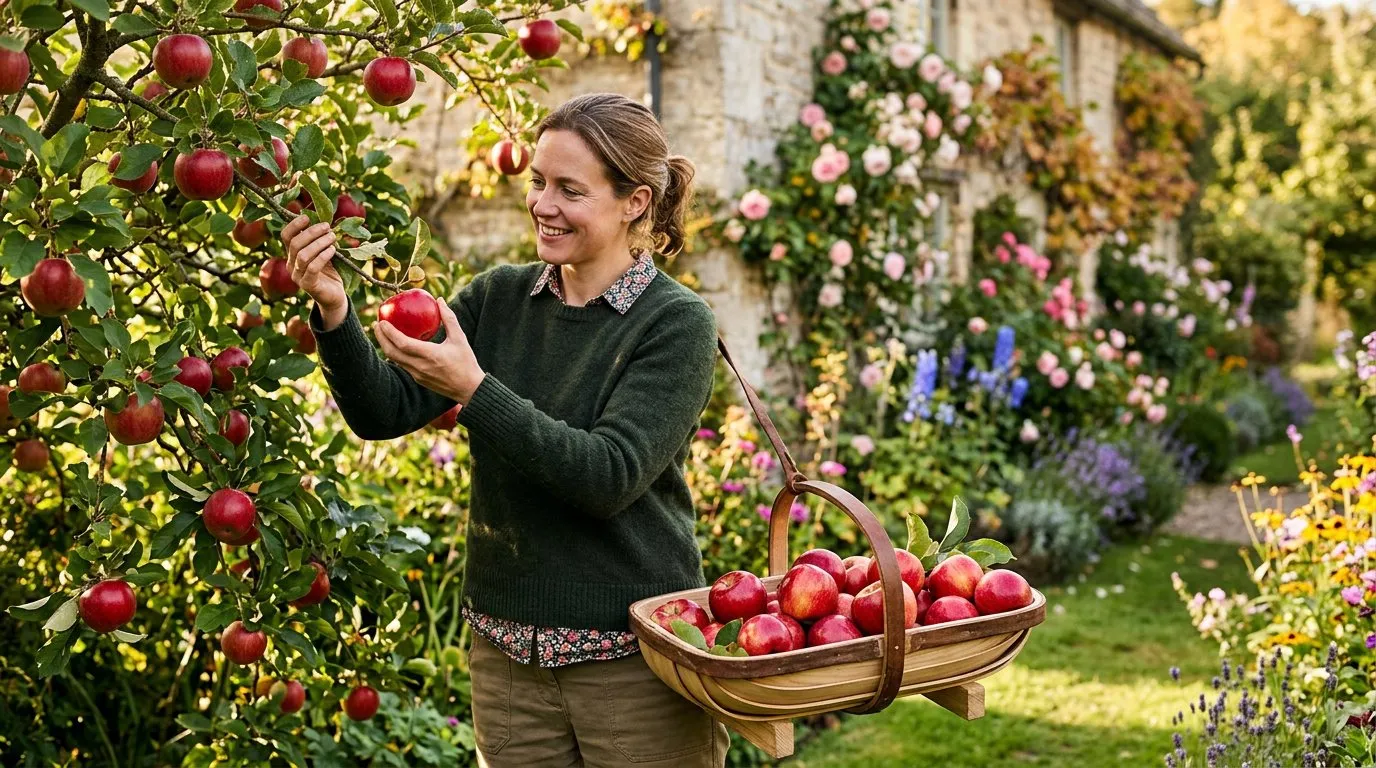 Picking ripe Discovery apples. Lift and twist gently to detach from the spur.
Common mistakes growing apple trees
Choosing the wrong rootstock
A full-size M25 tree in a small suburban garden quickly overwhelms the space, shading everything around it and producing fruit too high to pick. Equally, an M27 tree in poor soil struggles and produces almost nothing. Match the rootstock to your garden size, soil quality, and ambitions.
Ignoring pollination requirements
Planting a single apple variety without a compatible partner nearby results in heavy blossom but no fruit. Before buying, check the pollination group and confirm a suitable partner within 15-20m. If space allows only one tree, choose a self-fertile variety like Braeburn or Greensleeves, or plant a family tree with multiple varieties grafted onto one rootstock.
Burying the graft union
The graft union is the swollen joint 10-15cm up the trunk where the variety meets the rootstock. If buried below soil level, the scion sends out its own roots. The tree then bypasses the dwarfing rootstock and grows to full size. Always check the graft sits well above the final soil surface, especially after mulching.
Pruning at the wrong time
Pruning spur-bearers in summer removes developing fruit buds. Pruning tip-bearers in winter removes the shoot tips that carry next year’s crop. Spring pruning causes excessive sap bleeding through fresh cuts. Know your variety type and prune at the correct time.
Neglecting thinning
Leaving every fruitlet on the tree seems generous but produces small, tasteless apples and triggers biennial bearing. Thin after the June drop to one fruit per 10-15cm. This single task turns crop quality.
Not clearing fallen fruit
Fallen and rotting apples harbour brown rot, codling moth pupae, and other pests. Clear fallen fruit weekly during the harvest season. Add sound windfalls to the compost, but bag and bin any with visible rot or pest damage.
Now you’ve mastered apple trees, read our guide on how to graft fruit trees in the UK to learn how to propagate your own named varieties and convert mature trees to new varieties through grafting.
Frequently asked questions
When is the best time to plant an apple tree in the UK?
Plant bare-root apple trees from November to March. This dormant period gives roots 3-4 months to establish before spring growth starts. Container-grown trees can go in at any time of year, but autumn and winter planting still produces stronger trees. Avoid planting into frozen or waterlogged ground. If your bare-root tree arrives during unsuitable weather, heel it into a temporary trench of moist soil until conditions improve.
Do apple trees need a pollination partner?
Most apple varieties need a different variety nearby for cross-pollination. The partner must be from the same or adjacent flowering group (groups 1-7) and within 15-20m. Triploid varieties like Bramley need two other varieties as their pollen is sterile. Self-fertile varieties including Braeburn, Falstaff, and Greensleeves set fruit alone, but crop 20-30% heavier with a partner.
Which rootstock should I choose for a small garden?
M9 is the best rootstock for small gardens. Trees reach 2-2.5m, fruit within 2-3 years, and yield 15-20kg annually. For patio pots and containers, M27 produces a very compact tree at just 1.5m tall. Both need permanent staking because their root systems stay small. Ensure your soil is fertile and well-drained, as dwarf rootstocks are less tolerant of poor conditions than vigorous ones.
How long before an apple tree produces fruit?
Trees on dwarf rootstocks fruit within 2-3 years of planting. Semi-dwarf M26 trees take 3-4 years. Semi-vigorous MM106 trees need 4-5 years. Full-size M25 trees can take 6-8 years before the first meaningful crop. Buying a 2-3 year old tree from a nursery shortens the wait considerably compared to planting a one-year maiden whip.
Why is my apple tree not fruiting?
The most common cause is poor pollination. Confirm a compatible partner variety flowers nearby at the same time. Late spring frost kills blossom and destroys that year’s crop entirely. Over-feeding with nitrogen (especially from lawn fertiliser running off near the tree) produces leafy growth instead of fruit buds. Biennial bearing affects some varieties, particularly Bramley, where the tree alternates between heavy and light cropping years.
When should I prune an apple tree?
Prune spur-bearing varieties in winter between November and February when the tree is fully dormant. Prune tip-bearing varieties in late July or August to retain the fruiting shoot tips. The aim is an open goblet shape with good light penetration. Remove dead, diseased, and crossing branches first. Then shorten the previous year’s growth by one-third, cutting to an outward-facing bud. Never prune in spring when sap is rising, as cuts bleed heavily and heal slowly.
What are the best apple varieties for the UK?
Cox’s Orange Pippin is the finest-flavoured dessert apple, though it needs a warm, sheltered spot. Discovery ripens earliest in August with a strawberry-like taste. Braeburn is self-fertile and stores for months. James Grieve thrives in cooler northern and Scottish gardens. For cooking, Bramley’s Seedling is unmatched, producing massive crops that cook to a perfect fluffy puree. Worcester Pearmain offers intense flavour and beautiful blossom.
Can I grow an apple tree in a pot?
Yes, use a tree on M27 rootstock in a 40-50 litre container. Fill with loam-based compost like John Innes No 3 for stability and nutrient retention. Water daily in summer and feed weekly with a high-potash liquid fertiliser from April to September. Position in full sun and protect from wind, as pots are top-heavy. Repot every 2-3 years, trimming the outer roots by one-third to keep the tree in the same container.
Lawrie has been gardening in the West Midlands for over 30 years. He grows his own veg using no-dig methods, keeps a wildlife-friendly garden, and writes practical advice based on real UK growing conditions.