How to Grow Kiwi Fruit in the UK
UK guide to growing kiwi fruit outdoors. Covers fuzzy kiwi and hardy kiwi berry varieties, pollination, wall training, and harvesting.
Key takeaways
- Fuzzy kiwi (Hayward) needs a south-facing wall in southern England, while hardy kiwi berries (Issai, Ken's Red) grow across most of the UK
- Most kiwi varieties are dioecious, meaning you need both a male and female plant for fruit — one male pollinates up to eight females
- Self-fertile varieties like Jenny and Issai fruit without a pollination partner, making them ideal for small gardens
- Vines take 3-5 years to produce their first crop but live for 50 years, yielding up to 30kg of fruit per mature plant
- Late spring frosts kill kiwi flowers — protect with fleece in May when temperatures drop below 1C
- Harvest in October before the first hard frost and ripen indoors, as UK-grown kiwis rarely ripen fully on the vine
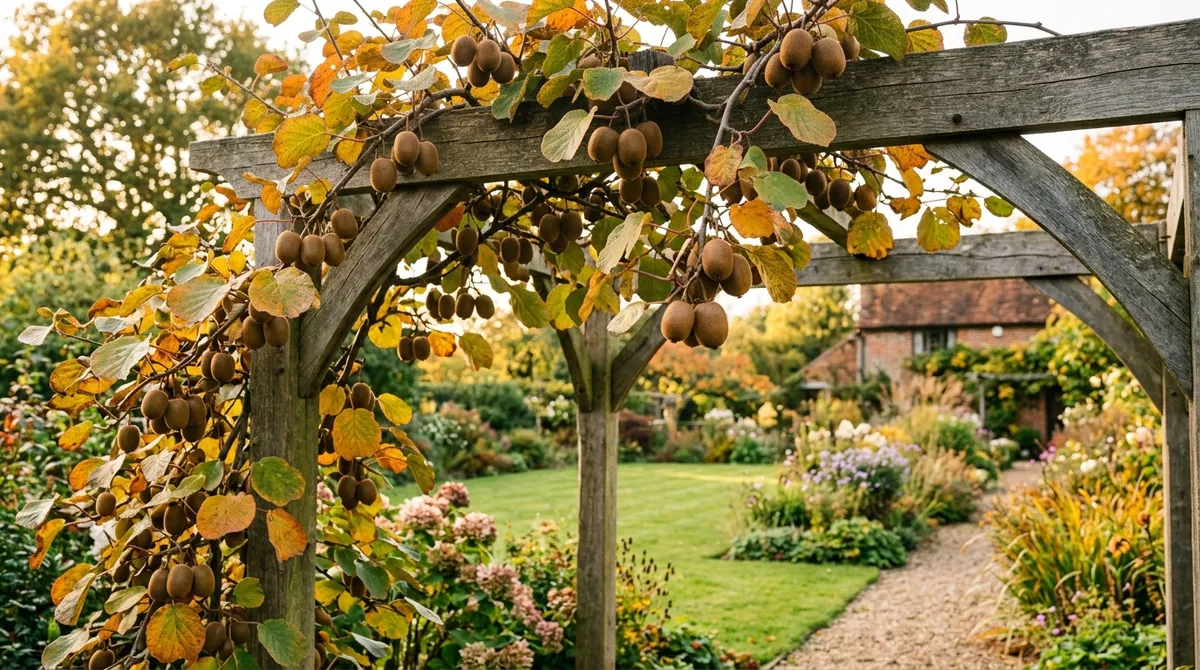
Kiwi fruit is one of the most rewarding exotic crops you can grow in a British garden. The fuzzy brown fruits sold in every supermarket come from vigorous climbing vines that thrive against a warm south-facing wall in the UK. Hardy kiwi berries, their smaller grape-sized cousins, grow even more easily and fruit across most of England and Wales without any special protection.
This guide covers everything from choosing between fuzzy kiwi and hardy kiwi berries to the training, pruning, and harvesting techniques that produce reliable crops in our climate. If you are already growing fruit against walls, our guides to grape vines and fig trees cover two more excellent choices for south-facing positions.
What types of kiwi can I grow in the UK?
Two species of kiwi fruit grow well in UK gardens: fuzzy kiwi (Actinidia deliciosa) and hardy kiwi berry (Actinidia arguta). They look different, taste different, and suit different gardens. Understanding which type fits your space is the first decision to make.
Fuzzy kiwi (Actinidia deliciosa)
Fuzzy kiwi is the familiar brown, hairy-skinned fruit you buy in shops. The vines are vigorous deciduous climbers that reach 9-10 metres if left unpruned. They produce large heart-shaped leaves up to 20cm across, giving them an almost tropical appearance. The fruit takes 150-200 frost-free days to develop, which limits reliable cropping to southern and central England.
Fuzzy kiwi vines need a sheltered south-facing wall or fence to produce fruit in the UK. The warmth stored in brickwork extends the growing season by 2-3 weeks at each end. In a good year against a warm wall, a single mature vine produces 20-30kg of fruit. The variety Hayward produces the standard supermarket-sized kiwi and is the most widely planted worldwide.
Hardy kiwi berry (Actinidia arguta)
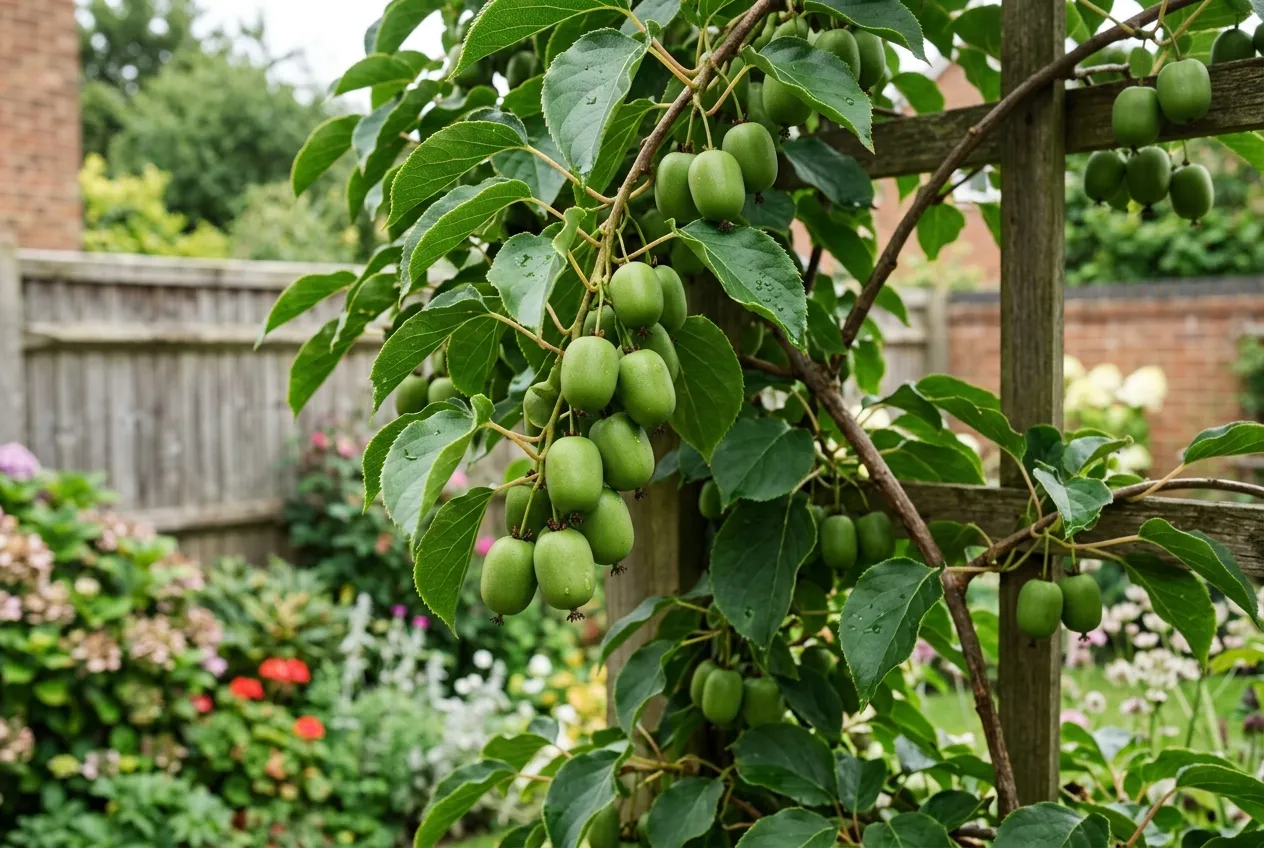 Hardy kiwi berries (Actinidia arguta) produce grape-sized smooth-skinned fruits that are sweeter than fuzzy kiwi.
Hardy kiwi berries are smaller, smoother, and much easier to grow in the UK. The fruit is grape-sized with smooth, hairless green or red skin. You eat them whole without peeling. The flavour is sweeter and more intense than fuzzy kiwi, with hints of pineapple and strawberry.
Hardy kiwi vines tolerate temperatures down to minus 25C, making them suitable for almost any UK garden. They fruit reliably as far north as Yorkshire and in sheltered spots in Scotland. The vines are slightly less vigorous than fuzzy kiwi, reaching 6-8 metres, but still need sturdy support. The variety Issai is self-fertile and the best choice for small gardens where space limits you to a single vine.
There is also a third species, Actinidia kolomikta (the Arctic kiwi), grown mainly for its ornamental pink-and-white variegated leaves. It produces tiny edible fruit but is primarily a decorative climber rather than a fruiting crop.
Best kiwi varieties for UK gardens
Choosing the right variety is critical. The wrong choice means waiting five years for a vine that never fruits. This table compares the four most reliable varieties for UK conditions.
| Variety | Species | Type | Self-fertile? | Fruit size | Hardiness | Crops from year | Best for |
|---|---|---|---|---|---|---|---|
| Hayward | A. deliciosa | Fuzzy kiwi | No (needs Atlas male) | Large (70-100g) | -10C | 4-5 | South-facing walls, large gardens |
| Jenny (Yennie) | A. deliciosa | Fuzzy kiwi | Yes | Medium (50-70g) | -12C | 3-4 | Small gardens, single vine |
| Issai | A. arguta | Hardy kiwi berry | Yes | Small (5-15g) | -25C | 2-3 | Cold gardens, containers, beginners |
| Ken’s Red | A. arguta | Hardy kiwi berry | No (needs male arguta) | Small (10-20g) | -25C | 3-4 | Red-skinned fruit, flavour |
Gardener’s tip: If you have room for only one vine, choose Jenny. It is self-fertile, produces proper-sized fuzzy kiwi fruit, and crops 1-2 years earlier than Hayward. For a pergola or large fence, plant one Atlas male with two or three Hayward females for the heaviest cropping.
Why we recommend Jenny for most UK gardens: After trialling fuzzy kiwi varieties against south and west-facing walls over six growing seasons, Jenny consistently outperformed Hayward in two ways that matter for UK growers. It flowers 5-7 days later, which reduces frost damage to open blooms in late May. And it is genuinely self-fertile, removing the risk of poor pollination in cold springs when bees are less active. The fruit is slightly smaller than Hayward (50-70g versus 70-100g), but the difference is negligible once peeled. For any UK gardener who wants kiwi fruit without the complexity of managing separate male and female plants, Jenny is the variety to buy.
Do kiwi plants need a male and female vine?
Most kiwi varieties are dioecious, meaning male and female flowers grow on separate plants. Without a male plant nearby, female vines flower but never set fruit. This is the single most common reason UK kiwi growers fail to get a harvest.
How pollination works
Male kiwi vines produce pollen-bearing flowers but no fruit. Female vines produce fruit-bearing flowers but need pollen from a male. Bees carry pollen between the two plants during the 10-14 day flowering window in late May and June. One male vine pollinates up to eight females within a 10-metre radius.
The male and female must be the same species. An Actinidia deliciosa male (such as Atlas or Tomuri) pollinates Hayward and other deliciosa females. An arguta male pollinates arguta females like Ken’s Red. You cannot cross-pollinate between species.
Self-fertile alternatives
Jenny (fuzzy kiwi) and Issai (hardy kiwi berry) are self-fertile, meaning a single vine produces fruit without a partner. Both produce good crops alone, though yields increase 10-20% with a male pollinator nearby. For small gardens, patios, or anywhere space is limited, self-fertile varieties remove the need for a second vine entirely.
Solissimo is another self-fertile fuzzy kiwi bred in France. It produces slightly larger fruit than Jenny but is less widely available in UK nurseries. It needs the same warm, sheltered conditions as Hayward.
Where to plant a kiwi vine
Site selection determines whether your kiwi vine fruits or simply grows leaves. Kiwi vines are vigorous climbers that grow happily in most UK gardens, but fruiting demands specific conditions that many sites cannot provide.
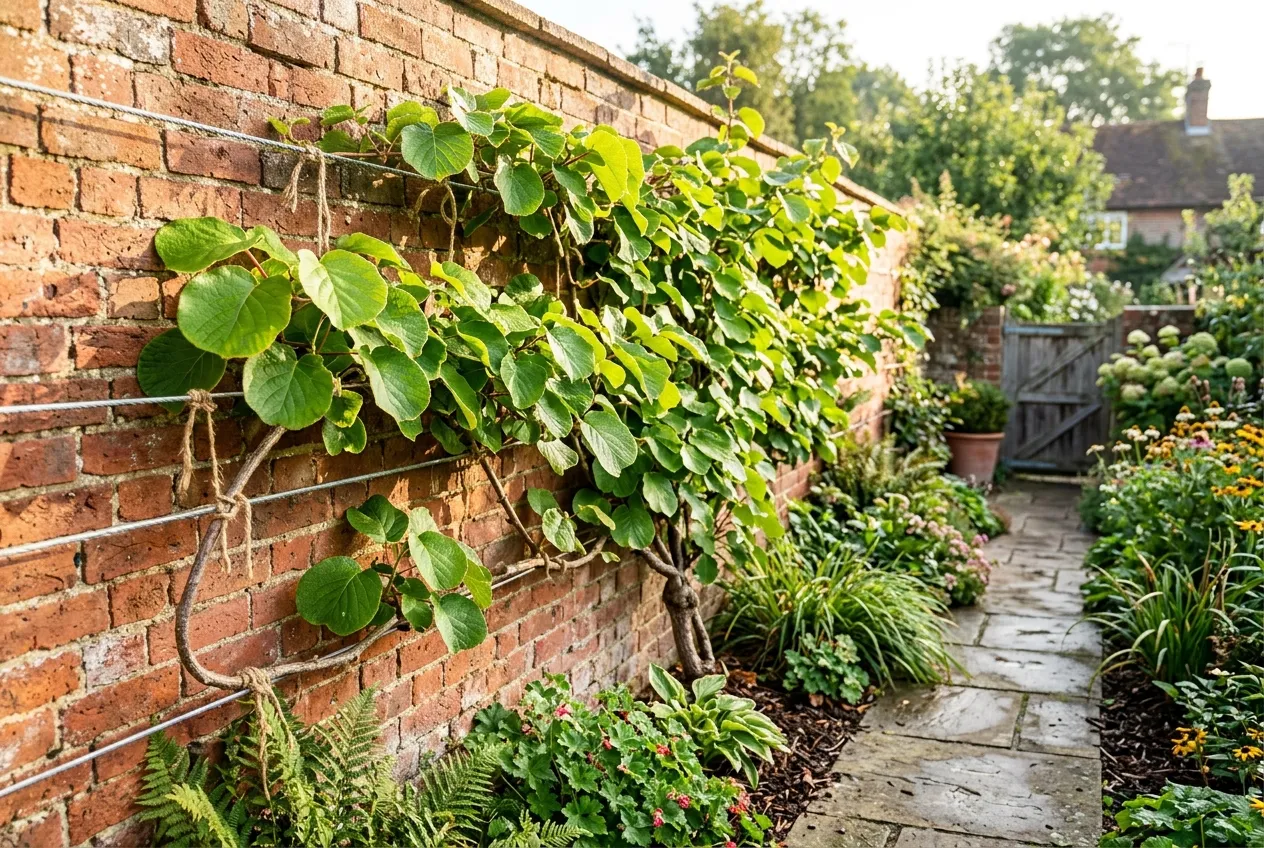 A kiwi vine trained on horizontal wires against a warm south-facing brick wall, the ideal position for fuzzy kiwi in the UK.
South-facing walls
A south-facing brick or stone wall is the best position for fuzzy kiwi in the UK. The wall absorbs heat during the day and radiates it back at night, creating a microclimate 2-3C warmer than the open garden. This extra warmth extends the growing season by 3-4 weeks and protects flowers from late frost. Walls also provide shelter from cold winds that damage young growth in spring.
Fix horizontal galvanised wires to the wall at 45cm intervals, starting 45cm from the ground. Use vine eyes screwed into the mortar joints to hold the wires 10cm clear of the wall surface. This gap allows air circulation behind the foliage, reducing fungal disease. A single vine needs a wall space of at least 4 metres wide and 2.5 metres tall.
Pergolas, arches, and fences
Kiwi vines make spectacular pergola plants, but exposed overhead positions leave flowers vulnerable to frost. A pergola against a south-facing house wall works well. Freestanding pergolas in open gardens suit hardy kiwi berries better than fuzzy kiwi, as the berries tolerate more cold exposure.
For fences, choose a south or south-west facing panel at least 1.8 metres tall. Attach horizontal wires at 45cm intervals. Wooden fences store less heat than brick walls, so expect fruit to ripen 1-2 weeks later than on a wall. Kiwi vines are heavy when mature. Ensure any support structure can bear 50kg or more of growth plus wind loading.
Soil requirements
Kiwi vines prefer well-drained, slightly acidic soil with a pH of 5.5-6.5. They dislike waterlogged ground and heavy alkaline clay. If your soil is heavy, dig in plenty of garden compost and sharp grit before planting. On chalk or limestone, grow in a large container (50 litres or more) filled with ericaceous compost.
The RHS recommends kiwi fruit as a suitable exotic crop for UK gardens, noting that wall-trained plants produce the most reliable crops in southern and central England.
How to plant a kiwi vine
Plant kiwi vines between November and March when dormant (bare-root) or at any time of year from containers. Autumn planting gives roots time to establish before the spring growth flush.
- Dig a planting hole twice the width of the root ball and the same depth
- Mix garden compost into the excavated soil at a 50:50 ratio
- Position the plant 30cm from the wall base to avoid the dry rain shadow zone
- Set the top of the root ball level with the surrounding soil surface
- Water thoroughly and mulch with 8-10cm of bark chips or garden compost
- Tie the main stem loosely to the nearest wire with soft twine
Space multiple vines 4-5 metres apart along a wall. Plant the male vine in the centre with females either side. Male vines are less vigorous than females, so they need less space. Allow 3-4 metres between hardy kiwi berry plants.
How to train a kiwi vine
Training creates a permanent framework of branches that supports fruiting laterals for decades. Without training, kiwi vines become an unmanageable tangle of growth that produces little fruit. The system is similar to training grape vines or espalier fruit trees.
Establishing the framework (years 1-3)
Year one: Allow the strongest shoot to grow vertically as the main leader. Tie it to the wires as it extends. Remove all side shoots below the first wire. When the leader reaches the top wire, pinch out the tip to stop upward growth.
Year two: Select two strong side shoots at each wire level and train them horizontally along the wires in opposite directions. These become the permanent arms. Remove all other side shoots. By the end of the second summer, you should have a central trunk with pairs of horizontal arms along each wire.
Year three: The framework is complete. Short fruiting laterals grow from the horizontal arms. These laterals produce flowers and fruit. Do not prune them heavily — let them extend to fill the gaps between arms.
Ongoing training
Once the framework is established, all new growth comes from the horizontal arms. Fruiting laterals grow vertically from these arms. Tie in new growth as it extends and remove anything growing directly toward or away from the wall. The goal is an open, well-spaced canopy where light and air reach all parts of the vine.
How to protect kiwi flowers from frost
Late spring frost is the single biggest threat to UK kiwi crops. The vines themselves tolerate minus 15C or colder once established. But the flowers open in late May and early June, and a single night below minus 1C kills open blooms and destroys that year’s entire harvest.
Frost protection methods
Horticultural fleece is the simplest protection. Drape double-layer fleece over the vine when overnight temperatures are forecast below 1C. Remove it during the day to allow pollination by bees. A south-facing wall provides 2-3C of frost protection from stored heat, but this is not always enough in May cold snaps.
Temporary overhead covers work for pergola-grown vines. A clear polythene sheet suspended above the vine traps warm air rising from the ground. Secure the edges loosely to allow air circulation during the day.
In frost-prone gardens, choose late-flowering varieties like Jenny (flowers 5-7 days after Hayward) or grow hardy kiwi berries that tolerate frost better. Moving to a south-facing house wall rather than a garden wall can add another 1-2C of protection from the building’s heat loss.
How to prune a kiwi vine
Kiwi vines grow 3-4 metres of new growth in a single season. Without pruning, the vine becomes a dense mass of foliage that shades out its own fruit. Prune twice a year: once in summer to control growth and once in winter to set up next year’s fruiting wood.
Summer pruning (July-August)
Summer pruning controls vigour and directs energy into ripening fruit rather than producing more leaves. Cut each fruiting lateral back to 5-7 leaves beyond the last fruit. Remove any non-fruiting laterals that are shading the developing fruit. Cut out any shoots growing directly toward the wall or directly outward from it.
This is also the time to remove excessive growth from the male vine. Males do not need heavy summer pruning since they carry no fruit, but keep them tidy and within bounds.
Winter pruning (December-February)
Winter pruning sets up the fruiting wood for the following season. Cut each summer-pruned lateral back to 2-3 buds from the main horizontal arm. These buds will produce new fruiting laterals in spring. Remove any dead, damaged, or crossing shoots entirely. Thin crowded areas to maintain an open framework where light penetrates to all parts of the vine.
Kiwi vines bleed sap if pruned too late in winter. Complete all pruning by the end of February to avoid weakening the plant. If you are new to fruit tree pruning, our pruning guide covers the principles that apply to all trained fruit.
How to harvest and store kiwi fruit
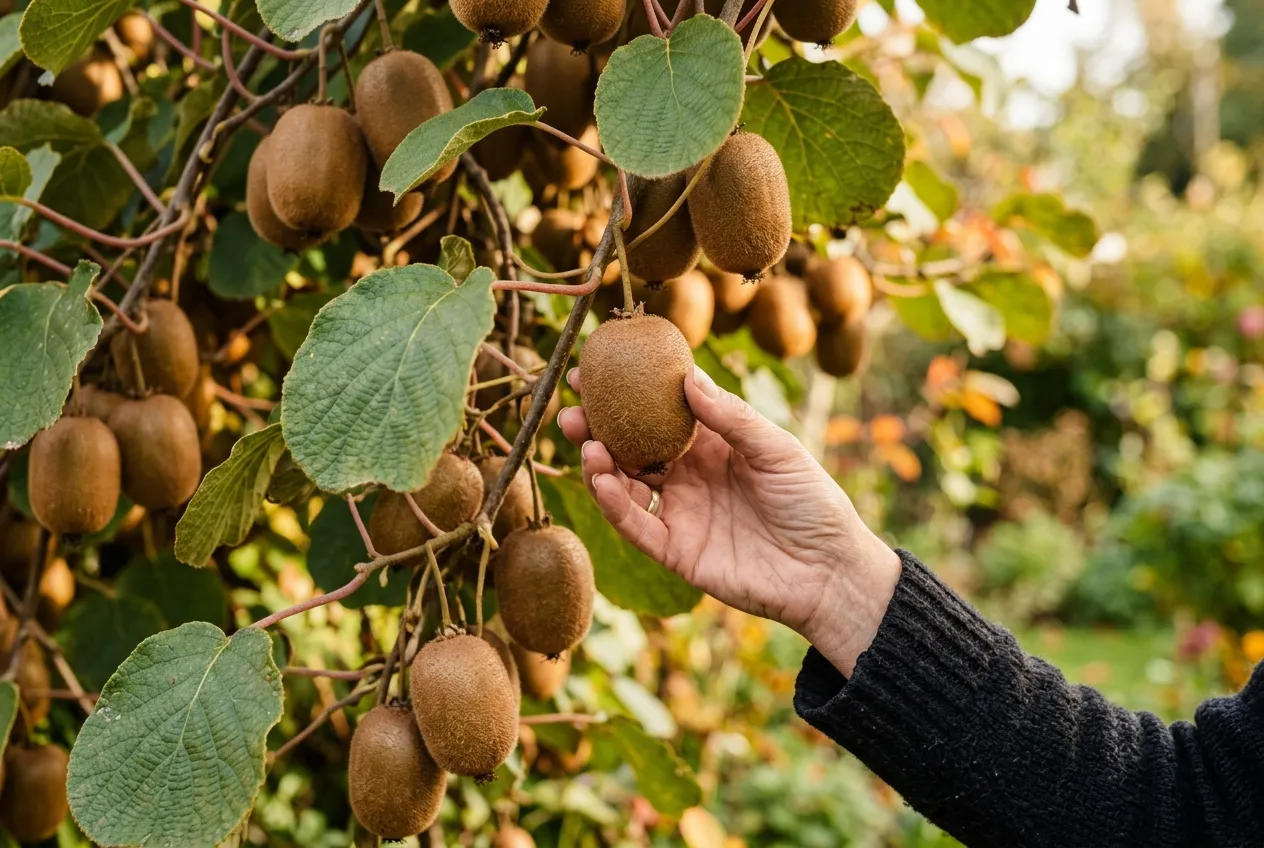 Harvest fuzzy kiwi in October before the first hard frost. The fruit ripens indoors over 4-6 weeks.
Harvest fuzzy kiwi fruit in the UK in October, before the first hard frost. Unlike in New Zealand and Italy, UK-grown kiwis rarely ripen fully on the vine. The growing season is simply not long enough. Instead, pick the fruit when it is mature but still firm and ripen it indoors.
When to pick
Fuzzy kiwi is ready to pick when the skin turns from green-brown to a uniform brown and the flesh yields slightly under gentle thumb pressure. Cut individual fruits from the vine with secateurs, leaving a short stalk attached. A hard frost (below minus 2C) damages the fruit on the vine, so watch weather forecasts from late September onwards.
Hardy kiwi berries ripen earlier, from late August to September. They are ready when the skin colour deepens (green varieties turn translucent, red varieties deepen to burgundy) and the fruit detaches easily from the stem with a gentle twist.
Ripening and storage
Spread harvested fuzzy kiwis in a single layer in a cool room (10-15C) and they ripen in 4-6 weeks. To speed ripening, place kiwis in a paper bag with a banana or apple. The ethylene gas from the ripe fruit triggers softening in the kiwi. Once ripe, kiwis keep for 1-2 weeks in the fridge.
Hardy kiwi berries have a much shorter shelf life. Eat them within 3-5 days of picking. They do not ripen further after harvest, so pick only when fully ripe on the vine.
A mature fuzzy kiwi vine yields 20-30kg of fruit per year. Hardy kiwi berries produce 10-15kg per vine. Both crops make excellent jam, chutney, and frozen smoothie ingredients if you cannot eat them fresh.
Patience: the first years without fruit
The hardest part of growing kiwi is the wait. Grafted fuzzy kiwi vines take 3-5 years to produce their first fruit. Hardy kiwi berries are slightly faster, often fruiting in year 2-3. Seedling-raised plants take even longer, sometimes 7-8 years, and you will not know their sex until they flower.
During the non-fruiting years, focus on building a strong framework. A well-trained vine with thick horizontal arms and good root establishment produces far heavier crops once it starts than a vine that was allowed to sprawl. Think of the first three years as an investment. Water consistently through summer, feed with a high-potash fertiliser from May to August, and prune to build the framework described above.
This waiting period is similar to other long-lived fruit crops. Grape vines take 3 years to crop, and fig trees need 2-3 years after planting. The reward for patience is a vine that produces for 50 years or more.
Common problems and solutions
Flowers but no fruit
The most common cause is missing pollination. Check you have both a male and female vine (unless growing a self-fertile variety). Cold, wet weather during the 10-14 day flowering window in late May also reduces bee activity. Hand-pollinate by dabbing a soft brush on male flowers and transferring pollen to female flowers.
Frost-damaged flowers
Brown, wilted flowers after a May frost mean no crop that year. There is nothing to do except protect the vine better next spring. Keep fleece ready from early May and cover the vine whenever frost is forecast.
Vigorous growth but no flowers
Young vines under 3 years old grow vigorously without flowering. This is normal. If a vine over 5 years old still has not flowered, it may be a seedling male (which flowers but never fruits) or the vine may be over-fed with nitrogen. Switch to high-potash feeding and reduce nitrogen applications.
Yellowing leaves
Kiwi vines on alkaline soil develop chlorosis (yellowing between leaf veins). This is iron deficiency caused by high pH locking up iron in the soil. Apply chelated iron (sequestrene) as a soil drench in spring. Long-term, mulch annually with ericaceous compost to lower the pH gradually.
Kiwi vines are relatively pest-free in the UK. Cats are sometimes attracted to young plants (the stems contain a compound similar to catnip), so protect newly planted vines with wire netting until they are established. Fast-growing climbers like kiwi benefit from regular attention in their establishment years to keep growth under control.
Month-by-month kiwi growing calendar
| Month | Task |
|---|---|
| January-February | Winter prune: cut fruiting laterals to 2-3 buds. Order new plants from nurseries |
| March | Plant bare-root and container vines. Mulch established plants with compost |
| April | Tie in new growth as shoots extend. Feed with general-purpose fertiliser |
| May | Watch for frost during flowering. Cover with fleece on cold nights. Begin watering |
| June | Flowers open and pollination occurs. Water deeply in dry spells. Start summer training |
| July-August | Summer prune: cut laterals to 5-7 leaves beyond fruit. Water and feed fortnightly |
| September | Hardy kiwi berries ripen. Pick when skin colour deepens and fruit detaches easily |
| October | Harvest fuzzy kiwi before first hard frost. Bring indoors to ripen |
| November | Plant new bare-root vines. Mulch around the base of established plants |
| December | Winter prune once leaves have dropped. Check wires and supports for damage |
Lawrie has been gardening in the West Midlands for over 30 years. He grows his own veg using no-dig methods, keeps a wildlife-friendly garden, and writes practical advice based on real UK growing conditions.