Succession Planting Guide for the UK
Plan succession sowing for a continuous harvest from March to October. Covers best crops, sowing intervals, and month-by-month UK schedules.
Key takeaways
- Sow lettuce every 2-3 weeks from March to August for continuous salad May to October
- Radishes are the fastest succession crop, ready in 4-6 weeks from each sowing
- French beans sown every 3 weeks from May to July produce pods from July to October
- Succession planting prevents wasteful gluts and extends the productive harvest season
- Combine with catch cropping and interplanting to get two or three harvests from each bed
- Cloches and fleece extend the season by 3-4 weeks at each end for early and late sowings
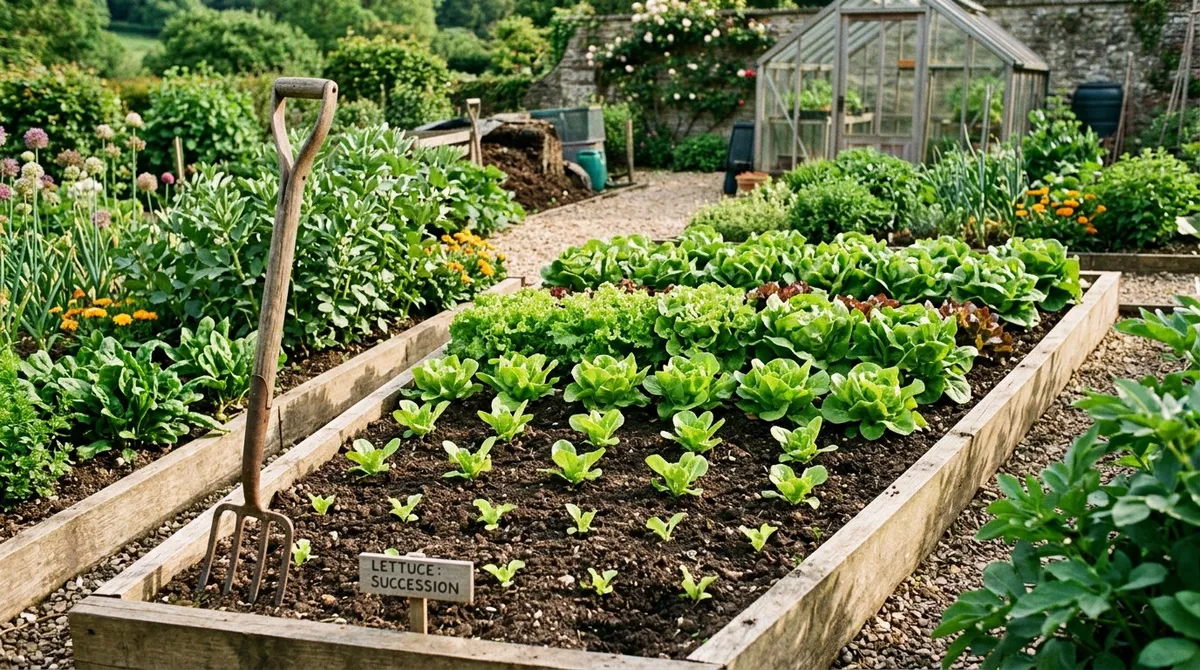
Succession planting solves the feast-or-famine pattern every allotment holder knows. Nothing for weeks, then suddenly more lettuce than you can eat, more beans than the freezer can hold, and courgettes appearing faster than you can give them away. The glut arrives, lasts two weeks, and then it is gone. The bed sits empty. The harvest season feels disappointingly short.
Succession planting solves this completely. Instead of sowing all your seed in one go, you sow small amounts at regular intervals throughout the growing season. The result is a steady, manageable harvest that keeps your kitchen supplied with fresh vegetables from spring to autumn.
I have been succession sowing on my West Midlands allotment for years. It took some trial and error to get the timings right for our climate, but the difference in productivity is remarkable. This guide covers the technique in detail, with specific UK dates and crop-by-crop instructions.
How succession planting works
Succession planting means sowing a small batch of the same crop every 2-4 weeks rather than sowing everything at once. Each batch matures at a different time, spreading the harvest over weeks or months instead of concentrating it into a short glut.
The principle is simple. Lettuce takes roughly 8-10 weeks from seed to harvest. If you sow a row on 1st March, another on 21st March, another on 11th April, and so on through to August, you have fresh lettuce available continuously from late May to October. No gaps. No gluts.
This approach works because most vegetables have a short harvest window. A head of lettuce is at its best for 7-10 days before it bolts. A row of radishes is ready for about a week. French beans crop heavily for 2-3 weeks then slow down. By staggering sowings, each batch hits its prime as the previous one finishes.
The method applies to any fast-growing crop with a defined harvest period. It does not work for crops that occupy the ground for months (pumpkins, parsnips, Brussels sprouts) or those that crop continuously over a long season (indeterminate tomatoes, courgettes).
Best crops for succession sowing
The ideal succession crop matures quickly, has a short harvest window, and can be sown over a long season. Here are the best UK candidates, ranked by how well they suit the technique.
Top-tier succession crops
These respond brilliantly to staggered sowing and should be the foundation of any succession planting plan.
Lettuce — the ultimate succession crop. Matures in 8-12 weeks depending on variety. Harvest window is just 7-10 days before bolting in warm weather. Sow every 2-3 weeks from March to August. Our lettuce growing guide covers variety selection and growing conditions.
Why we recommend Little Gem as the foundation lettuce for succession sowing: After 30 seasons of trialling every lettuce variety suitable for UK succession sowing, Little Gem consistently outperforms all others in reliability and harvest window. It is bolt-resistant enough to hold for 12-14 days even in warm June weather — roughly twice as long as large-headed varieties — which gives far more tolerance for the natural variation in timing between batches. On my allotment, a 30cm row of Little Gem sown every two weeks provides a steady supply from late May through to October with almost no waste to bolting.
Radish — the fastest vegetable in the garden. Ready in 4-6 weeks from sowing. Sow every 2-3 weeks from March to September. Summer varieties grow at any time; winter varieties (mooli, Black Spanish) sow from July onward.
Spring onions — mature in 8-12 weeks. Sow every 3-4 weeks from March to July. Varieties like White Lisbon and Ishikura are reliable and quick-growing.
Spinach — fast-growing leafy green, ready in 6-8 weeks. Bolts quickly in summer heat, so succession sowing ensures a continuous supply. Sow every 3 weeks from March to September, choosing heat-resistant varieties for summer.
Strong succession crops
French beans — bush varieties produce pods for 2-3 weeks then slow down. Sow every 3 weeks from mid-May to early July for continuous beans from July to October.
Beetroot — matures in 8-12 weeks. Golf-ball-sized roots have the best flavour and texture. Sow every 3-4 weeks from April to July. See our beetroot growing guide for variety advice.
Carrots — slower than lettuce but still benefit from succession sowing. Sow every 4-6 weeks from March to June. Early varieties mature faster than maincrops. Our carrot growing guide covers sowing and pest prevention.
Peas — mangetout and sugar snap types crop for 2-3 weeks. Sow every 3 weeks from March to June for a longer harvest. See our pea growing guide for support methods and varieties.
Sowing intervals: crop-by-crop guide
Getting the interval right is the key to successful succession planting. Too frequent and you waste seed and space. Too infrequent and you get gaps in the harvest.
| Crop | Sowing interval | Sow from | Sow until | Weeks to harvest | Harvest window |
|---|---|---|---|---|---|
| Lettuce (leaf) | 2 weeks | March | August | 6-8 | 7-10 days |
| Lettuce (head) | 3 weeks | March | July | 10-12 | 10-14 days |
| Radish | 2 weeks | March | September | 4-6 | 5-7 days |
| Spring onion | 3 weeks | March | July | 8-12 | 14-21 days |
| Spinach | 3 weeks | March | September | 6-8 | 7-14 days |
| French beans | 3 weeks | Mid-May | Early July | 8-10 | 14-21 days |
| Beetroot | 3-4 weeks | April | July | 8-12 | 21-28 days |
| Carrots (early) | 4 weeks | March | June | 10-14 | 21-28 days |
| Peas (mangetout) | 3 weeks | March | June | 10-12 | 14-21 days |
| Turnips | 3 weeks | March | August | 6-8 | 14 days |
| Salad rocket | 2 weeks | April | September | 4-6 | 7-10 days |
| Coriander | 2-3 weeks | April | August | 6-8 | 7-10 days |
The golden rule: sow the next batch when the previous one has germinated and produced its first set of true leaves. This visual trigger is more reliable than counting days, because weather conditions affect germination speed.
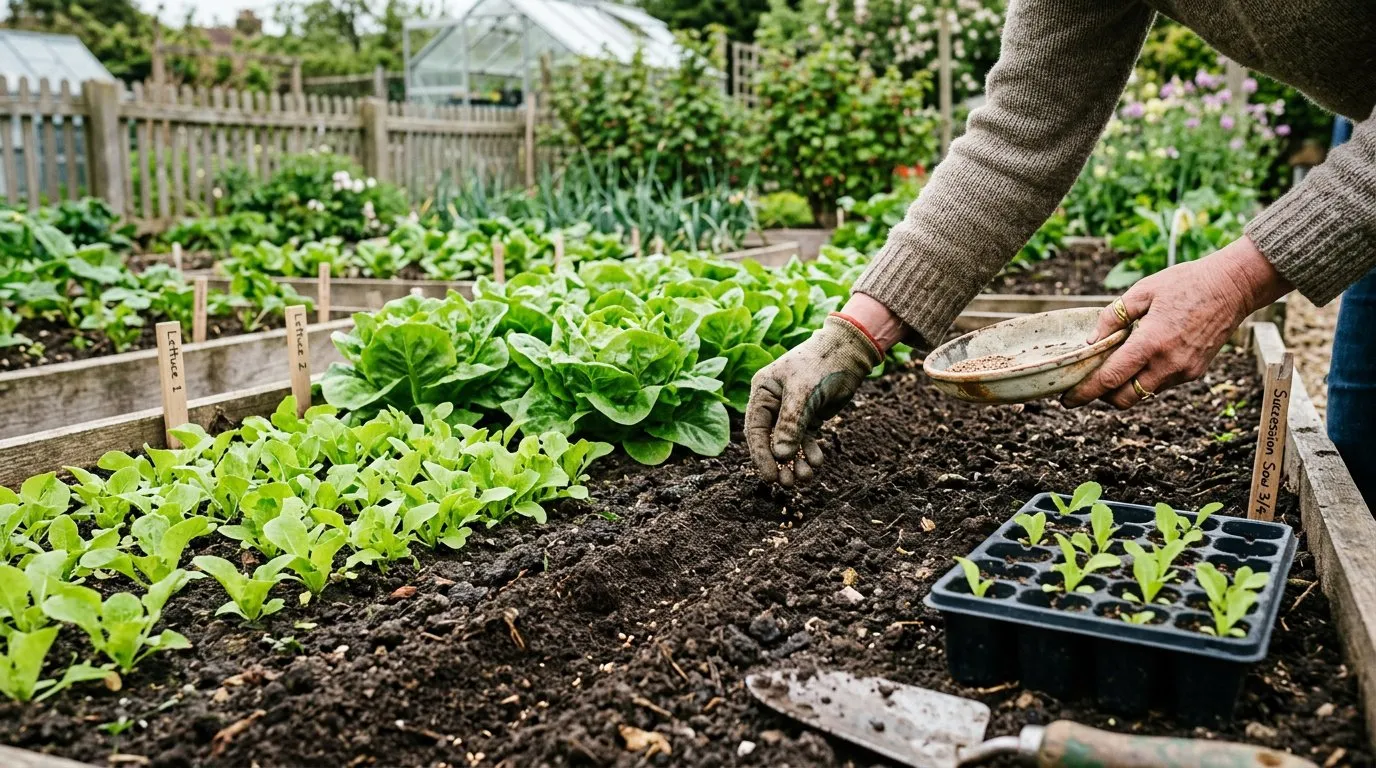 Sowing a new batch of lettuce seed into a shallow drill. Timing the next sowing to when the previous batch shows true leaves keeps the succession flowing.
Month-by-month succession planting plan
This calendar covers the full UK growing season from March to September. It assumes an average UK climate. Northern growers should delay spring dates by 2-3 weeks; southern growers can start 1-2 weeks earlier. Check our seed sowing calendar for regional adjustments.
March
The growing season begins. Soil temperature is the limiting factor — most seeds need at least 7-10C to germinate. Use cloches or fleece to warm the soil.
- Sow outdoors under cloches: lettuce, radish, spinach, peas (early varieties)
- Sow indoors: lettuce in modules for transplanting, early beetroot
- Action: This is succession batch 1. Mark the date in your diary.
March sowings benefit hugely from protection. A simple cloche raises soil temperature by 3-5C, which is enough to trigger germination two to three weeks earlier than open ground. Even a sheet of clear polythene laid over the soil for a week before sowing warms the ground.
April
Soil is warming and day length increasing. Most crops germinate reliably now without protection.
- Sow outdoors: lettuce batch 2, radish batch 2-3, spring onions batch 2, spinach batch 2, carrots (first sowing), turnips, peas batch 2
- Sow indoors: French beans for planting out in May
- Action: Check March sowings. When you see true leaves, sow the next batch.
May
The last frost date passes in most of the UK (mid to late May in the Midlands, earlier in the south). Tender crops can go outdoors after hardening off.
- Sow outdoors: everything from April plus French beans (first outdoor sowing mid-May), beetroot batch 2, coriander, salad rocket
- Transplant: lettuce modules sown indoors in April
- Action: Succession is now in full swing. You should have 2-3 batches of lettuce and radish at different stages.
June
The busiest month for succession sowing. Long days and warm soil mean fast germination and rapid growth. Lettuce needs heat-resistant varieties now (Lollo Rossa, Little Gem, Batavia types) to avoid premature bolting.
- Sow outdoors: lettuce batch 4-5, radish batch 6-7, French beans batch 2, beetroot batch 3, spring onions batch 3, carrots batch 3, peas (last sowing for the year)
- Action: Start harvesting March sowings. First radishes and baby lettuce should be ready.
July
The early harvests are in full swing. Gaps appear in beds as crops are picked. This is where catch cropping (see below) fills the empty space.
- Sow outdoors: lettuce batch 6-7, radish batch 8-9, French beans (last sowing early July), beetroot batch 4, spring onions (last sowing), spinach batch 5
- Harvest: lettuces, radishes, peas, early beetroot, spring onions, French beans
- Action: Clear spent pea plants and sow catch crops in the empty space.
August
Sowing options narrow as autumn approaches. Focus on fast-maturing crops that will beat the shortening days. Our vegetable planting calendar lists all crops suitable for August sowing.
- Sow outdoors: lettuce (last batch), radish batch 10-11, spinach batch 6, winter rocket, spring cabbage
- Harvest: French beans, beetroot, carrots, lettuce, spring onions
- Action: Clean and cloche any beds for late sowings. Order autumn onion sets and garlic.
September
The succession sowing season closes for most crops. Protect late sowings with cloches and fleece to extend the harvest into autumn.
- Sow outdoors under cloches: radish (last batch), winter lettuce varieties, lamb’s lettuce, winter spinach
- Harvest: Main crop carrots, beetroot, late French beans, autumn lettuce, spinach
- Action: Cover late sowings with fleece. Clear spent crops and sow green manure on empty beds.
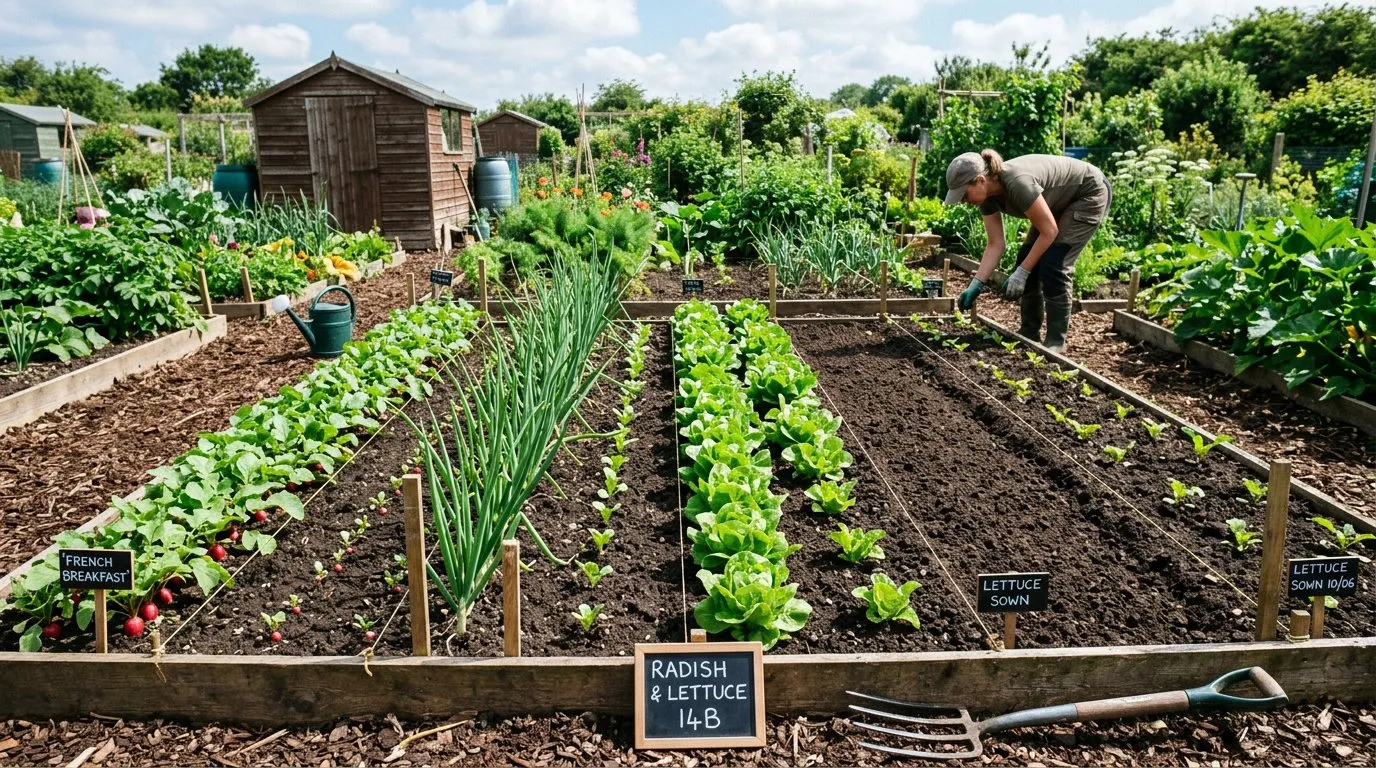 Three batches of beetroot at different growth stages. The staggered sowings produce a rolling harvest instead of a single glut.
Catch cropping: filling the gaps
Catch cropping means growing a fast-maturing crop in the gap between two main crops. It maximises productivity by ensuring no bed sits empty during the growing season.
Classic catch-cropping opportunities in a UK vegetable garden:
| Main crop cleared | Gap available | Catch crop to sow | Weeks to harvest |
|---|---|---|---|
| Early potatoes (July) | July-September | Lettuce, radish, turnips | 4-8 weeks |
| Peas (July) | July-September | French beans, spinach, beetroot | 6-10 weeks |
| Broad beans (July) | July-October | Lettuce, spring onions, spring cabbage | 6-12 weeks |
| Garlic (July) | July-September | Radish, rocket, lamb’s lettuce | 4-8 weeks |
| Early carrots (July) | July-October | Late lettuce, winter spinach | 6-10 weeks |
| Onions (August) | August-October | Winter lettuce, lamb’s lettuce under cloches | 6-10 weeks |
The key is to clear the spent crop immediately and sow the catch crop the same day or within a few days. Rake the surface level, sow, and water. Every week of delay is a week of growing time lost.
On my allotment, the bed that grew early potatoes always gets a catch crop of lettuce and radish. The potatoes come out in early July, and the lettuce is ready by September. That one bed produces two full crops in a single season.
Interplanting for maximum yield
Interplanting means growing two or more crops in the same bed at the same time, using the difference in growth speed and size to avoid competition. It pairs a slow-growing crop with a fast-growing one that is harvested before the slow crop needs the space.
Effective interplanting combinations
- Lettuce between cabbages: Plant cabbage transplants at normal spacing (45cm). Sow lettuce in the gaps. The lettuce matures and is harvested long before the cabbages spread to fill the space.
- Radish between carrots: Sow radish seed in the same row as carrots. Radishes germinate in 3-5 days and mark the row (carrot seeds take 14-21 days). Harvest the radishes before the carrots need the room.
- Spring onions between sweetcorn: The upright sweetcorn plants leave plenty of ground-level space for a row of spring onions.
- Spinach under climbing beans: The bean canopy provides shade that spinach appreciates in summer, reducing bolting.
Interplanting works best when one crop is tall and the other is short, or when one matures quickly and the other slowly. The two crops should not compete for the same resources at the same time.
Avoiding gluts
Gluts happen when you sow too much of one crop at once. Succession sowing is the solution, but you also need to calibrate the quantity at each sowing.
A family of four needs roughly 6-8 lettuce heads per week during summer. A head lettuce takes 10-12 weeks to mature and produces one head. Sow 8 lettuce plants every 3 weeks and you have a continuous supply without waste.
For French beans, one 1.5-metre row of bush beans produces roughly 2kg of pods over its 2-3 week harvest window. If you eat beans twice a week, one row per sowing is ample. Three staggered sowings give you beans from July to October without the overwhelming glut of picking a kilo every other day.
The calculation is simple for each crop:
- How much do you eat per week?
- How much does one sowing produce?
- How long is the harvest window?
- Sow enough for each window, and time the next batch to fill the gap.
Most gardeners — myself included — still sow too much at each batch. Start smaller than you think. You can always sow more if the first batch is not enough. You cannot un-sow a glut.
Extending the season with cloches and fleece
Cloches and horticultural fleece add 3-4 weeks to each end of the UK growing season. This extends your succession planting from a March-September window to a February-October window, adding significantly more harvests.
Early season (February to March)
Cover prepared beds with cloches or clear polythene for 2 weeks before sowing. This warms the soil from winter temperatures (4-6C) to the 8-10C needed for germination. Sow hardy crops like lettuce, radish, and spinach under the cloches. Remove or ventilate on warm days to prevent overheating.
Late season (September to November)
Cover late sowings of lettuce, spinach, rocket, and lamb’s lettuce with cloches or fleece as temperatures drop in October. The protection keeps the soil warm enough for continued growth. Winter varieties of lettuce (Winter Density, Arctic King) tolerate frost but grow very slowly without cloche protection. Our winter salad harvesting guide covers the full approach to year-round salad growing, including which varieties survive the hardest frosts.
Season extension tools
| Tool | Temperature gain | Best for | Cost |
|---|---|---|---|
| Horticultural fleece | +2-3C | Frost protection, light coverage | Low (reusable) |
| Clear polythene cloche | +3-5C | Warming soil, early season | Low |
| Rigid glass/plastic cloche | +4-6C | Winter salads, overwintering | Medium |
| Cold frame | +5-8C | Hardening off, winter crops | Medium |
| Unheated greenhouse | +5-10C | Year-round salads, early starts | Higher |
For sowing seeds indoors to get a head start before transplanting outside, see our guide to indoor seed sowing.
The RHS recommends succession sowing as one of the most effective techniques for maximising vegetable garden productivity. Their advice aligns with everything in this guide: little and often is better than all at once.
Planning your first succession season
Start with just two or three crops in your first year of succession planting. Lettuce and radish are the easiest because they are fast-growing and forgiving of timing errors. Add French beans once you are comfortable with the rhythm.
Here is a simple first-year plan:
| Sowing date | Lettuce (6-8 plants) | Radish (30cm row) | French beans (1m row) |
|---|---|---|---|
| Early March | Sow under cloche | Sow under cloche | — |
| Late March | Sow batch 2 | Sow batch 2 | — |
| Mid-April | Sow batch 3 | Sow batch 3 | — |
| Early May | Sow batch 4 | Sow batch 4 | — |
| Mid-May | Sow batch 5 | Sow batch 5 | Sow batch 1 |
| Early June | Sow batch 6 | Sow batch 6 | Sow batch 2 |
| Late June | Sow batch 7 | Sow batch 7 | Sow batch 3 |
| Mid-July | Sow batch 8 | Sow batch 8 | — |
| Early August | Sow batch 9 (last) | Sow batch 9 | — |
| Late August | — | Sow batch 10 | — |
| Mid-September | — | Sow batch 11 (under cloche) | — |
This plan gives you roughly 20 weeks of continuous lettuce, 25 weeks of radish, and 12 weeks of French beans. From three crops and three short rows each fortnight.
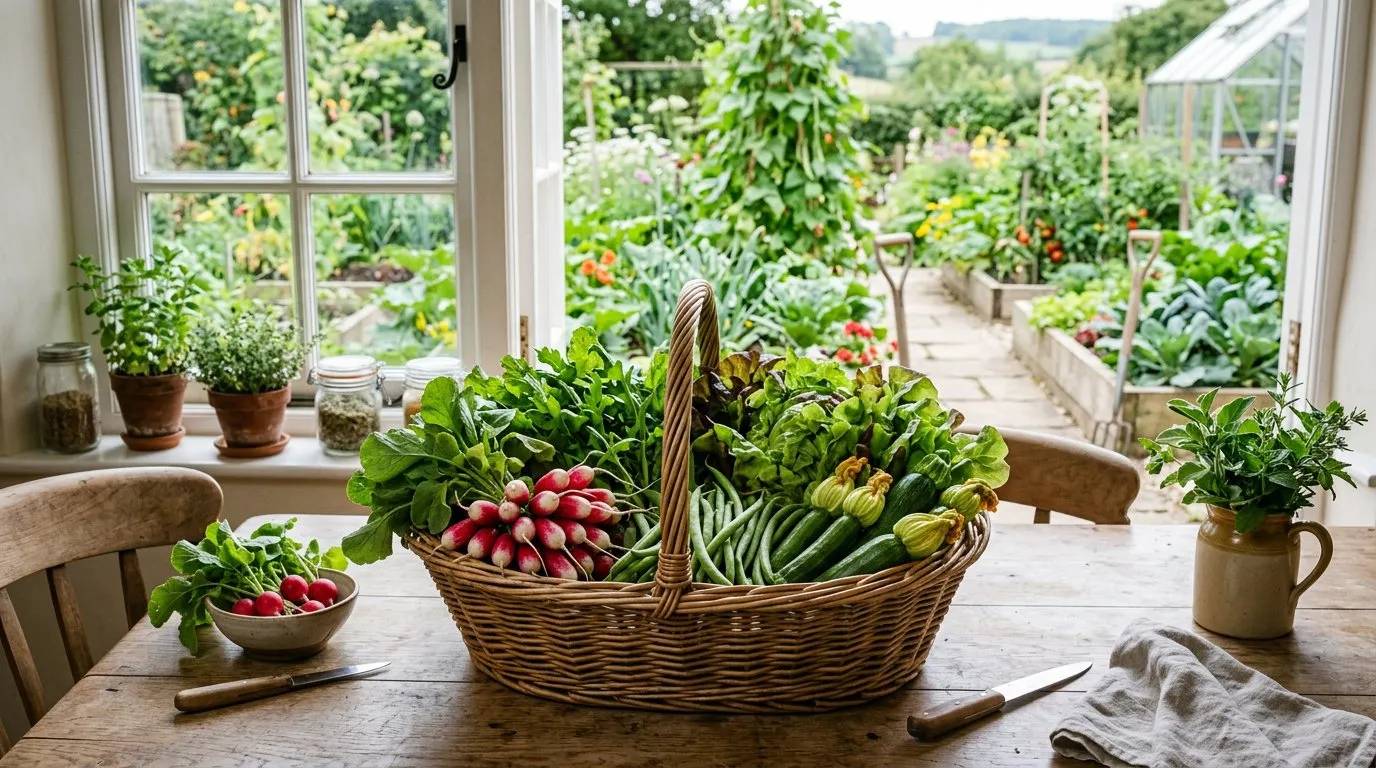 A late-July harvest from succession-planted beds: lettuce, radish, French beans, and beetroot all picked the same morning from different batches.
Succession planting in containers
Container growers can succession sow just as effectively as allotment holders. The smaller scale actually makes it easier to manage because you sow just a handful of seeds at a time.
Use shallow troughs or window boxes (at least 15cm deep) for lettuce, radish, and salad leaves. Deeper pots (30cm+) suit beetroot, spring onions, and French beans.
The approach is identical: sow a small batch every 2-3 weeks into fresh or refreshed compost. When a container is harvested, top up with fresh compost and re-sow. A kitchen windowsill with four troughs on a 2-week rotation provides year-round salad without ever setting foot in the garden.
Combining succession planting with crop rotation
Succession planting and crop rotation work together naturally. Your rotation plan determines which family grows in each bed. Within that bed, succession sowing determines when and how often you sow.
For example, the allium and salad bed (Group 4 in a four-bed rotation) is perfect for succession lettuce, spring onions, and spinach. Sow short rows at intervals throughout the season. The legume bed (Group 1) suits succession sowings of French beans.
The rotation gives each bed its purpose. Succession sowing fills that bed with a continuous supply rather than a single crop. The two techniques complement each other perfectly.
Troubleshooting succession planting
Most succession sowing problems come from timing errors or environmental factors. Here are the common issues and fixes.
Batches maturing at the same time
This happens in hot weather when later sowings catch up with earlier ones. The solution is to widen the interval between sowings in summer (3 weeks instead of 2) and narrow it in spring when growth is slower.
Gaps between harvests
This usually means the sowing interval is too long for that crop. Shorten the gap by a week and see if the next season fills better. Note down what worked and adjust annually.
Summer bolting (lettuce, spinach)
Heat causes leafy greens to bolt (flower) prematurely, shortening the harvest window. Use bolt-resistant varieties for June to August sowings (Lollo Rossa, Batavia, Little Gem). Sow in partial shade if possible. Water consistently — dry stress triggers bolting faster than heat alone.
Poor germination in summer
Lettuce germinates poorly above 25C. In hot spells, sow in the evening and keep the seed bed moist. Alternatively, start seeds indoors where temperatures are lower and transplant the seedlings.
Slugs destroying young seedlings
Each succession batch is vulnerable to slugs when small. Protect young sowings with copper tape around containers, or scatter organic slug pellets around newly emerged seedlings. Once plants are established (4-6 true leaves), they tolerate some slug damage without significant loss.
Now you have mastered succession planting, read our seed sowing calendar for precise month-by-month UK sowing dates across every crop.
Succession planting is the single most effective technique for getting more food from the same space. It turns a garden that produces food for a few frantic weeks into one that feeds you steadily from spring to autumn. Start small, keep notes, and expand each year as the rhythm becomes familiar. By your third season, you will wonder how you ever grew vegetables any other way.
Lawrie has been gardening in the West Midlands for over 30 years. He grows his own veg using no-dig methods, keeps a wildlife-friendly garden, and writes practical advice based on real UK growing conditions.