Grow Winter Salad Leaves in the UK
Grow fresh salad leaves all winter with a cold frame or unheated greenhouse. Frost-hardy varieties, sowing schedules, and harvesting tips for UK gardens.
Key takeaways
- Lamb's lettuce is the hardiest winter salad, surviving -15C unprotected
- Sow in August-September — growth stops when daylight drops below 10 hours in November
- An unheated greenhouse stays 2-5C warmer at night, 15-20C warmer on sunny days
- Cut-and-come-again harvesting gives 8-12 pickings from a single sowing
- Cold frames can hit 35-40C on sunny days if unventilated — open lids above 8-10C
- Bubble wrap insulation adds 2-3C and costs under £30 for a 6x8ft greenhouse
Winter salad growing in the UK is not only possible, it is one of the most satisfying ways to keep your kitchen supplied with fresh leaves from November through March. While most gardeners pack away their tools in October, a cold frame or unheated greenhouse keeps lamb’s lettuce, mizuna, winter purslane, and hardy spinach producing right through the coldest months.
The secret is timing. You sow in late summer, not winter. Plants establish their root systems during the warm days of September and October, then sit tight through the short days of December and January before growth picks up again in February. This guide covers which varieties survive UK frost, when to sow them, and how to keep harvesting fresh salad when supermarket bags cost three times the summer price.
Can you really harvest salad all year round in the UK?
Yes, but winter harvesting depends on sowing at the right time and choosing the right varieties. The key insight that catches most people out is that winter is for harvesting, not sowing. Growth virtually stops when daylight drops below 10 hours in November. December gives UK gardens just 7.5-8 hours of daylight. Even in a heated greenhouse, salad plants barely grow during the darkest weeks.
The solution is to sow in August and September. This gives plants 6-8 weeks of warm autumn weather to build strong root systems and put on leaf growth before the short days arrive. By November, your lamb’s lettuce, mizuna, and winter spinach are well-established plants sitting in a holding pattern, ready to be picked leaf by leaf through the winter months.
Joy Larkcom, who won the RHS Veitch Memorial Medal for her work on salad growing, proved in the 1980s that British gardens could produce far more than lettuce and tomato. Her books introduced mizuna, tatsoi, pak choi, and dozens of other Asian and European salad plants to UK growers. Charles Dowding later refined the approach with his no-dig method, demonstrating year-round salad production from a quarter-acre plot in Somerset.
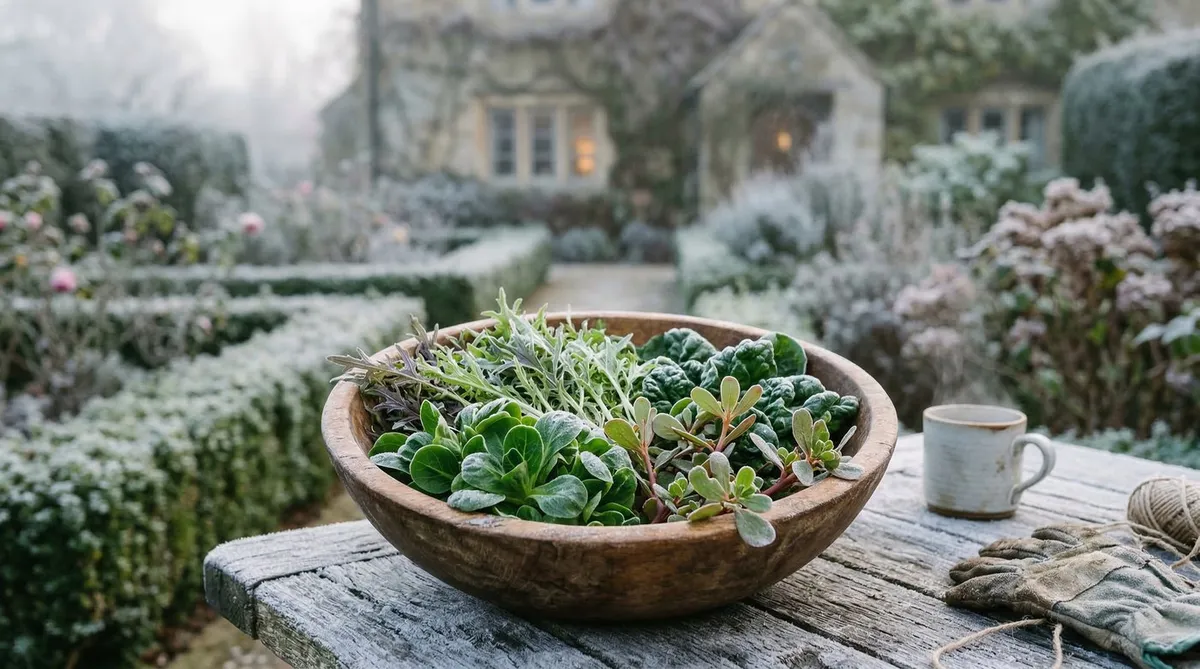
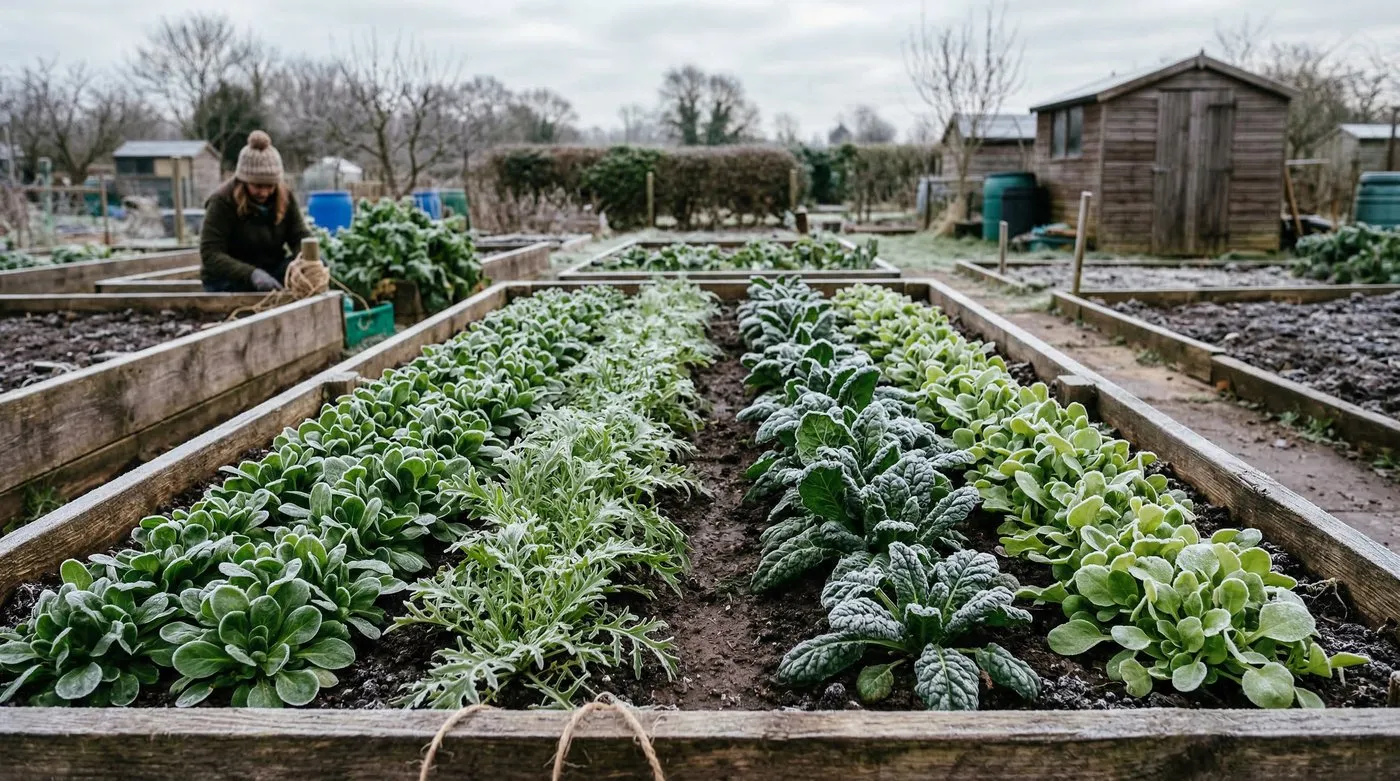 Lamb’s lettuce, mizuna, and winter purslane growing through a December frost. These varieties survive -10C or below with minimal protection.
Which salad leaves survive frost in a UK winter?
Lamb’s lettuce is the single hardiest winter salad leaf, surviving -15C unprotected in open ground. Beyond lamb’s lettuce, a dozen other varieties will crop reliably through British winters with some protection from a cold frame, cloche, or greenhouse.
The table below ranks winter salad varieties by frost tolerance. The “under cover” column shows minimum survival temperatures inside a cold frame or unheated greenhouse.
| Variety | Unprotected | Under cover | Speed to harvest | Flavour |
|---|---|---|---|---|
| Lamb’s lettuce (mâche) | -15C | -18C | 6-8 weeks | Mild, nutty |
| Spinach (savoyed types) | -15C | -18C | 4-6 weeks | Earthy, rich |
| Winter Density lettuce | -9.5C | -12C | 6-8 weeks | Sweet, crunchy |
| Arctic King lettuce | -10C | -12C | 6-8 weeks | Crisp, mild |
| Tatsoi | -12C | -19C | 4-5 weeks | Mild mustard |
| Claytonia (winter purslane) | -10C | -15C | 6-8 weeks | Mild, succulent |
| Land cress | -10C | -15C | 6-8 weeks | Peppery, watercress-like |
| Mizuna | -4C | -12C | 3-4 weeks | Mild, feathery |
| Rocket | -5C | -8C | 3-4 weeks | Peppery, sharp |
| Red mustards | -8C | -10C | 3-4 weeks | Hot, spicy |
| Pak choi | -4C | -7C | 4-5 weeks | Mild, crisp |
| Endive | -7C | -8C | 6-8 weeks | Bitter, complex |
One detail that matters: adolescent plants are hardier than mature ones. A small lettuce plant survives temperatures 3-5C colder than a full-sized head. This is another reason to keep harvesting outer leaves rather than letting plants grow to full size.
For a deeper look at growing lettuce through all seasons, including bolt-resistant summer varieties, our dedicated guide covers variety selection and month-by-month sowing.
When to sow winter salad for January to March harvests
Sow from early August to mid-September, this is the critical window. Miss it and your plants will not have enough established growth to survive the winter. The table below shows exact sowing dates, time to first harvest, and the harvest window for each crop.
| Crop | Sow | Weeks to baby leaf | Harvest period |
|---|---|---|---|
| Lamb’s lettuce | Early Aug, mid Sep | 6-8 weeks | Oct, Mar |
| Mizuna | Early Aug, early Sep | 3-4 weeks | Oct, Feb |
| Rocket | Early Aug | 3-4 weeks | Sep, Dec |
| Land cress | Jul, Aug | 6-8 weeks | Oct, Mar |
| Claytonia | Aug, Sep | 6-8 weeks | Nov, Apr |
| Winter Density lettuce | Sep, Oct | 6-8 weeks | Nov, Mar |
| Spinach (Medania) | Aug, Sep | 4-6 weeks | Oct, Mar |
| Tatsoi | Aug, Sep | 4-5 weeks | Oct, Mar |
| Red mustards | Aug, early Sep | 3-4 weeks | Sep, Dec |
Daylight is the limiting factor, not temperature. UK gardens get just 8 hours of daylight in January. Growth essentially stops from mid-November until late February, regardless of how warm you keep the greenhouse. The plants are alive and holdable, but they are not putting on new leaf.
New sowings resume from mid-February when daylight hits 10 hours. Start with Arctic King and Winter Density lettuce under cover. By early March, with 11+ hours of daylight, you can sow mizuna, mustards, and pak choi again. Growth accelerates noticeably through March and by April you are back to normal succession planting intervals.
Suttons sell a Winter Mix seed blend of approximately 850 seeds bred for cold-weather cropping. The leaves are ready in 3 weeks from sowing under glass and produce up to 3 crops from a single sowing using the cut-and-come-again method.
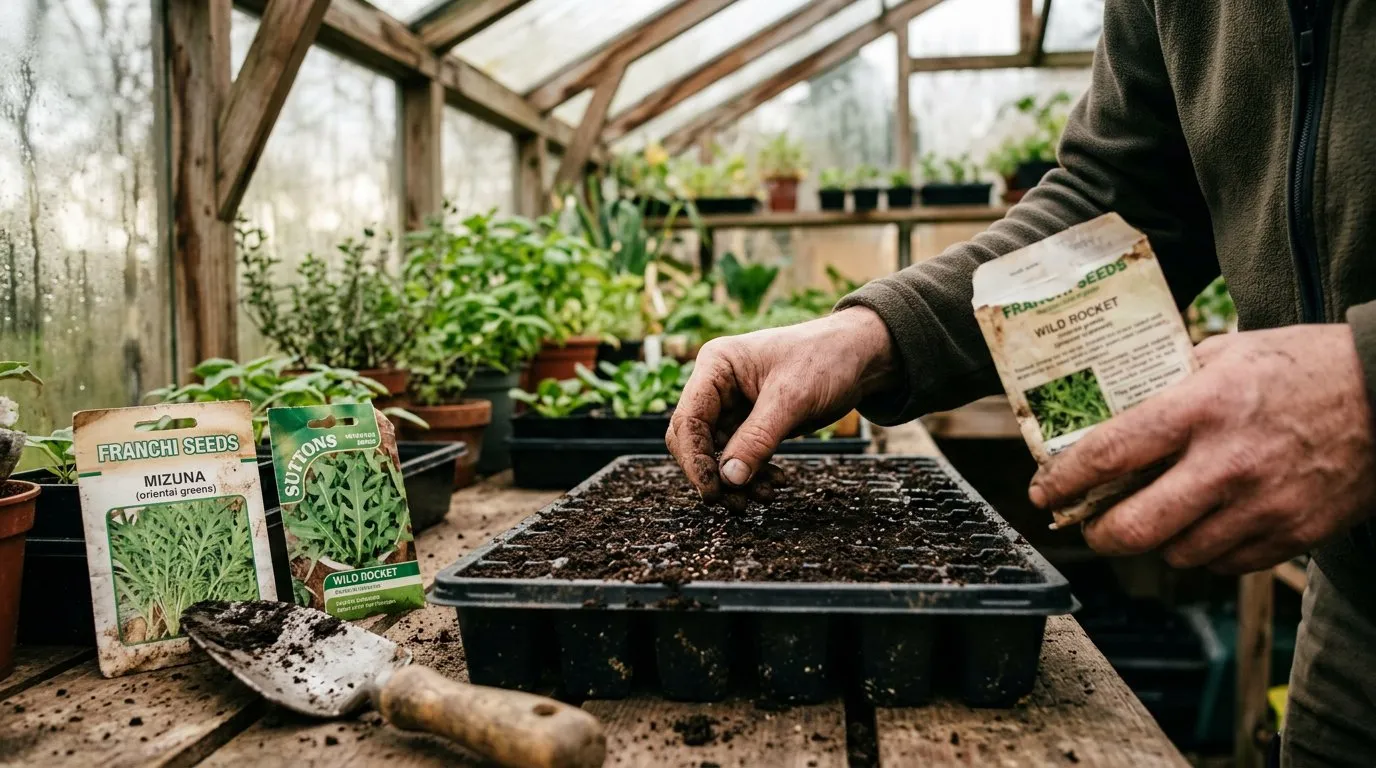 Sowing winter salad seeds in August. Module trays let you transplant seedlings into cold frames or greenhouse beds once they have 3-4 true leaves.
How cold does an unheated greenhouse get in winter?
An unheated greenhouse stays 2-5C warmer than outside on calm winter nights and 15-20C warmer on sunny days. That margin is the difference between a living salad crop and a frozen one. On a still December night when the outside temperature drops to -3C, the inside of a glass greenhouse typically sits at -1C to +2C, cold, but above the survival threshold for most winter salad varieties.
Wind changes the equation. On a windy night, the temperature gain shrinks to just 1-2C as moving air strips heat from the glass. This is why positioning matters: a greenhouse against a south-facing wall or fence holds warmth better than one exposed on all sides.
| Glazing type | Heat retention vs single glass | Light transmission |
|---|---|---|
| Single-pane glass (3-4mm) | Baseline | 90%+ |
| Twin-wall polycarbonate (4mm) | 40-65% less heat loss | 80-82% |
| Twin-wall polycarbonate (8mm) | Better insulation | 78-80% |
| Bubble wrap over single glass | 30-50% less heat loss | Reduced |
Adding bubble wrap insulation to the inside of a greenhouse costs under £30 for a 6x8ft structure and adds 2-3C of frost protection. Combined with a layer of horticultural fleece draped directly over the plants, you can gain 4-6C over outside temperatures, enough to keep even moderately hardy crops like pak choi alive through most UK winters.
For more on keeping a greenhouse productive through cold months, our greenhouse insulation guide covers materials, methods, and costs in detail. The greenhouse growing calendar gives month-by-month sowing schedules for all crops, not just salads.
How to use a cold frame for winter salads
A cold frame is the most cost-effective way to grow winter salad in the UK. It provides the same frost protection as an unheated greenhouse for a fraction of the price, and soil inside a cold frame runs 5-10C warmer than open ground.
Position the frame against a south-facing wall with the sloping lid angling towards the sun. The wall absorbs heat during the day and radiates it back at night, keeping interior temperatures several degrees above a freestanding frame.
Ventilation rules that save your crop
Ventilation is where most people go wrong. A sealed cold frame on a sunny day, even in January, can reach 35-40C inside. At those temperatures, your carefully nurtured winter salads cook faster than frost would kill them.
| Outside temperature | Action |
|---|---|
| Above 8-10C with sun | Open lid 30-50mm |
| Above 15C | Open lid fully |
| By 3pm (winter) | Close lid to trap warmth |
| Night below -5C | Close fully, add fleece over frame |
Automatic wax-cylinder vent openers eliminate the risk entirely. They open the lid when the temperature inside reaches 13-21C and close again as it cools. At £15-25, a vent opener pays for itself the first time it saves a tray of seedlings from an unexpectedly warm afternoon.
Condensation causes more winter losses than frost. Water sparingly, only when the top 20mm of soil is dry. Always water in the morning so surfaces dry before the lid closes for the night. Remove yellowing leaves promptly; grey mould (Botrytis cinerea) colonises dead tissue first and spreads fast in enclosed, humid spaces.
The Elite Min-E-Lite cold frame range is British-made in Bolton from greenhouse-grade aluminium with 3mm toughened safety glass. The compact 4x2ft model holds 12-16 seed trays and comes with dual roof vents and a 20-year warranty. For a fuller look at cold frame growing beyond winter salads, our cold frame gardening guide covers positioning, seasonal crops, and month-by-month calendars.
Cut-and-come-again: how to get 12 harvests from one sowing
Cut-and-come-again means harvesting outer leaves while leaving the central growing point intact. The plant regrows new leaves in 2-3 weeks during autumn, or 3-4 weeks in the shortest winter days. A single August sowing of lamb’s lettuce or mizuna gives 8-12 separate harvests from October through March.
The technique is simple. Use clean scissors and cut leaves at 5-10cm tall, snipping 2-3cm above the base. Never pull leaves, pulling damages the crown and invites disease. Harvest the outer ring of leaves first and leave the younger inner leaves to grow on.
Timing your cuts matters. In autumn (October-November), you can cut every 2 weeks and the plants recover quickly. From December to February, stretch the interval to 3-4 weeks. Growth is so slow during the darkest weeks that overcutting exhausts the plant. Resume fortnightly cuts from late February when daylight picks up.
The best varieties for repeat cutting are lamb’s lettuce, mizuna, tatsoi, rocket, and spinach. Butterhead and cos lettuces work less well because they grow towards a single head rather than a spreading rosette. If you prefer headed lettuce, grow Winter Density and harvest the whole head, then resow, this is closer to the succession planting approach.
Charles Dowding, the UK’s leading no-dig advocate, recommends leaf radish as the most vigorous of all winter salad leaves for cut-and-come-again growing. It keeps producing new growth until December outdoors and even longer under cover.
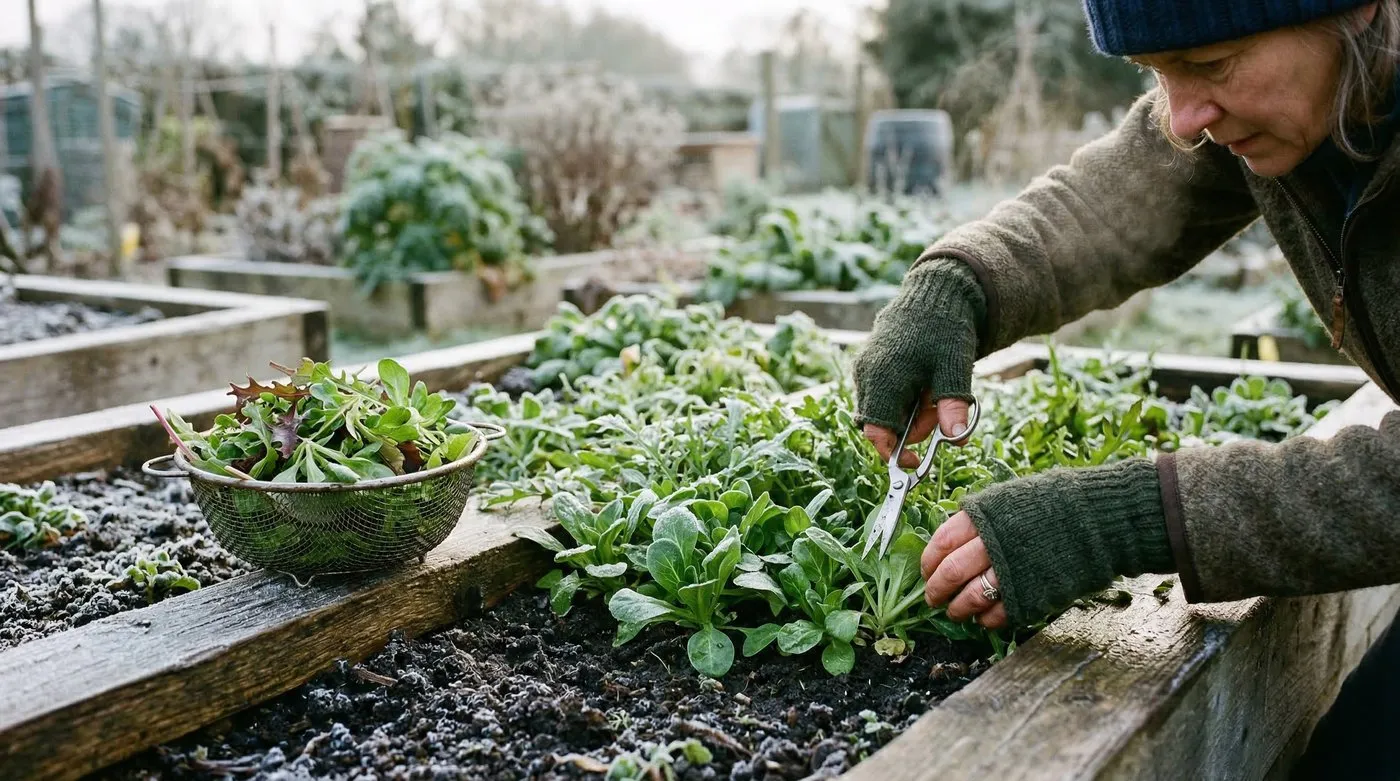 Cut-and-come-again harvesting: snip leaves 2-3cm above the base and the plant regrows in 2-3 weeks.
Five mistakes that kill winter salad crops
Most winter salad failures come from timing errors and overwatering, not cold. Here are the five most common problems and how to avoid them.
1. Sowing too late. October sowings rarely establish before the short days shut growth down. Plants sit as tiny seedlings all winter and often rot in cold, wet soil. Sow by mid-September at the latest.
2. Overwatering. Winter salads need far less water than summer crops. The combination of cold soil and excess moisture causes root rot and encourages grey mould. Water only when the top 20mm of soil is dry, and always in the morning.
3. Forgetting to ventilate. A closed cold frame on a sunny winter day is a death trap. Even in January, solar gain can push internal temperatures past 35C. Open lids above 8-10C and close by 3pm.
4. Growing in waterlogged soil. Plants freeze faster in saturated ground because wet soil conducts cold more efficiently than drained soil. If your soil is heavy clay, grow winter salads in raised beds or containers with good drainage. Our guide to growing in grow bags is a practical alternative for poorly drained plots.
5. Leaving dead foliage. Yellowing and dead leaves are a landing pad for Botrytis. Remove them every time you harvest. Good hygiene is more important in winter than any other season because air circulation is lower and humidity is higher inside enclosed frames and greenhouses.
Building a winter salad plan: what to grow and where
A practical winter salad garden does not need much space. A single cold frame, three or four containers, or a 2m row in an unheated greenhouse produces enough mixed leaves for two people through the winter.
Start with the bulletproof trio: lamb’s lettuce, mizuna, and spinach. These three give you mild, peppery, and earthy flavours from a single August sowing. Add winter purslane (claytonia) for a succulent, crunchy texture and land cress if you like the peppery bite of watercress without needing running water.
For greenhouse growers, tatsoi is an excellent addition. It handles -19C under cover and its spoon-shaped leaves have a gentle mustard flavour that works raw or briefly wilted. Pak choi needs more protection, it is the weakest link in winter, but grows fast enough in spring to make up for its winter limitations.
If you are growing in containers or grow bags, lamb’s lettuce and mixed winter salad seed blends are the easiest starting point. Sow thickly, harvest as baby leaves, and resow every 3-4 weeks from August through September for staggered harvests.
Related reading
- How to grow cress and watercress UK
- How to grow spinach UK
- How to grow lettuce UK
- Container vegetable gardening UK
- How to grow microgreens UK
Frequently asked questions
Lawrie has been gardening in the West Midlands for over 30 years. He grows his own veg using no-dig methods, keeps a wildlife-friendly garden, and writes practical advice based on real UK growing conditions.