Flower Arranging from Your Garden UK
Flower arranging from your garden for beginners. Cutting, conditioning, and arranging techniques from 9 years of growing and styling UK garden flowers.
Key takeaways
- You need just 5-8 different stem types to build a professional-looking garden arrangement
- Cut flowers before 8am when stems hold maximum water — midday harvesting cuts vase life by 40%
- Condition every stem in lukewarm water (38-43C) for at least 4 hours before arranging
- Build arrangements using the tall-medium-filler method: spires first, focal flowers second, fillers last
- A 3m x 2m cutting patch produces enough stems for a fresh bouquet every week from June to October
- Foliage is the secret to natural-looking arrangements — aim for 30-40% greenery in every vase
Flower arranging from your garden starts with growing the right plants, cutting them at the right time, and understanding a few basic techniques that turn a handful of stems into something worth displaying. You do not need formal training, expensive equipment, or a florist’s eye. A kitchen jug, sharp secateurs, and 5-8 types of stem from a small cutting patch are enough to produce arrangements that look better than most shop-bought bouquets.
This guide covers everything a beginner needs: the best garden flowers for arranging in the UK, how to harvest and condition stems for maximum vase life, a seasonal cutting calendar, and step-by-step arrangement techniques. Every recommendation comes from nine seasons of growing and arranging in a Staffordshire cutting garden on heavy clay soil.
What are the best garden flowers for arranging?
The best garden flowers for arranging fall into three categories: focal flowers, fillers, and foliage. Every arrangement needs all three. Focal flowers are the large, eye-catching blooms that draw the eye. Fillers are smaller, airy stems that add texture and movement. Foliage provides structure and the green backdrop that makes colours pop.
The best flowers for cutting in UK gardens include dozens of varieties, but beginners should focus on these proven performers:
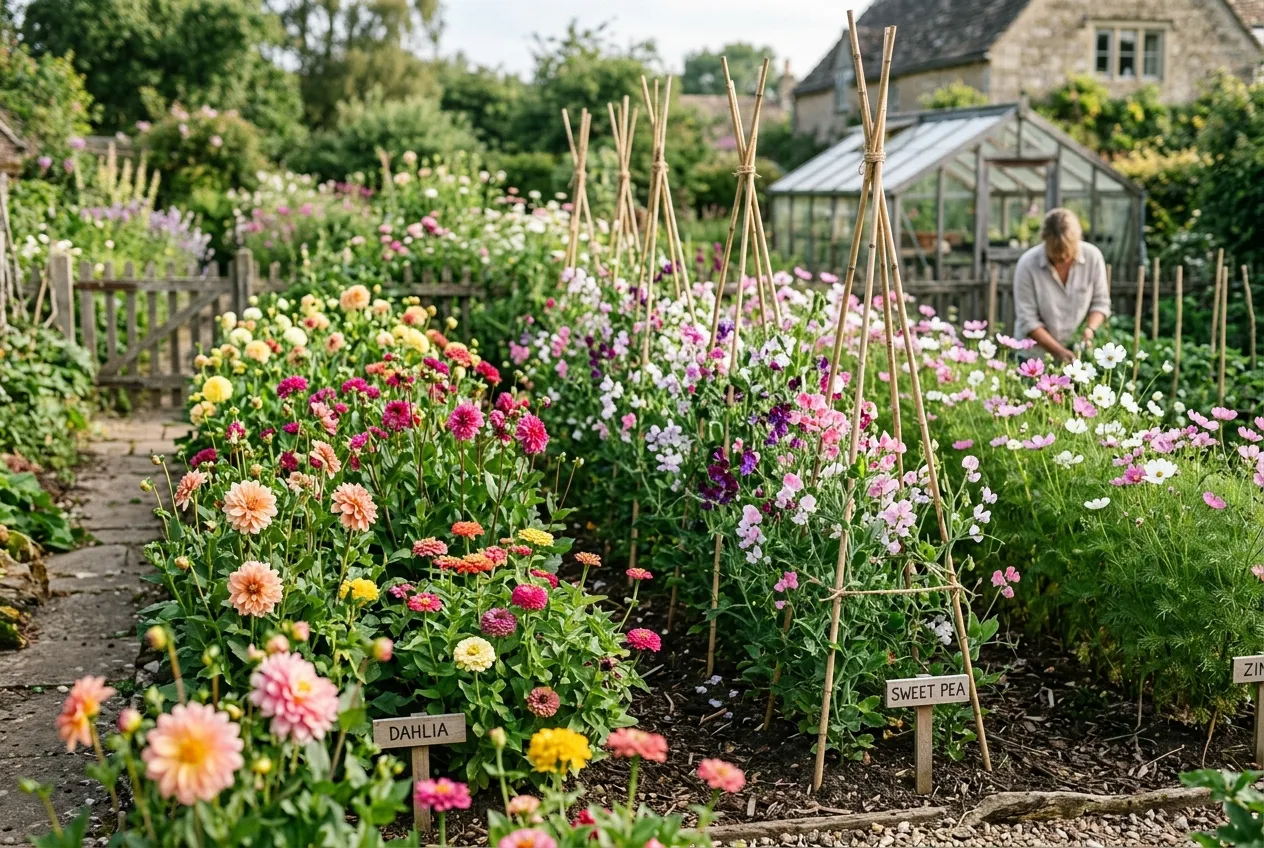
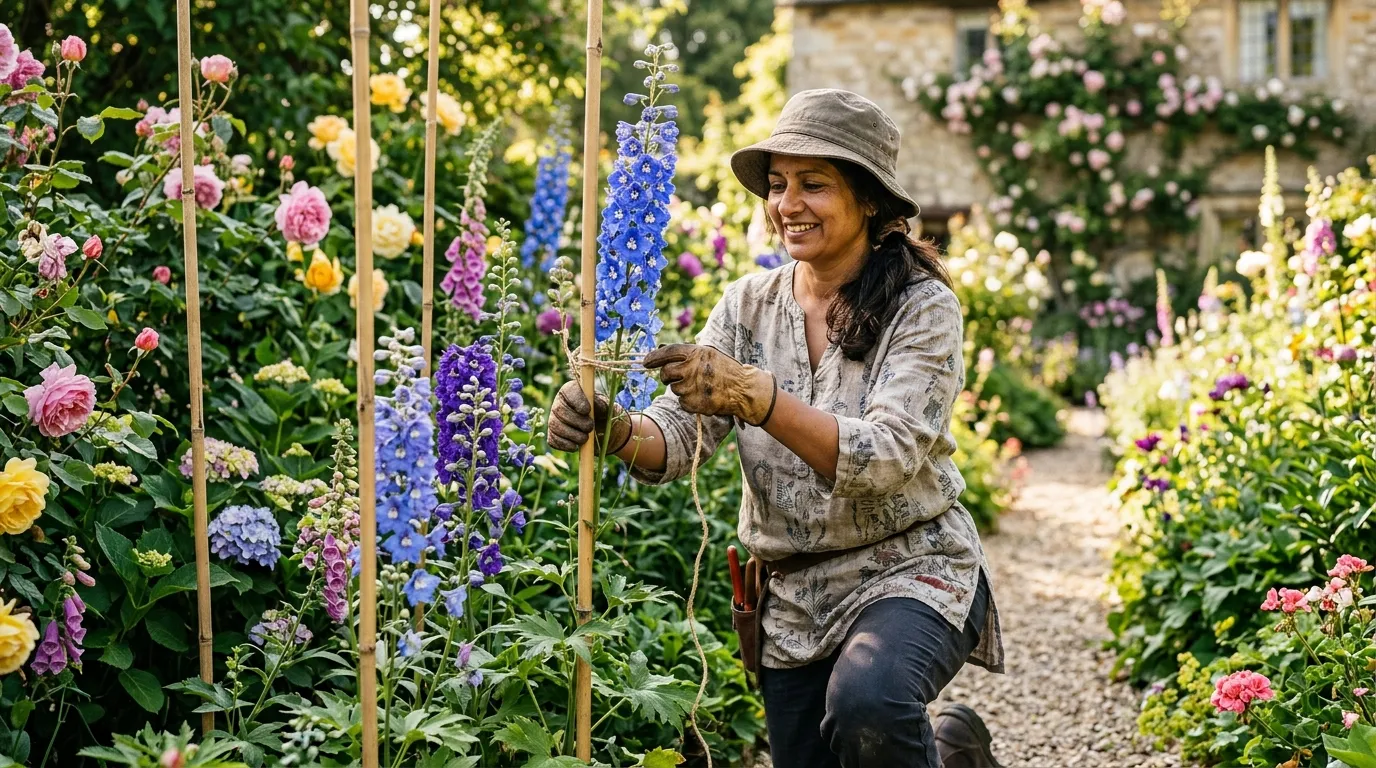
A dedicated cutting garden with dahlias, sweet peas on cane wigwams, and cosmos provides stems from June to October.
Focal flowers for arrangements
| Flower | Season | Vase Life | Best For |
|---|---|---|---|
| Rose | June-Oct | 7-12 days | Classic shape, long-lasting |
| Dahlia | July-Oct | 5-7 days | Bold colour, large heads |
| Peony | May-June | 5-7 days | Romantic, scented blooms |
| Sunflower | July-Sept | 7-10 days | Height and drama |
| Hydrangea | July-Sept | 7-14 days | Volume, dries well |
Filler flowers for texture
Cosmos, ammi (bishop’s flower), nigella, feverfew, and astrantia are the five best fillers for garden arrangements. They add lightness and movement between focal blooms. Without fillers, arrangements look stiff and formal. With them, even three roses in a jug look natural.
Sweet peas deserve special mention. They work as both scent and filler, producing clouds of delicate flowers from June to September. Pick every 2-3 days or they stop flowering entirely.
Foliage for structure
Aim for 30-40% foliage in every arrangement. Pittosporum provides year-round dark green stems. Eucalyptus adds silver-grey texture. Rosemary gives height and fragrance. Lady’s mantle (Alchemilla mollis) doubles as both filler and foliage with its lime-green flower heads.
Grow a dedicated row of foliage plants in your cutting garden. Most beginners underestimate how much greenery they need. A single arrangement uses 7-10 foliage stems.
How do you harvest flowers for arranging?
Harvest garden flowers before 8am when stems hold their maximum water content. Stems cut in cool morning temperatures retain 40% more moisture than those cut at midday. The heat of a July afternoon causes rapid transpiration through the leaves, meaning water exits the stem faster than it enters.
Take a bucket of lukewarm water (38-43C) into the garden. Cut each stem at a 45-degree angle with sharp secateurs and place it in the water within 10 seconds. Air enters the xylem vessels the moment you cut. A stem left on a garden bench for even 5 minutes needs re-cutting before it will hydrate properly.
Cut at different stages depending on the flower type:
- Roses: Cut when the bud is half open and yields to a gentle squeeze
- Dahlias: Cut fully open — they do not continue opening after cutting
- Sweet peas: Cut when 2-3 flowers are open with the top bud still closed
- Cosmos: Cut when petals are just fully open but the centre is still tight
- Foxgloves: Cut when the bottom third of flowers are open
Always cut stems longer than you think you need. You can trim down during arranging, but you cannot add length. I cut everything at least 40cm and trim to final size once I know the vessel.
How do you condition cut flowers before arranging?
Conditioning means preparing cut stems to absorb maximum water before you arrange them. It is the single most important step for vase life and the one beginners most often skip. The full process for conditioning cut flowers takes 4-8 hours, but most of that time is passive soaking.
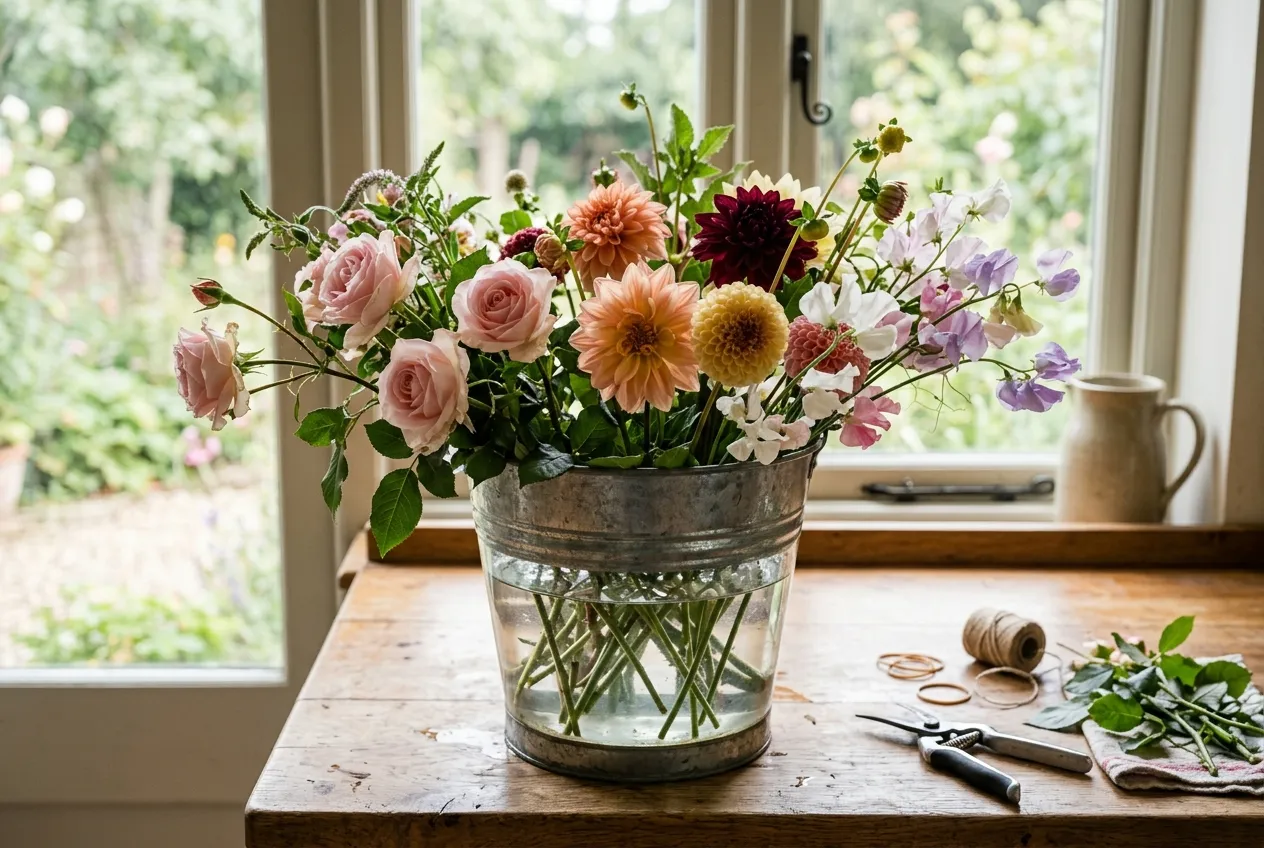
Conditioning freshly cut stems in deep lukewarm water for 4-8 hours before arranging doubles their vase life.
Step-by-step conditioning process
-
Fill a clean bucket with lukewarm water at 38-43C. Warm water travels up stems faster than cold and contains less dissolved oxygen that could cause air locks.
-
Re-cut stems underwater at a 45-degree angle. Submerge the bottom 5cm in the bucket and make the cut beneath the surface. This prevents new air bubbles entering the vessels.
-
Strip all foliage that would sit below the water line. Submerged leaves rot within 24 hours, breeding bacteria that clog the stem vessels and shorten vase life by 3-5 days.
-
Add commercial flower food to the water. It extends vase life by 25-30% over plain water. If you have none, use one teaspoon of white sugar plus two drops of bleach per litre.
-
Leave stems in deep water for a minimum of 4 hours. Overnight is better. Place the bucket in a cool room (15-18C) away from direct sunlight. The stems draw water steadily during this rest period, fully hydrating before the stress of being arranged.
Special conditioning for woody stems
Roses, lilac, and hydrangeas have woody stems that absorb water slowly. After the angled cut, split the bottom 3cm of stem with secateurs. This exposes more surface area and helps water uptake. Searing is another option for stubborn hydrators: dip the cut end in boiling water for 10 seconds, then transfer straight to cold water.
What is the best arrangement technique for beginners?
The tall-medium-filler method is the simplest arrangement technique and produces natural-looking results every time. It works in any vessel, from a kitchen jug to a formal vase. The principle is straightforward: build a framework of tall stems, add focal flowers at medium height, then fill gaps with lighter stems and foliage.
The foliage grid
Before adding any flowers, create a grid of foliage inside your vessel. Cross 5-7 stems of pittosporum, eucalyptus, or rosemary at different angles. This criss-cross network holds subsequent stems in place without the need for floral foam (which is single-use plastic and should be avoided).
Alternatively, scrunch a ball of chicken wire into the vessel mouth. This gives even better stem control for wide-necked jugs and urns.
Step-by-step arrangement
-
Set the height. Place your tallest stems first — foxgloves, delphiniums, or snapdragons. These should be roughly 1.5 times the height of the vessel. For a 20cm jug, stems of 30cm above the rim look balanced.
-
Add focal flowers. Position roses or dahlias at slightly different heights through the centre and just below the tallest stems. Use odd numbers: 3, 5, or 7 focal blooms look more natural than even groups.
-
Fill with airy stems. Tuck in cosmos, ammi, nigella, or astrantia around and between the focal flowers. These soften the outline and create depth.
-
Check the profile. Rotate the arrangement and look from all sides. Fill any gaps with short foliage or small filler stems. The arrangement should look full but not crammed.
-
Adjust and trim. Step back 2 metres and look at the overall shape. Snip any stems that stick out too far or droop below the vessel rim.
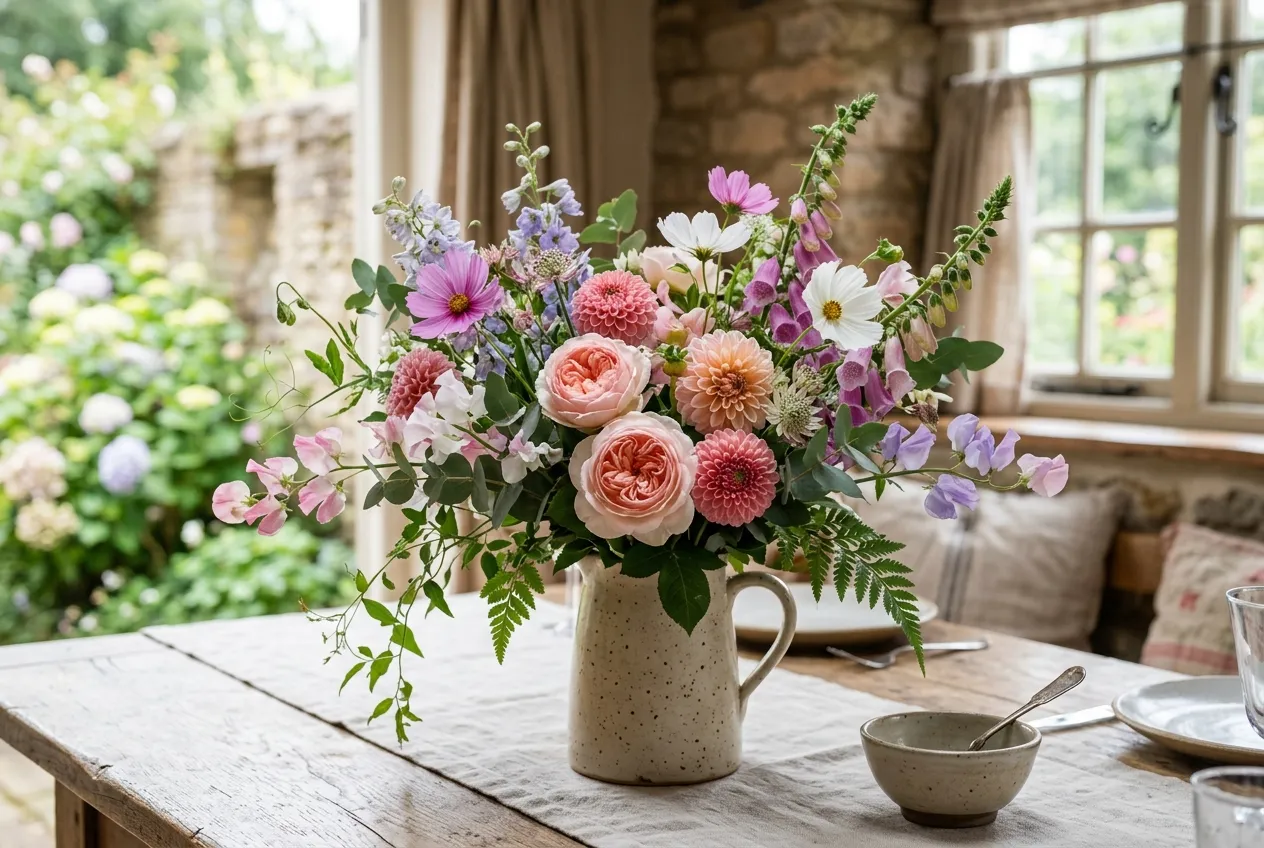
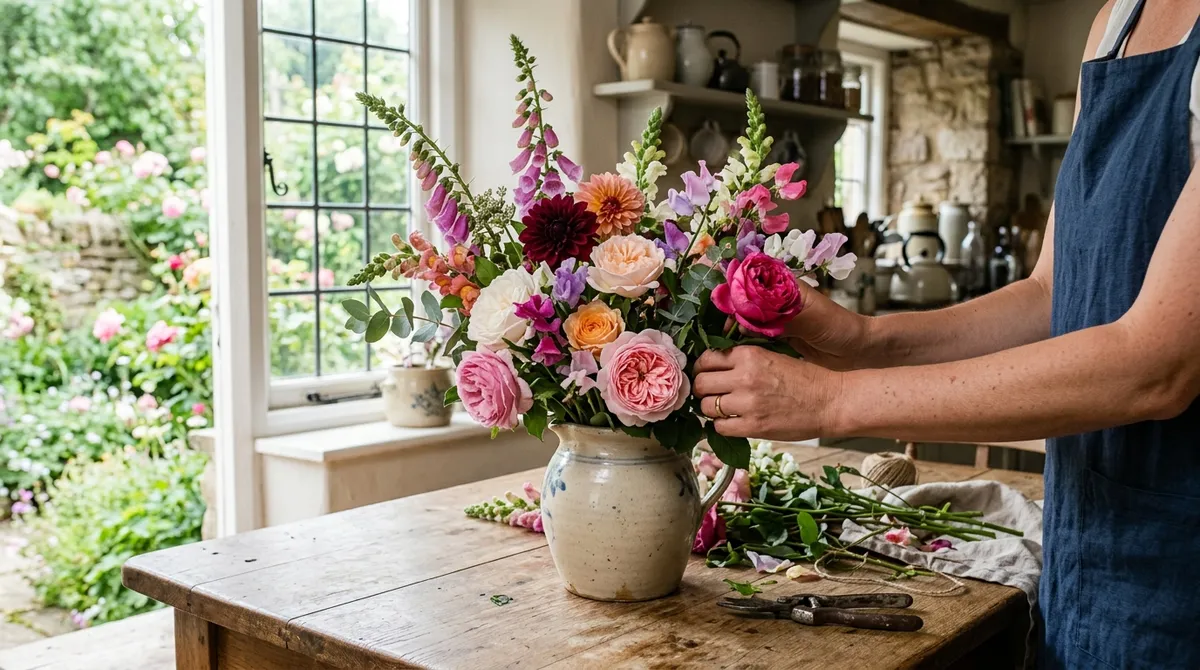
A finished arrangement using the tall-medium-filler method. Foxgloves and delphiniums set the height, roses and dahlias provide focal colour, cosmos and sweet peas fill the gaps.
Which flowers can you cut each month in the UK?
A well-planted cutting garden produces stems from April to November in most UK regions. The table below shows what is available each month. Growing a mix of spring flowers, summer annuals, and autumn perennials ensures you never have a month without material.
| Month | Focal Flowers | Fillers | Foliage |
|---|---|---|---|
| April | Tulips, daffodils | Forget-me-not, honesty | Pittosporum, rosemary |
| May | Peonies, alliums | Cow parsley, aquilegia | Euphorbia, lady’s mantle |
| June | Roses, sweet peas | Ammi, nigella | Eucalyptus, mint |
| July | Dahlias, lilies | Cosmos, feverfew | Pittosporum, fennel |
| August | Dahlias, gladioli | Cosmos, scabious | Eucalyptus, rosemary |
| September | Dahlias, asters | Cosmos, verbena | Cotinus, berries |
| October | Chrysanthemums | Amaranth, grasses | Rosehips, ivy |
| November | Chrysanthemums | Dried hydrangeas | Holly, evergreens |
Use the flower planting calendar to plan sowings so each month has fresh material ready to cut. Succession sowing cosmos every 3 weeks from April gives continuous flowers from July to October rather than one flush in August.
How do you make arrangements last longer?
Properly maintained arrangements last 7-10 days at room temperature. Neglected arrangements wilt after 3-4 days regardless of how well you conditioned the stems. Daily maintenance takes less than 2 minutes and makes the difference.
Daily and bi-daily care
- Change the water every 2 days. Bacteria multiply rapidly in stale water above 20C, clogging stem vessels. Each water change should include fresh flower food.
- Re-trim stems by 2cm at every water change. A fresh angled cut re-opens the vessels.
- Remove spent blooms. Dead flowers release ethylene gas that accelerates wilting in neighbouring stems. Pull out any flower past its best immediately.
- Keep away from fruit. Ripening bananas, apples, and tomatoes release ethylene gas. A fruit bowl on the same table shortens arrangement life by 2-3 days.
- Avoid direct sunlight and radiators. Heat accelerates water loss through the petals. A cool hallway or north-facing windowsill is ideal.
Which flowers to remove first
Sweet peas fade after 4-5 days. Remove them and replace with fresh stems. Roses last 7-12 days and are usually the last to wilt. Dahlias sit between at 5-7 days. As shorter-lived flowers fade, replace them with fresh cuts from the garden. A good arrangement evolves over its lifespan rather than collapsing all at once.
What equipment do beginners need for flower arranging?
You need just four items: sharp secateurs, a clean bucket, a vessel, and flower food. Expensive tools, floral foam, pin frogs, and specialist wire are unnecessary for garden arrangements. Most of what florists stock is designed for commercial work with imported stems, not for home gardeners using fresh-cut garden flowers.
Essential equipment
| Item | Purpose | Cost |
|---|---|---|
| Bypass secateurs | Clean stem cuts without crushing | 8-25 |
| Bucket (10L) | Conditioning harvested stems | 3-5 |
| Ceramic jug or vase | Holding the finished arrangement | 5-20 |
| Flower food sachets | Extending vase life by 25-30% | 3-5 per box of 20 |
| Chicken wire (optional) | Stem support grid in wide vessels | 4-6 per roll |
Invest in sharp secateurs above everything else. Blunt secateurs crush stem cells, reducing water uptake by up to 30%. The best secateurs for UK gardeners start at around 8 for a basic bypass pair. Clean the blades with rubbing alcohol between cuts to prevent spreading bacterial infections between stems.
How do you grow a cutting garden for arranging?
A cutting garden of just 3m x 2m provides weekly bouquets from June to October. Dedicated cutting beds are not about display — they exist purely to produce stems for indoor arrangements. That means tight rows, heavy feeding, and regular harvesting with no guilt about stripping the bed bare.
Start with a sunny spot (6+ hours of direct sun) and well-drained soil. If your soil is heavy clay, add 5cm of garden compost dug in each autumn. For detailed layout plans, row spacing, and bed dimensions, the full cutting garden layout guide covers everything from a 6 sq m starter plot to an 18 sq m production bed.
First-year cutting garden plan
For your first season, grow these five easy flowers from seed:
- Cornflowers — sow direct outdoors March. No indoor sowing needed. Flowers June-September.
- Cosmos ‘Purity’ and ‘Dazzler’ — sow indoors late March, plant out May. Flowers July-October.
- Sweet peas — sow October or February under cover. Plant out April. Flowers June-September.
- Calendula — sow direct outdoors March-April. Flowers May-September.
- Nigella — sow direct outdoors March. Flowers June-August. Beautiful seed pods for dried arrangements.
Add dahlia tubers in year two for July-October focal flowers, and a row of perennial plants like astrantia and achillea for stems that return each year without replanting.
Feed the cutting bed every fortnight with a high-potash liquid fertiliser (tomato feed works well) once flowering starts. Heavy cutting depletes the plant’s energy reserves, and regular feeding replaces what harvesting takes away.
What are common flower arranging mistakes?
The biggest beginner mistake is skipping the conditioning step. Flowers placed straight from garden to vase lose 40% of their potential vase life. Four hours of deep-water conditioning is non-negotiable for any arrangement you want to last longer than 3 days.
Other frequent mistakes:
- Too few stem types. Arrangements with fewer than 4 types of stem look flat and monotonous. Aim for 5-8 types minimum: 2-3 focal flowers, 2-3 fillers, and 2-3 foliage varieties.
- No foliage. Arrangements without greenery look like they belong in a hospital. Foliage creates depth, fills gaps, and makes colours richer by contrast. The RHS recommends growing dedicated foliage plants alongside cut flowers.
- Even numbers. Three roses look more natural than two. Five dahlias work better than four or six. The eye finds odd groupings dynamic and even groupings static.
- Stems all the same length. Cut focal flowers at 3 different heights. Tall stems provide drama, medium stems fill the middle, and short stems spill over the vessel edge.
- Dirty vessels. Bacteria from a previous arrangement survive in unwashed vases and shorten the next arrangement’s life by 2-3 days. Scrub with hot soapy water and a bottle brush before every use.
- Overcrowding. Stems packed too tightly cannot drink. Leave space between stems for air circulation and water movement. If you cannot see through the arrangement at all, you have used too many stems.
Flower arranging from your own garden is one of the most satisfying skills a UK gardener can develop. Start small with a jug of cosmos and cornflowers, learn the conditioning basics, and build your confidence before attempting larger displays. The flowers are free, the results are immediate, and every arrangement teaches you something about colour, shape, and what your garden can produce.
Lawrie has been gardening in the West Midlands for over 30 years. He grows his own veg using no-dig methods, keeps a wildlife-friendly garden, and writes practical advice based on real UK growing conditions.