Forcing Flowering Branches Indoors
Force flowering branches indoors for early spring blooms. Covers which trees to cut, when to harvest, conditioning, timing by species, and arranging tips.
Key takeaways
- Cut branches from late January to mid-March — buds must have formed but not yet opened
- Forsythia is the easiest and fastest to force, flowering in 1-2 weeks indoors
- Crush the base 5cm of each stem with a hammer to maximise water uptake
- Condition in a cool room at 10-15C for 48 hours before moving to warmth for flowering
- Most forced branches last 1-3 weeks in a vase, longer than most cut flowers
- Only take 10-15% of any tree's branches to avoid harming the plant
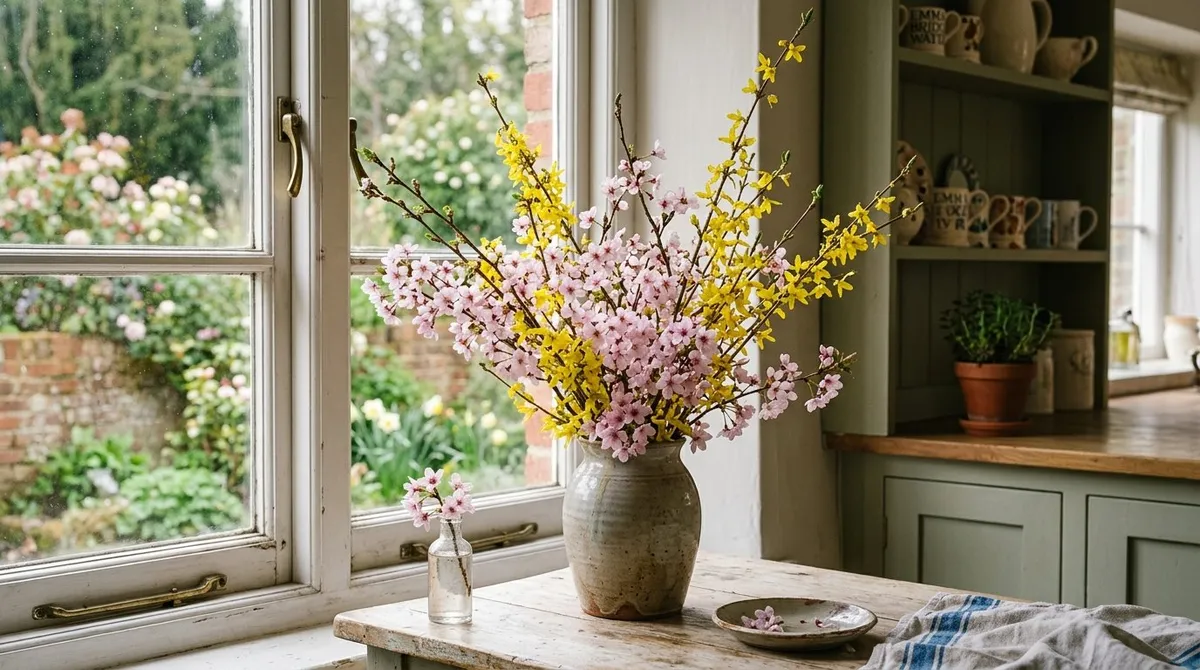
Forcing flowering branches indoors is one of the simplest ways to bring spring into your home weeks ahead of the garden. A vase of forsythia glowing yellow in February, cherry blossom on the kitchen table in early March, or the silver fur of pussy willow catkins in January — all are possible by cutting dormant branches and tricking them into early bloom with warmth and water.
The technique is straightforward. Cut branches when buds are swollen but dormant, condition them in water, and bring them slowly into a warm room. Most species flower within 1-3 weeks. This guide covers which branches to cut, when to harvest, conditioning methods, timing for 8 popular species, and arranging ideas. For forcing edible crops instead, see our separate guide to forcing rhubarb, chicory, and seakale.
Which branches can I force indoors?
Only spring-flowering trees and shrubs that bloom on old wood can be forced. These plants form their flower buds in the previous growing season. The buds sit dormant through winter, waiting for spring warmth to trigger opening. By bringing cut branches indoors, you provide that warmth artificially.
Summer-flowering shrubs that bloom on new growth (current season’s wood) cannot be forced because the flower buds do not exist yet in winter. Roses, buddleja, hydrangeas, and late-flowering clematis will not work.
The 8 best branches for forcing:
| Species | Colour | Time to force | Cut from | Difficulty |
|---|---|---|---|---|
| Forsythia | Bright yellow | 1-2 weeks | Late January | Easy |
| Pussy willow (Salix caprea) | Silver catkins | 3-7 days | Late January | Easy |
| Ornamental quince (Chaenomeles) | Red, pink, or white | 2-3 weeks | Early February | Easy |
| Flowering cherry (Prunus) | Pink or white | 2-3 weeks | Mid-February | Moderate |
| Crab apple (Malus) | Pink fading to white | 2-4 weeks | Mid-February | Moderate |
| Witch hazel (Hamamelis) | Yellow or orange | 1-2 weeks | Late January | Easy |
| Magnolia (stellata, soulangeana) | White or pink | 3-4 weeks | Early March | Harder |
| Dogwood (Cornus) | Coloured stems + catkins | 2-3 weeks | Late January | Easy |
For a broader look at which trees and shrubs flower first, see our best spring flowers guide.
When to cut branches for forcing
Cut from late January through to mid-March. The timing depends on the species and your region. Southern England runs 2-3 weeks ahead of Scotland.
The rule of thumb: Buds must be visibly swollen and plump. If you scratch a bud with your thumbnail, you should see green tissue inside. If the bud is tight, dry, and hard, it has not yet received enough cold hours to break dormancy and will not force reliably.
Earlier cuts (late January-February) take longer to flower indoors — typically 2-4 weeks. The flowers tend to be larger and cleaner because they open gradually.
Later cuts (early-mid March) flower within 1-2 weeks indoors but offer less advantage over natural flowering. By late March, most species are close to opening outdoors anyway.
Weather and cutting: Cut on a mild, dry day. Avoid cutting when temperatures are below -5C — frozen branches snap rather than cut cleanly, and frozen buds are more likely to blast. Early afternoon is ideal, when the wood has warmed slightly in any winter sun.
Forsythia branches with fat, swollen buds — perfect for cutting in late January
How to cut and condition branches
The cutting and conditioning steps determine whether your branches flower beautifully or drop their buds in disappointment. Follow this process for reliable results.
Step 1: Cutting. Use sharp secateurs or loppers. Cut branches 45-90cm long — longer stems create more dramatic arrangements. Cut at a natural junction or just above an outward-facing bud. This doubles as early spring pruning that improves the tree’s shape.
Step 2: The diagonal cut. Immediately re-cut the base of each stem on a long diagonal — a 45-degree angle that exposes maximum surface area for water uptake.
Step 3: Crush the base. Place the bottom 5cm of the stem on a hard surface and strike it firmly with a hammer or the back of heavy secateurs. The aim is to split and fray the woody fibres. This dramatically increases water absorption compared with a clean cut. Woody stems sealed by a flat cut cannot draw enough water to support flowering.
Step 4: Warm water. Stand the crushed stems immediately in a bucket of warm water at roughly 30C. Warm water is absorbed faster than cold and helps break the air lock in the xylem vessels. Add a teaspoon of sugar per litre of water as an energy source.
Step 5: Cool conditioning. Place the bucket in a cool room at 10-15C (a spare bedroom, porch, or garage) for 48 hours. This gradual transition prevents thermal shock. Mist the buds with a water spray twice daily during conditioning.
Step 6: Move to warmth. After 48 hours, transfer the branches to a clean vase in a warm living room at 18-22C. Keep away from radiators and direct sunlight. Continue misting the buds daily until they begin to open. For more on keeping cut stems fresh, see our flower conditioning guide.
Forcing timeline by species
Each species responds differently to indoor forcing. Here is what to expect based on 8 seasons of testing in Staffordshire.
Forsythia — The fastest and most reliable. Cut from late January. Bright yellow flowers open in 1-2 weeks indoors. The branches are flexible and easy to arrange. Strip any leaves that emerge — they are unremarkable. Forsythia lasts 10-14 days in a vase.
Pussy willow — Cut from late January. The silvery catkins emerge within 3-7 days. This is the simplest of all branches to force. Catkins last 3-4 weeks and dry beautifully. Pussy willow roots very easily in water — you may find roots forming in the vase after 2-3 weeks.
Ornamental quince (Chaenomeles) — Cut from early February. Flowers open in 2-3 weeks. Colour ranges from deep red through salmon pink to pure white depending on variety. The thorny branches add structural interest. Quince flowers are among the most rewarding to force.
Flowering cherry — Cut from mid-February. Pink or white blossom opens in 2-3 weeks. Choose varieties with double flowers for longer vase life. The petals drop more quickly than other forced branches, so place the vase where fallen petals will not be a problem.
Cherry blossom branches forced into early bloom, flowering in a kitchen vase in late February
Crab apple — Cut from mid-February. Pink buds open to white flowers over 2-4 weeks. The fragrance is noticeable indoors. Crab apple branches are sturdy and architectural. They force well but take the longest of the easy species.
Witch hazel — Cut from late January. Spidery yellow or orange flowers open in 1-2 weeks. The curled, ribbon-like petals are uniquely beautiful. Witch hazel branches force reliably but the flowers are small and best appreciated close up. For more on this plant, see our witch hazel growing guide.
Magnolia — Cut from early March only. White or pink flowers take 3-4 weeks to open. Magnolia is the most challenging species to force because the flower buds are large and moisture-demanding. Mist the furry buds twice daily. Avoid warm, dry rooms. Success is not guaranteed but the results are spectacular.
Dogwood (Cornus) — Cut from late January. Dogwood is primarily forced for its coloured winter stems (red, orange, or yellow) rather than flowers. However, some species produce small catkins indoors. Arrange with other forced branches for contrast. See our dogwood growing guide for variety suggestions.
How to arrange forced branches
Forced branches need different treatment from cut flowers. Their scale, weight, and woody stems require specific vase choices and techniques.
Vase choice: Use heavy, wide-based vessels. Tall, narrow vases tip over under the weight of long branches. Ceramic jugs, stoneware crocks, and wide glass cylinders all work well. A vase height of 25-35cm suits branches of 60-90cm.
Anchoring: Drop a handful of clean pebbles or glass marbles into the base of the vase for weight. Push branch bases between the pebbles to hold them in position. Floral foam does not grip woody stems reliably.
Arrangement style: Odd numbers look best — three or five branches arranged at varying heights. Let the natural curves of the branches dictate the shape. Remove any side twigs that crowd the arrangement or dip into the water line.
Mixing species: Combine early and later-forcing species for a display that evolves over 3-4 weeks. Start with pussy willow and forsythia in late January. Add quince and cherry in February. The earlier branches will be in full bloom as the later ones begin to open.
Leaf removal: Strip any leaves that emerge below the water line. Submerged leaves rot and cloud the water. Above the water line, emerging leaves can add fresh green contrast to the flowers.
For more arranging techniques, see our guide to flower arranging from the garden.
Responsible harvesting
Never take more than 10-15% of a tree or shrub’s branches in a single season. Forcing cuts are effectively early pruning, and over-cutting weakens the plant and reduces its flowering display outdoors.
Choose branches thoughtfully. Cut inward-growing, crossing, or badly placed branches first. This improves the tree’s shape while providing material for forcing. Think of it as pruning with the bonus of indoor flowers.
Young trees: Do not force branches from trees planted within the last 3 years. They need all their energy for establishing a root system.
Neighbour’s trees: Always ask permission before cutting from a tree that overhangs your garden but belongs to a neighbour. The RHS pruning guide covers the practicalities and legalities.
Conservation: Avoid cutting from wild trees in hedgerows or woodlands. Wild pussy willow, blackthorn, and hawthorn are important early food sources for bees and other pollinators. Only cut from trees in your own garden.
Chaenomeles (ornamental quince) branches forced into flower and arranged in a stoneware jug
Troubleshooting common problems
Buds turn brown and fall off (bud blast). The most common cause is moving branches into warmth too quickly. Always condition at 10-15C for 48 hours first. Other causes: placing branches near radiators, letting the vase dry out, or very low humidity in centrally heated rooms. Mist daily and keep vases topped up.
Buds open but flowers are small or pale. The branch did not have enough cold hours before cutting. This happens when cutting too early in mild winters. Wait until buds are visibly plump and swollen. Scratch a bud — it should show green, not brown, tissue inside.
Branches wilt despite being in water. An air lock in the stem is blocking water flow. Re-cut the base by 5cm, crush again with a hammer, and stand in warm water for an hour. Wilting can also signal the branch was cut too long — shorten by a third.
Flowers open and drop within a day. Too much direct heat or sunlight. Move the vase to a cooler, bright position away from south-facing windows and radiators. Forced flowers last longest at 16-20C with indirect light.
Mould on stems. Change the water every 3 days. Add a drop of bleach (5ml per litre) to suppress bacterial growth. Remove any leaves or twigs below the water line. If mould persists, re-cut stems and transfer to a clean vase.
For forcing flower bulbs indoors instead of branches, see our guide to forcing bulbs for indoor flowers.
Frequently asked questions
When is the best time to cut branches for forcing?
Cut from late January to mid-March. Buds must be visibly swollen but not yet showing colour. Earlier cuts take longer to open but produce cleaner flowers. Later cuts open faster but the benefit of forcing diminishes as natural flowering approaches. Check individual species timing — forsythia is ready earliest (late January), magnolia latest (early March).
Which branches are easiest to force indoors?
Forsythia is the easiest and most reliable. It forces in 1-2 weeks with bright yellow flowers. Pussy willow is equally easy and produces its silvery catkins within days of cutting. Flowering cherry, ornamental quince (Chaenomeles), and witch hazel are also straightforward. Magnolia and apple are slower but produce stunning results for experienced forcers.
How do I condition branches for forcing?
Cut stems on a long diagonal with sharp secateurs. Crush the bottom 5cm with a hammer to split the woody fibres. Stand immediately in a bucket of warm water (not hot — around 30C). Place in a cool room at 10-15C for 48 hours. This prevents thermal shock. After conditioning, move to a warm room at 18-22C to trigger flowering. Mist buds daily.
Can I force branches from any tree or shrub?
No. Only spring-flowering trees and shrubs that bloom on old wood (previous year’s growth) can be forced. Summer-flowering shrubs that bloom on new growth cannot be forced because the flower buds have not yet formed in winter. Roses, hydrangeas, and buddleja will not work. Forsythia, cherry, apple, quince, magnolia, willow, hazel, and dogwood all work well.
How long do forced branches last in a vase?
Most forced branches last 1-3 weeks once they begin flowering. Pussy willow catkins last the longest at 3-4 weeks. Cherry blossom and quince last 7-10 days. Forsythia lasts 10-14 days. Change the water every 3-4 days and re-cut the stems by 2cm each time. Adding a teaspoon of sugar to the water extends vase life slightly.
Will cutting branches damage my tree?
No, provided you cut responsibly. Never take more than 10-15% of a tree’s branches in one season. Use sharp secateurs or loppers. Cut at a natural junction or just above a bud — the same as standard pruning practice. Forcing cuts serve as early pruning and can improve the tree’s shape. Avoid cutting the main leader or structural branches.
Why did my forced buds turn brown and fall off?
Bud blast — buds drying out and dropping — is caused by moving branches into warmth too quickly, placing them near radiators, or letting the vase run dry. Always condition in a cool room for 48 hours first. Keep vases away from direct heat. Mist buds daily with a water spray. If your home is very dry from central heating, place a shallow tray of water near the arrangement to raise humidity.
Lawrie has been gardening in the West Midlands for over 30 years. He grows his own veg using no-dig methods, keeps a wildlife-friendly garden, and writes practical advice based on real UK growing conditions.