Key takeaways
- Witch hazel flowers on bare branches from December to March when almost nothing else blooms
- Hardy to minus 20 degrees C, suitable for all UK regions including exposed northern gardens
- Requires acid to neutral soil (pH 5.5-7.0) and will not tolerate chalk or limestone
- 'Jelena' (copper-orange) and 'Pallida' (sulphur-yellow) are the two most reliable UK varieties
- Needs virtually no pruning and reaches 3-4m tall and wide in 15 years
- Autumn foliage rivals Japanese maples for colour intensity in shades of orange, red, and gold
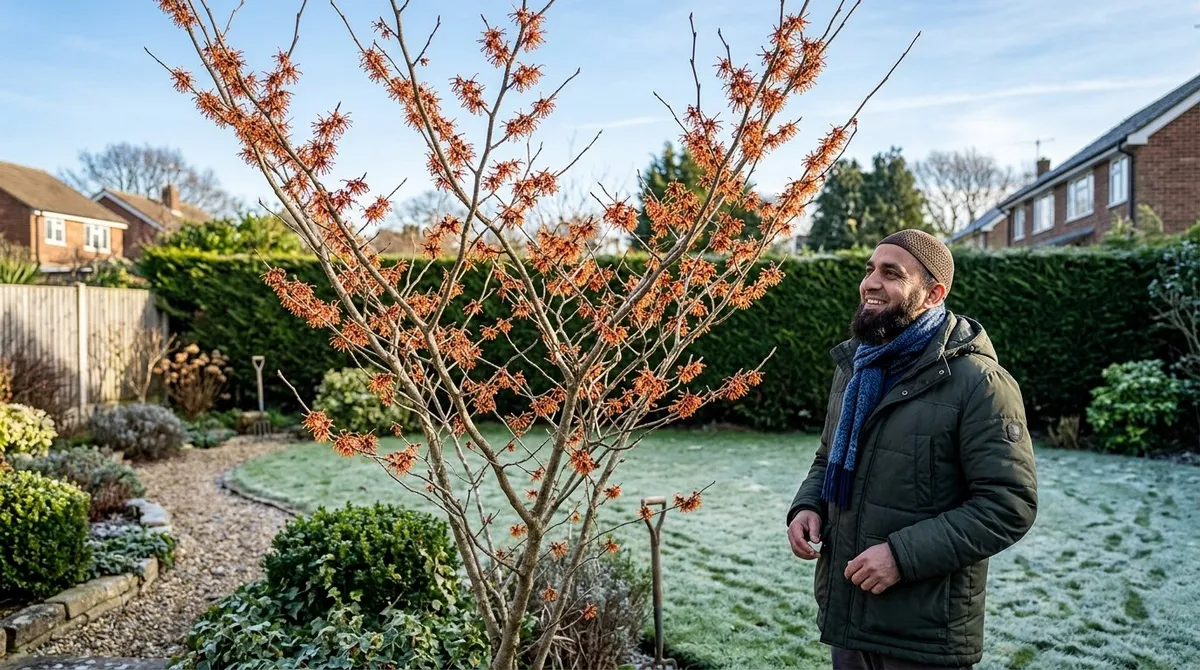
Witch hazel is the most spectacular winter-flowering shrub you can grow in a British garden. While other plants sit dormant from December to March, Hamamelis produces clusters of spidery, fragrant flowers on completely bare branches. The effect against a cold blue sky or frosty lawn is striking. Few plants deliver this level of impact during the darkest months of the year.
Beyond winter flowers, witch hazel earns its place with some of the finest autumn foliage of any garden shrub. The large leaves turn intense shades of orange, crimson, and gold before falling. This is a plant that gives two peak seasons from a single specimen. It needs acid to neutral soil, a sheltered spot, and almost no maintenance. This guide covers everything from choosing the right species to planting, pruning, and the best companion plants for winter-flowering gardens.
What types of witch hazel can you grow in the UK?
Three species and one hybrid group account for nearly all witch hazel grown in British gardens. Each has distinct characteristics worth understanding before you buy.
Chinese witch hazel (Hamamelis mollis)
Chinese witch hazel is the most intensely fragrant species. The flowers are pure golden yellow with a sweet, spicy scent that carries several metres on still winter air. Native to central China, it was introduced to Britain in 1879 and has proved fully hardy across all UK regions. Plants reach 3-4m tall and wide in 15 years. The large, rounded leaves turn butter yellow in autumn.
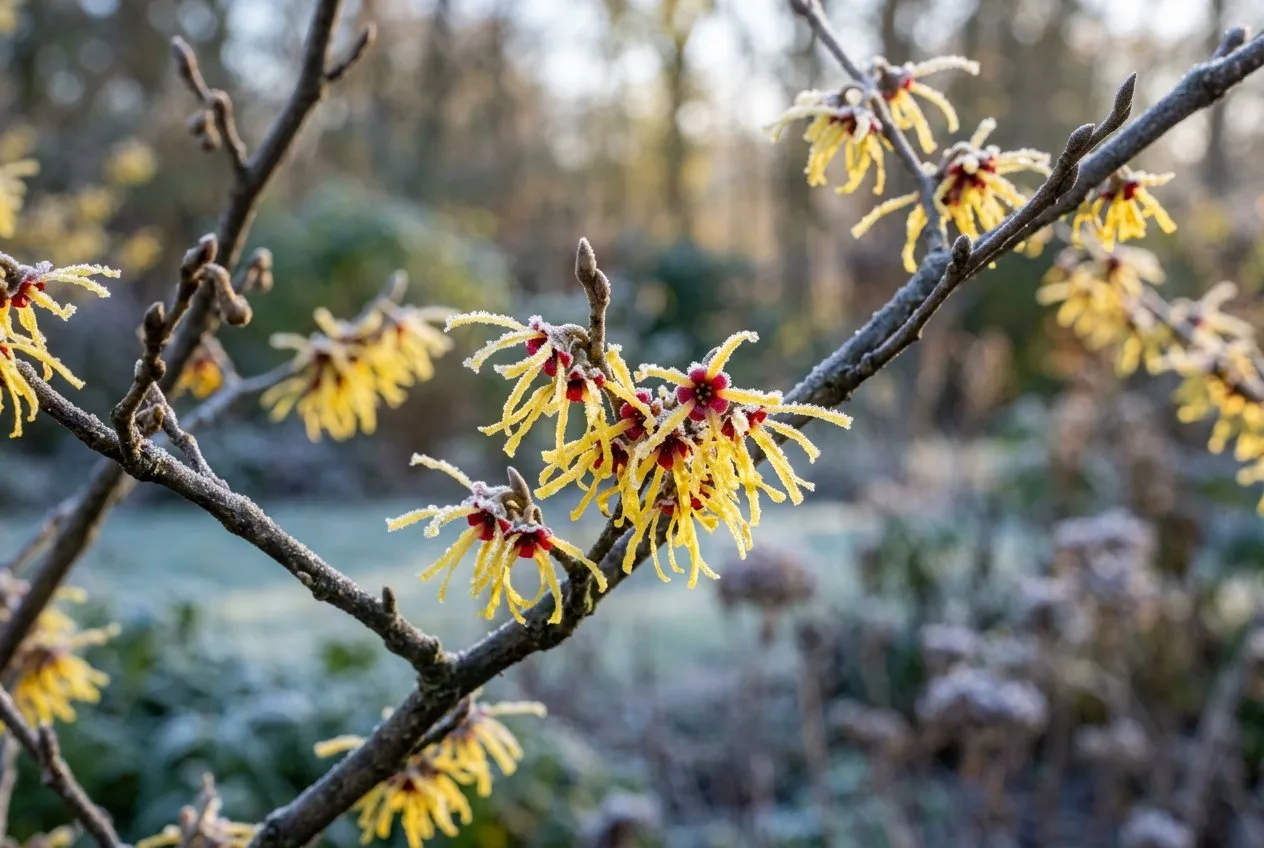 Hamamelis mollis flowers with their characteristic spidery yellow petals and red centres, photographed on a frosty January morning
Japanese witch hazel (Hamamelis japonica)
Japanese witch hazel produces smaller, more twisted petals than the Chinese species. The flowers are pale yellow, sometimes with a reddish flush at the base. Scent is lighter than H. mollis. It is less commonly planted in UK gardens because the hybrid group (H. x intermedia) offers better flower colour, stronger scent, and superior autumn foliage. Japanese witch hazel is fully hardy to minus 20 degrees C.
Hybrid witch hazel (Hamamelis x intermedia)
Hybrid witch hazel is a cross between H. mollis and H. japonica. This is the group that produces the widest range of flower colours, from pale yellow through copper-orange to deep red. Nearly all named garden varieties belong here. The hybrids combine the strong scent of the Chinese parent with the compact habit of the Japanese species. They are fully hardy, reaching 3-4m in 15 years, and produce outstanding autumn colour in shades of orange, red, and gold.
Virginian witch hazel (Hamamelis virginiana)
Virginian witch hazel is the species used in herbal medicine and skincare products. It flowers in autumn (October to November) rather than winter, which makes it less useful for winter garden interest. The small yellow flowers are often hidden by the autumn foliage. It is a larger plant, reaching 5-6m, and tolerates a wider range of soil conditions than the Asian species. Grow it if you want the medicinal plant, but choose H. x intermedia for garden display.
Best witch hazel varieties for UK gardens
Named varieties of Hamamelis x intermedia are grafted onto H. virginiana rootstock. Grafted plants cost more (typically 40-60 pounds for a 60-80cm plant) but flower within 2-3 years. Seed-grown plants are unpredictable in colour and can take 6-8 years to produce flowers.
Jelena
Pallida
The finest yellow-flowered witch hazel. Large, sulphur-yellow flowers with a strong, sweet fragrance that is the best of any cultivar. Flowers from December to February, often the earliest of the hybrids. Autumn foliage turns clear golden yellow. Reaches 3m in 15 years. RHS AGM holder. If you want maximum scent, choose ‘Pallida’.
Diane
The deepest red witch hazel widely available in the UK. Dark crimson-red flowers open from January to March. Scent is lighter than ‘Pallida’ or ‘Jelena’. Autumn colour is outstanding, with leaves turning rich red and orange-red. Reaches 3m in 15 years. The dark flowers show best against a pale background such as a white wall or light-coloured evergreen hedge.
Arnold Promise
Bright golden-yellow flowers from February to March, slightly later than ‘Pallida’. A vigorous grower reaching 4m, making it the largest of the commonly grown hybrids. Good autumn colour in shades of orange and red. Developed at the Arnold Arboretum in Massachusetts and well-suited to cold, exposed UK gardens.
Aphrodite
A newer cultivar with large flowers in rich orange-red. Flowers from January to March with a good sweet scent. Autumn foliage turns vibrant orange-red. Reaches 3m in 15 years. Less widely available than the older varieties but increasingly stocked by specialist nurseries. Worth seeking out for its exceptionally large individual flowers.
Variety comparison table
| Variety | Flower colour | Peak flowering | Scent strength | Autumn colour | Mature height | AGM |
|---|---|---|---|---|---|---|
| Jelena | Copper-orange | Jan-Mar | Good | Orange, crimson, scarlet | 3.5m | Yes |
| Pallida | Sulphur-yellow | Dec-Feb | Excellent | Golden yellow | 3m | Yes |
| Diane | Dark crimson-red | Jan-Mar | Light | Red, orange-red | 3m | Yes |
| Arnold Promise | Golden-yellow | Feb-Mar | Good | Orange, red | 4m | Yes |
| Aphrodite | Orange-red | Jan-Mar | Good | Orange-red | 3m | No |
How to plant witch hazel
Correct planting position and soil preparation determine long-term success with witch hazel. Get these right and the plant will thrive for decades with almost no intervention.
Choosing the right position
Witch hazel needs a sheltered spot out of cold, drying winds. Wind damages the delicate flowers and reduces scent carry. East-facing positions are risky because morning sun after frost thaws frozen buds too quickly, causing petal damage. West or south-facing positions are ideal. Light dappled shade is acceptable, but 4-6 hours of direct sun per day produces the best flowering and autumn colour.
Plant where you will see it from a window during winter. The flowers are at their best viewed against dark backgrounds such as evergreen hedges, conifers, or dark fencing. A specimen planted 3-4m from a frequently used window makes a daily centre piece from December to March.
Soil requirements
Acid to neutral soil (pH 5.5-7.0) is essential. Witch hazel will not grow in chalk or alkaline conditions. On alkaline soil, the leaves develop interveinal chlorosis (yellowing between the veins) and the plant gradually declines. Test your soil pH before buying. Most garden centres sell simple pH test kits for under two pounds.
The ideal soil is moist but well-drained, rich in organic matter. Witch hazel grows naturally in woodland edge conditions with deep, humus-rich soil. Heavy clay is fine provided it is acid or neutral. Sandy soil works if you add organic matter to retain moisture. Thin, dry soil over chalk is the one condition that will kill witch hazel.
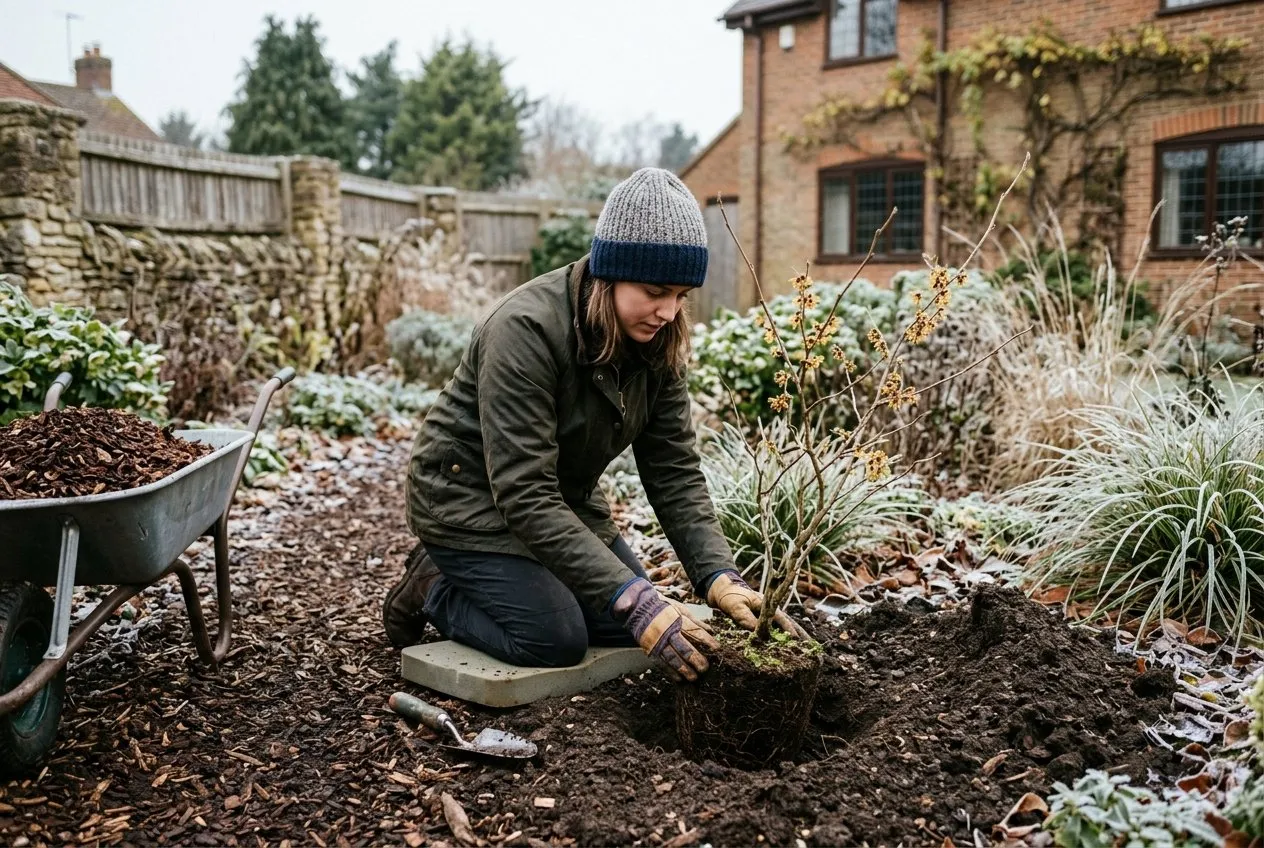 Planting a young witch hazel in a prepared border in winter, the ideal time for bare-root and container-grown plants
Planting method
Dig a hole twice the width of the root ball but no deeper. Hamamelis is grafted, so the graft union (a swollen point near the base of the stem) must sit at or just above soil level. If buried, the rootstock can produce suckers that overwhelm the grafted variety.
Mix the excavated soil with 25-30% leaf mould or ericaceous compost. Backfill, firm gently, and water well with two full watering cans (approximately 18 litres). Apply an 8-10cm mulch of bark chips or leaf mould around the base, keeping it 5cm clear of the stem.
When to plant
Plant from October to March while the plant is dormant. Autumn planting (October to November) is ideal because roots establish before the ground cools fully. Container-grown plants can be planted at any time, but avoid midsummer drought and frozen ground. Water new plants weekly through their first summer if rainfall is below 25mm per week. Witch hazel also makes an excellent choice for gardens designed around trees with outstanding autumn colour.
Caring for witch hazel
Once established, witch hazel is one of the lowest-maintenance shrubs you can grow. It asks very little beyond an annual mulch.
Watering
Water new plants regularly through their first two summers. Established plants cope with normal UK rainfall. During prolonged dry spells (3 or more weeks without rain), give a thorough soak of 15-20 litres per plant. Witch hazel prefers consistently moist soil but tolerates short dry periods.
Feeding
Witch hazel rarely needs feeding in good soil. On poorer ground, apply a light dressing of ericaceous fertiliser in April. A 5cm annual mulch of leaf mould provides slow-release nutrients and maintains soil acidity. Avoid alkaline mulches such as mushroom compost, which raises soil pH over time.
Pruning
Witch hazel needs virtually no pruning. This is one of its greatest advantages. Remove dead, damaged, or crossing branches in late spring (April to May) after flowering finishes. Use clean, sharp secateurs. If you need to reduce size, remove one or two complete branches at the base rather than shearing or hedging. Hard pruning causes dieback and spoils the natural vase-shaped habit. For general pruning principles, see our guide to how to prune shrubs.
Removing rootstock suckers
Watch for suckers emerging from below the graft union. These are vigorous H. virginiana shoots that will outcompete the grafted variety if left. Suckers have smaller, rounder leaves than the grafted cultivar. Pull them off at the base rather than cutting, which encourages regrowth. Check two or three times per year during the growing season.
Autumn colour from witch hazel
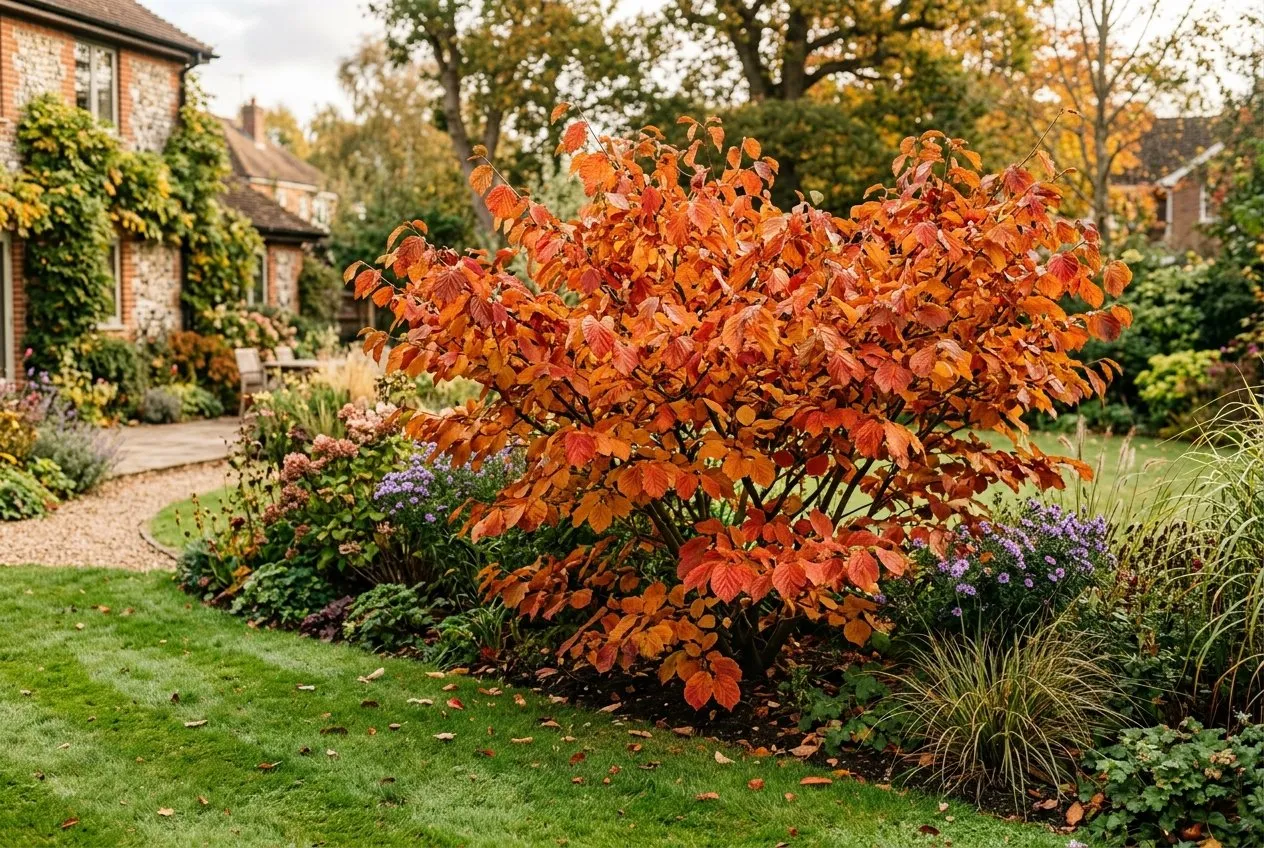 Hamamelis x intermedia in full autumn colour, rivalling Japanese maples for intensity
Witch hazel produces some of the most striking autumn foliage of any garden shrub. The large, rounded leaves turn vivid shades of orange, red, crimson, and gold from late October. The colour lasts 3-4 weeks before the leaves drop, revealing the bare branch structure that will carry winter flowers. This makes witch hazel a genuine dual-season plant. It earns its garden space twice over.
Best varieties for autumn colour
‘Jelena’ produces the most dramatic autumn display, with leaves passing through orange, copper, crimson, and scarlet. ‘Diane’ turns deep red and claret. ‘Pallida’ offers clear golden-yellow. ‘Arnold Promise’ gives a mix of orange and red. For the best autumn impact, plant witch hazel where low afternoon sun backlights the foliage. The translucent leaves glow when lit from behind. If autumn foliage is a priority, combine witch hazel with acers and amelanchier for a display that lasts from late September through November.
Companion plants for winter interest
Witch hazel sits naturally in a winter garden scheme. Surround it with plants that provide ground-level interest while the hamamelis flowers overhead.
Snowdrops (Galanthus nivalis) carpet the ground from January to March, flowering at exactly the same time. Winter aconites (Eranthis hyemalis) add golden-yellow ground cover from February. Hellebores (Helleborus x hybridus) provide flowers from January to April in shades of white, pink, purple, and green.
For evergreen structure, Sarcococca confusa (sweet box) offers glossy foliage and intensely fragrant white flowers in January. Mahonia x media ‘Charity’ provides yellow flower spikes from November to January. For another deciduous winter performer with the same bare-branch flowering habit, pair it with wintersweet (Chimonanthus), whose waxy yellow blooms carry one of the strongest scents in the winter garden. These companions create a winter garden that holds interest from November right through to April. Browse our full guide to the best winter-flowering plants for UK gardens for more ideas.
Witch hazel’s preference for acid soil also makes it a natural companion for rhododendrons, camellias, and pieris. All share the same soil requirements. A border built around these acid-loving plants creates year-round interest: witch hazel in winter, camellias and pieris in spring, and rhododendrons in late spring. See our guide to the best plants for acid soil for more options.
Common mistakes when growing witch hazel
Most witch hazel failures trace back to soil pH. Understanding these pitfalls saves expensive plants from early death.
Planting in alkaline soil
The single most common mistake. Witch hazel cannot tolerate a pH above 7.0. Symptoms include yellowing leaves with green veins (chlorosis), poor growth, sparse flowers, and eventual death over 2-4 years. Always test soil pH before buying.
Planting too deep
Burying the graft union encourages rootstock suckers and can cause bark rot at the base. Set the top of the root ball level with the soil surface. On heavy clay, plant 2-3cm proud of the surrounding soil.
Hard pruning
Witch hazel does not respond well to heavy cutting. Shearing or drastic reduction causes dieback and destroys the natural habit. If size reduction is needed, remove entire branches at the base over 2-3 years.
Exposed windy sites
Cold, drying winds damage the delicate winter flowers and strip scent. Plant in a sheltered position. A hedge, wall, or fence on the prevailing wind side makes a significant difference to flower quality and longevity.
Buying seed-grown plants
Cheap, unnamed witch hazel plants from garden centres are often seed-grown. These are unpredictable in flower colour and can take 6-8 years to bloom. Always buy named, grafted varieties from specialist nurseries. The higher cost (40-60 pounds versus 10-15 pounds) is repaid with guaranteed colour and flowering within 2-3 years.
Month-by-month witch hazel care
| Month | Task |
|---|---|
| January | Enjoy flowers. No action needed. |
| February | Peak flowering month for most varieties. |
| March | Flowering continues. Plant new specimens. |
| April | Remove dead or crossing branches after flowering ends. Apply ericaceous fertiliser if needed. |
| May | Top up mulch to 8-10cm depth with bark or leaf mould. |
| June | Water newly planted specimens if dry. Established plants need nothing. |
| July | Continue watering first-year plants in dry spells. |
| August | No action. Check for rootstock suckers and remove. |
| September | Check for rootstock suckers. Plant new specimens from late September. |
| October | Autumn colour begins. Plant new specimens. |
| November | Leaves drop. Plant new specimens. |
| December | Early varieties begin flowering. Enjoy the scent. |
Frequently asked questions
When is the best time to plant witch hazel in the UK?
Plant from October to March while dormant. Autumn planting (October to November) is ideal because roots establish before the ground cools fully. Container-grown specimens can go in at any time of year, but avoid midsummer drought and frozen ground. Water well at planting and mulch with 8-10cm of bark or leaf mould to retain moisture and suppress weeds.
Will witch hazel grow in clay soil?
Clay soil suits witch hazel if the pH is acid to neutral. Heavy clay retains the moisture that Hamamelis prefers. Dig in leaf mould or ericaceous compost to improve structure, and mulch annually with bark chips. The one condition clay must meet is a pH between 5.5 and 7.0. Alkaline clay over chalk or limestone will cause chlorosis and poor growth within 2-3 years.
Can I grow witch hazel in a container?
Witch hazel grows in a large pot for 5-8 years. Use a container at least 50cm in diameter and depth, filled with ericaceous compost mixed with 20% perlite for drainage. Water regularly through the growing season and feed fortnightly from April to August with ericaceous liquid fertiliser. Plan for a permanent garden position eventually, as the root system will outgrow any container.
Does witch hazel need pruning?
Witch hazel needs almost no pruning. Remove dead, damaged, or crossing branches in late spring after flowering finishes. Never hard-prune as it resents heavy cutting and regrows slowly. If you must reduce size, remove one or two entire branches at the base rather than shearing the whole plant. The natural vase-shaped habit is part of the plant’s beauty.
Why is my witch hazel not flowering?
Alkaline soil above pH 7.0 is the most common cause. Test your soil pH first. Other causes include insufficient sunlight (needs 4-6 hours daily), frost damage to buds on exposed sites, and immaturity. Seed-grown plants can take 6-8 years to flower, while grafted cultivars bloom within 2-3 years. Excessive nitrogen fertiliser also promotes leaf growth at the expense of flowers.
How fast does witch hazel grow in the UK?
Witch hazel grows 20-30cm per year in favourable conditions. A young plant reaches 2m in roughly 7 years and 3-4m in 15 years. Growth is slower than many garden shrubs, but the plant is exceptionally long-lived, reaching 40-50 years with minimal care. The slow growth rate is an advantage in small gardens. See our guide to the best trees for small gardens for more slow-growing options.
Is witch hazel toxic to pets or children?
Witch hazel is not toxic to dogs, cats, or children. The RHS lists Hamamelis with no known toxicity. The bark and leaves of Hamamelis virginiana have been used in herbal medicine for centuries. All parts of the ornamental garden hybrids (H. x intermedia) are completely safe around pets and young children.
Now you have mastered growing witch hazel, explore our guide to the best scented plants for UK gardens to build a year-round fragrance garden with witch hazel as the winter centrepiece.
Our team produces practical UK gardening guidance from source research, contributor records and established horticultural practice. Editorial standards are overseen by Matt W.