Holiday Watering Solutions for UK Plants
Holiday watering solutions to keep plants alive while you are away. Covers capillary matting, drip systems, water spikes, and DIY methods.
Key takeaways
- Most UK garden plants die within 3-7 days without water in summer, houseplants within 5-10 days indoors
- Capillary matting keeps pots up to 15cm moist for 5-7 days from a 10-litre reservoir tray
- A gravity-fed drip system waters 10-20 containers for up to 14 days and costs 30-50 pounds
- DIY bottle drippers cost nothing and sustain a single pot for 3-5 days in warm weather
- Grouping plants together and mulching with 5-7cm of bark reduces water loss by 30-50%
- A pre-holiday deep soak of 2-3 litres per 20cm pot extends survival by 48-72 hours
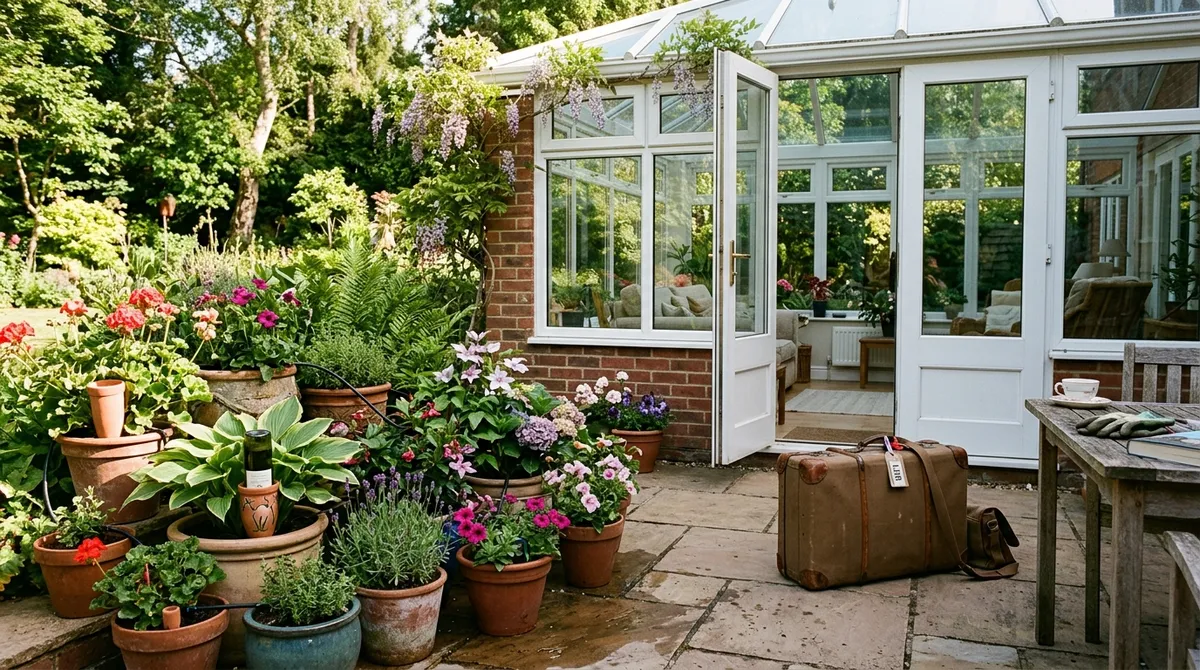
Holiday watering is the single biggest cause of plant loss for UK gardeners who travel between June and September. A week without water in summer kills most container plants, stresses border plantings, and can destroy an entire greenhouse crop. The good news is that reliable solutions exist at every budget, from free DIY methods to automated systems that handle a fortnight unattended.
This guide draws on six summers of holiday-tested methods in a Staffordshire garden. It covers every approach from bottle drippers to gravity-fed drip irrigation, with honest results on what works, what fails, and what each method actually costs.
How quickly do plants die without water in the UK?
The answer depends on plant type, container size, and temperature. Outdoor container plants on a south-facing patio lose moisture fastest because sun heats the pot walls and compost dries from all sides. A 20cm terracotta pot in direct sun loses its available moisture in 24-48 hours on a day above 25C.
Greenhouse plants face even worse conditions. Temperatures inside an unventilated greenhouse reach 40-50C on a sunny July afternoon. Tomatoes in 10-litre grow bags use 2-3 litres per plant per day. A week away means 14-21 litres of undelivered water per plant.
Houseplants survive longer because indoor temperatures are lower and evaporation is slower. Most indoor plants in 12-15cm pots last 5-10 days without water in a typical UK room at 18-22C. Succulents and cacti tolerate 2-4 weeks.
Open-ground borders cope better than containers. Established shrubs with roots 30-60cm deep access subsoil moisture. Mulched borders on clay soil survive 10-14 days without rain in a normal UK summer. Sandy soils dry out in 5-7 days.
| Plant situation | Survival without water (summer) | Risk level |
|---|---|---|
| Greenhouse tomatoes/cucumbers | 1-2 days | Critical |
| Terracotta pots in full sun | 1-3 days | Critical |
| Plastic containers on patio | 3-5 days | High |
| Houseplants in 12-15cm pots | 5-10 days | Medium |
| Hanging baskets | 1-2 days | Critical |
| Mulched borders on clay | 10-14 days | Low |
| Mulched borders on sand | 5-7 days | Medium |
| Succulents and cacti | 14-28 days | Low |
What are the best holiday watering methods?
Not all methods are equal. Some handle a weekend, others manage a fortnight. This comparison table ranks every common approach by duration, reliability, and cost so you can match the method to your trip length.
| Method | Duration covered | Reliability | Cost | Best for |
|---|---|---|---|---|
| Gravity drip irrigation | 7-14 days | 9/10 | 30-50 pounds | Greenhouse, patio containers |
| Mains drip with timer | Unlimited | 9/10 | 40-80 pounds | Large gardens, long holidays |
| Capillary matting | 5-7 days | 7/10 | 5-10 pounds | Small houseplants, herbs |
| Self-watering pots | 7-14 days | 8/10 | 8-25 pounds each | Individual statement plants |
| Water spikes/globes | 3-5 days | 5/10 | 1-3 pounds each | Short weekends, top-ups |
| DIY bottle dripper | 3-5 days | 4/10 | Free | Emergency, single pots |
| Neighbour/friend | Unlimited | Variable | Free (favour owed) | Complex gardens, greenhouses |
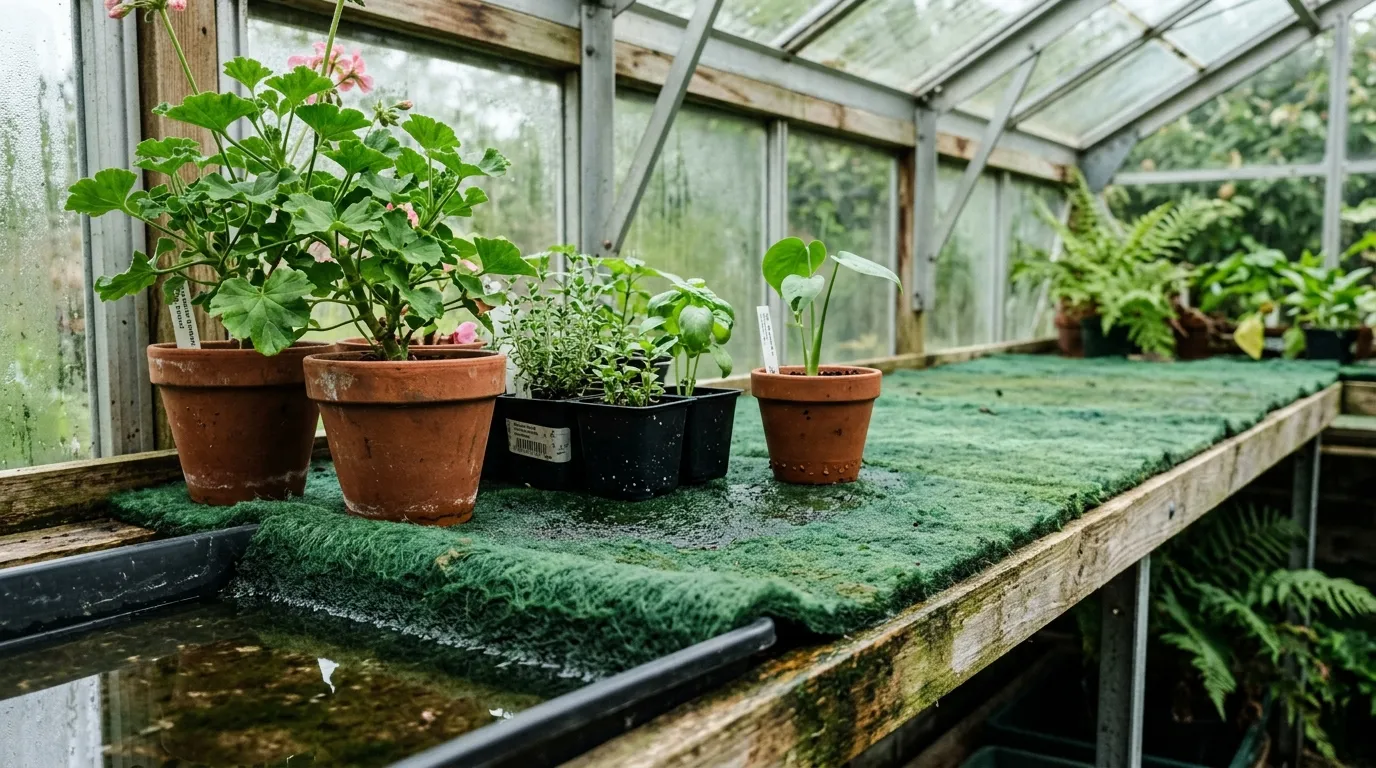 Capillary matting keeps 10-15 small pots alive for 5-7 days by wicking water from a reservoir tray placed at one end of the table.
How to set up drip irrigation for holidays
Drip irrigation is the gold standard for holiday watering. A gravity-fed system needs no electricity, no mains water, and handles a fortnight unattended.
Gravity-fed barrel systems
Raise a water barrel at least 1 metre above pot level on a sturdy shelf or stand. Connect 13mm main tubing from the barrel tap, then run 4mm spaghetti tubes to each pot with an adjustable dripper at the end. A 100-litre barrel feeding 15 drippers at 1-2 litres per hour provides one daily watering session for approximately 7 days. Link two barrels for 14 days.
A battery tap timer (15-30 pounds) opens the barrel valve once or twice daily for a set duration. This gives precise control over volume. Without a timer, a slow-release tap works but is harder to calibrate.
What a basic drip kit costs
| Component | Cost | Coverage |
|---|---|---|
| Battery tap timer | 15-30 pounds | 1 tap |
| 13mm main tubing (10m) | 4-7 pounds | Main run |
| 4mm spaghetti tubing (25m) | 3-5 pounds | 15-25 pots |
| Adjustable drippers (pack of 20) | 4-6 pounds | 20 pots |
| 100-litre barrel with stand | 20-40 pounds | 7-day supply |
| Complete starter kit | 30-50 pounds | Full greenhouse |
Why we recommend gravity-fed drip systems over mains timers for most UK gardeners: After testing both across six summer holidays, the gravity barrel is more reliable for the average greenhouse or patio setup. Mains timers depend on water pressure staying consistent, and I have seen two instances where a pressure drop from the water company during a heatwave reduced flow to a trickle. The gravity barrel delivers the same flow every time. The only downside is finite capacity, which two linked barrels solve for trips up to 14 days.
Testing before you travel
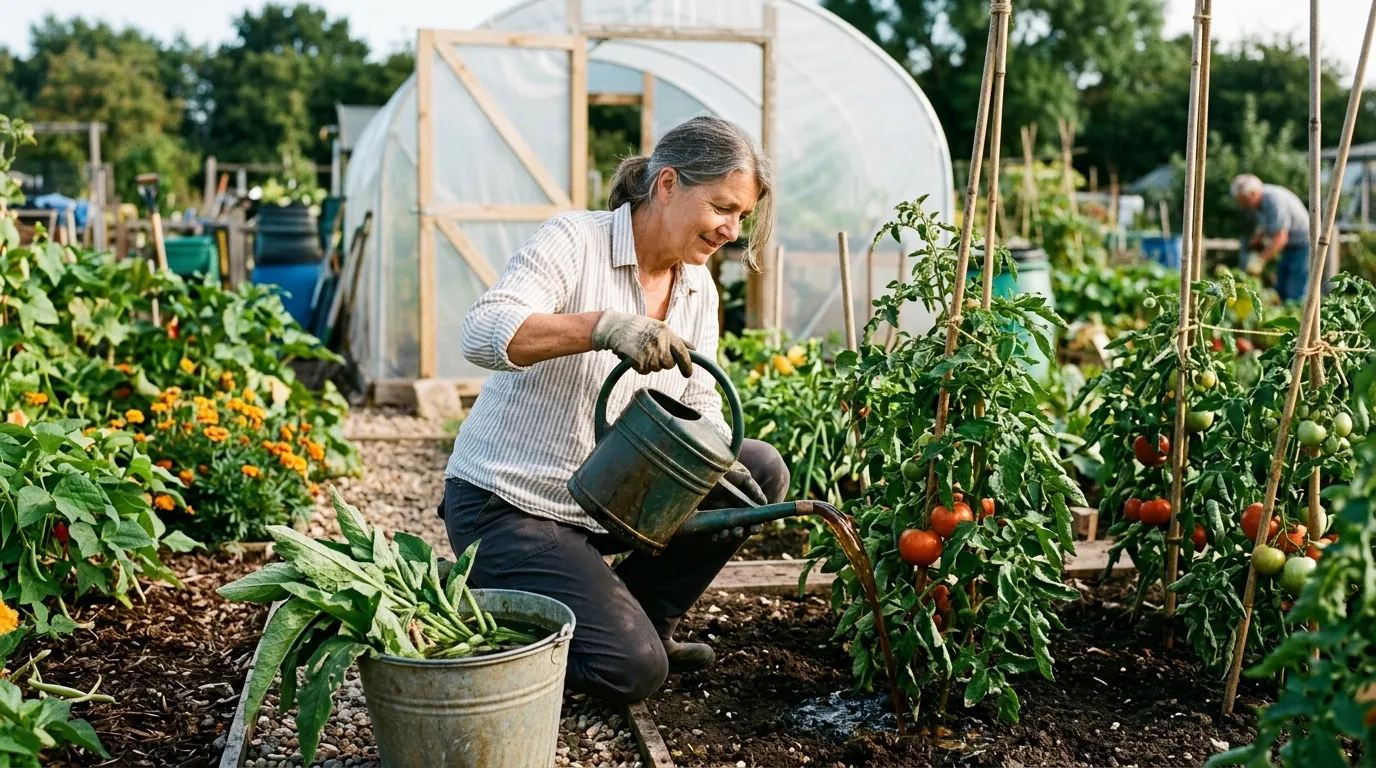
Run the system for 5-7 days before departure. Check every dripper daily. Look for blocked emitters (mineral deposits are the usual cause in hard water areas), leaking connections, and pots that are too wet or too dry. Adjust flow rates so each pot receives the right amount. A 10-litre tomato pot needs 1.5-2 litres daily. A 15cm herb pot needs 200-300ml.
How does capillary matting work for houseplants?
Capillary matting draws water from a reservoir through felt-like material by capillary action. Pots placed on the wet mat absorb moisture through their drainage holes. It is the simplest and cheapest method for houseplants and small herb pots.
Setting up a capillary mat station
- Place the mat on a flat, waterproof surface (kitchen table with a plastic sheet works)
- Drape one end into a water reservoir (a washing-up bowl holding 8-10 litres)
- Ensure the mat stays in contact with the water at all times
- Place pots directly on the mat without saucers
- Use pots with large drainage holes so compost contacts the mat
A 50cm x 100cm mat with a 10-litre reservoir keeps 10-15 small pots (up to 15cm diameter) moist for 5-7 days. Larger pots draw too much water and the mat cannot wick fast enough to keep up.
Limitations of capillary matting
Capillary matting struggles with pots larger than 15cm diameter. The wicking force cannot pull water high enough through deep compost. Pots must have unglazed bases or large drainage holes. Glazed ceramic pots without drainage holes will not work at all. The reservoir needs a stable surface, and a pet or child can easily knock it over.
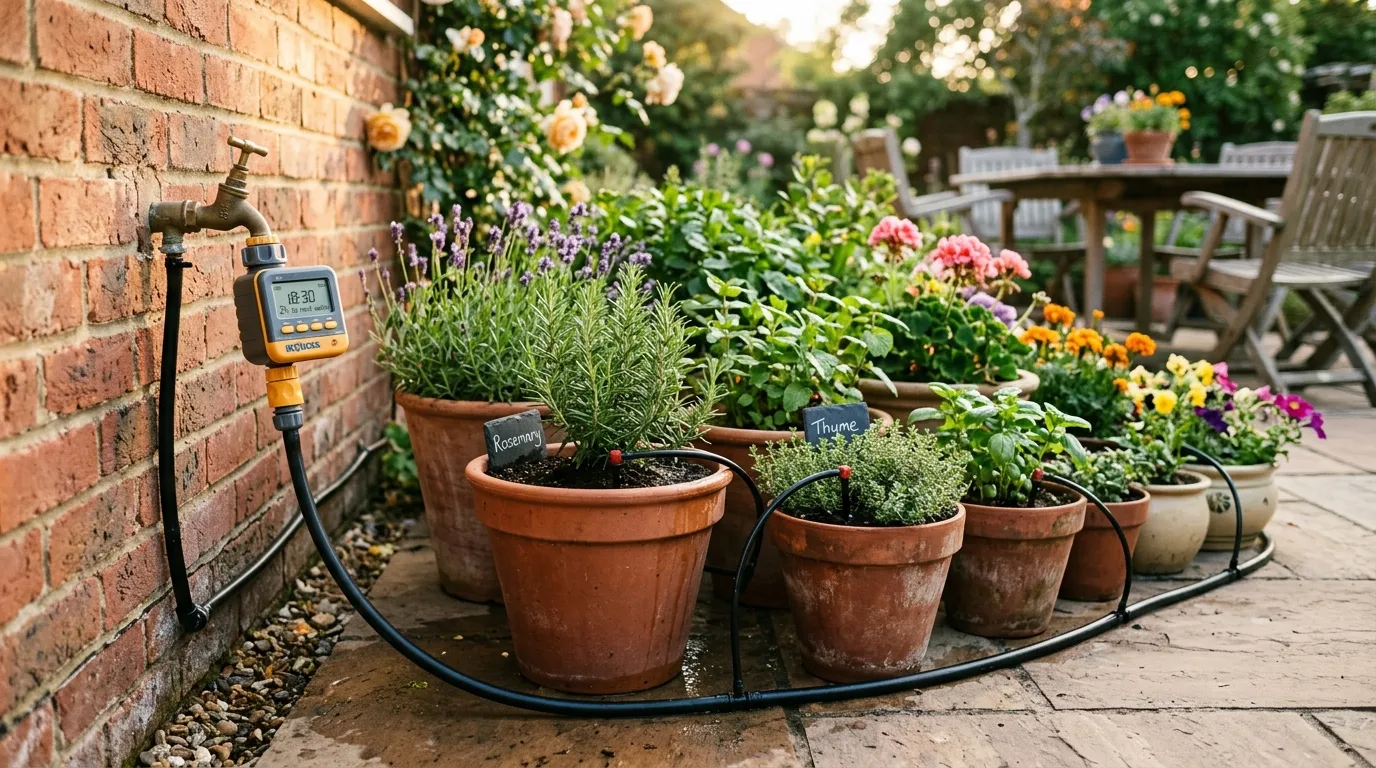 A gravity-fed drip system delivers 1.5-2 litres per day to each tomato plant from a raised 100-litre barrel, covering a 10-14 day holiday.
How to prepare plants before going on holiday
Preparation in the 5-7 days before departure makes more difference than the watering method itself. A well-prepared garden survives twice as long as an unprepared one with the same automated system.
The pre-holiday preparation checklist
7 days before: Deep water all borders at 20 litres per square metre. Apply compost mulch or bark chips at 5-7cm depth to all exposed soil. This reduces evaporation from bare ground by 60-70%.
5 days before: Set up and test automated systems. Run drip irrigation for a full cycle and check every emitter. Set up capillary matting and confirm all pots are wicking properly. Move container vegetables to a shaded or semi-shaded position.
3 days before: Deadhead all flowering plants. Flowers and developing seed heads draw significant moisture. Removing them reduces water demand by 15-20%. Harvest any ripe vegetables to stop plants channelling water into fruit production.
Day before: Give everything a final deep soak. Water each 20cm container with 2-3 litres until water runs freely from drainage holes. Water greenhouse plants to saturation. Fill all reservoirs, barrels, and trays to maximum capacity.
Morning of departure: Do one final visual check. Confirm timers are running, capillary mats are wet, and all barrel taps are open.
Grouping plants to reduce water loss
Moving plants together is one of the most effective free strategies. Grouped plants create a humid microclimate around each other through their combined transpiration. This reduces individual water loss by 15-25% compared with isolated pots on an open patio.
Move all outdoor containers to the shadiest part of the garden. North-facing walls and under-tree positions are ideal. Place pots on a tray of wet pebbles or gravel for extra humidity at root level. For houseplants, gather everything onto one table in a north or east-facing room away from radiators and direct sun.
How to keep greenhouse plants alive during holidays
Greenhouses present the toughest holiday watering challenge. Temperatures reach 40-50C on sunny days, and plants in pots have no access to ground moisture. For a dedicated guide to greenhouse auto-watering systems, see our full article.
Temperature control is as important as water
A greenhouse that overheats above 35C for several hours damages plants even if compost is moist. Automatic roof vents (Bayliss XL Autovent, around 25-35 pounds) open at a preset temperature and close when it cools. Fit at least one per 6ft section. Apply temporary shade paint (Coolglass, 8-12 pounds per tin) to the south and west-facing glass. Leave the door wedged slightly open if security allows.
The greenhouse holiday setup
| Element | Action | Why it matters |
|---|---|---|
| Watering | Gravity drip system with 200-litre barrel | Provides 10-14 days of automated water |
| Ventilation | Automatic roof vents set at 21-24C | Prevents heat damage above 35C |
| Shading | Shade paint or 50% mesh on south glass | Reduces internal temperature by 5-10C |
| Damping down | Wet the floor before leaving | Raises humidity, slows transpiration |
| Feeding | Liquid feed 3 days before departure | Avoids salt build-up in drying compost |
DIY and budget holiday watering methods
Not every trip needs a 50-pound drip system. For weekends and short breaks of 3-5 days, cheaper methods work well enough.
Bottle drippers
Fill a 1-litre or 2-litre plastic bottle. Pierce a 1-2mm hole in the cap with a heated needle. Push the bottle upside down into the compost. Water trickles out as the soil draws moisture. A 2-litre bottle sustains a 20cm pot for 3-5 days in moderate temperatures. In hot weather above 25C, it runs dry faster.
Water spikes and globes
Ceramic water spikes screw onto standard bottle necks and deliver water through a porous tip. They cost 1-3 pounds each and provide slightly more consistent flow than a hole-in-the-cap bottle. Glass watering globes (5-10 pounds each) look attractive but hold only 200-300ml and last 1-3 days at most. Neither method is reliable for more than 5 days.
The bath or sink method for houseplants
Place a folded towel in the bath. Run 2-3cm of water over the towel. Stand pots directly on the wet towel with saucers removed. The towel wicks water to the pot bases. This keeps houseplants alive for 5-7 days and costs nothing. Use a plug that seals well, and leave the bathroom door ajar for air circulation.
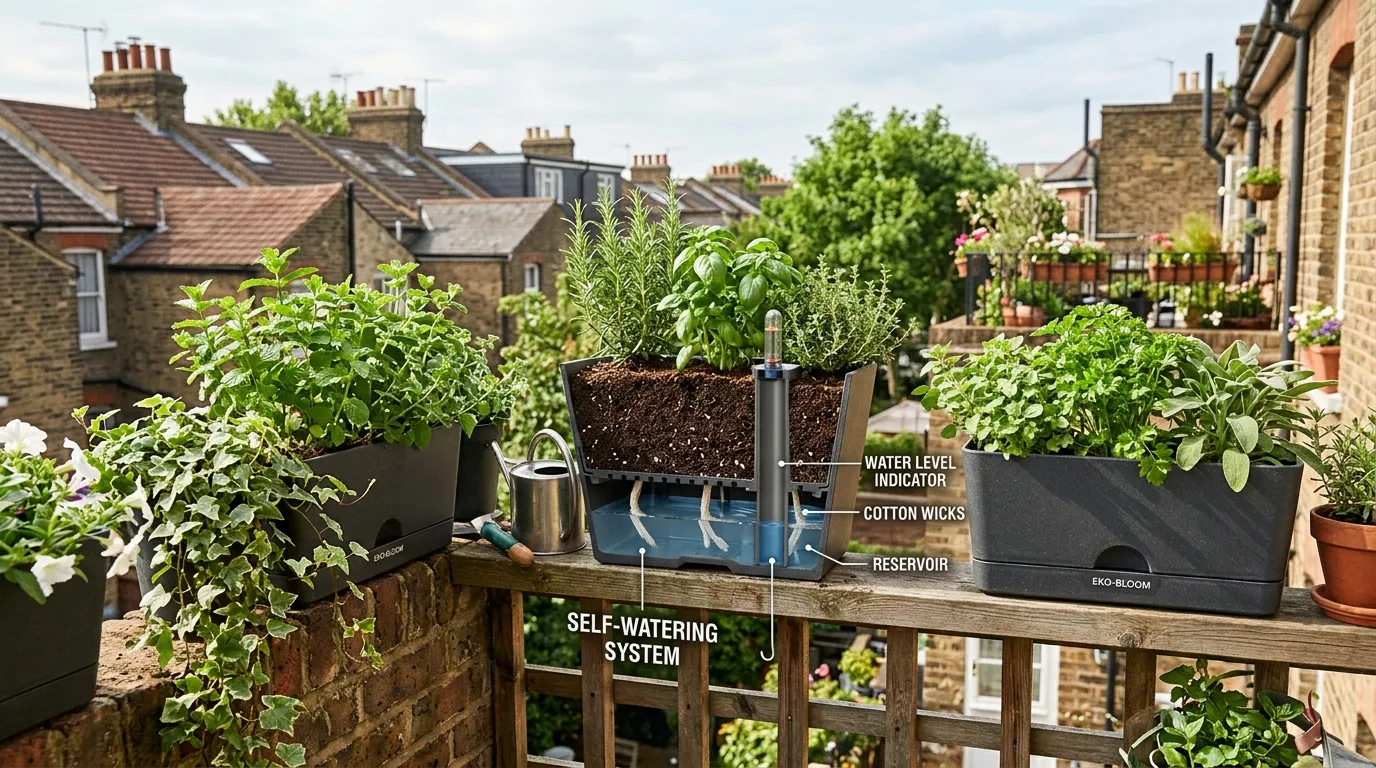 Self-watering pots with a 3-5 litre built-in reservoir keep medium houseplants watered for 7-14 days without intervention.
Field Report: six summers of holiday watering trials
Over six summer holidays (2019-2025), I tested every common holiday watering method in a Staffordshire garden on heavy clay (pH 6.8), a 6x8ft greenhouse, and a collection of 15 houseplants.
Key findings:
- Gravity drip irrigation kept 18 greenhouse tomato and pepper plants alive through a 12-day absence in July 2024. Two linked 100-litre barrels delivered 1.5 litres per plant per day. Zero plant losses. Total system cost: 45 pounds.
- Capillary matting on a kitchen table sustained 14 houseplants in 10-15cm pots for 9 days in August 2023, using two 10-litre reservoir trays. Two larger plants (20cm pots) showed drought stress by day 6 because the mat could not wick fast enough.
- DIY bottle drippers failed to sustain outdoor container plants beyond 4 days in the 2022 heatwave (temperatures above 35C). The bottles ran dry by day 3 on south-facing pots. They remain useful only for short weekends in moderate weather.
- Water spikes gave inconsistent results. Ceramic spikes performed better than plastic ones, delivering a steadier flow. But variation between individual spikes was 30-50%, meaning some pots dried out while adjacent ones stayed wet. Not reliable enough for trips over 5 days.
- Grouping and mulching extended survival in every trial. Pots moved to shade and grouped together lasted 2-3 days longer than identical isolated pots in sun. Mulching containers with 5cm of bark chips reduced daily water loss by roughly 30%.
- The neighbour method worked perfectly in 2019 and 2021. In 2020 the neighbour forgot for 3 days and I lost six hanging baskets. Automated systems are more reliable than goodwill alone.
These results inform every recommendation in this guide. The gravity drip system is the only method I trust for trips longer than a week.
Common holiday watering mistakes to avoid
Overwatering before departure. Saturating compost until it is waterlogged damages roots within 48 hours. Water deeply but stop when water flows from drainage holes. Do not leave pots standing in saucers of water.
Not testing the system. A drip kit installed the morning you leave has unknown failure points. Blocked drippers, loose connections, and incorrect flow rates are invisible until you run the system for several days. Always test for 5-7 days minimum.
Relying on a single method. Bottle drippers work for weekend trips. They do not sustain a garden for a fortnight. Match the method to the trip length using the comparison table above.
Forgetting ventilation. Greenhouse plants die from heat as readily as from drought. Without automatic vents and shading, temperatures above 40C kill plants even if compost is moist. Solve both problems or solve neither.
Feeding on the day of departure. Liquid feed increases salt concentration in compost as it dries. Feed 3-4 days before travelling, not the morning you leave. This gives the plant time to use the nutrients while moisture levels are still high.
Holiday watering for different plant types
Different plants need different strategies. A single method rarely covers an entire mixed collection.
Outdoor containers
Group containers in shade. Mulch the surface of each pot with 3-5cm of bark or gravel. Use drip irrigation with a timer for trips over 5 days. For shorter breaks, water deeply the day before and use bottle drippers as supplementary top-ups. For trips over 5 days, double-check that every pot drains freely and no saucers trap standing water beneath containers.
Houseplants
Move all houseplants to a north or east-facing room. Group them on a tray of wet pebbles. Set up capillary matting for small pots. For larger specimens in 20cm+ pots, use water spikes or self-watering inserts. Close curtains halfway to reduce light intensity and slow transpiration without plunging plants into complete darkness.
Greenhouse plants
Install a gravity drip system with sufficient barrel capacity for the full trip (15-20 litres per plant per week for tomatoes). Fit automatic vents. Apply shade paint. Damp down the floor before leaving. Proper watering technique during the growing season prepares plants with deeper root systems that handle brief dry spells better.
Open-ground borders
Established borders with good mulching need the least intervention. Water deeply at 20 litres per square metre a week before departure and mulch any bare soil. Newly planted shrubs and trees within their first year need more attention: use a leaky hose on a timer or ask a neighbour to soak them twice during a fortnight’s absence.
Month-by-month holiday watering risk
| Month | Risk level | Typical daily water loss | Key concern |
|---|---|---|---|
| January-March | Very low | 0-1mm | Frost damage, not drought |
| April | Low | 1-3mm | Late-planted seedlings only |
| May | Medium | 3-5mm | Greenhouse crops starting |
| June | High | 5-7mm | Peak growing, school holidays begin |
| July | Critical | 6-8mm | Hottest month, main holiday season |
| August | Critical | 5-7mm | Sustained heat, soil reserves depleted |
| September | Medium | 3-5mm | Cooling nights, shorter days |
| October-December | Low | 0-2mm | Overwatering more likely than drought |
June through August is the danger period. If you travel in winter, the risk is overwatering from rain and waterlogging, not drought. Move tender pot plants under cover and ensure drainage is clear.
The RHS recommends grouping container plants and using water-retaining gel crystals mixed into compost for additional moisture retention, though in my trials they added only 1-2 extra days at best.
Frequently asked questions
Now you have a tested system for holiday watering, read our guide on water-efficient gardening for year-round techniques that reduce your garden’s water demand and make every future holiday easier to prepare for.
Lawrie has been gardening in the West Midlands for over 30 years. He grows his own veg using no-dig methods, keeps a wildlife-friendly garden, and writes practical advice based on real UK growing conditions.