Skimmia
Skimmia japonica
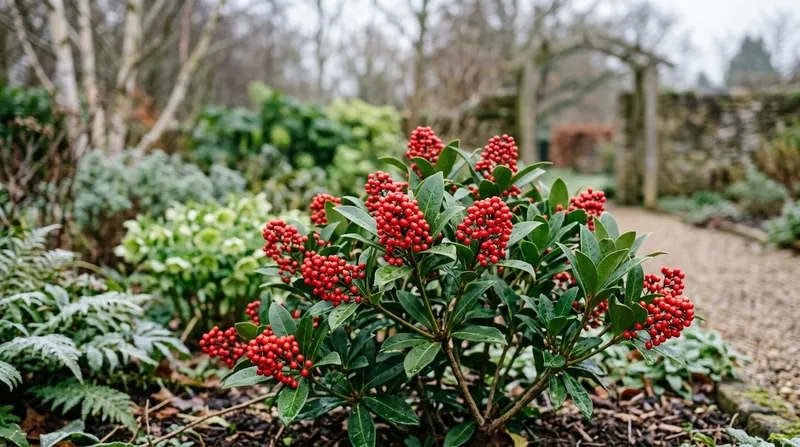
A compact, dome-shaped evergreen shrub valued for its clusters of fragrant white flowers in spring and bright red berries that persist through winter. Male and female flowers are on separate plants, so both are needed for berries. Thrives in shade and acid to neutral soils. Ideal for small gardens, containers and north-facing borders throughout the UK. Provides reliable winter colour.
How to grow skimmia
Plant in autumn or spring in acid to neutral soil enriched with leaf mould or garden compost. Skimmia thrives in partial or full shade, making it perfect for north-facing borders and under trees. In full sun, the leaves tend to yellow — this shrub genuinely prefers shade. Water regularly, especially container plants. Mulch annually with composted bark. Feed in spring with an ericaceous fertiliser. To get berries, plant at least one male variety (such as 'Rubella') near one or more females (such as 'Veitchii'). The self-fertile cultivar 'Reevesiana' produces berries without a pollinator. Grows well in containers of peat-free ericaceous compost.
Pruning
Skimmia rarely needs pruning. Simply remove any dead or damaged shoots in spring. If the plant becomes too large, it can be lightly trimmed after flowering. Hard pruning is tolerated but rarely necessary as growth is naturally slow and compact. Deadhead female plants only if berry production is not wanted.
Propagation
- Semi-ripe cuttings in late summer
- Layering in autumn
Common problems
- Yellowing leaves in alkaline soil or full sun
- Scale insects on stems
- Horse chestnut scale
- Berries only appear with both male and female plants present