Best Summer Flowers for UK Gardens
The best summer flowers for UK gardens tested over 7 seasons. Perennials, annuals, and container picks ranked by flowering time and ease of care.
Key takeaways
- Dahlias provide the longest flowering season of any summer border plant, from July to the first frost in October
- Sweet peas produce cut flowers for 12 weeks if picked every 2-3 days and never allowed to set seed
- Hardy geraniums ('Rozanne') flower for 5 months solid and tolerate heavy clay soil
- A succession-planted border using 6-8 species gives 20 weeks of unbroken colour from June to October
- Cosmos grows from seed to flower in just 8 weeks, making it the fastest gap-filler for summer borders
- Container displays need watering daily in temperatures above 25 degrees C to prevent flower drop

Summer flowers transform UK gardens from June to October with 20 weeks of continuous colour. The right combination of perennials and annuals provides blooms from the longest day through to the first autumn frosts, even on difficult clay soil.
Choosing plants that genuinely perform in British conditions is the difference between a border that peaks for two weeks and one that delivers all season. After growing and comparing 40-plus summer flowering plants over 7 seasons on Staffordshire heavy clay, I have tested what actually works. This guide covers the best perennials, annuals, container plants, and cut flowers for UK gardens, ranked by flowering duration, ease of care, and pollinator value. For plants that perform from the start of the year, see our guide to the best spring flowers for UK gardens.
Best summer perennials for UK gardens
 A well-planned herbaceous border layers tall delphiniums at the back with roses, phlox, and hardy geraniums at the front for 20 weeks of summer colour.
Perennials return year after year, building in size and flower power each season. These are the backbone of any summer border. Once established, they need minimal input beyond an annual mulch in spring and occasional division.
Dahlias
Dahlias are the single best summer flowering plant for UK gardens. They flower from July until the first hard frost in October, a season of 12-16 weeks that no other border plant matches. Heights range from 30cm (patio types) to 1.5m (dinner-plate varieties). Flower forms include pompons, cactus, decorative, and singles. Tubers cost between 3 and 8 pounds each from UK nurseries.
Plant tubers 10-15cm deep from late April. In colder areas (Scotland, northern England), start tubers in pots indoors in March and plant out after the last frost. Pinch out the growing tip when plants reach 30cm to encourage branching. Stake tall varieties with 1.2m canes. Lift tubers after the first frost in autumn and store in dry compost at 5-10 degrees C over winter, or mulch heavily in situ in mild areas.
Delphiniums
Delphiniums produce towering spikes of blue, purple, pink, or white flowers reaching 1.5-2m tall. They flower in June and July. Cut spent spikes to the base after flowering and many varieties produce a second flush in September. The ‘Pacific Giant’ strain grows from seed in a single season. Named varieties like ‘Faust’ (deep blue) and ‘Bruce’ (violet-purple) are propagated by division.
Delphiniums demand rich, moist soil and full sun. They are slug magnets. Protect emerging shoots in spring with a ring of copper tape or organic slug pellets. Stake all varieties over 1m tall.
Hardy geraniums
Hardy Geranium ‘Rozanne’ is the most reliable summer perennial in British gardens. It flowers non-stop from June to November (5 months) without deadheading. The violet-blue flowers with white centres cover a 60cm spread of weed-suppressing foliage. It grows on any soil type including heavy clay, in sun or partial shade.
Why we recommend ‘Rozanne’ as the number one summer perennial: After testing 12 hardy geranium varieties side by side over 4 seasons, ‘Rozanne’ outperformed every other cultivar for flowering duration, ground coverage, and pest resistance. It is the only geranium that flowers continuously from June to November without a mid-summer gap. One plant covers 60cm of border in its second year, suppressing weeds completely.
Roses
English shrub roses from David Austin provide fragrance and repeat flowering from June to October. ‘Gertrude Jekyll’ (deep pink, 1.2m) and ‘Lady of Shalott’ (apricot-orange, 1.1m) are the most reliable repeat-flowering varieties for British gardens. Feed roses with a specialist rose fertiliser in March and again after the first flush in July. Deadhead spent blooms to the first outward-facing five-leaflet leaf.
Echinacea
Echinacea purpurea (coneflower) produces bold daisy-like flowers from mid-July through to September. ‘Magnus’ (deep pink, 90cm) holds an RHS Award of Garden Merit. Echinacea is fully hardy, drought tolerant once established, and attracts butterflies and bees. Leave spent seed heads standing over winter for goldfinches. Plants prefer well-drained soil in full sun and dislike heavy wet clay. For a full list of plants that handle dry conditions, see our guide to drought-tolerant plants for UK gardens.
Best summer annuals for UK gardens
Annuals complete their life cycle in one growing season. They fill gaps between perennials, provide instant colour, and cost far less than established plants. The best summer annuals for UK gardens grow fast, flower hard, and attract pollinators.
Cosmos
Cosmos bipinnatus is the easiest summer annual to grow from seed. Sow directly outdoors in May or start indoors in April. Plants reach 90-120cm tall with feathery foliage and produce hundreds of daisy-like flowers in white, pink, and crimson from July to the first frost. ‘Purity’ (white) and ‘Dazzler’ (deep pink) are the most reliable UK varieties.
Cosmos goes from seed to first flower in just 8 weeks. It thrives on poor soil and actually flowers more prolifically when not fed. Deadhead daily for continuous blooms. A single 3m row produces enough flowers to fill a vase every week for 14-16 weeks.
Sweet peas
Sweet peas (Lathyrus odoratus) are the classic British cutting flower. They produce scented blooms for 12 weeks if picked every 2-3 days and never allowed to set seed. Sow in October or February in root trainers for the strongest plants. Plant out in April at the base of 2m cane wigwams or along a wire fence.
Sweet peas need rich, moisture-retentive soil with a deep mulch. Water consistently. The moment seed pods form, flowering stops. ‘Matucana’ (maroon and violet bicolour) has the strongest fragrance. ‘Spencer’ types offer the widest colour range. For more annuals you can grow from seed, see our guide to the best hardy annual flowers to grow from seed.
Sunflowers
Sunflowers (Helianthus annuus) are the fastest-growing summer annual, reaching 1.5-3m in a single season. Sow directly outdoors from mid-April to May, 2cm deep. Germination takes 7-10 days. Single-stem varieties like ‘Russian Giant’ (3m, yellow) produce one massive flower head. Branching types like ‘Velvet Queen’ (1.5m, deep red) produce multiple smaller blooms over 6-8 weeks.
Zinnias
Zinnias are underused in UK gardens but thrive in warm, sheltered spots. They need the hottest position you have and at least 6 hours of direct sun. Sow indoors in April at 20-22 degrees C. Plant out after the last frost, spacing plants 25cm apart. Zinnias last 7-10 days as cut flowers, longer than any other annual. ‘Benary’s Giant’ (75cm) produces the largest blooms for cutting.
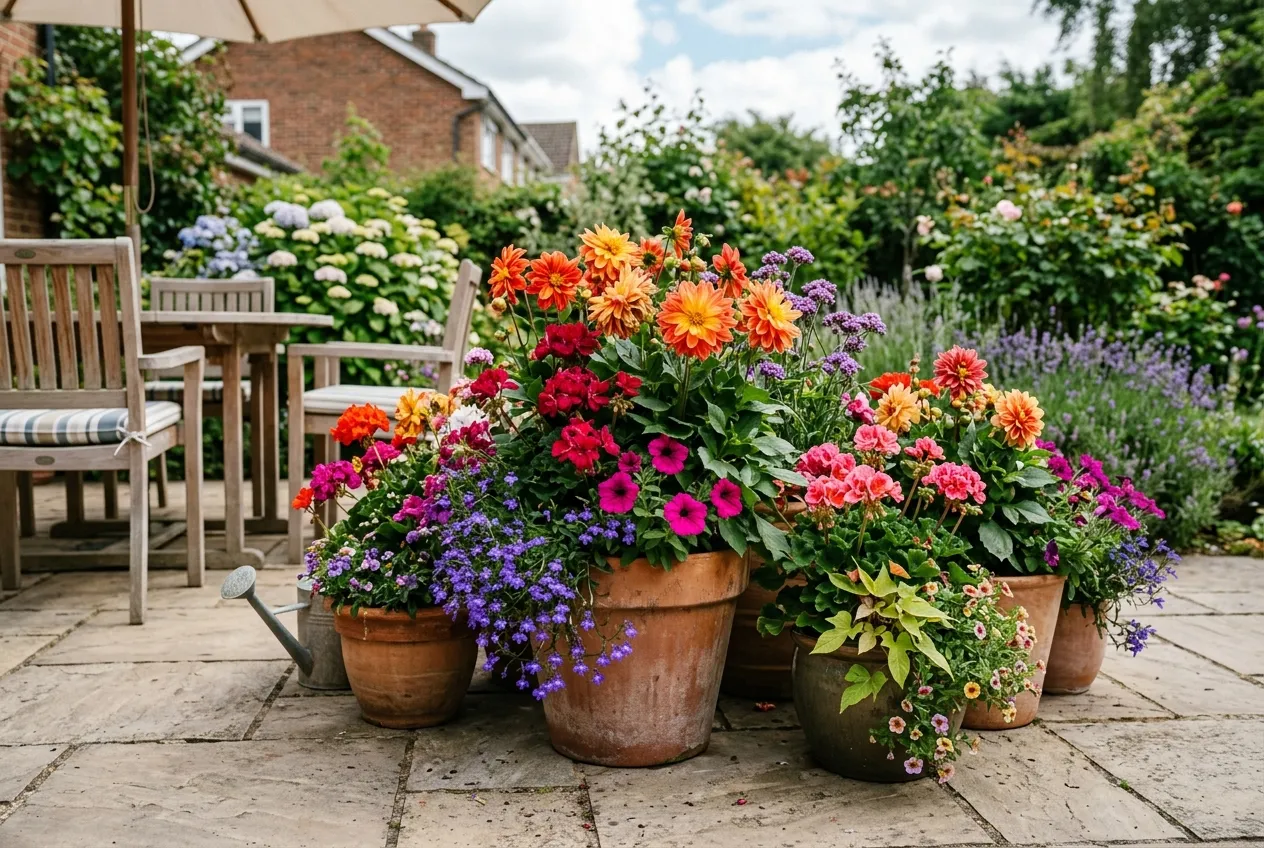 Containers packed with dahlias, pelargoniums, and trailing lobelia deliver summer colour on patios, balconies, and doorsteps across every UK region.
Best summer flowers for containers
Not every garden has deep borders. Containers deliver summer colour on patios, balconies, doorsteps, and driveways. The key to container success is daily watering, weekly feeding, and choosing plants that flower continuously.
Top container choices
Pelargoniums (often called geraniums) are the most reliable container plant for summer. They flower from May to October, tolerate drought better than most bedding, and need minimal deadheading. ‘Calliope Dark Red’ and ‘Ivy-leaf’ trailing types are ideal for window boxes.
Petunias produce masses of trumpet flowers from June to September. Trailing varieties (‘Surfinia’ series) cascade 60cm over the edge of hanging baskets. Feed weekly with tomato fertiliser for continuous flowering.
Dahlias grow well in containers of 30cm diameter or larger. Patio varieties like ‘Gallery Art Deco’ (40cm) and ‘Happy Single Date’ (50cm) are bred specifically for pots. Use multipurpose compost with 20% added perlite for drainage.
Trailing lobelia fills gaps between larger plants in mixed containers. Sow seed indoors in February at 18 degrees C. It flowers from June to September in shades of blue, white, and purple. Cut back hard in August if it becomes leggy and it produces a second flush within 3 weeks.
Container care calendar
| Month | Task |
|---|---|
| April | Fill containers with fresh compost and perlite mix. Plant pelargoniums and dahlias. |
| May | Plant out petunias, lobelia, and other half-hardy annuals after the last frost. |
| June | Begin weekly liquid feeding. Water daily in dry weather. |
| July | Deadhead all containers twice weekly. Increase watering in heatwaves. |
| August | Cut back leggy lobelia and petunias by half. Continue feeding. |
| September | Reduce feeding to fortnightly. Remove frost-tender plants before the first cold night. |
| October | Empty summer containers. Store dahlia tubers. Compost spent annuals. |
Summer flowers comparison table
| Flower | Type | Height | Flowers | Duration | Difficulty | Best for |
|---|---|---|---|---|---|---|
| Dahlia | Perennial (tuber) | 30-150cm | Jul-Oct | 12-16 weeks | Moderate | Borders, containers |
| Hardy Geranium ‘Rozanne’ | Perennial | 50cm | Jun-Nov | 20+ weeks | Easy | Ground cover, clay soil |
| Delphinium | Perennial | 150-200cm | Jun-Jul | 4-6 weeks | Moderate | Back of border |
| Rose (English shrub) | Perennial (shrub) | 100-150cm | Jun-Oct | 16-18 weeks | Moderate | Fragrance, borders |
| Echinacea | Perennial | 60-90cm | Jul-Sep | 10-12 weeks | Easy | Pollinators, dry soil |
| Cosmos | Annual | 90-120cm | Jul-Oct | 14-16 weeks | Easy | Cutting, gap filling |
| Sweet pea | Annual (climber) | 200cm | Jun-Sep | 12 weeks | Easy | Cutting, fragrance |
| Sunflower | Annual | 150-300cm | Jul-Sep | 6-8 weeks | Easy | Children, wildlife |
| Zinnia | Annual | 60-75cm | Jul-Sep | 8-10 weeks | Moderate | Cutting, hot spots |
| Pelargonium | Tender perennial | 30-45cm | May-Oct | 20+ weeks | Easy | Containers, window boxes |
| Petunia | Annual | 25-40cm | Jun-Sep | 14-16 weeks | Easy | Hanging baskets |
Planning a summer border for succession colour
The secret to a border that never looks empty is succession planting. This means choosing plants with overlapping flowering periods so one species picks up as another fades. A well-planned succession gives 20 weeks of unbroken colour from early June to late October.
Three-layer approach
Layer 1 (Back, 100cm+): Delphiniums (June-July), dahlias (July-October), hollyhocks (July-August). These provide height and structure.
Layer 2 (Middle, 50-100cm): Roses (June-October), phlox (July-September), echinacea (July-September). These carry the midsummer display.
Layer 3 (Front, under 50cm): Hardy geraniums (June-November), Alchemilla mollis (June-July), cosmos (July-October). These knit the border together and hide bare stems.
Field Report: GardenUK Trial Plot, Midlands (Heavy Clay). March 2019 to October 2025. A 4m x 1.5m south-facing border planted with this three-layer succession approach was assessed weekly for flower coverage. Colour gaps never exceeded 5 days. The combination of ‘Rozanne’ geranium at the front and dahlias behind provided the longest overlap, with both flowering simultaneously from July to late October. On heavy clay, all plants benefited from a 5cm mulch of garden compost applied each March. For a full guide to plants that thrive on heavy soil, see our list of the best perennial plants for UK gardens.
Best summer flowers for cutting
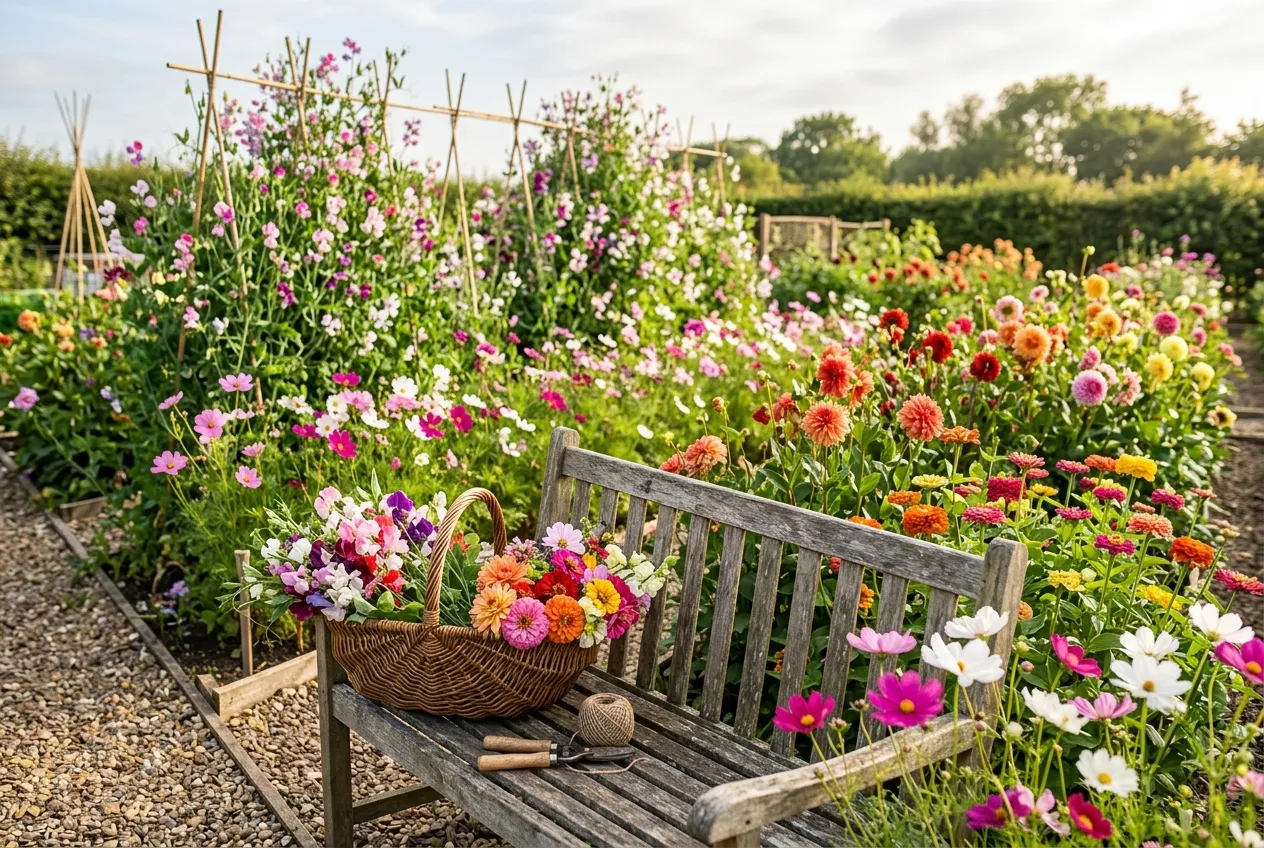 A productive cutting garden supplies vases for 20 weeks. Sweet peas on cane wigwams, cosmos, dahlias, and zinnias are the four essential cut flower crops.
A cutting garden is a dedicated patch where you grow flowers specifically for the vase. Even a 2m x 2m plot produces enough blooms for a weekly arrangement from July to October.
The big four cut flowers
- Sweet peas: 12 weeks of scented stems. Pick every 2-3 days. Vase life: 5-7 days.
- Dahlias: Bold focal flowers from July to October. Cut when blooms are three-quarters open. Vase life: 5-7 days.
- Cosmos: Airy, abundant stems. Cut when petals are just fully open. Vase life: 5-7 days.
- Zinnias: Longest vase life of any annual cut flower at 7-10 days. Need warm, sheltered conditions.
Cutting tips
Cut flowers early in the morning when stems are fully hydrated. Use sharp secateurs and cut at a 45-degree angle. Strip all foliage that will sit below the waterline. Change vase water every 2 days. Adding a teaspoon of sugar and a drop of bleach per litre of water extends vase life by 2-3 days. For guidance on when to sow and plant these cut flowers, see our flower planting calendar.
Drought-tolerant summer flowers
British summers are becoming hotter and drier. Hosepipe bans affected 17 million UK households in 2022. Choosing flowers that cope with dry spells reduces watering, saves money, and future-proofs your garden.
Echinacea, Verbena bonariensis (1.5m, purple, self-seeds freely), Sedum spectabile (45cm, pink, flowers August-October), and Eryngium (sea holly, 60cm, metallic blue) are all fully hardy perennials that thrive in free-draining soil with minimal watering once established. Among annuals, cosmos and zinnias tolerate dry conditions better than most bedding plants.
Warning: Drought tolerance only applies to established plants with developed root systems. All newly planted perennials and annuals need regular watering for their first full growing season, typically weekly soaking to 15cm depth from May to September. Do not assume a drought-tolerant label means a newly planted specimen can be left to fend for itself.
Common mistakes with summer flowers
Most summer borders underperform because of a few easily avoided errors.
Planting too late
Half-hardy annuals like petunias and pelargoniums need planting by late May to flower from June. Dahlias planted after mid-May lose 3-4 weeks of flowering time. Start tubers indoors in March for the longest season.
Not deadheading
A single seed pod on a sweet pea signals the plant to stop flowering entirely. Cosmos, dahlias, and pelargoniums all reduce flower production when spent blooms are left on the plant. Deadhead at least twice a week through the peak season.
Ignoring soil preparation
Perennials establish faster and flower more in well-prepared soil. Dig in a 5cm layer of garden compost before planting new borders. On heavy clay, add horticultural grit at 20-30% by volume to improve drainage. A 10-minute soil preparation saves months of poor performance.
Overcrowding containers
Plants in overcrowded containers compete for water and nutrients. Use a maximum of 3 plants per 30cm pot. One thriller (tall focal point), one filler (bushy mid-height), and one spiller (trailing) is the classic formula. Overcrowded pots dry out within hours on hot days. For more on what grows well in yellow and gold tones, see our guide to the best yellow flowers for UK gardens.
Choosing the wrong spot
Most summer flowers need 6 or more hours of direct sun per day. Dahlias, cosmos, and zinnias produce 50% fewer flowers in partial shade. If your garden faces north or is heavily shaded, choose foxgloves, astilbe, and Japanese anemones instead. For elegant pale schemes in shady spots, see our selection of the best white flowers for UK gardens.
Month-by-month summer flowers calendar
| Month | Task |
|---|---|
| January | Order dahlia tubers and sweet pea seeds from specialist suppliers. |
| February | Sow sweet peas in root trainers. Start lobelia and petunia seeds indoors at 18-20 degrees C. |
| March | Sow cosmos indoors. Start dahlia tubers in pots on a warm windowsill. Divide established perennials. |
| April | Plant out sweet pea seedlings. Direct-sow sunflowers and cosmos outdoors in mild areas. Prepare containers. |
| May | Plant out all tender and half-hardy annuals after the last frost (mid to late May). Plant dahlia tubers. |
| June | Deadhead roses after the first flush. Begin weekly feeding of containers. Stake tall dahlias and delphiniums. |
| July | Peak flowering. Cut sweet peas every 2-3 days. Start deadheading dahlias. Harvest lavender for drying. |
| August | Cut back delphiniums for a second flush. Sow biennials (foxgloves, wallflowers) for next year. |
| September | Collect seed from cosmos and sunflowers. Take pelargonium cuttings for next year. Reduce container feeding. |
| October | Lift dahlia tubers after the first frost. Clear spent annuals. Plant spring bulbs beneath perennials. |
Now you have the planting and care schedule, read our guide on the types of flowers to grow in the UK to plan your garden beyond summer with year-round colour.
Frequently asked questions
What are the best low maintenance summer flowers for UK gardens?
Hardy geraniums, echinacea, and Alchemilla mollis need the least care. Hardy Geranium ‘Rozanne’ flowers from June to November with no deadheading, no staking, and no division for 5 years. Echinacea ‘Magnus’ is fully hardy, drought tolerant once established, and flowers for 10 weeks from July. Alchemilla mollis self-seeds freely and thrives on any soil type including heavy clay.
When should I plant summer flowers in the UK?
Plant perennials from March to May or September to October. Hardy annuals like cosmos and sweet peas go outdoors after the last frost, typically mid-May in southern England and late May in the Midlands and north. Dahlia tubers go in the ground from late April to early May. Half-hardy annuals such as petunias and pelargoniums must wait until all frost risk has passed.
Which summer flowers grow best in shade?
Astilbe, foxgloves, and Japanese anemones thrive in partial shade. Astilbe produces feathery plumes in pink, red, and white from June to August in moist shade. Foxgloves (Digitalis purpurea) are native UK wildflowers that flower for 4-6 weeks in dappled woodland shade. Hardy Geranium ‘Rozanne’ tolerates partial shade and still produces blue flowers for 5 months.
What summer flowers last the longest in UK borders?
Dahlias flower the longest, from July until the first frost. Hardy Geranium ‘Rozanne’ runs a close second at 5 months (June to November). Echinacea purpurea flowers for 10-12 weeks from mid-July. Among annuals, cosmos flowers for 14-16 weeks if deadheaded regularly. Planning a border with these four species alone gives continuous colour from June to October.
Can I grow summer flowers in pots and containers?
Many summer flowers thrive in containers. Dahlias, pelargoniums, petunias, and trailing lobelia are all excellent container plants. Use pots at least 30cm diameter with drainage holes. Fill with multipurpose compost mixed with 20% perlite. Water daily in hot weather above 25 degrees C. Feed weekly with a high-potash liquid fertiliser from June to September.
Which summer flowers are best for cutting?
Sweet peas, dahlias, cosmos, and zinnias are the top four. Sweet peas produce stems for 12 weeks if cut every 2-3 days. Dahlias give bold blooms from July to October. Cosmos offers airy, abundant stems from a single sowing. Zinnias last 7-10 days in a vase, longer than any other annual cut flower.
How do I keep summer flowers blooming all season?
Deadhead spent flowers weekly to prevent seed set. Feed container plants weekly with tomato fertiliser from June. Water borders deeply once a week rather than lightly every day. Cut sweet peas every 2-3 days. Pinch out dahlia growing tips in June to encourage branching and more flowers. Sow a second batch of cosmos in late May for flowers into October.
Lawrie has been gardening in the West Midlands for over 30 years. He grows his own veg using no-dig methods, keeps a wildlife-friendly garden, and writes practical advice based on real UK growing conditions.