Daylilies: Tough, Beautiful, Impossible to Kill
Grow daylilies in UK gardens with varieties for every border. Covers Hemerocallis types, reblooming cultivars, division, edible flowers, and clay soil.
Key takeaways
- Each daylily flower lasts just one day, but a mature plant produces 200-400 buds across a 10-12 week season
- Hemerocallis fulva (tawny daylily) is naturalised across the UK and virtually indestructible on any soil
- 'Stella de Oro' is the best reblooming daylily for UK gardens, producing flowers from June through September
- Daylily flowers and buds are edible and widely used in Chinese cooking — harvest buds the day before opening
- Divide clumps every 4-5 years in spring to maintain flowering and create free plants
- Daylilies are one of the most pest-free and disease-free perennials available to UK gardeners
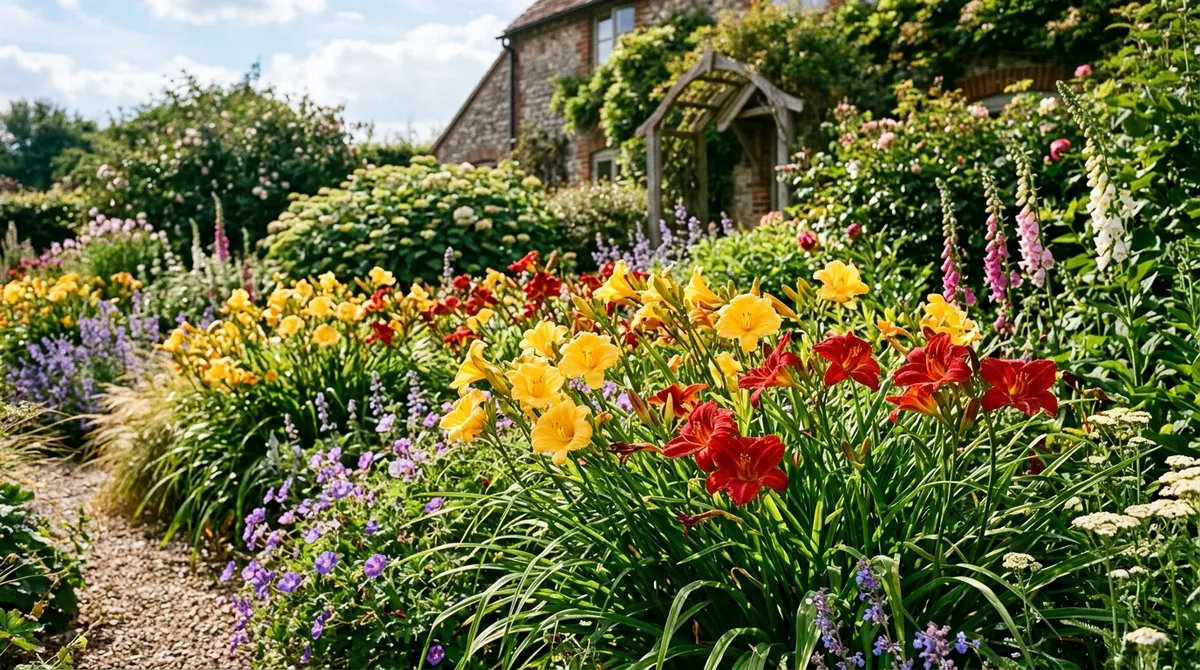
Daylilies are the most forgiving perennials in British gardening. Each individual flower lasts just a single day — opening at dawn, finished by the next morning. Yet a mature plant produces 200-400 buds across its season, opening 3-5 new blooms every day for weeks on end. The display is constant and prolific from June well into September on reblooming varieties.
The name Hemerocallis comes from the Greek for “beautiful for a day.” The plant itself is beautiful for decades. Daylilies tolerate clay, sand, drought, partial shade, and near-total neglect. They shrug off pests and diseases that flatten other perennials. A clump planted today will still be flowering in thirty years with nothing more than occasional division.
What are the best daylily varieties for UK gardens?
The daylily world is vast. Over 90,000 named cultivars exist, mostly bred in the United States. Many American varieties struggle in Britain’s cooler, wetter climate. The varieties below have proven themselves across multiple seasons on clay soil in the West Midlands.
Hemerocallis fulva (tawny daylily) is the wild species, naturalised across Britain since the Tudor era. Burnt-orange flowers on 90cm stems in July. It spreads by underground stolons and is virtually indestructible. This is the daylily you see growing in cottage garden ditches, railway embankments, and derelict gardens. It will grow anywhere.
‘Stella de Oro’ is the best reblooming daylily for UK conditions. Golden-yellow flowers on compact 40cm plants from June through September — a 10-12 week season. It produces more flowers per plant than any other variety in our trials. Ideal for the front of a border, path edges, or containers on a patio or small space.
‘Pardon Me’ produces deep cranberry-red flowers with a green throat on 45cm stems. Compact, tidy, and reblooming. The colour holds well without fading in sun. This is the best red daylily for small borders and is reliable on clay.
‘Gentle Shepherd’ is the closest to a true white daylily. Near-white ruffled flowers with a green throat on 70cm stems. It flowers in July and August without reblooming, but the individual flowers are among the largest and most elegant of any hardy variety.
‘Stafford’ is a classic British-bred variety with deep red flowers and a yellow throat on 75cm stems. Flowering July to August. Named and raised in the West Midlands — appropriate given our trial garden location. Vigorous and reliable.
For other long-flowering perennials that share the same toughness, see our guide to the best perennial plants for UK gardens.
Daylily variety comparison table
| Variety | Height | Colour | Flowering Period | Reblooms? | Spread Rate | Best For |
|---|---|---|---|---|---|---|
| H. fulva (tawny) | 90cm | Burnt orange | July | No | Fast (stolons) | Wild areas, banks |
| ’Stella de Oro’ | 40cm | Golden yellow | June-Sept | Yes | Slow clump | Front of border, pots |
| ’Pardon Me’ | 45cm | Cranberry red | June-Sept | Yes | Slow clump | Small borders |
| ’Gentle Shepherd’ | 70cm | Near white | July-Aug | No | Slow clump | Mixed borders |
| ’Stafford’ | 75cm | Deep red, yellow throat | July-Aug | No | Moderate clump | Mixed borders |
| ’Corky’ | 60cm | Lemon yellow | June-July | No | Slow clump | Cottage gardens |
| ’Catherine Woodbery’ | 75cm | Lavender pink | July-Aug | No | Slow clump | Pastel schemes |
| ’Frans Hals’ | 60cm | Red and yellow bi-colour | June-Aug | Partial | Moderate clump | Bold displays |
Where should I plant daylilies in the garden?
Daylilies flower best in full sun — at least six hours of direct sunlight daily. They tolerate partial shade, producing healthy foliage but fewer flower stems. In my Staffordshire trials, plants in full sun produced roughly double the flower count of identical divisions in half shade.
Soil type is almost irrelevant. Heavy clay, light sand, chalky alkaline ground, acid peaty soil — daylilies grow in all of them. The thick fleshy roots store water and nutrients, making the plants tolerant of poor conditions that starve other perennials. On the heavy clay in our trial garden, they required no soil amendment at planting and have performed consistently for seven years. For more plants that handle heavy soil, see our clay soil planting guide.
Spacing depends on variety. Compact types like ‘Stella de Oro’ need 40-45cm between plants. Taller varieties need 60cm. Space generously — daylilies fill their allotted space within two seasons and overcrowded plantings need dividing sooner.
Border position depends on height. ‘Stella de Oro’ and ‘Pardon Me’ sit at the front. ‘Stafford’, ‘Gentle Shepherd’, and the tawny species go in the middle or back. The arching grass-like foliage looks good even when plants are not in flower, providing useful green structure among summer perennials.
How to plant daylilies in the UK
Plant daylilies from March to May or September to October. Container-grown plants from garden centres can go in at any time the ground is workable, though spring planting gives the strongest first-season results.
Dig a hole twice the width of the root ball and the same depth. Daylilies should be planted with the crown (where the leaves meet the roots) at soil level — not buried. Planting too deep is the most common establishment failure. The crown sitting under more than 2cm of soil can rot, especially on heavy ground.
Backfill with the excavated soil. Do not add compost or fertiliser to the planting hole — daylilies do better starting in the native soil and adapting to it. Water thoroughly after planting. Apply a 5cm mulch of bark or garden compost around but not over the crown.
New plants need watering during dry spells in their first summer. Once established (after one full growing season), daylilies are genuinely drought-tolerant. The fleshy roots store enough water to survive weeks without rain. Established plants on our clay soil have not been watered since planting and have never shown drought stress. For more plants that handle dry conditions, see our guide to drought-tolerant plants for UK gardens.
How to divide daylilies and make free plants
Division is the only regular maintenance daylilies need. After 4-5 years, clumps become congested. The centre of the clump develops woody, exhausted roots that stop producing flower stems. Outer growth remains vigorous but flowers decline overall.
When to divide: Early spring (March-April) is the best time, just as new green shoots emerge from the crown. Autumn division (September-October) also works but gives plants less time to establish roots before winter dormancy.
How to divide: Lift the entire clump with a garden fork. Wash soil off the roots with a hose — this lets you see the root structure clearly. Pull the clump apart into sections by hand, or use two back-to-back forks for large clumps. Each division should have at least 3 fans of leaves and a healthy portion of roots. Discard the woody central portion.
Replanting: Trim roots to 15cm and cut foliage back to 15-20cm. This reduces water loss while new roots establish. Replant at the same depth as before with the crown at soil level. Water thoroughly. Divisions often flower the same summer, though the display reaches full strength in the second year.
A single mature clump typically yields 6-10 divisions. This is genuinely free gardening — one plant bought in 2019 can become a border full by 2026. For more propagation techniques, see our guide to plant propagation by division and cuttings.
Can you eat daylily flowers and buds?
Daylily flowers and buds are edible and have been eaten in East Asian cooking for thousands of years. Dried daylily buds (jin zhen, or golden needles) are a staple ingredient in Chinese hot and sour soup, mu shu pork, and Buddhist vegetarian dishes.
Harvest buds the day before they open, when they are plump and showing colour but still closed. These have the best texture — firm, slightly crunchy, with a mild sweetness. Each bud is 8-10cm long on most varieties.
Fresh flowers have a delicate, slightly sweet flavour. Remove the stamens and pistil (they can be bitter) and use the petals in salads, as a garnish, or dipped in light batter and fried as tempura.
Safety note: Only Hemerocallis species are edible. Do not confuse them with true lilies (Lilium), which are toxic to humans and extremely toxic to cats. If you have cats, see our guide to plants toxic to cats for a full list of species to avoid. Daylilies and true lilies look quite different — daylilies have grass-like basal leaves while true lilies have leaves arranged up a central stem.
Start with small portions when eating daylilies for the first time. Some people experience mild digestive sensitivity to certain varieties.
What problems affect daylilies?
Very few. Daylilies are among the most trouble-free perennials in UK gardens. The list of things that can go wrong is short.
Hemerocallis gall midge is the only significant pest in the UK. Adult midges lay eggs in developing flower buds. Affected buds become swollen and distorted instead of opening normally. The infestation is unsightly but not fatal. Pick off and destroy affected buds as soon as you spot the swelling. Bin them — do not compost. This reduces the population over successive years.
Slugs occasionally damage young spring growth, especially on heavy clay soils. Established plants outgrow slug damage quickly. Protect emerging shoots in March with a ring of grit or organic slug pellets if damage is severe. See our full slug control guide for more options.
Crown rot occurs only in waterlogged soil. On well-drained ground, it is essentially unknown. If your soil lies wet in winter, plant daylilies on a slight mound to keep the crown above the water table.
Leaf streak (a fungal infection) causes yellow streaks along the leaves. It is more common in warm, humid summers. Remove affected foliage and improve air circulation around plants. It is rarely serious enough to affect flowering.
No routine spraying or treatment is required for daylilies. They are genuinely low-maintenance plants that reward neglect with flowers. For other trouble-free plants, see our guide to low-maintenance garden plants.
How to combine daylilies with other perennials
Daylilies blend naturally into mixed borders. The grass-like foliage provides useful green structure, and the flowers add colour during the main summer display months.
With ornamental grasses: Daylilies and grasses share a similar leaf texture. Combine ‘Stella de Oro’ with Stipa tenuissima or miscanthus for a naturalistic prairie effect. The contrast between the solid daylily flowers and the airy grass plumes is striking.
With summer perennials: Plant daylilies alongside rudbeckia, echinacea, and salvia for a long-season border that flowers from June to October. The succession works naturally — daylilies peak in July, rudbeckia takes over in August, and salvia carries into autumn.
Under roses: Low-growing daylilies like ‘Stella de Oro’ make excellent ground cover beneath shrub roses. They hide the bare legs of the rose bushes while adding a second layer of flower colour. The daylily foliage also suppresses weeds.
In containers: Compact varieties grow well in pots of 30cm diameter or larger. Use loam-based compost. Water regularly in summer. Feed fortnightly with a balanced liquid fertiliser from April to August. Container plants need dividing every 3 years.
Frequently asked questions
How long do daylily flowers last?
Each individual daylily flower lasts just one day. The bloom opens in the morning and is finished by the following morning. However, each flower stem (scape) carries 15-30 buds that open in succession over several weeks. A mature clump produces multiple scapes, extending the total flowering period to 6-12 weeks depending on variety.
Are daylilies good for clay soil in the UK?
Daylilies are among the best perennials for heavy clay soil. Their thick, fleshy roots tolerate the poor drainage and compaction that kills many perennials. On heavy Staffordshire clay, every Hemerocallis variety in our trials has thrived without any soil amendment. They are more reliable on raw clay than hostas, astilbe, or most other moisture-tolerant perennials.
When should I divide daylilies?
Divide daylilies in early spring, just as new shoots emerge in March or April. Lift the entire clump with a fork, wash off the soil, and pull or cut it into sections with at least 3 fans of leaves each. Replant immediately at the same depth. Divisions establish quickly and often flower the same summer.
Can you eat daylily flowers?
Yes, daylily flowers and buds are edible and widely used in Chinese and Japanese cooking. Harvest buds the day before they open for the best texture. Fresh flowers have a mild, slightly sweet flavour and work in salads, stir-fries, and tempura. Only eat Hemerocallis species — do not confuse them with true lilies (Lilium), which are toxic.
Do daylilies spread aggressively?
Most modern daylily varieties form tidy clumps that expand slowly. They do not spread by runners or self-seeding. The one exception is Hemerocallis fulva (tawny daylily), which spreads by underground stolons and can colonise large areas. If you want a contained plant, choose named hybrid varieties rather than the wild species.
Why has my daylily stopped flowering?
Overcrowded clumps are the most common cause of reduced daylily flowering. After 4-5 years, the centre of the clump becomes congested and stops producing flower scapes. Divide the clump in spring, discard the woody centre, and replant the vigorous outer sections. Flowering resumes within one season of division.
Do daylilies grow in shade?
Daylilies tolerate partial shade but flower best in 6 or more hours of direct sun. In shade, plants produce healthy foliage but fewer flower scapes. Pale-coloured varieties perform better in shade than dark reds and purples, which need full sun to develop their richest colour. For a shaded border, combine daylilies with shade specialists like hostas and ferns.
Lawrie has been gardening in the West Midlands for over 30 years. He grows his own veg using no-dig methods, keeps a wildlife-friendly garden, and writes practical advice based on real UK growing conditions.