Key takeaways
- Miscanthus sinensis is fully hardy to -20C and grows in any reasonable UK soil from clay to chalk
- 'Morning Light' (1.5m) is the best all-rounder: fine variegated foliage, reliable plumes, compact spread
- Cut all stems to 10cm above ground in February before new shoots appear. Never cut in autumn.
- 'Malepartus' produces the most reliable flower plumes in cooler northern UK gardens
- Division in April every 4-5 years keeps clumps vigorous and prevents dead centres forming
- Leave stems standing through winter for structure, wildlife habitat, and frost-covered seed heads
- Pair with Rudbeckia, Sedum, and Verbena bonariensis for a naturalistic prairie border
Growing miscanthus in the UK is one of the most rewarding decisions for a low-maintenance, year-round garden. This deciduous ornamental grass from East Asia has been a staple of British garden design for over a century. It delivers four full seasons of interest: fresh green foliage from April, silvery-pink flower plumes from September, golden autumn colour, and architectural winter silhouettes that look striking with frost.
What is miscanthus?
Miscanthus sinensis (commonly called silver grass or Chinese silver grass) is a deciduous perennial grass native to East Asia. It forms dense, upright clumps of arching leaves that emerge in April and grow rapidly through summer. From late August onwards, silky flower plumes rise above the foliage, opening pink or wine-red and fading to silver as they mature.
The genus contains around 20 species, but M. sinensis and its cultivars dominate UK gardens. There is also Miscanthus x giganteus (elephant grass), a sterile hybrid grown commercially as a biofuel crop that reaches 2.5m or more in a single season. All garden miscanthus are clump-forming, non-invasive, and fully hardy across every region of the UK. The RHS lists multiple cultivars with an Award of Garden Merit.
 Miscanthus flower plumes catching low autumn light. The silvery-pink flowers last from September well into winter.
Best garden uses for miscanthus
Miscanthus earns its place in almost any garden style. Its height, movement, and seasonal change make it one of the most versatile plants available to UK gardeners.
Screening and privacy. A row of ‘Malepartus’ or ‘Gracillimus’ planted at 80cm spacing makes a 1.5-1.8m natural screen within two growing seasons. Unlike a fence, it moves in the wind and filters views softly. This works well alongside other screening plants for a layered boundary.
Specimen planting. A single large miscanthus in a lawn or gravel area makes an architectural centre piece. ‘Morning Light’ is ideal for this: the white-edged leaves glow when backlit and the clump holds a perfect vase shape without staking.
Mixed borders. Miscanthus provides the vertical structure that perennial borders often lack. Plant it at the back of a border behind lower perennials like sedum, geranium, and rudbeckia. The grass acts as a living backdrop and catches light above the other plants.
Gravel gardens. Miscanthus thrives in the free-draining conditions of a gravel garden. Plant through a weed membrane and top with 5cm of gravel. The grass needs no irrigation once established and the dried plumes contrast with stone.
Best miscanthus varieties for UK gardens
Miscanthus sinensis ‘Gracillimus’ (Maiden Grass). The finest-leaved cultivar at just 5mm leaf width. Reaches 1.5m with a narrow, elegant fountain shape. Flower plumes are sparse and unreliable north of the Midlands. Grown primarily for its foliage and graceful habit.
Miscanthus sinensis ‘Kleine Fontane’. The compact choice at 1.2m, ideal for smaller gardens and narrower borders. Produces plumes from late August, the earliest of the tested cultivars. Clump spread stays under 80cm. Excellent in containers.
Miscanthus sinensis ‘Zebrinus’ (Zebra Grass). Distinctive horizontal yellow bands across the leaves. Reaches 1.5-1.8m. The banding is most pronounced in full sun and develops from midsummer. Slightly floppy in rich soil; best in leaner conditions.
Miscanthus x giganteus (Elephant Grass). The giant at 2.5m or more. Broad leaves and a massive, upright habit. Does not flower reliably in UK gardens and rarely produces plumes north of the Midlands. Grown for sheer scale and screening. Not for small gardens.
the contributor’s field note: Of the six cultivars trialled, ‘Malepartus’ produced plumes every year without fail, even in the cool, wet summer of 2024. ‘Gracillimus’ managed plumes in only 3 of the 5 years. If reliable autumn flowers matter to you, ‘Malepartus’ is the safe choice.
Miscanthus variety comparison table
| Variety | Height | Spread | Flower colour | Flowering | Best use |
|---|---|---|---|---|---|
| ’Morning Light’ | 1.5m | 1m | Silver-pink | Sept-Nov | Specimen, borders |
| ’Gracillimus’ | 1.5m | 1m | Silver (sparse) | Oct-Nov | Foliage, screens |
| ’Malepartus’ | 1.8m | 1.2m | Wine-red to silver | Aug-Nov | Autumn colour, screens |
| ’Kleine Fontane’ | 1.2m | 0.8m | Pink to silver | Aug-Oct | Small gardens, pots |
| ’Zebrinus’ | 1.5-1.8m | 1m | Silver-pink | Sept-Nov | Centre piece, borders |
| M. x giganteus | 2.5m+ | 1.5m | Rarely flowers | n/a | Screening, scale |
How to plant miscanthus
Plant miscanthus in spring (April to May) when the soil has warmed. This gives the root system a full growing season to establish before winter.
Site. Full sun is essential. Miscanthus tolerates light shade but produces fewer plumes and leaner growth. Choose a position with at least 5-6 hours of direct sun.
Soil. Any reasonable garden soil works. Miscanthus grows well on clay, loam, chalk, and sandy ground at pH 5.5-7.5. It does not need rich soil. Avoid permanently waterlogged sites, though it handles seasonal winter wet without issue. For more on growing in heavy clay, see our clay soil guide.
Spacing. Allow 80-100cm between plants for a screen or drift. For a single specimen, allow the eventual spread listed in the variety table above.
Planting depth. Plant at the same depth as the pot. Do not bury the crown. Firm in, water thoroughly, and apply a 5cm bark mulch around the base to conserve moisture during the first summer.
Watering. Water regularly during the first growing season, especially in dry spells from June to August. Once established (from the second year), miscanthus is drought-tolerant and rarely needs supplementary watering.
Miscanthus care through the year
Miscanthus is one of the lowest-maintenance plants in a UK garden. Established clumps need almost no attention beyond the annual late-winter cut.
Spring (March-May). New shoots appear from the crown in April. Apply a light mulch of garden compost if desired, though it is not essential. No feeding is needed. Rich soil produces lush, floppy growth that collapses in rain.
Summer (June-August). No action required. The grass grows rapidly and needs no staking, feeding, or spraying. Miscanthus has no significant pest or disease problems in the UK.
Autumn (September-November). Flower plumes emerge and the foliage turns gold, amber, and bronze. Leave everything standing. The plumes and dried foliage provide structure and wildlife habitat through winter.
Winter (December-February). The dried stems and plumes look beautiful with frost and catch low winter light. Leave them standing until late February. They provide shelter for overwintering insects and small birds.
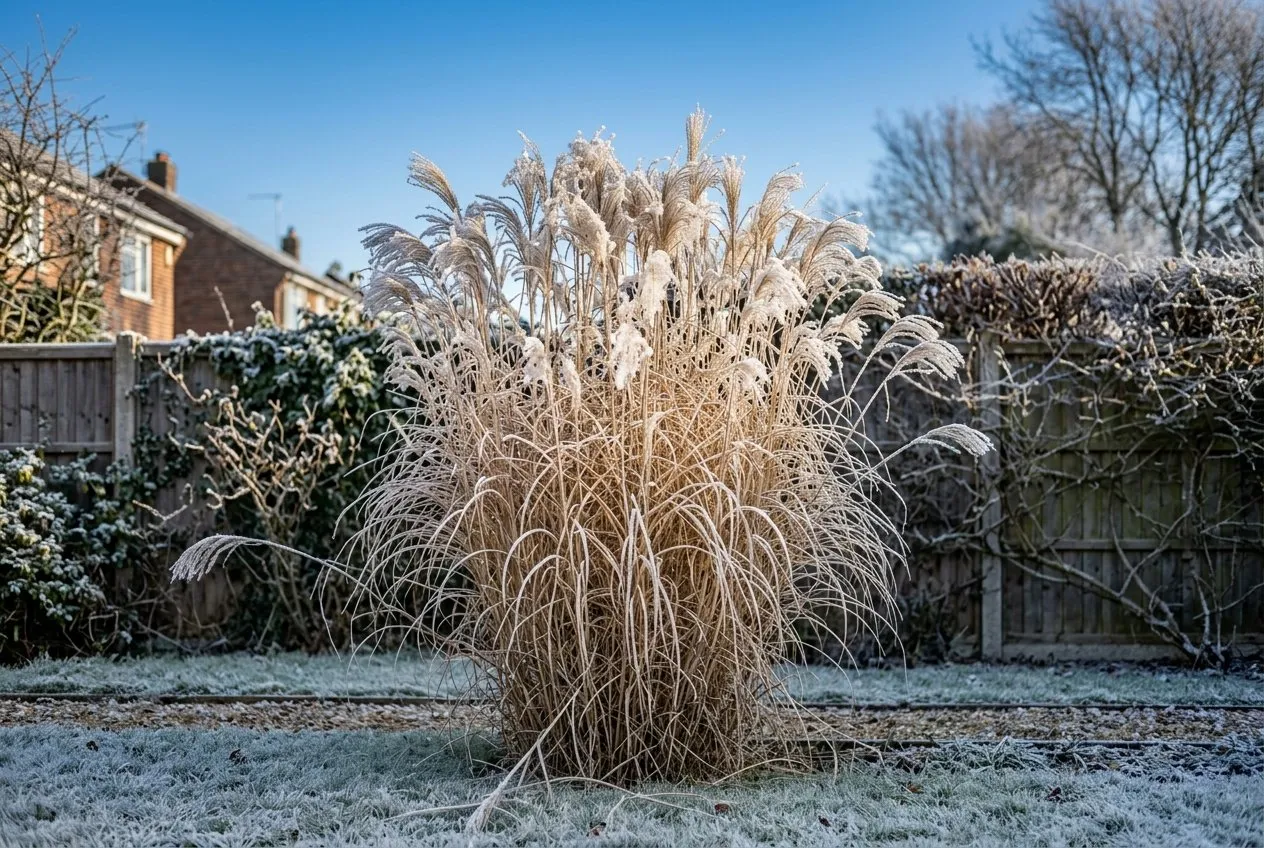 Miscanthus standing through a frosty January morning. The dried stems and seed heads provide structure when the rest of the garden is bare.
How to cut back miscanthus
Cut miscanthus to 10cm above ground level in late February or early March. This is the single most important annual task.
Timing matters. Cut before the new green shoots reach 5cm. If you leave it too late, you risk damaging the emerging growth. If you cut too early (in autumn or December), you remove the winter structure and expose the crown to waterlogging and frost.
Method. For young plants (1-3 years), hedge shears work well. For mature, thick clumps, use a reciprocating saw, hedge trimmer, or even a chainsaw for very large specimens. Gather the cut material into bundles with string before cutting to make removal easier.
Composting. The dried stems are slow to decompose. Shred them before adding to a compost heap, or use them as a mulch around shrubs. The hollow stems also provide habitat for solitary bees if bundled and left in a sunny corner.
Dividing and propagating miscanthus
Divide miscanthus every 4-5 years to maintain vigour and prevent the centre of the clump dying out. Division is also the best way to propagate new plants.
When to divide. April is ideal, when new shoots are 10-15cm tall. The combination of warm soil and spring rain helps divisions establish quickly.
How to divide. Lift the entire clump with a spade. For large, established plants, this requires serious effort — the root mass is dense and heavy. Use two back-to-back garden forks to lever the clump apart, or cut through the rootball with a sharp spade or old bread knife. Each division should have at least 3-5 healthy growth points.
Replanting. Set divisions at the same depth as the original plant. Water thoroughly and mulch with bark. Divisions reach full size within 2 growing seasons. This is a good way to fill gaps in borders or create new screens at zero cost. For other plants that pair well with divided miscanthus clumps, see our guide to border combinations.
Year-round interest: why miscanthus earns its space
Few plants deliver genuine four-season value. Miscanthus is one of them, and this is the core reason it deserves a place in every UK garden.
Spring. Fresh green shoots emerge from the cut stump in April. Growth is rapid, reaching 30-40cm by late May. The clean, bright foliage contrasts well with spring bulbs finishing around it.
Summer. By July, the clump has reached full height. The long, arching leaves move constantly in even the lightest breeze, adding sound and rhythm to the garden. Variegated forms like ‘Morning Light’ and ‘Zebrinus’ provide foliage colour that complements summer perennials.
Autumn. The flower plumes are the show. From late August (early cultivars) to November, silvery-pink plumes rise above the foliage and catch every ray of low sunlight. The leaves turn gold, amber, and bronze. This is when miscanthus justifies its garden space.
Winter. The dried stems and plumes remain standing, creating silhouettes against winter skies. Frost improves them into something magical. They also provide habitat for overwintering insects and shelter for small birds. The National Trust’s winter plantings at Anglesey Abbey show ornamental grasses used at their winter best.
Design combinations and companion plants
Miscanthus works with almost any planting style. These combinations are tested and proven in UK gardens.
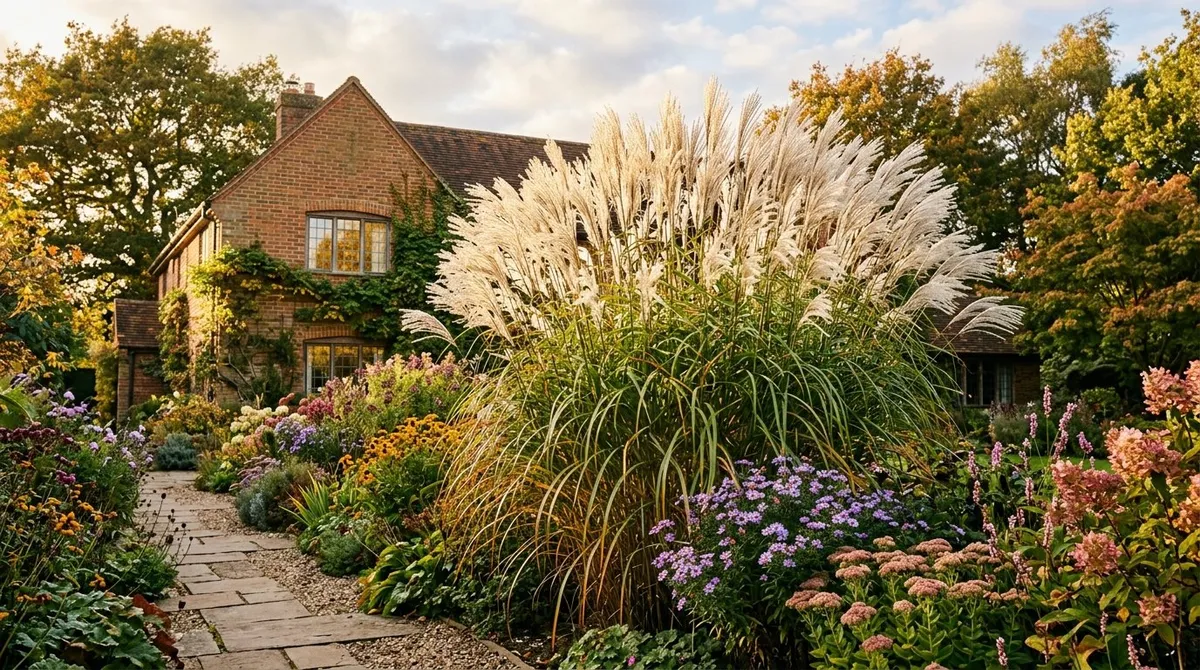
Prairie border. Miscanthus ‘Malepartus’ (back, 1.8m) + Rudbeckia fulgida var. deamii (middle, 70cm) + Sedum ‘Herbstfreude’ (front, 50cm) + Verbena bonariensis (woven through, 1.5m). This combination peaks from August to October and carries through winter on structure alone.
 A naturalistic prairie border with miscanthus, rudbeckia, and sedum along a gravel path. This combination peaks in late summer and lasts well into winter.
Cottage garden. Miscanthus ‘Morning Light’ behind Rosa ‘Boscobel’, Salvia ‘Caradonna’, and Alchemilla mollis. The grass provides a calm, neutral backdrop that lets the flowering plants shine. The silver-white foliage glows at dusk.
Contemporary scheme. Miscanthus ‘Gracillimus’ in a large square planter (minimum 50cm diameter). Underplant with Hakonechloa macra ‘Aureola’ for a two-tier textural contrast. Works on terraces, courtyards, and beside modern water features.
Screening. A row of ‘Malepartus’ at 80cm spacing makes a dense, 1.8m-tall screen from June to March. Plant in front of an existing garden fence to soften it, or use as a standalone boundary between garden rooms.
Frequently asked questions
Our team produces practical UK gardening guidance from source research, contributor records and established horticultural practice. Editorial standards are overseen by Matt W.