How to Grow Gladioli in the UK
Gladioli bring dramatic vertical colour to UK gardens from July to September. Covers planting corms, staking, succession planting, and winter storage.
Key takeaways
- Plant corms 10-15cm deep from mid-March (under cover) or mid-April (outdoors) through to late May
- Stagger plantings every two weeks from April to June for flowers from July through to October
- Stake tall varieties when stems reach 20cm to prevent wind damage and snapping
- Cut for the vase when the bottom two or three florets open, leaving four leaves on the plant
- Gladiolus thrips are the number one pest, causing silvery streaks on leaves and distorted flowers
- Lift corms six weeks after flowering, dry thoroughly, and store at 5-10 Celsius over winter
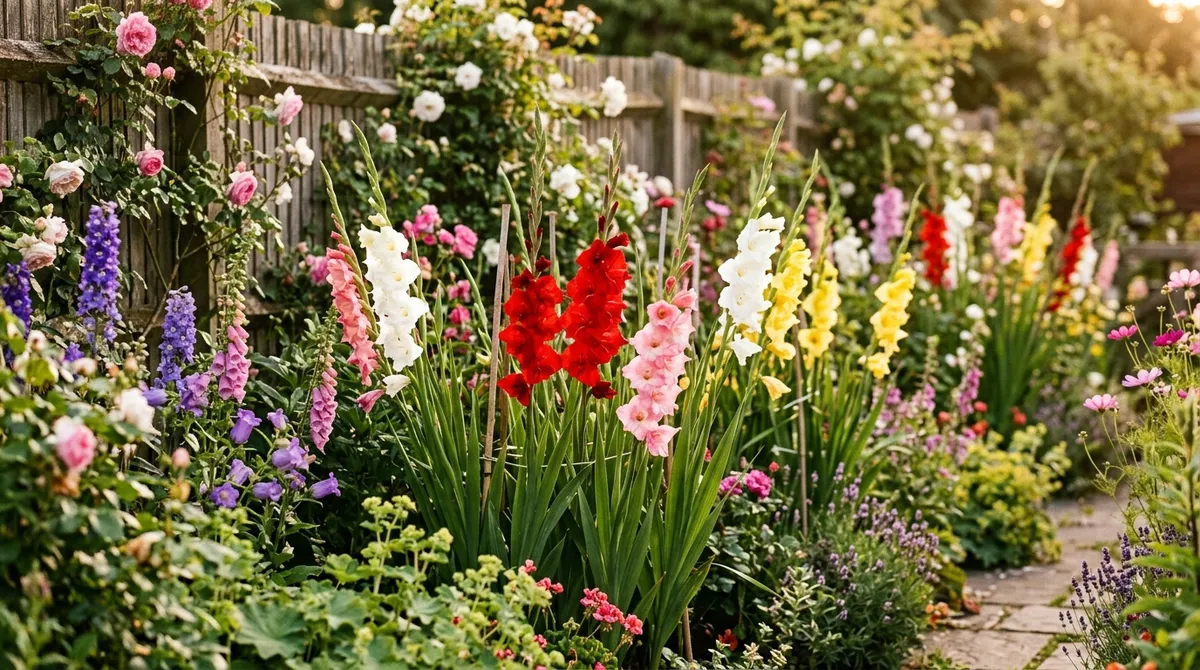
Gladioli are among the most dramatic summer-flowering plants you can grow in a British garden. Their tall, sword-shaped flower spikes reach 60 to 150cm high and bloom in almost every colour imaginable, from deep velvety reds and purples to soft pinks, whites, and vivid yellows. A packet of ten corms costs between three and eight pounds, and each corm produces a new replacement corm plus several smaller cormlets every season, giving you more plants each year for free.
Gladioli belong to the Iris family (Iridaceae) and originate mainly from South Africa, with around 300 wild species. The Royal Horticultural Society lists gladioli among their recommended summer bulbs for UK gardens. The name comes from the Latin gladius, meaning sword, referring to the flat, blade-like leaves. This guide covers everything from choosing the right type and planting corms to succession planting, staking, cut flower harvesting, pest control, and winter storage, all based on hands-on growing experience in Midlands clay soil.
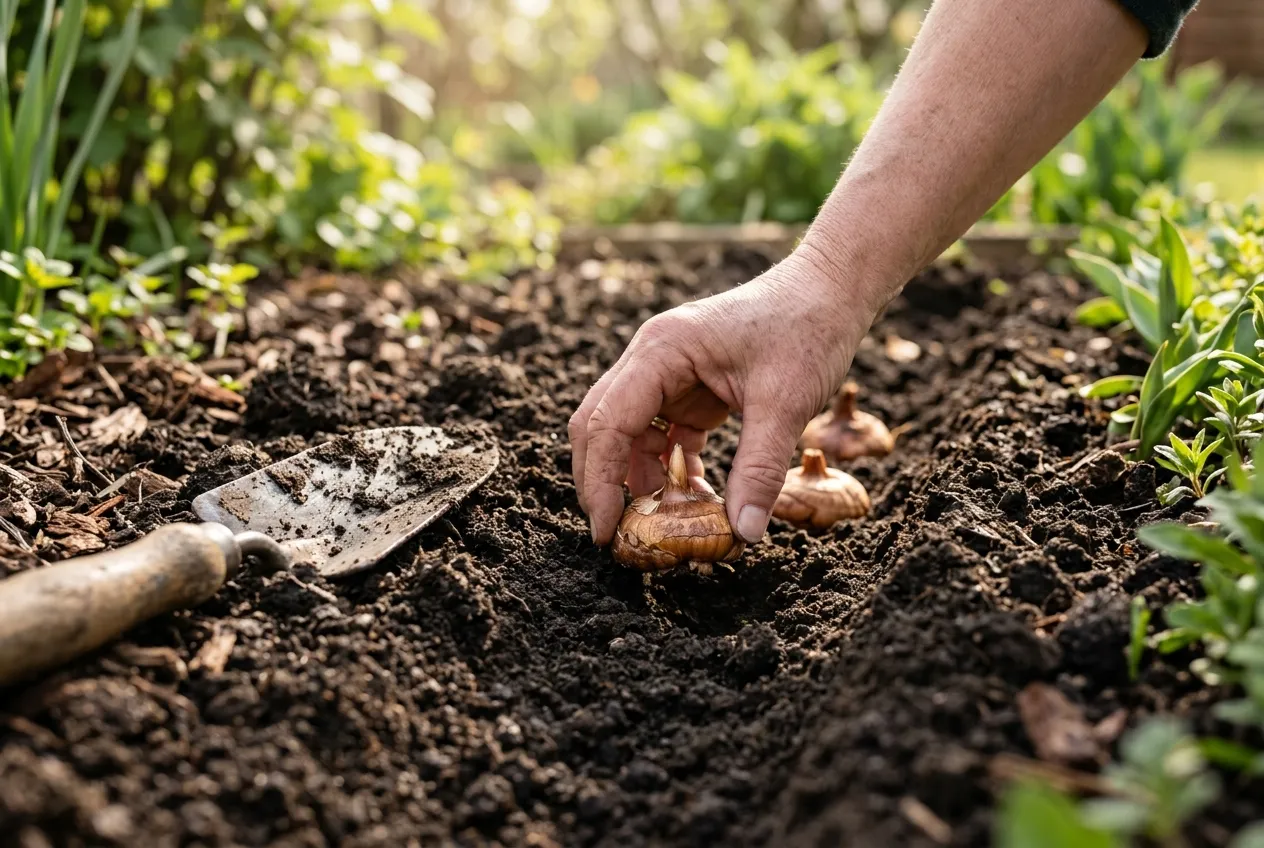
Planting gladioli corms in spring, pointed end facing upward, 10-15cm deep
What types of gladioli can I grow in the UK?
Five main groups of gladioli thrive in British gardens, each with distinct characteristics suited to different situations. Understanding which type works best for your space and purpose saves disappointment and wasted money. Here is how they compare.
Large-flowered gladioli (Grandiflorus)
The classic exhibition type and by far the most popular group. Tall stems reach 90-150cm with large, ruffled florets 10-14cm across. Each spike carries 20-26 florets, with 6-8 open at once. Colours include every shade from white through to near-black. ‘Peter Pears’ (salmon-orange) and ‘White Prosperity’ are reliable UK performers. These need staking and are outstanding as cut flowers.
Nanus gladioli
Compact plants reaching just 40-60cm tall. Smaller, more delicate flowers than the Large-flowered types. Hardier than other groups, surviving to around minus 10 Celsius, so they often overwinter outdoors in sheltered southern gardens. ‘Nymph’ (white with pink markings) and ‘Impressive’ (pink) are widely available. Plant in groups of 10-15 for the best effect in borders.
Primulinus gladioli
Mid-height plants at 60-90cm with elegant, hooded upper petals. More natural-looking than the Large-flowered types. Fewer florets per spike but a graceful, less formal appearance. Good for cottage-style borders and naturalistic planting. Often available in warm tones of yellow, orange, and salmon.
Butterfly gladioli
Similar height to Primulinus types at 60-90cm. Distinguished by dramatic throat markings and contrasting colour blotches on the petals. ‘Algarve’ (apricot with red blotch) and ‘Impressive’ types are popular. These make particularly striking cut flowers due to their bold colour contrasts.
Hardy Gladiolus communis subsp. byzantinus
The only truly hardy gladiolus for UK gardens. Survives to minus 15 Celsius without lifting. Magenta-pink flowers on 60-90cm stems in June, earlier than other types. Naturalises freely in well-drained soil, spreading by both corms and seed. Plant it and forget it. Perfect for wildlife-friendly borders alongside dahlias and other summer perennials.
Gladioli type comparison
| Type | Height | Flower size | Hardy in UK? | Best for | Corms per pack (approx. price) |
|---|---|---|---|---|---|
| Large-flowered | 90-150cm | 10-14cm | No, lift annually | Exhibition, cutting, borders | 10 for 4-8 pounds |
| Nanus | 40-60cm | 5-7cm | Marginal, sheltered spots | Borders, pots, naturalising | 15 for 3-5 pounds |
| Primulinus | 60-90cm | 6-8cm | No, lift annually | Cottage borders, cutting | 10 for 3-6 pounds |
| Butterfly | 60-90cm | 7-10cm | No, lift annually | Cutting, dramatic displays | 10 for 4-7 pounds |
| G. communis byzantinus | 60-90cm | 4-5cm | Yes, to minus 15C | Naturalising, wildlife | 20 for 4-6 pounds |
How to buy good quality gladioli corms
Buy firm, plump corms with no visible mould, soft spots, or deep blemishes. A healthy large-flowered gladiolus corm should be 10-14cm in circumference. Larger corms produce stronger first-year spikes with more florets. Avoid any corms that feel lightweight or papery, as these have dried out and may not sprout.
Purchase from specialist bulb suppliers rather than bargain bins. The best UK sources include Peter Nyssen, J. Parker’s, and Sarah Raven, plus the RHS online shop. Order in January or February for the widest variety selection. Most suppliers dispatch from February through to April.
Check corms for signs of gladiolus thrips before planting. Tiny black or brown insects, barely 1.5mm long, hide under the papery husk. If you spot any, soak the corms in lukewarm water at 45 Celsius for 10 minutes before planting to kill them.
When and how to plant gladioli in the UK
Timing
Plant gladioli corms outdoors from mid-April in southern England and early May further north. Soil temperature needs to reach at least 10 Celsius for reliable sprouting. Use a soil thermometer pushed 10cm deep to check. In a cold or wet spring, delay by a week or two rather than planting into cold, sodden soil where corms will sit and rot.
For the earliest flowers, start corms in 9cm pots of multipurpose compost under cover from mid-March. Keep them in a frost-free greenhouse, conservatory, or bright windowsill at 12-15 Celsius. This gives you a 4-6 week head start. Harden off and plant out after the last frost.
Planting depth and spacing
Plant corms 10-15cm deep with the pointed growing tip facing upward. Space them 10-15cm apart for a massed display, or 20cm apart if you want larger individual spikes. Deeper planting, at the full 15cm, anchors tall stems better and reduces the need for staking.
In heavy clay soil, add a 2cm layer of horticultural grit beneath each corm to improve drainage and prevent basal rot. On light sandy soil, enrich the planting hole with garden compost to retain moisture. Gladioli are greedy feeders and do best in fertile, well-drained soil in full sun. They need at least six hours of direct sunlight daily.
Planting in rows vs groups
For cut flower production, plant in straight rows 30cm apart. This makes harvesting, staking, and maintenance far easier. For border displays, plant in informal groups of 7-15 corms. Odd numbers look more natural. Tuck groups between established perennials such as lilies and late-summer asters for a layered effect.
How to do succession planting for continuous gladioli
Plant a fresh batch of corms every two weeks from mid-April through to early June. This single technique transforms a brief three-week gladiolus display into three months of continuous flowers from late July through to October.
A typical succession schedule for the Midlands:
- Batch 1: Mid-April (flowers late July)
- Batch 2: Early May (flowers mid-August)
- Batch 3: Mid-May (flowers late August)
- Batch 4: Early June (flowers mid-September)
- Batch 5: Mid-June (flowers early October, weather permitting)
Each batch takes roughly 90-100 days from planting to first flower, depending on variety and summer temperatures. Large-flowered types are slightly slower than Nanus and Butterfly types. Adjust your schedule if summer is unusually cool or warm.
Succession planting also staggers the lifting date in autumn, spreading the workload. Earlier-planted corms finish flowering sooner and can be lifted first. This is particularly useful to know when you are planning your flower planting calendar for the whole season.
How to stake and support gladioli
Stake tall gladioli varieties when stems reach 15-20cm to prevent wind damage. Large-flowered types are top-heavy once the spike develops and will snap in anything above a moderate breeze without support.
Three effective staking methods:
-
Individual canes: Push a 120cm bamboo cane alongside each plant when planting. Tie the stem loosely with soft garden twine as it grows, adding ties every 20-30cm. This is the easiest method for small numbers.
-
Grow-through supports: Place metal ring supports or pea netting over the planting area before shoots emerge. Stems grow up through the grid and are supported naturally. Best for group plantings.
-
String-and-post cordon: For cut flower rows, hammer a stake at each end of the row and run horizontal strings at 30cm intervals. This is the method commercial growers use.
Nanus, Primulinus, and Butterfly types at 40-90cm rarely need staking unless your garden is very exposed. Hardy G. communis byzantinus supports itself well in a mixed border.
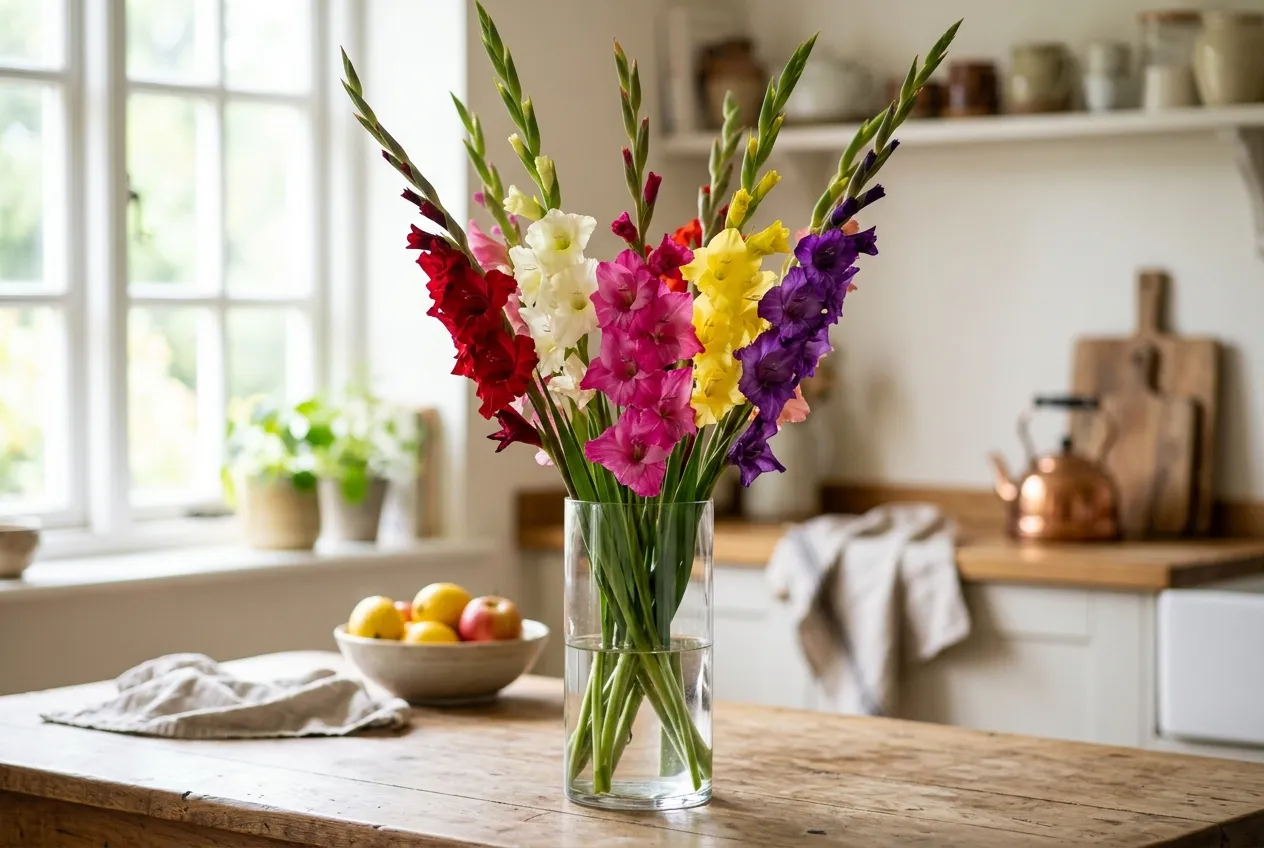
Gladioli make outstanding cut flowers, lasting 7-10 days in a vase
How to grow gladioli as cut flowers
Cut gladioli for the vase when the bottom two or three florets have opened. The remaining buds continue opening in water over the following week, giving you up to 10 days of vase life. This makes gladioli one of the longest-lasting summer cut flowers. If you enjoy arranging flowers, our guide to conditioning cut flowers covers how to maximise vase life for all types.
Cutting technique
Use a sharp, clean knife or secateurs. Cut the stem at an angle early in the morning when temperatures are cool and the plant is fully hydrated. Leave at least four leaves on the plant. These leaves feed the replacement corm developing underground. Removing too many leaves weakens next year’s corm.
Vase care
Strip any foliage that would sit below the water line. Place stems in deep, clean water with cut flower food. Change the water every two days. Remove the lowest florets as they fade to encourage the upper buds to open fully. Keep the vase out of direct sunlight and away from fruit bowls, as ethylene gas from ripening fruit shortens vase life.
Best varieties for cutting
Large-flowered types give the most dramatic arrangements. ‘White Prosperity’, ‘Peter Pears’ (salmon), ‘Plum Tart’ (deep plum), and ‘Green Star’ (lime green) are all excellent. For smaller, more relaxed arrangements, Nanus varieties like ‘Nymph’ work beautifully. Growing gladioli alongside other popular types of flowers gives you material for mixed arrangements all summer.
How to feed and water gladioli
Feed gladioli fortnightly with a high-potash liquid fertiliser from when the flower spike begins to emerge. Tomato feed (NPK roughly 4-5-8) works well and is widely available. High-potash feeding promotes strong flower spikes and helps the replacement corm develop fully for next year.
Water thoroughly during dry spells, particularly once the flower spike is developing. Gladioli have relatively shallow root systems and suffer quickly in drought. A deep weekly soak of 10-15 litres per square metre is better than frequent light watering. Mulch around the base of plants with 5cm of garden compost or bark chips to retain soil moisture and suppress weeds.
Do not feed after flowering finishes. The plant needs to divert energy into the replacement corm, not produce new foliage.
How to deal with gladiolus thrips
Gladiolus thrips (Thrips simplex) are the number one pest of gladioli in the UK. These tiny insects, just 1-1.5mm long, feed by rasping leaf and flower tissue. The damage shows as silvery streaks on leaves and white flecking on flower petals. Badly infested plants produce distorted, discoloured flowers that fail to open properly.
Identifying thrips damage
Check the undersides of leaves for tiny black or brown insects. In severe cases, you can see them moving on the flower buds. Damage worsens in hot, dry summers when thrips breed rapidly, producing multiple generations in a single season.
Treatment
- Organic: Spray with pyrethrin-based insecticide at the first sign of damage. Repeat every 7-10 days during hot weather. Encourage natural predators such as lacewings and ladybirds.
- Cultural: Soak corms in water at 45 Celsius for 10 minutes before planting to kill overwintering thrips. Remove and burn badly infested foliage rather than composting it.
- Prevention: Rotate planting positions annually. Do not plant gladioli in the same spot two years running. Inspect stored corms regularly over winter and discard any showing thrips activity.
Other gladioli pests and diseases
Grey mould (Botrytis)
A fungal disease causing brown patches on leaves and fuzzy grey mould on flowers. Worse in wet summers and overcrowded plantings. Improve air circulation by spacing corms adequately. Remove affected foliage promptly. Avoid overhead watering.
Fusarium wilt (Gladiolus yellows)
A soil-borne fungal disease causing yellowing and wilting of leaves from the base upward. Corms show dark, sunken lesions. There is no chemical cure. Remove and destroy infected plants and corms. Do not replant gladioli in affected soil for at least four years.
Slugs and snails
Young shoots emerging in spring are vulnerable. Use slug pellets (ferric phosphate type), beer traps, or copper tape around container rims. Check plants at dusk during damp weather when slugs are most active.
Corm rot
Soft, mushy corms with a sour smell indicate bacterial or fungal rot. Usually caused by waterlogged soil or storing damp corms. Improve drainage at planting time and ensure corms are bone-dry before winter storage.
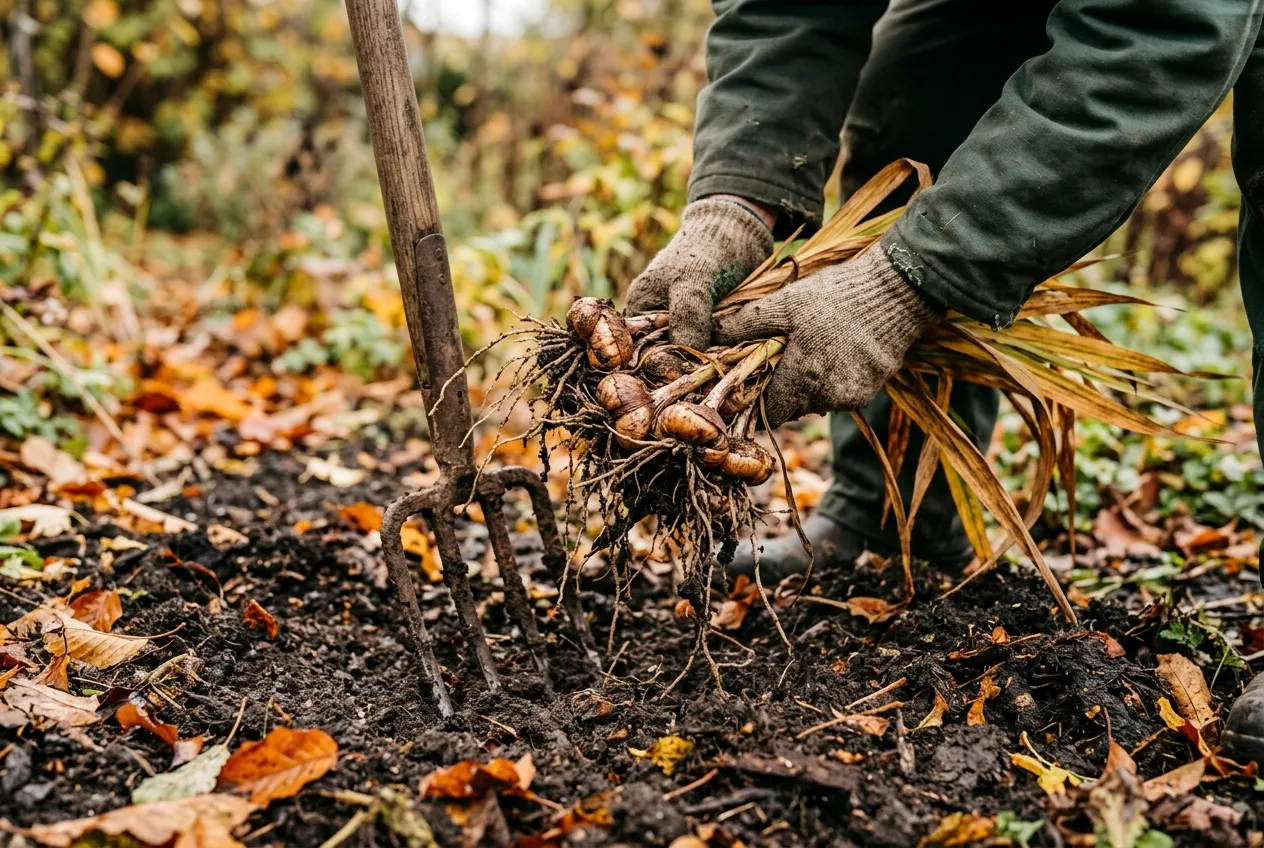
Lift gladioli corms six weeks after flowering, before the first hard frost
How to lift and store gladioli corms for winter
Lift gladioli corms approximately six weeks after flowering, before the first hard frost. In most of the UK, this means September for early-planted batches and October or November for later plantings. Do not rush the lifting. The replacement corm needs those six weeks of post-flowering growth to reach full size.
Step-by-step lifting process
- Cut back the foliage to about 5cm above the corm once the leaves start yellowing.
- Lift carefully with a garden fork, pushing in well away from the base to avoid spearing the corms.
- Shake off loose soil. You will see the new replacement corm sitting on top of the old, shrivelled parent corm.
- Snap off the old parent corm from the base. It separates easily.
- Remove cormlets (small pea-sized corms around the base). Keep these if you want to grow them on, or discard.
- Dry the corms in a warm, airy place (a greenhouse, shed bench, or warm garage) for 2-3 weeks. Spread them in a single layer on newspaper or mesh trays.
- Clean by removing loose husks and trimming old roots once fully dry.
Winter storage
Store dried corms in paper bags, net bags, or shallow trays at 5-10 Celsius. An unheated spare room, frost-free garage, or cool shed works well. Avoid airtight containers, as trapped moisture causes rot. Check corms monthly through winter. Discard any that feel soft or show mould.
Cormlets (the small ones) can be grown on to flowering size in 2-3 years. Store them the same way as full-sized corms and plant in spring 5cm deep. They produce foliage in the first year but rarely flower until the second or third season.
Can I overwinter gladioli in the ground?
Only Gladiolus communis subsp. byzantinus reliably survives UK winters without lifting. This species is hardy to minus 15 Celsius and naturalises freely in well-drained soil across southern and central England. It flowers in June, earlier than other types, with magenta-pink blooms.
All other gladioli are half-hardy and risk being killed by a combination of frost and winter wet. In exceptionally mild, well-drained coastal gardens in Cornwall, Devon, or the Channel Islands, Large-flowered types occasionally survive outdoors with a thick 15cm mulch of bark chips or straw. But this is a gamble. The safest approach in most of the UK is to lift and store every autumn.
Nanus types are slightly hardier than Large-flowered types and sometimes survive in sheltered city gardens with good drainage. If you want to try leaving them, plant 15cm deep and mulch heavily with bracken or straw in November. Accept that you may lose some in a harsh winter.
Growing gladioli in containers
Gladioli adapt well to container growing. Use a pot at least 30cm deep and 20cm across. Five to seven corms per pot gives a full display. Fill with multipurpose compost mixed with 20% perlite for drainage.
Plant 10cm deep. Water when the top 3cm of compost dries out. Feed fortnightly with tomato fertiliser from when the spike emerges. Stake each stem with a slim bamboo cane. Move pots to a frost-free spot or lift the corms when foliage dies back.
Container growing is perfect for Nanus and Butterfly types, which stay compact enough not to look top-heavy in a pot. Place pots on a sunny patio or terrace for maximum impact.
Month-by-month gladioli growing calendar
| Month | Task |
|---|---|
| January-February | Order corms from suppliers. Check stored corms for rot. |
| March | Start corms in pots under cover for early flowers. |
| April | Plant first outdoor batch mid-April (south). Harden off pot-started plants. |
| May | Continue succession planting every 2 weeks. Stake emerging stems. |
| June | Final outdoor planting early June. Begin feeding when spikes appear. |
| July | First flowers from March-started corms. Water deeply in dry weather. |
| August | Peak flowering season. Cut for the vase. Watch for thrips. |
| September | Late batches still flowering. Lift earliest-planted corms 6 weeks after flowering. |
| October | Lift remaining corms before first hard frost. Dry in a warm, airy place. |
| November | Clean and store dried corms at 5-10 Celsius. Mulch any G. byzantinus left in ground. |
| December | Check stored corms monthly. Discard any showing rot or mould. |
Frequently asked questions
Lawrie has been gardening in the West Midlands for over 30 years. He grows his own veg using no-dig methods, keeps a wildlife-friendly garden, and writes practical advice based on real UK growing conditions.