How to Grow Pothos in the UK
How to grow pothos (devil's ivy) as a houseplant in UK homes. Covers varieties, light needs, watering, propagation, and common problems with real data.
Key takeaways
- Pothos tolerates 200-1,500 lux, covering north-facing rooms to bright living rooms in UK homes
- Water every 7-10 days in summer and every 10-14 days in winter when the top 3cm of soil feels dry
- Six varieties suit UK homes: golden, marble queen, neon, manjula, njoy, and cebu blue
- Propagate by cutting a stem below a node and placing in water at 18-24C for 2-4 weeks
- Pothos is toxic to cats and dogs — calcium oxalate crystals cause mouth and throat irritation
- Yellow leaves usually mean overwatering, while brown leaf tips signal low humidity below 40%
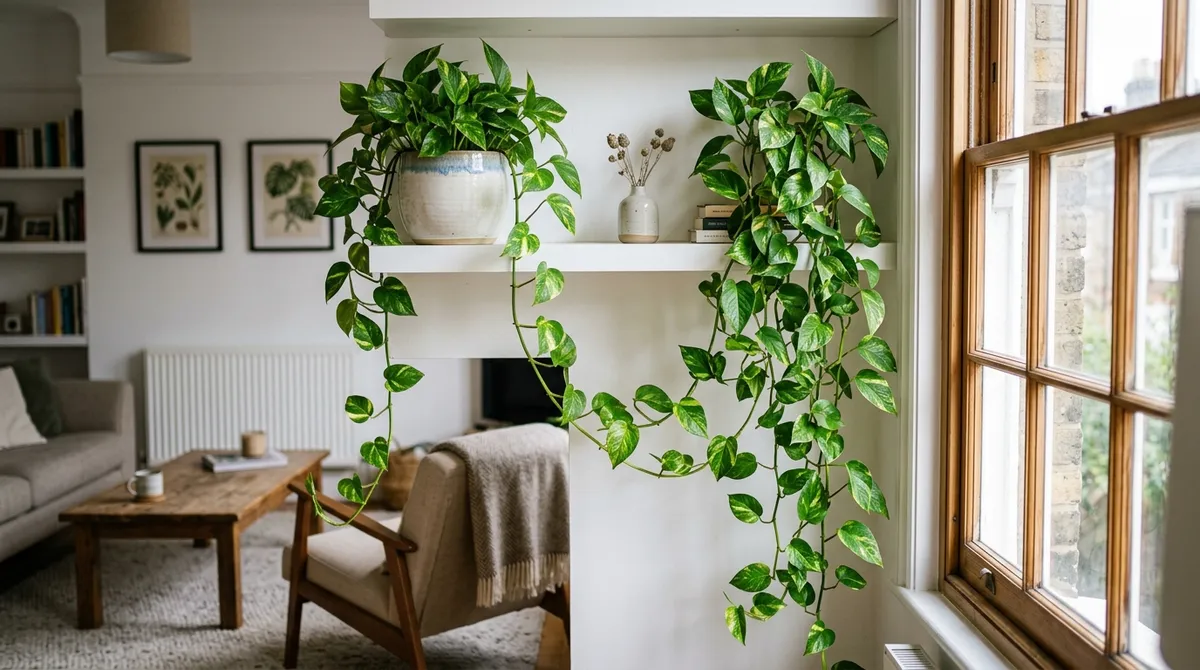
Pothos is the plant that forgives everything. Forget to water it for a fortnight, stick it in a dim hallway, ignore it for months on end, and it still grows. Officially named Epipremnum aureum and commonly called devil’s ivy, it is a trailing tropical vine that has adapted to life inside UK homes better than almost any other species.
This guide covers every variety worth growing, the specific light and watering needs for British conditions, how to propagate for free, and the common problems that catch people out. All recommendations are based on three years of growing pothos across multiple rooms in a West Midlands home.
Which pothos varieties grow best in UK homes?
Six pothos varieties perform reliably in UK indoor conditions. Each has different variegation patterns and light requirements. Choosing the right one for your room matters because variegated types lose their colouring in low light.
Golden pothos
The original and most widely sold variety. Heart-shaped leaves of mid-green splashed with golden-yellow variegation. Tolerates 200-1,500 lux, making it suitable for any room in the house. Trails 2-3 metres indoors. Available from most UK garden centres and supermarkets for 4-8 pounds in a 12cm pot. This is the variety to start with if you have never grown a houseplant before.
Marble queen pothos
White and green marbled foliage that is more heavily variegated than golden pothos. Needs brighter light of 500-1,500 lux to maintain the white patterning. In rooms below 400 lux, new leaves emerge predominantly green. Grows more slowly than golden pothos because the white sections contain less chlorophyll. A stunning plant in a bright east or south-facing room.
Neon pothos
Vivid chartreuse-yellow leaves with no variegation. The brightest pothos variety and excellent for lifting dark corners. Tolerates low light better than marble queen because the leaves are uniformly coloured. Slightly harder to find in UK shops but available online from specialist houseplant retailers for 6-12 pounds.
Manjula pothos
Large, rounded leaves with cream, silver, and green variegation. Each leaf has a unique pattern. Needs bright indirect light of 600-1,500 lux. Grows more slowly and compactly than golden pothos. A collector’s variety, typically 10-18 pounds from online UK houseplant sellers.
N’Joy pothos
Smaller leaves than most varieties with sharp green and white variegation. Compact growth habit makes it suitable for shelves and small spaces. Needs 500-1,500 lux. Widely available in UK garden centres since 2023. Prices range from 6-10 pounds for a young plant.
Cebu blue pothos
Silver-blue arrow-shaped leaves that look completely different from other pothos varieties. In bright light, mature leaves develop fenestrations (holes) similar to a monstera. Needs 400-1,200 lux. Less common in UK shops but gaining popularity. Expect to pay 8-15 pounds from specialist sellers.
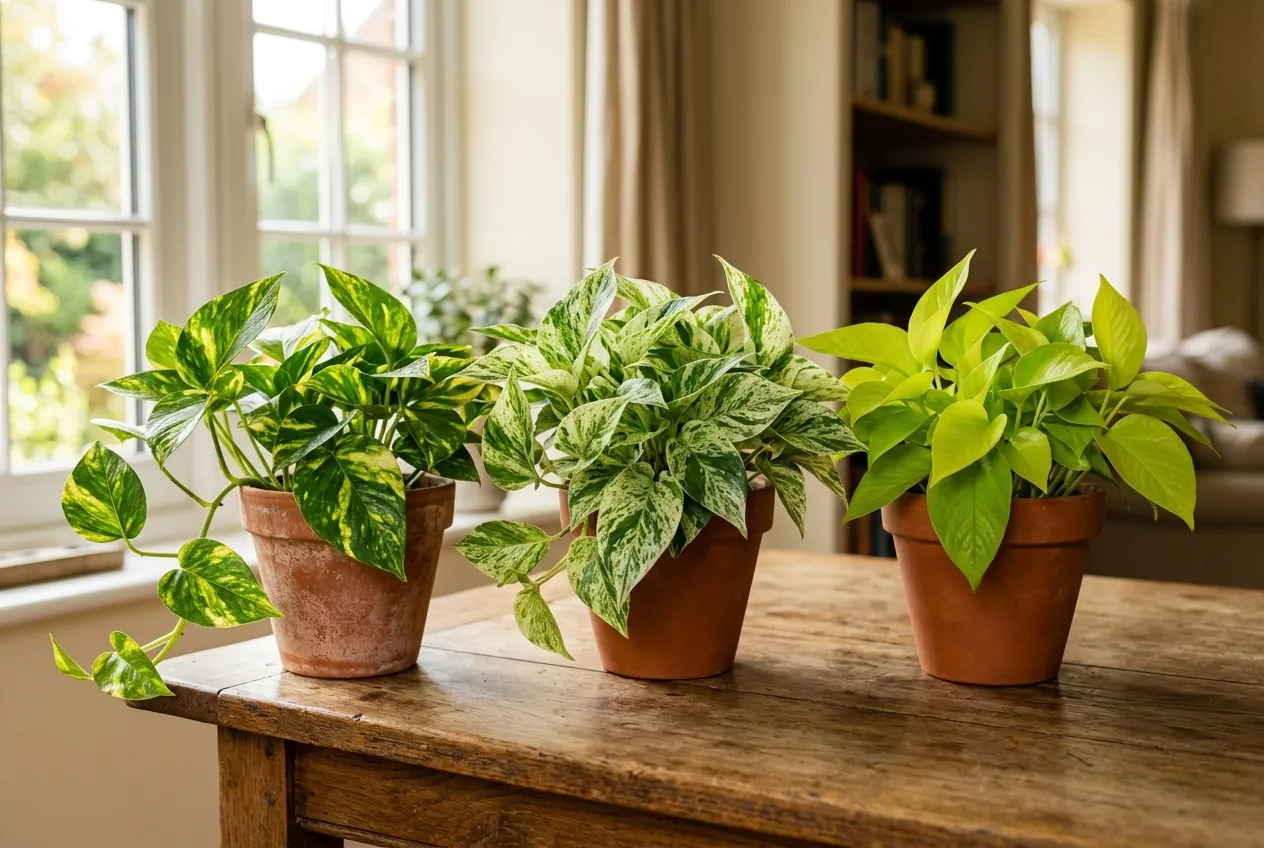 Golden, marble queen, and neon pothos side by side. The colour differences are striking in person.
Pothos variety comparison table
| Variety | Light (lux) | Growth rate | Max trail | UK price | Best for |
|---|---|---|---|---|---|
| Golden | 200-1,500 | Fast (30-45cm/month) | 2-3m | 4-8 | Beginners, any room |
| Marble queen | 500-1,500 | Moderate (15-25cm/month) | 2m | 6-12 | Bright rooms |
| Neon | 200-1,200 | Fast (25-40cm/month) | 2-3m | 6-12 | Dark corners |
| Manjula | 600-1,500 | Slow (10-20cm/month) | 1.5m | 10-18 | Collectors |
| N’Joy | 500-1,500 | Moderate (15-20cm/month) | 1.5m | 6-10 | Small shelves |
| Cebu blue | 400-1,200 | Moderate (20-30cm/month) | 2m | 8-15 | Unusual foliage |
Why we recommend golden pothos for beginners: After growing all six varieties across three years and multiple room aspects, golden pothos outperformed every other type in low-light UK conditions. It maintained strong variegation at 300 lux where marble queen reverted to green within 8 weeks.
Light requirements for pothos in UK rooms
Pothos tolerates a wider light range than almost any houseplant, from 200 lux in a north-facing hallway to 1,500 lux near a south-facing window. Understanding what each room in a typical UK home provides helps you place the right variety in the right spot.
UK indoor light levels vary enormously by aspect and season. In midwinter, a north-facing room in the Midlands receives as little as 150-300 lux on a cloudy day. A south-facing window might hit 2,000-5,000 lux in summer but drop to 500-800 lux in December. Our guide to low-light houseplants covers more species for dim rooms.
North-facing rooms (150-500 lux): Golden pothos and neon pothos cope well. Marble queen and manjula lose variegation here. Growth slows to 5-10cm per month in winter.
East or west-facing rooms (400-1,500 lux): Ideal for all varieties. This is where marble queen and n’joy show their best variegation. Expect 20-35cm of new growth per month from April to September.
South-facing rooms (1,000-5,000 lux): All varieties thrive, but keep plants 1-2 metres from the glass to avoid leaf scorch from direct midday sun. Cebu blue develops its distinctive fenestrations most readily here.
If you want to understand how other plants perform in low-light UK rooms, our indoor plants guide compares twelve species by light tolerance.
How to water pothos correctly
Water pothos when the top 3cm of soil feels dry. In practice, this means every 7-10 days in summer and every 10-14 days in winter in a typical UK home. The plant tells you when it is thirsty. Leaves droop and curl slightly, then recover completely within 2-4 hours of watering.
The watering method matters more than the schedule. Water thoroughly until it runs freely from the drainage holes. Let the pot drain completely, then tip away any water sitting in the saucer after 30 minutes. Pothos roots rot when they sit in standing water.
UK tap water is fine for pothos. Unlike some tropical houseplants that need rainwater or filtered water, pothos tolerates the calcium in hard UK tap water without problems. I have watered mine with Staffordshire hard tap water (300+ ppm) for three years with no leaf spotting or mineral buildup issues.
Overwatering is the number one killer. Roots need oxygen between waterings. In a cold UK room at 15-18C, compost stays wet for far longer than in the 25C tropical conditions pothos evolved in. If in doubt, wait another 3 days. A slightly underwatered pothos recovers in hours. An overwatered, root-rotted pothos takes weeks to save, if it survives at all.
For general watering principles across all houseplants, our beginner house plants guide covers the fundamentals.
Temperature and humidity for UK homes
Pothos grows best at 18-24C, which matches most heated UK rooms. It tolerates temperatures down to 10C but growth stops below 15C. The real danger in British homes is cold draughts near windows and exterior doors in winter, where air temperature can drop 5-8C below the room average.
Humidity of 40-60% suits pothos well. UK homes with central heating often drop to 30-35% humidity in winter, which causes brown leaf tips. A few simple fixes work:
- Group pothos with other houseplants to create a humid microclimate
- Place the pot on a tray of wet pebbles (water evaporates around the leaves)
- Mist leaves 2-3 times per week in winter
- Move plants to a bathroom where shower steam raises humidity to 60-80%
Avoid placing pothos near radiators. The combination of extreme heat (30C+ at pot level) and bone-dry air (under 25% humidity) causes rapid leaf browning. Position plants at least 1 metre from any heat source.
How to propagate pothos for free
Pothos is one of the easiest houseplants to propagate. A single healthy plant produces unlimited new ones through stem cuttings in water or soil. This is the most reliable propagation method I have tested across 40+ cuttings over two years.
Water propagation (recommended method)
- Select a healthy stem with at least 3-4 leaves
- Cut 1cm below a node (the small brown bump where aerial roots emerge)
- Remove the lowest leaf so at least one node sits below the waterline
- Place the cutting in a glass jar of clean water at 18-24C
- Position in bright indirect light (400-800 lux)
- Change the water every 5-7 days to prevent bacterial growth
- White roots appear in 7-14 days, reaching 5-8cm in 3-4 weeks
- Transfer to soil when roots are 5-8cm long
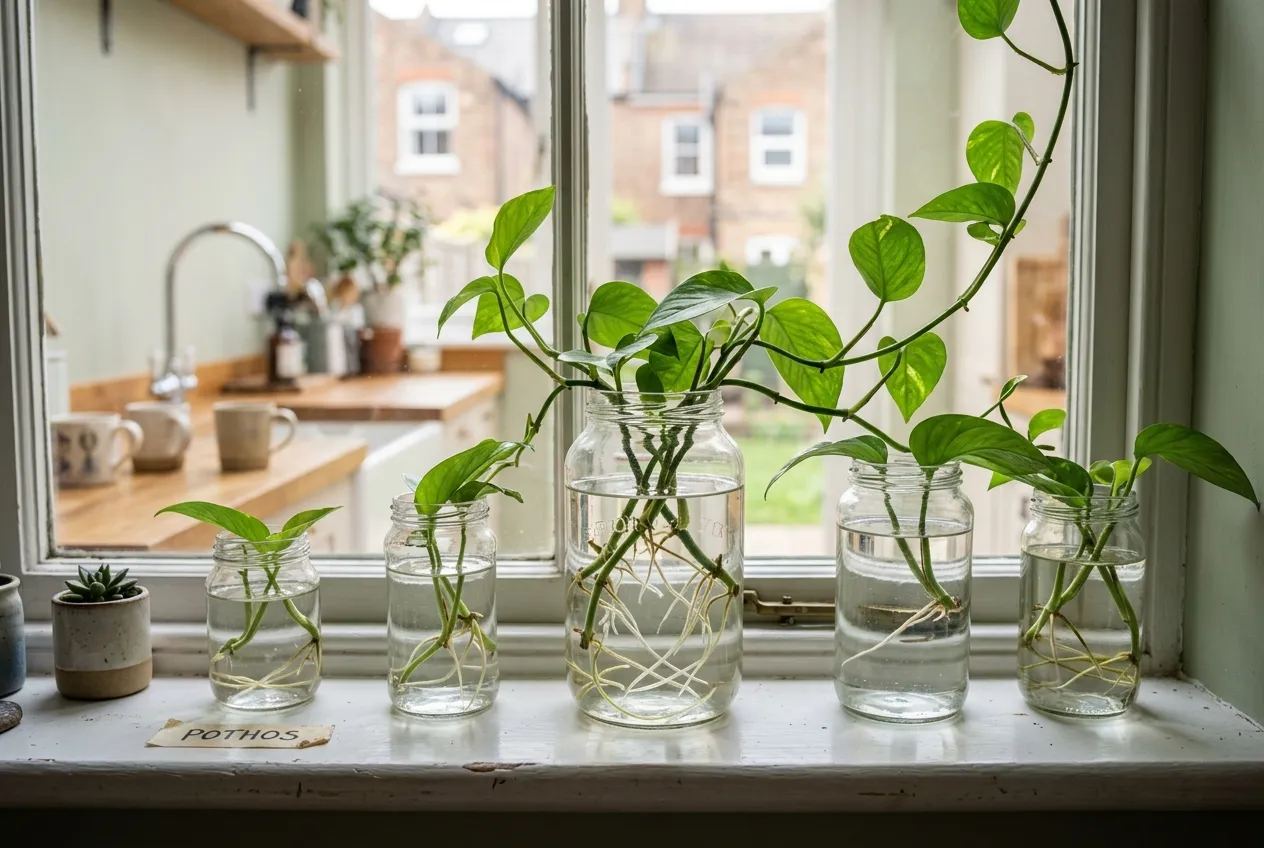 Pothos cuttings rooting in water on a kitchen windowsill. Roots are visible after two weeks.
The critical mistake most people make is leaving cuttings in water indefinitely. Water roots are structurally different from soil roots. The longer a cutting stays in water beyond 4-6 weeks, the harder the transition to soil becomes. Transfer promptly when roots reach 5-8cm.
For more detailed propagation techniques covering division, layering, and air layering, read our plant propagation guide.
Soil propagation
Follow steps 1-3 above, then plant the cutting directly into moist peat-free compost mixed with 30% perlite. Cover the pot with a clear plastic bag to maintain humidity above 60%. Remove the bag for 30 minutes daily to prevent mould. Roots establish in 3-6 weeks. This method skips the water-to-soil transition but has a slightly lower success rate (around 80% versus 95% for water propagation in my testing).
If you want to try propagating other houseplants too, our houseplant propagation guide covers methods for 15 popular species.
Potting mix and repotting
Use a peat-free houseplant compost mixed with 25-30% perlite. This creates the fast-draining, airy mix that pothos roots need. Pure compost retains too much moisture in UK homes where cooler temperatures slow evaporation. Our peat-free compost guide explains why peat-free matters and which brands work best.
Repot pothos every 18-24 months or when roots circle the inside of the pot or grow through drainage holes. Move up one pot size only (e.g. 12cm to 15cm). A pot that is too large holds excess moisture around the roots. The best time to repot in the UK is March to May, when increasing daylight triggers active growth.
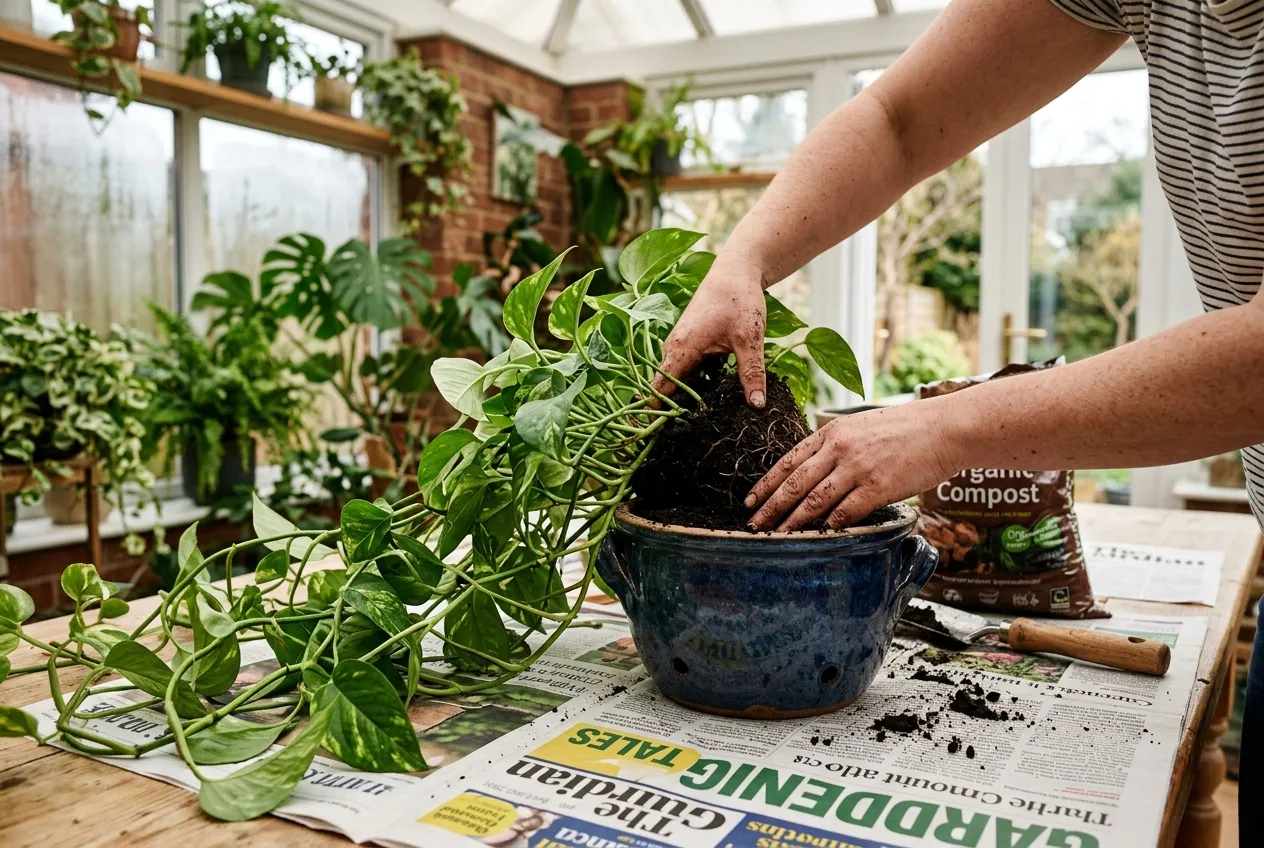 Repotting a mature pothos. Move up one pot size and add perlite to the compost for better drainage.
For a step-by-step guide to the repotting process, read our how to repot houseplants article.
Common pothos problems and fixes
Yellow leaves
Overwatering causes 80% of yellow pothos leaves. Roots sitting in wet soil for days suffocate and begin to rot. Check drainage holes are clear, remove any saucer water, and let the top 3-4cm dry before the next watering. If the stem base feels mushy, root rot has set in. Cut healthy stems above the rot and propagate fresh cuttings.
Brown leaf tips
Low humidity below 40% dries leaf edges. Common in UK homes with central heating running from October to March. Increase humidity using the methods in the temperature section above. Brown tips do not recover, but new growth will be healthy once humidity improves.
Leggy growth with small leaves
Insufficient light causes stretched stems with widely spaced, undersized leaves. Move the plant closer to a window or to a brighter room. Pothos in 200-300 lux grows half the leaf size of pothos in 800-1,200 lux. Prune leggy stems back to a node and propagate the cuttings to create a fuller plant.
Loss of variegation
Variegated varieties revert to green in low light. The plant produces more chlorophyll to compensate for dim conditions, overwriting the white or yellow patterns. Move marble queen, manjula, or n’joy to a spot receiving at least 500 lux. Prune reverted (all-green) stems to encourage new variegated growth.
Fungus gnats
Tiny black flies around the soil surface indicate fungus gnats. They breed in consistently moist compost. Let the top 3cm dry completely between waterings to break the breeding cycle. A 1cm layer of horticultural grit on the soil surface prevents adult gnats from laying eggs. Our houseplant flies guide covers the full treatment hierarchy.
Pothos care calendar for the UK
| Month | Action |
|---|---|
| January-February | Reduce watering to every 12-14 days. No feeding. Check for cold draught damage near windows. |
| March | Resume regular watering as growth restarts. Repot if rootbound. Begin feeding monthly. |
| April-May | Active growth period. Water every 7-10 days. Feed with half-strength liquid fertiliser every 4 weeks. Take cuttings for propagation. |
| June-August | Fastest growth (30-45cm/month in bright light). Keep out of direct midday sun. Mist if humidity drops below 40% during heatwaves. Can place outdoors in sheltered shade if night temps exceed 12C. |
| September | Bring outdoor plants inside before night temps drop below 12C. Reduce feeding to every 6 weeks. |
| October-November | Slow down watering. Stop feeding by end of November. Move away from cold windows. |
| December | Minimum watering every 12-14 days. No feeding. Maintain temperatures above 10C. Check for pests in warm, dry indoor air. |
Pothos safety and toxicity
Pothos is toxic to cats, dogs, and humans. All parts of the plant contain insoluble calcium oxalate crystals (raphides) that cause immediate pain, swelling, and drooling if chewed. In cats and dogs, symptoms include pawing at the mouth, excessive drooling, vomiting, and difficulty swallowing. Contact the RSPCA or a vet immediately if a pet ingests pothos leaves.
For households with pets, hang pothos high on shelves or in hanging baskets out of reach. Alternatively, choose entirely non-toxic species. Our pet-safe plants guide covers safe and dangerous species in detail.
According to the RHS, Epipremnum aureum is listed as a plant with low to moderate toxicity if ingested.
Frequently asked questions
Is pothos a good houseplant for beginners?
Pothos is the single best houseplant for beginners. It tolerates low light, irregular watering, and dry central-heated air. It wilts visibly when thirsty, then recovers within hours of watering. You can grow it in soil or plain water, making it almost impossible to kill through neglect. If you are just starting out with houseplants, the beginner guide on this site covers five more forgiving species.
Can pothos grow in a north-facing room?
Yes, pothos grows well in north-facing UK rooms with 200-500 lux. Growth slows compared to brighter positions, and highly variegated types like marble queen may revert to plain green. Golden pothos and jade pothos are the best choices for low-light rooms.
How often should I water pothos in winter?
Water pothos every 10-14 days in winter. UK central heating dries the air but lower light slows growth, so the plant uses less water. Push a finger 3cm into the soil. If dry, water thoroughly until it drains from the base. If still damp, wait another 3-4 days.
Is pothos toxic to cats and dogs?
Yes, pothos is toxic to cats and dogs. All parts contain calcium oxalate crystals that cause pain, swelling, and drooling if chewed. Hang the plant out of reach or choose a pet-safe alternative such as spider plant or Boston fern.
Why are my pothos leaves turning yellow?
Overwatering is the most common cause of yellow pothos leaves. Soggy soil suffocates roots and triggers rot. Check that the pot has drainage holes and that water is not sitting in a saucer. Let the top 3cm dry between waterings. Other causes include cold draughts below 10C and too much direct sun.
How do I make my pothos grow faster?
Place pothos in bright indirect light of 800-1,500 lux and maintain temperatures of 18-24C. Feed with a balanced liquid fertiliser (10-10-10) diluted to half strength every 4 weeks from April to September. Pothos grows 30-45cm per month in ideal conditions versus 5-10cm in low light.
Can I grow pothos outdoors in the UK?
No, pothos cannot survive UK winters outdoors. It is a tropical plant native to Southeast Asia that suffers damage below 10C and dies at frost. You can place pots outside in a sheltered spot from June to September when night temperatures stay above 12C, but bring them indoors before autumn.
Lawrie has been gardening in the West Midlands for over 30 years. He grows his own veg using no-dig methods, keeps a wildlife-friendly garden, and writes practical advice based on real UK growing conditions.