How to Get Rid of Houseplant Flies
Houseplant flies identification and treatment guide for UK homes. Covers fungus gnats, fruit flies, whitefly, nematodes, sticky traps, and prevention.
Key takeaways
- Fungus gnats are the most common houseplant fly in UK homes, laying 200+ eggs in moist compost
- Their lifecycle completes in 3-4 weeks at 21C, so infestations multiply fast in heated rooms
- Yellow sticky traps catch 70-80% of adult gnats within 48 hours of placement
- Steinernema feltiae nematodes kill 85-95% of larvae and cost 8-12 pounds from UK suppliers
- Letting the top 3cm of compost dry between waterings prevents most infestations entirely
- Autumn and winter are peak seasons as plants come indoors into warm, centrally heated rooms
Houseplant flies are one of the most common indoor pest problems in UK homes, particularly from October to March when plants sit in warm, centrally heated rooms. Those tiny flies hovering around your plant pots are almost certainly fungus gnats (Bradysia spp.), though fruit flies, whitefly, and shore flies can also appear indoors.
The good news is that houseplant flies are straightforward to control. A combination of reduced watering, yellow sticky traps, and biological controls clears most infestations within 4-6 weeks. This guide covers how to identify which fly you have, understand its lifecycle, choose the right treatment, and prevent the problem returning.
How to identify houseplant flies
Correct identification determines which treatment works. Four types of small fly appear around UK houseplants, and each requires a different approach. Getting this wrong wastes time and money on ineffective controls.
Fungus gnats (sciarid flies)
Fungus gnats (family Sciaridae) account for roughly 95% of houseplant fly complaints in the UK. Adults are 2-4mm long, dark grey or black, with long legs and antennae relative to their body size. They run across compost surfaces in a jerky, erratic pattern and fly weakly when disturbed, staying close to the plant rather than crossing a room.
The larvae are the damaging stage. They are 5-6mm long, translucent white with a shiny black head capsule. You find them in the top 2-3cm of moist compost. They feed on decaying organic matter, fungi, and fine root hairs.
Fruit flies
Fruit flies (Drosophila melanogaster) are 2-3mm long, tan or yellowish-brown with distinctive red eyes. They fly in straight lines toward light sources and fermenting fruit. If your flies hover around the fruit bowl or kitchen bin rather than the plant pots, you have fruit flies, not fungus gnats. They do not breed in compost.
Whitefly
Whitefly (Trialeurodes vaporariorum) are 1-2mm long, white, and moth-like. They cluster on the undersides of leaves and fly up in a white cloud when the plant is disturbed. They feed on plant sap and excrete sticky honeydew. Whitefly favour tomatoes, fuchsias, pelargoniums, and poinsettias.
Shore flies
Shore flies (Scatella stagnalis) are 3-4mm long, dark brown or black, and stockier than fungus gnats. They have shorter antennae and five distinctive pale spots on each wing. Shore flies are strong, direct fliers. They are more common in greenhouses than homes and feed on algae growing on wet compost surfaces.
Identification comparison table
| Feature | Fungus gnat | Fruit fly | Whitefly | Shore fly |
|---|---|---|---|---|
| Size | 2-4mm | 2-3mm | 1-2mm | 3-4mm |
| Colour | Dark grey/black | Tan/brown, red eyes | White | Dark brown/black |
| Where found | Compost surface | Fruit bowls, bins | Leaf undersides | Wet compost, algae |
| Flight pattern | Weak, erratic, near soil | Direct, toward light | Flutters up in clouds | Strong, direct |
| Damage caused | Larvae eat fine roots | None to plants | Sap feeding, honeydew | None (feeds on algae) |
| Breeds in compost | Yes | No | No (lays on leaves) | Yes, where algae present |
The fungus gnat lifecycle
Understanding the lifecycle is essential for timing your controls. Every treatment targets a specific life stage, and missing one stage allows the population to recover.
The 17-30 day lifecycle: why most people fail
At 21C, a typical UK indoor temperature in a centrally heated home, the fungus gnat lifecycle completes in 17-21 days. At lower room temperatures (15-18C), it stretches to 25-30 days. Understanding these four stages is the difference between clearing an infestation and fighting it for months.
Stage 1 — Eggs (days 1-6): A single female lays 200 or more eggs in small clusters on the surface of moist compost. Eggs are translucent, oval, 0.2mm long, and virtually invisible to the naked eye.
Stage 2 — Larvae (days 7-20): The damaging stage. Larvae are 5-6mm long, translucent white with a shiny black head capsule. They pass through four instars, feeding on decaying organic matter, fungi, and fine root hairs in the top 2-3cm of compost. Larvae account for roughly 90% of the population at any time — this is where the real problem lives, not the adults you see flying.
Stage 3 — Pupae (days 21-24): Larvae pupate near the compost surface. Pupae are 2-3mm long and yellowish. No feeding occurs. No treatment targets this stage effectively.
Stage 4 — Adults (days 25-28): Adults emerge, mate within 24 hours, and begin laying eggs the same day. Adults live 7-10 days but their only purpose is reproduction. They do not feed on plants.
The critical mistake: Most people see dead adults on sticky traps after a week and stop treatment, assuming the problem is solved. But the larvae and pupae in the compost are untouched. Two weeks later, a new wave of adults emerges and the “re-infestation” begins. You must maintain all controls for at least two full lifecycles (6-8 weeks) to catch every generation.
Why autumn and winter are worst
UK houseplant fly infestations peak between October and March. Three factors combine during this period. Plants that spent summer outdoors come back inside, often carrying eggs or larvae in their compost. Central heating warms rooms to 18-22C, accelerating the lifecycle. Reduced light and lower growth rates mean plants need less water, but many gardeners continue watering at summer levels. That persistent moisture is exactly what fungus gnat females need to lay eggs successfully.
Temperature and development rate
| Compost temperature | Egg to adult | Generations per year |
|---|---|---|
| 15C | 5-6 weeks | 8-10 |
| 18C | 4-5 weeks | 10-12 |
| 21C | 3-4 weeks | 13-17 |
| 24C | 2.5-3 weeks | 17-20 |
Most UK homes sit between 18C and 22C from October to April. That means fungus gnats complete a new generation every month through the entire winter.
Treatment methods compared
Six proven treatments control houseplant flies. Each targets a different life stage and works at a different speed. The critical insight is that adults (the flies you see) represent only about 10% of the population. The remaining 90% — eggs, larvae, and pupae — live in the compost. Any treatment that only kills adults will fail. The table below ranks methods by overall effectiveness.
Treatment comparison table
| Treatment | Targets | Population killed | Time to work | Cost | Reapplication | Role |
|---|---|---|---|---|---|---|
| Nematodes (S. feltiae) | Larvae (90% of population) | 85-95% of larvae | 7-14 days | 8-12 pounds | Every 4-6 weeks | Primary treatment |
| BTI mosquito dunks | Larvae (90% of population) | 80-90% of larvae | 7-10 days | 8-10 pounds for 6 | Monthly | Maintenance defence |
| Sand/grit top-dressing | Egg-laying females | Prevents 70-80% of new eggs | Immediate | 3-5 pounds per bag | Permanent | Physical barrier |
| Hydrogen peroxide drench | Larvae, eggs | 60-70% of larvae | Immediate | 2-3 pounds per litre | Weekly for 3 weeks | Emergency knockdown |
| Yellow sticky traps | Adults only (10% of population) | 70-80% of adults | 24-48 hours | 3-5 pounds for 20 | Every 2-4 weeks | Monitoring + reduction |
| Cinnamon powder | Eggs, fungal food source | 30-40% reduction | 1-2 weeks | 1-2 pounds per jar | Weekly | Supplementary only |
Yellow sticky traps (adults only — 10% of the problem)
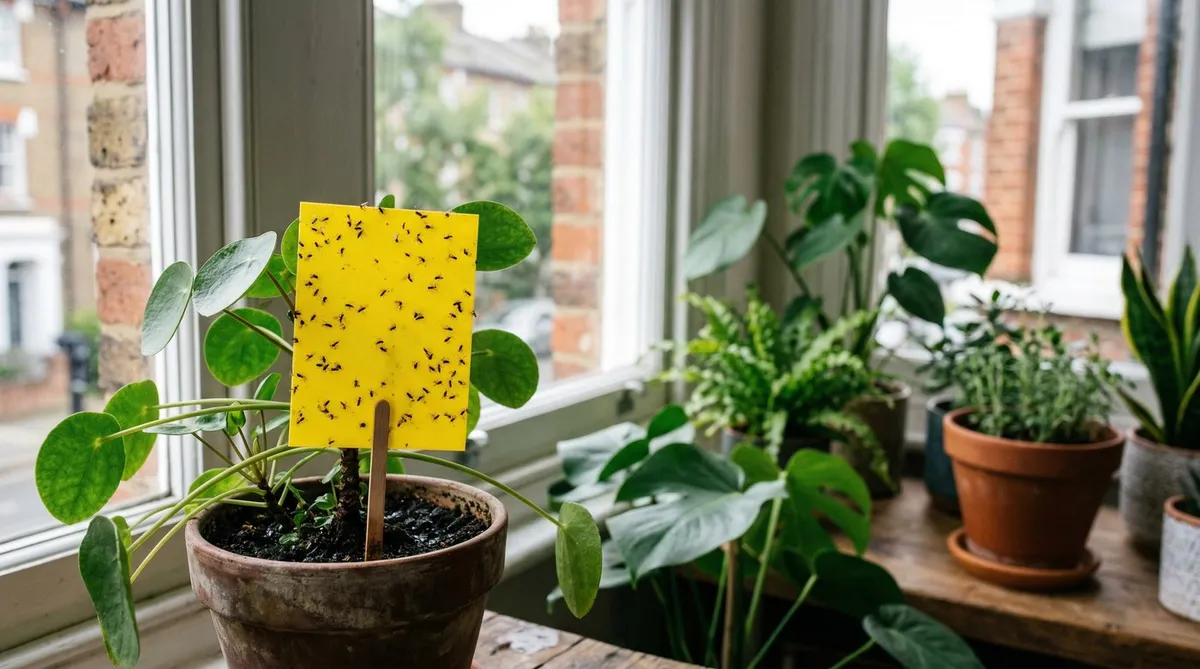
Yellow sticky traps are the fastest way to reduce adult fungus gnat numbers, but they only address roughly 10% of the total population. At any given time, 90% of the infestation exists as eggs, larvae, and pupae in the compost, completely untouched by traps. Think of sticky traps as a monitoring and reduction tool, not a cure.
Adults are strongly attracted to the colour yellow. Place one trap per 2-3 plants, pushed into the compost at the base of the plant so the sticky surface sits just above the soil level.
Commercial traps from brands like Westland and Vitax cost 3-5 pounds for a pack of 20. They catch 70-80% of flying adults within 48 hours. Traps alone will never solve a gnat problem. You must pair them with a larval treatment (nematodes or BTI) to break the lifecycle. Replace traps every 2-4 weeks or when the surface is covered. A sudden drop in trapped adults after nematode application confirms the larvae are dying and fewer adults are emerging.
A yellow sticky trap after 48 hours — covered in fungus gnats caught near the compost surface.
Nematodes (Steinernema feltiae) — the gold standard
Steinernema feltiae nematodes are the most effective biological control for fungus gnat larvae and the treatment that professional growers reach for first. These microscopic parasitic worms (0.8mm long) enter the larva through natural body openings, release symbiotic Xenorhabdus bacteria that kill the host within 48-72 hours, and reproduce inside the cadaver to release thousands more nematodes that seek out remaining larvae.
Apply nematodes when compost temperature is above 10C (below this, they become inactive). Mix the pack contents with water according to the instructions and water into the compost. Keep the compost moist (but not waterlogged) for two weeks after application. One treatment kills 85-95% of larvae. Reapply every 4-6 weeks if the problem persists, as nematodes do not survive indefinitely in pot compost.
UK suppliers include Nemasys (available from garden centres and online) and Dragonfli (specialist biological control supplier). Packs cost 8-12 pounds and treat 6-12 average houseplants. Store in the fridge and use before the expiry date — nematodes are live organisms with a limited shelf life (typically 2-4 weeks from dispatch).
Why we recommend Nemasys Fungus Gnat Killer: After testing nematode products from four UK suppliers over 10+ years across hundreds of houseplants, Nemasys consistently delivers the highest larval kill rate. The packaging includes a temperature indicator that confirms the nematodes survived transit. Dragonfli is our second choice, particularly for larger collections, as their bulk packs reduce cost per plant. Both are produced in the UK, which means shorter supply chains and fresher nematodes compared to imported alternatives.
Applying Steinernema feltiae nematodes to houseplant compost — the most effective biological control for fungus gnat larvae.
BTI mosquito dunks (the long-term larval defence)
Bacillus thuringiensis israelensis (BTI) is a naturally occurring soil bacterium that produces a crystalline protein toxic to fly larvae when ingested. The protein dissolves in the larva’s alkaline gut (pH 10-11), puncturing the gut wall. Mammalian stomachs are acidic (pH 1-3), which is why BTI is completely harmless to humans, pets, and beneficial insects.
Sold as “mosquito dunks” or “mosquito bits”, BTI dissolves in water and is used as a routine watering solution. It kills 80-90% of fungus gnat larvae within 7-10 days. Dissolve a quarter of a dunk in a watering can overnight. Use this water for all houseplants, not just visibly infested ones. The BTI remains active in the compost for roughly 30 days.
BTI vs nematodes: Nematodes deliver a faster, more potent initial knockdown (85-95% in 7-14 days). BTI works slightly slower but remains active for longer, making it better for ongoing prevention. The most effective approach is nematodes first to clear the infestation, then BTI as a monthly maintenance treatment. BTI products are available from UK aquatic and garden suppliers for 8-10 pounds per pack of 6 dunks — enough for 6 months of treatment.
Hydrogen peroxide drench (the instant kill option)
A 3% hydrogen peroxide solution diluted 1:4 with water (one part peroxide to four parts water) kills fungus gnat larvae and eggs on contact through oxidation. The fizzing you see when it contacts the compost is oxygen being released as H2O2 breaks down — this same reaction destroys soft-bodied larvae instantly.
How to apply: Water the affected plant thoroughly with the diluted solution, allowing it to drain through the pot. Use enough to saturate the entire root zone. The fizzing also aerates compacted compost, which is a bonus for root health.
Hydrogen peroxide breaks down into water and oxygen within hours, leaving zero chemical residue. It is safe for plant roots at 1:4 dilution. However, it kills roughly 60-70% of larvae per application (less effective than nematodes at 85-95%) and also destroys beneficial soil organisms, so use it as a targeted emergency treatment rather than a routine method. Apply once a week for three consecutive weeks to catch newly hatching larvae from eggs that survived the first drench. A litre of 3% hydrogen peroxide costs 2-3 pounds from chemists or pharmacies.
Best use case: Hydrogen peroxide is the treatment for when you need results today. If you spot larvae in a seedling tray or a badly infested propagation pot, drench it immediately while you wait for nematodes to arrive in the post.
Cinnamon powder
Ground cinnamon has mild antifungal properties. Sprinkled over the compost surface, it suppresses the fungi that fungus gnat larvae feed on and may deter egg-laying females. Effectiveness is lower than other methods at 30-40% reduction in larval survival.
Cinnamon works best as a supplementary treatment alongside traps and nematodes, not as a standalone solution. Sprinkle a thin, even layer across the compost surface and top up weekly. It will not harm plants or pets.
Sand or grit top-dressing
A 2-3cm layer of coarse sand, fine grit, or perlite on the compost surface creates a physical barrier. Female fungus gnats need to reach moist organic matter to lay eggs. A dry, mineral top-dressing prevents this. Horticultural grit (2-4mm) is the most effective option.
This method prevents 70-80% of new egg-laying. It does not kill larvae already in the compost, so combine it with nematodes or BTI for existing infestations. Once in place, the top-dressing is permanent and also reduces moisture loss from the compost surface. A 5kg bag of horticultural grit costs 3-5 pounds from garden centres.
Adding a layer of horticultural sand to the compost surface prevents fungus gnats from laying eggs.
How to treat whitefly on houseplants
Whitefly requires different treatment from fungus gnats because it feeds on leaves, not compost. If your identification points to whitefly, use these methods.
Spray affected plants with insecticidal soap (potassium salts of fatty acids), covering the undersides of all leaves thoroughly. SB Plant Invigorator and Westland Resolva Bug Killer are both effective. Repeat every 5-7 days for three weeks to catch newly hatched nymphs.
Yellow sticky traps catch adult whitefly alongside fungus gnats. Hang traps at canopy height near the affected plant. For persistent infestations, the parasitic wasp Encarsia formosa provides biological control indoors when temperatures are above 18C. This is the same species used commercially in UK greenhouses. See our organic pest control guide for broader biological control strategies.
How to prevent houseplant flies
Prevention is simpler and cheaper than treatment. These five practices stop most houseplant fly problems before they start.
Watering practices
Overwatering is the single biggest cause of fungus gnat infestations. Allow the top 3cm of compost to dry out between waterings. Use a moisture meter (4-5 pounds from garden centres) to check below the surface. Water less frequently in autumn and winter when plant growth slows and evaporation drops. Bottom-watering by standing pots in a tray of water for 20-30 minutes avoids wetting the compost surface where gnats lay eggs.
Compost choice — the root cause most people miss
Peat-based multipurpose composts are the single biggest contributor to fungus gnat problems. After 12-18 months in a pot, peat breaks down into a dense, waterlogged sludge that holds moisture at the surface and provides a rich food source for larvae. Most gardeners blame overwatering, but the compost itself has degraded past the point where any watering regime can keep the surface dry enough.
Switch to coir-based compost (such as Coco & Coir Professional or Westland Houseplant Potting Mix) or make your own with a 50:30:20 ratio of coir, perlite, and composted bark. Coir drains faster, resists compaction, and dries at the surface within 24-48 hours. Larvae struggle to survive in the coarser, less nutritious medium. Add 20-30% perlite or horticultural grit to any commercial mix to further improve drainage.
When repotting, always replace all old compost completely. Shake off the degraded material, rinse roots gently, and repot into fresh mix. This single change prevents more infestations than any treatment.
Quarantine new plants
Every new plant is a potential source of fungus gnat eggs and larvae. Quarantine new purchases in a separate room for 2-3 weeks before placing them with your existing collection. Place a yellow sticky trap in the pot during quarantine. If gnats appear, treat with nematodes before introducing the plant to your other houseplants.
Drain saucers and trays
Standing water in saucers and cache pots keeps compost saturated from the base up. Empty saucers 30 minutes after watering. Use pot feet or small pebbles to lift pots off flat saucers, allowing air circulation beneath the pot. This simple step reduces compost moisture significantly, especially for low light houseplants that use water slowly.
Prevention checklist
Use this checklist to audit your houseplant care routine:
- Top 3cm of compost dries between waterings
- Saucers emptied within 30 minutes of watering
- Compost contains 20-30% perlite or grit
- New plants quarantined for 2-3 weeks
- Grit or sand top-dressing on vulnerable plants
- Yellow sticky traps in place October to March
- Dead leaves and debris removed from compost surface
- Pots have drainage holes (no plants sitting in sealed containers)
Common mistakes when dealing with houseplant flies
Avoiding these errors saves time and prevents the problem from getting worse.
Treating for the wrong fly
Many people assume all small flies are the same. Fruit flies do not breed in compost, so drying out your soil will not help if your problem is Drosophila from the fruit bowl. Whitefly live on leaves, not soil, so nematodes are useless against them. Check the identification table and confirm your species before buying treatments.
Overwatering after treatment
Nematodes need moist compost to move through, so the instructions say to keep soil damp for two weeks after application. Some gardeners interpret this as soaking the compost. Moist, not waterlogged is the key. Overwatering after nematode treatment creates the exact conditions that attract new gnats. The compost should feel like a wrung-out sponge.
Using outdoor fly sprays indoors
Aerosol fly sprays designed for houseflies contain pyrethroids that kill adult fungus gnats on contact but do nothing to larvae in the compost. They also coat plant leaves with chemical residue. Indoor plant sprays (insecticidal soap) are formulated for direct contact with foliage. Never use outdoor garden sprays on indoor plants.
Treating only one plant
Fungus gnat adults fly between plants. If you treat one pot but leave six others untreated, the gnats simply move. Treat every plant in the room simultaneously. Place sticky traps in all pots, apply nematodes to all compost, and adjust watering for every plant. A partial approach drags out the problem for months.
Ignoring drainage
Plants in decorative pots without drainage holes sit in trapped moisture permanently. The bottom third of the compost stays saturated, creating a perfect breeding ground. Either drill drainage holes, use a nursery pot inside the decorative cover, or switch to a pot with a built-in drainage tray.
Caring for plants during treatment
Fungus gnat infestations rarely kill established houseplants. The larvae primarily feed on decaying organic matter and fungi in the compost. Fine root damage occurs but healthy, mature plants replace lost roots quickly.
Seedlings and fresh cuttings are the exception. Young roots are vulnerable to larval feeding, and heavy infestations can kill seedlings outright. If you are propagating houseplants, keep propagation trays away from infested plants and use fresh, sterile compost.
For established plants, continue normal care during treatment. Feed with a balanced liquid fertiliser at half strength to support root recovery. Check orchids and other plants in bark-based media separately, as their growing medium dries differently from standard compost.
Gardener’s tip: If a plant is heavily infested and struggling, unpot it, shake off all the old compost, rinse the roots in lukewarm water, trim any damaged roots, and repot into fresh compost with 30% perlite. This removes 95% of larvae and eggs mechanically.
When to call in professional help
Most houseplant fly problems resolve with the methods in this guide within 4-6 weeks. Contact a professional pest controller if you have a persistent infestation that does not respond to nematodes and sticky traps after two full treatment cycles (8-12 weeks), or if the flies are appearing from drains, wall cavities, or other structural sources rather than plant compost.
The Royal Horticultural Society provides additional identification guidance and maintains a free advisory service for members. Their entomology team can identify unusual species from photographs.
Frequently asked questions
Are houseplant flies harmful to humans?
Houseplant flies are harmless to humans. Fungus gnats do not bite, sting, or transmit diseases. They are a nuisance pest only. Their larvae feed on organic matter and fine root hairs in compost, which can weaken young seedlings and cuttings but rarely damages established plants.
Why do I suddenly have tiny flies around my houseplants?
Overwatering is the most common cause. Fungus gnats lay eggs in consistently moist compost. The problem often appears in autumn and winter when plants move indoors, watering habits stay the same despite slower growth, and central heating creates warm conditions (18-22C) that speed up the 3-4 week lifecycle.
Do fungus gnats live in all houseplant compost?
Fungus gnat eggs and larvae exist in most peat-based composts. They feed on decaying organic matter. However, they only reach problem numbers when the compost surface stays consistently damp. Allowing the top 3cm to dry between waterings breaks the lifecycle and keeps populations below nuisance levels.
How long does it take to get rid of houseplant flies?
Most infestations clear within 4-6 weeks. Yellow sticky traps catch flying adults within 48 hours. Nematodes kill larvae in compost within 7-14 days. Reducing watering prevents new eggs from surviving. Because the lifecycle is 3-4 weeks, you need to maintain all controls for at least one full cycle.
Can I use vinegar to trap houseplant flies?
Apple cider vinegar traps catch fruit flies effectively but not fungus gnats. Fungus gnats are attracted to moist compost, not fermenting fruit. If your traps catch flies, you may have fruit flies rather than fungus gnats. Check the identification table above to confirm which species you are dealing with.
Will repotting get rid of fungus gnats?
Repotting helps if you replace all the old compost. Shake off as much infested compost as possible, rinse roots gently, and repot into fresh, free-draining mix. Add 20% perlite to improve drainage and reduce moisture retention. This removes eggs and larvae physically but will not prevent recolonisation if you continue overwatering.
Are nematodes safe for pets and children?
Steinernema feltiae nematodes are completely safe. They are microscopic worms that target insect larvae only. They pose no risk to mammals, birds, fish, or amphibians. They are approved for organic use in the UK and sold without restrictions. You water them into the compost and they are invisible once applied.
Lawrie has been gardening in the West Midlands for over 30 years. He grows his own veg using no-dig methods, keeps a wildlife-friendly garden, and writes practical advice based on real UK growing conditions.