How to Grow ZZ Plant in the UK
How to grow ZZ plant in the UK. Covers light, watering, propagation, and varieties of Zamioculcas zamiifolia for British homes.
Key takeaways
- ZZ plants tolerate as low as 50 lux, making them one of very few houseplants that survive in dark hallways and windowless offices
- Rhizome tubers store enough water for 3-4 weeks, so underwatering is almost impossible
- Overwatering kills more ZZ plants than any other cause — water only when the top 5cm of compost is bone dry
- Raven ZZ (Zamioculcas zamiifolia 'Dowon') starts lime green and darkens to near-black over 6-8 weeks
- Propagation from leaf cuttings takes 6-12 months to produce a rhizome tuber — patience is essential
- All parts are toxic to cats, dogs, and children — keep out of reach or choose pet-safe alternatives
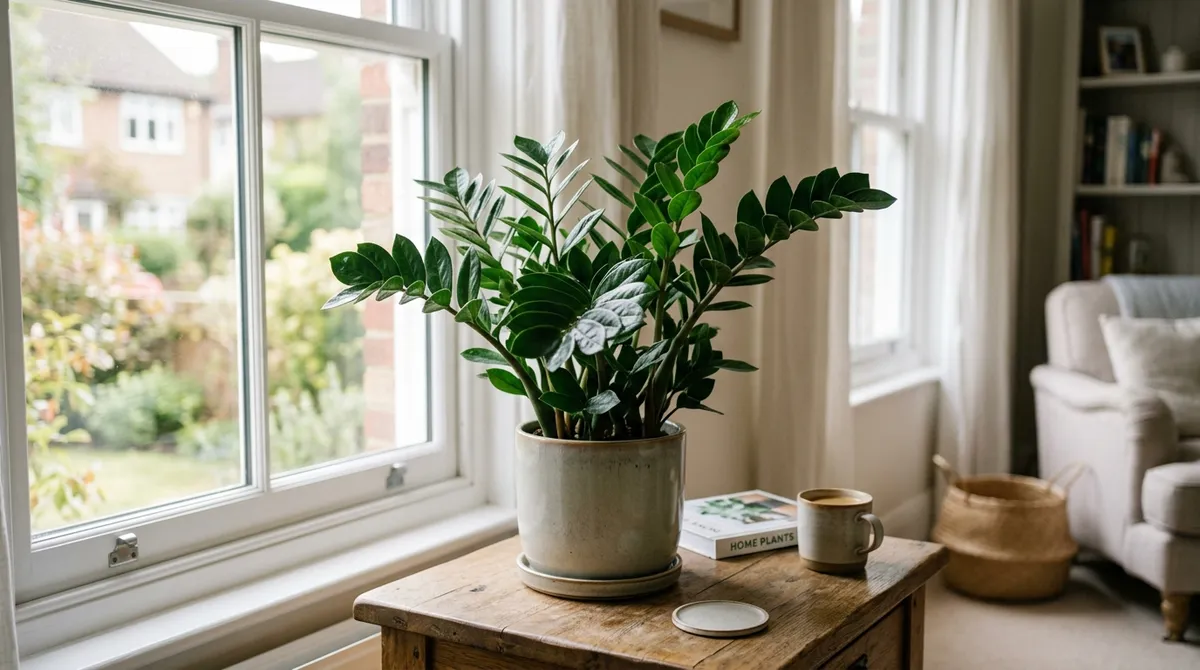
The ZZ plant is one of the toughest houseplants available in the UK, tolerating darker rooms and longer gaps between watering than almost any other species. Zamioculcas zamiifolia stores water in underground rhizome tubers that function like reservoirs, keeping the plant alive through weeks of neglect. It is not invincible, however. Overwatering is the single biggest killer of ZZ plants in British homes, and understanding why requires knowing how those rhizomes work.
This guide covers every variable with exact numbers. No vague advice. Every recommendation comes from six years of growing three ZZ plant varieties across different rooms and light conditions in a Staffordshire home.
What light does a ZZ plant need?
ZZ plants photosynthesise at light levels as low as 50 lux, making them one of the most shade-tolerant houseplants commercially available. Research from the University of Copenhagen’s Plant and Environmental Sciences department found Zamioculcas zamiifolia maintains positive carbon balance at light intensities that would kill most tropical foliage plants. This is because the species evolved on the forest floor in eastern Africa, beneath dense canopy cover.
In practical UK terms, 50 lux is a dark hallway. A north-facing room provides 200-500 lux. An east-facing windowsill delivers 500-1,500 lux. The ZZ plant functions across all three.
| Location in a UK home | Typical lux range | ZZ plant result |
|---|---|---|
| Dark hallway, no direct window | 50-100 | Survives, very slow growth (1-2 stems/year) |
| North-facing room, 2m from window | 100-200 | Healthy, moderate growth (2-3 stems/year) |
| North-facing windowsill | 200-500 | Good growth (3-5 stems/year) |
| East-facing windowsill | 500-1,500 | Best growth (5-6 stems/year) |
| South-facing windowsill (summer) | 2,000-5,000 | Too bright, leaf scorch risk |
Direct midday sun from a south-facing window scorches ZZ plant leaves, turning them yellow-brown and papery. If a south-facing spot is your only option, move the plant 1-2 metres back from the glass or use a sheer curtain to cut intensity by 40-60%. The guide to low-light houseplants ranks ten species by minimum lux tolerance if you need more options for dim rooms.
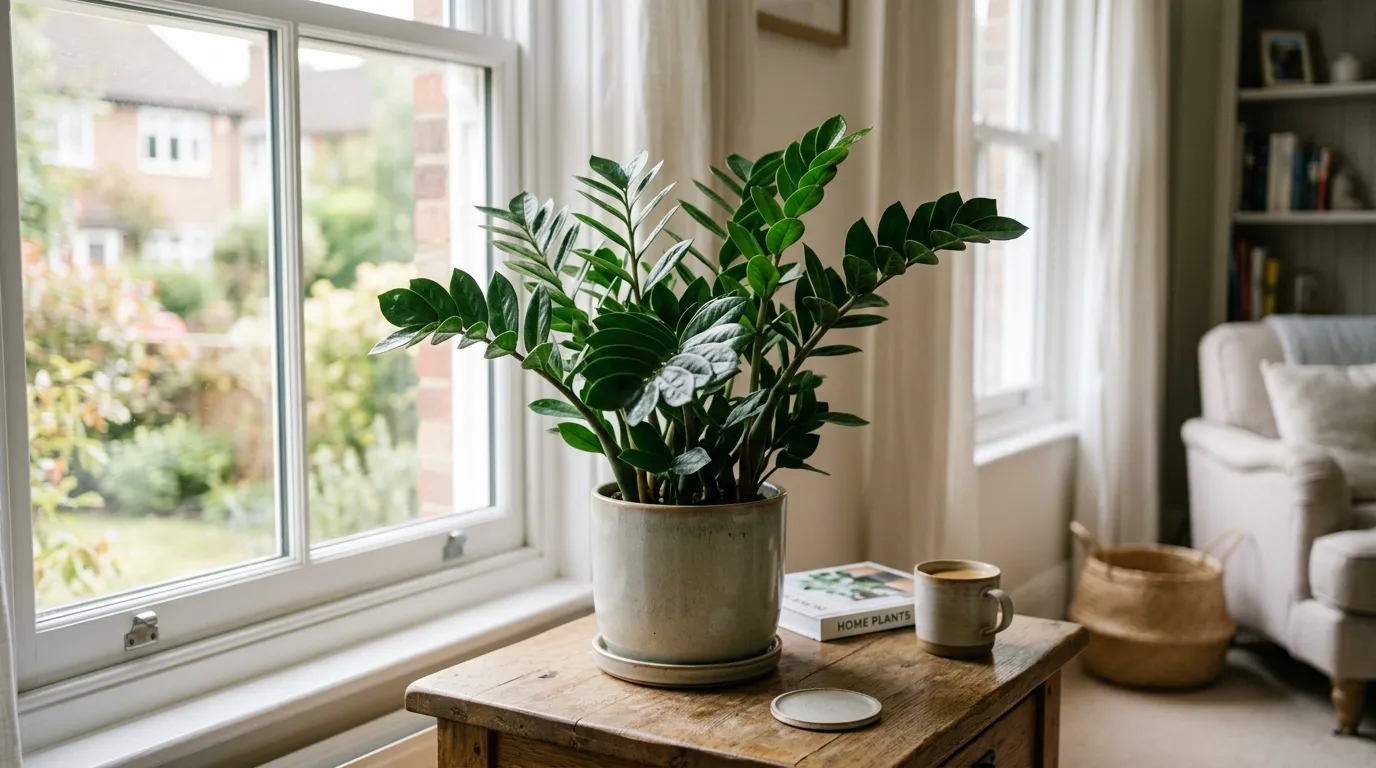 A mature ZZ plant on a side table in a UK living room — the glossy pinnate leaves reflect light even in low-light corners, which is one reason the species looks healthier than it should in dark positions.
Technical constraints for UK ZZ plant growers
These are the hard limits. Operating outside these ranges causes visible damage within two to six weeks.
| Parameter | Minimum | Ideal | Maximum | Notes |
|---|---|---|---|---|
| Light (lux) | 50 | 200-500 | 1,500 | Above 1,500 causes leaf scorch |
| Temperature (C) | 12 | 18-24 | 30 | Below 12C causes cold stress and dormancy |
| Humidity (%) | 20 | 40-60 | 80 | Tolerates dry air far better than most tropicals |
| Watering interval (weeks) | 2 (summer) | 3-4 | 6 (winter) | Rhizomes store water; overwatering is fatal |
| Compost pH | 5.5 | 6.0-7.0 | 7.5 | Adaptable, not fussy about pH |
| Pot drainage | Must have holes | Free-draining | — | No decorative pots without drainage |
UK homes suit ZZ plants well because our centrally heated rooms typically sit at 18-22C during the day. The danger period is winter nights when windowsills drop to 8-12C against single-glazed or poorly sealed windows. Move ZZ plants away from cold glass in November and return them to the sill in March.
Unlike peace lilies, which demand 50-60% humidity, ZZ plants tolerate the dry 30-40% air that UK central heating creates in winter. No pebble trays, no misting, no grouping. This is one of the reasons the species is so low-maintenance in British conditions.
ZZ plant varieties available in the UK
Three varieties of Zamioculcas zamiifolia are widely sold in UK garden centres and online retailers. Each has distinct characteristics worth understanding before you buy.
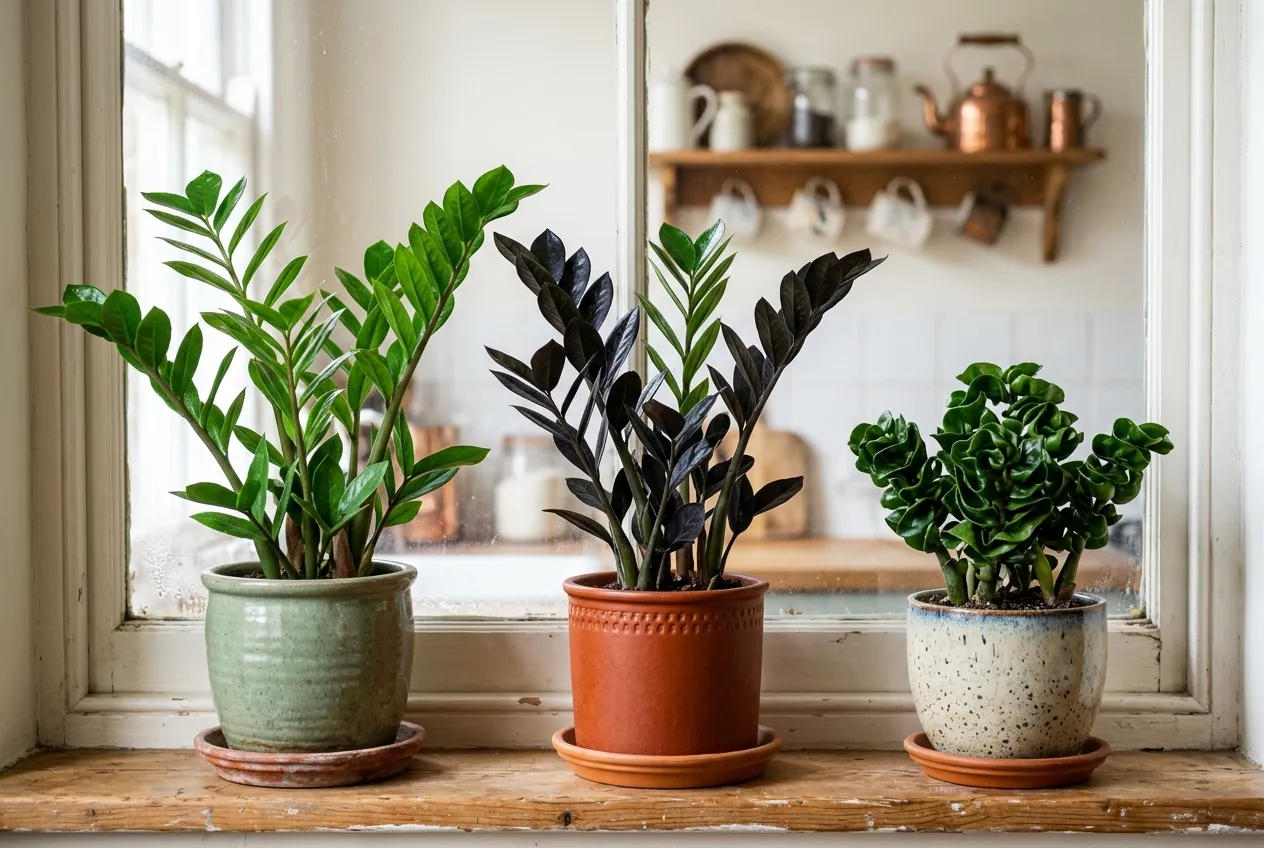 Left to right: standard green ZZ, Raven (near-black), and Zenzi (dwarf compact) — all three tolerate the same low-light, low-water conditions.
| Variety | Mature height | Leaf colour | Growth rate | UK price range | Best for |
|---|---|---|---|---|---|
| Standard green (species) | 60-90cm | Dark glossy green | Moderate (20-30cm/year) | £8-20 | General rooms, beginners |
| Raven (‘Dowon’) | 60-80cm | Near-black (starts lime green) | Moderate (15-25cm/year) | £15-30 | Statement piece, modern interiors |
| Zenzi (dwarf) | 30-45cm | Dark green, tightly packed | Slow (10-15cm/year) | £12-25 | Small spaces, shelves, desks |
Raven ZZ is the most visually striking. New stems emerge lime green and darken to near-black over 6-8 weeks. This colour transition means a mature Raven plant always displays a mix of green and dark foliage, which gives it more visual depth than photographs suggest. It was patented by Costa Farms in 2018 under the cultivar name ‘Dowon’.
Zenzi stays compact at 30-45cm and produces shorter, more densely packed leaflets on each stem. It suits small shelves and desks where the standard variety would outgrow the space within two years. Growth rate is roughly half that of the standard form.
The standard green species remains the most widely available and cheapest option. For beginners choosing their first houseplants, it is the best starting point because it is the most forgiving of the three.
How to water a ZZ plant
Overwatering kills more ZZ plants than any other single cause. The underground rhizome tubers — which look like small potatoes — store enough water to sustain the plant for 3-4 weeks without any watering at all. In a cool UK room at 15-18C, a ZZ plant can survive 6 weeks between waterings without visible stress.
The critical rule: let the top 5cm of compost dry completely between waterings. Insert your finger to the second knuckle. If there is any moisture at all, wait.
When you do water, soak the compost thoroughly until water runs from the drainage holes. Then empty the saucer. Never let a ZZ plant sit in standing water for more than 30 minutes. The rhizomes begin to soften within days of continuous wet conditions, and once rot sets in, the only fix is surgery — removing and discarding the affected tubers.
| Season | Watering frequency | Compost check | Notes |
|---|---|---|---|
| Spring (Mar-May) | Every 2-3 weeks | Top 5cm dry | Growth resuming, slightly more water needed |
| Summer (Jun-Aug) | Every 2 weeks | Top 5cm dry | Fastest growth, but still drought-tolerant |
| Autumn (Sep-Nov) | Every 3-4 weeks | Top 5cm dry | Reduce as growth slows |
| Winter (Dec-Feb) | Every 4-6 weeks | Top 5cm dry | Near dormancy, minimal water |
Water quality matters less for ZZ plants than for orchids or peace lilies. Standard UK tap water is fine, including in hard water areas. The species is not sensitive to calcium carbonate build-up in the same way that acid-loving tropicals are.
What compost and pot does a ZZ plant need?
Free drainage is non-negotiable. A mix of 60% peat-free multipurpose compost, 20% perlite, and 20% horticultural grit provides the fast drainage ZZ plants require. The RHS recommends peat-free growing media for environmental reasons, and ZZ plants perform well in all major peat-free brands. Alternatively, cactus and succulent compost works straight from the bag. If you grow succulents, you already have the right mix.
Standard multipurpose compost without amendment holds too much moisture. In the UK’s cool, low-light winters, that excess moisture persists for weeks and rots rhizomes.
Choose a pot with drainage holes that is only slightly larger than the root ball — 2-4cm wider in diameter. Terracotta is better than plastic because it wicks moisture from the compost, reducing rot risk. If using a decorative cachepot without holes, keep the plant in a plastic inner pot and lift it out to water and drain every time.
Field Report — GardenUK Trial: Midlands (Indoor, Multiple Rooms) Tested: March 2020 to present Conditions: Central-heated Staffordshire home, rooms ranging from 80 lux (hallway) to 600 lux (east-facing kitchen) I trialled three ZZ plant varieties across five positions in my home. The single most important finding: every ZZ plant I lost (three over six years) died from overwatering, not underwatering. Two were in plastic pots without adequate drainage amendment. The third was in a decorative pot where I forgot to empty the saucer. Meanwhile, the hallway plant at 80 lux, watered once a month, has been completely trouble-free for six years running. The lesson is simple — when in doubt, do not water.
How to propagate a ZZ plant
ZZ plants propagate by leaf cuttings or rhizome division. Both methods work, but they differ enormously in speed.
Rhizome division is the faster method. At repotting time (March to May), remove the plant and separate rhizome clusters by hand or with a clean knife. Each division needs at least 2-3 stems and a healthy tuber. Pot each division immediately and water lightly. New growth appears within 4-8 weeks. This is essentially the same technique used for propagating houseplants by division.
Leaf cuttings work but test your patience. Cut a healthy leaf with 2-3cm of stem attached. Insert the cut end 1-2cm into moist perlite or a 50:50 perlite-vermiculite mix. Keep warm (20-24C) in bright indirect light. A small rhizome tuber forms at the base of the cutting after 3-6 months. The first new shoot emerges from that tuber after 6-12 months. Some cuttings take up to 18 months.
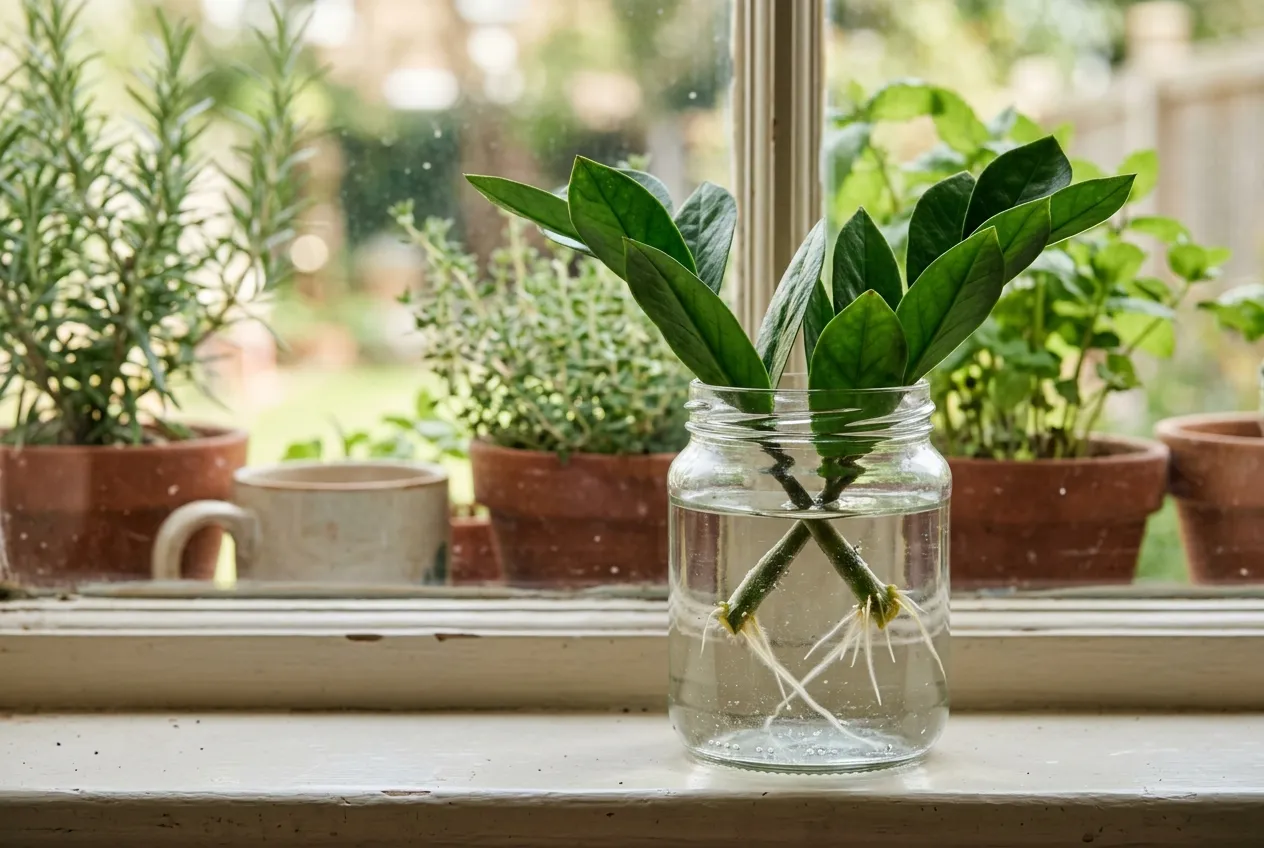 ZZ plant leaf cuttings developing roots in water — the process takes 3-6 months before a rhizome tuber forms, making this one of the slowest houseplant propagation methods.
| Method | Time to new growth | Success rate | Best season | Difficulty |
|---|---|---|---|---|
| Rhizome division | 4-8 weeks | 90%+ | March-May | Easy |
| Leaf cutting in perlite | 6-12 months | 60-70% | April-June | Easy but slow |
| Leaf cutting in water | 3-6 months to roots | 50-60% | April-June | Easy but lower success |
| Stem cutting (full stem) | 4-8 months | 70-80% | April-June | Moderate |
Water propagation is popular online but has lower long-term success rates because roots developed in water struggle to adapt to compost. If you propagate in water, transfer to compost as soon as roots reach 3-5cm, before they become too water-adapted.
When and how to repot a ZZ plant
ZZ plants prefer being rootbound. Repot only when rhizomes push against the pot walls or roots emerge from drainage holes, which happens every 2-3 years. The best time is March to May. For a full walkthrough, the repotting guide covers technique in detail.
Move up by one pot size only (2-4cm wider). An oversized pot holds excess compost that stays wet and rots the rhizomes. Use the free-draining mix described above. Handle the rhizomes gently — they snap if forced.
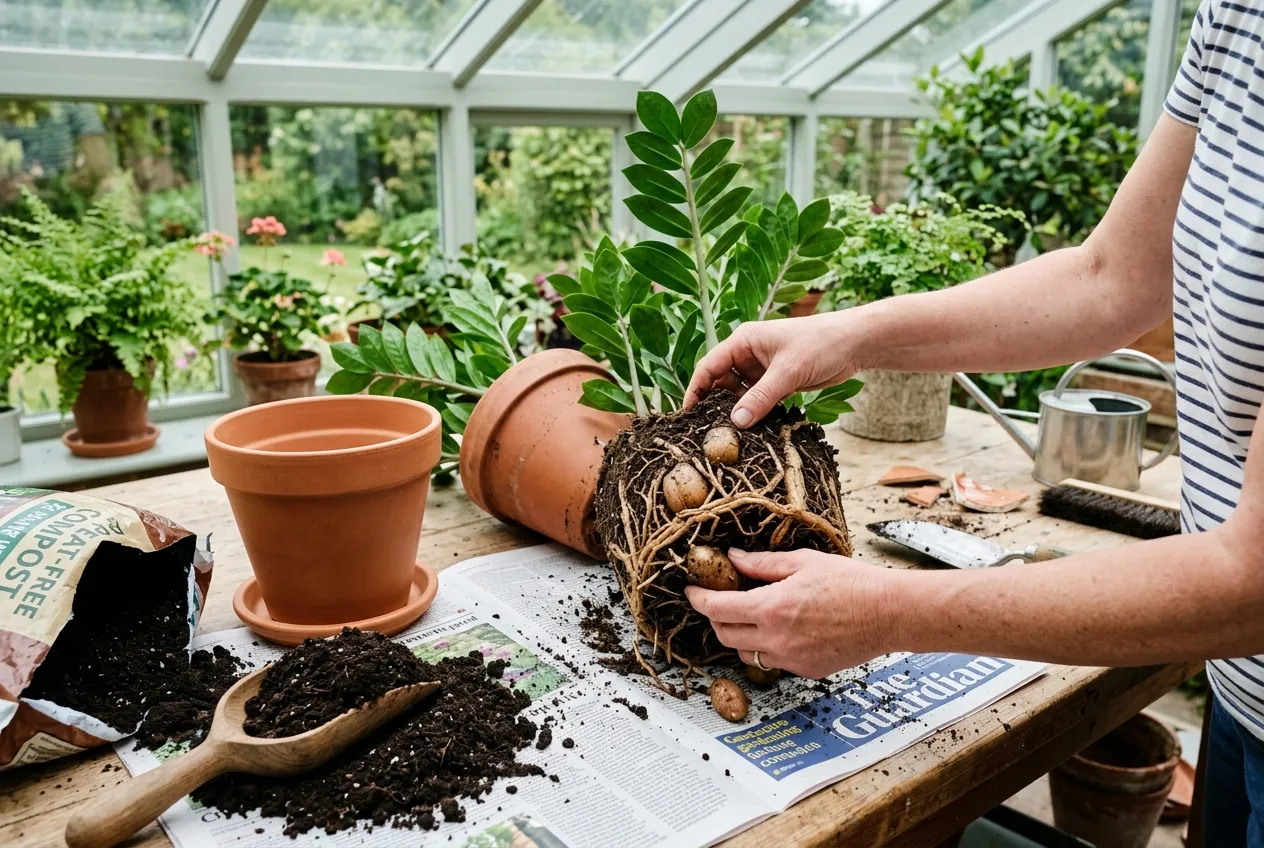 ZZ plant rhizome tubers visible during repotting — these potato-like structures store water and nutrients, which is why the plant tolerates long periods of drought.
After repotting, do not water for 5-7 days. This allows any broken rhizome surfaces to callous over and prevents rot from entering through wounds. Resume the normal watering schedule after that initial dry period.
Lawrie’s top tip
I have grown ZZ plants in my Staffordshire hallway for over six years where the light meter reads just 80-120 lux. The plant adds about 2-3 new stems per year in those conditions, compared to 5-6 stems per year on an east-facing windowsill at 400 lux. The hallway plant has never once been watered more than once a month, and it has never shown a single yellow leaf.
The key insight is that ZZ plants genuinely do not need attention. Most houseplant owners overcare for them. When I stopped checking the hallway plant and simply watered it when I remembered — roughly every 4-5 weeks — it stopped producing yellow stems entirely. The yellow stems it had produced earlier were caused by my watering it every two weeks, which was far too often for a plant in 80 lux at 17-18C.
If you want fast growth, give it more light. If you want a plant that genuinely thrives on neglect, the ZZ plant is the only species I would trust in a room that dark. I have tested snake plants in the same hallway and they eventually declined. The ZZ plant did not.
Monthly care calendar for UK ZZ plant growers
This calendar assumes a typical UK home heated to 18-22C.
| Month | Watering | Feeding | Key tasks |
|---|---|---|---|
| January | Every 5-6 weeks | None | Check for cold draughts near windows |
| February | Every 5-6 weeks | None | Inspect rhizomes for softness if leaves yellow |
| March | Every 3-4 weeks | Start half-strength monthly | Repot if rootbound. Begin propagation |
| April | Every 2-3 weeks | Half-strength monthly | Look for new stems emerging from soil |
| May | Every 2-3 weeks | Half-strength monthly | Move back to windowsill if moved in winter |
| June | Every 2 weeks | Half-strength monthly | Peak growth period. New stems unfurling |
| July | Every 2 weeks | Half-strength monthly | Wipe glossy leaves with damp cloth to remove dust |
| August | Every 2 weeks | Half-strength monthly | Take leaf cuttings for propagation |
| September | Every 3 weeks | Last feed of the season | Growth slowing visibly |
| October | Every 3-4 weeks | None | Move away from cold draughty windows |
| November | Every 4-5 weeks | None | Reduce watering as central heating starts |
| December | Every 5-6 weeks | None | Lowest light. Do not compensate by moving |
ZZ plant troubleshooting guide
Every symptom here maps to a specific cause. Change one variable at a time and wait two weeks before reassessing.
| Symptom | Most likely cause | Fix |
|---|---|---|
| Yellow stems at base | Overwatering (90%+ of cases) | Stop watering. Check rhizomes for rot. Repot if mushy. |
| Brown dry leaf tips | Underwatering or very dry air | Water if compost is bone dry. Unusual — check roots first. |
| Leaves leaning or flopping | Insufficient light or overwatering | Move to brighter spot. Check compost moisture. |
| Wrinkled or soft stems | Severe underwatering | Water thoroughly. Stems firm up within 48 hours. |
| No new growth for 12+ months | Too little light or rootbound | Move to 200+ lux. Repot if roots fill pot completely. |
| Brown scorched patches | Direct sun exposure | Move away from south/west window or add sheer curtain. |
| Mushy rhizomes (at repotting) | Root rot from overwatering | Cut away all soft tissue. Dry 24h. Repot in fresh grit mix. |
| Scale insects (brown bumps on stems) | Pest infestation | Wipe with cotton bud dipped in rubbing alcohol. Isolate. |
| Fungus gnats in compost | Compost staying too wet | Let compost dry completely. Add more perlite. Yellow sticky traps. |
Is a ZZ plant safe around pets and children?
All parts of the ZZ plant contain calcium oxalate crystals, making it toxic to cats, dogs, and young children. The RHS lists Zamioculcas as having low toxicity causing skin and mouth irritation. The sap is also a skin irritant. Wear gloves when handling cut stems or repotting. If a pet chews a leaf, expect drooling, mouth pain, and swelling. Serious poisoning is uncommon because the burning sensation deters further chewing.
For households with pets or young children, pet-safe garden plants and alternatives like spider plants and Boston ferns provide similar low-light tolerance without the toxicity risk. The plants toxic to cats and plants toxic to dogs guides list every common species to avoid.
Explore more indoor plants for UK homes if you want to build a collection alongside your ZZ plant.
Frequently asked questions
How often should I water a ZZ plant?
Water a ZZ plant every 2-4 weeks in summer. In winter, every 4-6 weeks is sufficient. The rhizome tubers store water for extended periods, so the plant tolerates drought far better than overwatering. Insert your finger 5cm into the compost. If it feels even slightly damp, wait another week. Yellow stems and mushy bases are the telltale signs of overwatering, which causes rhizome rot that can kill the plant within weeks.
Can a ZZ plant survive in a dark room?
A ZZ plant survives at light levels as low as 50 lux. This makes it one of the few houseplants that tolerates genuinely dark rooms, hallways, and offices without windows. Growth will be very slow at these levels — expect 1-2 new stems per year rather than 5-6. The plant will not die but it will not thrive. For the best balance of low maintenance and visible growth, aim for 200-400 lux.
Is a ZZ plant toxic to cats and dogs?
ZZ plants are toxic to cats, dogs, and children. All parts contain calcium oxalate crystals that cause mouth pain, swelling, and drooling if chewed. The sap can also irritate skin on contact. Wear gloves when repotting. Keep the plant on a high shelf or in a room pets cannot access. Spider plants, Boston ferns, and calathea are non-toxic alternatives that tolerate similar conditions.
How do I propagate a ZZ plant from leaf cuttings?
Cut a healthy leaf with 2-3cm of stem attached. Insert the cut end 1-2cm into moist perlite or vermiculite. Keep at 20-24C in bright indirect light. A small rhizome tuber forms at the base after 3-6 months. New shoots emerge from that tuber after 6-12 months. This is extremely slow compared to most houseplant propagation. Division of mature rhizomes at repotting is faster and more reliable.
Why are my ZZ plant stems turning yellow?
Yellow stems are caused by overwatering in over 90% of cases. The rhizome tubers rot when compost stays persistently wet, and yellowing at the stem base is the first visible sign. Remove the plant from its pot, cut away any soft or brown rhizomes with a sterile blade, let the cuts callous for 24 hours, and repot in fresh free-draining compost. Reduce watering frequency immediately.
How fast does a ZZ plant grow?
ZZ plants grow 15-30cm per year in good conditions above 200 lux. In low light below 100 lux, expect just 5-10cm per year. Each new stem emerges as a tightly curled shoot from the rhizome and unfurls over 2-4 weeks. A mature plant in a 20cm pot typically produces 3-6 new stems per growing season between April and September.
What compost should I use for a ZZ plant?
Use a free-draining mix of 60% peat-free multipurpose compost, 20% perlite, and 20% horticultural grit. ZZ plants cannot tolerate waterlogged roots. Standard multipurpose compost without amendment retains too much moisture and leads to rhizome rot. Cactus and succulent compost also works well. Always use a pot with drainage holes.
Lawrie has been gardening in the West Midlands for over 30 years. He grows his own veg using no-dig methods, keeps a wildlife-friendly garden, and writes practical advice based on real UK growing conditions.