Types of Roses UK: Complete Guide
Types of roses for UK gardens explained. Covers hybrid teas, floribundas, climbers, ramblers, shrub, ground cover, patio, and wild roses with data tables.
Key takeaways
- 8 main rose types grow in UK gardens, from 30cm patio roses to 10m ramblers
- Hybrid teas produce the classic single-bloom cutting rose; floribundas give longer-lasting mass colour in borders
- Climbing roses reach 3-5m on walls and arches; ramblers grow 6-10m but mostly flower once in June-July
- David Austin English roses combine old-fashioned scent and form with modern disease resistance
- Ground cover and patio roses suit small gardens and containers, needing minimal pruning
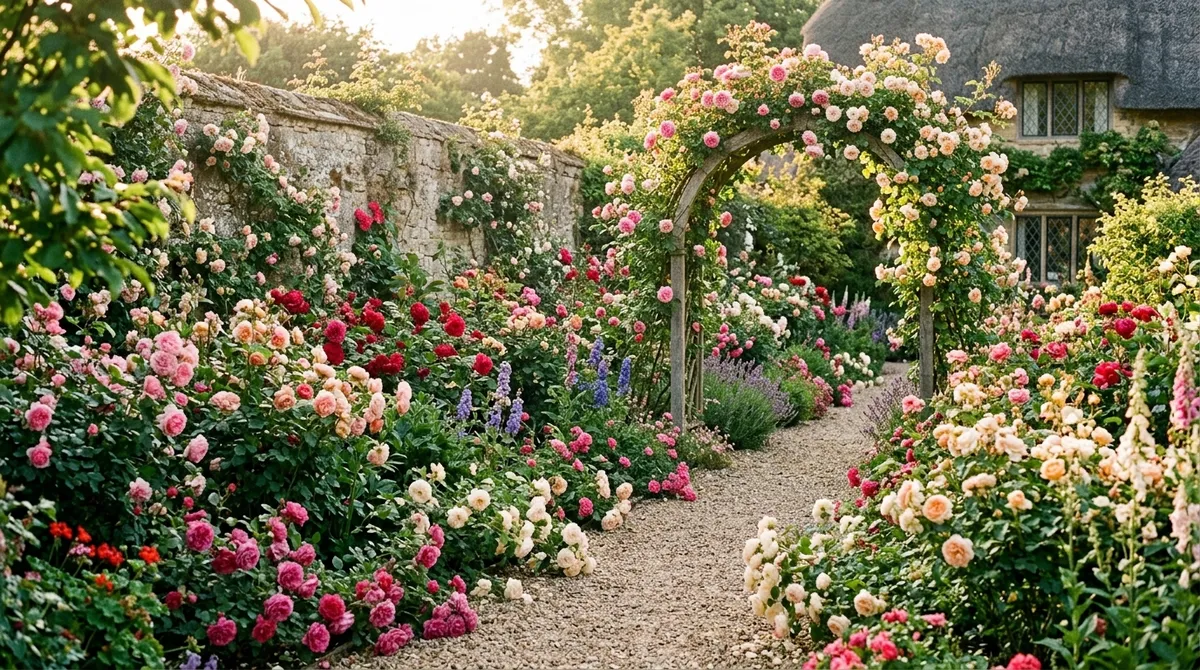
Types of roses in the UK fall into eight distinct groups, each with different heights, flowering habits, and uses. Whether you have a 2m balcony wall or a 30m country garden boundary, there is a rose type bred for exactly that spot.
Roses have been the backbone of British gardens since the Roman occupation. Today, the UK rose industry is worth over 100 million pounds annually, and the RHS lists more than 3,000 cultivars with current Award of Garden Merit status. This guide breaks down every type, compares them side by side, and helps you pick the right rose for your garden, your soil, and your level of experience.
What are the 8 main types of roses grown in UK gardens?
British gardens grow eight main rose types, classified by growth habit and flowering pattern. The groups range from 30cm miniatures to 10m ramblers. Each type has evolved for a different garden role, from formal bedding to wildlife hedging.
Understanding these groups is the first step to choosing correctly. A hybrid tea in the wrong spot will disappoint just as much as a rambler on a 1.5m fence. The table below summarises all eight types at a glance, with detailed profiles following.
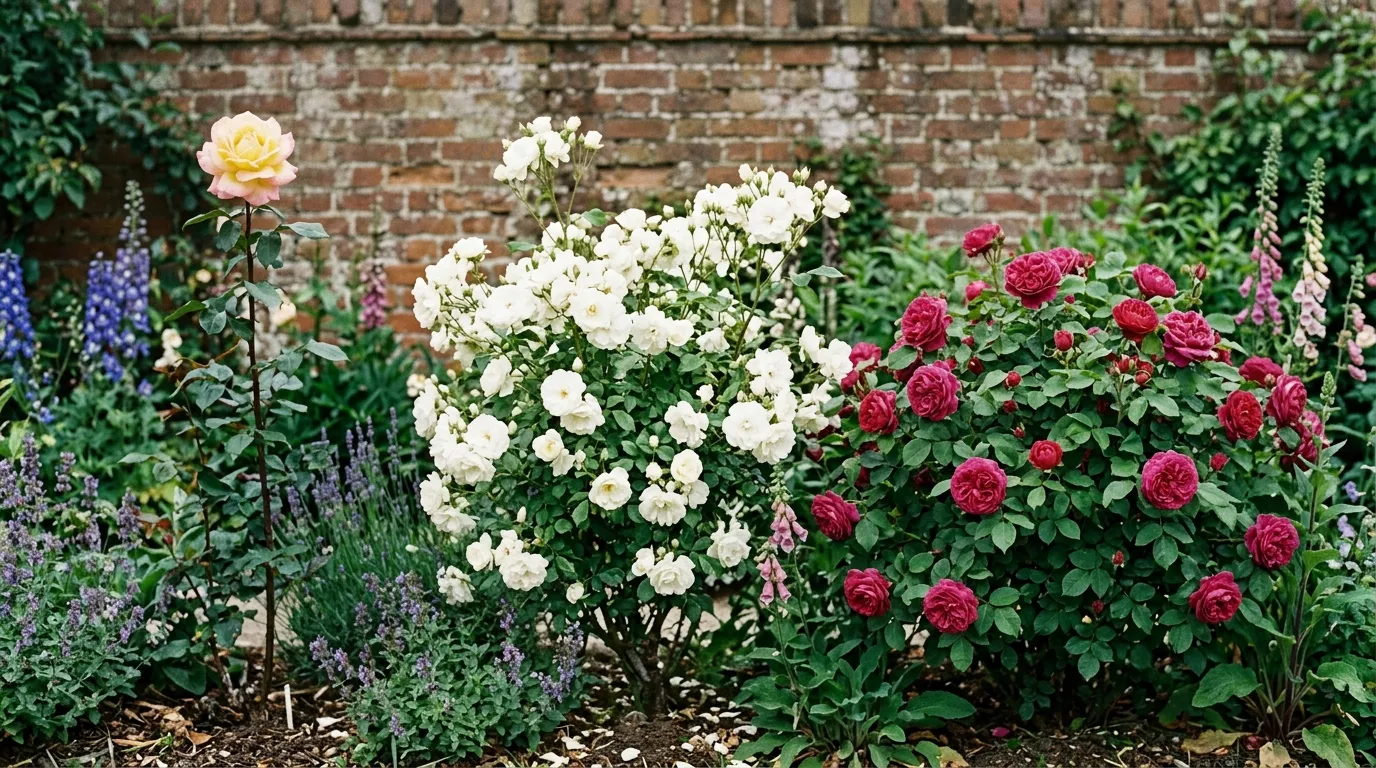
Hybrid teas, floribundas, and shrub roses are the three most widely planted types in UK gardens.
Rose type comparison table
| Type | Height | Spread | Flower style | Scent | Repeat flowering | Disease resistance | Pruning group | Best for |
|---|---|---|---|---|---|---|---|---|
| Hybrid tea | 90cm-1.5m | 60-75cm | Single large blooms | Good to strong | Yes (Jun-Oct) | Moderate | Hard (Feb-Mar) | Cut flowers, formal beds |
| Floribunda | 60cm-1.2m | 60-90cm | Clusters of 5-15 | Mild to moderate | Yes (Jun-Oct) | Good | Moderate (Feb-Mar) | Borders, hedging, mass colour |
| Climbing | 3-5m | 2-3m | Clusters on long canes | Variable | Most varieties | Moderate to good | Light (autumn/spring) | Walls, fences, arches |
| Rambling | 6-10m | 4-6m | Large sprays, 20-100 flowers | Mild to moderate | Usually once (Jun-Jul) | Good to excellent | After flowering (Jul-Aug) | Pergolas, trees, wild gardens |
| Shrub | 1-2m | 1-1.5m | Single to fully double | Often strong | Varies by variety | Good to excellent | Light shaping (spring) | Mixed borders, hedging |
| Ground cover | 30-60cm | 1-2m | Small clusters | Mild | Yes (Jun-Sep) | Excellent | Minimal | Banks, edges, low maintenance |
| Miniature/patio | 30-60cm | 30-45cm | Small single or clusters | Mild to none | Yes (Jun-Sep) | Good | Light (spring) | Containers, edging, patios |
| Species/wild | 1-3m | 1-3m | Single 5-petal flowers | Variable | Once (Jun-Jul) + hips | Excellent | Rarely needed | Hedging, wildlife, hips |
What are hybrid tea roses?
Hybrid tea roses produce the classic, high-centred bloom that most people picture when they think of a rose. Each stem carries one large flower, 8-14cm across, on a long straight stalk perfect for cutting. They grow 90cm to 1.5m tall and flower repeatedly from June to October in the UK.
Hybrid teas were first bred in 1867 by crossing tea roses with hybrid perpetuals. Today they account for roughly 35% of all roses sold in British garden centres. They need hard annual pruning in February to March, cutting stems to 15-20cm from the base to maintain shape and vigour.
Best hybrid tea varieties for UK gardens:
- ‘Peace’ — yellow flushed pink, 110cm, RHS AGM, the world’s most famous rose
- ‘Mister Lincoln’ — deep velvety red, 120cm, powerful damask fragrance
- ‘Elina’ — cream-ivory, 100cm, World’s Favourite Rose award winner
- ‘Silver Jubilee’ — salmon-pink, 100cm, outstanding in UK rain
- ‘Just Joey’ — copper-orange, 90cm, RHS AGM, strong fragrance
Hybrid teas demand the most attention of any rose type. They are moderately susceptible to black spot, and need feeding three times yearly: March, June, and late July.
What are floribunda roses?
Floribunda roses carry clusters of 5 to 15 smaller flowers per stem, creating a bigger colour impact than hybrid teas from a single plant. They flower continuously from June to late October and grow 60cm to 1.2m tall. The name means “abundance of flowers” in Latin, and it is accurate.
Floribundas were developed in the early 20th century by crossing hybrid teas with polyantha roses. They inherit the polyantha’s cluster-flowering habit and the hybrid tea’s colour range. They tolerate imperfect pruning better than hybrid teas and resist disease more reliably, making them the best rose type for beginners.
Best floribunda varieties for UK gardens:
- ‘Iceberg’ — white, 100cm, the world’s best-selling rose, RHS AGM
- ‘Arthur Bell’ — yellow fading to cream, 90cm, strong fragrance, rain-tolerant
- ‘Trumpeter’ — scarlet red, 60cm, superb for low hedging
- ‘Absolutely Fabulous’ — yellow, 90cm, Rose of the Year 2010, excellent disease resistance
- ‘Bonica’ — soft pink, 90cm, RHS AGM, virtually immune to black spot
Prune floribundas in late February to March, but less severely than hybrid teas. Cut to 25-30cm from the base. For detailed pruning instructions, see our guide to pruning roses.
How tall do climbing roses grow in the UK?
Climbing roses produce long, stiff canes that reach 3 to 5m when trained against walls, fences, arches, and obelisks. Unlike ramblers, most modern climbers repeat-flower from June to October, giving months of colour on vertical surfaces. They flower on both old and new wood, so you get blooms even after a hard winter.
Training is the key to getting the most flowers from a climber. Fan the main stems out horizontally or at 45 degrees against the support. This triggers side shoots (laterals) along the entire length, and each lateral produces a cluster of blooms. A vertically trained climber flowers only at the top. For more vertical planting ideas, see our guide to climbing plants.
Best climbing rose varieties for UK gardens:
- ‘New Dawn’ — blush pink, 4m, the world’s most widely grown climbing rose, RHS AGM
- ‘Compassion’ — salmon-pink, 3m, RHS AGM, tolerates north-facing walls
- ‘Gertrude Jekyll’ (climbing form) — rich pink, 3.5m, powerful old-rose fragrance
- ‘The Generous Gardener’ — pale pink, 3.5m, excellent disease resistance, RHS AGM
- ‘Madame Alfred Carriere’ — white, 5m, tolerates shade, flowers from May
Climbing roses need a support structure. Fix horizontal wires to a wall at 45cm intervals using vine eyes, or choose a free-standing obelisk or arch. Space wires 45cm apart from 60cm above ground level.
What is the difference between climbing and rambling roses?
Rambling roses are the giants of the rose world, growing 6 to 10m with flexible, pliable canes that weave through trees, cover pergolas, and scramble over large structures. Most ramblers flower once in a spectacular June-July display, producing sprays of 20 to 100 small flowers per cluster.
The critical difference from climbers is flowering wood. Most ramblers flower on the previous year’s growth, not on new wood. This means pruning happens immediately after flowering in July-August: cut out one-third of the oldest canes at ground level and tie in the new whippy growth that will flower the following year.
Best rambling rose varieties for UK gardens:
- ‘Rambling Rector’ — white, 6m, semi-double, produces masses of orange hips
- ‘Paul’s Himalayan Musk’ — lilac-pink, 10m, one of the most vigorous roses in existence
- ‘Albertine’ — salmon-pink, 5m, RHS AGM, strong fragrance, one flush in June
- ‘Bobbie James’ — white, 8m, covers an entire tree canopy
- ‘Kiftsgate’ — white, 10m+, the UK’s largest rose at Kiftsgate Court in Gloucestershire
Ramblers suit gardens with space. A single ‘Paul’s Himalayan Musk’ can cover a 10m tree. They are not suited to small walls, fences, or compact arches where a climber is the better choice.
| Feature | Climbing roses | Rambling roses |
|---|---|---|
| Height | 3-5m | 6-10m |
| Cane type | Stiff, upright | Flexible, pliable |
| Flowering | Repeat (Jun-Oct) | Usually once (Jun-Jul) |
| Flowers on | Old and new wood | Previous year’s wood |
| Pruning time | Autumn or spring | After flowering (Jul-Aug) |
| Best for | Walls, arches, obelisks | Trees, pergolas, large structures |
| Typical flower count per cluster | 5-15 | 20-100 |
What are shrub roses and why are they good for UK gardens?
Shrub roses form a broad group including old garden roses (gallicas, damasks, Albas, centifolias), modern shrub roses, and David Austin English roses. They typically grow 1 to 2m tall with a bushy, arching habit that works in mixed borders alongside perennials and grasses.
Many shrub roses carry the strongest fragrances of any rose type. Damask roses and David Austin varieties in particular produce the intense old-rose scent that perfumers prize. Shrub roses are generally more disease-resistant than hybrid teas, needing less spraying and less precise pruning. They suit gardeners who want roses without the maintenance burden.
Best shrub rose varieties for UK gardens:
- ‘Gertrude Jekyll’ — rich pink, 120cm, voted Britain’s favourite rose scent by the RHS
- ‘Lady of Shalott’ — salmon-orange, 120cm, extremely hardy, good for beginners
- ‘Olivia Rose Austin’ — soft pink, 90cm, outstanding black spot resistance
- ‘Charles de Mills’ — crimson-purple, 120cm, old garden rose, intensely fragrant
- Rosa rugosa ‘Roseraie de l’Hay’ — crimson-purple, 180cm, virtually indestructible, salt-tolerant
Rosa rugosa varieties deserve special mention. They tolerate salt wind, poor soil, and total neglect. They produce large hips rich in vitamin C (20 times the concentration of oranges) and provide autumn food for birds. They make excellent informal hedging in exposed, windy UK gardens.
Which roses work as ground cover?
Ground cover roses grow just 30 to 60cm tall but spread 1 to 2m wide, forming dense mats of foliage and flowers that suppress weeds and stabilise banks. They are the lowest-maintenance rose type, needing only an annual trim with shears in spring. Most are highly disease-resistant, bred specifically for public planting schemes where spraying is impractical.
These roses work brilliantly on slopes, along path edges, at the front of borders, and cascading over low walls. They flower from June to September with clusters of small blooms. Many were bred by the German firm Kordes and the Danish firm Poulsen for municipal planting, but they perform just as well in private gardens.
Best ground cover rose varieties for UK gardens:
- ‘Flower Carpet Pink’ — 60cm x 120cm, the original ground cover rose, virtually disease-proof
- ‘Kent’ — white, 45cm x 90cm, RHS AGM, neat and compact
- ‘Surrey’ — soft pink, 60cm x 120cm, RHS AGM, excellent repeat-flowering
- ‘Nozomi’ — pearl-pink, 45cm x 150cm, single flowers, good for trailing over walls
- ‘Snow Carpet’ — white, 30cm x 90cm, miniature ground cover, suits containers
Ground cover roses need full sun (minimum 4-5 hours) and well-drained soil, like all roses. Space plants 60-90cm apart for complete coverage within two growing seasons.
Are miniature and patio roses good for containers?
Miniature and patio roses grow 30 to 60cm tall and are purpose-bred for containers, window boxes, patios, and edging. They produce proportionally smaller flowers, 2-5cm across, in clusters. Most repeat-flower from June to September. They are hardy throughout the UK, tolerating winter temperatures down to minus 15C without protection.
The distinction between miniature and patio roses is blurred. Miniatures are generally shorter (30-45cm) with smaller leaves, while patio roses (45-60cm) have slightly larger flowers. In practice, garden centres sell both under the patio label. They cost 8 to 15 pounds bare-root or 12 to 20 pounds in a container.
Best miniature and patio rose varieties for UK gardens:
- ‘Sweet Dream’ — apricot-peach, 45cm, Rose of the Year, RHS AGM
- ‘Top Marks’ — orange-vermilion, 45cm, Rose of the Year, brilliant colour
- ‘Pretty Polly’ — soft pink, 40cm, fragrant, compact
- ‘Stars ‘n’ Stripes’ — red and white striped, 35cm, miniature, conversation starter
- ‘Baby Love’ — bright yellow, 50cm, single flowers, excellent disease resistance
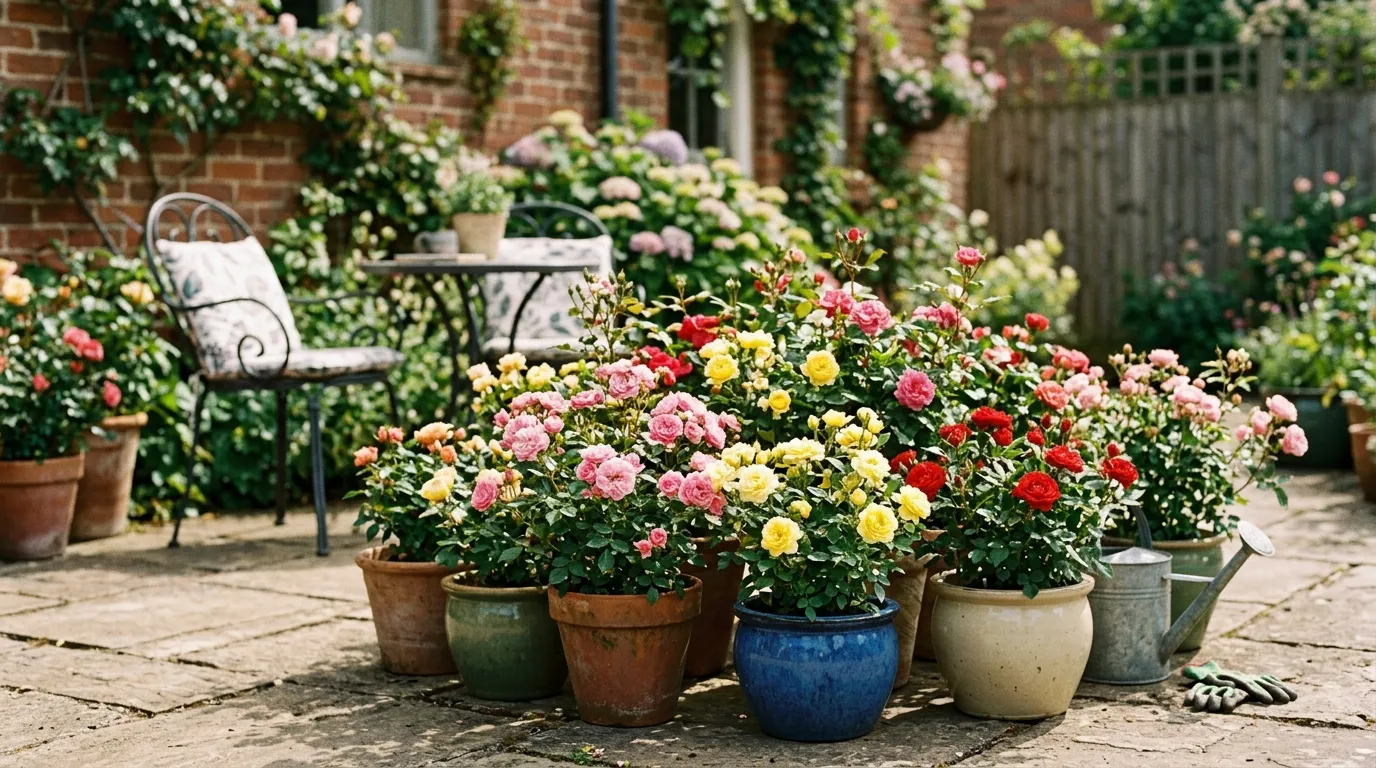
Patio roses like ‘Sweet Dream’ thrive in 40cm pots of John Innes No. 3 compost with good drainage.
Use containers of at least 40cm diameter with drainage holes. Fill with John Innes No. 3 mixed with 20% perlite. Feed fortnightly with liquid rose fertiliser from April to August. Water daily in summer, as pots dry out faster than open ground.
Which wild and species roses grow best in the UK?
Species roses are the original wild roses from which all cultivated types descend. They produce simple, single flowers with five petals, followed by decorative hips in autumn and winter. Most flower once in June-July. They are the toughest roses of all, shrugging off disease, poor soil, and neglect.
The UK has several native species roses. Rosa canina (dog rose) grows in hedgerows across Britain and produces scarlet hips used in rosehip syrup (containing 1,700mg vitamin C per 100g). Rosa rugosa, originally from Japan, has naturalised in UK coastal areas and is now considered invasive in some sand dune habitats.
Best species and wild rose varieties for UK gardens:
- Rosa canina — UK native, pink-white, 3m, hedgerow scrambler, prolific hips
- Rosa rugosa — magenta or white, 1.8m, salt-tolerant, huge tomato-red hips
- Rosa glauca — blue-grey foliage, pink flowers, 2m, ornamental leaf colour
- Rosa moyesii — blood-red, 3m, spectacular flask-shaped orange hips
- Rosa spinosissima — cream-white, 1m, UK native, earliest to flower (May)
Species roses are excellent for wildlife. They provide pollen and nectar for bees in summer and hips for birds (particularly fieldfares, redwings, and blackbirds) in autumn and winter. They make an ideal component of a wildlife-friendly garden. Rosa rugosa makes a stock-proof hedge when planted at 60cm spacing.
How do I choose the right type of rose for my garden?
Choosing the correct rose type depends on five factors: available space, desired height, sun exposure, soil conditions, and how much time you can spend on maintenance. This decision flowchart simplifies the process.
Step 1: How much space do you have?
- Under 1m width — patio/miniature rose or ground cover
- 1-2m width — hybrid tea, floribunda, or compact shrub rose
- 2-5m vertical — climbing rose
- 5m+ vertical or horizontal — rambling rose
Step 2: What do you want it for?
- Cut flowers — hybrid tea (best stems) or David Austin shrub rose (best fragrance)
- Mass garden colour — floribunda or ground cover
- Vertical coverage — climbing or rambling
- Low maintenance — shrub rose, ground cover, or species
- Wildlife and hips — species or rugosa
- Containers — patio/miniature rose
Step 3: How much sun does the spot get?
Most roses need a minimum of 4-5 hours direct sunlight. Shade-tolerant exceptions include ‘Compassion’ (climber), ‘Madame Alfred Carriere’ (climber), ‘Gertrude Jekyll’ (shrub), and most Alba roses. See our guide to plants for shade for non-rose alternatives.
Step 4: What is your soil type?
Roses grow in most UK soils from sand to heavy clay, provided the pH sits between 6.0 and 6.5. On chalky/alkaline soils above pH 7.5, choose Rosa rugosa or Alba roses, which tolerate lime. On heavy clay, improve drainage with grit and organic matter before planting.
What are the best roses for beginners in the UK?
The five varieties below tolerate imperfect care, resist disease without spraying, and deliver reliable flowers across all UK regions. They are the roses I recommend to anyone planting their first bush.
| Variety | Type | Height | Scent | Disease resistance (RHS 1-9) | Why it suits beginners |
|---|---|---|---|---|---|
| ’Iceberg’ | Floribunda | 100cm | Mild | 7 | World’s best seller, flowers non-stop, minimal care |
| ’Olivia Rose Austin’ | Shrub | 90cm | Strong | 9 | Outstanding black spot resistance, compact |
| ’Flower Carpet Pink’ | Ground cover | 60cm | Mild | 9 | Virtually disease-proof, self-cleaning |
| ’Lady of Shalott’ | Shrub | 120cm | Warm tea | 8 | Very hardy, fast to establish, forgiving |
| ’New Dawn’ | Climber | 4m | Mild-moderate | 8 | The easiest climbing rose, repeat-flowering |
All five are widely available from UK nurseries. Bare-root plants cost 8 to 15 pounds each and are available from November to March. See our guide to planting roses for step-by-step instructions.
Which roses have the best scent?
Fragrance is the quality that separates roses from every other garden flower. The compounds responsible include geraniol, citronellol, and damascenone, and concentration varies enormously between types. Old garden roses and David Austin English roses consistently deliver the strongest scents.
Top 5 roses for scent in UK gardens:
- ‘Gertrude Jekyll’ (shrub) — voted Britain’s favourite rose scent by the RHS, rich old-rose damask
- ‘Munstead Wood’ (shrub) — deep crimson, blackberry and damask fragrance
- ‘Mister Lincoln’ (hybrid tea) — powerful damask, the classic red rose scent
- ‘Compassion’ (climber) — salmon-pink, strong sweet fragrance, RHS AGM
- ‘Charles de Mills’ (old garden) — crimson-purple, intense centifolia perfume
Place scented roses near seating areas, beside paths, and close to doorways where you will walk past them daily. South and west-facing walls are ideal, as warmth intensifies scent release.
Which roses grow in shade?
Most roses need 4 to 5 hours of direct sun, but a handful tolerate partial shade (2-4 hours of direct sun or dappled light throughout the day). No rose thrives in full shade.
| Variety | Type | Shade tolerance | Flowers | Notes |
|---|---|---|---|---|
| ’Madame Alfred Carriere’ | Climber | North wall | White-pink | Flowers from May, 5m |
| ’Compassion’ | Climber | North wall | Salmon-pink | RHS AGM, scented |
| ’The Generous Gardener’ | Climber | Partial | Pale pink | Disease-resistant |
| ’Gertrude Jekyll’ | Shrub | Partial | Rich pink | Scented, RHS AGM |
| Rosa glauca | Species | Partial | Pink, small | Grown for foliage colour |
| ’Iceberg’ | Floribunda | Partial | White | Tolerates 3-4 hours sun |
For more shade-tolerant planting options beyond roses, see our guide to the best plants for shade.
Which roses are best for cutting and flower arranging?
Hybrid tea roses produce the longest, straightest stems with single blooms, making them the classic cutting rose. David Austin shrub roses offer fuller, more fragrant flowers but on shorter stems. The best cutting roses combine long vase life (7+ days), strong stems, good fragrance, and slow-opening buds.
Top 5 roses for cutting in UK gardens:
- ‘Peace’ (hybrid tea) — 110cm stems, huge blooms, 10-day vase life
- ‘Elina’ (hybrid tea) — cream, long stems, World’s Favourite Rose
- ‘Gertrude Jekyll’ (shrub) — rich pink, most fragrant cut rose, 7-day vase life
- ‘Olivia Rose Austin’ (shrub) — soft pink, rosette form, excellent in arrangements
- ‘Just Joey’ (hybrid tea) — copper-orange, RHS AGM, 8-day vase life
Cut roses early in the morning when stems are fully hydrated. Cut just above a leaf joint with five leaflets. Place stems in water immediately and re-cut the base at 45 degrees before arranging.
Which roses grow well in containers?
Container growing opens roses to gardeners with no borders at all: balconies, courtyards, patios, and doorsteps. The key is choosing compact varieties and providing the right growing medium. Roses are heavy feeders, so container compost depletes faster than garden soil.
| Variety | Type | Height | Pot size (min) | Notes |
|---|---|---|---|---|
| ’Sweet Dream’ | Patio | 45cm | 30cm | Rose of the Year, apricot |
| ’Top Marks’ | Patio | 45cm | 30cm | Brilliant orange-vermilion |
| ’Boscobel’ | Shrub | 90cm | 50cm | David Austin, scented |
| ’Harlow Carr’ | Shrub | 100cm | 50cm | Rose-pink, disease-resistant |
| ’Baby Love’ | Miniature | 50cm | 30cm | Yellow, single flowers |
| ’Iceberg’ | Floribunda | 100cm | 50cm | The classic white rose |
Use John Innes No. 3 compost mixed with 20% perlite. Feed fortnightly with liquid rose feed (NPK 6-4-6) from April to August. Water daily in summer. Repot every 2-3 years, replacing the top 5cm of compost annually. For the full method covering pot sizes, compost mixes, winter protection, and a monthly care calendar, see our dedicated guide to growing roses in containers.
Why are David Austin English roses so popular?
David Austin English roses were first bred at Albrighton in Shropshire in 1961. David Austin crossed old garden roses (gallicas, damasks, centifolias) with modern hybrid teas and floribundas. The goal was to combine old-fashioned rosette flower forms and strong fragrance with modern repeat-flowering, a wider colour range, and improved disease resistance.
Over 200 varieties have been introduced since 1961. They are now the UK’s most popular rose group for garden planting, outselling hybrid teas in most years. The RHS has awarded AGM status to more David Austin varieties than any other single breeder.
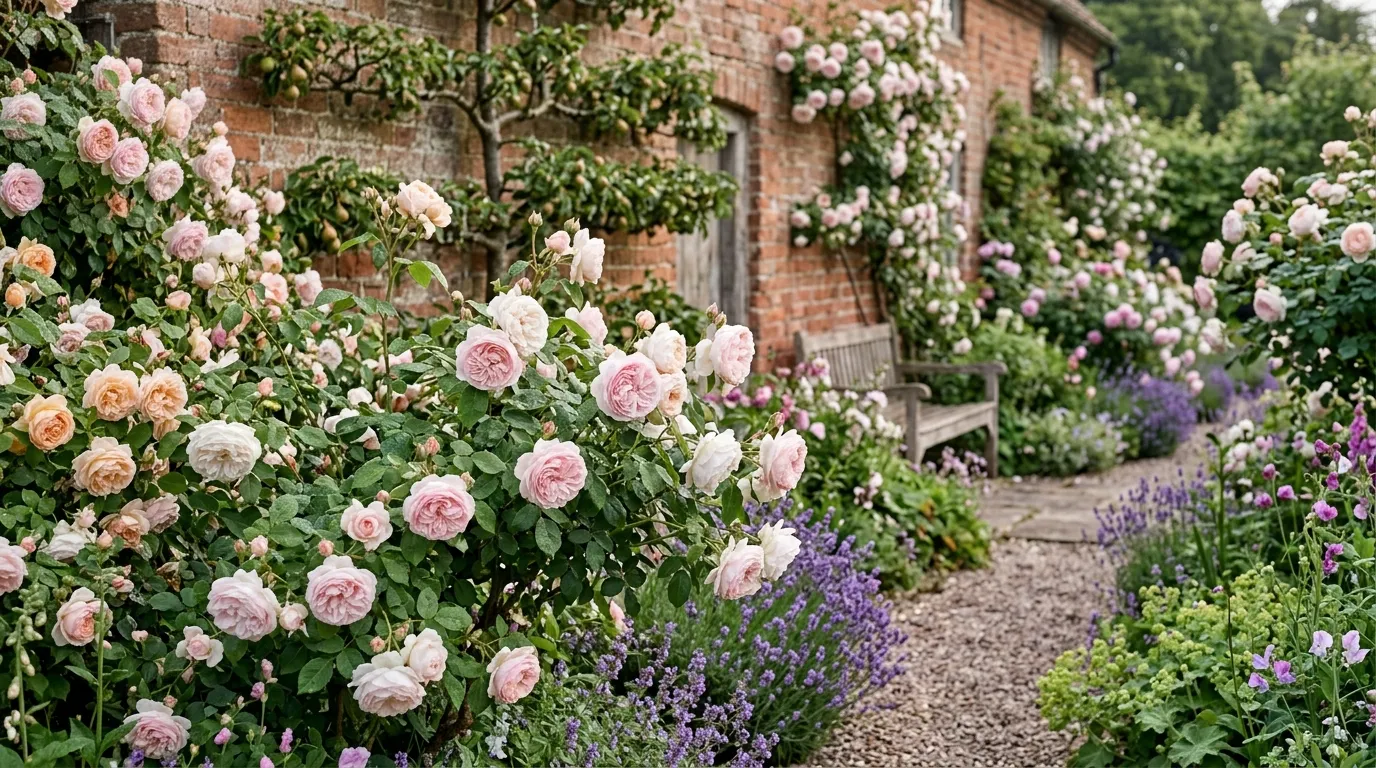
David Austin English roses combine old-fashioned charm with modern performance. Over 200 varieties have been bred in Shropshire since 1961.
Key David Austin varieties for UK gardens:
| Variety | Colour | Height | Scent | RHS AGM | Best for |
|---|---|---|---|---|---|
| ’Gertrude Jekyll’ | Rich pink | 120cm | Strong | Yes | Scent, borders, cutting |
| ’Lady of Shalott’ | Salmon-orange | 120cm | Warm tea | No | Beginners, hardiness |
| ’Olivia Rose Austin’ | Soft pink | 90cm | Fruity | Yes | Disease resistance |
| ’Boscobel’ | Salmon-pink | 90cm | Myrrh | Yes | Small gardens, pots |
| ’The Generous Gardener’ | Pale pink | 350cm | Strong | Yes | Climbing, arches |
| ’Munstead Wood’ | Deep crimson | 100cm | Damask | Yes | Scent, dark colour |
| ’The Lark Ascending’ | Apricot-pink | 150cm | Light | Yes | Disease resistance |
| ’Darcey Bussell’ | Deep crimson | 100cm | Fruity | Yes | Compact borders |
David Austin roses are available bare-root from the David Austin nursery in Albrighton or from most UK garden centres. Bare-root plants cost 15 to 25 pounds. Container plants cost 20 to 35 pounds.
Should I plant bare-root or container-grown roses?
This decision affects cost, establishment speed, and planting window. Both methods produce healthy, long-lived plants, but bare-root roses offer clear advantages for autumn and winter planting.
| Factor | Bare-root | Container-grown |
|---|---|---|
| Cost | 8-15 pounds | 15-30 pounds |
| Planting window | November to March only | Year-round |
| Establishment | Faster root spread | Slower (root-bound risk) |
| Variety choice | Widest selection | Limited to stocked varieties |
| Transport | Lightweight, mail-order | Heavy, fragile |
| Ideal timing | November-December | October-March |
Bare-root roses cost 40-60% less than container-grown equivalents and are available in far more varieties. They are dispatched dormant, with naked roots wrapped in damp material. They must be planted within a few days of arrival, or heeled into a temporary trench if the ground is frozen.
For full planting instructions, see our guide to when and how to plant roses in the UK.
How do I prune different types of roses?
Each rose type has a distinct pruning requirement. Getting this right is the single most important factor for flower production and plant health. Wrong pruning rarely kills a rose, but it reduces flowering dramatically.
| Rose type | Pruning time | Method | Cut to |
|---|---|---|---|
| Hybrid tea | Late Feb-mid Mar | Hard | 15-20cm from base |
| Floribunda | Late Feb-mid Mar | Moderate | 25-30cm from base |
| Climbing | Late autumn/spring | Light, train horizontally | Remove 1 in 4 oldest canes |
| Rambling | After flowering (Jul-Aug) | Remove oldest third | Ground level |
| Shrub | Spring | Light shaping | Remove dead/crossing |
| Ground cover | Spring | Trim with shears | 10-15cm above ground |
| Patio/miniature | Spring | Light tidy | Remove dead, shape |
| Species/wild | Rarely needed | Remove dead wood only | — |
Always use sharp bypass secateurs (not anvil type, which crush stems). Cut at 45 degrees, 5mm above an outward-facing bud. Clean blades between plants with a 10% bleach solution to prevent spreading disease. For detailed technique, see our complete rose pruning guide.
Which roses have the best disease resistance?
Disease resistance is the most important factor for low-maintenance rose growing in the UK. Our wet summers create perfect conditions for black spot (Diplocarpon rosae), which affects 72% of hybrid teas in an average year. Choosing resistant varieties eliminates the need for spraying entirely.
The RHS rates rose disease resistance on a 1-9 scale during UK field trials at Wisley and Harlow Carr. Score 7+ means minimal or no spraying needed. Score 8-9 means virtually disease-free in normal UK conditions.
Top disease-resistant roses by type:
| Variety | Type | RHS disease score | Black spot | Rust | Mildew |
|---|---|---|---|---|---|
| Rosa rugosa varieties | Species | 9 | Immune | Immune | Immune |
| ’Flower Carpet’ series | Ground cover | 9 | Resistant | Resistant | Resistant |
| ’Olivia Rose Austin’ | Shrub | 9 | Resistant | Resistant | Resistant |
| ’The Lark Ascending’ | Shrub | 9 | Resistant | Resistant | Resistant |
| ’Bonica’ | Floribunda | 8 | Resistant | Moderate | Resistant |
| ’New Dawn’ | Climber | 8 | Resistant | Resistant | Moderate |
| ’Iceberg’ | Floribunda | 7 | Moderate | Resistant | Moderate |
| ’Peace’ | Hybrid tea | 6 | Susceptible | Moderate | Moderate |
For existing roses affected by black spot, see our detailed black spot treatment guide. Prevention starts with variety choice, but good air circulation, avoiding overhead watering, and a 7-8cm bark mulch layer also reduce infection significantly.
Rose planting and care calendar for UK gardens
| Month | Task |
|---|---|
| January | Plant bare-root roses if ground is not frozen. Order from catalogues. |
| February | Finish bare-root planting. Start pruning hybrid teas and floribundas late in the month (south). |
| March | Complete pruning. Apply 7-8cm mulch. First feed with rose fertiliser (NPK 6-4-6). |
| April | Watch for aphids. Spray preventively for black spot if needed. Tie in new climber growth. |
| May | Deadhead spent blooms to encourage repeat flowering. Water in dry spells. |
| June | Second feed after first flush. Continue deadheading. First flowers on climbers and ramblers. |
| July | Third feed in late July. Prune ramblers after flowering finishes. |
| August | Take semi-ripe cuttings. Continue deadheading for autumn flush. |
| September | Stop deadheading to allow hip formation on species roses. Stop feeding. |
| October | Prepare planting holes for bare-root arrivals. Plant container roses. |
| November | Plant bare-root roses. Best month for establishment before winter. |
| December | Continue planting bare-root. Prune tall stems on hybrid teas to prevent wind rock. |
For a full monthly planting schedule covering all garden plants, see our flower planting calendar.
Roses for every garden situation
| Situation | Recommended type | Top picks |
|---|---|---|
| Small garden (under 50sqm) | Patio, compact shrub | ’Sweet Dream’, ‘Boscobel’, ‘Harlow Carr’ |
| North-facing wall | Shade-tolerant climber | ’Madame Alfred Carriere’, ‘Compassion’ |
| Windy/coastal site | Rugosa, species | Rosa rugosa, ‘Roseraie de l’Hay’ |
| Clay soil | Most roses (with prep) | ‘Iceberg’, ‘Gertrude Jekyll’, ‘New Dawn’ |
| Wildlife garden | Species, rugosa | Rosa canina, Rosa rugosa, ‘Rambling Rector’ |
| Formal bedding | Hybrid tea, floribunda | ’Peace’, ‘Trumpeter’, ‘Absolutely Fabulous’ |
| Cottage garden | Shrub, old garden, climber | ’Gertrude Jekyll’, ‘Charles de Mills’, ‘New Dawn’ |
| Containers only | Patio, miniature | ’Sweet Dream’, ‘Top Marks’, ‘Baby Love’ |
| Cut flower garden | Hybrid tea, David Austin | ’Peace’, ‘Elina’, ‘Gertrude Jekyll’ |
| Low maintenance | Ground cover, rugosa | ’Flower Carpet’, ‘Kent’, Rosa rugosa |
Roses are one of the most versatile types of flowers to grow in UK gardens. Whether you have a sunny cottage border or a shaded courtyard, there is a rose type that fits. They also combine well with flowering shrubs like lavender, philadelphus, and buddleja for extended seasonal interest.
Frequently asked questions
What are the main types of roses in the UK?
The UK grows eight main types: hybrid tea, floribunda, climbing, rambling, shrub, ground cover, miniature/patio, and species (wild) roses. Hybrid teas and floribundas are the most widely planted, accounting for roughly 50% of all roses sold in British garden centres. Each type has a distinct growth habit, pruning requirement, and ideal garden use. The choice depends on your available space, sun exposure, and desired maintenance level.
Which type of rose is best for beginners?
Floribunda roses are the best type for UK beginners. They produce masses of flowers over a long season from June to October, tolerate imperfect pruning, and resist black spot better than hybrid teas. ‘Iceberg’ has been the world’s best-selling rose for decades precisely because it forgives neglect. David Austin shrub roses like ‘Olivia Rose Austin’ (RHS disease score 9) and ‘Lady of Shalott’ are equally forgiving.
What is the difference between climbing and rambling roses?
Climbers grow 3-5m and repeat-flower; ramblers grow 6-10m and mostly flower once. Climbing roses have stiff canes suited to walls, fences, and arches. Rambling roses have flexible stems that weave through trees and cover pergolas. Climbers flower on old and new wood, so they bloom even after hard winters. Most ramblers flower on the previous year’s growth and are pruned immediately after flowering in July-August.
Can I grow roses in pots and containers?
Yes, patio and miniature roses thrive in containers of 40cm diameter or larger. Use John Innes No. 3 compost mixed with 20% perlite for drainage. Feed fortnightly from April to August with liquid rose fertiliser. Compact David Austin varieties like ‘Boscobel’ (90cm) also grow well in 50cm pots. Water daily in summer, as containers dry faster than open ground. Repot every 2-3 years.
Which roses are most disease-resistant in the UK?
Rosa rugosa varieties score 9/9 for disease resistance and never need spraying. Among cultivated roses, David Austin’s ‘Olivia Rose Austin’ and ‘The Lark Ascending’ also score 9 on the RHS scale. Ground cover roses bred by Kordes, including the ‘Flower Carpet’ series, are virtually immune to black spot, rust, and powdery mildew. Choose RHS Award of Garden Merit varieties, which are trialled in real UK weather conditions.
When should I prune different types of roses?
Prune hybrid teas and floribundas in late February to mid-March. Climbing roses are pruned in late autumn or early spring, focusing on tying in horizontal growth. Ramblers are pruned immediately after flowering in July-August. Shrub roses need only light shaping in spring. Ground cover roses can be trimmed with shears. Species roses rarely need pruning beyond removing dead wood.
What are David Austin English roses?
David Austin roses are a group bred in Shropshire since 1961, combining old-fashioned flower forms with modern repeat-flowering. Over 200 varieties have been introduced, crossing old garden roses with hybrid teas and floribundas. They offer the strongest fragrances of any modern rose group. Top UK picks include ‘Gertrude Jekyll’ (Britain’s favourite rose scent), ‘Lady of Shalott’ (best for beginners), and ‘Olivia Rose Austin’ (best disease resistance).
Lawrie has been gardening in the West Midlands for over 30 years. He grows his own veg using no-dig methods, keeps a wildlife-friendly garden, and writes practical advice based on real UK growing conditions.