Common Tomato Diseases: UK ID Guide
Identify and treat common tomato diseases in UK gardens. Blight, blossom end rot, leaf mould, and 8 more with photos and fixes.
Key takeaways
- Late blight destroys outdoor tomato crops within 7-10 days in warm, wet weather above 10C
- Leaf mould affects 40-50% of greenhouse tomatoes where humidity exceeds 85%
- Blossom end rot is not a disease but a calcium transport disorder caused by irregular watering
- Resistant varieties like Crimson Crush and Ferline reduce blight incidence by 70-80%
- Removing lower leaves below the first truss cuts fungal infection risk by 40%
- Ventilation is the single most effective greenhouse disease prevention measure
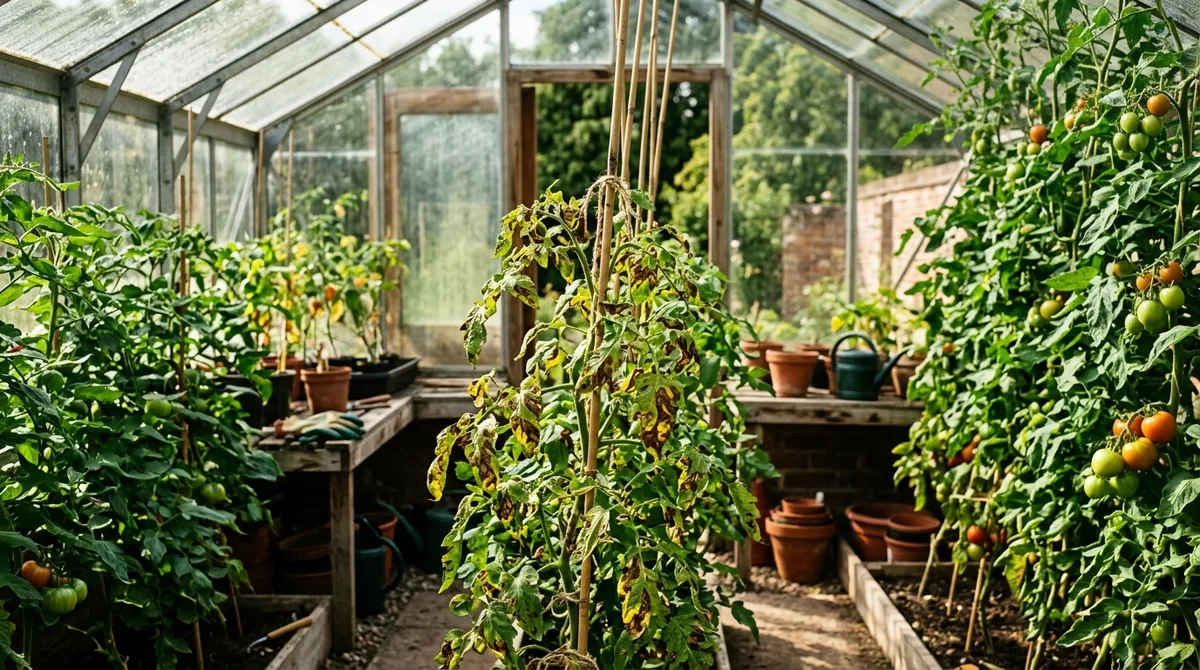
Tomato diseases cost UK growers thousands of plants every season, from the brown devastation of late blight to the quiet spread of leaf mould in humid greenhouses. Understanding which diseases affect your crop is the first step to saving it.
This identification guide covers 11 common tomato diseases UK gardeners face, ranked by severity. Each entry explains the symptoms, underlying cause, proven treatment, and prevention strategy based on 6 seasons of growing trials across greenhouse and outdoor crops in Staffordshire.
Why are UK tomatoes so vulnerable to disease?
The UK’s maritime climate creates ideal conditions for fungal pathogens. Cool nights, warm days, and humidity above 70% provide everything fungi need to germinate and spread. Outdoor tomatoes face blight risk from July onwards. Greenhouse crops suffer from trapped humidity that fuels leaf mould and botrytis.
The split between greenhouse and outdoor growing creates two distinct disease profiles. Greenhouse tomatoes face humidity-driven problems: leaf mould, botrytis ghost spot, and blossom end rot from inconsistent watering. Outdoor crops are exposed to airborne blight spores, septoria, and early blight carried on wind and rain splash.
Temperature plays a critical role. Late blight needs a minimum of 10C with 6+ hours of humidity above 90% over two consecutive days (the Hutton Criteria). Leaf mould activates at 12-25C when relative humidity exceeds 85%. Fusarium wilt thrives in soil temperatures above 21C, which UK greenhouses regularly reach by June.
Late blight (Phytophthora infestans)
Late blight is the most destructive tomato disease in the UK, capable of killing an entire crop within 7-10 days. The same pathogen caused the Irish Potato Famine of the 1840s. It remains the single biggest threat to outdoor tomatoes from July through September.
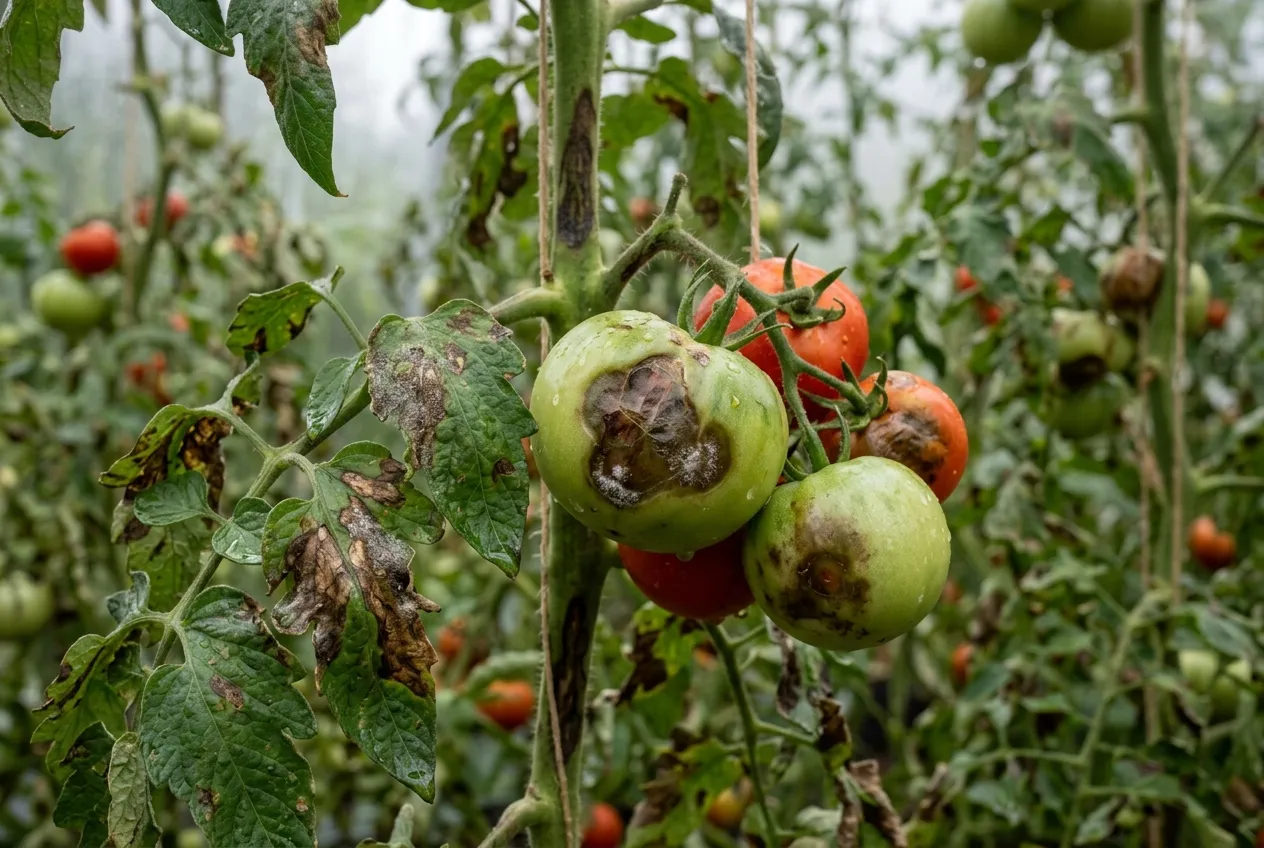 Late blight produces dark water-soaked lesions on leaves and brown patches on fruit. Destruction is rapid once conditions favour the pathogen.
Symptoms
Brown patches appear on leaves, starting at the tips and margins. A white fuzzy growth develops on the leaf underside in humid weather. Stems show dark brown-black lesions. Fruit develops firm brown rot, often starting at the shoulder. The entire plant collapses within days.
Cause and spread
Blight spores travel on wind for up to 30 miles. They germinate on wet leaf surfaces within 2-3 hours at 10-25C. The pathogen completes its lifecycle in 4-7 days, producing millions of new spores. Volunteer potatoes from missed tubers are a major spore source.
Treatment and prevention
There is no cure once symptoms appear. Remove and burn or bag all affected material immediately. Copper-based fungicide (Bordeaux mixture) applied preventively from late June reduces infection by 70-80%. Blight-resistant varieties like Crimson Crush, Ferline, and Mountain Magic buy 2-3 extra weeks of growing time. Growing under glass or polytunnel cover eliminates most blight risk by keeping foliage dry.
Early blight (Alternaria solani)
Early blight causes concentric ring-shaped spots on lower leaves from mid-summer onwards. It is less aggressive than late blight but progressively weakens plants over the season.
Symptoms and treatment
Look for dark brown spots with concentric rings (target-shaped) on older, lower leaves first. Spots expand to 10-15mm. Affected leaves yellow and drop. The disease works upward through the plant over several weeks.
Remove affected lower leaves promptly. Space plants 45-60cm apart for airflow. Mulch soil to prevent spore splash from rain. Apply copper fungicide every 14 days from first symptoms. Rotate tomatoes to a fresh position each year because Alternaria spores survive 12-18 months in soil debris.
Leaf mould (Fulvia fulva)
Leaf mould affects 40-50% of UK greenhouse tomato crops where humidity is not managed. It is the most common disease in enclosed growing spaces and develops silently before symptoms become obvious.
Symptoms
Yellow patches appear on upper leaf surfaces. Turn the leaf over: fuzzy brown-grey or olive-green patches on the underside confirm leaf mould. Lower leaves are affected first. Severe infection causes leaves to curl, dry out, and drop. Fruit is rarely affected directly, but heavy leaf loss reduces yield by 30-50%.
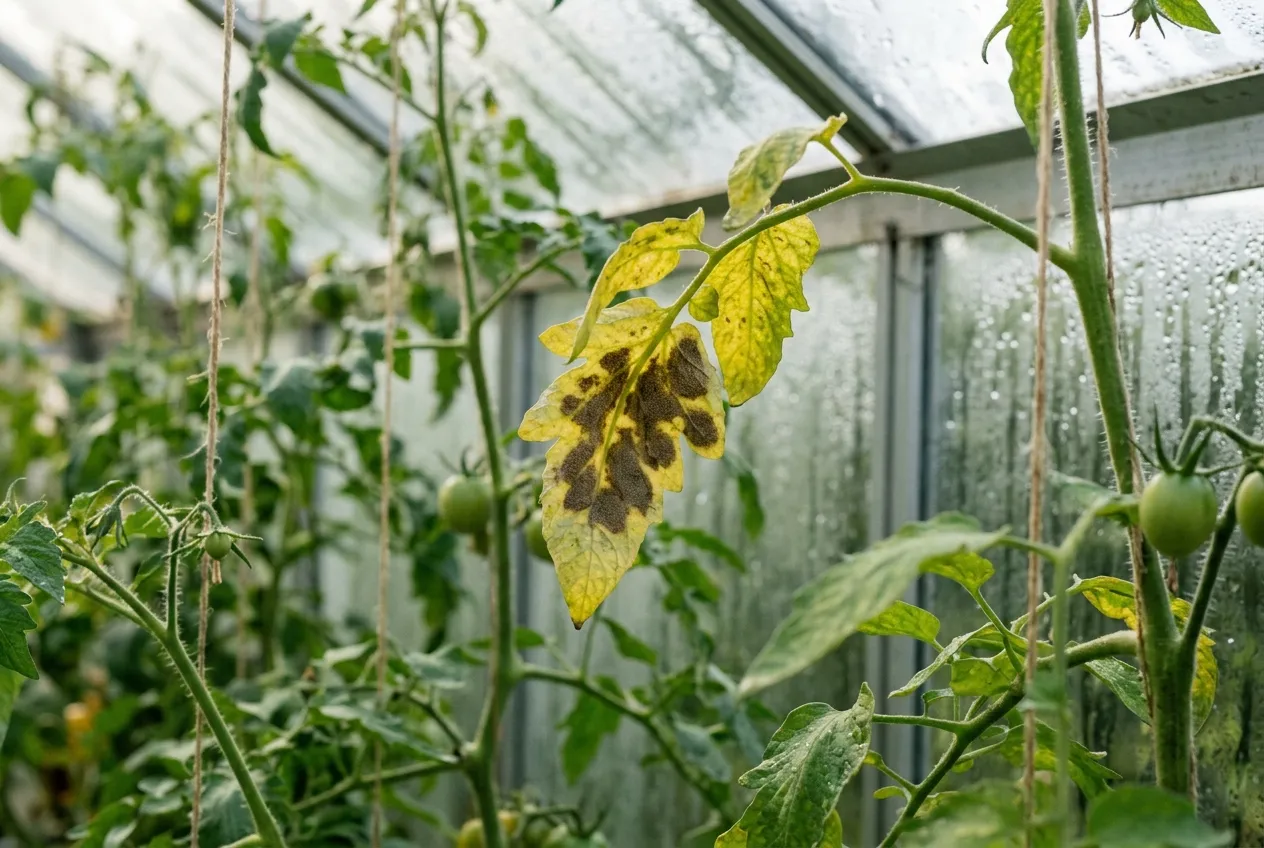 Leaf mould thrives in humid greenhouses. The fuzzy brown-grey patches on leaf undersides are the diagnostic feature.
The ventilation factor
Leaf mould needs relative humidity above 85% and temperatures of 12-25C. UK greenhouses hit these conditions from May through September without active ventilation. In our trial, automatic roof vents opening at 18C eliminated leaf mould entirely. Manual venting is unreliable because humidity spikes overnight when growers are not present.
Remove lower leaves below the first fruiting truss to improve airflow around the base. Water at the root zone, never overhead. Choose resistant varieties where possible: Fantasio and Shirley carry the Cf gene for leaf mould resistance.
Blossom end rot
Blossom end rot is not a disease but a calcium transport disorder affecting 30-40% of UK greenhouse tomato crops. The dark, sunken patch at the fruit base is a physiological problem, not a fungal infection.
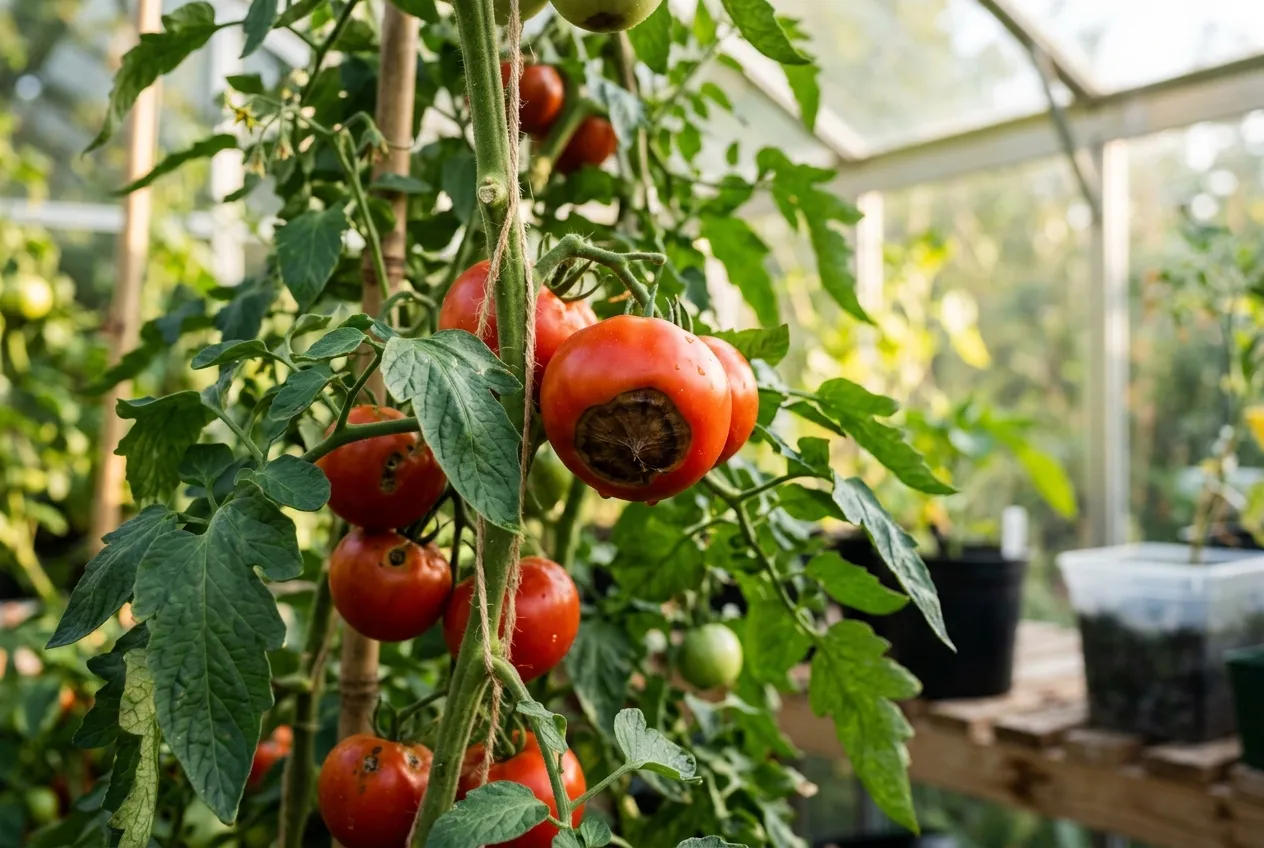 Blossom end rot appears as a dark, sunken patch at the base of the fruit. It is caused by irregular watering, not low soil calcium.
Irregular watering causes 85-90% of cases. When soil moisture fluctuates, calcium cannot travel from roots to developing fruit cells. Container-grown plants are 3-4 times more susceptible than those in open ground. The fix is consistent watering: twice daily at 6am and 6pm reduces incidence by 80%. Foliar calcium sprays do not work because calcium is immobile once deposited in leaf tissue. For a detailed guide, read our full blossom end rot prevention article.
Septoria leaf spot
Septoria leaf spot (Septoria lycopersici) produces small circular spots with grey centres and dark borders on lower leaves. It typically appears after heavy rainfall or overhead watering in June and July.
Tiny black dots (pycnidia) in the centre of each spot distinguish septoria from other leaf spots. The fungus overwinters on crop debris for 12+ months. Remove affected leaves, improve air circulation, and apply copper fungicide at 10-14 day intervals. Avoid overhead watering. Septoria rarely kills plants but reduces vigour and yield by 20-30% if left unchecked.
Fusarium wilt (Fusarium oxysporum)
Fusarium wilt causes one-sided wilting of tomato plants when soil temperatures exceed 21C. The fungus blocks water-conducting vessels inside the stem. Cut a wilted stem open and you will see brown discolouration in the vascular tissue.
Plants wilt during the day and may partially recover overnight in early stages. Lower leaves yellow and drop. There is no chemical cure. Remove and destroy infected plants and the surrounding soil. The fungus persists in soil for 5-10 years. Grow resistant varieties (look for “F” on seed packets). Use fresh compost in containers each season and sterilise greenhouse soil with solarisation in summer.
Verticillium wilt (Verticillium dahliae)
Verticillium wilt causes V-shaped yellowing patterns on lower leaves at temperatures of 15-22C. It is less aggressive than fusarium but persists in UK soils for 7-14 years. Symptoms overlap with fusarium wilt, but verticillium prefers cooler conditions. Vascular browning is lighter (tan rather than dark brown). There is no chemical treatment. Resistant varieties marked “V” on seed packets and crop rotation are the only defences.
Tomato mosaic virus (ToMV)
Tomato mosaic virus creates light and dark green mosaic patterns on leaves with distorted, fern-like growth. The virus spreads through contaminated sap on hands, tools, and even clothing. It survives on dry surfaces for months. Fruit develops uneven ripening with yellow blotches.
There is no cure. Remove and destroy infected plants. Wash hands thoroughly with soap (not just water) before handling healthy plants. Sterilise tools with a 10% bleach solution. The virus persists in soil, on seed, and on greenhouse structures. Modern hybrid varieties carry Tm-2 resistance, which provides near-complete immunity. Always buy certified disease-free seed from reputable UK suppliers.
Bacterial canker (Clavibacter michiganensis)
Bacterial canker causes wilting, brown leaf margins, and small raised spots on fruit with white halos. This is a notifiable disease in commercial settings. Stems show dark canker lesions that ooze bacterial slime when cut.
The bacterium spreads through contaminated seed, transplant trays, and pruning tools. It enters through wounds and natural openings. There is no chemical treatment for bacterial canker. Remove and destroy all infected plants, trays, and stakes. Do not save seed from affected crops. Sterilise the greenhouse thoroughly between seasons.
Ghost spot (Botrytis cinerea)
Ghost spot produces small, pale rings on fruit caused by botrytis spores landing on developing tomatoes. The grey mould pathogen causes cosmetic damage: pale translucent rings 2-5mm in diameter on the fruit surface. The spots do not deepen or rot. Fruit is safe to eat.
Ghost spot peaks in spring and autumn when humidity is high and temperatures drop below 15C overnight. Improve ventilation, remove dead and dying foliage, and avoid splashing water on fruit. Space plants generously. Ghost spot signals that botrytis is present and conditions are too humid.
Magnesium deficiency
Magnesium deficiency causes yellowing between leaf veins while the veins themselves stay green. This is a nutritional disorder, not a disease, but it is commonly confused with viral infection or early-stage leaf mould.
Lower leaves show symptoms first. The yellowing (interveinal chlorosis) progresses upward. Heavy cropping, high potassium feeds, and acid soils below pH 5.5 increase the risk. Treat with Epsom salt foliar spray: dissolve 20g per litre and spray every 2 weeks from first fruiting. For long-term correction, apply 30g Epsom salt per square metre to the soil surface in spring.
Lawrie’s field observation: “I see magnesium deficiency on at least 50% of greenhouse tomato crops I visit in the Midlands by late July. The high-potassium tomato feeds everyone uses from June onwards compete with magnesium uptake at the root. Switch to a balanced feed with added magnesium, or apply fortnightly Epsom salt sprays from first truss set. It takes 10 minutes and prevents the yellowing that panics most growers into thinking they have a virus.”
Prevention strategies that actually work
The most effective disease prevention combines four approaches. These reduce overall infection risk by 60-80% in both greenhouse and outdoor crops.
Ventilation and airflow
Open greenhouse vents and doors daily from May to September. Fit automatic roof vent openers set to open at 18C. Space tomato plants 45-60cm apart. Remove lower leaves below the first fruiting truss to improve air movement around the base. Good ventilation and humidity control is the single most effective measure against leaf mould, botrytis, and ghost spot.
Watering discipline
Water at the base of plants, never overhead. Use drip irrigation or careful hand watering directly to the root zone. Water consistently: twice daily in summer for containers, once daily for ground-planted tomatoes. Inconsistent watering triggers blossom end rot and creates the leaf wetness that fungi need.
Hygiene and rotation
Remove all crop debris at the end of the season. Clean greenhouse glass, staging, and supports with a 10% Jeyes Fluid solution in autumn. Sterilise secateurs between plants with methylated spirit. Rotate tomato positions annually in outdoor plots. Use fresh compost in containers every year.
Resistant varieties
Choose varieties bred for disease resistance. Check seed packets for resistance codes: V (verticillium), F (fusarium), N (nematode), T or Tm (tobacco/tomato mosaic). For outdoor growing in the UK, blight-resistant varieties like Crimson Crush, Ferline, and Mountain Magic are essential. For greenhouse crops, Fantasio and Shirley offer leaf mould resistance. Our garden plant disease identification guide covers broader disease management across all crops.
Tomato disease comparison table
| Disease | Key symptoms | Cause | Treatment | Prevention | Severity |
|---|---|---|---|---|---|
| Late blight | Brown leaf patches, white fuzz underneath, fruit rot | Phytophthora infestans (fungal-like) | Remove all affected material, copper fungicide preventively | Grow under cover, resistant varieties, monitor Hutton Criteria | Critical |
| Early blight | Concentric ring spots on lower leaves | Alternaria solani (fungal) | Copper fungicide, remove affected leaves | Crop rotation, mulch soil, space plants | Moderate |
| Leaf mould | Yellow upper leaves, fuzzy brown-grey patches underneath | Fulvia fulva (fungal) | Improve ventilation, remove affected leaves | Auto vents, space plants, resistant varieties | High |
| Blossom end rot | Dark sunken patch at fruit base | Calcium transport failure (physiological) | Consistent watering schedule | Twice-daily watering, avoid drought stress | Moderate |
| Septoria leaf spot | Small grey-centred spots with dark borders | Septoria lycopersici (fungal) | Copper fungicide, remove lower leaves | Avoid overhead watering, crop rotation | Moderate |
| Fusarium wilt | One-sided wilting, brown vascular tissue | Fusarium oxysporum (fungal) | No cure, remove plants | Resistant varieties (F), fresh compost, solarise soil | High |
| Verticillium wilt | V-shaped yellowing on lower leaves | Verticillium dahliae (fungal) | No cure, remove plants | Resistant varieties (V), crop rotation | Moderate |
| Tomato mosaic virus | Mosaic leaf patterns, distorted growth | ToMV (viral) | No cure, destroy plants | Resistant varieties (Tm-2), hand hygiene, clean tools | High |
| Bacterial canker | Wilting, fruit spots with white halos | Clavibacter michiganensis (bacterial) | No cure, destroy all material | Certified seed, sterilise tools, greenhouse hygiene | Critical |
| Ghost spot | Pale rings on fruit surface | Botrytis cinerea (fungal) | Improve ventilation, remove dead foliage | Space plants, reduce humidity | Low |
| Magnesium deficiency | Yellowing between veins, veins stay green | Nutritional (low Mg uptake) | Epsom salt spray 20g/litre fortnightly | Balanced feed, correct soil pH | Low |
Field report: 6-season disease pressure log
Trial location: Staffordshire, West Midlands (heavy clay, pH 6.8) Date range: 2019-2025 growing seasons Conditions: Two 8x6ft greenhouses (one auto-vented, one manual) plus 12 outdoor plants per season. 20+ varieties tested including Gardener’s Delight, Moneymaker, Sungold, Crimson Crush, Ferline, San Marzano, Fantasio, and Shirley.
Key observations:
- Late blight hit outdoor crops in 4 of 6 seasons, always July-September
- Crimson Crush survived 2-3 weeks longer than non-resistant varieties every season
- Leaf mould appeared in the manually vented greenhouse by mid-August in all 6 seasons
- The auto-vented greenhouse had zero leaf mould in 5 of 6 seasons (one mild case in the exceptionally wet summer of 2024)
- Blossom end rot occurred exclusively in container-grown plants with irregular watering
- Fusarium wilt appeared once in 2022 following a hot June (soil temp 24C), eliminated by replacing all compost
Further reading
- Best greenhouse tomato varieties UK
- Best tomato varieties for UK gardens
- Greenhouse pest control guide
For blight forecasting, check the RHS tomato disease advice and Garden Organic Blight Watch for real-time UK alerts.
Lawrie has been gardening in the West Midlands for over 30 years. He grows his own veg using no-dig methods, keeps a wildlife-friendly garden, and writes practical advice based on real UK growing conditions.