Key takeaways
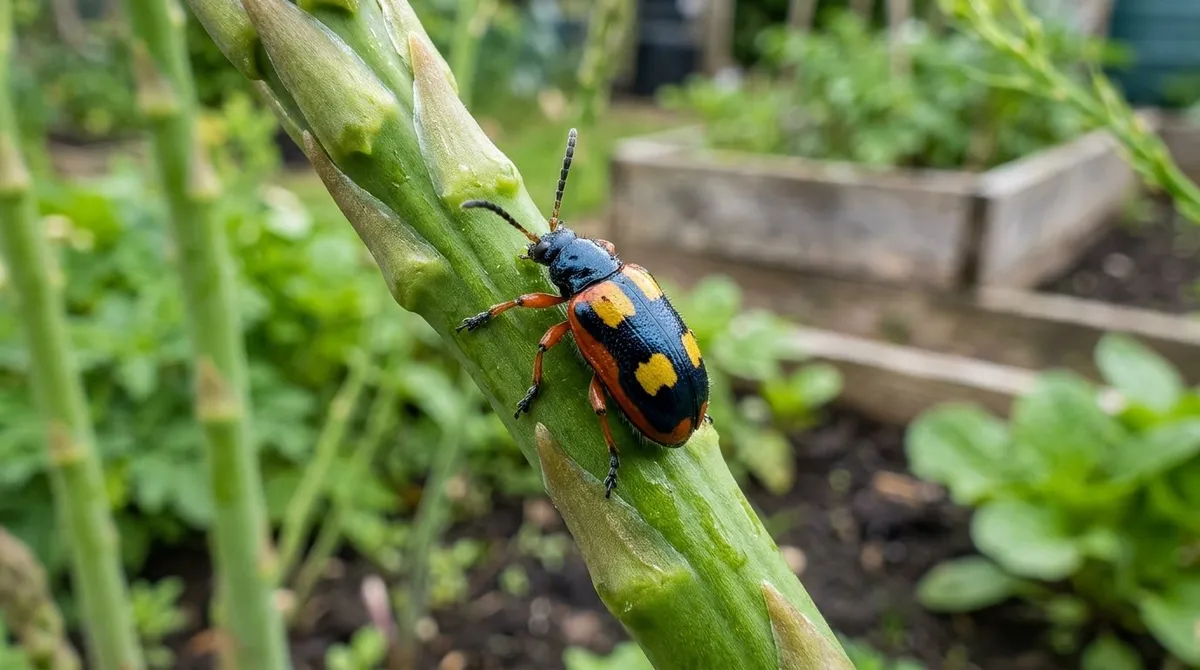
- Common asparagus beetle has three yellow squares on each dark blue wing case (6-7mm)
- Damage matters most on summer fern, not spring spears - the fern feeds next year's crop
- Daily morning inspection May to August catches adults before egg-laying
- Hand-pick into a jar of soapy water - the most reliable UK control method
- Larvae are the bigger threat than adults - they can defoliate ferns in days
- Cut and burn old fern in late autumn - destroys overwintering adult shelter
- No approved chemical controls for amateur UK growers - organic methods only
The first time you see asparagus beetles you wonder how you missed them. Six-millimetre dark blue beetles with three yellow squares on each wing case, hopping off green spears as you walk past, leaving small chewing scars and dark cylindrical eggs glued end-on to the stems. By the time you have spotted them, the next generation is already hatching.
For the broader picture of UK garden pests, our organic pest control guide UK covers the principles that apply across crops.
The two species: common and spotted
Two species of Crioceris attack UK asparagus. They are related but behave slightly differently.
Common asparagus beetle (Crioceris asparagi)
The widespread UK species and the one most growers encounter.
- Size: 6-7mm long
- Body: Dark metallic blue-black with creamy-yellow rectangular spots (three on each wing case)
- Head/thorax: Orange-red with black markings
- Eggs: Dark brown-black, cylindrical, 1mm long, laid end-on along stems and ferns
- Larvae: Slug-like, 6-9mm long, dark grey to olive-green with black head
- Damage: Both adults and larvae feed on spears and fern foliage
Spotted asparagus beetle (Crioceris duodecimpunctata)
Less common in the UK, more in southern England than the north.
- Size: 6-7mm long
- Body: Orange-red with twelve small black spots arranged in two rows
- Head: Black
- Eggs: Greenish-yellow, laid singly on fern foliage (not on spears)
- Larvae: Orange-yellow, develop inside asparagus berries (not on foliage)
- Damage: Larvae feed inside berries; adults nibble fern foliage but cause less damage than common species
The common species is the priority for most UK growers. The spotted species is more of a nuisance than a serious pest. Both can be present on the same bed.
For a quick visual check, the RHS asparagus beetle page shows large-format photographs of all life stages.
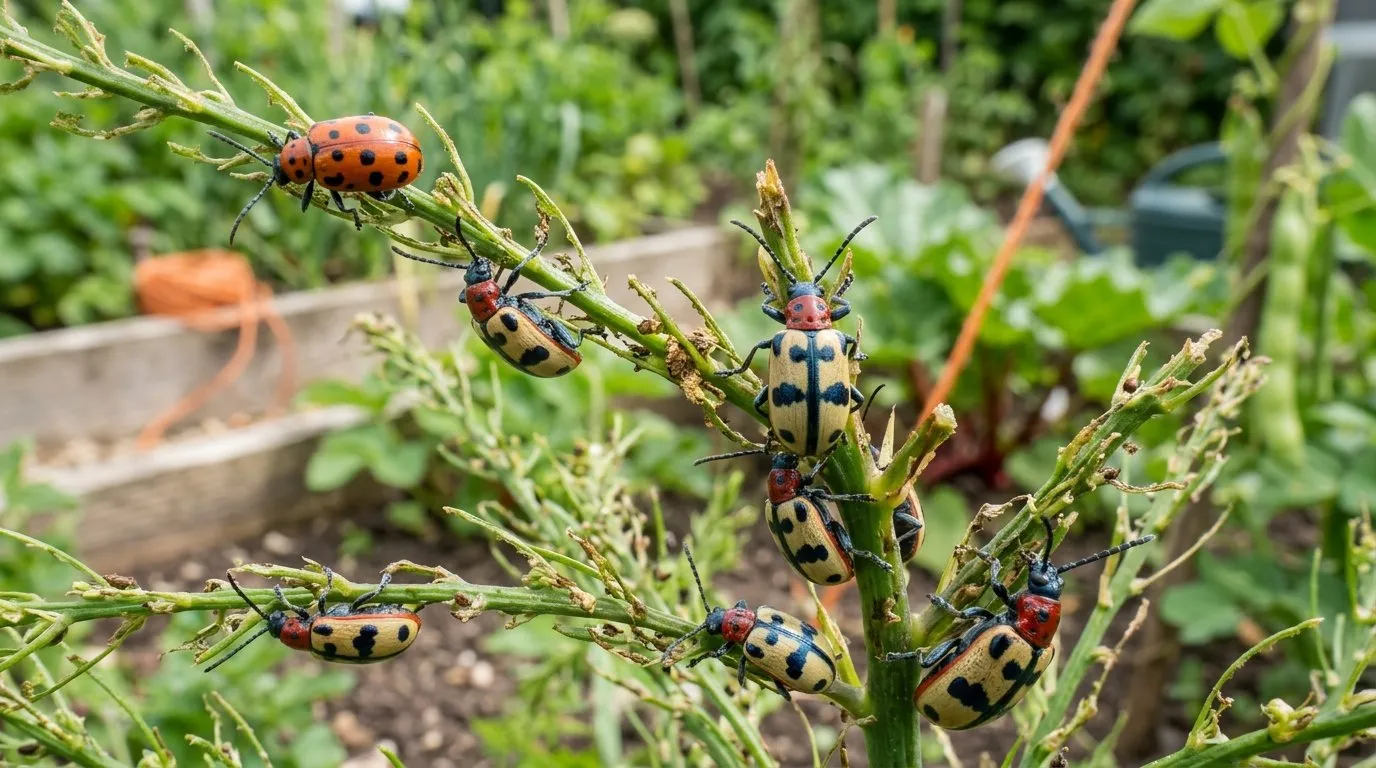 The common asparagus beetle (Crioceris asparagi) feeding on summer asparagus fern. Adults are 6-7mm long with three creamy-yellow rectangular spots on each dark blue wing case. They fly readily on warm days and drop to the ground when disturbed - approach quietly to catch them.
The lifecycle
Understanding the lifecycle is the foundation of organic control. Three generations per year in the UK, often overlapping by midsummer.
Stage 1: Overwintering adults emerge (April-May). Beetles overwinter as adults in soil, plant debris, hollow stems, and crevices in nearby walls or sheds. As soil temperatures rise above 10C, they emerge and find asparagus beds within days. The first sign each year is fresh bite marks on early spears.
Stage 2: First-generation eggs (May-June). Females lay 200-300 eggs each, glued end-on along the stems and fern. Eggs hatch in 4-7 days at warm temperatures.
Stage 3: Larvae feed (mid-May to June). Larvae feed for 10-14 days on spears and fern, then drop to the ground to pupate in soil cells.
Stage 4: Second-generation adults (June-July). Pupation takes 7-14 days. New adults emerge and the cycle repeats.
Stage 5: Second-generation eggs and larvae (July-August). This is the critical generation - it does most damage to the post-harvest fern that the crown depends on for next year’s energy.
Stage 6: Third generation (August-September). A partial third generation in warm summers. Larvae from this generation pupate, emerge as adults, and find overwintering shelter.
Stage 7: Overwintering (October-March). Adults find shelter and remain dormant until the next spring.
The implication for control: every adult killed before egg-laying prevents 200-300 future beetles. Daily inspection in May is the highest-leverage moment in the year.
How to identify the damage
Three damage patterns to watch for.
1. Spear chewing. Small irregular bite marks on developing spears, sometimes with a scoop-shape from the tip. Adult feeding only. Cosmetic but indicates the beetles are present.
2. Egg masses on stems. Dark cylindrical eggs glued end-on along stems and fern stalks. Often in lines of 3-7 eggs. The most diagnostic sign of imminent larval damage. Squash eggs immediately.
3. Fern defoliation. Larval feeding strips the green fronds from fern stems, leaving bare stalks. Severe infestations defoliate ferns within 7-14 days. This is the most destructive damage and the reason crowns fail over multiple seasons.
The damage pattern is your tactical guide. Spear chewing alone is acceptable. Egg masses require immediate squashing. Fern defoliation is an emergency.
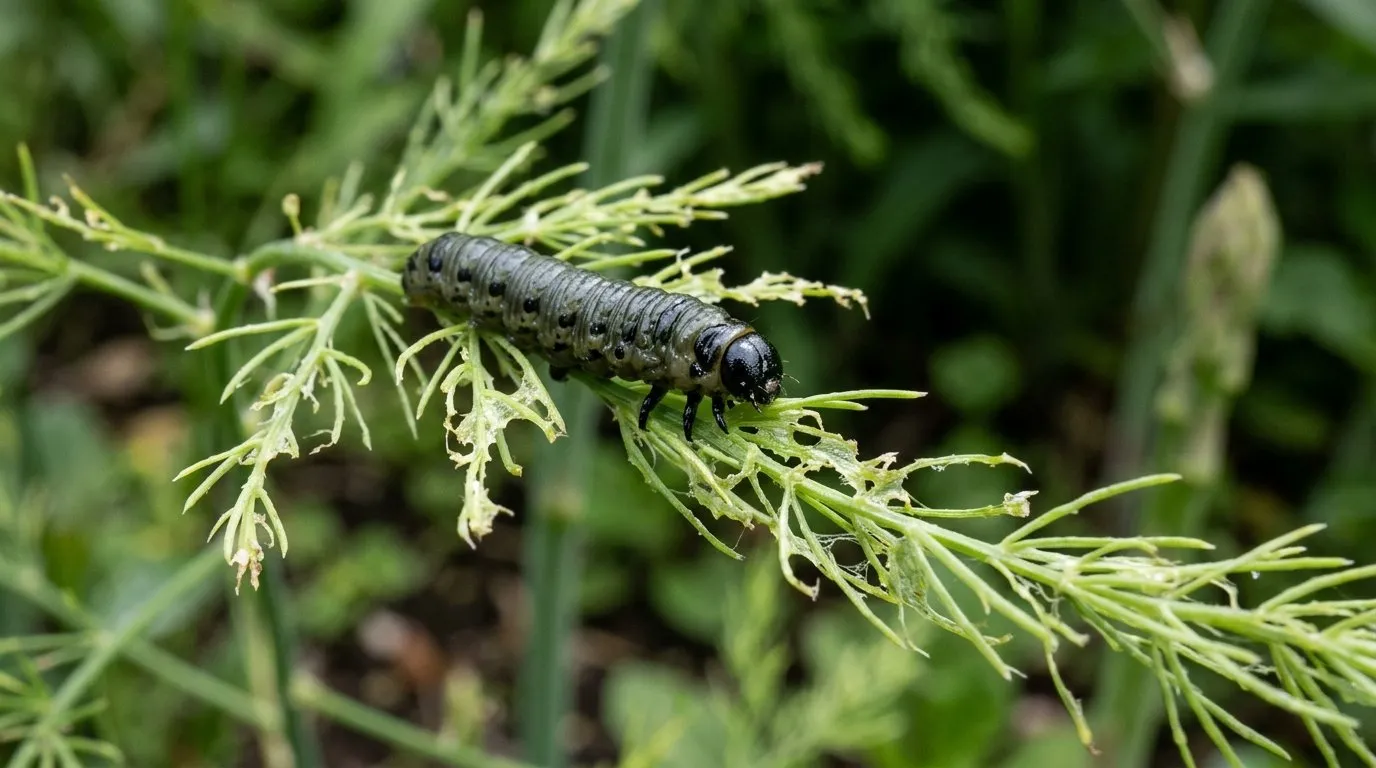 The larval stage. Larvae are 6-9mm long, slug-like, dark grey to olive-green with a black head. They are slow-moving but voracious - a heavy population can defoliate a fern in 7-14 days. Larvae are easier to hand-pick than adults because they cannot fly.
The daily inspection routine
Time of day: Morning, between 09:00 and 11:00. Adults are active but slower than midday. Drop temperatures to 12-14C and they barely move.
What to bring: A small jar of warm soapy water. Standard washing-up liquid in tap water works fine. The soapy surface kills the beetles by breaking water tension.
What to do:
- Walk the bed slowly. Look at every spear and fern stalk. Check both sides of fern fronds.
- Look for eggs first. Dark cylindrical specks glued to stems. Squash on sight - they are not protected by anything.
- Pick adults carefully. Beetles drop to the ground when disturbed. Approach slowly and pinch them off into the jar. Cup your other hand under the leaf as backup.
- Pick larvae. Slug-like grey-green grubs. Easier to pick than adults because they cannot fly.
- Check stems for clusters. Beetles often congregate at growing tips and on the upper third of fern.
- Note the count. A simple tally tells you population trends. Below 5 a day is manageable. Above 20 a day means the population is winning.
Frequency: Daily in May, June, and July. Every other day in August. Weekly in September.
Time investment: 5-10 minutes per day on a 10-crown bed. Worth it - this is the most effective UK organic control by a clear margin.
 The daily 5-minute hand-picking routine. Approach beetles slowly in the cooler morning, pinch them off into a jar of soapy water, and squash any eggs you find. Daily through May to August catches each generation before egg-laying and prevents population build-up.
Egg identification and removal
Eggs are the easiest stage to defeat because they cannot escape. Knowing what they look like turns 5-second discoveries into population-level wins.
Common asparagus beetle eggs:
- 1mm long, dark brown-black
- Cylindrical, glued end-on to stems and fern
- Often in lines of 3-7 along a single stem
- Visible to the naked eye but easier to spot with reading glasses or a hand lens
- Found from May to August on stems, fern, and growing tips
Spotted asparagus beetle eggs:
- Greenish-yellow
- Laid singly, not in lines
- Mostly on fern foliage rather than stems
- Less visible than common species eggs
Removal: Pinch off with finger and thumb, or scrape with a fingernail. Squash on the leaf surface or drop into the soapy-water jar. Each egg removed is one fewer larva to feed on the bed.
A single morning’s egg-squashing session in mid-May can prevent 100+ larvae from hatching. The most efficient single use of inspection time.
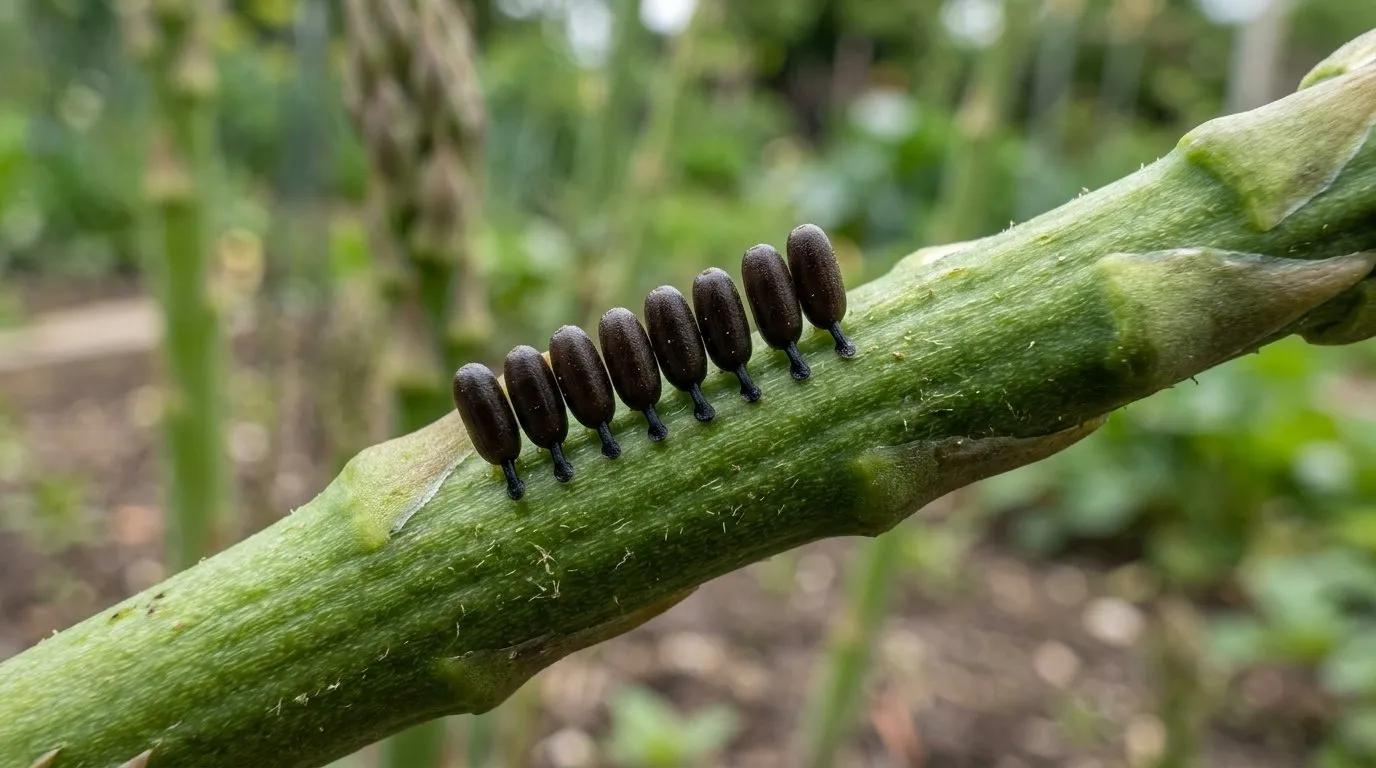 Asparagus beetle eggs glued end-on along a spear. Each female lays 200-300 eggs across the season. Squashing eggs on sight prevents the next generation - the most efficient single use of inspection time. A single morning’s egg-squashing in mid-May prevents 100+ future beetles.
Biological controls
Encouraging natural enemies is the long-term foundation of asparagus beetle management.
Parasitic wasps (Tetrastichus asparagi). Native UK chalcid wasps that parasitise asparagus beetle eggs. Adults emerge from beetle eggs instead of larvae. Encouraged by:
- Avoiding broad-spectrum pesticides on or near the asparagus bed
- Planting nectar-rich flowers nearby (alyssum, fennel, dill, yarrow)
- Maintaining a wild edge to the bed
Ground beetles (Carabidae). Predators of larvae and pupae in soil. Encouraged by:
- A 50cm-wide strip of rough ground around the bed (not bare soil, not lawn)
- A small log pile or stone pile as ground beetle shelter
- Avoiding deep cultivation that kills beetles
Birds. Robins, blackbirds, and tits all eat asparagus beetle larvae. A bird table or feeding station nearby brings them through the bed regularly.
Biological controls do not eliminate beetles but reduce population pressure significantly. Combined with daily inspection, they bring the population to a manageable level within 2-3 years on most beds.
Companion planting and bed design
Some companion plants discourage asparagus beetle or attract beneficial insects.
| Plant | Effect |
|---|---|
| Tomatoes | Solanine in foliage deters beetles (mild effect) |
| Parsley | Lures parasitic wasps; provides cover for predators |
| Basil | Volatile oils may confuse adult beetles |
| Calendula and tagetes | Attract hoverflies that prey on larvae |
| Nasturtiums | Trap crop - lure beetles away from asparagus |
Avoid: Onions, garlic, and other alliums close to asparagus - asparagus does not respond well to allium companions.
Bed layout: A 50cm rough-grass strip around the bed shelters ground beetles and other predators. A 1m-wide flower border on one side (annual hardy flowers, herbs) supports parasitic wasps and hoverflies. Nectar plants like agastache draw in hoverflies and parasitic wasps; see our guide on how to grow agastache. The bed itself should be mulched with composted manure or wood chip to discourage adult overwintering in soil cracks.
For a deeper companion planting framework, see our companion planting guide UK.
Autumn hygiene: the off-season win
The work you do in October and November sets up the next year’s beetle pressure.
Cut and burn old fern. Once fern has yellowed in October-November, cut to ground level. Burn (allowed on most allotments in autumn-winter) or take to council green waste. Do not compost - beetle adults overwinter in hollow stems.
Clear plant debris from the bed. Fallen fern fragments, weeds, mulch chunks - anywhere a beetle could shelter. Aim for a clean bed surface by late November.
Avoid disturbing soil deeper than 5cm. Adult beetles overwinter 2-5cm deep in soil. Raking the surface disturbs and exposes them to predators (ground beetles, robins) - useful. Deep digging kills ground beetles and other allies - counterproductive.
Do a pre-spring inspection in mid-March. Walk the bed and check for emerging adults. The first 1-2 weeks of beetle activity in late April or early May is when populations are smallest and easiest to control.
Top up mulch. A 5cm layer of well-rotted compost in autumn discourages overwintering and provides slow-release nutrition for the spring crop.
For the autumn jobs in general, our autumn gardening jobs UK calendar covers what to do across the kitchen garden.
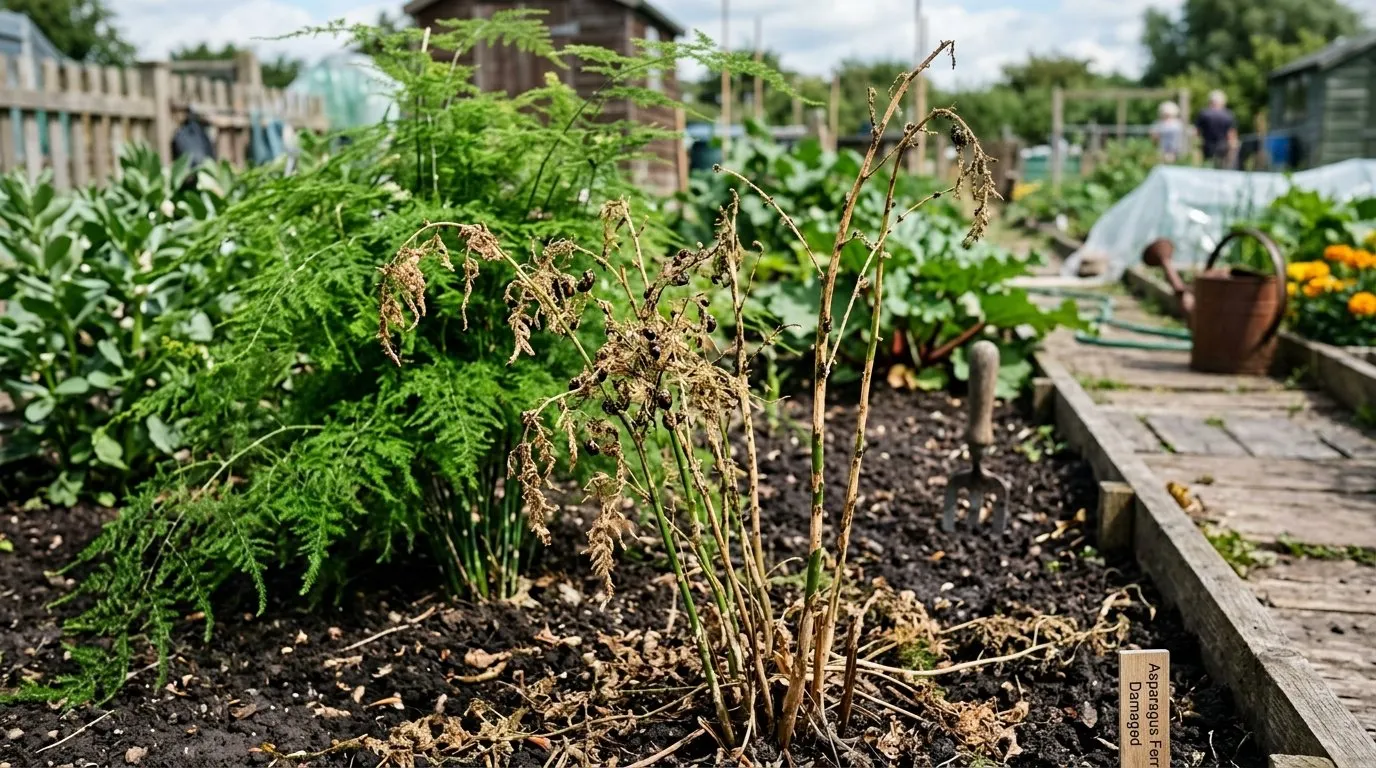 Heavy larval damage to asparagus fern in late summer. Defoliated ferns cannot photosynthesise, the crown cannot store energy for next spring, and the bed gradually fails. Year-on-year fern damage is the main reason asparagus beds collapse within 5-7 years.
Why fern damage matters more than spear damage
The single most important concept in asparagus beetle management.
Spring spears (April-mid June) feed the household. A few chewed spears are cosmetic. The crop continues despite light beetle damage.
Summer fern (mid-June to October) feeds the crown. The fern is the photosynthetic engine that builds up the crown for next year’s spears. If the fern is defoliated by larvae in July, the crown enters winter with low reserves. Next spring’s spear production is reduced. After 2-3 years of fern damage, the crown fails completely.
This is why the daily inspection routine matters most from late June through August - the post-harvest period when the fern is doing the work that determines next year’s harvest. Many UK growers stop checking after the spears finish in mid-June. That is precisely when checking matters most.
A bed managed for spear quality alone gradually fails. A bed managed for fern protection lives for 15-20+ years.
Recovery for damaged beds
If your asparagus bed has had heavy beetle damage in past seasons, recovery takes 1-2 years.
Year of recovery:
- Implement daily inspection from May to August. Catch every generation before egg-laying.
- Cut and burn old fern in October. Remove overwintering shelter.
- Mulch with 5cm of well-rotted compost in November. Discourages adult overwintering.
- Allow fern to grow undefended in summer. No harvest beyond mid-June - let the fern develop fully to feed the crown.
- Plant companion flowers. Yarrow, alyssum, and parsley encourage parasitic wasps and predators.
- Boost crown nutrition. A spring top-dressing of seaweed feed supports recovery.
By year 2 the bed should produce a noticeable improvement in spear count and quality. By year 3 it should be back to full production.
For badly damaged beds with crown losses, the only fix is replacement crowns. New asparagus crowns are £3-5 each from spring suppliers like Suttons Seeds and Marshalls Garden. Plant in March-April. Allow 2 years before harvesting.
Quick checklist
For asparagus beetle control through the season:
- Daily morning inspection May-August (5 minutes) ✓
- Jar of soapy water for hand-picking ✓
- Squash any eggs spotted ✓
- Hand-pick adults and larvae ✓
- Companion planting (alyssum, parsley, calendula) ✓
- Wild edge / rough strip around bed for predators ✓
- Cut and burn old fern in October ✓
- Top up mulch in November ✓
- Pre-spring inspection in mid-March ✓
Done consistently, the daily inspection routine prevents the population from establishing and keeps the bed productive for 15-20 years. Skip the inspection and the bed fails within a decade. The lever is small, daily, and entirely organic.
Related articles
Our team produces practical UK gardening guidance from source research, contributor records and established horticultural practice. Editorial standards are overseen by Matt W.