How to Grow Coreopsis in the UK
How to grow coreopsis (tickseed) in UK gardens. Covers best perennial varieties, thread-leaf types, prairie planting, division, and long flowering.
Key takeaways
- Thread-leaf coreopsis (C. verticillata) is the most reliable group for UK gardens — long-lived and tough
- 'Moonbeam' and 'Zagreb' are the two best-performing UK varieties after 5 years of trials
- Flowers continuously from June to October with regular deadheading — up to 20 weeks of colour
- Grandiflora types flower heavily but often die after 2-3 years in UK conditions
- Full sun and well-drained soil are essential — plants rot in winter on waterlogged clay
- Divide every 3 years in spring to maintain vigour and prevent die-out in the centre
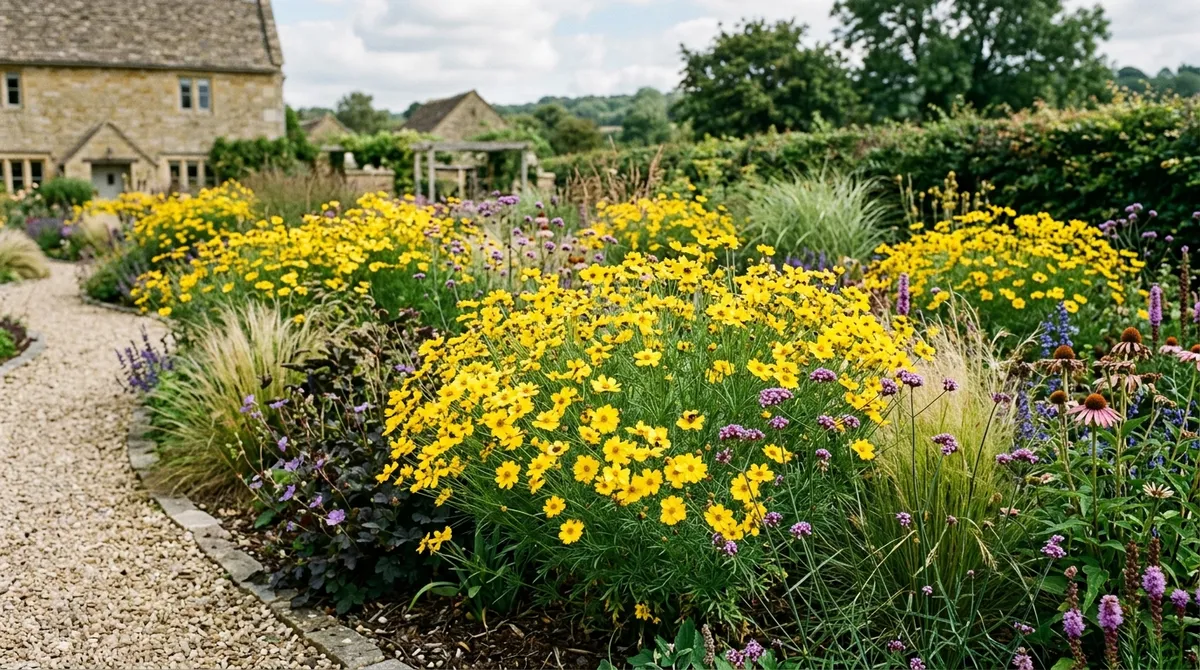
Coreopsis is the garden plant that flowers when everything else has stopped. While most perennials deliver their main display in a concentrated burst of a few weeks, coreopsis carries on from June through October. That is up to 20 weeks of continuous colour from a single planting. No other hardy perennial in the UK can match that duration.
The genus includes annuals and perennials, but it is the perennial species that matter most for British gardens. Thread-leaf coreopsis (C. verticillata) and grandiflora coreopsis (C. grandiflora) are the two main groups. They look similar in flower but behave very differently in UK growing conditions. Choosing the right one makes the difference between a plant that performs for a decade and one that dies in its third winter.
What types of coreopsis can I grow in the UK?
Three species account for nearly all the coreopsis sold in UK garden centres and nurseries. Each has distinct characteristics, strengths, and weaknesses.
Thread-leaf coreopsis (C. verticillata)
This is the group to prioritise for UK gardens. The leaves are finely divided into thread-like segments, giving the plant an airy, fern-like texture. Plants form dense, spreading clumps that widen steadily through rhizomatous roots. They are fully hardy, long-lived, and tolerant of all but the wettest soils.
‘Moonbeam’ is the most famous variety. Its pale, sulphur-yellow flowers have a soft, understated quality that mixes with almost anything. Plants reach 50cm and flower from June to September with regular deadheading. ‘Zagreb’ is more compact at 40cm with brighter, golden-yellow flowers. It is the toughest of all coreopsis for UK conditions.
Grandiflora coreopsis (C. grandiflora)
These produce the largest, showiest flowers. Individual blooms reach 5-7cm across in bright gold, sometimes with a dark red centre. The display is spectacular in the first year. The problem is longevity. In UK gardens, grandiflora types frequently die after 2-3 years. Winter wet is usually the killer rather than cold.
‘Early Sunrise’ and ‘Sunfire’ are the most commonly sold. Both are worth growing if you treat them as short-lived perennials and replace them regularly. On well-drained soil in sheltered positions, they sometimes persist longer.
Annual coreopsis (C. tinctoria)
Also called plains coreopsis or calliopsis. This annual species produces bicoloured flowers in yellow, red, and mahogany combinations. Plants grow 30-60cm tall and flower from July to October. Sow direct in spring like calendula or cosmos. They self-seed on light soils and provide a useful filler while perennial types establish.
Variety comparison table
| Variety | Species | Height (cm) | Flower colour | Flowering period | UK longevity |
|---|---|---|---|---|---|
| Moonbeam | C. verticillata | 45-50 | Pale sulphur yellow | June-September | 8-10+ years |
| Zagreb | C. verticillata | 35-40 | Golden yellow | June-October | 8-10+ years |
| Route 66 | C. verticillata | 40-45 | Yellow with red ring | June-September | 5-8 years |
| Early Sunrise | C. grandiflora | 40-45 | Bright gold, semi-double | June-August | 2-3 years |
| Sunfire | C. grandiflora | 35-40 | Gold with red eye | June-August | 2-3 years |
| Sunkiss | C. grandiflora | 25-30 | Gold with red centre | June-August | 2-3 years |
The longevity column tells the real story. Thread-leaf types outlast grandiflora varieties by a factor of three to four. For a permanent planting, ‘Zagreb’ and ‘Moonbeam’ are the only sensible choices.
Where should I plant coreopsis?
Getting the position right is essential. Coreopsis tolerates a narrow range of conditions compared to many perennials. Full sun and good drainage are non-negotiable.
Light requirements
Full sun for a minimum of 6 hours daily. Coreopsis evolved on the prairies and plains of North America where shade is rare. In partial shade, stems stretch, flowering reduces, and plants weaken. South-facing and west-facing positions are ideal. A border backed by a south-facing fence or wall provides the warmth and shelter that coreopsis appreciates.
Soil requirements
Well-drained soil is critical. Coreopsis tolerates poor, sandy, gravelly, and chalky soils. It does not tolerate heavy, waterlogged clay. Winter wet around the roots kills more coreopsis in the UK than frost ever will.
On clay soils, improve drainage by adding grit to the planting hole and mulching with gravel rather than organic matter. Raised beds offer the best solution for persistent drainage problems. Our guide to drought-tolerant plants covers other species that share these requirements.
For gravel gardens, coreopsis is one of the finest choices. The combination of drought tolerance, long flowering, and low maintenance makes it perfect for this style of planting.
Spacing
Space thread-leaf types 40-50cm apart. They spread by rhizomes and fill gaps within 2-3 years. Space grandiflora types 30-40cm apart. They do not spread and can be planted more closely.
How do I plant and establish coreopsis?
Spring planting gives the best results in UK gardens. It allows the roots to establish during the warm months before facing their first winter.
When to plant
Plant pot-grown coreopsis from April to June. Avoid autumn planting on heavy or wet soils. The combination of young roots and winter waterlogging kills a high proportion of autumn-planted coreopsis. On light, free-draining soils, September planting is acceptable.
Planting method
Dig a hole twice the width of the pot and the same depth. Mix a handful of horticultural grit into the excavated soil. Set the plant so the crown sits exactly at soil level, not below. Backfill, firm gently, and water well. Apply a 3cm mulch of gravel or grit around the crown. Avoid organic mulches which retain moisture against the crown over winter.
Growing from seed
Sow indoors in March or April. Scatter seed on the surface of moist compost and press lightly. Do not cover. Seeds need light to germinate. Keep at 15-20C and expect germination in 14-21 days. Prick out into 9cm pots and grow on. Harden off and plant out after the last frost in May.
Seed-raised coreopsis often flower in their first summer, though the display is lighter than in subsequent years. Named varieties like ‘Moonbeam’ and ‘Zagreb’ do not come true from seed. Buy plants or divide existing clumps for these.
How do I care for coreopsis through the year?
Coreopsis is a low-input perennial once established. The three essentials are deadheading, division, and winter drainage management.
Deadheading
Regular deadheading is the single biggest factor in flowering duration. Removing spent flowers every 5-7 days stimulates continuous bud production. Without deadheading, plants set seed, flowering slows, and the season ends 6-8 weeks earlier. Use scissors on thread-leaf types, as the fine stems are difficult to snap cleanly by hand.
Watering
Established coreopsis is genuinely drought-tolerant. In normal UK summers, supplementary watering is unnecessary for plants in the ground. During extended dry spells (4+ weeks without rain), a deep soak every 10 days prevents stress. Container-grown plants need more frequent watering, typically every 2-3 days in hot weather.
Feeding
Avoid high-nitrogen feeds, which produce soft, floppy growth. A single application of general-purpose fertiliser in April is sufficient for most soils. On very poor, sandy ground, a second feed in June supports the long flowering season. Comfrey feed diluted to half strength works well.
Winter care
Cut back dead stems to ground level in late autumn after flowering ends. On clay soils, apply a 3cm gravel mulch over the crown to improve winter drainage. Do not apply organic mulch, which holds moisture against the roots. On well-drained soils, no winter protection is needed. All C. verticillata varieties are hardy to at least -15C.
How and when do I divide coreopsis?
Division is essential for maintaining healthy, vigorous plants. Without it, thread-leaf coreopsis clumps die out in the centre and grandiflora types exhaust themselves.
When to divide
Divide in March or early April as new growth emerges. This gives divisions the entire growing season to re-establish before winter. Autumn division is risky in the UK because damaged roots combined with winter wet frequently cause losses.
Method
Lift the entire clump with a garden fork. Shake off loose soil. For thread-leaf types, pull the clump apart by hand into sections, each with a healthy mass of roots and several growing points. For grandiflora types, use a sharp knife to cut through the woody crown. Discard the tired, woody centre of the clump and replant only the vigorous outer sections.
Replanting
Prepare the new planting hole with fresh soil and added grit. Plant divisions at the same depth as the original. Water well and mulch with gravel. New growth appears within 2-3 weeks. Divisions flower normally in the same season, though the display is lighter until the root system re-establishes fully.
Division frequency
Every 3 years is the standard recommendation for thread-leaf types. Every 2 years extends the life of grandiflora types by preventing them from exhausting their root reserves. Consistent division is the single most effective way to keep coreopsis performing long-term.
How do I use coreopsis in garden design?
Coreopsis brings something unusual to UK borders. Its long flowering season fills the gap between the June peak and the autumn asters. The fine, airy texture of thread-leaf types contrasts with bolder perennials.
Prairie and naturalistic planting
Thread-leaf coreopsis is one of the key plants for prairie-style gardens in the UK. It combines naturally with ornamental grasses, echinacea, yarrow, and salvia. The fine foliage of ‘Moonbeam’ weaves between grass stems to create that signature prairie effect of flowers floating in a sea of texture.
Gravel garden planting
The combination of drought tolerance and compact habit makes ‘Zagreb’ ideal for gravel gardens. Plant alongside lavender, sedum, and dianthus. The bright yellow flowers provide a warm contrast to the silver and purple tones typical of Mediterranean-style plantings.
Border planting
In traditional mixed borders, coreopsis fills the mid-summer to early autumn period when many spring and early summer perennials have finished. Position ‘Moonbeam’ in the middle of a border where its 50cm height bridges the gap between low edging plants and taller back-of-border subjects. The pale yellow flowers blend with almost any colour scheme.
Containers
Dwarf varieties and compact types like ‘Sunkiss’ and ‘Zagreb’ perform well in large containers. Use a gritty, free-draining compost mix (50% multipurpose compost, 50% perlite or grit). Full sun is essential. Feed fortnightly with a balanced liquid fertiliser. Container gardening is also a good solution for gardeners on heavy clay who want to avoid drainage problems.
Common problems growing coreopsis in the UK
Coreopsis is largely pest and disease free. Almost all problems relate to growing conditions rather than external threats.
Winter die-back
The most common problem. Plants that looked healthy all summer fail to emerge in spring. Winter waterlogging is almost always the cause. Prevention is better than cure. Improve drainage before planting. Use gravel mulches. Choose thread-leaf types over grandiflora. On persistently wet sites, grow in raised beds or containers.
Short lifespan of grandiflora types
Grandiflora coreopsis flowers so heavily that it exhausts its root reserves within 2-3 years. Regular deadheading to prevent seed set helps, but these varieties are inherently short-lived in UK conditions. Accept this and propagate replacements, or switch to thread-leaf types for permanent plantings.
Slugs
Young plants and fresh divisions are vulnerable to slug damage in spring. Protect with nematode biological controls or copper barriers. Established clumps are rarely troubled.
Aphids
Greenfly occasionally colonise stem tips in early summer. Hose off with water or leave for ladybirds and hoverflies to manage. Aphids rarely cause significant damage to established coreopsis. The RHS advises encouraging natural predators rather than spraying.
Crown rot
A soft, black rot at the base of the plant, usually in late winter or early spring. Caused by prolonged wet conditions around the crown. Affected plants cannot be saved. Remove and improve drainage before replanting. Gravel mulch and raised planting prevent recurrence.
Frequently asked questions
Is coreopsis a perennial in the UK?
Yes, most coreopsis are perennial in UK gardens but longevity varies by species. Thread-leaf coreopsis (C. verticillata) is fully hardy and long-lived, persisting for 10+ years with regular division. Grandiflora types are technically perennial but often short-lived, dying after 2-3 years in UK conditions. Winter wet rather than cold is usually the cause of losses. Good drainage is essential for all types.
What is the best coreopsis for UK gardens?
Coreopsis verticillata ‘Zagreb’ is the most reliable variety for UK gardens. It produces golden-yellow flowers on compact 40cm plants from June to October. It tolerates heavier soils than other varieties and has excellent longevity. ‘Moonbeam’, with pale sulphur-yellow flowers on 50cm stems, is the other top performer for UK conditions.
Why does my coreopsis keep dying?
Most coreopsis deaths in UK gardens are caused by winter waterlogging, not cold. Grandiflora types are especially vulnerable. Improve drainage by adding grit to the planting hole, mulching with gravel instead of organic matter, and raising the planting area slightly. Short-lived grandiflora varieties also exhaust themselves by flowering too heavily. Deadheading and division help, but switching to thread-leaf types is the most reliable solution.
Does coreopsis need full sun?
Yes, coreopsis needs a minimum of 6 hours of direct sun daily. In partial shade, plants become leggy, flower less, and are more prone to winter losses. Full sun and an open, airy position produce the densest flowering and strongest plants. South and west-facing positions are ideal. North-facing sites are unsuitable.
How do I divide coreopsis?
Divide coreopsis clumps every 3 years in March or early April. Lift the entire clump with a fork and pull apart into sections with healthy roots and shoots. Discard the woody centre. Replant divisions at the same depth in refreshed soil with added grit. Water well and new growth appears within 2-3 weeks. Division is the best way to maintain vigour and prevent die-out.
Can I grow coreopsis from seed?
Yes, coreopsis germinates easily from seed sown in March or April. Sow on the surface of moist compost and do not cover, as seeds need light to germinate. Keep at 15-20C and expect germination in 14-21 days. Grow on in 9cm pots and plant out after the last frost. Seed-grown plants often flower in the first summer. Named varieties do not come true from seed.
Is coreopsis good for pollinators?
Yes, coreopsis is an excellent pollinator plant, especially for bees and hoverflies. The open, daisy-like flowers provide easy access to nectar and pollen. The long flowering period from June to October supplies food during the critical late-summer gap when many other flowers have finished. Thread-leaf varieties are particularly valuable because the fine foliage does not shade out the flowers.
Lawrie has been gardening in the West Midlands for over 30 years. He grows his own veg using no-dig methods, keeps a wildlife-friendly garden, and writes practical advice based on real UK growing conditions.