Key takeaways
- Direct sow calendula outdoors from March to May, or September for earlier spring flowers
- Petals are edible with a mild peppery flavour, used in salads, rice dishes, and butter
- Outstanding companion plant that attracts aphid-eating hoverflies to vegetable beds
- Self-seeds prolifically once established, returning year after year without resowing
- Deadhead regularly to extend flowering from June through to first frost in November
- Calendula oil and salve made from dried petals has genuine anti-inflammatory properties
Calendula is the most useful annual flower you can grow in a UK garden. It feeds you, feeds pollinators, protects your vegetables, seeds itself for free, and keeps flowering from June until November’s first hard frost. Few plants deliver this much from a single packet of seed.
Known as pot marigold, Calendula officinalis has been grown in British gardens since at least the 13th century. The name comes from the Latin calendae, meaning the first day of each month, because it was said to flower in every month of the year. In mild UK winters, that claim is not far from the truth.
How do I sow calendula seeds?
Calendula is one of the easiest flowers to grow from seed. The large, curved seeds are easy to handle and germinate reliably. Direct sowing outdoors is the simplest method and produces the strongest plants.
Sow seeds where you want them to flower from March to May. Wait until the soil temperature is above 10C. Make shallow drills 1cm deep and 30cm apart. Drop seeds every 10cm and cover lightly. Water gently and mark the rows. Germination takes 7-14 days.
Thin seedlings to 25-30cm spacing once they have two pairs of true leaves. The thinnings can be transplanted elsewhere, though calendula slightly resents root disturbance. Water transplants well and shade them for a few days.
For earlier flowers, sow in September. Autumn-sown calendula overwinters as small rosettes and flowers 4-6 weeks ahead of spring-sown plants the following year. This works well across southern and central England. In exposed northern gardens, protect autumn-sown plants with fleece during harsh spells.
What soil and position does calendula need?
Full sun produces the most flowers, but calendula tolerates light shade, making it useful for east-facing borders that only get morning sun. Flowering is reduced in shade but the plants remain healthy.
The one condition calendula dislikes is persistent waterlogging. On poorly drained ground, grow in raised beds or add grit to improve drainage. In containers, use any multipurpose compost with a handful of perlite mixed in.
Calendula does not need rich soil. In fact, highly fertile ground produces lush foliage at the expense of flowers. Avoid adding compost or manure before sowing. Save the good soil for hungry crops like courgettes and squash.
Why is calendula such a good companion plant?
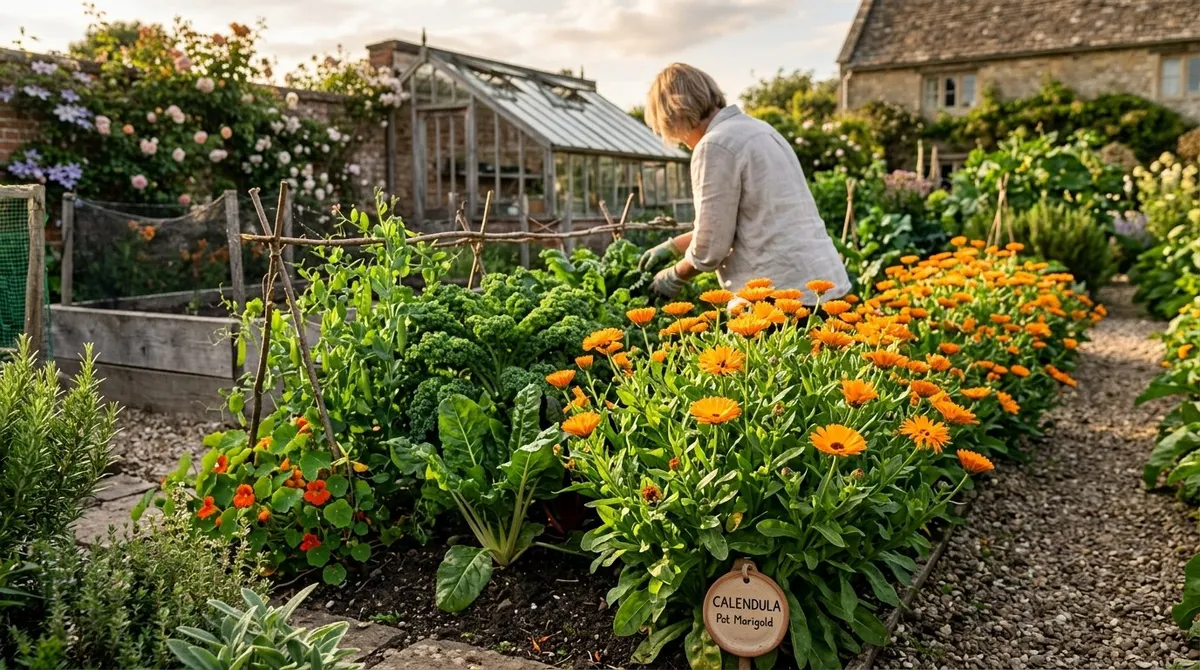
Calendula earns its place in the companion planting hall of fame for three reasons. First, its open, daisy-like flowers produce abundant nectar and pollen that attract hoverflies, lacewings, and parasitic wasps. The larvae of these beneficial insects consume vast numbers of aphids.
Second, calendula flowers attract aphids to themselves, acting as a sacrificial trap crop. Blackfly often cluster on calendula stems rather than attacking nearby broad beans or brassicas. Let them. The hoverflies will find them.
Third, calendula roots exude compounds that may suppress certain soil nematodes. Research from Wageningen University found measurable nematode reduction in soil where calendula had grown. This makes it useful in vegetable bed rotations as a green manure or cover crop.
Plant calendula every 60cm along the edges of vegetable beds. Interplant between rows of broad beans, lettuces, and brassicas. The flowers also attract bees for pollinating runner beans and courgettes.
Are calendula petals really edible?
Yes, and they have been eaten in Britain for centuries. Calendula was a common kitchen garden herb throughout the medieval and Tudor periods. The petals were used to colour and flavour soups, stews, rice, and cheese. They earned the nickname “poor man’s saffron” because they add a similar golden colour to dishes at a fraction of the cost.
Only eat Calendula officinalis, not French or African marigolds (Tagetes species), which are different plants entirely. Pull the individual petals from the flower head and discard the green calyx, which tastes bitter.
Fresh petals have a mild, slightly peppery flavour with faint honey notes. Scatter them over salads, stir into risotto for the last 2 minutes of cooking, infuse in melted butter for a golden colour, or freeze in ice cubes for drinks. Dried petals lose their subtle flavour but keep their colour, making them a useful natural food colouring.
For the best flavour, harvest petals in the morning after dew has dried but before the hottest part of the day. Only use flowers from plants that have not been treated with any pesticides.
What are the best calendula varieties for UK gardens?
Not all calendula varieties are created equal. Some excel as cut flowers, others are bred for edible use, and a few are selected for compact container growth. Here are six tried and tested varieties.
| Variety | Height | Colour | Best For | Mildew Resistance | Notes |
|---|---|---|---|---|---|
| ’Indian Prince’ | 60cm | Orange-red, dark reverse | Cutting, borders | Moderate | Striking bicolour petals |
| ’Snow Princess’ | 50cm | Cream-white | Cutting, edible | Moderate | Unusual colour, mixes well |
| ’Art Shades’ | 55cm | Apricot, cream, orange mix | Cottage borders | Low | Classic seed mixture |
| ’Neon’ | 45cm | Vivid bright orange | Borders, containers | Good | Best mildew resistance |
| ’Erfurter Orangefarbige’ | 50cm | Deep orange | Edible, medicinal | Moderate | High resin, best for salves |
| ’Porcupine’ | 50cm | Orange, quilled petals | Novelty, cutting | Moderate | Unusual spiky petal form |
‘Indian Prince’ is outstanding for cut flowers. Its petals are rich orange on top with a deep mahogany-red reverse. The contrast is visible when flowers catch the light. Stems reach 60cm, long enough for tall vases. It is also one of the most vigorous self-seeders.
‘Erfurter Orangefarbige’ is the one to grow for herbal use. Its petals contain higher levels of the resins and essential oils used in calendula salve. It is an old German variety that has been selected for medicinal quality over ornamental value.
How do I keep calendula flowering all summer?
The single most important task is deadheading. Remove spent flower heads every few days to prevent seed formation. Once a calendula plant sets seed, it switches its energy from flowering to ripening those seeds. Consistent deadheading extends flowering from June right through to November.
Cut spent heads back to the next bud or leaf joint. Do not just pull off the petals and leave the seed head behind. Use scissors or a sharp thumbnail. A weekly pass through your calendula patch takes only a few minutes.
In mid-July, if plants become leggy and sparse-looking, cut them back hard to 15cm above ground. Water and give a light liquid feed. Fresh growth and a new flush of flowers will follow within 3-4 weeks. This mid-season chop technique works well for calendula.
If you want seeds for saving, stop deadheading the last flush from late September. Let these seed heads dry on the plant until they turn brown and papery. Collect the curved, spiky seeds and store in paper envelopes.
How do I save calendula seeds?
Calendula seeds are among the easiest to save. The large, curved seeds are unmistakable and dry well on the plant. You can save seed from any open-pollinated variety. F1 hybrid seeds will not breed true, but most calendula varieties are open-pollinated.
Leave the last flowers of the season to mature on the plant from late September. Seed heads are ready when they turn brown and feel dry and papery. The ring of curved seeds loosens and can be rubbed off easily. If wet weather threatens, cut entire heads and dry them indoors on newspaper.
Separate the seeds from any chaff and store in labelled paper envelopes in a cool, dry place. Calendula seed remains viable for 3-5 years if stored properly. Glass jars with silica gel packets work well for longer-term storage.
Self-sown calendula seedlings will appear around the parent plants in autumn or early spring. These volunteer seedlings are often the strongest plants you will grow. Thin them to 25cm apart and let them flower where they land, or transplant them carefully when small.
How do I make calendula salve and oil?
Calendula has been used in herbal medicine for centuries. Modern research confirms that its petals contain triterpenoids and flavonoids with genuine anti-inflammatory and antimicrobial properties. The Royal Horticultural Society notes its long history of medicinal use in British gardens.
To make calendula-infused oil, first dry fresh petals on a rack for 3-5 days until they feel papery with no moisture. Fill a clean glass jar half full with dried petals. Cover completely with olive oil or sweet almond oil. Seal tightly and place on a sunny windowsill for 4-6 weeks, shaking daily. Strain through muslin into a dark glass bottle.
To convert the oil into a healing salve, gently warm 100ml of calendula oil in a double boiler. Add 12-15g of beeswax pellets and stir until melted. Pour into small tins or jars and allow to set at room temperature. The salve is soothing on dry skin, minor cuts, insect bites, and chapped lips.
Use only ‘Erfurter Orangefarbige’ or other high-resin varieties for the strongest medicinal preparations. Modern ornamental varieties bred for large flowers sometimes have lower concentrations of active compounds.
How do I manage powdery mildew on calendula?
Powdery mildew is the most common problem affecting calendula in the UK. It appears as a white, dusty coating on leaves and stems, typically from mid-July onwards as temperatures fluctuate and overnight dew becomes heavier.
Prevention is more effective than cure. Space plants at 30cm intervals to allow air to circulate freely around the foliage. Avoid overhead watering, which creates the surface moisture mildew spores need to germinate. Water at the base of plants in the morning.
A fortnightly spray of diluted milk (1 part semi-skimmed milk to 9 parts water) reduces mildew severity. The proteins in milk create conditions on the leaf surface that inhibit fungal growth. Research from the University of Adelaide found milk sprays as effective as synthetic fungicides on squash mildew.
Remove badly affected leaves as soon as you spot them. Bag and bin them rather than composting, as mildew spores survive composting temperatures. In severe cases, cut plants back hard, remove all affected foliage, and allow fresh growth to emerge.
What is the difference between calendula and marigolds?
This confusion catches many gardeners. Calendula officinalis (pot marigold) and Tagetes species (French and African marigolds) are entirely different plants from different continents. They share only the common name “marigold” and superficially similar orange flowers.
Calendula is native to southern Europe. It has been grown in British gardens since medieval times. Its petals are edible and medicinal. Plants are hardy annuals that tolerate frost and self-seed reliably. The leaves are long, slightly sticky, and aromatic.
Tagetes species are native to the Americas. French marigolds (Tagetes patula) and African marigolds (Tagetes erecta) are half-hardy annuals killed by frost. Their petals have a strong, pungent smell that some people find unpleasant. They are grown as bedding plants and companion plants in their own right, but their edibility is debated and they lack calendula’s medicinal properties.
When buying seed or plants, always check the Latin name. If it says Calendula officinalis, it is the pot marigold described in this article. If it says Tagetes, it is a different plant entirely.
How does calendula fit into an edible flower garden?
Calendula is the anchor plant for any edible flower collection. Its long flowering season, self-seeding habit, and versatile petals make it the most productive edible bloom you can grow.
Pair it with nasturtiums for peppery leaves and flowers, borage for its cucumber-flavoured blue flowers, and violas for their delicate flavour and colour range. Together, these four plants provide edible flowers from May right through to November with minimal effort.
Grow calendula in a dedicated bed near the kitchen door for easy harvesting. Alternatively, scatter it through vegetable beds where it doubles as a companion plant. The flowers attract pollinators to nearby crops while providing a steady harvest of petals for the kitchen.
Harvest petals regularly. Regular picking encourages fresh blooms just like deadheading does. A patch of 10-12 calendula plants provides enough petals for weekly salad garnishes, occasional cooking use, and still leaves plenty of flowers for the pollinators.
Frequently asked questions
When should I sow calendula seeds in the UK?
Sow calendula seeds directly outdoors from March to May. Seeds germinate in 7-14 days at soil temperatures above 10C. For earlier flowers, sow in September and overwinter young plants. Autumn-sown calendula flowers 4-6 weeks ahead of spring-sown plants. You can also start seeds indoors in February for planting out after the last frost. Calendula dislikes root disturbance, so sow into modules rather than open trays if starting indoors.
Are calendula petals safe to eat?
Yes, calendula petals are completely safe and widely eaten. Only use Calendula officinalis varieties, not ornamental Tagetes marigolds. The petals have a mild, slightly peppery flavour with a hint of saffron. Pull petals from the flower head and scatter over salads, stir into risotto, or infuse in butter. Avoid eating petals from plants treated with pesticides. Remove the green calyx before eating as it tastes bitter.
Does calendula really deter aphids?
How do I stop calendula getting powdery mildew?
Good air circulation is the best defence against powdery mildew. Space plants 30cm apart and avoid overhead watering. Powdery mildew appears as a white dusty coating on leaves, typically from late July onwards as nights get cooler and dewy. Remove badly affected leaves immediately. Varieties like ‘Neon’ show better mildew resistance than older cultivars. A fortnightly spray of diluted milk (1 part milk to 9 parts water) reduces severity.
Will calendula self-seed in my garden?
Yes, calendula self-seeds prolifically once you let seed heads mature. Leave the last flush of flowers to form seed from September onwards. Seeds drop around the parent plant and germinate in autumn or early spring. Self-sown seedlings are often hardier than deliberately sown ones. Thin to 25-30cm apart to prevent overcrowding. If self-seeding becomes excessive, deadhead more aggressively in late summer.
Can I make calendula oil at home?
Yes, homemade calendula oil is simple to produce. Dry fresh petals for 3-5 days on a rack until papery. Fill a clean jar half full with dried petals and cover with olive oil or sweet almond oil. Seal and leave in a warm, sunny spot for 4-6 weeks, shaking daily. Strain through muslin. The resulting infused oil is used for skin balms, lip salves, and minor wound care. It keeps for 6-12 months in a dark bottle.
Our team produces practical UK gardening guidance from source research, contributor records and established horticultural practice. Editorial standards are overseen by Matt W.