Best Half-Hardy Annuals for UK Gardens
Top 15 half-hardy annuals for UK gardens with sowing dates, heights, and hardening off advice. Cosmos, zinnia, nicotiana, and cleome tested on clay.
Key takeaways
- Half-hardy annuals need indoor sowing at 18-24C from February to April — they cannot survive frost
- Plant out after the last frost date, typically mid-May in England and early June in Scotland
- Harden off over 10-14 days by gradually increasing outdoor exposure before transplanting
- Cosmos bipinnatus is the most productive, yielding 50-80 stems per plant over 14 weeks
- Zinnias, tithonia, and celosia need the warmest spots — at least 6 hours of direct sun daily
- Pinching seedlings at 15-20cm doubles the number of flowering stems on most species
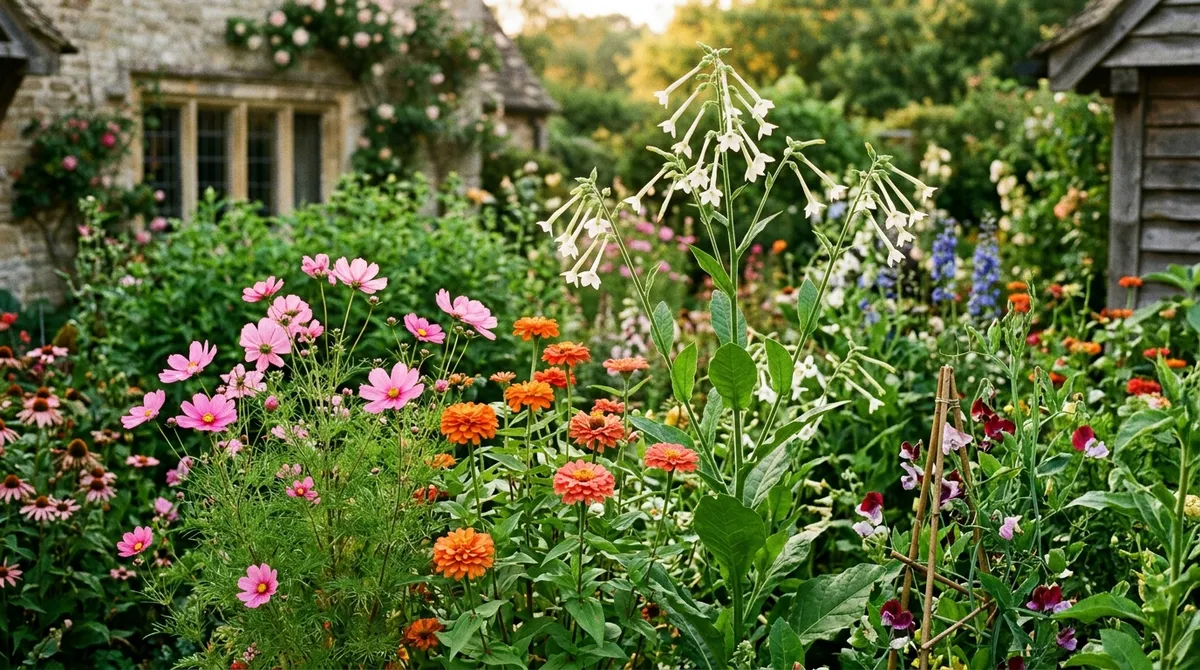
Half-hardy annuals are the backbone of summer colour in UK gardens. These frost-sensitive flowers need indoor sowing from February to April, but the extra effort pays off with months of continuous blooms from July until the first autumn frost wipes them out.
The distinction matters. Hardy annuals tolerate frost and go straight into the ground in March. Tender annuals need greenhouse heat year-round. Half-hardy annuals sit between these extremes. They germinate at 18-24C indoors, grow on for 8-12 weeks, and then thrive outdoors once all frost risk has passed. This guide covers the 15 best species for UK conditions, tested across four seasons on Staffordshire clay.
What makes an annual half-hardy?
Half-hardy annuals originate from warm climates and lack the cellular mechanisms to survive freezing temperatures. A single night at -1C kills most half-hardy seedlings outright. This means they cannot be sown outdoors until late May in most of England, and early June in Scotland and northern counties.
The practical consequence is indoor sowing. You need a propagator or warm windowsill maintaining 18-24C for germination, followed by 6-10 weeks of growing on under good light. The seedlings then undergo a hardening off period of 10-14 days before transplanting into their final positions. Our guide to sowing seeds indoors covers the full process.
This extra work is what puts some gardeners off. But a single packet of cosmos seed costing £2.50 produces 40 plants. Buying the same number as plug plants would cost £25-35. The economics of indoor sowing are overwhelming.
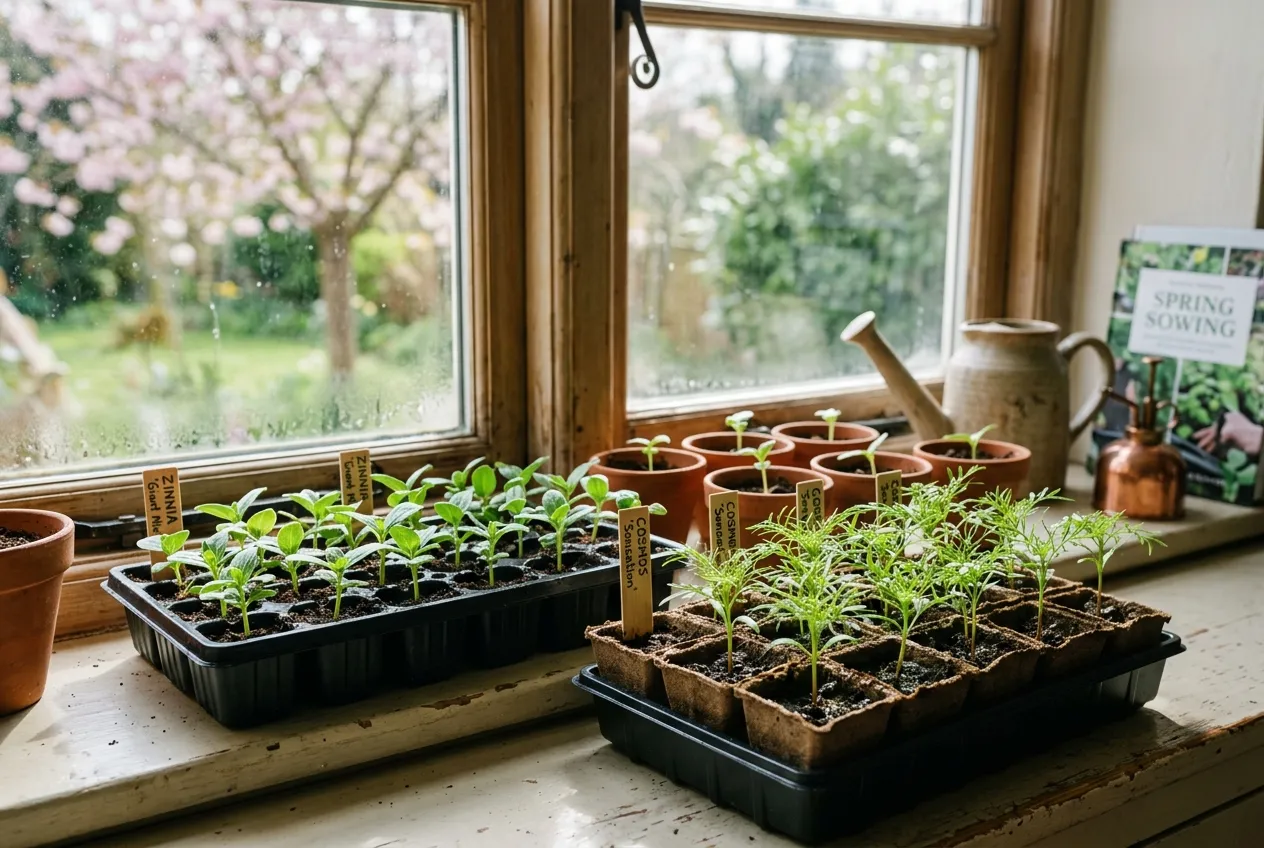 Half-hardy annual seedlings need 8-12 weeks of indoor growth before they face UK outdoor conditions.
When to sow half-hardy annuals in the UK
Timing depends on your region and the species. Sow too early and seedlings become leggy on dark windowsills. Sow too late and plants flower for only a few weeks before frost ends the show. The sweet spot for most species is mid-March to mid-April.
Here is the sowing calendar that works in the West Midlands, where our last frost typically falls in the second week of May. Adjust by two weeks later for Scotland, one week later for northern England, and one week earlier for the south coast.
| Species | Sow indoors | Germination temp | Days to germinate | Plant out |
|---|---|---|---|---|
| Cosmos bipinnatus | Mid-March | 18-21C | 7-14 | Late May |
| Zinnia elegans | Late March | 20-24C | 5-7 | Early June |
| Nicotiana sylvestris | Early March | 20-25C | 10-21 | Late May |
| Cleome hassleriana | Mid-March | 21-24C | 10-14 | Early June |
| Tithonia rotundifolia | Late March | 20-24C | 7-14 | Early June |
| Rudbeckia hirta | February | 18-21C | 14-21 | Mid-May |
| Celosia | Late March | 21-25C | 8-14 | Early June |
| Salvia (annual types) | Early March | 20-24C | 12-21 | Late May |
| Verbena bonariensis | February | 18-22C | 14-28 | Mid-May |
| Lobelia erinus | February | 18-24C | 14-21 | Late May |
Rudbeckia hirta and Verbena bonariensis benefit from early February sowing because they are slow to develop. Cosmos and zinnias grow fast and should not be sown before mid-March or they outgrow their pots before planting out time.
How to harden off half-hardy annuals properly
Hardening off is the stage where most half-hardy annuals fail. Plants raised at 20C indoors cannot cope with a sudden move to 8C nights and wind. The cell walls are soft, the stomata are unused to outdoor humidity, and the stems lack the structural strength to handle gusts.
The 14-day method works reliably. On days one and two, place seedlings outdoors in a sheltered, shaded spot for 2-3 hours during the warmest part of the afternoon. Bring them inside before 4pm. Increase exposure by 1-2 hours daily through the first week, gradually introducing more direct sunlight. During the second week, leave plants out during the day and bring them in only if night temperatures drop below 8C. By day 14, they should tolerate full outdoor conditions.
A cold frame transforms hardening off. Open the lid by degrees over two weeks and the frame buffers wind and temperature swings automatically. I now harden off all half-hardies in cold frames and have not lost a single tray since 2024.
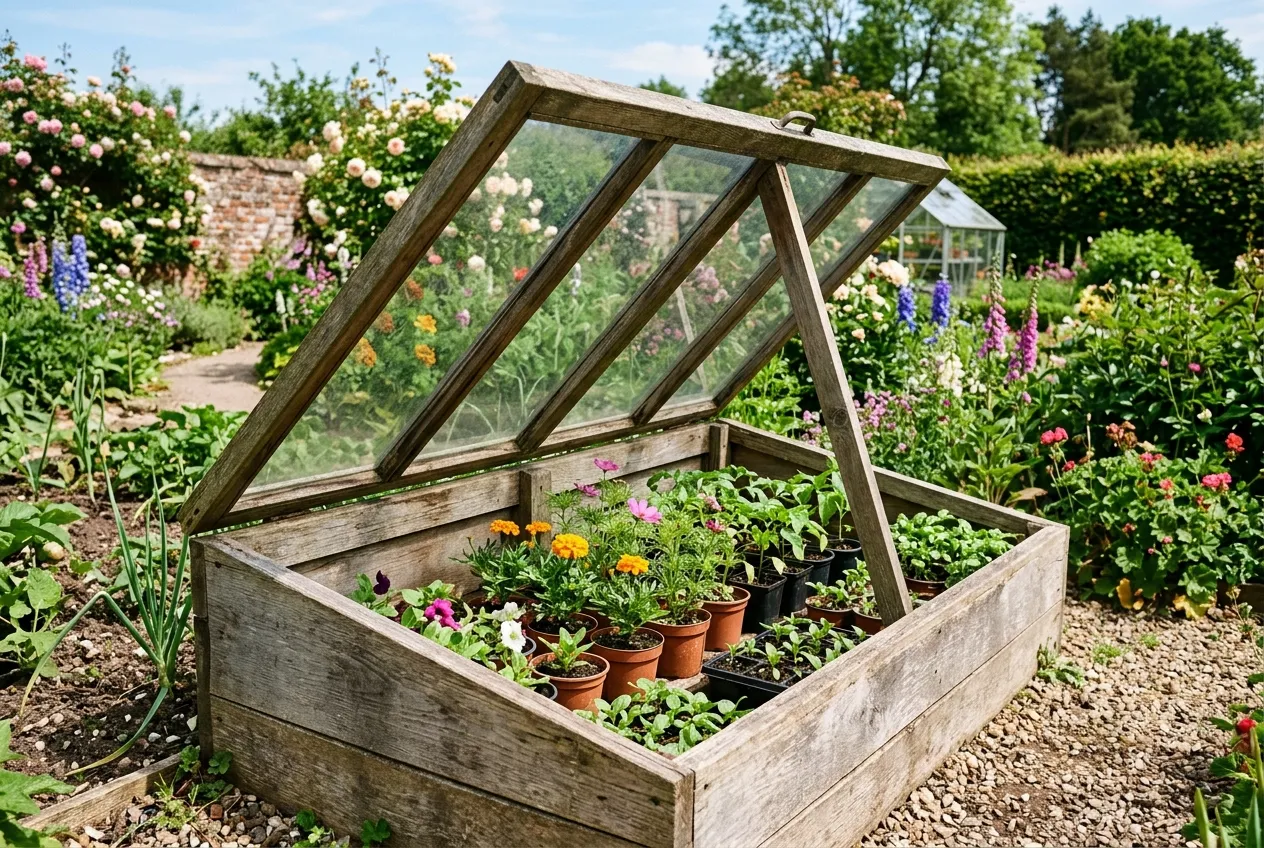 A cold frame makes hardening off half-hardy annuals almost foolproof. Open the lid a little more each day.
The top 15 half-hardy annuals for UK gardens
These 15 species earned their place through four years of side-by-side trials. Every one flowers reliably in average UK summers and tolerates the clay, wind, and unpredictable weather that defines gardening in the Midlands.
Cosmos bipinnatus
The single most productive half-hardy annual for UK gardens. A well-grown cosmos plant produces 50-80 cut flower stems between July and October. The ferny foliage reaches 90-120cm and the single or semi-double flowers come in white, pink, magenta, and crimson. ‘Purity’ (white), ‘Dazzler’ (magenta), and ‘Rubenza’ (deep crimson) are the best named varieties. Cosmos handles light clay, tolerates partial shade for part of the day, and self-seeds in mild winters. Read our full cosmos growing guide for variety comparisons.
Zinnia elegans
Zinnias demand the warmest, most sheltered spot you have. In return, they produce large, fully double blooms in every colour except blue, lasting 7-10 days in a vase. ‘Benary’s Giant’ is the benchmark variety at 90cm, but compact types like ‘Zahara’ (25cm) suit containers. Soil temperature must reach 15C before planting out. See our detailed zinnia growing guide for pinching and mildew advice.
Nicotiana sylvestris
The tobacco plant reaches 150cm and produces cascading white trumpet flowers that release an intoxicating evening scent. Plant it near seating areas or open windows. Flowers attract hawk-moths at dusk. Smaller species include N. alata (60-90cm, mixed colours) and N. langsdorffii (90cm, lime green bells). Nicotiana tolerates partial shade better than most half-hardies.
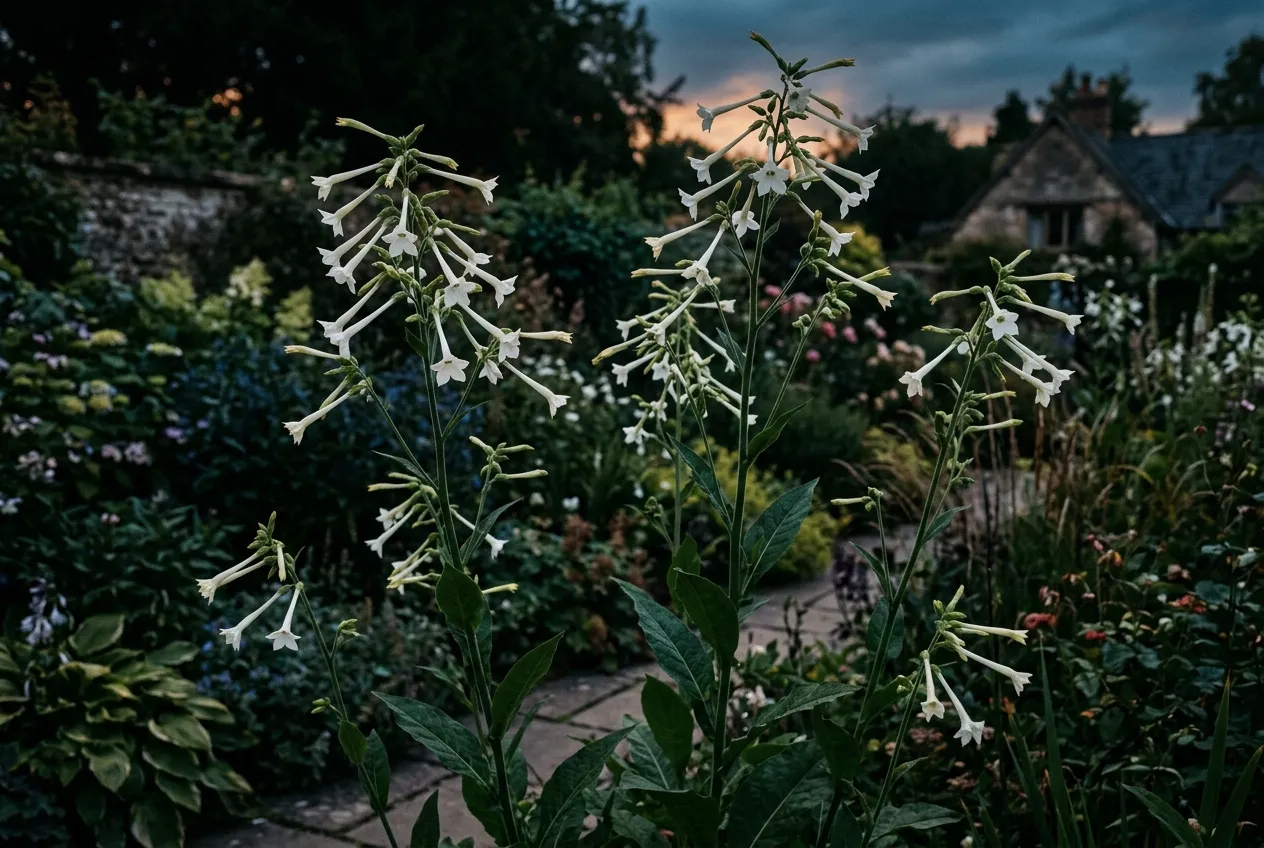 Nicotiana sylvestris reaches 150cm and fills the garden with scent at dusk. Perfect near a seating area.
Cleome hassleriana
Spider flower is one of the most architectural half-hardies available. Plants reach 120-150cm with large, airy flower heads in pink, purple, or white. Thorny stems deter rabbits. Cleome needs warmth (above 15C nights) and shelter from wind. ‘Violet Queen’ and ‘Helen Campbell’ (white) are the best UK performers.
Tithonia rotundifolia
The Mexican sunflower produces vivid orange-red daisy flowers on sturdy 150-180cm stems from August to frost. It is the best half-hardy annual for attracting late-season butterflies, particularly red admirals and painted ladies. ‘Torch’ is the standard tall variety. ‘Fiesta del Sol’ is a compact form at 60-70cm for smaller gardens.
Rudbeckia hirta
Black-eyed Susan flowers non-stop from July to October. Plants reach 50-70cm with golden, orange, or bicolour daisy flowers around a dark central cone. ‘Cherokee Sunset’ gives fully double blooms. ‘Cappuccino’ offers unusual brown-red tones. Sow early (February) because rudbeckia is slow to reach flowering size. Technically a short-lived perennial, it performs best treated as a half-hardy annual in the UK.
Amaranthus
Love-lies-bleeding (A. caudatus) produces dramatic 60cm trailing crimson tassels from 120cm plants. A. cruentus ‘Hot Biscuits’ gives upright bronze-orange plumes. Both are striking in mixed borders and as cut flowers. Amaranthus needs full sun and warmth, but tolerates poor soil.
Celosia
Cockscomb (C. cristata) and plumed celosia (C. argentea var. plumosa) bring tropical colour to UK borders. The ‘Bombay’ series gives compact 30cm plants in hot pinks, oranges, and reds. Celosia needs the highest germination temperature (21-25C) and the most sheltered spot in the garden.
Annual salvia
Salvia viridis (painted sage) and S. horminum produce colourful bracts in blue, pink, and white on 45-60cm stems. Salvia coccinea ‘Lady in Red’ (60cm, scarlet) flowers from July to frost. S. farinacea ‘Victoria’ (45cm, blue spikes) is superb for formal bedding. All attract bees heavily.
Verbena bonariensis
Tall verbena reaches 150-180cm with clusters of tiny purple flowers on wiry stems from July to November. It is see-through, so plant it at the front or middle of borders despite its height. The most reliably self-seeding half-hardy annual in the UK. Attracts butterflies all season.
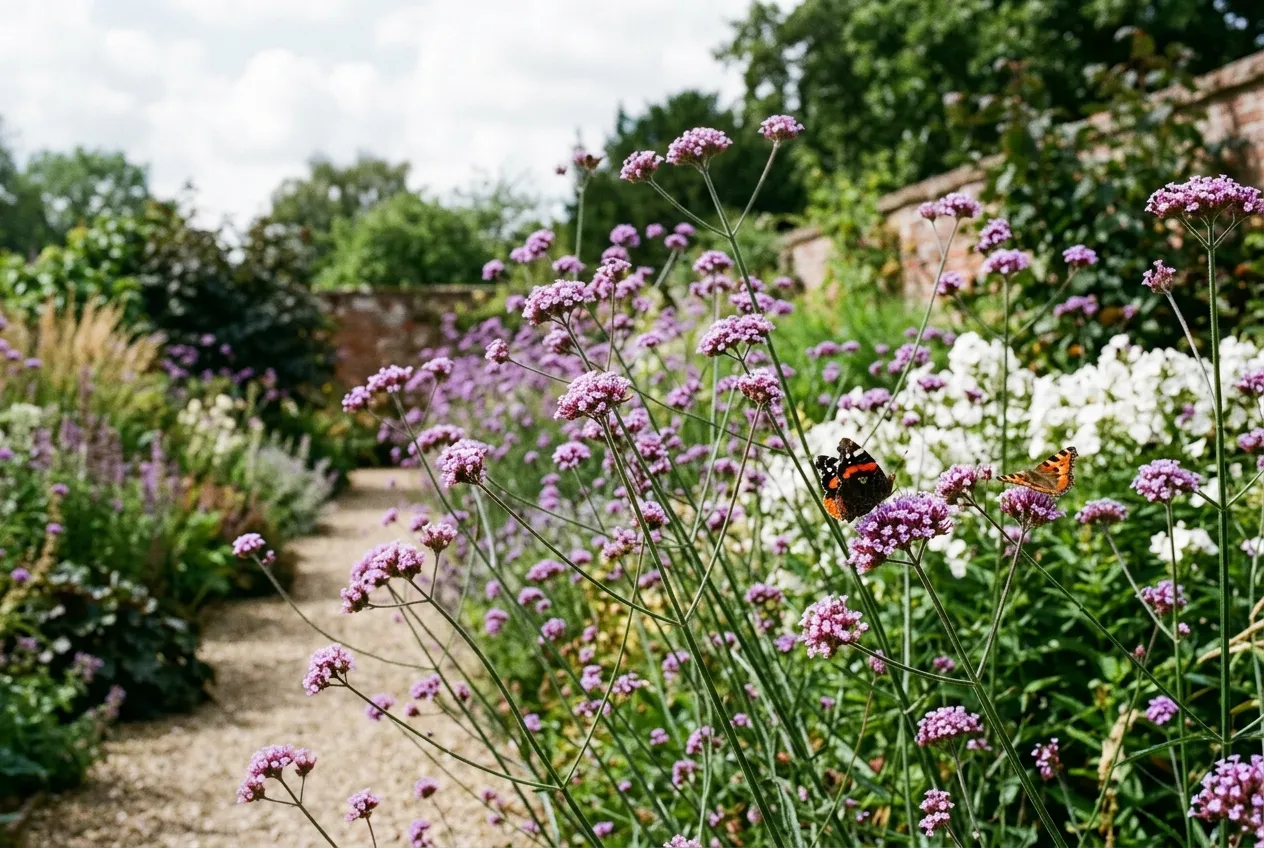 Verbena bonariensis flowers from July to November and self-seeds reliably in sheltered gardens.
Ricinus communis
The castor oil plant grows 150-200cm in a single season with large, dramatic palmate leaves in green, bronze, or deep purple-red. ‘Carmencita’ is the best dark-leaved form. Ricinus is purely foliage — the flowers are insignificant. All parts are highly toxic, so not suitable for gardens with young children. Plant it as a striking architectural accent in drought-tolerant borders.
Dahlia from seed
Growing dahlias from seed rather than tubers gives flowering plants in the same year for a fraction of the cost. ‘Bishop’s Children’ produces dark-leaved single flowers in mixed colours. ‘Coltness Hybrids’ give compact 45cm plants. Sow in February at 20C and treat as half-hardy annuals. They will form tubers by autumn which can be lifted and stored. Our dahlia growing guide covers tuber care.
Tagetes (French and African marigolds)
French marigolds (T. patula, 20-30cm) and African marigolds (T. erecta, 60-90cm) are among the easiest half-hardies. Outstanding as companion plants — French marigolds suppress whitefly on tomatoes and root-knot nematodes in soil. ‘Zenith’ and ‘Inca’ are dependable African types. Our marigold guide covers the full range.
Lobelia erinus
Trailing lobelia is the classic basket and container plant. Compact varieties reach 10-15cm; trailing types cascade 30-40cm. Flowers in blue, purple, white, or carmine. Sow early (February) on the surface — the seed is dust-fine. Lobelia needs consistent moisture and will stop flowering in drought. Feed weekly with liquid tomato fertiliser to sustain blooming.
Petunia
Petunias flower from June to October in every colour imaginable. Grandiflora types (10-12cm flowers) suit containers. Multiflora types (5-7cm flowers) handle rain better for bedding. Trailing ‘Surfinia’ types cascade 90cm or more from hanging baskets. Deadhead regularly. Our petunia growing guide covers all three types in detail.
Comparison of the top 10 half-hardy annuals
| Species | Height | Spacing | Sow indoors | Flower colour | Best use | Stems per plant |
|---|---|---|---|---|---|---|
| Cosmos bipinnatus | 90-120cm | 40-50cm | Mid-March | White, pink, magenta, crimson | Cutting, borders | 50-80 |
| Zinnia elegans | 60-90cm | 25-30cm | Late March | All except blue | Cutting, borders | 30-50 |
| Nicotiana sylvestris | 120-150cm | 50-60cm | Early March | White | Evening scent, back of border | 15-25 |
| Cleome hassleriana | 120-150cm | 40-50cm | Mid-March | Pink, purple, white | Architectural, borders | 10-15 |
| Tithonia rotundifolia | 150-180cm | 60cm | Late March | Orange-red | Butterflies, back of border | 20-30 |
| Rudbeckia hirta | 50-70cm | 30cm | February | Gold, orange, bicolour | Cutting, borders, pots | 25-40 |
| Verbena bonariensis | 150-180cm | 40cm | February | Purple | See-through planting | 30-50 |
| Celosia | 30-90cm | 20-30cm | Late March | Red, pink, orange, yellow | Bedding, pots | 8-15 |
| Annual salvia | 45-60cm | 25-30cm | Early March | Blue, red, pink, white | Bedding, bees | 15-25 |
| Tagetes (French) | 20-30cm | 20cm | Late March | Yellow, orange, red | Companion planting, edging | 30-60 |
How to pinch half-hardy annuals for more flowers
Pinching the growing tip forces branching and doubles or triples the number of flower stems. The technique works on cosmos, zinnia, cleome, rudbeckia, and dahlia seedlings. It does not suit nicotiana, lobelia, or petunia.
Pinch when seedlings reach 15-20cm tall and have at least 4-5 pairs of true leaves. Use clean fingernails or sharp snips to remove the central growing tip just above a leaf pair. Two or more side shoots emerge from the nodes below within a week. Each side shoot produces its own flower stem, and many of those will branch again.
On cosmos, an unpinched plant produces 25-35 stems. A pinched plant produces 50-80. The trade-off is that pinched plants start flowering 7-10 days later, but the total season yield is far greater. Our guide to growing annuals from seed covers pinching across all annual types.
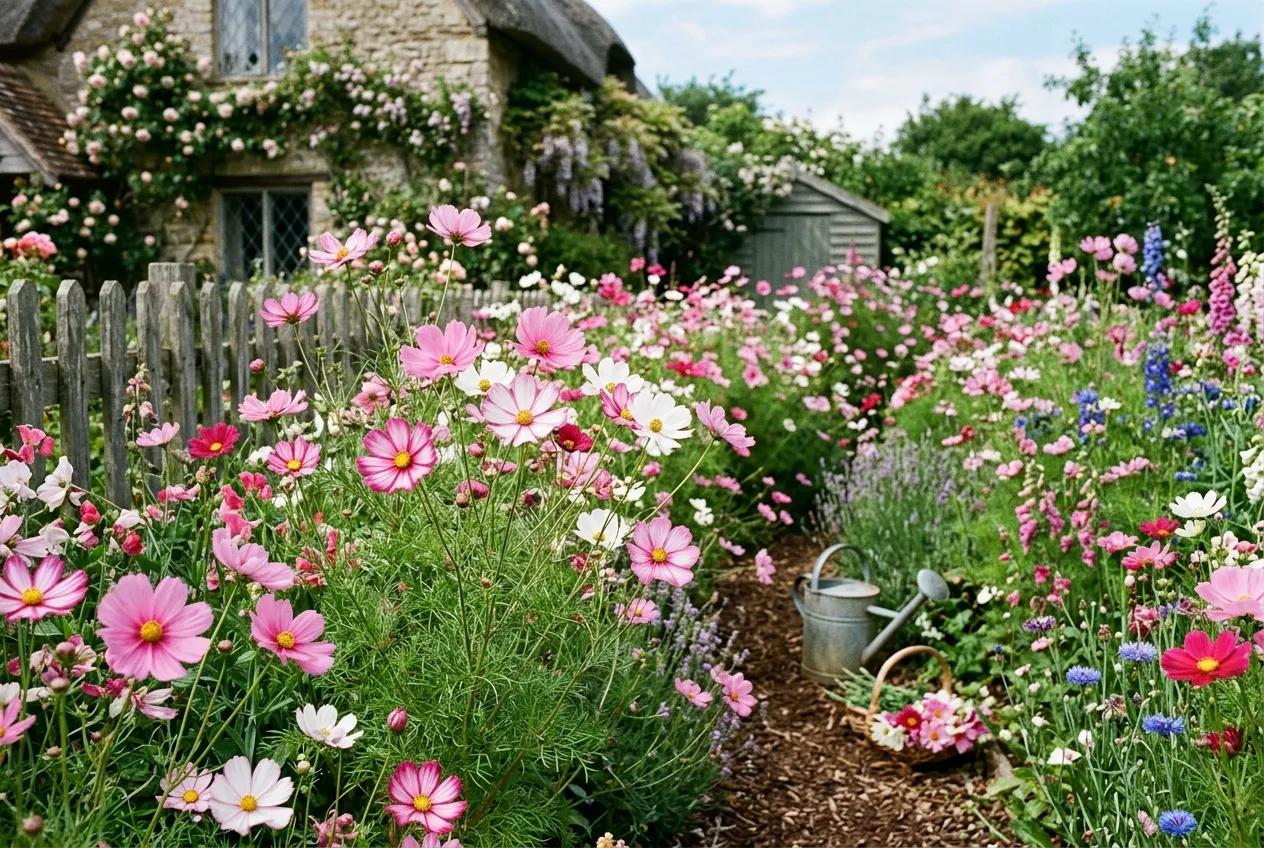 Pinched cosmos plants produce 50-80 stems per season. The ferny foliage reaches 90-120cm by midsummer.
Feeding and watering half-hardy annuals
Most half-hardy annuals are greedy feeders. They grow fast and flower hard, depleting soil nutrients quickly. A weekly liquid feed from first bud to first frost keeps plants productive. Use a high-potash tomato fertiliser (Tomorite or similar) diluted to the manufacturer’s rate.
Water at the base of plants, never overhead. Wet foliage invites botrytis (grey mould) and powdery mildew, both of which thrive in the warm, humid conditions that half-hardies prefer. Morning watering is best because leaves dry before evening coolness. In containers, daily watering is essential during July and August.
Mulch around the base of plants with 5cm of garden compost after planting out. This conserves moisture, suppresses weeds, and feeds the soil as it breaks down. On heavy clay, a gravel mulch 3cm deep improves drainage around the stem base and reduces the risk of collar rot, which kills celosia and cleome on wet soils.
Common problems with half-hardy annuals in the UK
The UK climate presents three main challenges: late frosts, cool summers, and slug damage. Late frosts are managed by correct hardening off and patience. Do not plant out before mid-May in England or early June in Scotland, regardless of how warm April feels.
Cool summers reduce flowering in heat-lovers like zinnia, celosia, and tithonia. In these years, choose cosmos, nicotiana, and verbena, which handle cooler conditions. Growing against a south-facing wall or fence gives an extra 2-3C of warmth that makes the difference for borderline species.
Slugs target newly planted seedlings. Protect transplants with copper tape rings, beer traps, or wool pellets for the first three weeks after planting. Once stems toughen, slug damage drops sharply. Biological slug control using nematodes applied in April provides six weeks of protection covering the critical transplanting window.
Last frost dates across the UK
The last frost date determines when you plant out. Getting this wrong kills seedlings and wastes weeks of indoor growing. These dates are averages — check local forecasts each year.
| Region | Typical last frost | Safe planting date |
|---|---|---|
| South coast and London | Late April | Early May |
| South-west England | Early May | Mid-May |
| Midlands (incl. Staffordshire) | Mid-May | Late May |
| Northern England | Late May | Early June |
| Scotland (lowlands) | Late May to early June | Mid-June |
| Scotland (highlands) | Mid-June | Late June |
In practice, the safest approach is to wait one week beyond your average last frost date. The cost of losing a week’s growth is nothing compared to the cost of replacing 50 dead seedlings after an unexpected frost.
The RHS frost date finder provides localised data based on your postcode and is worth checking each spring.
Frequently asked questions
What is the difference between half-hardy and hardy annuals?
Half-hardy annuals are killed by frost and must be started indoors. Hardy annuals tolerate frost and can be sown direct outdoors from March. This means half-hardy types like cosmos, zinnia, and nicotiana need a heated propagator or warm windowsill to germinate, adding 8-12 weeks of indoor growing before planting out. Hardy annuals such as cornflower, nigella, and calendula skip this step entirely. Our hardy annuals guide covers the best frost-tolerant species.
When should I sow half-hardy annuals in the UK?
Sow half-hardy annuals indoors from late February to mid-April. Most species germinate best at 18-24C and need 8-12 weeks of indoor growth before planting out after the last frost. In southern England, the last frost is typically mid-May. In the Midlands, late May is safer. In Scotland and northern England, delay planting out until early June.
How do I harden off half-hardy annuals?
Harden off over 10-14 days starting two weeks before your planting out date. Place seedlings outdoors in a sheltered spot for 2 hours on day one, increasing by 1-2 hours daily. Bring them in every night for the first week. In the second week, leave them out overnight if no frost is forecast. A cold frame simplifies this process and protects against unexpected cold snaps.
Can I direct sow half-hardy annuals outdoors in the UK?
Only after the last frost in late May or June. Direct sowing works for cosmos and nicotiana in warm, sheltered gardens, but plants flower 4-6 weeks later than indoor-raised seedlings. Zinnias, celosia, and cleome need soil temperatures above 15C to germinate outdoors and rarely perform well from direct sowing in the UK climate.
Which half-hardy annuals are best for cutting?
Cosmos bipinnatus is the top cut flower, producing 50-80 stems per plant. Zinnia elegans gives large, long-lasting blooms. Nicotiana sylvestris adds dramatic height and scent. Rudbeckia hirta flowers from July to October. Cleome hassleriana provides unusual spider-like blooms. All hold well in a vase for 7-10 days when cut at bud stage and conditioned in cool water.
Do half-hardy annuals self-seed in UK gardens?
Some do in mild areas. Nicotiana sylvestris, Verbena bonariensis, and cosmos self-seed in sheltered south-facing gardens. However, seedlings appear late (May-June) and may not flower before the first frost in colder regions. In Staffordshire, only Verbena bonariensis reliably self-seeds for us. Collect seed from the best plants in September and store dry for spring sowing.
What is the cheapest way to grow half-hardy annuals?
Grow from seed rather than buying plug plants. A packet of cosmos seed costs £2-3 and produces 30-50 plants. A tray of 15 plug plants costs £8-12. You need a warm windowsill or heated propagator (£15-30) and seed trays (£5-10), but the equipment lasts for years. Saving seed from your own plants makes subsequent years almost free.
Lawrie has been gardening in the West Midlands for over 30 years. He grows his own veg using no-dig methods, keeps a wildlife-friendly garden, and writes practical advice based on real UK growing conditions.