Key takeaways
- Hakonechloa is one of the few ornamental grasses that thrives in partial to full shade — most grasses need full sun
- 'Aureola' (golden-striped) is the most widely grown cultivar and lights up dark corners from April to November
- Plants reach 30-45cm tall and spread to 40-60cm, making them ideal for borders, containers, and ground cover
- Allow 3 years for a new plant to reach its full cascading habit — hakonechloa is slow to establish but long-lived
- Autumn colour is outstanding: foliage turns from gold through bronze to deep red before dying back in November
- Hardy to -20C across all UK regions and virtually pest-free once established
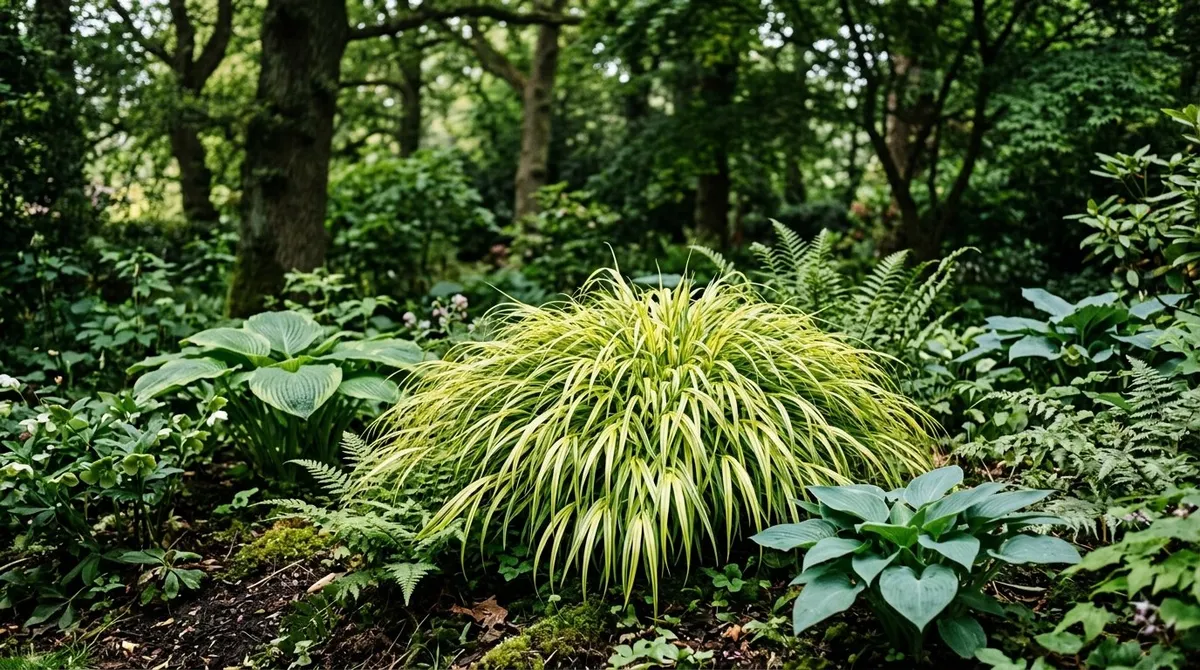
Hakonechloa is the grass that breaks the rules. While almost every ornamental grass demands full sun, hakonechloa thrives in shade and turns dark corners of the garden into something worth looking at. Its arching, bamboo-like foliage ripples in the lightest breeze and changes colour through the seasons, from fresh lime-green in spring to blazing bronze and red in autumn.
What is hakonechloa and where does it come from?
Hakonechloa macra is a deciduous perennial grass native to the volcanic cliffs of the Hakone mountains in central Honshu, Japan. It is the only species in its genus, which makes it botanically unusual. In the wild, it clings to moist, rocky slopes in the forest understorey, often in deep shade with its roots in humus-rich soil between rocks.
The Hakone region sits about 80km south-west of Tokyo. The mountains receive heavy rainfall (over 2,500mm annually) and the forests provide constant shade. This natural habitat explains exactly why hakonechloa behaves the way it does in UK gardens. It wants moisture, shade, shelter, and humus-rich soil. Give it those four things and it will reward you for decades.
The Japanese have cultivated hakonechloa for centuries in traditional gardens, where its graceful arching habit symbolises flowing water. Western gardeners discovered it in the mid-20th century, and the golden cultivar ‘Aureola’ won the RHS Award of Garden Merit. Today it is one of the most sought-after shade plants for British gardens.
Unlike most ornamental grasses, hakonechloa grows from slowly creeping rhizomes rather than forming a dense central crown. Each rhizome produces a fan of arching leaves that cascade outward, creating a mound shape that looks like a miniature waterfall of foliage. The effect is completely unlike any other grass in cultivation.
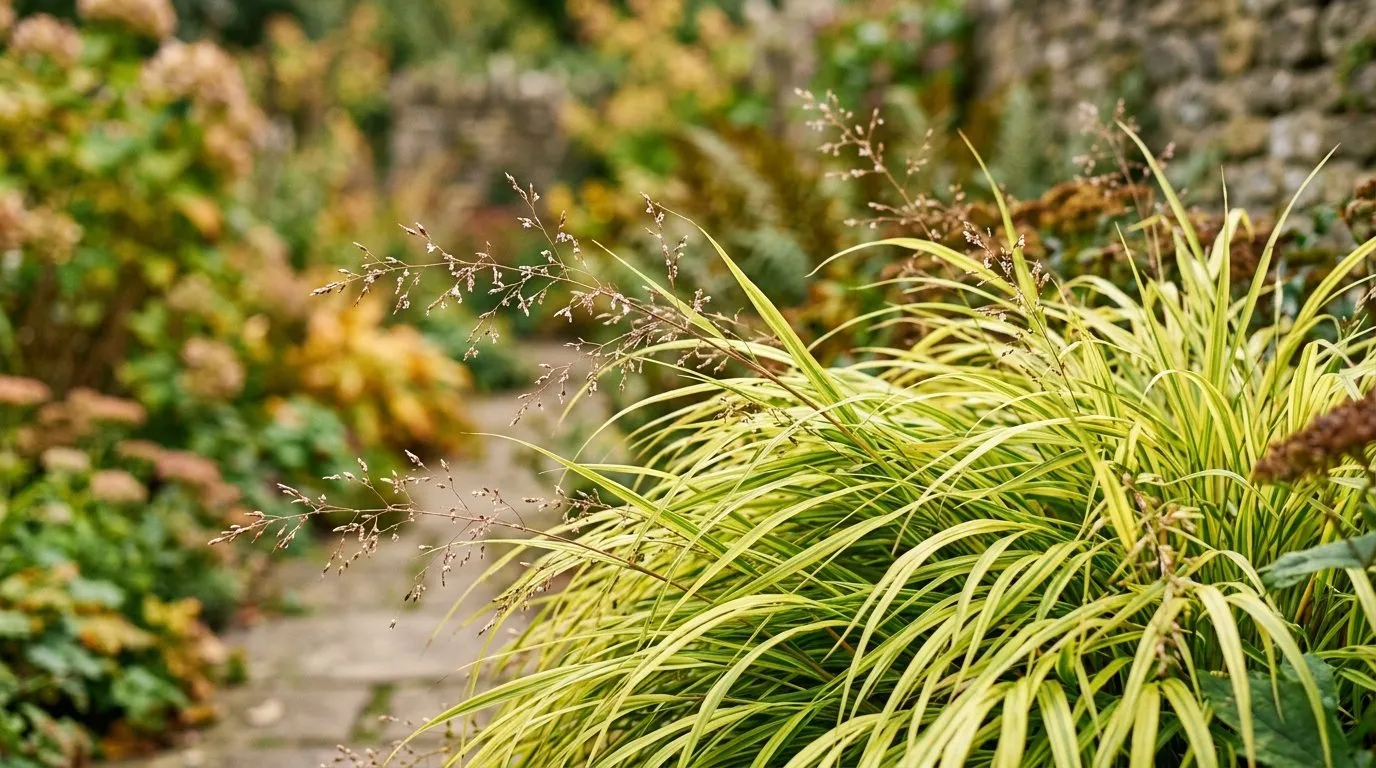
Best hakonechloa varieties for UK gardens
Five forms of hakonechloa are widely available in UK nurseries, ranging from the plain green species to fully golden cultivars. Each has slightly different light requirements and vigour. Choosing the right cultivar for your conditions makes the difference between a plant that glows and one that merely survives.
| Cultivar | Height | Foliage colour | Light preference | Growth rate | Notes |
|---|---|---|---|---|---|
| Hakonechloa macra (species) | 40-45cm | Rich green | Full shade to partial | Moderate | Strongest grower, best for deep shade |
| ’Aureola’ | 30-40cm | Golden-yellow with green stripes | Dappled to partial shade | Slow | Most popular, RHS AGM, stunning autumn colour |
| ’All Gold’ | 25-35cm | Solid bright gold | Dappled to partial shade | Slow | Brightest colour but needs moisture |
| ’Naomi’ | 30-40cm | Green with red-purple streaks | Partial shade | Slow | Dramatic autumn colour, red tones develop from July |
| ’Nicolas’ | 20-25cm | Green flushed red in autumn | Partial shade to sun | Slow | Most compact form, suits containers and rockeries |
‘Aureola’ is the variety most gardeners should start with. The golden-yellow leaves striped with green are vivid from April to November. In autumn, the gold turns to warm apricot, then bronze, then deep red over several weeks. No other shade plant provides this length of colour display. A mature clump of ‘Aureola’ beneath a Japanese maple is one of the finest planting combinations possible.
‘All Gold’ is the most luminous but also the most demanding. Without consistent moisture, the solid gold leaves scorch at the tips. In a shaded border with humus-rich soil that stays damp through summer, it is electric. In a drier spot, stick with ‘Aureola’.
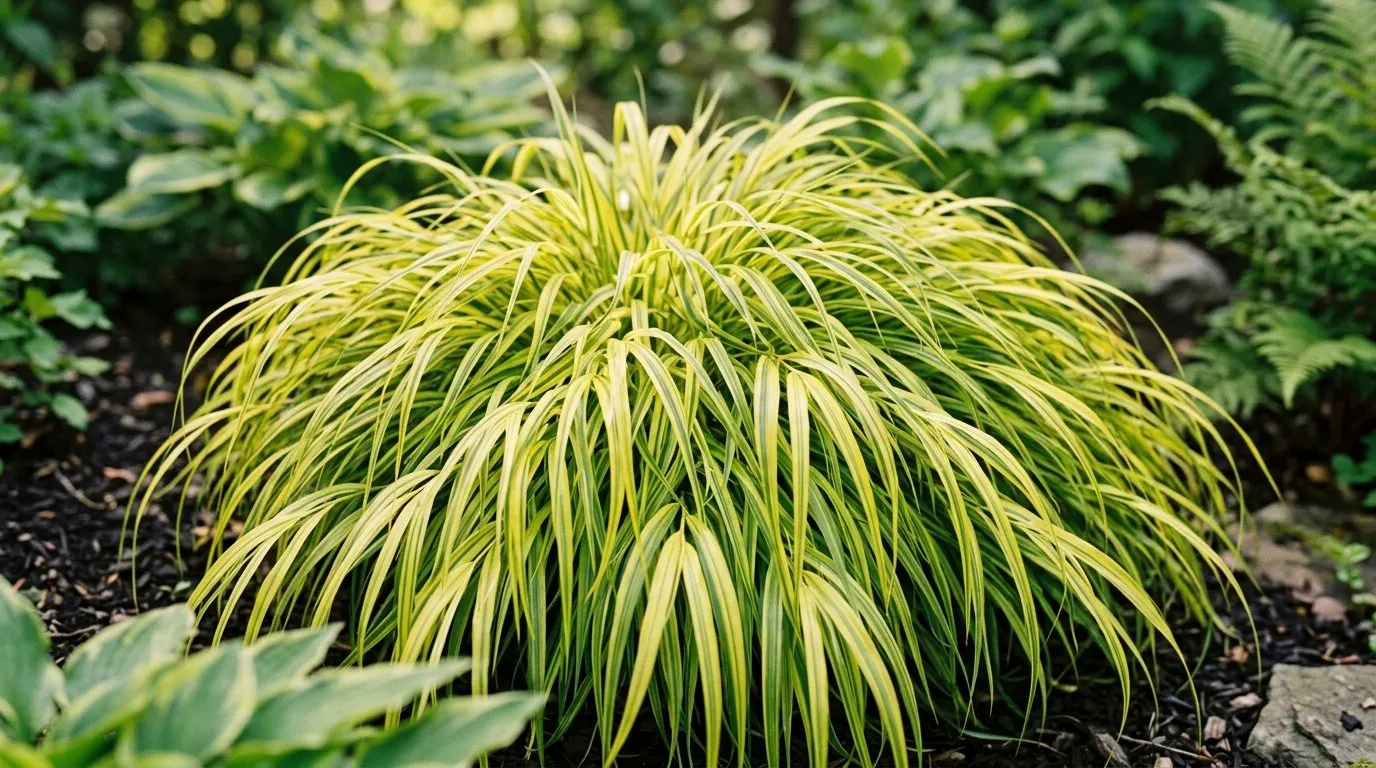
The plain green species is underrated. It grows faster than any golden form and tolerates deeper shade. Where ‘Aureola’ would sulk, the species produces a dense, lush mound of bright green leaves that arch gracefully and turn clear amber in autumn. At a third of the price of named cultivars, it is worth considering for larger plantings.
How to plant hakonechloa
Plant hakonechloa in April or May in humus-rich soil that holds moisture but is never waterlogged. Spring planting is essential. The slow root system needs a full growing season to anchor before the first winter. Autumn planting is possible but risky in colder regions.
Follow these steps:
- Dig a hole twice the width of the pot and the same depth
- Mix the excavated soil with equal parts leaf mould or compost
- Add a handful of horticultural grit on heavy clay
- Set the plant at exactly the same depth as it was in the pot
- Backfill, firm gently, and water thoroughly
- Mulch with a 5cm layer of leaf mould, keeping it clear of the crown
Spacing depends on the effect you want. For individual specimen plants in a border, space 40-50cm apart. For a continuous ground-cover carpet, plant at 30cm centres and allow 3 years to knit together. Three plants of ‘Aureola’ at 30cm spacing will cover a square metre within 4 years on good soil.
Water regularly through the first two summers. Hakonechloa is not drought-tolerant, especially during establishment. Once the root system has developed (after 2-3 years), it copes with short dry spells but always looks best with consistent moisture.
Does hakonechloa grow in full shade?
The green species grows reliably in full shade, including beneath mature trees where little else thrives. This is hakonechloa’s greatest strength. It joins a very short list of ornamental grasses that tolerate shade, alongside Deschampsia cespitosa and Luzula nivea. For more shade-tolerant plants, see our guide to the best shrubs for shade.
The golden cultivars behave differently in shade. ‘Aureola’ and ‘All Gold’ need some light to produce their best colour. In full shade they turn lime-green rather than gold. The plant remains healthy and attractive but the vivid golden colour that makes these cultivars so desirable is muted.
The ideal position for golden cultivars is dappled shade or a north-facing border that receives no direct midday sun. Morning sun for 2-3 hours followed by afternoon shade produces the richest gold without leaf scorch. Positions under high-canopy deciduous trees work perfectly because the trees let in winter and spring light when hakonechloa is pushing new growth.
Avoid two extremes. Full afternoon sun (especially south-facing) scorches golden cultivars and bleaches the foliage to a papery yellow-white. Dense dry shade under evergreen conifers is equally bad because the combination of low light and dry soil stunts even the green species.
How fast does hakonechloa spread?
Hakonechloa is one of the slowest ornamental grasses to establish. A 9cm pot planted in April will produce a small tuft of leaves by autumn. By the end of year two it doubles in size. By year three it reaches its full arching habit and starts to look like the plant you imagined when you bought it.
This slow pace frustrates gardeners used to fast-growing grasses like Stipa tenuissima or Miscanthus. The comparison is misleading. Hakonechloa grows from short rhizomes that creep outward at just 5-10cm per year. Stipa tenuissima self-seeds aggressively. Miscanthus produces a dense root mass that expands rapidly. Hakonechloa does neither. For a full comparison of ornamental grasses, see our dedicated guide.
The upside is that hakonechloa never becomes invasive. You will never need to dig it out or worry about it taking over a border. It stays exactly where you plant it and spreads gradually into a wider mound. After 6-8 years, a single plant fills an area roughly 50-60cm across. Compare that to a Japanese anemone, which colonises a square metre in two seasons.
To build ground cover faster, plant at 30cm centres and accept that the first 2-3 years will look sparse. Mulch between plants with leaf mould to suppress weeds while the hakonechloa fills in. Alternatively, buy larger plants in 2-litre or 3-litre pots. They cost more but give you a 2-year head start.
Divide established clumps after 5-6 years to create new plants. Lift the entire clump in April when shoots are 5-10cm tall. Tease apart into sections of 3-5 shoots with roots attached. Replant immediately and water well. Each division takes one full season to re-establish its arching habit.
Autumn colour and winter care
Hakonechloa delivers some of the finest autumn colour of any perennial. The transformation begins in September when the foliage shifts from summer gold or green to warm amber. Through October and November the colour deepens to rich bronze, copper, and finally deep red-purple. ‘Aureola’ and ‘Naomi’ produce the most dramatic autumn displays.
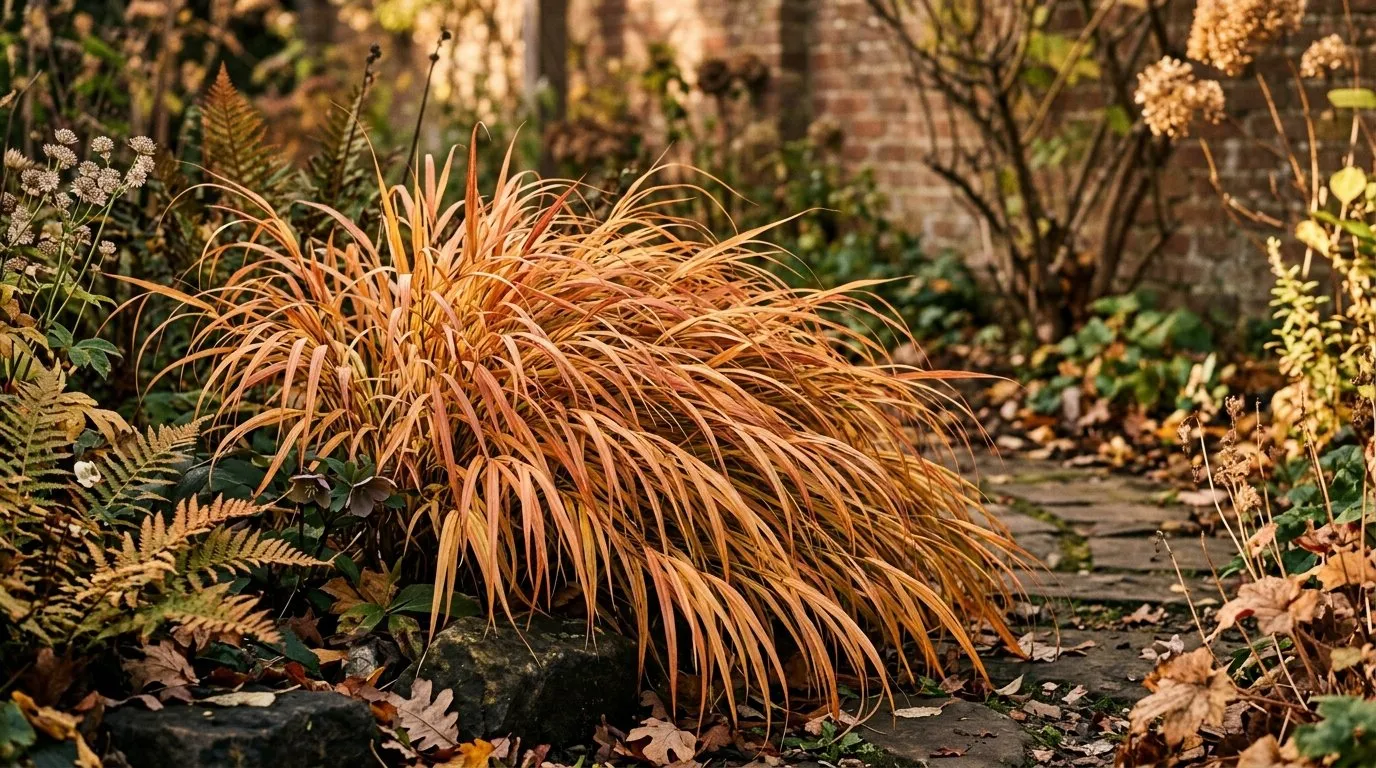
The autumn colour rivals that of Japanese maples and lasts for 6-8 weeks. Few perennials match this duration. The arching habit means the coloured foliage catches low autumn sunlight beautifully, especially in east or west-facing positions where the light hits the plant at an angle.
Winter care is straightforward. Hakonechloa is deciduous and the foliage dies back completely by late November. Leave the dead foliage in place through winter. It protects the crown from frost and adds structure to the winter garden, especially when rimmed with frost on cold mornings.
Cut back the dead foliage in late February or early March, before new growth appears. Cut to 5cm above ground level with sharp secateurs or shears. Remove the dead material and add it to the compost heap. New shoots emerge in April, unfurling the fresh foliage that starts the cycle again.
Feeding is minimal. A light application of fish, blood, and bone in April is enough. Avoid high-nitrogen fertilisers, which produce soft, floppy growth. In containers, feed fortnightly with liquid seaweed from April to August. In borders with annual leaf mould mulch, no additional feeding is necessary.
Hakonechloa suffers from almost no pests or diseases in the UK. Slugs occasionally nibble new spring shoots but rarely cause serious damage. The foliage is not a slug favourite compared to hostas. Vine weevil grubs can damage container-grown plants, so check the compost when repotting. The Royal Horticultural Society lists no significant pest or disease problems for this species.
Best companion plants for hakonechloa
Hakonechloa combines naturally with other shade-loving plants that share its need for moisture and humus-rich soil. The golden foliage contrasts beautifully with blue, purple, and deep green companions. The arching habit softens the edges of borders and paths.
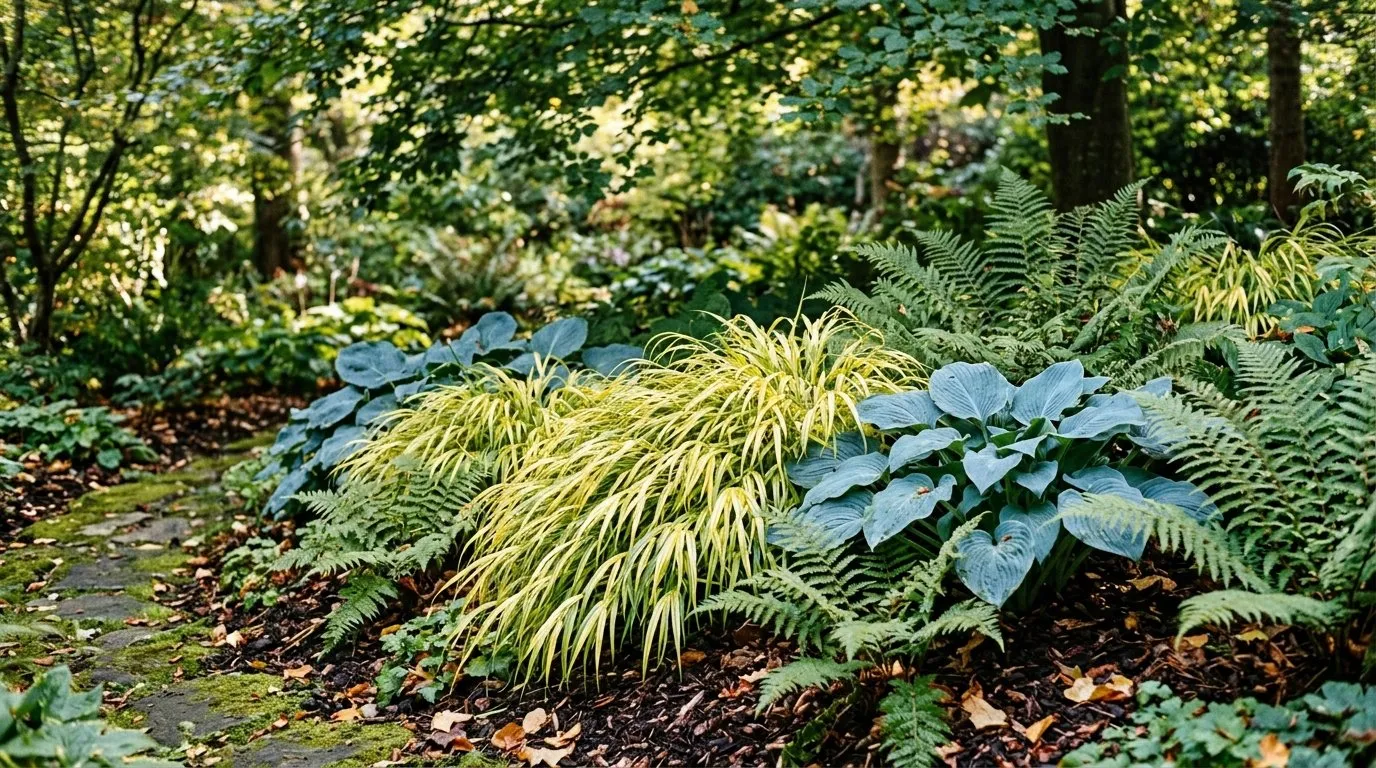
Hostas are the classic partner. Blue-leaved varieties like ‘Halcyon’ and ‘Blue Angel’ provide the perfect colour contrast to golden ‘Aureola’. The bold, rounded hosta leaves set off the fine-textured grass beautifully. Plant the hakonechloa in front of the hostas so it can cascade forward.
Ferns add a different texture again. The shuttlecock fern (Matteuccia struthiopteris) rises vertically while hakonechloa flows horizontally, creating a dynamic contrast. Polystichum setiferum (soft shield fern) works equally well and stays evergreen through winter when the hakonechloa is dormant. For more shade options, explore the best ground cover plants.
Heucheras offer year-round foliage in purple, silver, and amber tones. ‘Palace Purple’ and ‘Obsidian’ create a rich, dark backdrop that makes golden hakonechloa glow. Heucheras are semi-evergreen and fill the visual gap left when hakonechloa dies back in winter.
Other strong companions include:
- Brunnera macrophylla ‘Jack Frost’ — silver leaves, blue forget-me-not flowers in spring
- Epimedium grandiflorum — delicate spring flowers, wiry stems, tolerant of dry shade
- Tiarella cordifolia — foam flower, white spikes in spring, excellent ground cover
- Astilbe — feathery plumes in pink, red, and white, same moisture requirements
- Liriope muscari — evergreen, purple flower spikes in autumn, tidy edging plant
For a Japanese garden style, combine hakonechloa with acers, moss, and stepping stones. The grass softens hard landscaping and provides the sense of movement that characterises the best Japanese-influenced designs.
Growing hakonechloa in containers
Hakonechloa is one of the finest ornamental grasses for containers. The arching habit cascades over pot edges and the slow growth rate means it does not outgrow a container quickly. A single ‘Aureola’ in a dark-glazed pot makes a striking focal point on a shaded patio or beside a doorway.
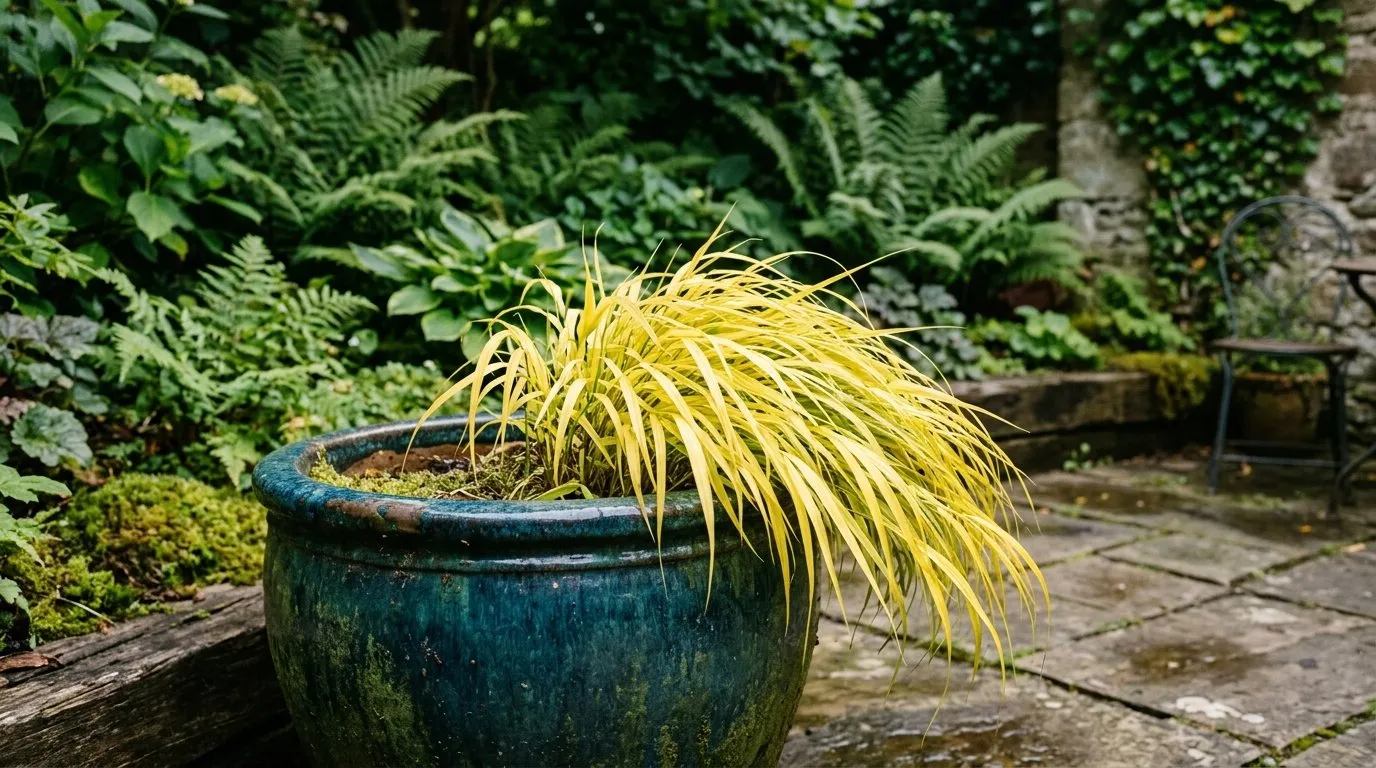
Choose a pot at least 30cm wide and 25cm deep with drainage holes. Terracotta, glazed ceramic, and stone all work well. Dark colours — charcoal, midnight blue, bronze — show off the golden foliage best. Avoid black plastic pots in sun, which overheat the roots.
Use peat-free multipurpose compost mixed with 20% perlite. The perlite ensures drainage while the compost retains moisture. Add a thin layer of crocks or gravel over the drainage holes to prevent waterlogging. Set the plant at the same depth as it was in the nursery pot.
Watering is the critical difference between containers and borders. Pots dry out faster than open ground, and hakonechloa will not tolerate drought. Water when the top 2cm of compost feels dry. In summer this means every 2-3 days. In a shaded position, every 4-5 days is usually enough. Reduce watering in winter but never let the compost go bone dry.
Feed fortnightly from April to August with dilute liquid seaweed fertiliser. Stop feeding in September to allow the plant to harden off before winter. Container-grown hakonechloa is slightly less winter-hardy than plants in the ground because pot compost freezes more readily than soil. In severe winters (below -10C), wrap the pot in bubble wrap or move it against a house wall.
Hakonechloa also works beautifully in troughs, window boxes, and raised beds where the cascading foliage can spill over edges. Combine with trailing ivy, small ferns, and miniature hostas for a shade-loving container display.
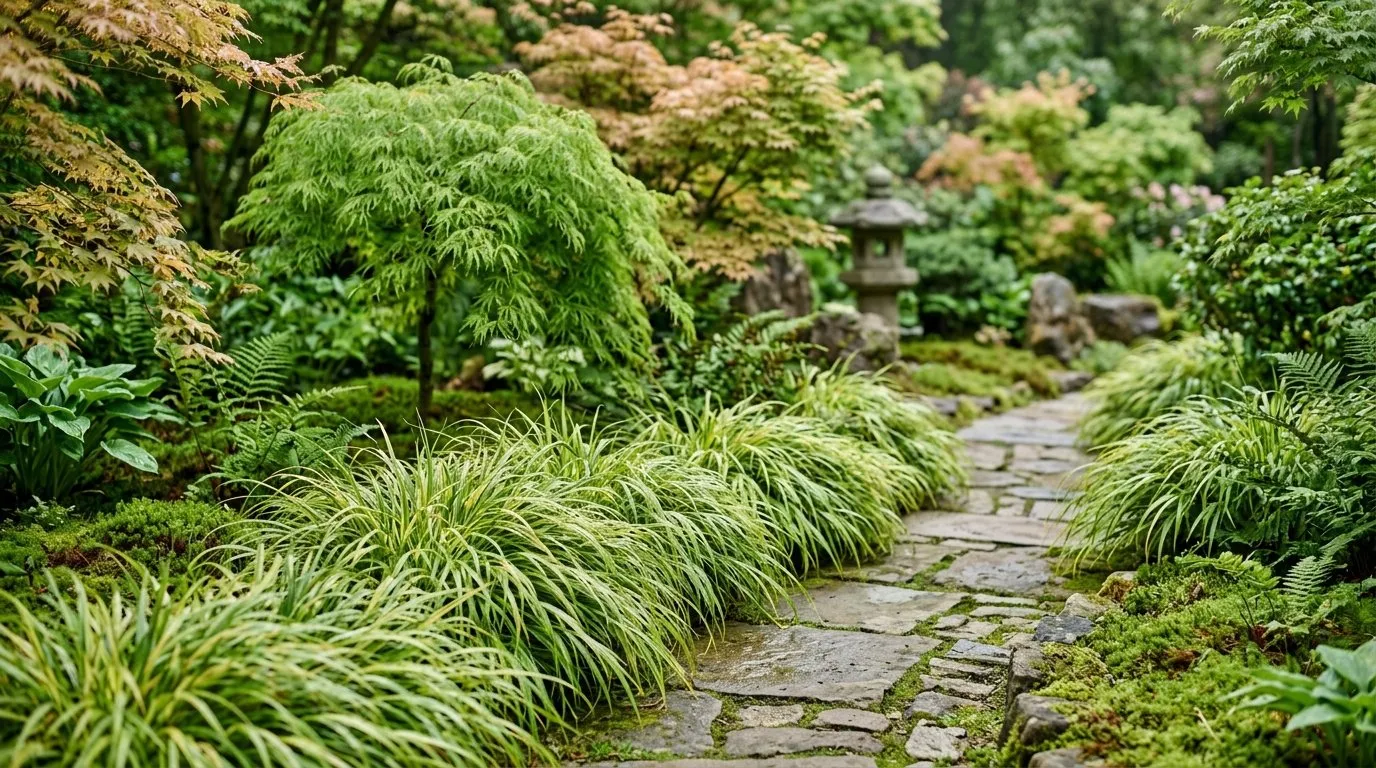 Hakonechloa lining a path in a Japanese-inspired UK garden. The arching leaves soften hard edges and pair naturally with stones, moss, and acers.
Frequently asked questions
Does hakonechloa grow in full shade?
Hakonechloa macra (the green species) grows well in full shade. Golden cultivars like ‘Aureola’ and ‘All Gold’ prefer dappled or partial shade. In deep shade they turn lime-green rather than gold, which is still attractive but less vibrant. Avoid dense dry shade directly under conifers, where even hakonechloa struggles. Under deciduous trees and on north-facing borders, it performs reliably.
How fast does hakonechloa spread?
Hakonechloa spreads very slowly by short rhizomes. A single plant takes 3-4 years to fill a 50cm area. It is never invasive and will not take over a border. The slow spread makes it expensive to buy as large plants but means it stays exactly where you put it. Divide established clumps after 5-6 years to create new plants.
Is hakonechloa hardy in the UK?
Yes, hakonechloa is fully hardy across all UK regions. It tolerates temperatures down to -20C, which is well below the coldest UK winters on record. No winter protection is needed. The foliage dies back naturally in November and fresh growth appears in April. In exposed sites, a light mulch of leaf mould over the crown adds extra insulation.
When should I plant hakonechloa?
Plant hakonechloa in April or May when the soil has warmed above 10C. Spring planting gives roots a full growing season to establish before winter. Autumn planting works but growth will be slower the following spring. Avoid planting in summer heat above 25C or in frozen winter ground. Water regularly through the first summer regardless of planting time.
Why is my hakonechloa not growing?
Slow growth in the first year is normal for hakonechloa. The plant puts energy into root development before producing visible top growth. Other common causes are too much direct sun (causes leaf scorch and stress), dry soil (hakonechloa needs consistent moisture), or heavy compacted soil without organic matter. Mulch with leaf mould and keep watered through summer.
Can I grow hakonechloa in a pot?
Hakonechloa is an excellent container plant. Use a pot at least 30cm wide with drainage holes. Fill with peat-free multipurpose compost mixed with 20% perlite for drainage. Water when the top 2cm of compost feels dry and feed fortnightly from April to August with liquid seaweed. Repot every 2-3 years in spring. Containers in full shade need less watering than those in partial sun.
How do I divide hakonechloa?
Divide hakonechloa in April when new growth is 5-10cm tall. Lift the entire clump carefully with a fork. Tease apart into sections of 3-5 shoots, each with a healthy root mass. Replant immediately at the same depth in soil enriched with compost and leaf mould. Water daily for the first two weeks. Divisions take one full season to re-establish their arching habit.
Our team produces practical UK gardening guidance from source research, contributor records and established horticultural practice. Editorial standards are overseen by Matt W.