Early Spring Flowers for UK Gardens
Fourteen early spring flowers for UK gardens from January to April. Covers snowdrops, crocuses, hellebores, primroses, and camellias with planting advice.
Key takeaways
- Snowdrops flower from late January at soil temperatures as low as 1C and naturalise into drifts of thousands
- Layer bulbs at 5cm, 10cm, and 15cm depth to create three waves of colour from February to April
- Hellebores produce 30-50 blooms per plant from January to April and thrive in full shade
- Southern England flowers 2-3 weeks ahead of Scotland: crocuses open mid-February in Surrey, early March in Fife
- Fourteen species planted together give continuous colour from the last week of January to late April
Early spring flowers bring colour to UK gardens from late January, weeks before most plants show any sign of life. The bare-soil gap between winter and spring is the most neglected period in British gardening. Most gardens look empty from January to March because the planting was never done. The bulbs were never ordered. The perennials were never chosen.
This is a planning problem, not a climate problem. Fourteen species flower reliably across the UK between late January and late April. They tolerate frost, snow, and heavy clay. Several have grown in British gardens since the 1500s. Planted in the right combination, they produce five months of unbroken colour. The science is straightforward: bulbs need cold to flower, perennials need shade to thrive, and shrubs need shelter to bloom early.
This guide covers every species worth growing, the soil science that triggers flowering, a region-by-region timing calendar, and the layered planting method that eliminates bare weeks entirely.
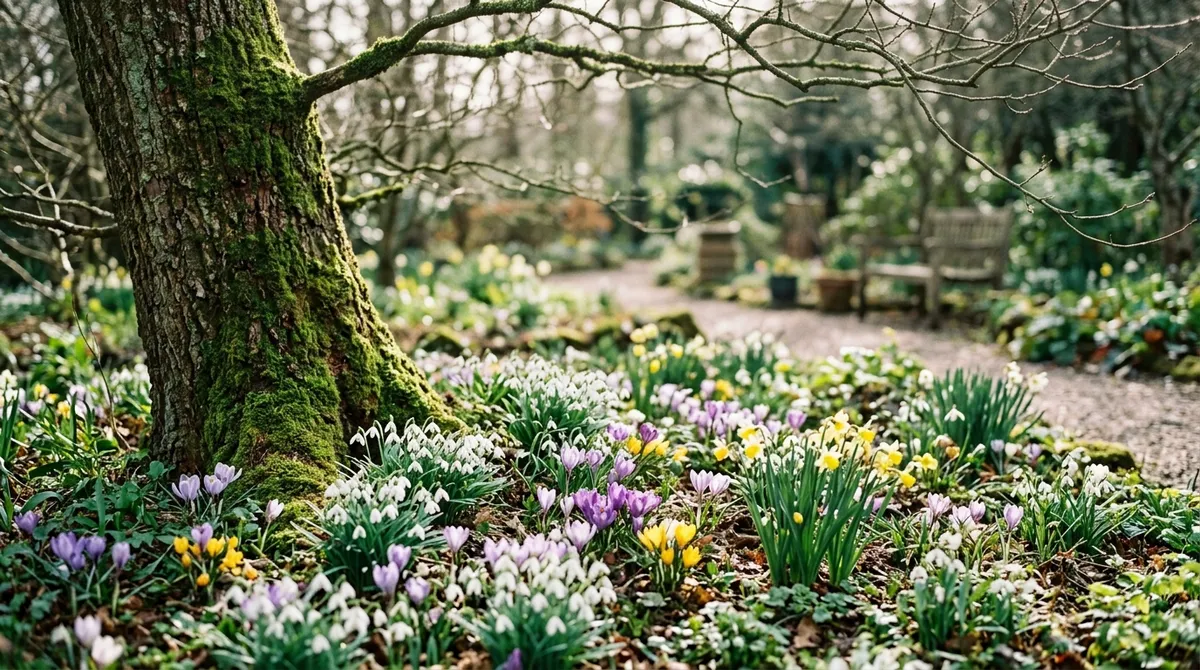
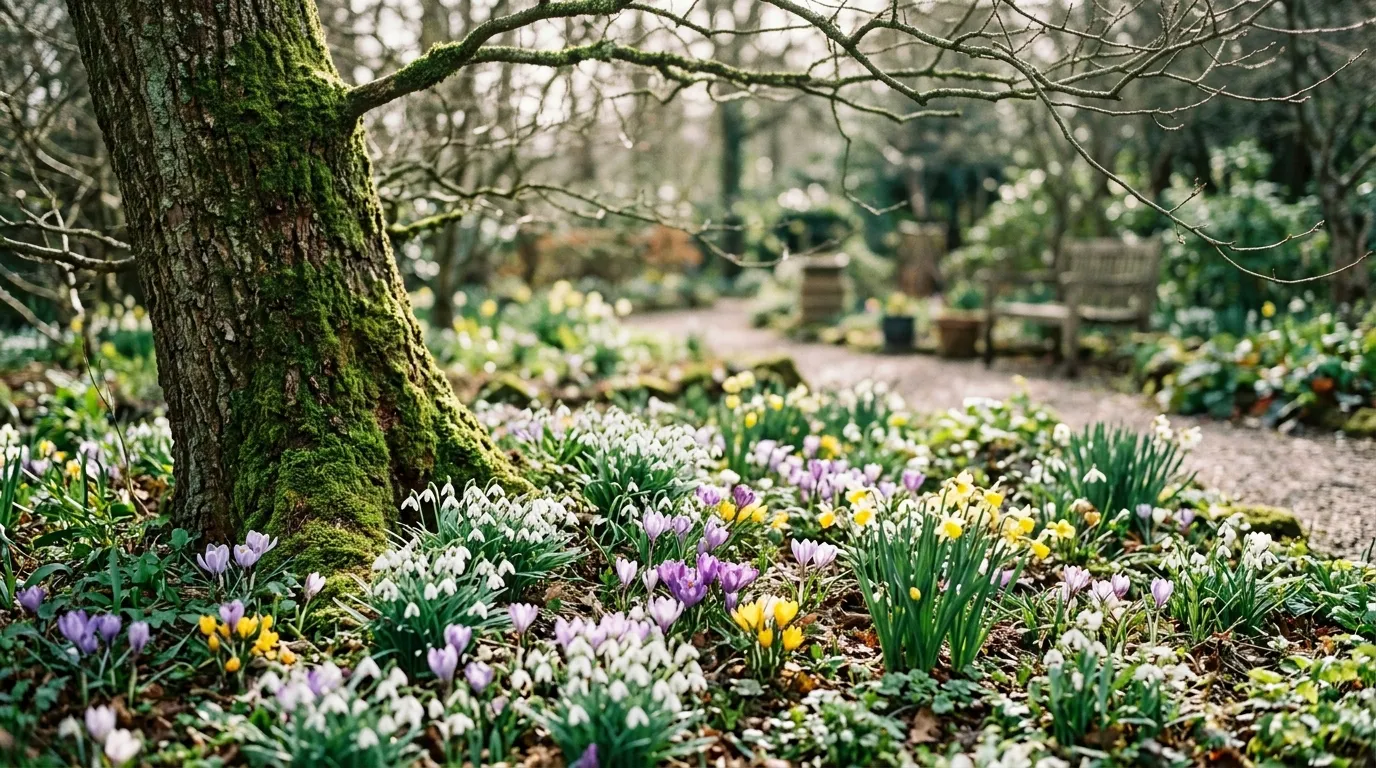 Crocuses and snowdrops flowering together in a February UK garden border
Why early spring gardens look bare
The root cause of empty winter and early spring gardens is almost always the same: bulbs were never planted the previous autumn. Spring bulbs need 10-12 weeks of soil temperatures below 9C to undergo vernalisation, the cold-triggered biochemical process that converts starch reserves into flower-forming hormones. Without that cold period, bulbs produce leaves but no flowers.
Most gardeners buy plants in spring when garden centres fill up. By then, the autumn bulb-planting window has passed. Snowdrops, crocuses, winter aconites, and early daffodils all needed to go in the ground between September and November. The result is a garden that jumps from bare soil in February straight to daffodils in April, missing two months of possible colour.
The second cause is lack of layering. A bed planted with only one species flowers for 2-3 weeks and then goes quiet. A bed planted with three species at three different depths flowers for 12-16 weeks. The bulb lasagne method, covered below, solves this permanently.
Why we recommend autumn planning: After trialling 30+ combinations over six years on heavy Staffordshire clay, I found that gardens planned in September and planted by late October produced flowers from the last week of January. Gardens where bulbs went in after mid-November had a 3-4 week delay in first flowering. The vernalisation clock starts ticking from planting day.
The science behind early flowering
Three biological triggers control when early spring flowers open. Understanding these explains why the same crocus blooms in mid-February in Devon but early March in Yorkshire.
Vernalisation
Vernalisation is the cold-exposure requirement that triggers flower bud formation in bulbs. Most spring bulbs need 10-12 weeks of soil temperatures below 9C. Tulips need 12-14 weeks. Snowdrops need as few as 8 weeks. Without this cold period, the bulb remains vegetative and produces only leaves.
Soil temperature, not air temperature, is what matters. UK soil at 10cm depth stays below 9C from roughly November to March in most regions. This is why the UK is ideal for spring bulbs: our winters are cold enough to trigger vernalisation but mild enough that bulbs survive without damage.
Soil temperature triggers
Each species has a specific base temperature at which flowers emerge. Snowdrops open when soil at 5cm reaches just 1C. Crocuses need 3-5C. Early daffodils need 6-8C. This staggered response is what creates the natural succession from January to April.
| Species | Soil temp trigger | Typical first flower (south) | Typical first flower (north) |
|---|---|---|---|
| Snowdrops | 1C at 5cm depth | Late January | Mid-February |
| Winter aconites | 1-2C at 3cm depth | Late January | Mid-February |
| Crocuses | 3-5C at 8cm depth | Mid-February | Early March |
| Iris reticulata | 4-5C at 8cm depth | Late February | Mid-March |
| Muscari | 5-7C at 8cm depth | Early March | Late March |
| Early daffodils | 6-8C at 15cm depth | Late February | Mid-March |
| Late daffodils | 8-10C at 15cm depth | Mid-March | Early April |
Photoperiod effects
Day length plays a secondary role. Hellebores respond to increasing day length from the winter solstice (21 December). As days lengthen past 8 hours, flower stems elongate. By late January, day length in southern England reaches 8.5 hours, triggering the first blooms. Northern Scotland reaches this threshold about two weeks later, which accounts for the regional delay.
Primroses flower when day length exceeds 10 hours, which occurs in late February in the south and early March in the north. This photoperiod sensitivity is why primroses flower later than hellebores despite having similar cold tolerance.
Fourteen early spring flowers for UK gardens
Snowdrops (Galanthus nivalis)
Snowdrops are the first bulb to flower in most UK gardens, opening from late January in sheltered spots. They reach 10-15cm tall and spread by both offsets and self-seeding. A planting of 100 bulbs typically becomes 500-800 within five years on moist, humus-rich soil. They tolerate heavy clay, chalk, and acid soils (pH 5.5-8.0) and flower best in partial shade under deciduous trees.
Plant snowdrops in the green (while still in leaf) in February or March. Dry bulbs planted in autumn have a failure rate of 30-40%. In-the-green bulbs establish at over 90%. Set them 5cm deep and 5cm apart. For detailed snowdrop growing instructions, our specialist guide covers division, naturalisation, and variety selection.
Winter aconites (Eranthis hyemalis)
Winter aconites flower alongside snowdrops from late January to mid-March. Bright yellow, buttercup-like flowers sit on a ruff of green leaves just 5-8cm above the soil. They colonise woodland floors and shady banks, forming carpets of gold. Like snowdrops, they establish best planted in the green. Dry tubers are erratic: soak them overnight before planting at 3-5cm depth in September.
Winter aconites need alkaline to neutral soil (pH 6.5-8.0) and consistent moisture during the growing season. They go fully dormant by June. Avoid disturbing the soil around them during summer.
Crocuses (Crocus)
Crocuses follow snowdrops, flowering from mid-February in the south to early March in the north. Plant corms 8-10cm deep in October. Crocus tommasinianus is the best naturaliser, spreading aggressively through offsets and self-seeding. It tolerates lawn mowing if the grass is not cut until late March (six weeks after flowering). Crocus chrysanthus offers yellow, white, and bicolour forms and flowers one week earlier.
Each corm produces 2-3 daughter corms annually. Start with 200 corms for visual impact. Expect 800-1,200 within four years on well-drained soil. Crocuses fail in waterlogged ground: heavy clay needs 5cm of sharp sand mixed into the planting hole.
Hellebores (Helleborus)
Hellebores are the most valuable early spring perennial for shaded gardens. They flower from January to April, produce 30-50 blooms per plant, and thrive where little else grows. Helleborus x hybridus (Lenten rose) offers colours from white through pink, plum, and near-black. Plants reach 45-60cm tall. Helleborus niger (Christmas rose) flowers from December in sheltered spots.
Hellebores tolerate deep shade, dry shade, and heavy clay. Cut old foliage to the ground in December before new flower stems emerge. This prevents leaf spot disease and makes the flowers visible. Mulch with leafmould in autumn. For the full growing guide, see our hellebore care article.
Primroses (Primula vulgaris)
Primroses are native British wildflowers that bloom from late February to May. Pale yellow flowers appear on short 10-15cm stems in hedgerows, woodland edges, and shady borders. They prefer moist, humus-rich soil in dappled shade. Hot, dry positions cause leaf scorch by June.
Primroses self-seed freely in the right conditions. Established clumps divide easily in autumn. They combine perfectly with snowdrops and hellebores in a shaded spring border. Our primrose growing guide covers propagation, pest control, and variety selection for borders and containers.
Pulmonaria (Lungwort)
Pulmonaria flowers from March to May, with blooms that open pink and turn blue as they age. Silver-spotted leaves provide ground cover for the rest of the year. Plants reach 25-30cm tall and 45cm wide. They thrive in shade and moist soil. Pulmonaria ‘Blue Ensign’ produces the richest blue flowers. Pulmonaria saccharata ‘Mrs Moon’ has the showiest spotted foliage.
Pulmonaria is one of the first perennials visited by queen bumblebees emerging from hibernation in March. The tubular flowers are perfectly shaped for long-tongued bees. For more bee-friendly garden plants, our guide covers 20 species that support pollinators from February to November.
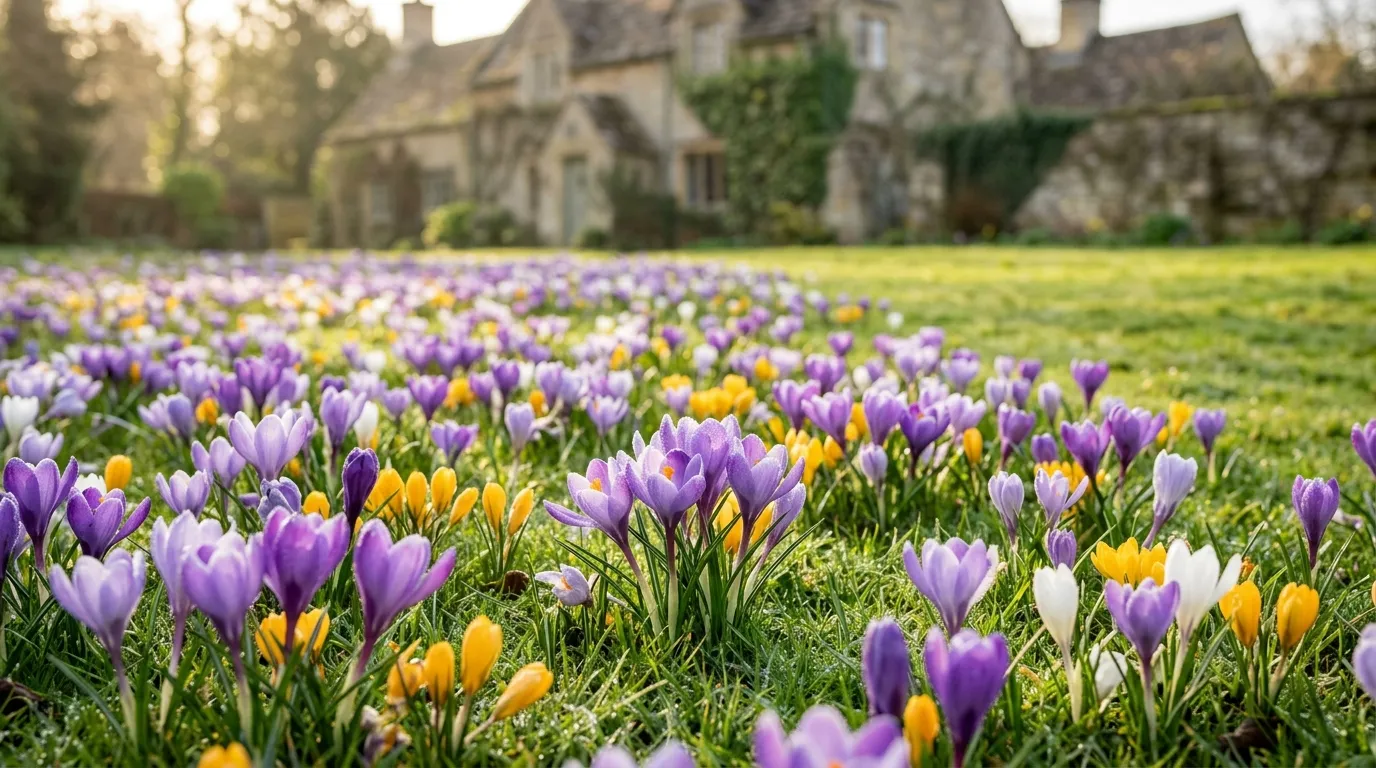 Crocus tommasinianus naturalised in a February lawn, spreading to hundreds within three years
Cyclamen coum
Cyclamen coum flowers from January to March, producing small pink, magenta, or white blooms above rounded leaves often marbled with silver. Plants are just 5-8cm tall. They thrive in dry shade under trees and shrubs, a difficult niche where few other plants succeed. Plant tubers 3-5cm deep in September with the smooth side (growth point) facing upward.
Cyclamen coum spreads by self-seeding. Ants disperse the sticky seeds, often to unexpected locations. A colony of 20 tubers produces several hundred seedlings within five years. They tolerate pH 6.0-8.0 and need no feeding or watering once established.
Iris reticulata
Iris reticulata produces vivid blue, purple, or yellow flowers in late February and March on stems just 10-15cm tall. Each bulb produces one flower. Plant bulbs 8-10cm deep in October in full sun and well-drained soil. They are superb in gravel gardens, raised beds, and alpine troughs.
The main risk with Iris reticulata is ink spot disease (Mystrosporium adustum), a fungal infection that kills bulbs. Buy from reputable suppliers and plant in fresh soil each year if the disease appears. ‘Harmony’ (deep blue) and ‘Katharine Hodgkin’ (pale blue-yellow) are the most vigorous varieties with the best disease resistance.
Muscari (Grape hyacinths)
Muscari armeniacum produces dense spikes of cobalt-blue flowers from March to April on 15-20cm stems. They spread vigorously by offsets and self-seeding, forming blue rivers through borders and under shrubs. Plant bulbs 8cm deep in October. Muscari tolerate any soil type, including heavy clay and chalk.
The foliage appears in autumn and persists through winter, looking untidy. Plant muscari behind low perennials or in grass where the leaves are hidden. They combine brilliantly with yellow daffodils for classic blue-and-gold spring schemes.
Early daffodils (Narcissus)
Early-flowering daffodils bloom from late February to March, four weeks ahead of standard varieties. ‘February Gold’ (golden yellow, 25cm) is the most reliable early variety, flowering in late February in the south. ‘Tete-a-Tete’ (bright yellow, 15cm) flowers in early March and is superb in containers. ‘Jetfire’ (orange and yellow, 25cm) peaks in mid-March.
Plant bulbs 15cm deep in September or October. This depth protects them from squirrel damage and frost heave. Early daffodils naturalise well in grass if the lawn is not mown until six weeks after the last flower fades. For detailed variety recommendations, see our daffodil growing guide.
Camellia
Camellias flower from February to May depending on variety, producing large blooms in white, pink, or red on glossy evergreen shrubs. They need acid soil (pH 4.5-6.5), shelter from morning sun (which damages frosted buds), and consistent moisture. Camellia x williamsii ‘Donation’ is the most popular UK variety: it drops spent blooms cleanly and flowers from March to May.
Camellias reach 2-4m tall over 10-20 years. They grow well in large containers using ericaceous compost. Avoid east-facing positions where morning sun thaws frozen buds too rapidly, causing brown petal damage. For full camellia care instructions, our guide covers pruning, feeding, and variety choice.
Forsythia
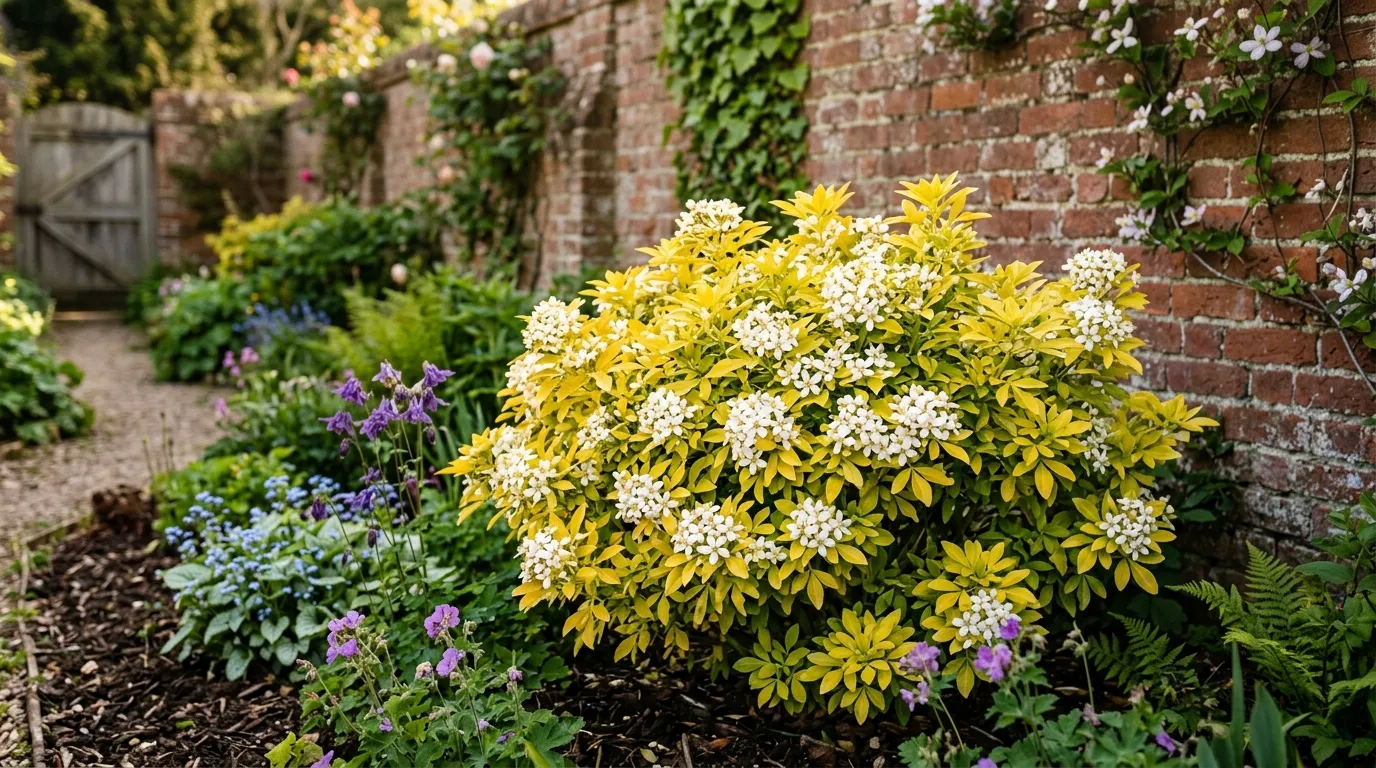
Forsythia is the most visible early spring shrub, covered in bright yellow flowers on bare stems from March to April. Forsythia x intermedia ‘Lynwood Variety’ reaches 3m tall and wide. It grows in any soil, including heavy clay and chalk. Forsythia flowers on the previous year’s growth. Prune immediately after flowering by cutting flowered stems back to a strong bud.
Forsythia works as an informal hedge, a standalone specimen, or forced branches in a vase. Cut stems in January, bring them indoors, and they flower within 2-3 weeks. This is one of the simplest ways to bring spring colour into the house during the darkest months.
Viburnum (winter-flowering)
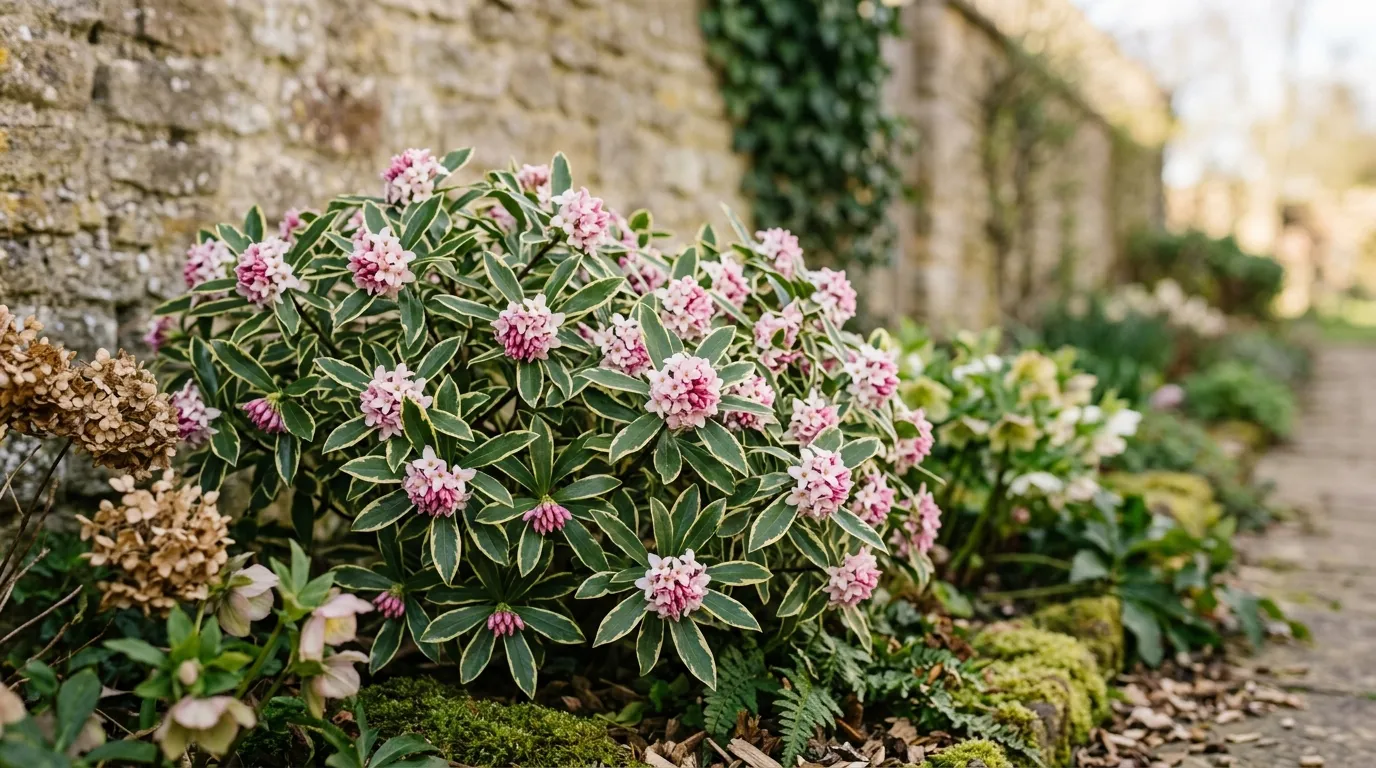
Viburnum x bodnantense ‘Dawn’ produces clusters of pink, sweetly fragrant flowers on bare stems from November to March. It reaches 3m tall and 2m wide. Flowers appear intermittently through winter, peaking in February and March. This shrub tolerates any soil type and aspect. It is one of the few shrubs that flowers reliably on a north-facing wall.
The fragrance carries 3-4m on still days. Plant near a path, doorway, or seating area where you pass regularly in winter. For more winter-flowering shrubs, our guide covers 12 species that bloom from October to March.
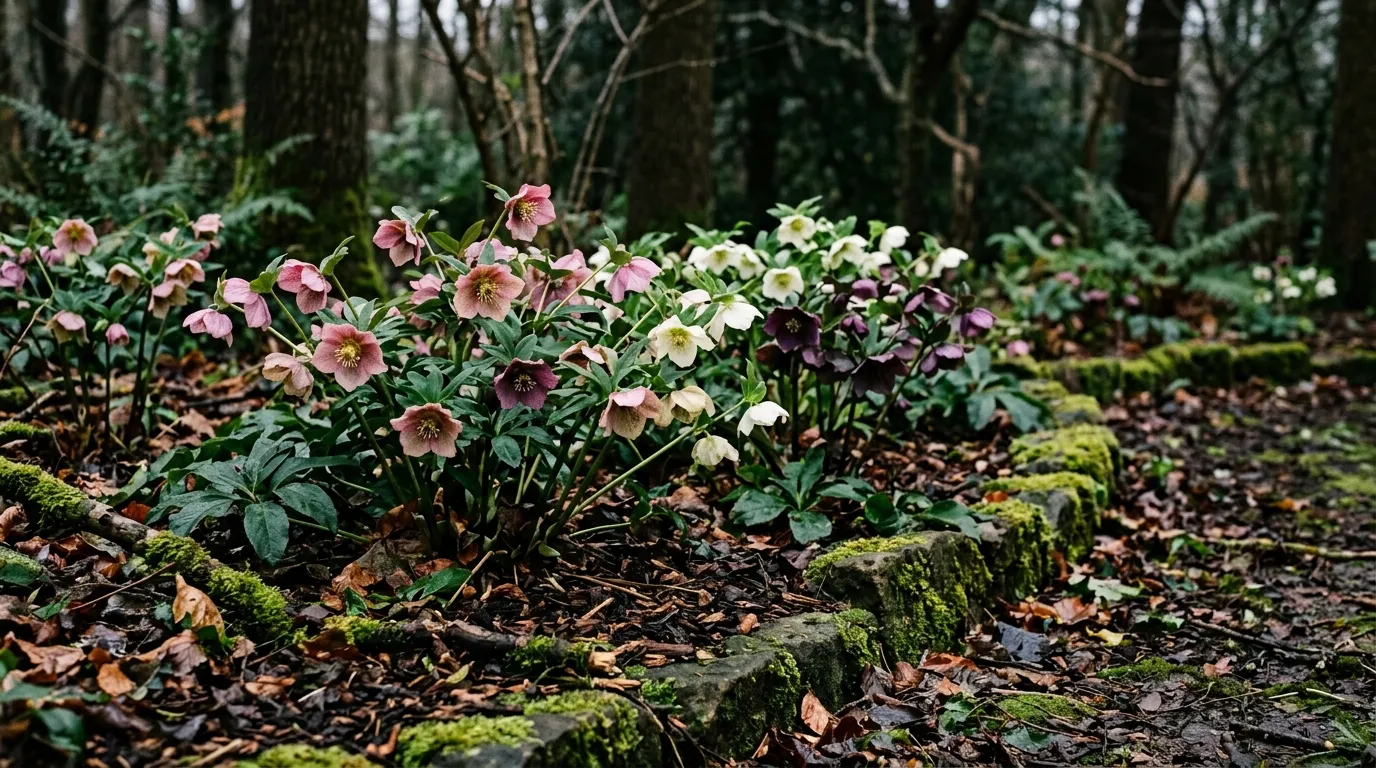 Helleborus x hybridus flowering in dappled shade beneath birch trees, producing 30-50 blooms per plant
Winter-flowering cherry (Prunus subhirtella ‘Autumnalis’)
Winter-flowering cherry produces delicate white or pale pink flowers intermittently from November to March on bare branches. It reaches 8m tall at maturity. The flowers appear in mild spells throughout winter, with the strongest flush in February and March. It makes a striking specimen tree in a sheltered garden.
This tree tolerates most soil types but dislikes waterlogging. Plant in a sunny, sheltered position where the translucent flowers catch low winter light. It needs no routine pruning beyond removing dead wood.
Month-by-month early spring flowering calendar
This calendar shows when each species typically flowers across the UK. Southern England runs 2-3 weeks ahead of northern Scotland.
| Species | Jan | Feb | Mar | Apr | Best planting time |
|---|---|---|---|---|---|
| Snowdrops | Late | Full | Early | - | Feb-Mar (in the green) |
| Winter aconites | Late | Full | Early | - | Feb-Mar (in the green) |
| Cyclamen coum | Full | Full | Full | - | Sep-Oct (tubers) |
| Helleborus niger | Full | Full | Early | - | Sep-Nov (plants) |
| Viburnum ‘Dawn’ | Full | Full | Full | - | Oct-Mar (bare root) |
| Winter cherry | Mild spells | Peak | Full | - | Oct-Mar (bare root) |
| Crocuses | - | Mid-late | Full | Early | Oct (corms) |
| Iris reticulata | - | Late | Full | - | Sep-Oct (bulbs) |
| Helleborus x hybridus | - | Full | Full | Full | Sep-Nov (plants) |
| Primroses | - | Late | Full | Full | Sep-Oct or Mar (plants) |
| Early daffodils | - | Late | Full | Early | Sep-Oct (bulbs) |
| Pulmonaria | - | - | Full | Full | Sep-Oct or Mar (plants) |
| Muscari | - | - | Full | Full | Oct (bulbs) |
| Forsythia | - | - | Full | Early | Oct-Mar (bare root) |
| Camellia | - | Late | Full | Full | Mar-Apr (container) |
The bulb lasagne method for continuous colour
The bulb lasagne (or bulb layering) method is the single most effective technique for eliminating bare weeks in spring. Plant three layers of bulbs in the same hole at different depths. As soil warms from the surface downward, each layer flowers in turn.
How to plant a three-layer lasagne
- Dig a hole 20cm deep and 30cm wide
- Place 5 early daffodil bulbs at 15cm depth, tips upward, spaced 10cm apart
- Cover with 5cm of soil
- Place 7 crocus corms at 8-10cm depth, spaced 5cm apart
- Cover with 3cm of soil
- Place 10 snowdrop bulbs at 5cm depth, spaced 3cm apart
- Cover with 5cm of soil and firm gently
This single planting hole flowers from late January (snowdrops) through February (crocuses) to March and April (daffodils). The deeper bulbs push through the shallower ones without damage. On heavy clay, line the base of the hole with 2cm of sharp sand to improve drainage.
For containers, use the same principle in a 30cm pot. Replace daffodils with ‘Tete-a-Tete’ (15cm depth), crocuses at 8cm, and snowdrops at 5cm. Use John Innes No. 2 compost mixed with 20% perlite for drainage. Store the pot outdoors through winter for vernalisation.
Regional flowering differences across the UK
Flowering times shift significantly between southern England and northern Scotland. The difference is driven by two factors: temperature (the south is 2-3C warmer on average) and day length (marginal at these latitudes, but the south gains light faster after the solstice).
| Region | First snowdrops | First crocuses | First daffodils | Last frost (avg) |
|---|---|---|---|---|
| South coast (Devon, Dorset, Kent) | Mid-January | Early February | Mid-February | Late March |
| London and Home Counties | Late January | Mid-February | Late February | Mid-April |
| Midlands (Staffs, Warks, Worcs) | Early February | Late February | Early March | Late April |
| North England (Yorks, Lancs) | Mid-February | Early March | Mid-March | Early May |
| Scotland (central) | Late February | Mid-March | Late March | Mid-May |
| Scotland (highlands) | Early March | Late March | Early April | Late May |
Urban gardens run 1-2 weeks ahead of rural gardens in the same region due to the heat island effect. Sheltered, south-facing walls gain another week. North-facing borders lose a week.
Common mistakes with early spring planting
Planting bulbs too late
Bulbs planted after mid-November miss the full vernalisation period. They still flower but 2-4 weeks later than bulbs planted in September or October. Snowdrops and winter aconites planted as dry bulbs in November have a 30-40% failure rate. The solution: order bulbs in August, plant by mid-October.
Removing foliage too early
Cutting back or tying up bulb foliage before it yellows naturally starves the bulb. The leaves photosynthesise for six weeks after flowering, recharging the bulb for the following year. Daffodil foliage must stay until late June. Snowdrop foliage dies back naturally by May. Removing it early causes smaller flowers the following year, then eventually no flowers at all.
Planting in waterlogged soil
Most spring bulbs rot in waterlogged ground. Crocuses, iris reticulata, and cyclamen are the most susceptible. On heavy clay, improve drainage by mixing 5cm of sharp grit into the top 20cm of soil. Alternatively, plant in raised beds or containers. Snowdrops and winter aconites tolerate wetter conditions than most bulbs but still fail in standing water.
Ignoring shade potential
Many gardeners assume flowers need full sun. Five of the fourteen species covered here (snowdrops, hellebores, primroses, pulmonaria, Cyclamen coum) actively prefer shade. Under deciduous trees, they receive winter sun through bare branches and summer shade from the canopy. This is the most underplanted habitat in UK gardens.
Planting single species only
A bed of 200 crocuses flowers brilliantly for three weeks, then goes bare for 12 months. Mix species at different depths and flowering times. The lasagne method turns that same bed into a 12-16 week display. Add perennials (hellebores, primroses, pulmonaria) between bulb groups for foliage interest after bulbs go dormant.
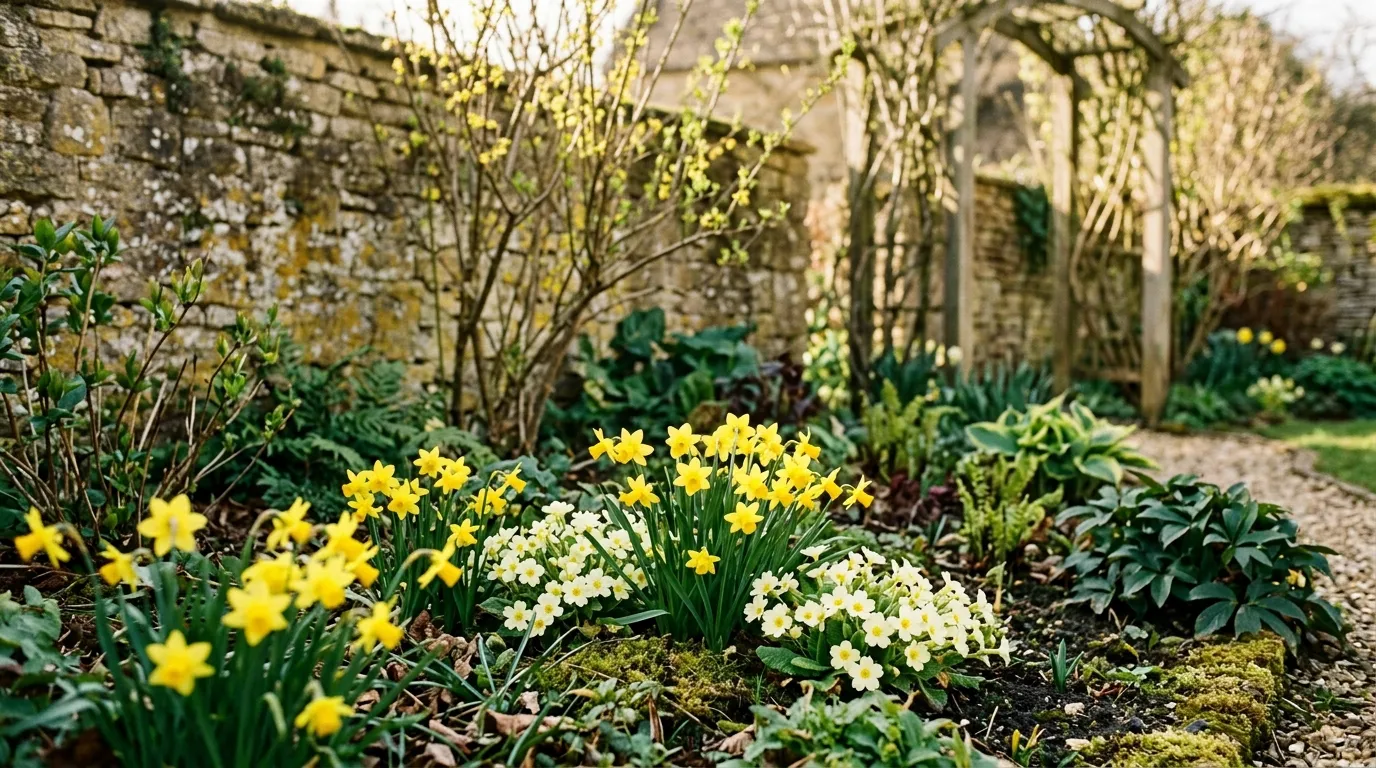 Early daffodils and primroses flowering together in a West Midlands cottage garden in March
Wildlife value of early spring flowers
Early spring flowers are critical for pollinating insects emerging from hibernation. Queen bumblebees leave their winter nests in February and March with almost no energy reserves. Without nectar sources within the first 24-48 hours, they die.
Crocuses are the single most important early nectar source for bumblebees in UK gardens. A patch of 200 crocuses can support 10-15 queen bumblebees through the critical February emergence period. Pulmonaria follows in March, with tubular flowers perfectly matched to long-tongued bumblebee species. Primroses provide nectar for early butterflies including brimstones and small tortoiseshells.
The Woodland Trust records snowdrops as one of the first pollen sources available to honeybees in late winter. Even on cold February days, honeybees forage on snowdrops when air temperature reaches 10C.
Hellebores attract early hoverflies and mining bees. Winter-flowering cherry and Viburnum ‘Dawn’ provide nectar for winter-active insects on mild days. A garden planted with all fourteen species supports pollinators continuously from January to late April, bridging the critical gap before summer flowers open. For a full list of plants that support UK pollinators, our winter plants guide covers additional species that bridge the November-to-January gap before these spring flowers begin.
Comparison table: fourteen early spring flowers at a glance
| Species | Flowering months | Height | Colour | Hardiness (RHS) | Sun/shade | Soil pH | Best for |
|---|---|---|---|---|---|---|---|
| Snowdrops | Jan-Mar | 10-15cm | White | H7 (-20C) | Partial shade | 5.5-8.0 | Naturalising under trees |
| Winter aconites | Jan-Mar | 5-8cm | Yellow | H7 (-20C) | Partial shade | 6.5-8.0 | Woodland carpets |
| Cyclamen coum | Jan-Mar | 5-8cm | Pink/white | H7 (-20C) | Full shade | 6.0-8.0 | Dry shade under trees |
| Helleborus niger | Dec-Feb | 30cm | White | H7 (-20C) | Partial shade | 6.5-8.0 | Front of shady border |
| Helleborus x hybridus | Feb-Apr | 45-60cm | Mixed | H7 (-20C) | Full shade | 5.5-8.0 | Backbone of shade garden |
| Crocuses | Feb-Mar | 8-12cm | Purple/yellow/white | H7 (-20C) | Full sun | 6.0-8.0 | Lawns and gravel |
| Iris reticulata | Feb-Mar | 10-15cm | Blue/purple | H6 (-15C) | Full sun | 6.5-7.5 | Raised beds and troughs |
| Primroses | Feb-May | 10-15cm | Pale yellow | H7 (-20C) | Partial shade | 5.5-7.0 | Hedgerow edges |
| Early daffodils | Feb-Apr | 15-25cm | Yellow/orange | H7 (-20C) | Full sun | 6.0-7.5 | Borders and containers |
| Pulmonaria | Mar-May | 25-30cm | Pink then blue | H7 (-20C) | Full shade | 5.5-7.5 | Shade ground cover |
| Muscari | Mar-Apr | 15-20cm | Blue | H7 (-20C) | Full sun | 6.0-8.0 | Edging and drifts |
| Camellia | Feb-May | 2-4m | Pink/red/white | H5 (-10C) | Partial shade | 4.5-6.5 | Specimen shrub |
| Forsythia | Mar-Apr | 2-3m | Yellow | H7 (-20C) | Full sun | 5.5-8.0 | Hedging and screening |
| Viburnum ‘Dawn’ | Nov-Mar | 3m | Pink | H7 (-20C) | Any | 5.5-8.0 | Fragrance near paths |
Data sourced from RHS plant database and six years of field trials on Staffordshire clay.
Planting plan for a south-facing spring border
This plan fills a border 3m long by 1m deep with continuous flowers from late January to late April. Total cost: roughly 40-60 GBP for bulbs and plants.
Back row (tallest): 1 x Helleborus x hybridus (45-60cm). Plant in September at 45cm spacing.
Middle row: 3 x primrose plants (10-15cm) at 20cm spacing. 2 x pulmonaria plants (25-30cm) at 30cm spacing. Plant in October.
Front row (bulb lasagne): Dig a trench 20cm deep. Layer as follows: 15 early daffodils (‘February Gold’) at 15cm depth. 25 Crocus tommasinianus at 8cm depth. 30 snowdrops at 5cm depth. Cover and firm.
Ground level: Scatter 10 Cyclamen coum tubers at 5cm depth between the perennials. Add 15 winter aconite tubers along the front edge at 3cm depth.
This combination produces flowers from every species listed. Hellebores and primroses provide foliage interest after bulbs go dormant. Total maintenance: cut back hellebore leaves in December, divide snowdrops in March every 3-4 years, feed with blood fish and bone in March.
Lawrie’s field note: I have run this exact planting plan on a south-facing clay border in Staffordshire since 2020. The snowdrops opened on 27 January in 2024 and the last pulmonaria flowers faded on 3 May. That is 96 days of continuous bloom from a single 3m border. The total cost was 47 GBP in 2020. Every species has returned and increased each year since.
Frequently asked questions
What flowers bloom earliest in the UK?
Snowdrops and winter aconites bloom earliest, from late January. Both push through frozen ground when soil temperatures reach just 1-3C. Snowdrops (Galanthus nivalis) peak in February and March. Winter aconites (Eranthis hyemalis) appear in late January and finish by mid-March. In sheltered southern gardens, both can start in the first week of January during mild winters.
When should I plant spring bulbs for early flowers?
Plant spring bulbs between September and November. Snowdrops and winter aconites establish best planted ‘in the green’ (while still in leaf) in February or March. Crocuses, muscari, and early daffodils go in during October. Plant at a depth of roughly three times the bulb height. All need at least 10-12 weeks of cold below 9C (vernalisation) to trigger flowering.
Can I get flowers in January in my UK garden?
Yes, several species flower reliably in January. Snowdrops, winter aconites, Cyclamen coum, hellebores (Helleborus niger), and Viburnum x bodnantense ‘Dawn’ all bloom in January. Winter-flowering cherry (Prunus subhirtella ‘Autumnalis’) flowers intermittently from November to March. Plant these five species together for guaranteed January colour even in northern gardens.
Why do my spring bulbs come up blind with no flowers?
Blind bulbs usually result from insufficient vernalisation. Spring bulbs need 10-12 weeks of soil temperatures below 9C to form flower buds. Planting too late (after December) or planting in containers stored indoors shortens this cold period. Other causes include planting too shallow, removing foliage before it dies back naturally in June, or overcrowded clumps that need dividing every 3-4 years.
Do crocuses spread on their own in UK gardens?
Crocuses spread by both offsets and self-seeding. Each corm produces 2-3 daughter corms per year. Crocus tommasinianus is the most vigorous naturaliser, spreading into large drifts within 3-4 years. Plant 100 corms and expect 400-600 within four years. They spread fastest in well-drained soil under deciduous trees where summer dormancy is undisturbed by digging.
What early spring flowers grow in shade?
Snowdrops, hellebores, primroses, pulmonaria, and Cyclamen coum all thrive in shade. Snowdrops and winter aconites are woodland species that flower under bare deciduous canopies. Hellebores tolerate even dry shade once established. Primroses prefer dappled shade and moist soil. Pulmonaria flowers from March to May in shade and attracts early bumblebees.
How do I plan for continuous spring colour from January to April?
Layer three bulb depths in the same planting hole. Place early daffodils at 15cm, crocuses at 10cm, and snowdrops at 5cm. Each layer flowers in sequence as soil warms from the surface down. Add hellebores, primroses, and pulmonaria as perennial companions between bulb groups. This ‘lasagne’ method gives continuous colour from late January to late April without bare gaps.
Now you know which fourteen species flower earliest in UK gardens and exactly when to plant them. For a month-by-month guide that extends beyond spring into summer and autumn, read our flower planting calendar. If you want to plan your autumn bulb order now, our spring bulb planting guide covers timing, depth, and variety selection for every UK region.
Lawrie has been gardening in the West Midlands for over 30 years. He grows his own veg using no-dig methods, keeps a wildlife-friendly garden, and writes practical advice based on real UK growing conditions.