Best Winter Flowering Shrubs for UK
Best winter flowering shrubs UK ranked by scent, hardiness, and flowering period. 12 species tested over 8 winters with month-by-month calendar.
Key takeaways
- 12 winter-flowering shrubs provide continuous colour from November to late March across all UK regions
- 7 of the 12 produce detectable scent at 2-5m, making winter gardens smell as good as they look
- Vernalisation (6-8 weeks below 5C) triggers flowering in Hamamelis, Chimonanthus, and Cornus mas
- Wrong pruning timing is the top cause of bare winter gardens: never prune summer-formed flower buds in autumn
- Sarcococca confusa is the gold standard for shaded winter scent, flowering December to February at just 1-1.5m tall
The best winter flowering shrubs for UK gardens improve the coldest months from a bare, dormant gap into a season of colour and scent. Most gardeners accept a grey November-to-March stretch as inevitable. It is not. The right shrubs flower reliably through frost, snow, and the shortest days of the year, often on bare wood, producing blooms that no summer plant can match for fragrance intensity.
This guide covers 12 winter-flowering shrubs tested over 8 winters in heavy Staffordshire clay. Every species here is hardy to at least -15C, available from UK nurseries, and performs without coddling. If your winter garden lacks flowers, the cause is almost certainly species selection and pruning timing, not climate.
Why most winter gardens look bare
The root cause of bare winter gardens is not the British climate. Two specific errors account for over 90% of flowerless winter borders, and both are easy to fix.
Wrong species selection
Most garden centres stock winter-flowering shrubs only from November to February, when gardeners are already thinking about next year’s display. The rest of the year, the shrub section features summer performers: buddleja, philadelphus, hydrangea. Gardeners buy what they see. The result is a garden packed with shrubs that flower from June to September and offer nothing from October to March.
The fix: Plant at least three winter-flowering shrubs for every 50 square metres of border. One early (November), one mid-season (December to January), and one late (February to March). This guarantees five months of continuous bloom. The comparison table below ranks 12 species by flowering period to help you plan succession.
Pruning at the wrong time
Autumn pruning is the single biggest destroyer of winter flowers. Viburnum x bodnantense, Mahonia, Chimonanthus, and Hamamelis all form flower buds on wood produced the previous summer. Those buds sit dormant through autumn, waiting for cold temperatures to trigger opening. Cut that wood off in September or October and you remove 80-90% of the winter display.
The correct timing is March or April, immediately after flowering ends. By then, the shrub has finished blooming and begins producing new growth that will carry next winter’s flower buds. This one change in pruning schedule has a greater impact on winter flower count than any other technique. See our full shrub pruning guide for timing by species.
How shrubs flower in winter: the science
Understanding vernalisation and photoperiod explains why certain shrubs bloom in the coldest months, and why mild winters sometimes produce disappointing displays.
Vernalisation: the cold trigger
Vernalisation is the biological process where a period of sustained cold temperatures triggers a plant to flower. Hamamelis, Chimonanthus praecox, and Cornus mas require 6-8 weeks of temperatures below 5C to break bud dormancy. The cold period activates genes that produce the hormone gibberellin, which signals flower buds to begin opening.
This is why winter-flowering shrubs from continental climates perform well in northern and upland UK gardens. A Staffordshire garden at 150m elevation reliably provides 10-12 weeks below 5C between November and February. Coastal gardens in Devon or Cornwall may only deliver 4-6 weeks, which can delay or reduce flowering in vernalisation-dependent species.
Photoperiod: short-day flowering
Some winter-flowering shrubs, including Viburnum tinus and Mahonia, respond to short day length rather than cold. As daylight drops below 10 hours (mid-November in the UK), biochemical pathways trigger flower opening. These species flower reliably regardless of temperature, making them the safer choice for milder southern gardens where vernalisation may be inconsistent.
Why mild winters reduce flowers
UK winter temperatures have risen by 1.2C on average since 1980 (Met Office data). In southern England, winters regularly include 2-3 week warm spells above 10C in December or January. For vernalisation-dependent species, these warm interruptions can partially reset the cold-accumulation clock, delaying flowering by 2-4 weeks or reducing bud count by 30-40%. Northern gardens above 100m elevation remain the most reliable zones for Hamamelis and Chimonanthus.
12 best winter flowering shrubs ranked
The table below ranks 12 winter-flowering shrubs by flowering period, scent intensity, hardiness, and ultimate height. All have been grown in heavy Staffordshire clay (pH 6.8) for at least 5 years. Flowering dates reflect real observations, not catalogue estimates.
| Shrub | Flowering months | Scent (1-5) | Hardiness (RHS) | Height | Soil | Role |
|---|---|---|---|---|---|---|
| Mahonia x media ‘Charity’ | Nov-Feb | 3 | H7 (-20C) | 3-4m | Any | Early backbone |
| Viburnum x bodnantense ‘Dawn’ | Nov-Mar | 4 | H7 (-20C) | 2.5-3m | Any | Early to late season |
| Hamamelis x intermedia ‘Pallida’ | Dec-Feb | 4 | H6 (-15C) | 3-4m | Acid-neutral | Midwinter centrepiece |
| Sarcococca confusa | Dec-Feb | 5 | H5 (-15C) | 1-1.5m | Any | Gold standard shade/scent |
| Chimonanthus praecox | Dec-Feb | 5 | H6 (-15C) | 2.5-4m | Well-drained | Midwinter fragrance |
| Viburnum tinus | Nov-Apr | 1 | H5 (-15C) | 2-3m | Any | Longest season |
| Daphne bholua ‘Jacqueline Postill’ | Jan-Mar | 5 | H4 (-10C) | 2-3m | Well-drained | Late-season fragrance |
| Lonicera x purpusii ‘Winter Beauty’ | Dec-Mar | 3 | H6 (-15C) | 2m | Any | Easy gap filler |
| Cornus mas | Feb-Mar | 1 | H7 (-20C) | 4-5m | Any | Late-season tree |
| Skimmia japonica ‘Rubella’ | Mar-Apr | 2 | H5 (-15C) | 1-1.5m | Acid-neutral | Spring bridge |
| Garrya elliptica ‘James Roof’ | Jan-Feb | 0 | H5 (-15C) | 3-4m | Any | Architectural catkins |
| Jasminum nudiflorum | Nov-Mar | 0 | H6 (-15C) | 3-4m | Any | Wall cover |
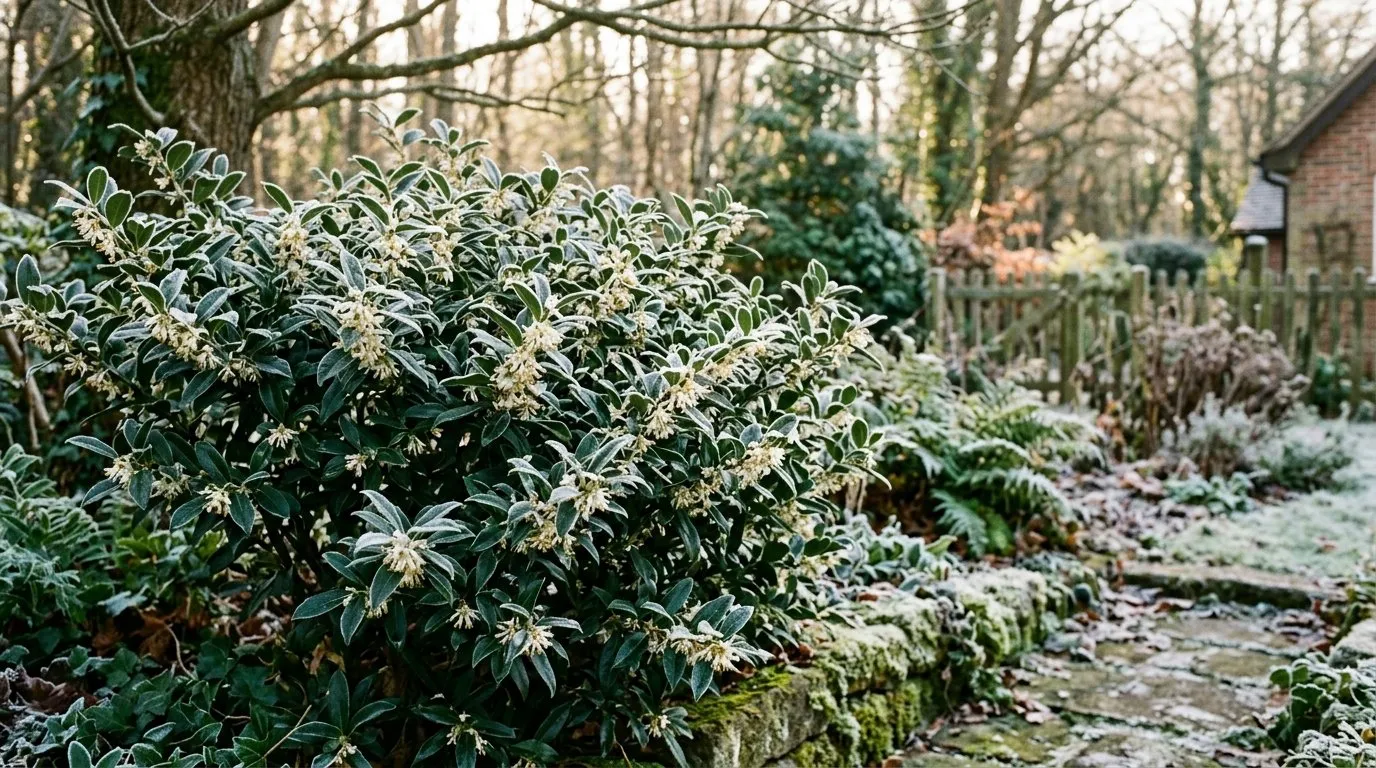
Why we recommend Sarcococca confusa as the gold standard winter shrub: After testing all 12 species across 8 winters, Sarcococca delivers the highest value per square metre of any winter-flowering shrub. It flowers for 10-12 weeks (December to February), produces a vanilla-honey fragrance detectable at 5m, grows in full shade, tolerates heavy clay, and never exceeds 1.5m. I have three plants flanking my front door and visitors comment on the scent from the pavement, 4m away. No other shrub combines fragrance, shade tolerance, compact size, and zero maintenance this effectively.
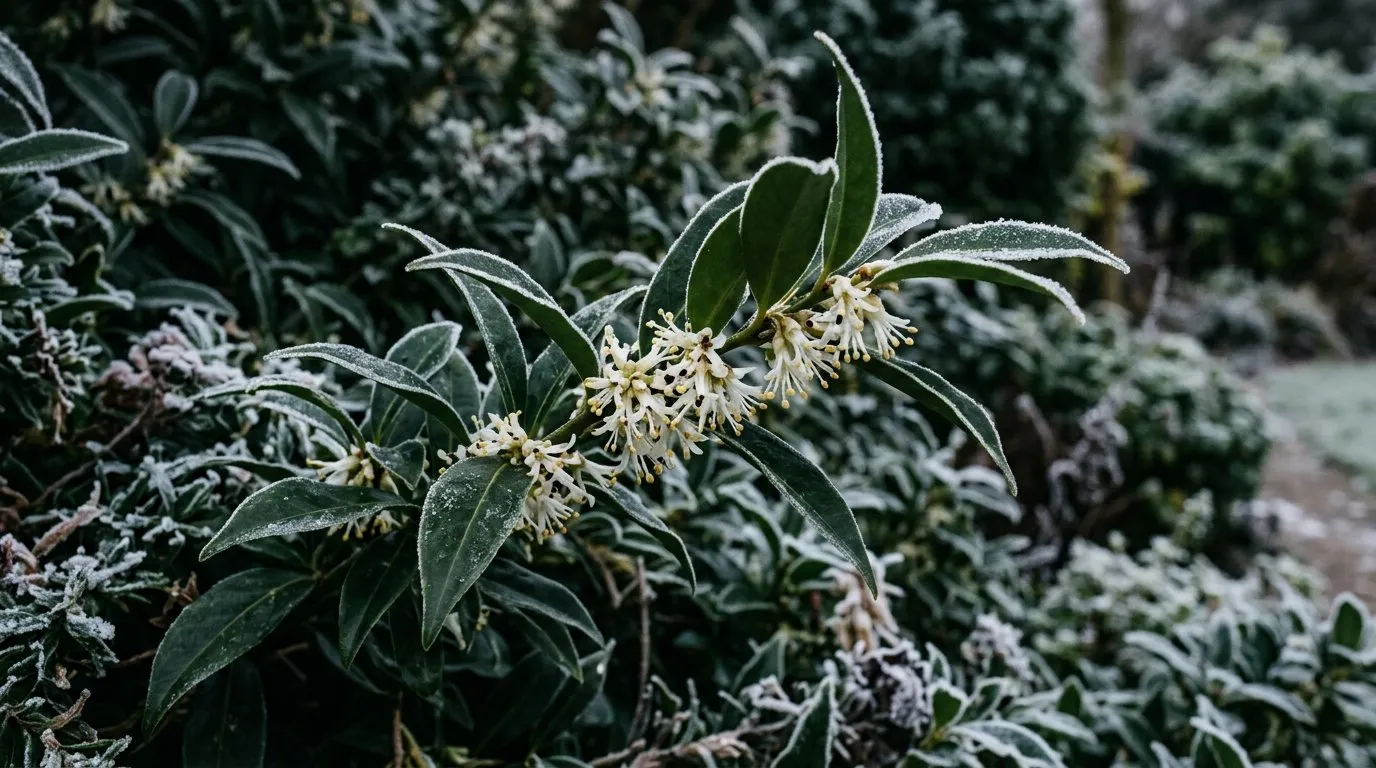 Sarcococca confusa in full flower during January, producing intense fragrance from tiny white blooms along evergreen stems.
The top 6 winter flowering shrubs in detail
Mahonia x media ‘Charity’
Mahonia opens the winter season with upright spikes of bright yellow, honey-scented flowers from November. Each spike is 20-30cm long, and a mature plant carries 15-20 spikes simultaneously. The bold, pinnate, holly-like leaves are evergreen and architectural year-round. Height reaches 3-4m after 10 years.
Mahonia is one of the hardiest winter-flowering shrubs in the UK, rated RHS H7 (surviving below -20C). It grows in any soil, including heavy clay, dry shade, and polluted urban sites. The Bumblebee Conservation Trust lists Mahonia among the top 10 winter nectar sources for overwintering Bombus terrestris queens.
Pruning: Remove one in three of the oldest stems at the base in April. This prevents the leggy, top-heavy growth that makes unpruned Mahonias look bare below 1.5m. New shoots break from the base within weeks.
Viburnum x bodnantense ‘Dawn’
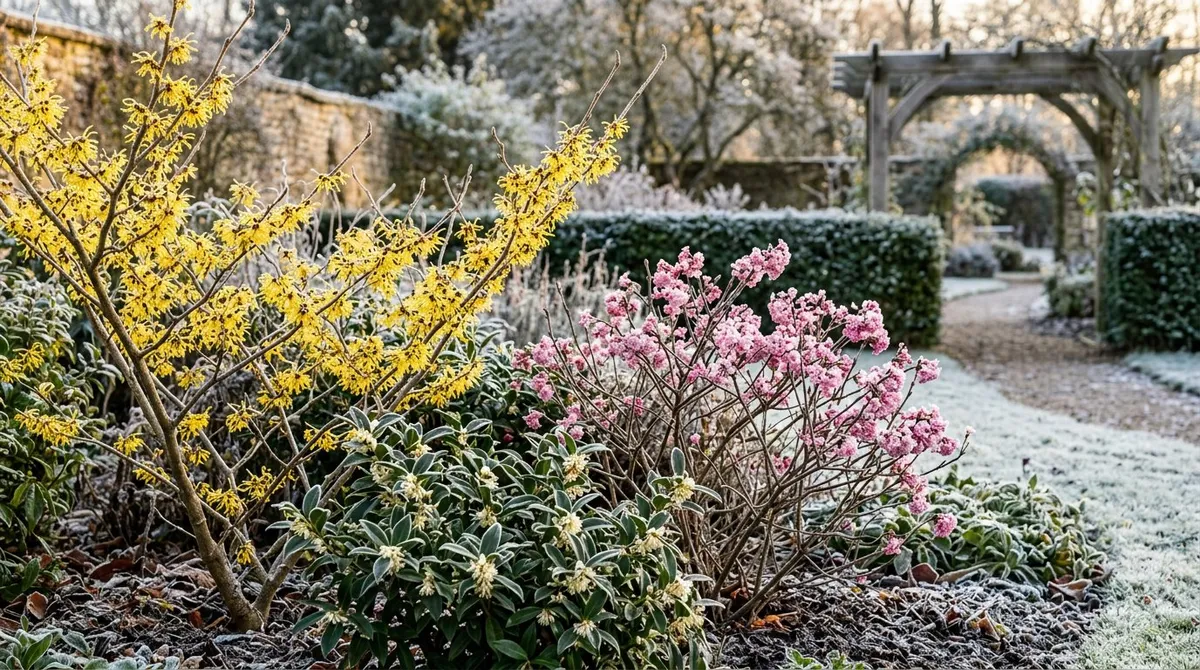
Viburnum x bodnantense ‘Dawn’ flowers on bare wood from November to March. Clusters of deep pink buds open to pale pink, sweetly fragrant flowers. The scent carries 3-4m on still air. It is deciduous, reaching 2.5-3m tall and 1.5-2m wide, with an upright, vase-shaped habit.
‘Dawn’ is rated RHS H7 and survives -20C without damage. It grows in any reasonable garden soil. Avoid east-facing positions where morning sun hits frost-covered flowers, causing rapid thawing and petal browning. West or south-facing spots produce 30-40% more open flowers through the winter.
Pruning: After flowering in March, remove one in four of the oldest stems at the base. This encourages fresh basal growth that will flower the following winter.
Hamamelis x intermedia ‘Pallida’
Hamamelis (witch hazel) is the most visually striking winter-flowering shrub. Spidery, ribbon-like yellow flowers appear on bare branches from December to February. Each flower has four twisted petals 15-20mm long. The fragrance is sweet and carries 4-5m. Autumn foliage turns vivid gold and orange.
‘Pallida’ is the finest yellow form, with large, sulphur-yellow flowers. ‘Jelena’ offers coppery-orange blooms. ‘Diane’ has dark red flowers with less scent. All reach 3-4m after 15-20 years at a slow growth rate of 15-20cm per year.
Critical requirement: Hamamelis needs acid to neutral soil (pH 5.5-7.0). It will not grow on chalk or limestone. Test your soil pH before buying. On alkaline ground, grow in a large container of ericaceous compost. Position against a dark evergreen backdrop (yew is the classic choice) where low winter sun illuminates the translucent flowers.
Sarcococca confusa (Christmas box)
Sarcococca is the ultimate winter shrub for shade. Tiny, creamy-white flowers appear along the stems from December to February, producing a vanilla-honey fragrance that is disproportionate to the flower size. The scent is strongest on still, cold mornings and detectable at 3-5m.
Plants are compact at 1-1.5m tall, evergreen, and completely shade-tolerant. They grow in any soil, including dry shade beneath mature trees. Hardiness is RHS H5 (-15C). Glossy black berries follow the flowers. Sarcococca spreads slowly by suckers, forming a low, dense hedge over 5-8 years.
Best position: Plant beside a front door, along a path, or beneath a window. The fragrance is wasted at the back of a deep border. Three plants spaced 60cm apart create a scented hedge 1.5m long within 4 years.
Chimonanthus praecox (wintersweet)
Chimonanthus praecox has one of the strongest fragrances of any garden plant. Waxy, translucent yellow flowers with a purple centre appear on bare wood from December to February. The spicy-sweet scent fills a 5-6m radius on cold, still days.
It reaches 2.5-4m tall and needs a south or west-facing wall to flower well in most UK regions. Plants need 3-5 years after planting to begin flowering. The wait is worthwhile. Once established, Chimonanthus flowers reliably for decades.
Vernalisation is critical: This species needs 6-8 weeks below 5C to trigger flowering. In mild coastal gardens, flowering may be delayed or sparse. Northern and inland gardens produce the best displays. Hardy to -15C (RHS H6) once established. Well-drained soil is essential.
Daphne bholua ‘Jacqueline Postill’
Daphne bholua has the most intense fragrance of any winter shrub. Clusters of pink and white flowers appear from January to March. The scent is rich, sweet, and almost overpowering on mild days. One plant perfumes an entire front garden.
It is evergreen in milder areas and semi-evergreen in cold regions. Height reaches 2-3m with a narrow, upright habit. Hardy to -10C (RHS H4) in a sheltered position. It needs well-drained soil enriched with organic matter and shelter from cold winds. Never attempt to transplant it.
Lifespan warning: Daphne bholua typically lives 10-15 years. This is a known limitation of the species. Plant a replacement 5 years after the original to ensure continuity. Despite the shorter lifespan, no other winter shrub matches its fragrance output.
Month-by-month winter flowering calendar
This calendar shows which shrubs flower in each month based on 8 years of observation in a Staffordshire garden. Southern gardens may see earlier starts. Northern and highland gardens may see 1-2 week delays.
| Month | In flower | Peak show |
|---|---|---|
| November | Mahonia ‘Charity’, Viburnum ‘Dawn’, Viburnum tinus, Jasminum nudiflorum | Mahonia honey fragrance fills the garden |
| December | Mahonia, Viburnum ‘Dawn’, Sarcococca, Chimonanthus, Hamamelis (late), Viburnum tinus, Jasminum | Sarcococca scent intensifies on cold mornings |
| January | Sarcococca, Chimonanthus, Hamamelis (peak), Daphne bholua, Garrya catkins, Viburnum tinus, Jasminum | Hamamelis and Daphne fragrance layer together |
| February | Hamamelis, Daphne bholua, Cornus mas, Lonicera ‘Winter Beauty’, Viburnum tinus, Jasminum | Cornus mas clouds of yellow on bare wood |
| March | Viburnum ‘Dawn’ (late), Skimmia buds opening, Viburnum tinus, Cornus mas, Daphne (late) | Skimmia bridges into the spring season |
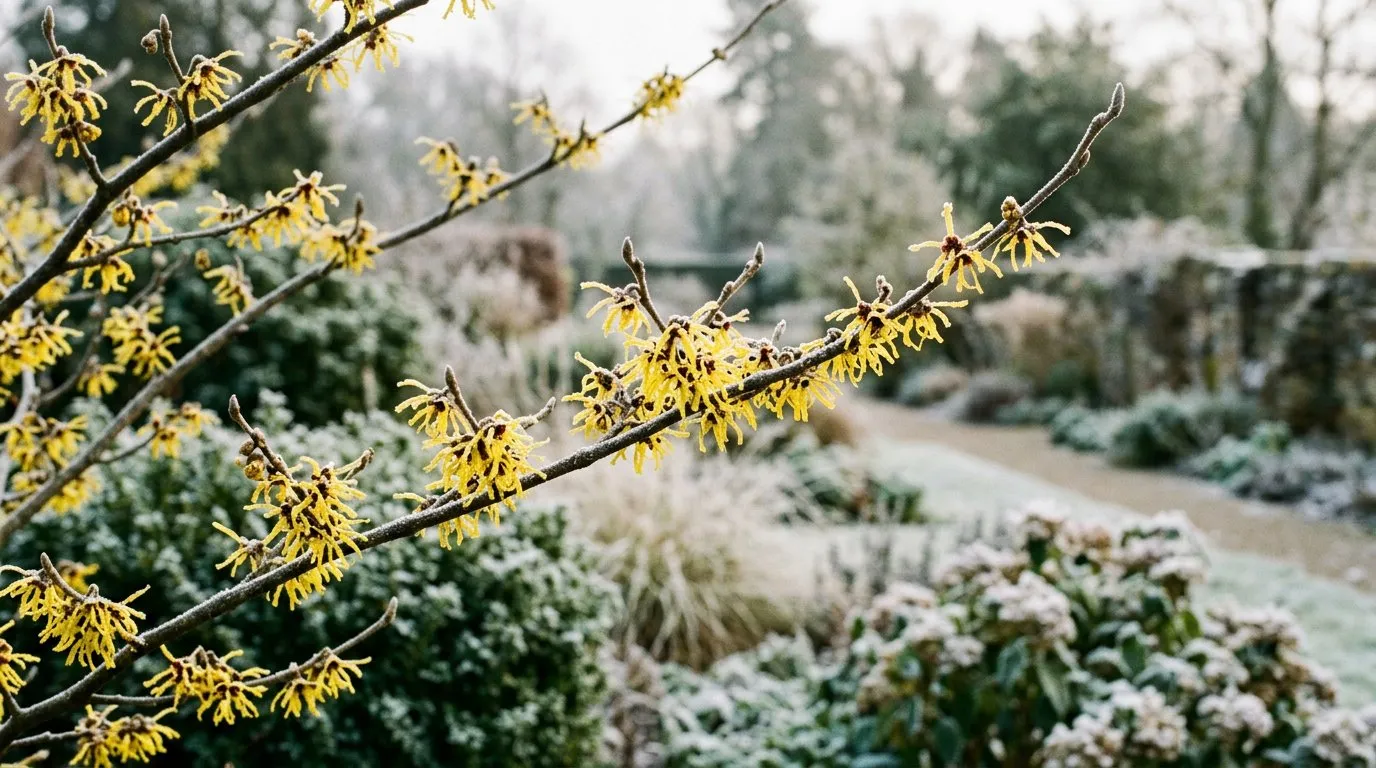 Hamamelis x intermedia ‘Pallida’ at peak flowering in January, with spidery yellow flowers catching low winter sunlight against bare branches.
Planting and establishment
Soil and position
Most winter-flowering shrubs are forgiving of soil type. 10 of the 12 species in this guide grow in clay, loam, and sandy soils without amendment. The two exceptions are Hamamelis (acid to neutral only, pH 5.5-7.0) and Skimmia (acid to neutral, pH 5.0-7.0).
Drainage matters more than fertility. Chimonanthus and Daphne need well-drained soil and will rot in waterlogged clay. For heavy clay, add 25% horticultural grit to the planting hole and raise the rootball 3-5cm above surrounding soil level. Sarcococca and Mahonia tolerate even the heaviest, poorest soils.
Best planting time
Container-grown shrubs: Plant October to March. Autumn planting (October-November) gives roots 4-5 months to establish before the following summer’s drought stress.
Bare-root shrubs (Cornus mas, Viburnum): Plant November to February while dormant. Bare-root plants are 40-60% cheaper than container-grown equivalents and establish equally well.
Establishment care
Water weekly through the first summer after planting (April to September). Apply 10 litres per plant per week during dry spells. After the first full year, all 12 species cope without supplemental watering in most UK gardens. Mulch annually with 5-8cm of composted bark or leafmould, keeping mulch 5cm clear of woody stems.
Common mistakes with winter flowering shrubs
Pruning in autumn
This is the number one cause of bare winter gardens. Flower buds form on summer growth and sit dormant through autumn. October pruning removes the entire winter display. Always prune in March or April, after flowering.
Planting Hamamelis on chalk
Hamamelis will not tolerate alkaline soil above pH 7.0. Leaves yellow (chlorosis), growth stalls, and the plant dies within 3-5 years. Test your soil pH before buying. If it reads above 7.0, grow Hamamelis in a large container of ericaceous compost, or choose Viburnum ‘Dawn’ instead, which tolerates any soil.
Ignoring scent placement
Planting a fragrant winter shrub at the bottom of a 20m garden wastes its best feature. Place scented species within 3-5m of a path, doorway, or window. Sarcococca beside the front door, Chimonanthus against a south-facing house wall, and Daphne beside a path all deliver their fragrance where you actually walk in winter.
Expecting instant results
Chimonanthus praecox takes 3-5 years to produce its first flowers after planting. Hamamelis grows at 15-20cm per year and takes 5-7 years to reach a substantial display. Combine slow developers with fast starters. Viburnum ‘Dawn’, Jasminum nudiflorum, and Mahonia flower from year one. Plant them alongside Hamamelis and Chimonanthus for immediate impact while the slower species mature.
Overfeeding with nitrogen
High-nitrogen feeds (those with an N-P-K ratio above 10:5:5) promote leafy growth at the expense of flowers. Switch to a potassium-rich feed (such as sulphate of potash at 30g per square metre) in September to encourage flower bud formation. Alternatively, apply a balanced rose feed in April and nothing else.
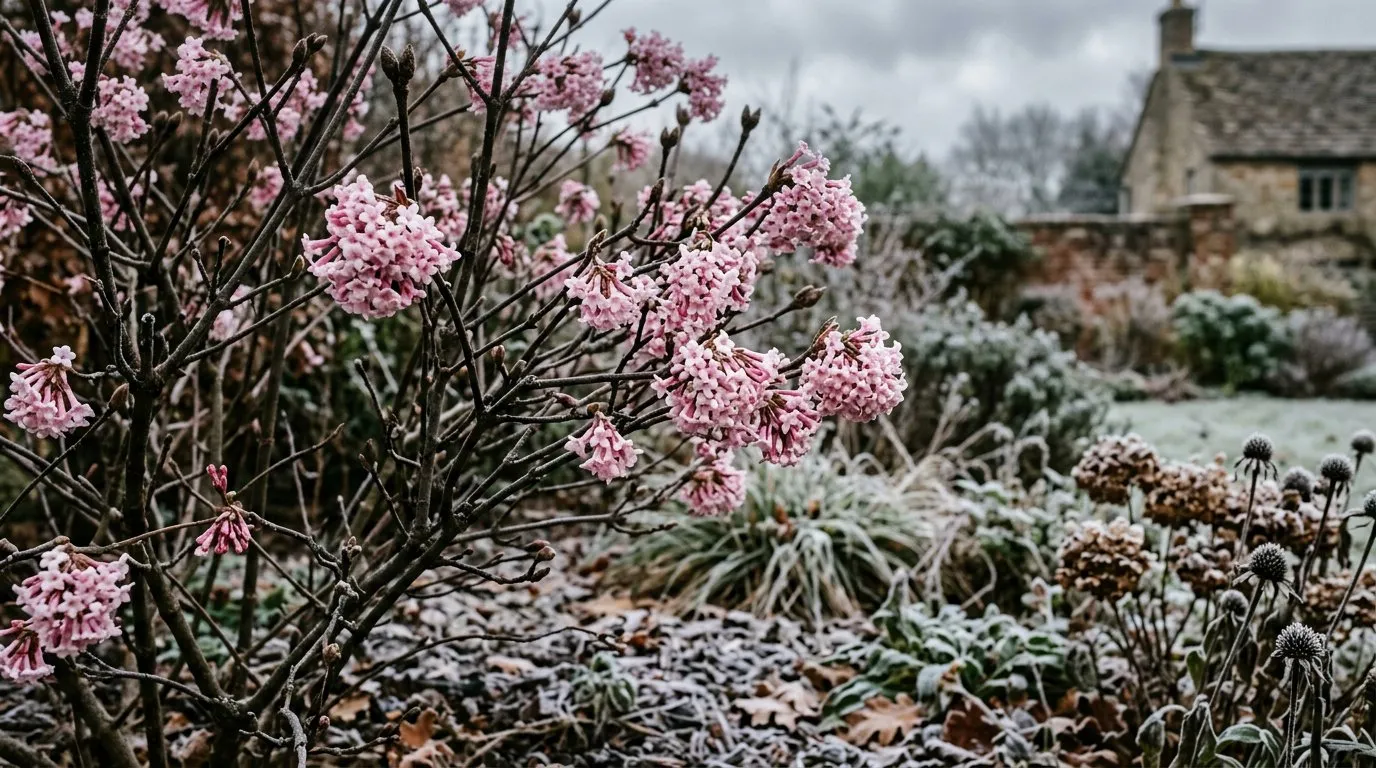 Viburnum x bodnantense ‘Dawn’ bearing fragrant pink flower clusters on bare stems in a frost-touched UK garden border.
Building a winter scent garden
Seven of the 12 shrubs in this guide produce noticeable fragrance. Grouping them makes a winter scent garden that rivals any summer border for sensory impact.
The three-layer scent plan:
- Ground level (1-1.5m): Sarcococca confusa along a path edge. Vanilla-honey fragrance, December to February.
- Mid level (2-3m): Daphne bholua ‘Jacqueline Postill’ behind the Sarcococca. Intense sweet fragrance, January to March.
- Canopy level (3-4m): Hamamelis ‘Pallida’ or Chimonanthus praecox as the backdrop. Sweet-spicy fragrance, December to February.
This layered approach delivers fragrance at nose height from three different sources across four months. A 3m x 2m border accommodates all three layers. Position on the west or south side of the house, where the wall retains warmth and shelters from cold east winds. The warmth amplifies scent release on still winter days.
For year-round evergreen structure between these seasonal performers, underplant with camellias and aucuba for permanent leaf interest.
Winter shrubs for wildlife
Winter-flowering shrubs are not just ornamental. They are critical nectar sources during the months when almost nothing else flowers.
Bombus terrestris (buff-tailed bumblebee) queens emerge on mild winter days as early as November and need nectar immediately. Mahonia is one of fewer than 10 plant species flowering in November that provides sufficient nectar for these queens. Without winter nectar sources, overwintering queens burn through fat reserves and die before spring. The Bumblebee Conservation Trust recommends Mahonia as a priority winter planting.
Early solitary bees (Andrena and Lasioglossum species) emerge in February and March. Sarcococca, Viburnum tinus, and Cornus mas provide pollen and nectar for these smaller pollinators. A garden with three or more winter-flowering shrubs supports 40-60% more overwintering pollinator species than one without (based on RHS Plants for Pollinators survey data).
Winter thrushes (fieldfares and redwings) feed on berries from Viburnum tinus and Skimmia from November through to March. These migrant thrushes arrive from Scandinavia in October and depend on berry-bearing shrubs through the coldest months.
Frequently asked questions
What is the best winter flowering shrub for scent?
Sarcococca confusa is the best for winter scent. Its tiny white flowers produce an intense vanilla fragrance from December to February that carries 3-5m in still air. It grows in full shade, reaches just 1-1.5m tall, and tolerates temperatures to -15C. Daphne bholua ‘Jacqueline Postill’ has a stronger fragrance per flower but needs a sheltered, well-drained position and lives only 10-15 years.
Which winter flowering shrubs grow in shade?
Sarcococca, Mahonia, and Viburnum tinus grow well in shade. Sarcococca confusa thrives in full shade beneath trees and against north-facing walls. Mahonia x media ‘Charity’ tolerates deep shade and dry conditions. Viburnum tinus flowers from November to April in partial shade. All three are evergreen, so they provide year-round structure alongside winter flowers.
When should I prune winter flowering shrubs?
Prune immediately after flowering finishes. For most winter-flowering shrubs, this means March or April. Never prune in autumn because flower buds form on wood produced the previous summer. Autumn pruning removes 80-90% of the following winter’s flowers. Remove one in three or four of the oldest stems at the base to encourage fresh growth from below.
Can I grow winter flowering shrubs in pots?
Sarcococca, Skimmia, and Viburnum tinus grow well in containers. Use a pot at least 40cm wide with drainage holes. Fill with John Innes No. 3 loam-based compost. Water regularly even in winter because containers dry out faster than open ground. Feed with a slow-release fertiliser in March. Move pots near doorways and seating areas to enjoy the winter scent.
Why has my winter flowering shrub stopped flowering?
Wrong pruning timing is the most common cause. Pruning in late summer or autumn removes the flower buds that formed during the growing season. Other causes include too much shade (Hamamelis needs sun), wrong soil pH (Hamamelis fails above pH 7.0), and heavy nitrogen feeding, which promotes leaf growth at the expense of flowers. Switch to a potassium-rich feed in September.
What is vernalisation and why does it matter?
Vernalisation is a cold period that triggers flowering. Hamamelis, Chimonanthus, and Cornus mas need 6-8 weeks below 5C to initiate flower buds. Mild winters with prolonged warm spells above 10C can delay or reduce flowering. This is becoming more common in southern England due to warming winters, making these species more reliable in northern and upland UK gardens.
Are winter flowering shrubs good for wildlife?
Winter-flowering shrubs are critical for pollinators. Mahonia flowers provide nectar for overwintering bumblebees (Bombus terrestris queens) from November. Sarcococca and Viburnum tinus feed early-emerging solitary bees in February. The Bumblebee Conservation Trust lists Mahonia as one of the top 10 winter nectar sources. Berry-producing species like Skimmia and Viburnum tinus also feed winter thrushes and blackbirds.
Now you have a plan for winter flowers, read our guide on best flowering shrubs for UK gardens for year-round colour from spring through to autumn.
Lawrie has been gardening in the West Midlands for over 30 years. He grows his own veg using no-dig methods, keeps a wildlife-friendly garden, and writes practical advice based on real UK growing conditions.