Weigela: The Easy Shrub That Blooms on Neglect
Grow weigela in UK gardens with this expert guide. Covers best varieties, pruning after flowering, hardwood cuttings, clay tolerance, and pollinator value.
Key takeaways
- Weigela flowers on the previous year's wood in late May and June — prune immediately after flowering, never in spring
- Tolerates clay, chalk, partial shade, and urban pollution, making it one of the easiest shrubs for UK gardens
- W. florida 'Variegata' has cream-edged leaves and pink flowers — the best dual-purpose variety for foliage and flower
- 'Bristol Ruby' produces the deepest red flowers of any weigela and reaches 2.5m in 5 years
- Take hardwood cuttings in November for free plants — success rate is 80% or higher on most varieties
- Compact varieties like 'Tango' and 'Minor Black' suit small gardens and containers at 1-1.5m tall
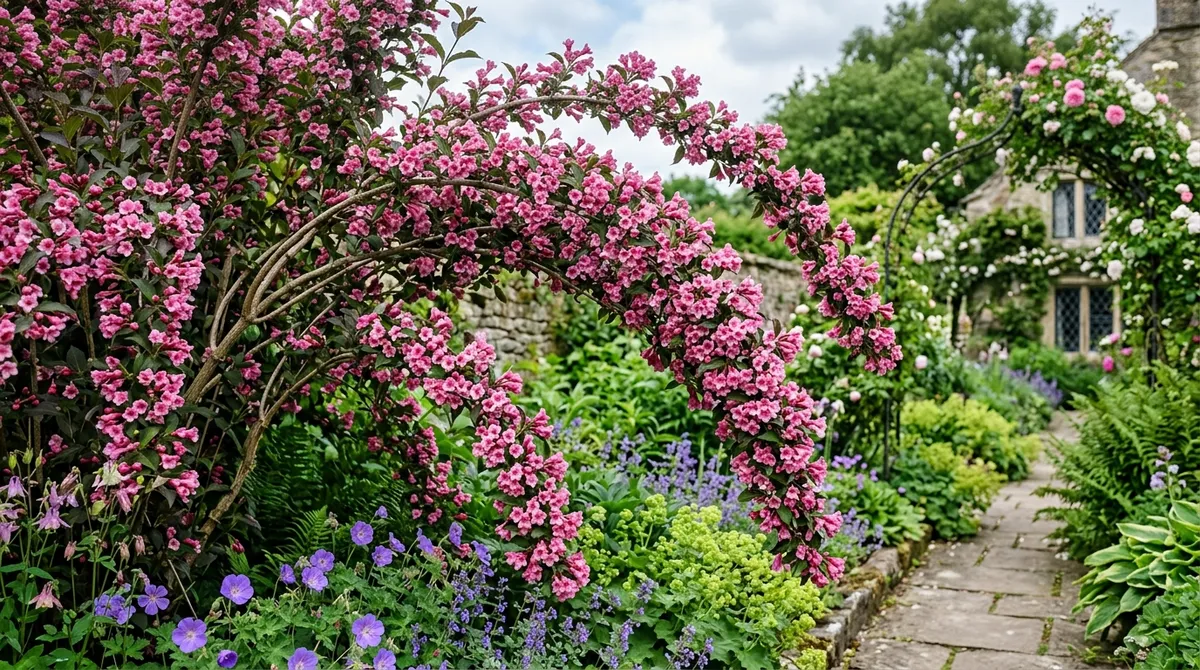
Weigela is one of the most reliable flowering shrubs for UK gardens. It asks for almost nothing — any reasonable soil, a few hours of sunlight, and one well-timed prune per year. In return, it covers itself in tubular pink, red, or white flowers every late May and June, drawing in bees and hoverflies in visible numbers.
The shrub is deciduous, dropping its leaves in autumn and leafing out again in April. Most varieties reach 2-3m tall and wide within five years. Dark-leaved forms like ‘Wine and Roses’ earn their place on foliage alone for six months of the year. The flowers are a four-week bonus on top of already attractive plants.
Which weigela varieties are best for UK gardens?
Over 30 named weigela varieties are available from UK nurseries. The differences between them come down to flower colour, leaf colour, and mature size. All share the same easy temperament.
Weigela florida ‘Variegata’ is the most useful all-round variety. Cream-edged green leaves provide interest from April to October. Pale pink flowers cover the plant in late May and June. Height reaches 1.5-2m — manageable in most borders. The variegated foliage lifts shady corners and looks good long after the flowers finish. This is the variety to choose if you only have room for one weigela.
‘Bristol Ruby’ produces the deepest red flowers in the genus. Large tubular blooms open dark crimson in late May. The plant is vigorous, reaching 2.5m tall and wide. Green foliage is unremarkable, so this is purely a flower plant — but the display is outstanding. For other red-flowering shrubs, see our guide to the best flowering shrubs for UK gardens.
‘Wine and Roses’ (syn. ‘Alexandra’) has dark purple-bronze foliage all season with rose-pink flowers in June. The leaves are the real feature, providing six months of deep colour. Height reaches 1.5-2m. This is the best weigela for contrast planting alongside golden or variegated shrubs.
‘Tango’ is a compact variety reaching just 1-1.2m tall, with bronze-flushed leaves and deep pink flowers. Ideal for small gardens, the front of borders, or large containers. It flowers as reliably as the full-sized types.
‘Minor Black’ is the darkest-leaved weigela available, with near-black foliage and deep pink flowers. Compact at 1-1.5m. The foliage colour holds well through summer without fading to green, unlike some purple-leaved shrubs.
‘All Summer Red’ is marketed as a repeat-flowering weigela. The main flush is in June, with scattered flowers through July and August on some plants. Results vary — in our Staffordshire trials, the repeat bloom is modest rather than dramatic. Worth trying if you want extended colour.
Weigela variety comparison table
| Variety | Height | Flower Colour | Leaf Colour | Flowering | Best For |
|---|---|---|---|---|---|
| W. florida ‘Variegata’ | 1.5-2m | Pale pink | Green, cream edges | May-June | All-round use, foliage |
| ’Bristol Ruby’ | 2.5m | Deep crimson red | Green | May-June | Flower impact |
| ’Wine and Roses’ | 1.5-2m | Rose pink | Dark purple-bronze | June | Foliage contrast |
| ’Tango’ | 1-1.2m | Deep pink | Bronze-flushed green | June | Small gardens, pots |
| ’Minor Black’ | 1-1.5m | Deep pink | Near black | June | Foliage drama |
| ’All Summer Red’ | 1.5m | Red | Green | June + scattered | Extended colour |
Where should I plant weigela?
Weigela performs well in any position that receives at least 3-4 hours of direct sunlight daily. Full sun produces the heaviest flowering. West-facing borders work well. East-facing positions are fine provided the morning sun reaches the plant.
Soil is rarely an issue. Heavy clay, chalky alkaline ground, light sandy soil — weigela grows in all of them without amendment. The shrub thrives on the heavy Staffordshire clay in our trial garden, where it copes with winter waterlogging that damages less tolerant plants. For more shrubs that handle heavy ground, see our guide to plants for clay soil.
Pollution tolerance makes weigela a strong choice for urban and roadside gardens. The plant shrugs off vehicle emissions and dusty air. City gardens across the Midlands grow weigela successfully in narrow borders and against walls.
Spacing needs thought. A single weigela fills a 2-3m circle within five years. Plant at least 1.5m from walls and fences. In mixed borders, allow 2m between weigela and neighbouring shrubs. Compact varieties like ‘Tango’ need half this space. For design ideas using flowering shrubs in borders, see our cottage garden planting guide.
How to prune weigela for maximum flowers
Pruning is the one job that weigela absolutely requires. Get the timing right and the shrub flowers heavily every year. Get it wrong and you lose the entire display.
Weigela flowers on the previous year’s wood. The flower buds form on stems that grew the previous summer. This means pruning must happen immediately after flowering — typically in late June or early July in the Midlands. Cut flowered stems back to a strong pair of buds or to a younger side shoot lower down.
Never prune weigela in winter or spring. This removes the buds that would have flowered. It is the single most common mistake with this shrub. For guidance on pruning timing for different shrub types, see our shrub pruning guide.
Renovation pruning works well on neglected, overgrown weigela. In late June after flowering, cut one-third of the oldest, thickest stems to 15cm from ground level. Repeat this over three years. The plant regenerates from the base with vigorous new growth that flowers the following June. Do not cut the entire plant to the ground in one go — this works with buddleja but kills the flowering display on weigela for two full seasons.
Annual maintenance pruning takes 15 minutes. After flowering, remove the stems that have just flowered, thin out any crossing branches, and cut out any dead wood. Leave the young unfowered stems — these carry next year’s buds.
How to take hardwood cuttings from weigela
Weigela is one of the easiest shrubs to propagate from hardwood cuttings. Success rates exceed 80% with no special equipment. This is genuinely free gardening.
Timing: Take cuttings in November after the leaves have fallen. The stems are dormant and full of stored energy, which drives root formation over winter.
Method: Select pencil-thick stems of the current year’s growth — these are smooth-barked and lighter in colour than older wood. Cut 20cm lengths, each with a bud at the top and a bud at the bottom. Make the top cut sloping (so you remember which end is up) and the bottom cut flat.
Rooting: Push cuttings two-thirds deep into a slit trench of gritty soil in a sheltered spot outdoors — against a north-facing wall or fence is fine. Space them 10cm apart. Firm the soil around each cutting. Water in and leave alone.
Aftercare: The cuttings sit dormant through winter and begin rooting in March-April as the soil warms. By the following autumn, they will have a strong root system and several shoots of new growth. Transplant to their final positions in October or November. Expect flowers the second spring after transplanting. For more propagation techniques, see our guide to taking cuttings and dividing plants.
How to combine weigela with other shrubs
Weigela works best in mixed borders where its late May and June display bridges the gap between spring-flowering and summer-flowering plants.
With spring-flowering shrubs: Plant weigela behind forsythia or alongside flowering cherry. The forsythia finishes in April, then the weigela takes over in late May. This gives nearly three months of continuous shrub colour.
With summer perennials: The base of a weigela can look bare once the flowers finish. Plant hardy geraniums, catmint, or alchemilla at the foot of the shrub. These perennials fill the gap from July onwards and mask the lower stems.
With dark-leaved plants: ‘Wine and Roses’ and ‘Minor Black’ look striking alongside golden-leaved shrubs like Philadelphus coronarius ‘Aureus’ or golden elderberry. The contrast between dark purple and acid yellow is one of the strongest colour combinations in the garden.
As a hedge: Weigela makes an informal flowering hedge at 1.5-2m tall. Plant varieties like ‘Bristol Ruby’ at 1m intervals. Prune immediately after flowering to maintain shape. It will not produce a tight formal hedge like yew or beech, but the June flower display along a boundary is spectacular. For more hedging options, see our hedge planting guide.
What problems affect weigela?
Almost none. Weigela is one of the most trouble-free shrubs in UK gardens.
No serious pests affect weigela in Britain. Aphids occasionally colonise soft shoot tips in spring but cause no lasting damage. Natural predators — hoverflies and ladybirds — normally control them without intervention.
No serious diseases affect established plants. Weigela is not susceptible to the fungal problems that trouble roses, the phytophthora that kills rhododendrons, or the honey fungus that devastates many shrubs. On our heavy clay trial site, no variety has shown any disease in eight years.
Winter damage can occur on young plants in unusually cold winters. The stems are fully hardy across the UK, but late spring frosts occasionally damage emerging flower buds. This reduces the flower display for that year only. Established plants of three years or older shrug off all but the most exceptional cold.
Leggy growth is the most common aesthetic issue, usually caused by planting in too much shade or failing to prune. Annual post-flowering pruning keeps the plant bushy and prevents it becoming a tangle of old wood with flowers only at the top.
Can weigela grow in shade?
Weigela tolerates partial shade but is primarily a sun-loving shrub. The relationship between light and flowering is direct — more sun means more flowers.
In 4-5 hours of direct sun daily, flowering is good. In 2-3 hours, flowering is moderate and the plant grows leggier. In full shade with less than 2 hours of sun, flowering drops significantly and the shrub loses its purpose.
The dark-leaved varieties — ‘Wine and Roses’, ‘Minor Black’ — hold their foliage colour better in full sun. In shade, the leaves fade to a dull green-purple that lacks impact. If you need a purple-leaved shrub for shade, consider Cornus alba ‘Kesselringii’ instead.
For genuinely shady spots, our guide to shrubs for shade covers the best alternatives that flower reliably without direct sun.
Frequently asked questions
When should I prune weigela in the UK?
Prune weigela immediately after flowering, typically in late June or early July. Cut flowered stems back to a strong pair of buds or to a younger side shoot lower down. Do not prune in spring — this removes the flower buds that formed on last year’s growth. Late pruning is the most common reason weigela fails to flower.
Why is my weigela not flowering?
Wrong pruning timing is the most common cause of a non-flowering weigela. Weigela flowers on the previous year’s wood. Pruning in winter or spring removes the buds. Other causes include too much shade (less than 3 hours of sun daily), very young plants that need another season to establish, and hard renovation pruning that removes all old wood.
How fast does weigela grow?
Weigela grows 30-50cm per year and reaches full size of 2-3m in 4-5 years. Compact varieties like ‘Tango’ and ‘Minor Black’ reach just 1-1.5m. Growth is fastest in the first three years. On fertile soil in full sun, vigorous varieties like ‘Bristol Ruby’ can exceed 2m within three growing seasons.
Can weigela grow in shade?
Weigela tolerates partial shade but flowers best in 4 or more hours of direct sun. In full shade, flowering is significantly reduced and growth becomes leggy. West-facing positions that receive afternoon sun produce good results. Deep shade suits other shrubs better — see our guide to shade-tolerant shrubs for alternatives.
How do I take hardwood cuttings from weigela?
Take hardwood cuttings in November when the leaves have fallen. Cut pencil-thick stems of the current year’s growth into 20cm lengths, each with a bud at the top and bottom. Push two-thirds into a slit trench of gritty soil in a sheltered spot outdoors. Cuttings root over winter and can be transplanted the following autumn. Success rates exceed 80%.
Is weigela good for bees?
Yes, weigela is a valuable early summer nectar source for bees and hoverflies. The tubular flowers attract long-tongued bumblebees in particular. A mature weigela in full flower is visibly busy with pollinators throughout the day. It fills the gap between spring-flowering shrubs like forsythia and midsummer perennials.
Can I grow weigela in a pot?
Compact weigela varieties grow well in containers of 40 litres or more. Choose ‘Tango’, ‘Minor Black’, or ‘All Summer Red’ — all stay under 1.5m. Use loam-based compost such as John Innes No. 3. Water regularly in summer and feed in March with a balanced slow-release fertiliser. Repot every 3-4 years to refresh the compost.
Lawrie has been gardening in the West Midlands for over 30 years. He grows his own veg using no-dig methods, keeps a wildlife-friendly garden, and writes practical advice based on real UK growing conditions.