How to Grow Elderberry in the UK
Grow elderberry in the UK: native Sambucus nigra and ornamental varieties. Pruning, elderflower cordial, elderberry wine, wildlife value, and safety.
Key takeaways
- Native Sambucus nigra grows 3-6m tall in almost any UK soil — including heavy clay — with almost no care
- Harvest elderflowers in June when fully open; harvest elderberries in September when deep purple-black
- Raw elderberries are mildly toxic — always cook them before eating or making wine and cordial
- Hard prune ornamental varieties like Black Lace annually for the best foliage; prune lightly if you want berries
- A single elder shrub feeds over 70 invertebrate species and is one of the best wildlife plants you can grow
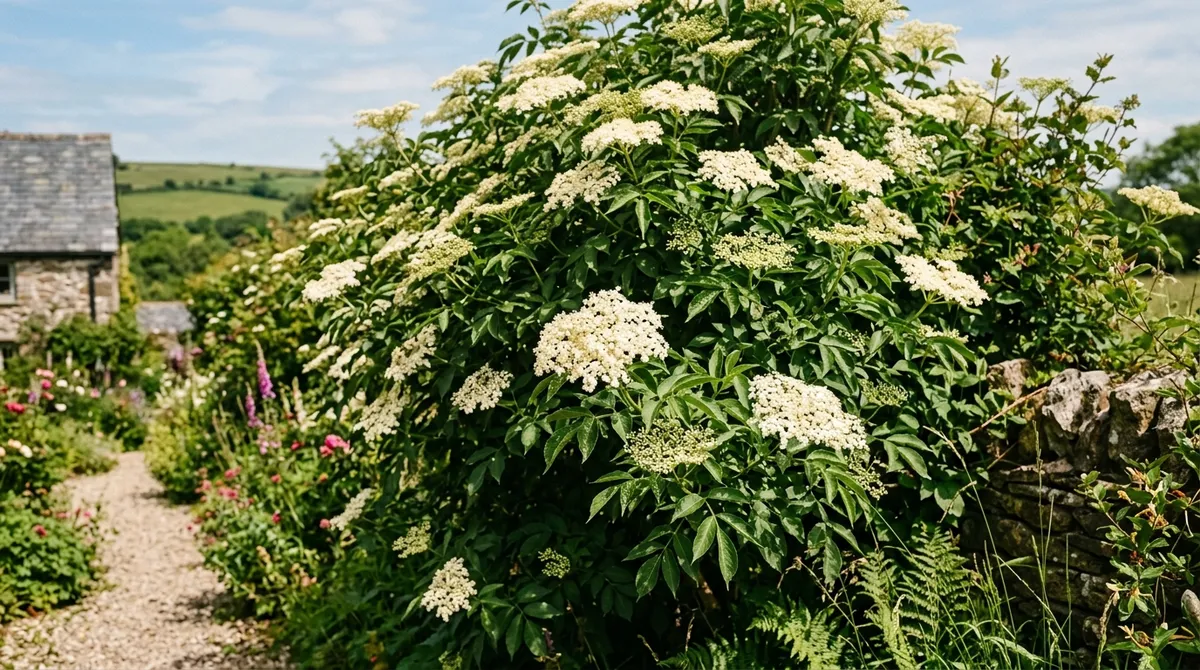
Elderberry is one of the most useful plants you can grow in a British garden. From a single shrub you get June elderflowers for cordial and fritters, September elderberries for wine and jam, architectural dark foliage from ornamental varieties, and a habitat for over 70 invertebrate species — all from a plant that grows on clay soil, tolerates shade, and needs almost no maintenance.
This guide covers native Sambucus nigra alongside the best ornamental varieties, with practical detail on pruning, harvesting, and turning the harvest into cordial and wine.
Native elder vs ornamental varieties: which should you grow?
The choice between native Sambucus nigra and ornamental dark-leaved varieties depends on what you want from the plant. Native elder gives you the biggest harvest and the most wildlife value. Ornamental varieties give you dramatic foliage that earns its place as a garden specimen even when not in flower or fruit.
Most gardeners who have the space grow both — a native elder tucked into a hedgerow or back corner for harvesting, and a Black Lace or Black Beauty as a focal point in a border.
Elder variety comparison
| Variety | Foliage | Flower | Berry yield | Height | Best for |
|---|---|---|---|---|---|
| Sambucus nigra (native) | Green, mid-size | Cream, large heads | High | 3-6m | Foraging, wildlife, hedgerow |
| Black Lace (‘Eva’) | Deep purple, finely cut | Pink-tinged | Moderate | 2-3m | Ornamental, cut foliage |
| Black Beauty (‘Gerda’) | Dark purple, bold | Dark pink, fragrant | Moderate | 3m | Ornamental, screening |
| Golden Tower | Golden-yellow, columnar | Cream | Low | 2-4m narrow | Small gardens, upright form |
| Sutherland Gold | Golden-yellow | Cream, large | Moderate | 3-4m | Foliage + berries |
| Laciniata | Green, deeply cut | Cream | High | 4-5m | Architectural + foraging |
RHS Award of Garden Merit holders: Black Lace (‘Eva’), Black Beauty (‘Gerda’), and Sutherland Gold all carry the AGM, confirming reliable garden performance across UK conditions. See the RHS Sambucus plant selector for the full list of recommended cultivars.
How to plant elder
Native elder and ornamental varieties share the same basic planting requirements, with a few practical differences in timing and positioning.
Soil: Elder grows in almost any soil — clay, loam, chalk, or sandy ground. It tolerates brief waterlogging better than most shrubs. On poor, dry soils add organic matter at planting to help establishment, but on average garden soil no improvement is needed. My Staffordshire clay plot grows native elder without any soil prep at all. If you are gardening on heavy clay and want to improve it for more demanding plants alongside the elder, how to improve clay soil has the full method.
Position: Full sun produces the best berry crop and the most intense foliage colour on ornamental varieties. Partial shade is tolerated — native elder grows naturally at woodland edges where it gets 3-4 hours of direct sun. This shade tolerance makes elder an excellent small tree or shrub layer plant in a forest garden. Avoid deep shade, which weakens growth and reduces flowering.
When to plant: Bare-root elders go in between November and March during dormancy. This is the cheapest way to buy native stock and planting bare-root trees and shrubs works especially well for elder, which establishes quickly. Container-grown plants go in year-round, but autumn planting gives the best start.
Spacing: Native elder in a hedge: 1-1.5m apart. Ornamental varieties as border specimens: allow the full spread of 2-3m — they look cramped when planted too close together.
First-year care: Water new plants during dry spells in their first summer. After establishment, elder needs no supplementary watering except in prolonged drought. No feeding is required on reasonable garden soil — excess nitrogen produces vigorous leafy growth at the expense of flowers and fruit.
How to prune elder
Pruning is where elder management gets interesting, because the right approach depends on what you want from the plant.
Hard pruning for foliage (ornamental varieties)
Black Lace, Black Beauty, and other ornamental varieties produce their best foliage on young wood. Hard pruning every spring — cutting all stems to within 30cm of the ground — forces the plant to send up fast, vigorous new growth with the largest leaves and the most intense colouration.
The timing is late February to early March, before growth starts. Use loppers or a pruning saw rather than secateurs for the thicker stems. The regrowth is dramatic — stems can reach 2m in a single season.
The downside: hard-pruned plants lose most of their flower buds, so berry production is minimal. If flowers and berries matter, see the compromise approach below. For general advice on technique, how to prune shrubs covers the fundamentals that apply here.
Light pruning for berries (native elder and larger varieties)
If elderflowers and elderberries are the priority, prune more lightly. In late winter, remove dead, damaged, and crossing stems. Cut back the previous year’s flowered growth by one third to stimulate new flowering shoots without removing all the buds.
On an established native elder that has been allowed to grow freely, you may also need to remove some of the oldest, thickest stems entirely — cut these to the base to let younger, more productive wood come through. This renovation technique keeps the plant productive for decades.
The compromise approach
For ornamental varieties where you want both foliage and berries: prune half the plant hard and leave the other half lightly trimmed. The hard-pruned half produces the bold foliage; the lightly pruned half flowers and fruits. Swap over the following year.
Harvesting elderflowers in June
Elderflowers are ready in June. Pick them when every floret in the flower head is fully open and the scent is strong and sweet — not musty. The peak window is around two to three weeks; pick regularly as flowers open rather than waiting for the whole plant to be in flower.
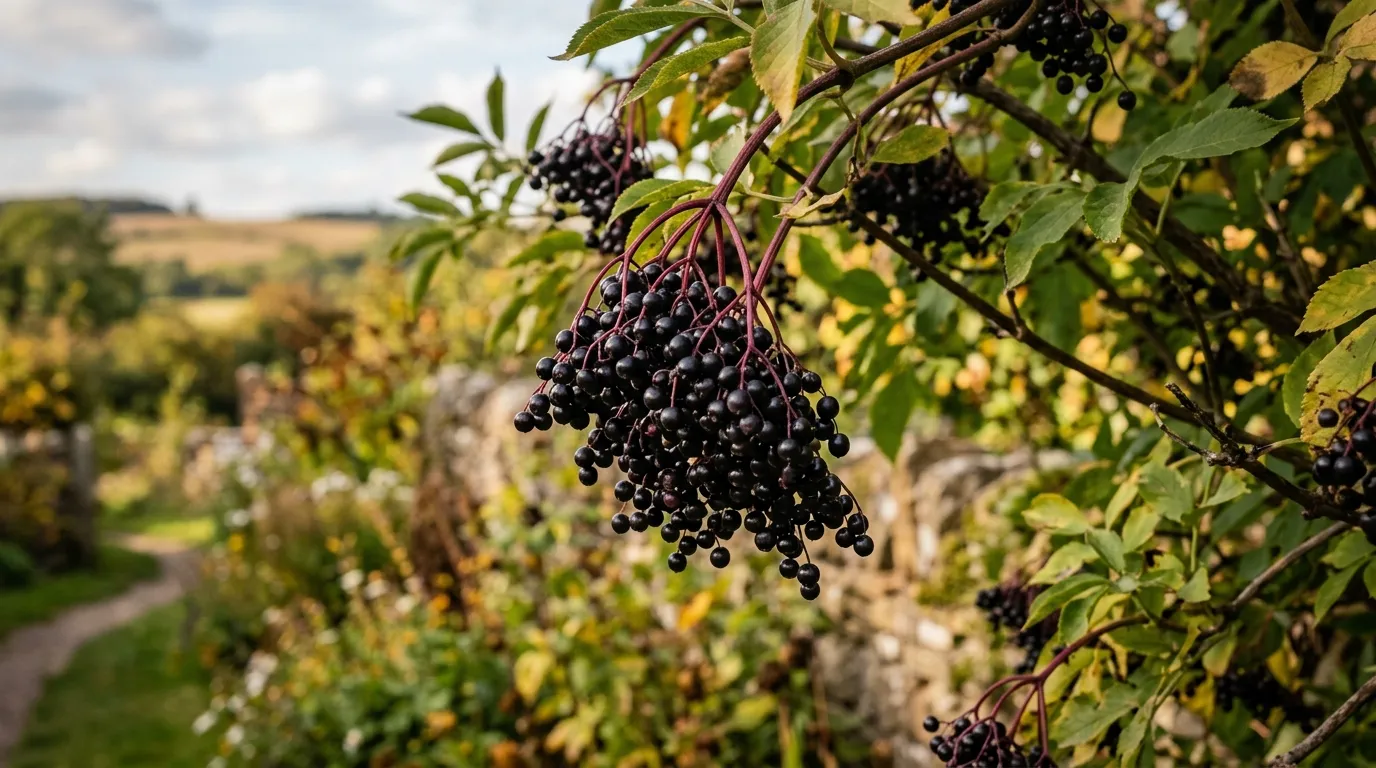
Elderberries ripen in September. Strip the berries from the stems with a fork. Always cook before eating.
How to pick: Use scissors or secateurs to cut the stem just below the flower head. Pick into a basket rather than a bag to avoid bruising. Take no more than a third of the flower heads from any one plant.
When to pick: Morning on a warm, dry day gives the most fragrant flowers. Avoid picking after rain, which dilutes the scent.
What to avoid: Any flower heads where the outer florets have started to brown or drop off. These smell unpleasant and will make your cordial taste musty.
Elderflower heads at peak ripeness — every floret open, creamy white, powerfully fragrant
Basic elderflower cordial recipe
This is the recipe I have settled on after ten years of making it. It produces around 1.5 litres of cordial from 20 large flower heads.
Ingredients: 20 large elderflower heads, 1.5kg white caster sugar, 1.5 litres water, 2 unwaxed lemons (zest and juice), 50g citric acid (optional — extends shelf life and adds tartness).
Method: Bring the water to a simmer and dissolve the sugar. Remove from heat. Add the flower heads, lemon zest, lemon juice, and citric acid if using. Stir gently, cover, and leave to infuse for 24-48 hours. Strain through a muslin cloth into sterilised bottles. Keeps refrigerated for up to 3 months, or freeze in ice cube trays for up to a year.
The cordial dilutes 1:5 with still or sparkling water. It also works in prosecco, lemonade, and — a personal favourite — poured over vanilla ice cream.
Harvesting elderberries in September
Elderberries are ready in September when they turn deep purple-black and hang in heavy drooping clusters. Test a few — ripe berries come away from the stem easily and stain your fingers deep purple.
Safety first: Raw elderberries contain sambunigrin, a compound that causes nausea and vomiting. Always cook them before eating. This is true whether you are making jam, cordial, or wine — cooking destroys the compound completely. The flowers are safe raw; the berries are not. Never eat elderberries straight from the shrub.
Harvesting: Use scissors to cut whole clusters from the bush. Strip the berries from the stems using a fork — run the fork down through the cluster over a bowl. Discard all green and pale berries, which are higher in the problematic compounds. Wash the berries thoroughly.
Yield: A mature native elder produces 3-5kg of berries per season. Ornamental varieties like Black Lace and Black Beauty produce around 1-2kg — their breeding prioritises foliage, not berry yield.
Deep purple-black elderberry clusters ready to pick — the berries detach easily and stain everything they touch
Making elderberry wine
Elderberry wine is one of the most rewarding home wine projects for a UK garden. The berries produce a deep red wine with body and tannin that improves significantly over 12-18 months.
Basic elderberry wine recipe (makes 4.5 litres / one demijohn):
Ingredients: 1.5kg ripe elderberries (stalks removed), 1.2kg white granulated sugar, 1 teaspoon wine yeast nutrient, 1 sachet wine yeast (Burgundy or all-purpose), 1 Campden tablet, juice of 1 lemon, water to 4.5 litres.
Method:
- Simmer the elderberries in 1 litre of water for 20 minutes. Mash and strain through muslin.
- Dissolve the sugar in the warm liquid. Make up to 4.5 litres with cold water.
- When cooled to below 24°C, add the lemon juice, yeast nutrient, and crumbled Campden tablet.
- Wait 24 hours, then add the wine yeast.
- Pour into a sterilised demijohn, fit the airlock, and ferment at room temperature (18-22°C) for 2-4 weeks until bubbling stops.
- Rack into a clean demijohn. Allow to clear for 4-6 weeks, then rack again.
- Bottle when clear. The wine is drinkable after 6 months; excellent after 12.
For other fruit preservation projects, how to preserve fruit and vegetables and how to make jam from garden fruit cover complementary techniques.
Ornamental elder in the garden border
Dark-leaved elder varieties have transformed the ornamental shrub border. Black Lace, in particular, has become a go-to plant for designers who want the texture of a Japanese maple with the toughness of a hedgerow native.
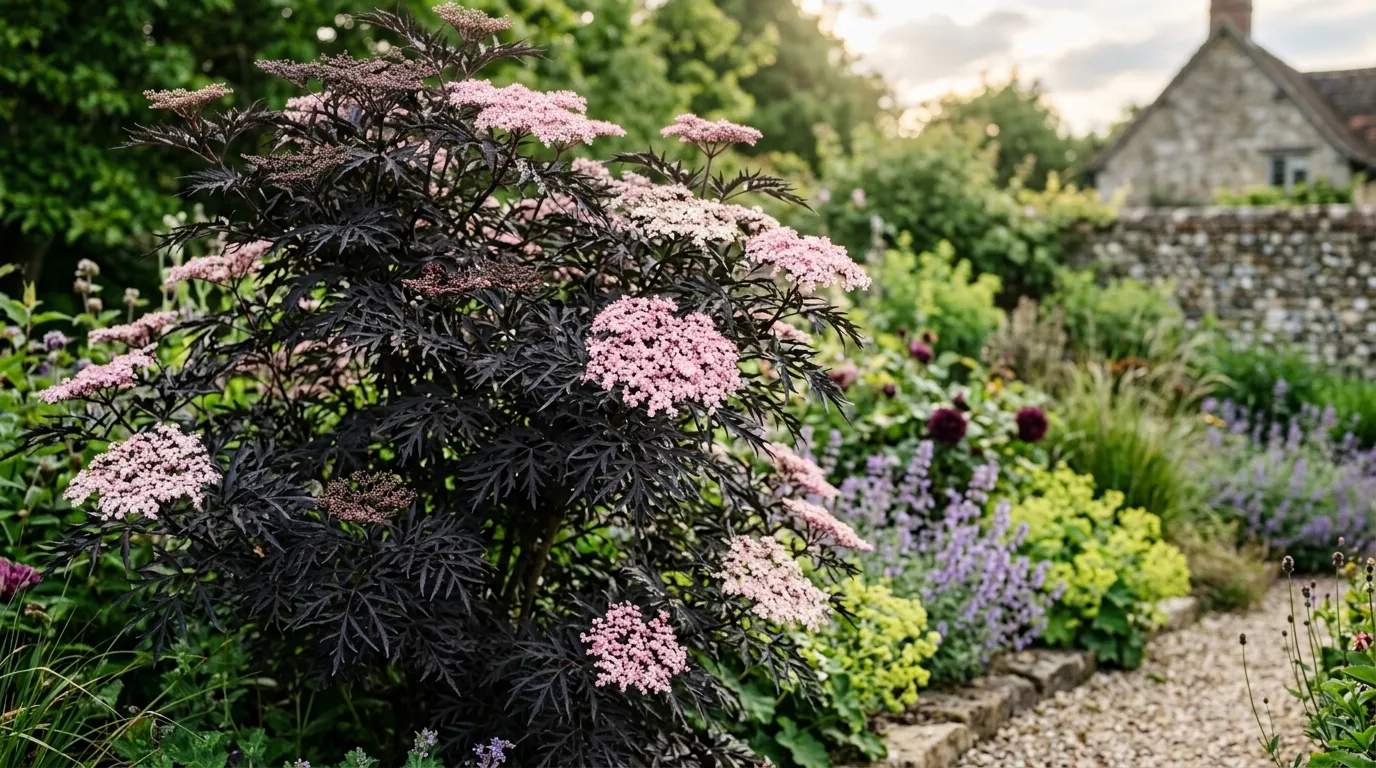
Sambucus nigra Black Lace combines dark purple, finely cut foliage with pink flowers. A striking ornamental shrub.
The key is using ornamental elder as a foliage plant rather than a flowering one — hard prune each spring for bold, velvety purple-black leaves that contrast with silver-leaved plants (Stachys, Senecio) and acid greens (Alchemilla, Euphorbia). The finely cut foliage of Black Lace particularly suits cottage-style planting.
Companion planting: Ornamental elder looks best against:
- Pale stachys or lamb’s ear for silver-purple contrast
- Alchemilla mollis for lime-green froth against the dark leaves
- Rosa glauca for complementary red-purple tones
- White-flowered actaea or anemone for late contrast
As a flowering shrub, ornamental elder earns its place in the border for three seasons — foliage from April, flowers in June (on unpruned growth), and berries through autumn. It also works well alongside native trees for UK gardens, where it brings wildlife value without overwhelming smaller spaces.
Black Lace elder (‘Eva’) — the finely cut purple foliage resembles Japanese maple but grows at hedgerow speed
Wildlife value: elder as a habitat plant
Native elder is one of the highest-value wildlife plants you can grow in a UK garden. A single shrub supports over 70 species of invertebrate, feeds dozens of bird species through autumn and winter, and provides flowers for pollinators in June when many other shrubs have finished.
Invertebrates: Elder supports aphids (blackfly is the most common) which in turn feed ladybirds, lacewings, and blue tit chicks. The bark and dead wood host specialist elder-associated species. The flowers attract hoverflies, bees, and beetles.
Birds: Blackbirds, robins, starlings, song thrushes, and wood pigeons all eat elderberries. Leave some unpicked through September and October to feed migrating birds building reserves for winter.
Blackfly (elder aphid): This is the most common problem on elder, and it is also largely harmless. Blackfly colonies form on soft new growth from May, but they do not significantly damage a healthy established plant. Natural predators — hoverfly larvae, ladybird adults and larvae — bring colonies under control by July without any intervention. Do not spray. The aphids are part of why elder supports so much other wildlife.
For more on making the most of plants like elder as habitat, how to create a wildlife garden covers the wider approach.
Propagating elder from hardwood cuttings
Elder propagates easily and for free from hardwood cuttings taken in November or December.
Method:
- Choose pencil-thick stems from healthy growth this year.
- Cut into 20-25cm sections with a clean cut just below a bud at the base and just above a bud at the top.
- Push two-thirds of each cutting into gritty compost in a pot, or directly into a sheltered nursery bed outdoors.
- Label and leave undisturbed for 12 months.
- By the following autumn, most cuttings will have rooted and produced 30-50cm of new growth.
- Pot on or plant out the following spring.
Success rate is high — expect 7 or 8 out of 10 cuttings to take. Elder is one of the most forgiving shrubs for hardwood propagation, and the method works even for beginners.
Common problems with elder
Elder is genuinely trouble-free once established. The problems that do occur are almost always cosmetic rather than serious.
Blackfly (elder aphid): Dense colonies on soft shoot tips from May onwards. Unsightly but rarely damaging. Leave for natural predators. Only intervene on young, newly planted specimens where heavy infestation could slow establishment — use a strong jet of water, not insecticide.
Leaf scorch: Brown leaf margins in summer, usually from dry or windy conditions. More common on ornamental varieties in exposed sites. Mulch the root zone and water during dry spells for the first two years after planting.
Coral spot: Orange-pink pustules on dead wood. Remove and destroy affected stems. Common if dead wood is left in place — good pruning hygiene prevents it.
Verticillium wilt: Wilting of individual branches despite moist soil, with brown staining in the wood beneath the bark. No chemical control. Remove and destroy affected branches, cutting back to clean wood. Improve drainage if the plant is in a low-lying spot.
Failure to flower: Most common on plants in heavy shade, or on ornamental varieties that have been hard-pruned. Move shaded plants, or adjust pruning to leave some older wood for flowering.
Foraging elder safely: a summary
- Elderflowers (June): safe raw — pick and use within 24 hours for the best flavour
- Elderberries (September): always cook before eating — simmer for at least 15 minutes
- Green, unripe berries: highest concentration of sambunigrin — never use
- Leaves and bark: mildly toxic — do not use in recipes
- Flowers after browning: harmless but unpleasant tasting — avoid
Wild elder identification is straightforward once you know the plant. Look for the compound leaves (5-7 leaflets per leaf), the distinctive musty-sweet scent of the bark when bruised, and the cream-coloured flat-topped flower heads from May to July. Foraging from cultivated garden elder or from hedgerows well away from traffic and agricultural sprays is safer than foraging from the urban roadside. Our full foraging guide for edible garden plants covers safe identification across multiple species.
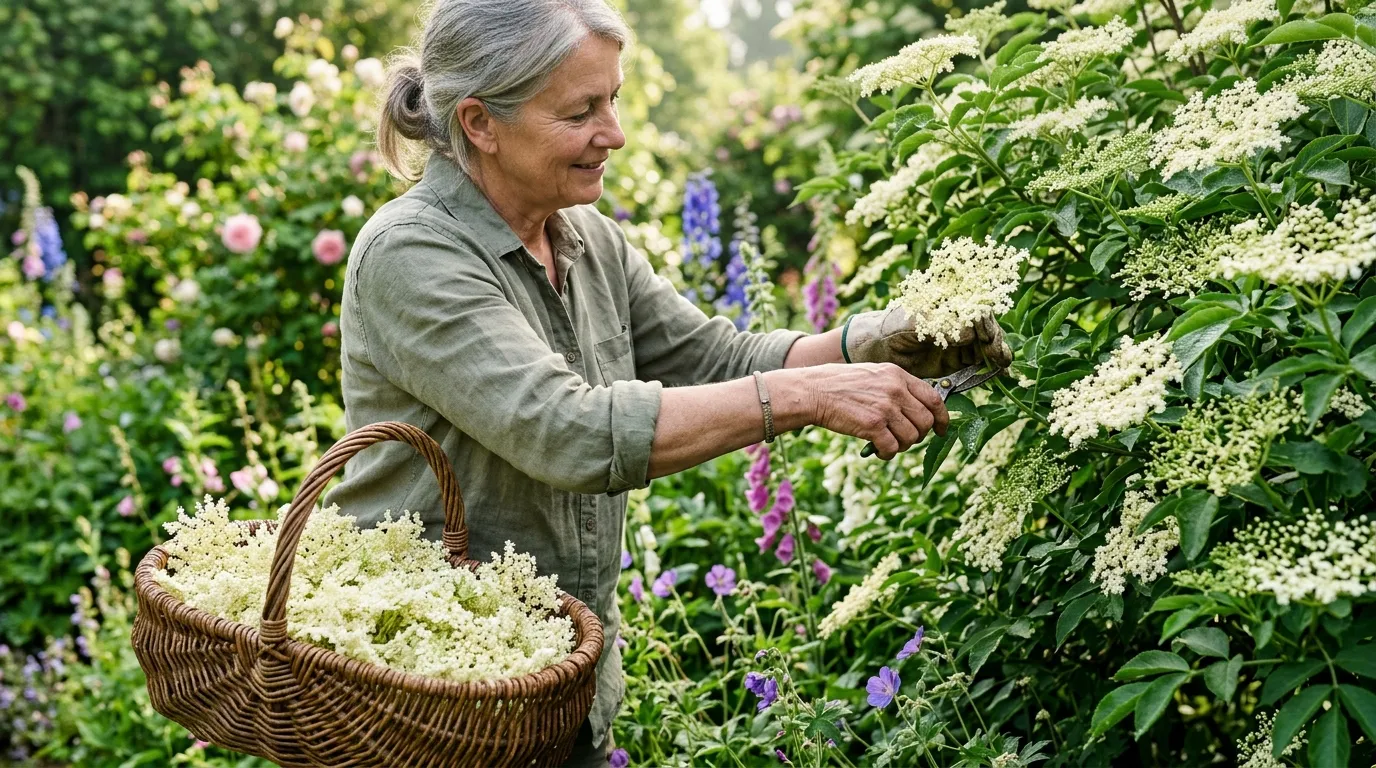
Elderflowers harvested in June for cordial. Pick on a dry morning when the pollen is fresh for the best flavour.
Related reading
- How to Grow Fruit Trees in the UK — apples, pears, plums, and cherries for the productive UK garden
- How to Prune Shrubs — timing, tools, and technique for all types of garden shrub
- Best Flowering Shrubs for UK Gardens — top ornamental shrubs with season-by-season interest
- Native Trees for UK Gardens — the best British native species to grow for wildlife and structure
- How to Make Jam from Garden Fruit — preserving elderberries, blackberries, and other garden fruit
Lawrie has been gardening in the West Midlands for over 30 years. He grows his own veg using no-dig methods, keeps a wildlife-friendly garden, and writes practical advice based on real UK growing conditions.