How to Make Jam from Garden Fruit
Complete UK guide to making jam from garden fruit. Covers pectin levels, sugar ratios, setting point tests, sterilising jars, and recipes for 6 fruits.
Key takeaways
- The jam setting point is exactly 104.5C, measured with a sugar thermometer
- Standard jam ratio is 1kg fruit to 1kg granulated sugar for most recipes
- High-pectin fruits like blackcurrants and gooseberries set most easily without additives
- Strawberry jam needs the juice of 2 lemons per kg of fruit to reach a firm set
- Properly sterilised and sealed jam keeps for 12 months in a cool, dark cupboard
- A 3kg batch of fruit makes roughly 10-12 standard 340g jars of jam
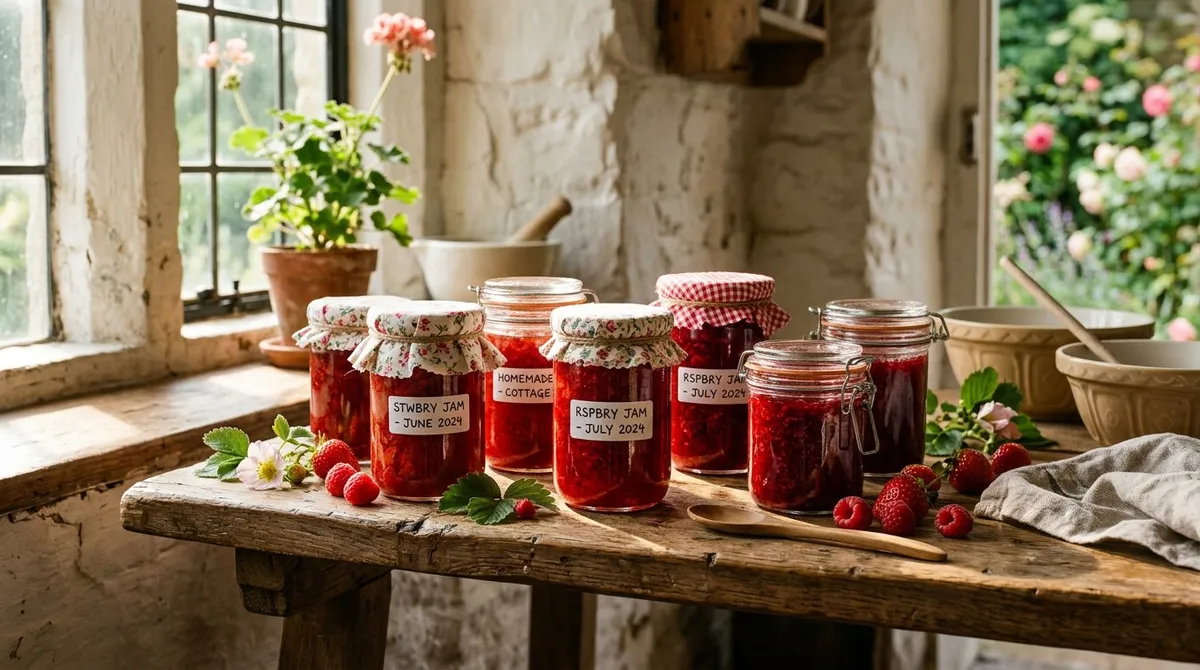
Making jam is one of the most satisfying ways to preserve a fruit harvest. A single afternoon in the kitchen can turn 3kg of garden raspberries or blackcurrants into enough jam to last a year. The process is straightforward. You need fruit, sugar, heat, and a little understanding of pectin. No specialist training or expensive equipment required.
This guide covers everything a UK gardener needs to know about jam making. It includes pectin levels for every common garden fruit, the correct sugar ratios, step-by-step recipes for six fruits, and troubleshooting for the problems that catch beginners out. Whether you have a single strawberry patch or a full soft fruit cage, these methods work.
Essential equipment for jam making
You do not need much to make jam. Most home kitchens already have everything required. The only specialist item worth buying is a sugar thermometer. It costs under five pounds and removes all guesswork from the setting point.
The equipment list:
- Heavy-bottomed preserving pan or large stainless steel saucepan (at least 6 litres)
- Sugar thermometer (digital or traditional)
- Long-handled wooden spoon
- Heatproof jug or ladle
- Jam jars with new lids (340g is the standard size)
- Jam funnel (optional but reduces mess)
- Cold saucers for the wrinkle test (keep 3 in the freezer)
Avoid aluminium or unlined copper pans. The acid in fruit reacts with these metals and taints the flavour. A wide, shallow pan is better than a tall, narrow one. The larger surface area helps water evaporate faster, producing a quicker set.
Jars must be glass with metal screw-top lids. Reuse jars from shop-bought jam, but always buy new lids. Used lids rarely seal properly. Kilner jars work well for gifting but cost more.
Warning: Boiling sugar reaches 104.5C and causes severe burns on contact. Keep children and pets away from the stove. Wear long sleeves and use a long-handled spoon. Never leave a boiling pan unattended.
Understanding pectin and acid levels
Pectin is the natural substance in fruit that makes jam set. Without enough pectin, jam stays liquid no matter how long you boil it. Different fruits contain different amounts. Knowing the pectin level of your fruit determines whether you need to add anything extra.
Acid works alongside pectin. It activates the pectin and helps it form a gel. Fruits low in acid need lemon juice to compensate. This is why strawberry jam recipes always call for lemon juice.
| Fruit | Pectin level | Acid level | Additional pectin needed? |
|---|---|---|---|
| Blackcurrants | High | High | No |
| Gooseberries | High | High | No |
| Cooking apples | High | High | No |
| Plums (damsons) | High | High | No |
| Raspberries | Medium | Medium | Rarely (add 1 lemon per kg) |
| Blackberries | Low-medium | Low | Yes (2 lemons per kg or pectin powder) |
| Strawberries | Low | Low | Yes (2 lemons per kg) |
| Cherries | Low | Low | Yes (2 lemons per kg or pectin powder) |
| Rhubarb | Low | High | Yes (mix with high-pectin fruit) |
Slightly under-ripe fruit contains more pectin than fully ripe fruit. A mix of three-quarters ripe to one-quarter under-ripe produces the best set. Overripe fruit has the least pectin. Use overripe fruit for sauces and coulis instead.
The RHS guide to growing soft fruit covers harvesting at the right stage for preserving.
Sugar ratios and types
The standard jam ratio is 1kg of fruit to 1kg of granulated sugar. This produces a sweet, well-set jam with a long shelf life. The sugar is not just for sweetness. It acts as a preservative and works with pectin to form the gel structure.
Which sugar to use:
- Granulated sugar is the standard choice. Cheapest and works perfectly.
- Preserving sugar has larger crystals that dissolve slowly and produce less scum. It costs more but gives a slightly clearer jam.
- Jam sugar contains added pectin. Use this only for low-pectin fruits like strawberries if you want to skip adding lemon juice. It is more expensive.
Do not reduce the sugar. Recipes calling for 1kg of sugar per 1kg of fruit are calibrated for setting and preservation. Cutting the sugar to 750g produces a softer set and a shorter shelf life (3-4 months instead of 12). Low-sugar jams must be kept in the fridge after opening and used within 2 weeks.
Warming the sugar before adding it to the fruit speeds up the process. Spread the sugar on a baking tray and place in a low oven at 100C for 10 minutes. Warm sugar dissolves faster and avoids cooling the fruit mixture.
How to test the setting point
The setting point is 104.5C. At this temperature, the combination of sugar, pectin, and acid forms a gel. There are two reliable ways to test it.
The thermometer method
Clip a sugar thermometer to the side of the pan. The bulb must sit in the jam but not touch the bottom of the pan. Watch the temperature climb as the jam boils. When it reaches 104.5C, remove the pan from the heat immediately. This method is precise and foolproof. We recommend it for beginners.
The wrinkle test (cold saucer method)
Before you start cooking, place 3 saucers in the freezer. When you think the jam is ready, remove the pan from the heat. Drop a teaspoon of jam onto a cold saucer. Wait 30 seconds. Push the edge of the jam pool with your fingertip. If the surface wrinkles, the jam is set. If it stays liquid, return the pan to the heat and boil for another 2 minutes before testing again.
Always remove the pan from the heat while testing. Leaving it on the stove means the jam continues cooking and may over-set during the test, producing a tough, rubbery texture.
Gardener’s tip: The wrinkle test and the thermometer sometimes disagree. Trust the thermometer. It is measuring the actual sugar concentration, while the wrinkle test depends on room temperature and saucer temperature.
How to sterilise jars properly
Sterilisation kills bacteria, yeasts, and moulds that cause jam to spoil. Skip this step and the jam develops mould within weeks, regardless of how well it was cooked.
Oven sterilisation method (recommended):
- Wash jars in hot soapy water. Rinse thoroughly.
- Place jars upside down on a clean baking tray.
- Heat the oven to 140C.
- Place the tray in the oven for 15 minutes.
- Leave jars in the oven until ready to fill.
- Boil lids separately in a pan of water for 5 minutes.
Filling the jars:
Use a heatproof jug or jam funnel to pour hot jam into hot jars. Leave a 5mm gap at the top. Place a waxed disc on the surface of the jam (wax side down). Screw on the hot lid immediately. The cooling jam makes a vacuum seal. You will hear the lid click as it seals.
Do not turn jars upside down after filling. This old-fashioned method does not improve the seal and can cause the jam to leak past the waxed disc.
Fruit jam recipes
Each recipe below uses the standard 1:1 ratio and makes roughly 4-5 jars of 340g. Scale up for a bigger harvest. A 3kg batch fills 10-12 jars and takes no more extra time than a 1kg batch.
Strawberry jam
Strawberry jam is the most popular but the hardest to set. Strawberries have low pectin and low acid. Lemon juice is essential.
Ingredients: 1kg hulled strawberries, 1kg granulated sugar, juice of 2 lemons.
Hull and halve the strawberries. Place in the preserving pan with the lemon juice. Warm gently over a low heat for 5 minutes to release juice. Do not add water. Add the sugar and stir over a low heat until fully dissolved. Do not let it boil before the sugar dissolves, or the jam crystallises.
Bring to a full rolling boil. Boil hard for 8-10 minutes, stirring occasionally to prevent sticking. Test for setting point at 104.5C. Skim off any scum with a slotted spoon. Let the jam cool in the pan for 10 minutes before potting. This short rest prevents the strawberry pieces from floating to the top of the jar.
Raspberry jam
The easiest jam for beginners. Raspberries have enough pectin and acid to set reliably with minimal fuss. The set is softer than plum or blackcurrant jam, which suits the fruit.
Ingredients: 1kg raspberries, 1kg granulated sugar, juice of 1 lemon.
Place the raspberries in the pan and warm gently for 5 minutes until the juices run. Add the sugar and lemon juice. Stir over low heat until dissolved. Boil hard for 5-8 minutes. Raspberry jam sets quickly. Test early to avoid over-setting. Pot immediately.
Autumn-fruiting varieties like Autumn Bliss and Polka make excellent jam. Summer varieties like Glen Ample and Tulameen work equally well. Use a mixture of fully ripe and slightly under-ripe berries for the best set.
Blackberry jam
Wild blackberries from hedgerows make superb jam, but their pectin content is unpredictable. Garden varieties are more consistent. Combine with cooking apple for a reliable set.
Ingredients: 750g blackberries, 250g peeled and chopped cooking apples, 1kg granulated sugar, juice of 1 lemon.
Simmer the apple pieces in 100ml of water for 10 minutes until soft. Add the blackberries and lemon juice. Warm gently for 5 minutes. Add the sugar and stir until dissolved. Boil hard for 10-12 minutes. Test for set. The apple provides the pectin that blackberries lack. See our foraging guide for tips on picking wild blackberries.
Plum jam
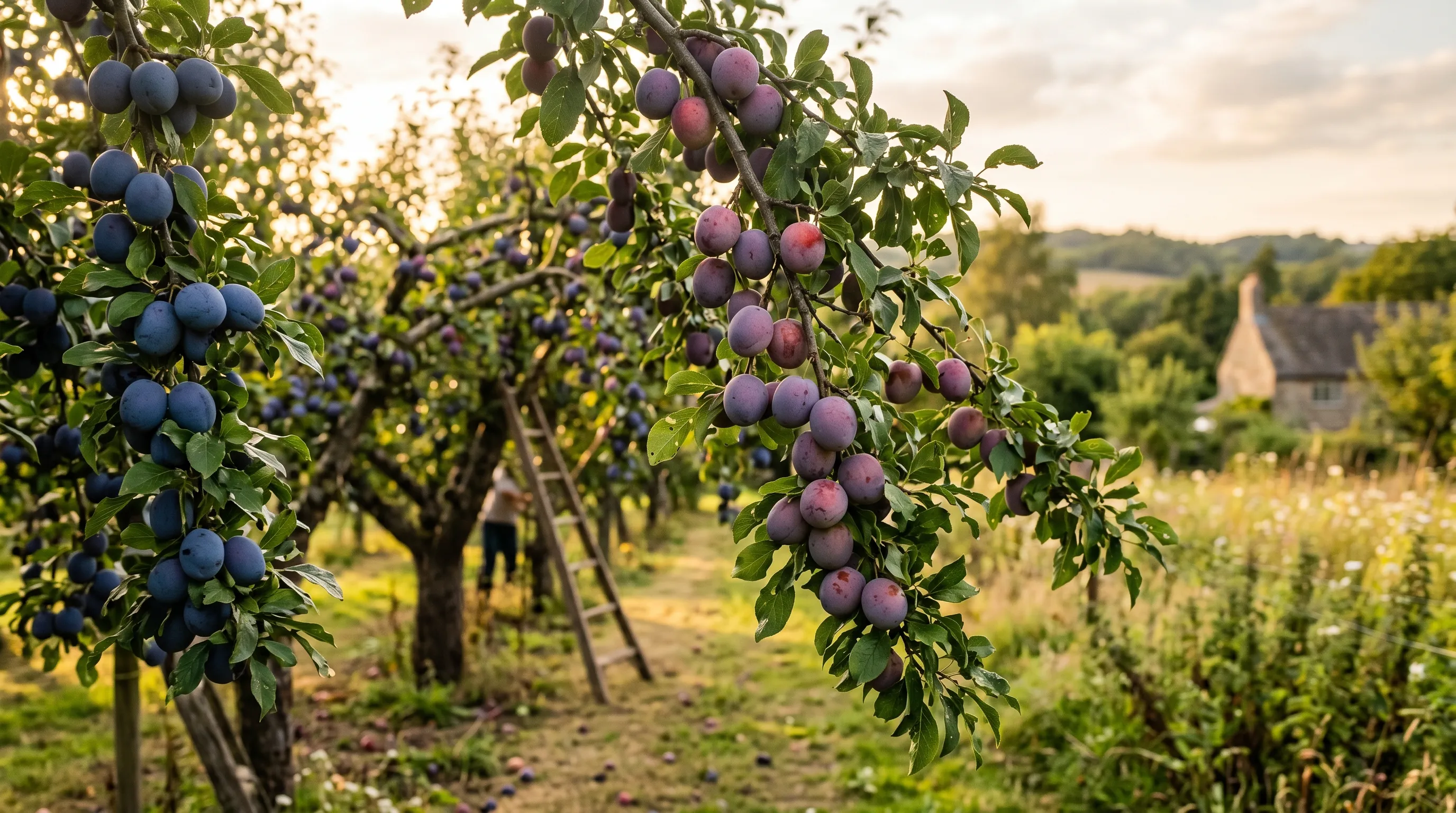
Plums have high pectin and make a firm, well-flavoured jam. Victoria is the classic UK variety for jam making. Damsons produce an even richer, more intensely flavoured jam but need slightly more sugar due to their sharpness.
Ingredients: 1kg plums (halved, stones removed), 1kg granulated sugar, 150ml water.
Place the halved plums and water in the pan. Simmer for 15 minutes until the fruit is completely soft and broken down. Add the sugar and stir until dissolved. Boil hard for 10-15 minutes. Skim any froth from the surface. Test for set. Pot into hot jars.
For damsons, increase the sugar to 1.2kg per 1kg of fruit. The stones are small and fiddly to remove before cooking. Simmer the damsons whole and fish out the stones as they float to the surface during cooking.
Gooseberry jam
Gooseberries have the highest pectin of any common garden fruit. They set so firmly that over-boiling produces a stiff, rubbery jam. Watch the timing carefully.
Ingredients: 1kg gooseberries (topped and tailed), 1kg granulated sugar, 300ml water.
Simmer the gooseberries in the water for 15-20 minutes until completely soft and mushy. The skins must break down fully. Add the sugar and stir until dissolved. Boil hard for 5-8 minutes only. Test early. Gooseberry jam reaches setting point faster than any other fruit. Pot immediately.
The colour depends on the variety. Green gooseberries make a pale amber jam. Red varieties like Hinnonmaki Red produce a beautiful deep rose colour.
Blackcurrant jam
Blackcurrants make the richest, most intensely flavoured jam. The high pectin and acid levels make it virtually impossible to fail. A single mature bush yields 4-5kg of fruit, enough for 16-25 jars.
Ingredients: 1kg blackcurrants (stripped from stalks), 1.2kg granulated sugar, 500ml water.
The extra water is essential. Blackcurrant skins are tough and need a long simmer to soften. Place the blackcurrants and water in the pan. Simmer for 30 minutes, stirring occasionally, until the fruit is completely soft and the liquid has reduced by roughly one third. Add the sugar and stir until dissolved. Boil hard for 5-8 minutes. Test for set. Pot into hot jars.
Why we recommend growing your own blackcurrants for jam making: After 30 years of preserving garden harvests, blackcurrants give the best return of any fruit for jam making. A single mature bush I planted in my garden produces consistently 4-5kg of fruit per season, yielding up to 25 jars of jam from one plant with minimal effort. No other garden fruit sets so reliably or produces such a deep, intense flavour. Variety ‘Ben Connan’ is my pick: compact enough for a small garden, disease-resistant, and the fruit strips cleanly from the stem in under five minutes.
Jam making fruit calendar
Timing matters. Each fruit has a narrow window of peak ripeness for jam making. Pick too early and you lose flavour. Pick too late and the pectin level drops.
| Fruit | Harvest window | Best jam-making period | Yield per plant |
|---|---|---|---|
| Gooseberries | Late June - July | Late June (slightly under-ripe) | 3-5kg per bush |
| Strawberries | June - July | Early-mid July (peak ripeness) | 200-400g per plant |
| Raspberries (summer) | June - August | July (mix ripe and under-ripe) | 1-2kg per cane row |
| Blackcurrants | July | Mid-July (fully ripe, easily stripped) | 4-5kg per bush |
| Plums (Victoria) | August - September | Late August (when fruit drops easily) | 20-30kg per mature tree |
| Blackberries | August - September | Late August - early September | 2-5kg per plant |
| Damsons | September - October | September (first frosts improve flavour) | 15-20kg per mature tree |
| Raspberries (autumn) | August - October | September (best balance of flavour and set) | 1-2kg per cane row |
Common jam making mistakes
These five mistakes account for nearly every failed batch of homemade jam. Avoid them and your jam will set every time.
Boiling before the sugar dissolves
This is the single biggest cause of crystallised, grainy jam. Sugar must dissolve completely over a low heat before you increase to a rolling boil. Stir continuously and check the back of the spoon. If you can still see or feel sugar crystals, keep stirring. This stage takes 5-10 minutes. Rushing it ruins the batch.
Not reaching a full rolling boil
A gentle simmer does not produce enough evaporation. The jam must reach a full rolling boil that cannot be stirred down. This vigorous boil drives off excess water and concentrates the sugar to the 104.5C setting point. Boil for the time specified in the recipe. A weak boil for 20 minutes gives worse results than a hard boil for 8 minutes.
Over-boiling high-pectin fruits
Gooseberries and blackcurrants set quickly. Five minutes of hard boiling is often enough. Over-boiling produces a dark, rubbery jam with a burned flavour. Test early and test often. Pull the pan off the heat while you check the setting point.
Using old or damaged lids
A proper vacuum seal requires an undamaged lid with an intact rubber coating. Dented, scratched, or reused lids rarely seal correctly. The jam may look fine initially but develops mould within weeks as air enters the jar. New lids cost pennies. Buy them in bulk. It is the cheapest investment in the entire process.
Filling cold jars with hot jam
Pouring 104C jam into a cold glass jar risks cracking the glass. It also prevents a proper vacuum seal from forming. Always fill hot jars with hot jam. Keep sterilised jars in the oven at 140C until the moment you need them.
Troubleshooting guide
| Problem | Cause | Fix |
|---|---|---|
| Jam won’t set | Low pectin, under-boiled | Reboil with juice of 2 lemons per kg, test again at 104.5C |
| Jam is too thick/rubbery | Over-boiled, too much pectin | Cannot fix once potted. Next batch: test earlier, reduce boil time |
| Crystals in the jam | Sugar not fully dissolved before boiling | Cannot fix once set. Next batch: stir longer over low heat |
| Mould on surface | Poor sterilisation, damaged lid | Discard the whole jar. The Food Standards Agency advises against scraping off mould |
| Fruit floating to top | Potted too quickly while hot | Let jam cool 10-15 minutes in the pan before potting. Stir gently |
| Bubbles in the jar | Fermentation from residual yeast | Discard. Ensure jars and lids are properly sterilised next time |
| Dark colour | Over-boiled or stored in light | Store in a dark cupboard. Reduce boiling time next batch |
Storage and shelf life
Properly made and sealed jam stores well. The high sugar content acts as a natural preservative.
Unopened jars: 12 months in a cool, dark cupboard. A pantry, garage shelf, or under-stairs cupboard all work well. Avoid anywhere with direct sunlight or temperature swings. Heat degrades colour and flavour over time.
Opened jars: 4-6 weeks in the fridge. Always use a clean, dry spoon. Introducing moisture or crumbs encourages mould. If mould appears, discard the entire jar. Do not scrape off the mould and eat the rest.
Low-sugar jam: 3-4 months unopened, 2 weeks in the fridge once opened. The reduced sugar provides less preserving power. Label these jars clearly.
Freezer jam: Some recipes call for uncooked or lightly cooked fruit set with pectin and frozen. These keep for 6 months in the freezer and 2 weeks in the fridge after defrosting. They are softer than cooked jam and have a fresher fruit flavour.
For more home preserving methods including chutneys, freezing produce, and pickling, see our full collection of easy vegetable recipes and preserving guides. Our article on storing apples and pears covers long-term fruit storage without cooking.
Now you’ve mastered making jam from garden fruit, read our guide on how to grow blackcurrants and redcurrants for the next step in building the most productive soft fruit jam garden.
Frequently asked questions
What temperature does jam set at?
Jam sets at 104.5C. Use a sugar thermometer clipped to the side of the pan for accuracy. Without a thermometer, use the wrinkle test: drop a teaspoon of jam onto a cold saucer, wait 30 seconds, and push it with your finger. If the surface wrinkles, it is ready.
Why won’t my homemade jam set properly?
Low pectin is the most common cause. Strawberries and blackberries have low natural pectin. Add the juice of 2 lemons per kg of fruit, or use 1 tablespoon of powdered pectin. Under-boiling is the second cause. The jam must reach a full rolling boil for at least 5 minutes.
How long does homemade jam last once opened?
Opened jam keeps for 4-6 weeks in the fridge. Unopened, properly sealed jam lasts 12 months stored in a cool, dark cupboard. Always use a clean spoon to avoid introducing bacteria. If mould appears on opened jam, discard the entire jar.
Which garden fruits are best for making jam?
Blackcurrants and gooseberries are the easiest because they have high pectin and acid. Plums and raspberries have medium pectin and set reliably. Strawberries and blackberries have low pectin and need added lemon juice or pectin powder to set.
Do I need to add pectin to homemade jam?
Not always. High-pectin fruits set without added pectin. Low-pectin fruits like strawberries need the juice of 2 lemons per kg, or 1 tablespoon of powdered pectin. Combining a low-pectin fruit with a high-pectin fruit also works. Mixing strawberries with redcurrants produces a reliable set.
How do I sterilise jars for jam making?
Wash jars in hot soapy water and rinse. Place upside down on a baking tray in the oven at 140C for 15 minutes. Boil lids separately in water for 5 minutes. Fill jars while still hot. Sterilisation kills bacteria and prevents mould during storage.
Can I use frozen fruit to make jam?
Yes, frozen fruit works well for jam. Defrost completely and include all the juice. Frozen fruit often produces a softer set because freezing breaks down cell walls. Add an extra tablespoon of lemon juice per kg to compensate. Frozen raspberries and blackcurrants make particularly good jam.
How much jam does 1kg of fruit make?
One kg of fruit plus 1kg of sugar makes roughly 1.5-1.7kg of jam. That fills 4-5 standard 340g jars. A productive blackcurrant bush yields 4-5kg of fruit per year, enough for 16-25 jars of jam from a single plant.
Lawrie has been gardening in the West Midlands for over 30 years. He grows his own veg using no-dig methods, keeps a wildlife-friendly garden, and writes practical advice based on real UK growing conditions.