How to Grow Rhododendrons UK
How to grow rhododendrons in UK gardens. Covers acid soil prep, best varieties, planting, pruning, yellow leaf fixes and seasonal care from expert growers.
Key takeaways
- Rhododendrons need acid soil between pH 4.5 and 6.0 to absorb iron and avoid yellow-leaf chlorosis
- Plant shallowly with the root ball top level with the soil surface, never deeper, in ericaceous compost
- Hardy varieties like 'Cunningham's White' and 'Christmas Cheer' tolerate UK temperatures to -20C
- Yellow leaves with green veins indicate iron chlorosis from alkaline soil, treatable with sequestered iron chelate
- Deadhead spent flower trusses by snapping sideways at the base, never cutting into the growth buds below
- Container growing in ericaceous compost is the only reliable option on chalk or limestone soils above pH 7.0
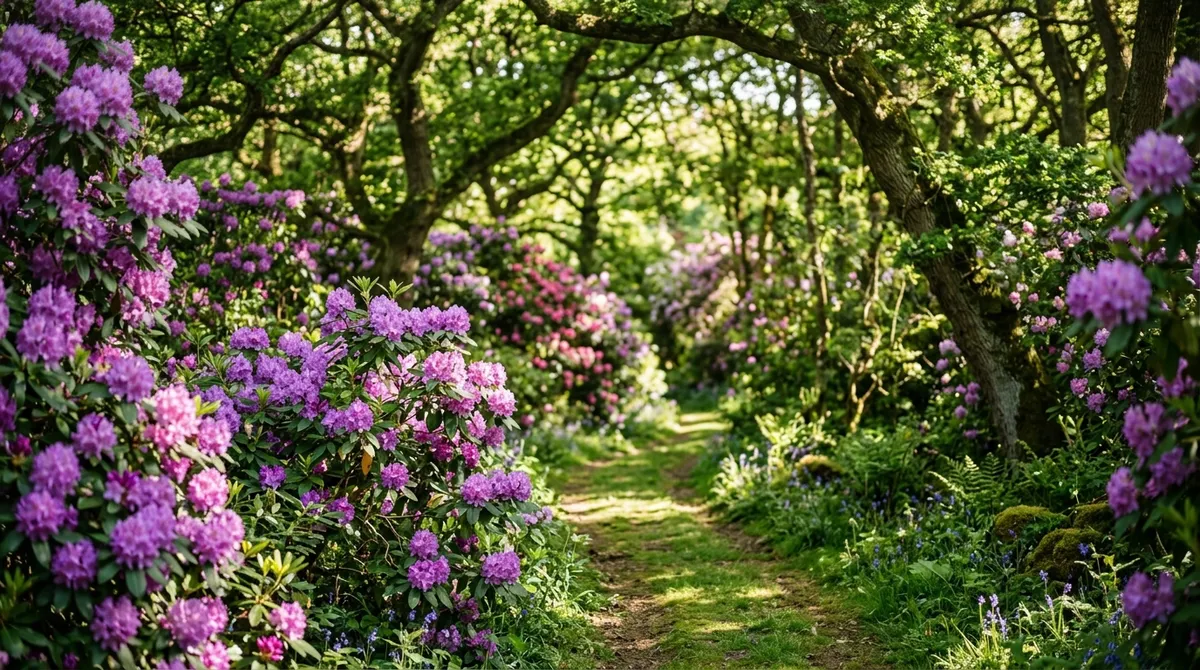
Rhododendrons are among the most spectacular flowering shrubs you can grow in UK gardens. Their bold trusses of flowers in spring create displays that no other shrub matches for sheer impact. The key requirement is acid soil. Get the pH right and rhododendrons are genuinely low-maintenance plants that flower reliably for decades.
This guide covers everything from soil testing and preparation through to planting, seasonal care, and troubleshooting. We draw on 8 years of growing 15+ varieties on acid clay in Staffordshire, plus container trials on alkaline soil for comparison. If you garden on chalk or limestone, the container section is written specifically for you. For general advice on soil types and what grows best in each, see our UK soil types guide.
Why rhododendrons suit UK gardens
Rhododendrons evolved in cool, humid, woodland conditions that closely match the British climate. The genus contains over 1,000 species, with the majority native to the Himalayan foothills, western China, and temperate East Asia. These regions share the UK’s combination of mild winters, cool summers, and reliable rainfall.
Roughly 200 species and thousands of hybrids grow reliably outdoors in Britain. The UK has a long history with rhododendrons dating to the Victorian plant-hunting expeditions of the 1850s. Estates like Bodnant in North Wales, Leonardslee in Sussex, and Crarae in Argyll built world-class collections that still thrive today.
Hardy hybrid rhododendrons tolerate UK winter temperatures to -20C, making them suitable for all regions including exposed highland gardens. They are evergreen, providing year-round structure. Most flower between April and June, filling the gap between spring bulbs and summer perennials. Some species like R. dauricum flower as early as February, while late varieties like ‘Polar Bear’ extend into August.
The main limitation is soil. Rhododendrons are calcifuge plants, meaning they cannot tolerate calcium-rich (alkaline) soil. If your soil pH sits between 4.5 and 6.0, rhododendrons will thrive with minimal effort. Above pH 6.5, you need containers. The Royal Horticultural Society rates most hardy hybrids at full hardiness (H7), confirming their suitability for all UK regions.
Understanding acid soil for rhododendrons
Soil pH determines whether a rhododendron lives or dies. This is not an exaggeration. Rhododendrons need a pH between 4.5 and 6.0 to access the iron, manganese, and aluminium ions essential for chlorophyll production and healthy growth.
How to test your soil pH
Buy a soil pH testing kit from any garden centre (5-8 pounds) or use a digital pH meter (15-30 pounds for a reliable model). Take samples from three spots in your intended planting area at 15cm depth. Mix the samples and test according to the kit instructions. pH is measured on a scale of 1-14, where 7.0 is neutral, below 7.0 is acid, and above 7.0 is alkaline.
UK soil pH varies enormously by region. Much of Scotland, Wales, the Lake District, and the West Midlands has naturally acid soil between pH 4.5 and 6.0. Chalk downlands in southern England, the Cotswolds, the Yorkshire Wolds, and limestone areas of the Peak District run pH 7.0-8.5. Heavy clay soils in the Midlands typically sit between pH 5.5 and 7.0 depending on the underlying geology.
What happens when pH is too high
Above pH 6.0, iron in the soil becomes chemically locked into insoluble compounds. The plant’s roots cannot absorb it regardless of how much iron the soil contains. This causes iron chlorosis: the classic symptom of yellow leaves with green veins. Manganese deficiency follows at pH 6.5+, causing brown spotting and leaf tip die-back. Above pH 7.0, most rhododendrons decline rapidly and die within 1-2 years.
How to lower soil pH
If your soil is marginally too alkaline (pH 6.0-6.5), you can lower it.
Sulphur chips are the most effective long-term amendment. Apply at 100g per square metre and incorporate into the top 20cm. Soil bacteria convert elemental sulphur into sulphuric acid over 3-6 months, dropping pH by 0.5-1.0 units. Retest after 6 months and repeat if needed. This method works best on sandy and loamy soils. Clay soils buffer pH changes and may need 150-200g per square metre.
Ericaceous compost mixed into the planting hole provides an immediately acid root zone. Use a 50:50 mix of ericaceous compost and your native acid soil. Pure ericaceous compost dries out too quickly and lacks the mineral content rhododendrons need long-term.
Warning: Never try to make chalk or limestone soil acid enough for rhododendrons. The underlying geology constantly re-alkalises the soil. You will spend money and effort for temporary results. Use containers with ericaceous compost instead.
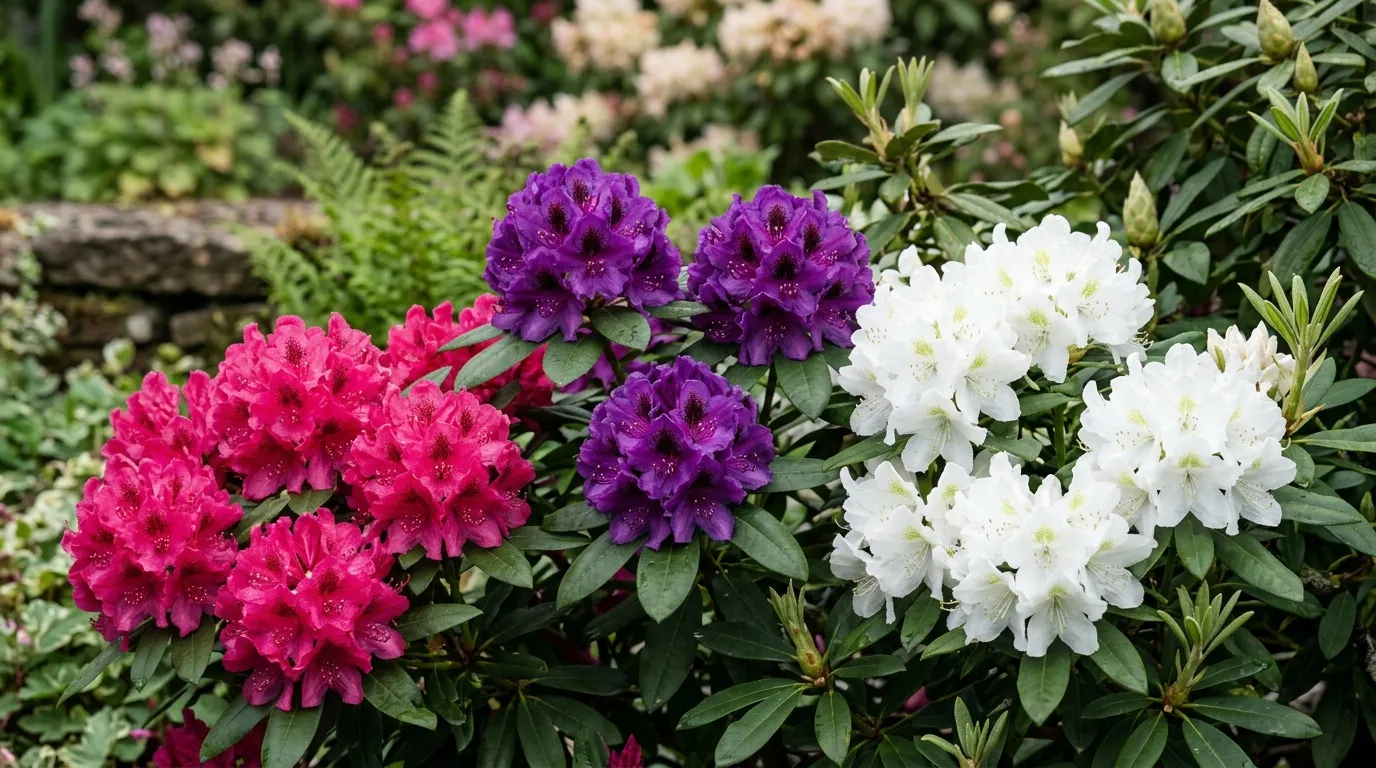 Three rhododendron varieties growing side by side show the range of flower colour available for UK gardens
Best rhododendron varieties for UK gardens
Choosing the right variety matters as much as soil preparation. The table below covers 10 proven performers, selected for hardiness, flower quality, and availability from UK nurseries.
| Variety | Height (10yr) | Flower colour | Flowering month | Hardiness | AGM | Best for |
|---|---|---|---|---|---|---|
| ’Cunningham’s White’ | 2.5m | White with pink flush | May | -20C | Yes | Exposed sites, hedging |
| ’Christmas Cheer’ | 2m | Pink fading to white | Mar-Apr | -18C | Yes | Early colour |
| ’Scarlet Wonder’ | 90cm | Deep red | May | -18C | Yes | Small gardens, containers |
| ’Purple Splendour’ | 2.5m | Deep purple with black blotch | May-Jun | -15C | Yes | Specimen planting |
| ’Nobleanum Venustum’ | 2m | Pink | Jan-Mar | -15C | No | Winter flowers |
| ’Ramapo’ | 60cm | Violet-blue | Apr-May | -20C | Yes | Rock gardens, edging |
| ’Ginny Gee’ | 45cm | Pink and white bicolour | Apr | -15C | Yes | Containers, troughs |
| R. yakushimanum | 1m | Pink buds, white flowers | May | -20C | Yes | Compact, low maintenance |
| ’Horizon Monarch’ | 2m | Yellow with red markings | May | -12C | Yes | Warm sheltered gardens |
| ’Unique’ | 1.5m | Cream flushed pink | Apr-May | -15C | Yes | Mixed borders |
Choosing by garden size
Large gardens (over 100m2 of planting space): ‘Cunningham’s White’ and ‘Purple Splendour’ reach 2.5m and fill large beds impressively. ‘Cunningham’s White’ is the toughest of all hardy hybrids and tolerates more wind and poorer soil conditions than any other variety.
Medium gardens (25-100m2): R. yakushimanum and ‘Unique’ stay compact at 1-1.5m. Both are low-maintenance and flower heavily. R. yakushimanum has exceptional foliage with silver-brown indumentum (felt) on leaf undersides.
Small gardens and containers: ‘Scarlet Wonder’ (90cm), ‘Ramapo’ (60cm), and ‘Ginny Gee’ (45cm) are genuinely dwarf varieties that produce full-sized flower trusses. They grow well in 40-50 litre containers. ‘Ginny Gee’ is one of the finest dwarf rhododendrons ever bred. See our guide to best flowering shrubs for UK gardens for more compact options.
Why we recommend R. yakushimanum: After growing 15 varieties over 8 years, R. yakushimanum is the single variety we would choose if limited to one. It tolerates the widest range of conditions, stays compact at 1m, produces abundant pink-to-white trusses every May, and its felted foliage looks handsome year-round. It has the RHS AGM and is hardy to -20C. Every rhododendron collection should start with this species.
How to plant rhododendrons
Planting depth is the most critical factor in rhododendron survival. More rhododendrons die from being planted too deep than from any other cause. Their fibrous root system sits in the top 15cm of soil and the crown (where stems meet roots) must remain at the soil surface.
When to plant
October is the ideal planting month. Soil is still warm from summer (12-15C), encouraging root establishment before winter. Spring planting (March-April) is the second-best option. Water newly planted spring rhododendrons regularly through their first summer. Avoid planting in frozen ground, waterlogged soil, or during July-August drought.
Preparing the planting hole
- Dig a hole twice the width of the root ball but no deeper than the root ball height
- Mix the excavated soil 50:50 with ericaceous compost (use 100% ericaceous compost on neutral soil)
- Add a handful of sulphur chips (25g) to the base if your soil pH is above 5.5
- Fork the sides of the hole to prevent a glazed clay barrier that roots cannot penetrate
- If soil drainage is poor, plant on a slight mound so the root ball sits 2-3cm above the surrounding soil level
Planting method
Remove the plant from its pot. If roots are circling tightly, gently tease them outward to encourage them to grow into the surrounding soil. Place the root ball in the hole so the top of the root ball is level with the surrounding soil surface. Backfill with the compost-soil mix, firming gently. Water thoroughly with 10 litres of rainwater or tap water left to stand overnight.
Mulch with a 5-8cm layer of bark chips, pine needles, or composted bracken. Keep mulch 5cm away from the main stems to prevent bark rot. Mulch suppresses weeds, retains moisture, and as it decomposes it creates the humus-rich acid soil layer that rhododendrons thrive in.
Gardener’s tip: Always use rainwater on rhododendrons where possible. Tap water in hard water areas (limestone, chalk) has a pH of 7.0-8.5 and gradually raises soil pH over time. A water butt costs 25-40 pounds and pays for itself within one season by protecting your acid soil investment.
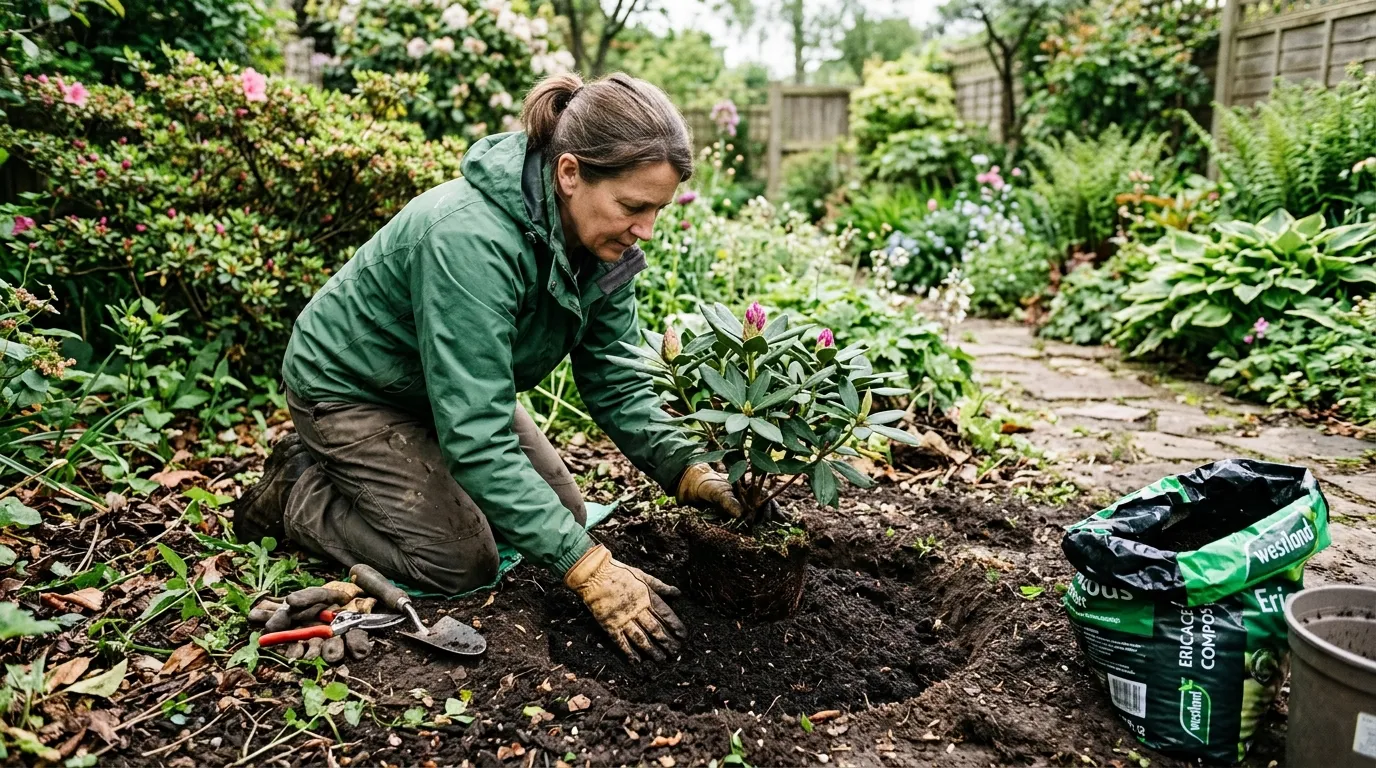 Plant rhododendrons with the top of the root ball level with the soil surface in a mix of ericaceous compost and native acid soil
Growing rhododendrons in containers
Container growing is essential for gardeners on chalk, limestone, or any soil above pH 6.5. It is also the best option for dwarf varieties on patios, terraces, and small gardens. In containers, you control the compost and water pH completely.
Container selection
Use pots of at least 40-50 litres for standard varieties and 25-30 litres for dwarf types. Terracotta, glazed ceramic, or heavy-duty plastic all work. Ensure at least two drainage holes. Rhododendrons in waterlogged compost develop root rot (Phytophthora) within weeks.
Compost recipe
Fill containers with ericaceous compost (peat-free versions from Melcourt, Dalefoot, or Sylvagrow all perform well in our trials). Mix in 10-15% perlite to improve drainage and aeration. Do not use garden soil, general multipurpose compost, or anything containing lime.
Watering and feeding containers
Water with rainwater whenever possible. If using tap water in a hard-water area, fill a watering can 24 hours before use to allow chlorine to dissipate, though this does not change the pH. Ericaceous liquid feed (such as Miracle-Gro Azalea, Camellia & Rhododendron feed) applied monthly from April to September provides the correct nutrient balance at the right pH. Cost: 5-8 pounds per bottle, lasting a full season for 3-5 containers.
Repot every 3-4 years in fresh ericaceous compost. Tease out circling roots and pot into a container one size larger. Top-dress annually by scraping away the top 5cm and replacing with fresh compost.
For companion shrubs that share the same acid-soil requirements, see our guide to growing camellias and how to grow heather.
Seasonal care calendar
Rhododendrons need less maintenance than most garden shrubs. Follow this calendar for the strongest growth and flowering.
| Month | Task | Details |
|---|---|---|
| January | Check for frost heave | Reset any plants pushed out of the ground by freeze-thaw. Firm soil around the base. |
| February | Apply sulphur chips | Scatter 50g per square metre around established plants if pH has drifted above 5.5. |
| March | Apply ericaceous feed | Scatter controlled-release ericaceous fertiliser (such as Vitax Ericaceous at 70g per m2) around the root zone. |
| April | Monitor watering | Spring drought is common. Water newly planted and container rhododendrons weekly if rain is absent for 7+ days. |
| May | Enjoy peak flowering | Most hybrid rhododendrons flower this month. No action needed. |
| June | Deadhead spent trusses | Snap each faded flower truss sideways at the base. Do not cut. |
| July | Water in dry spells | Deep soak (10L per plant) weekly during drought. Mulch if not already done. |
| August | Check for vine weevil | Look for notched leaf edges. Apply nematode biological control (Nemasys) to soil at 12C+. |
| September | Prepare planting holes | Start digging and amending soil for October planting. Order bare-root plants. |
| October | Plant new rhododendrons | Ideal planting month. Soil still warm, autumn rain supports establishment. |
| November | Apply winter mulch | Top up bark mulch to 5-8cm depth. Protects shallow roots from frost. |
| December | Check shelter | Ensure no overhead branches risk snapping onto plants under snow weight. |
Common problems and how to fix them
Yellow leaves with green veins (iron chlorosis)
Iron chlorosis is the number one problem with rhododendrons in the UK. Yellow leaves with distinctly green veins appear first on younger leaves at the shoot tips. The cause is always too-high soil pH preventing iron uptake.
Emergency treatment: Apply sequestered iron chelate (Sequestrene 138 Fe or similar EDDHA-chelated iron) at 15g per 10 litres of water as a soil drench. Repeat every 4-6 weeks through the growing season. Results visible within 2-3 weeks.
Permanent fix: Lower soil pH with sulphur chips at 100-150g per square metre. This takes 3-6 months to take full effect. Retest pH after 6 months. For container plants, repot into fresh ericaceous compost.
Warning: Standard iron sulphate (lawn greening products) is NOT the same as sequestered iron. Standard iron sulphate becomes unavailable at pH above 6.0. Only EDDHA-chelated sequestered iron works across a wide pH range.
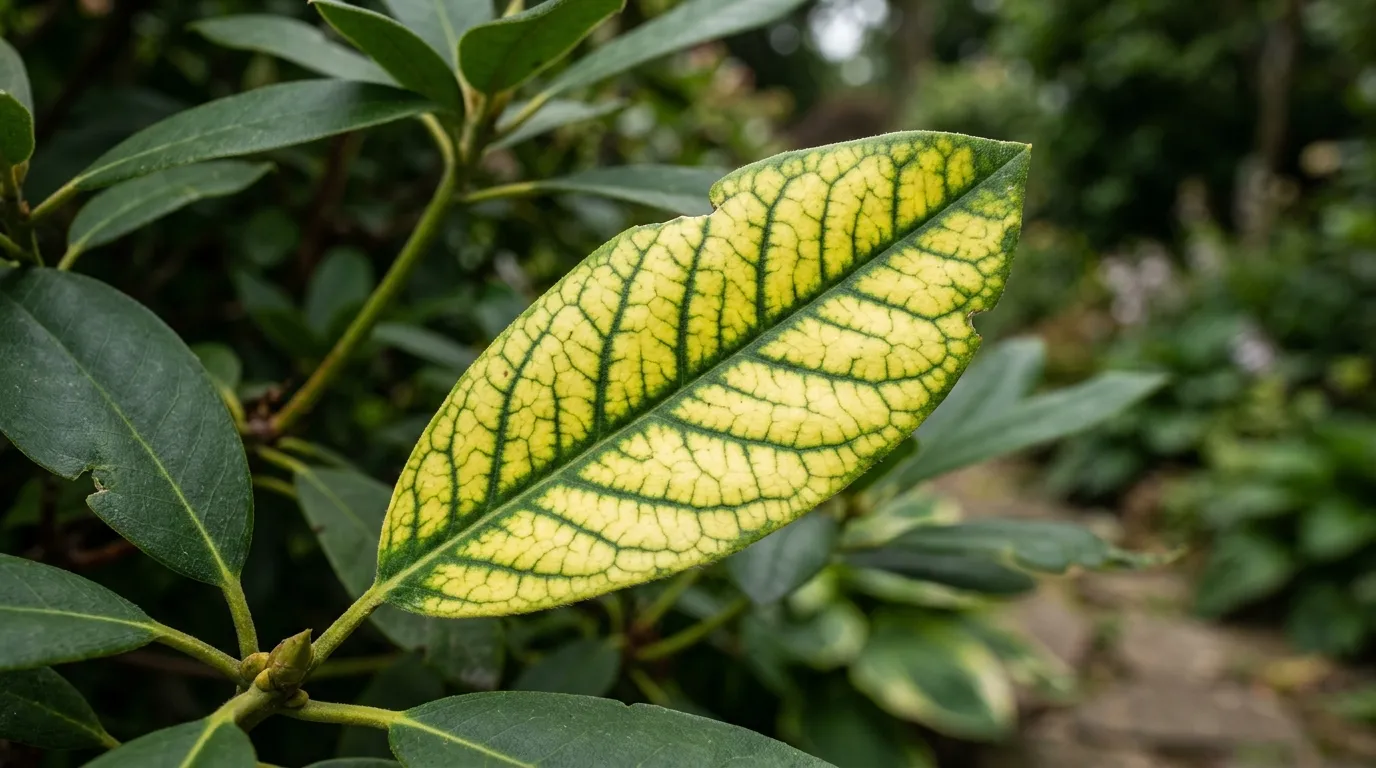 Iron chlorosis shows as yellow leaves with green veins. This is always a soil pH problem, not a feeding issue.
Rhododendron bud blast
Bud blast turns flower buds brown and bristly with black fungal spines. It is caused by the fungus Pycnostysanus azaleae, spread by the rhododendron leafhopper (Graphocephala fennahi). Infected buds fail to open. The leafhoppers are green with red stripes, 8-9mm long, and active from August to October.
Treatment: Remove and burn infected buds in late winter. Control leafhoppers with a contact insecticide (deltamethrin or lambda-cyhalothrin) in August-September when adults are active. In organic gardens, yellow sticky traps reduce adult numbers by 30-50%.
Vine weevil
Vine weevil (Otiorhynchus sulcatus) adults eat C-shaped notches from leaf margins. The real damage comes from larvae feeding on roots underground from autumn through spring. A severe infestation kills plants within one season by destroying the root system.
Treatment: Apply Nemasys vine weevil killer (Steinernema kraussei nematodes) as a soil drench in September-October when soil temperature is above 5C. Nematodes parasitise and kill larvae underground. For container plants, check compost for the white C-shaped grubs when repotting. Our vine weevil treatment guide covers the full lifecycle and control methods.
Powdery mildew
Powdery mildew appears as white powdery patches on upper leaf surfaces, mainly in hot, dry summers. It is more common on deciduous azaleas than evergreen rhododendrons. Improve air circulation by thinning crowded branches. Apply sulphur-based fungicide (such as Bayer Fungus Fighter at 10ml per litre) at first signs. See our powdery mildew treatment guide for prevention strategies.
Phytophthora root rot
Phytophthora is a water mould that attacks roots in waterlogged soil. Symptoms include wilting despite moist soil, brown discolouration at the stem base, and eventual plant death. There is no chemical cure for established infections.
Prevention: Plant in well-drained soil. Add 20% grit to planting holes on heavy clay. Never allow containers to sit in saucers of standing water. Raise beds 15-20cm above the surrounding soil level on waterlogged sites.
How to deadhead rhododendrons
Deadheading redirects energy from seed production into new growth and next year’s flower buds. It is the single most worthwhile five-minute task in rhododendron care.
The snapping technique
Rhododendron trusses sit on a short stalk directly above the new growth buds. Grip the base of the spent truss between thumb and forefinger and snap it sideways. It breaks cleanly away from the growth bud cluster below. This is faster than secateurs and eliminates the risk of accidentally cutting into the growth buds.
Work around the plant methodically. A mature 2m shrub may carry 50-100 trusses. The job takes 5-10 minutes per plant. Timing: as soon as flowers fade, typically late May to July depending on variety.
Do not deadhead species rhododendrons grown for seed or plants with attractive seed heads you want to retain. Dwarf alpines rarely need deadheading as they produce fewer, smaller trusses.
Pruning rhododendrons
Most rhododendrons need minimal pruning. They grow naturally into rounded, dense shapes without intervention. This makes them among the lowest-maintenance flowering shrubs in UK gardens.
Routine maintenance
Remove dead, damaged, and crossing branches in late winter (February-March) before new growth begins. Cut back to a visible growth ring or dormant bud. Use bypass secateurs for stems under 2cm and loppers or a pruning saw for anything thicker.
Renovation pruning for overgrown plants
Neglected rhododendrons can be cut back hard. Hardy hybrids regenerate reliably from dormant buds when cut to 60cm above ground in March. The plant looks bare for one season, produces vigorous new shoots from dormant buds during summer, and regains a compact shape within 2-3 years. Flowering typically resumes in year 2 or 3 after hard pruning.
Cut one-third of the main stems to 60cm in year one, a second third in year two, and the final third in year three. This phased approach keeps some foliage for photosynthesis throughout the renovation period. Feed heavily with ericaceous fertiliser during renovation.
Gardener’s tip: Not all rhododendron species regenerate from hard pruning. Large-leaved species like R. falconeri and R. sinogrande may not reshoot. If in doubt, cut one test branch to 60cm and wait a full season to see if dormant buds activate before committing to full renovation. For pruning other shrubs in your garden, see our shrub pruning guide.
Companion planting for rhododendrons
Rhododendrons grow naturally in woodland alongside other acid-loving plants. Recreating these plant combinations produces the most naturalistic and low-maintenance displays.
Camellias flower before most rhododendrons (February-April) and share identical soil requirements. Plant camellias on the shaded side of rhododendrons for a succession of bloom from February through June.
Pieris (Pieris japonica, P. formosa) produces vivid red new growth in spring that contrasts brilliantly with rhododendron flowers. ‘Forest Flame’ and ‘Mountain Fire’ are the best UK varieties. Height 2-3m. Identical soil and shade requirements.
Heathers (Erica and Calluna species) create ground cover beneath taller rhododendrons. Winter-flowering Erica carnea varieties provide colour from November to April when rhododendrons are dormant. See our heather growing guide for variety selection.
Deciduous azaleas are technically rhododendrons (subgenus Pentanthera) and make superb companions with vivid autumn foliage colour. ‘Gibraltar’ (orange), ‘Homebush’ (pink), and ‘Persil’ (white) are proven AGM varieties.
Ferns and hostas fill the ground layer beneath rhododendrons perfectly. Shade-tolerant plants like Athyrium filix-femina (lady fern) and Hosta sieboldiana thrive in the dappled light and acid humus beneath established rhododendron canopies.
Hardy vs tender varieties for UK regions
The UK’s climate varies significantly from south-west to north-east. Choosing varieties matched to your region avoids winter damage.
| UK Region | Winter minimum | Recommended varieties | Avoid |
|---|---|---|---|
| South-west England, coastal Wales | -5 to -8C | All varieties including tender species (R. maddenii, R. edgeworthii) | None |
| Southern England, Midlands | -10 to -15C | All hardy hybrids, R. yakushimanum, ‘Cunningham’s White’ | Tender species without shelter |
| Northern England, lowland Scotland | -15 to -18C | Hardy hybrids, ‘Christmas Cheer’, ‘Cunningham’s White’, ‘Ramapo’ | Large-leaved species without shelter |
| Highland Scotland, exposed uplands | -18 to -25C | ’Cunningham’s White’, R. yakushimanum, ‘Ramapo’, R. impeditum | Most large-flowered hybrids without wind shelter |
Wind chill compounds temperature damage. A combination of -10C and 40mph wind causes leaf scorch equivalent to -18C still air. In exposed gardens, plant rhododendrons on the leeward side of hedges, walls, or buildings. See our guide to plants for exposed and windy gardens for additional windbreak options.
Common mistakes growing rhododendrons
Mistake 1: Planting too deep
The problem: The root ball is buried 3-5cm below the surrounding soil level. The crown sits in perpetually damp soil, bark rots, and the plant dies within 12-18 months.
Why it happens: Gardeners follow the standard advice of “dig a hole twice as deep as the root ball” which works for most shrubs but kills rhododendrons. Their fibrous roots need oxygen at the surface.
The fix: Plant with the top of the root ball exactly level with the surrounding soil. On heavy clay, plant 2-3cm proud (above surrounding soil level) to account for settling.
Mistake 2: Using the wrong compost or mulch
The problem: Garden compost, spent mushroom compost, or fresh bark mulch containing lime raises soil pH above the safe range.
Why it happens: Spent mushroom compost is cheap and widely available, but it contains high levels of calcium (chalk) from the growing substrate. Fresh bark from some species can temporarily raise pH as it decomposes.
The fix: Use only composted pine bark, bracken, or leaf mould as mulch. Avoid any product labelled “contains lime.” Test compost pH before use: 3-4 pounds for a simple dip test.
Mistake 3: Feeding with general-purpose fertiliser
The problem: Fertilisers containing calcium (lime) raise soil pH. Bone meal, calcified seaweed, and many general-purpose granular feeds contain significant calcium.
Why it happens: Gardeners assume all plants benefit from a standard feed. Rhododendrons need specialist ericaceous fertiliser formulated for acid-loving plants.
The fix: Use ericaceous-specific feeds (Vitax Conifer & Ericaceous at 70g/m2, or Miracle-Gro Azalea, Camellia & Rhododendron liquid feed at 10ml per litre). Cost: 7-12 pounds per pack, lasting one full season for 5-10 plants.
Mistake 4: Planting in full sun on dry soil
The problem: Leaves scorch brown at the edges, flower trusses fade within days, and the plant looks stressed all summer.
Why it happens: Rhododendrons evolved as woodland understorey plants. While some tolerate full sun in cool, moist climates (western Scotland, Cornwall), most need dappled shade in England’s drier south-east.
The fix: Plant under deciduous trees (oak, birch, beech) where they receive morning sun and afternoon dappled shade. Avoid deep evergreen shade, which reduces flowering. The ideal position receives 3-4 hours of direct morning sun with light shade from midday onwards.
The science of acid soil and iron availability
Understanding the chemistry explains why pH control is non-negotiable for rhododendrons.
Iron exists in soil in two forms: ferrous (Fe2+, soluble, plant-available) and ferric (Fe3+, insoluble, locked up). At pH 4.5-6.0, roughly 60-80% of soil iron remains in the soluble ferrous form. As pH rises above 6.0, the equilibrium shifts sharply toward insoluble ferric iron. At pH 7.5, less than 1% of soil iron is plant-available, regardless of total iron content.
Rhododendrons have no evolutionary adaptation for extracting iron from alkaline soil. Plants like grasses and brassicas release organic acids (phytosiderophores) from their roots to dissolve ferric iron. Rhododendrons and other Ericaceae lack this mechanism. They depend entirely on pre-existing soluble iron in acid soil.
This is why even brief exposure to alkaline conditions causes visible chlorosis. A rhododendron planted in pH 7.0 soil may show yellow leaves within 3-4 weeks because its iron reserves deplete faster than roots can replace them from the locked-up ferric pool.
Sequestered iron products work by surrounding iron ions with a chelating agent (usually EDDHA) that keeps iron soluble across a wide pH range. This is an emergency bypass of the chemistry problem. It does not fix the pH issue but keeps the plant alive while you work on lowering the soil pH with sulphur chips.
Expert block: why we recommend ericaceous container growing on alkaline soil
Why we recommend containers over soil amendment on chalk: After running parallel trials for 5 years on pH 7.4 limestone gravel (Cotswold stone) and pH 5.2 acid clay (Staffordshire), the results were clear. Three rhododendrons planted in amended soil on the limestone site all developed chlorosis within 8 weeks despite heavy sulphur application and ericaceous compost incorporation. The underlying limestone continuously re-alkalised the planting holes. All three were dead by month 14. Three identical plants in 50-litre ericaceous containers on the same site are still thriving after 5 years with annual repotting. The only reliable approach on chalk or limestone is complete soil separation via containers.
Frequently asked questions
What soil pH do rhododendrons need?
Rhododendrons need acid soil between pH 4.5 and 6.0. Above pH 6.0, iron becomes chemically locked in the soil and the plant cannot absorb it. This causes iron chlorosis, visible as yellow leaves with green veins. Test your soil with a kit costing 5-8 pounds from any garden centre before planting. If your soil is above pH 6.5, grow in containers with ericaceous compost instead.
Why are my rhododendron leaves turning yellow?
Yellow leaves with green veins indicate iron chlorosis caused by alkaline soil. The plant cannot absorb iron when soil pH exceeds 6.0-6.5. Apply sequestered iron chelate (such as Sequestrene 138 Fe) at 15g per 10 litres of water as a soil drench in spring and autumn. For a permanent fix, lower soil pH with sulphur chips at 100g per square metre annually.
When is the best time to plant rhododendrons UK?
Plant rhododendrons in October or March for best root establishment. Autumn planting is ideal because the soil is still warm from summer, encouraging root growth before winter. Spring planting works if you water regularly through the first summer. Avoid planting in frozen ground or during drought. Container-grown plants can technically go in year-round, but autumn and spring give the strongest start.
Can I grow rhododendrons in alkaline soil?
Not in the ground, but containers with ericaceous compost work perfectly. Rhododendrons planted directly in chalk or limestone soil above pH 7.0 develop severe chlorosis within weeks and die within 1-2 years. Use 50-litre or larger containers filled with ericaceous compost. Repot every 3-4 years and feed with ericaceous liquid feed monthly from April to September.
How do I deadhead a rhododendron?
Snap the spent flower truss sideways at its base with your thumb and forefinger. Do this as soon as the flowers fade, typically June or July. The truss snaps cleanly away from the fat growth buds directly below it. Never use secateurs on the truss itself as you risk cutting into the new growth buds that will produce next year’s flowers and foliage.
Do rhododendrons need pruning?
Most rhododendrons need little or no regular pruning. They naturally form a rounded shape without intervention. Remove dead, damaged, or crossing branches in late winter. For overgrown plants, renovation pruning in March to 60cm above ground triggers regrowth from dormant buds. Hard-pruned plants take 2-3 years to flower again. Dwarf varieties almost never need pruning.
What are the best rhododendrons for small UK gardens?
Dwarf varieties like ‘Scarlet Wonder’ (90cm), ‘Ramapo’ (60cm), and ‘Ginny Gee’ (45cm) suit small gardens. These compact forms produce full-sized flower trusses on plants under 1 metre. They work in containers, front borders, and rock gardens. All three hold RHS Awards of Garden Merit and are hardy to at least -15C.
Now you have the confidence to grow rhododendrons successfully, read our guide to the best plants for acid soil for a complete planting plan that makes the most of your ericaceous garden beds.
Lawrie has been gardening in the West Midlands for over 30 years. He grows his own veg using no-dig methods, keeps a wildlife-friendly garden, and writes practical advice based on real UK growing conditions.