UK Soil Types: Identify Yours in Minutes
UK soil types explained with hand tests, pH ranges, and regional maps. Identify clay, sand, silt, loam, chalk, and peat in your garden.
Key takeaways
- Six UK soil types — clay, sandy, silt, loam, chalk, and peat — each with distinct pH, drainage, and nutrient profiles
- The squeeze test identifies your soil in 30 seconds: clay holds shape, sand crumbles, loam forms a ball that breaks apart
- Clay soil has a CEC of 20-40 meq/100g, holding 3-5 times more nutrients than sandy soil at 5-10 meq/100g
- Home pH testing kits cost £5-£15 and give results in 10 minutes; lab tests cost £25-£50 and measure NPK plus trace elements
- Adding 5-10cm of organic matter annually improves every soil type — it loosens clay, binds sand, and feeds soil biology
UK soil types determine what thrives in your garden more than any other factor. The six main types — clay, sandy, silt, loam, chalk, and peat — each have distinct drainage rates, pH ranges, and nutrient profiles that suit different plants. A 30-second hand test tells you exactly what you are working with, and a £5 pH kit reveals whether your soil is acid, neutral, or alkaline.
After 25 years of gardening, allotment work, and soil testing across the Midlands, I have handled every UK soil type in every condition. This guide covers how to identify your soil by hand, what grows best in each type, where each type is found across the UK, and how to improve problem soils without wasting money on the wrong amendments.
What are the six main UK soil types?
The UK sits on some of the most geologically varied bedrock in Europe, producing six distinct soil types. Each has a different particle size, drainage rate, and nutrient-holding capacity.
Clay soil has particles under 0.002mm. It drains slowly at 1-5mm per hour, holds nutrients well with a cation exchange capacity (CEC) of 20-40 meq/100g, and feels sticky when wet. Around 40% of UK gardens sit on clay.
Sandy soil has particles of 0.05-2mm. It drains rapidly at 50-100mm per hour, loses nutrients quickly (CEC 5-10 meq/100g), and feels gritty between your fingers. Found across Norfolk, Surrey heathland, and coastal areas.
Silt soil has particles of 0.002-0.05mm. It holds moisture well, feels smooth and silky, and is highly fertile. River valleys and floodplains in Cambridgeshire and the Humber estuary have the deepest silt deposits.
Loam is a balanced mix of clay, sand, and silt with organic matter. It drains freely while retaining moisture, has a CEC of 15-25 meq/100g, and is the most versatile growing medium. True loam is relatively rare in UK gardens.
Chalk and limestone soil sits over calcium carbonate bedrock. It is alkaline at pH 7.1-8.5, free-draining, and often shallow. Found across the Chilterns, South and North Downs, and Yorkshire Wolds.
Peat soil is formed from partially decomposed plant material in waterlogged conditions. It is very acidic at pH 3.5-5.5, moisture-retentive, and rich in organic matter. The Fens, Somerset Levels, and Scottish Highlands have significant peat deposits.
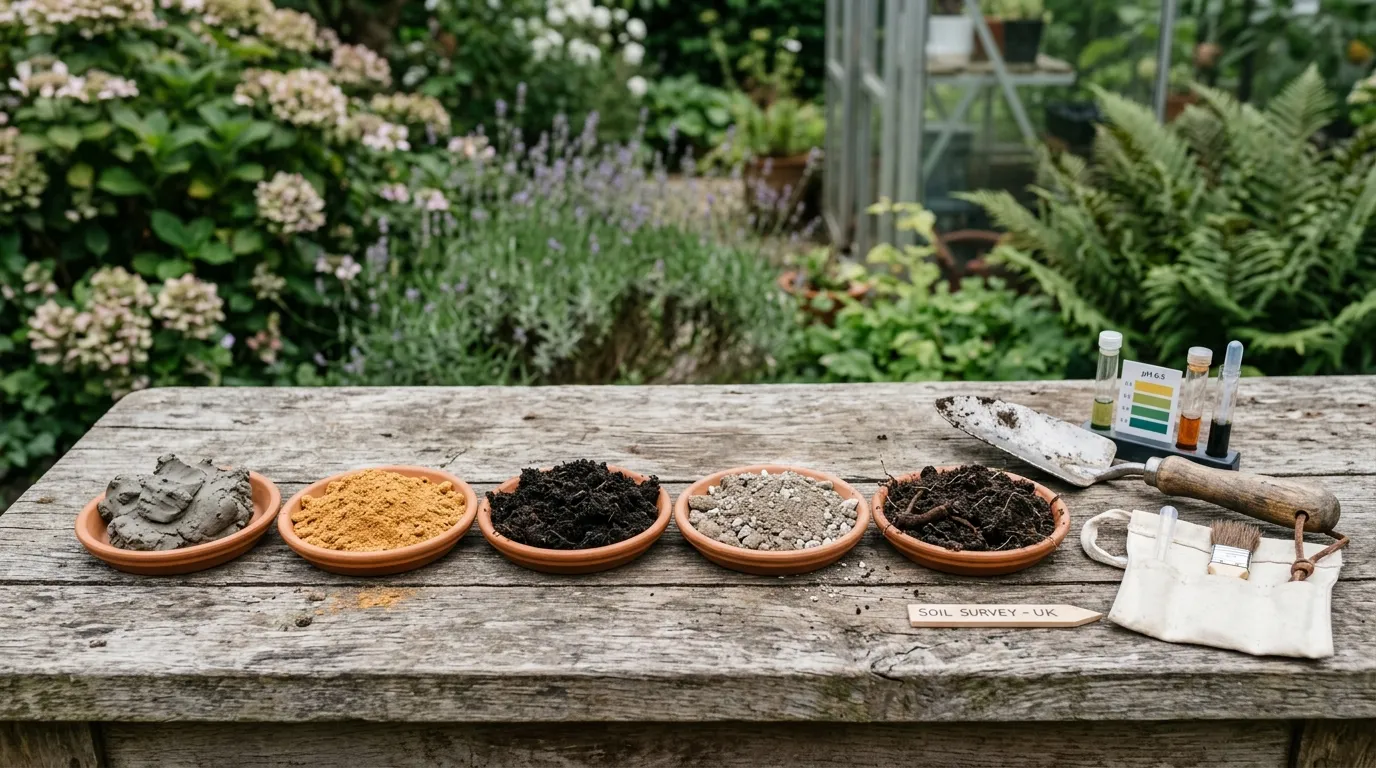
Six UK soil types compared: clay (dark, sticky), sand (pale, gritty), silt (smooth, grey-brown), loam (dark, crumbly), chalk (pale with white fragments), and peat (dark brown, fibrous).
How to identify your soil type with the hand squeeze test
You do not need a laboratory to identify your soil. Three simple hand tests give you a reliable answer in under five minutes. Grab a handful of soil from 15cm below the surface — not the top layer, which is mostly organic matter.
The squeeze test
Moisten a golf-ball-sized lump of soil until it is damp but not dripping. Squeeze it firmly in your fist and open your hand.
- Clay: Holds its shape firmly. Feels sticky and smooth. Leaves a shiny smear on your palm.
- Sandy: Falls apart immediately. Feels gritty. Individual grains visible.
- Silt: Holds shape briefly then crumbles. Feels smooth and silky, like flour.
- Loam: Forms a loose ball that breaks apart when you press it. Feels slightly gritty with a smooth undertone.
- Chalk: Crumbles quickly. May contain visible white fragments of calcium carbonate.
- Peat: Spongy and dark. Squeezes out moisture like a sponge. Fibrous texture.
The ribbon test
Roll a thumb-sized piece of moist soil between your thumb and forefinger, pressing it into a flat ribbon.
- Over 5cm ribbon: Heavy clay. Your soil has more than 40% clay particles.
- 2-5cm ribbon: Clay loam. A mix with significant clay content.
- Under 2cm or no ribbon: Sandy, silty, or loam. Low clay content.
The jar test
This is the most accurate home test. Fill a jam jar one-third with soil, add water to near the top, shake vigorously for two minutes, and leave it for 48 hours. The soil settles in layers: sand on the bottom (within 1 minute), silt in the middle (within 2 hours), and clay on top (within 48 hours). Measure each layer as a percentage of the total to determine your soil type.
A jar with roughly equal layers of sand, silt, and clay indicates loam. If the bottom sand layer is dominant, you have sandy soil. A thick top clay layer confirms clay soil.
UK soil type comparison: drainage, pH, nutrients, and best plants
This table compares all six soil types across the key factors that affect plant growth. Use it to match your soil to the right plants and amendments.
| Soil Type | Particle Size | pH Range | Drainage Rate | CEC (meq/100g) | Workability | Main UK Regions | Best Plants |
|---|---|---|---|---|---|---|---|
| Clay | Under 0.002mm | 6.0-8.0 | 1-5mm/hr (slow) | 20-40 (high) | Difficult when wet or dry | Midlands, Thames Valley, South East | Roses, geraniums, dogwoods, asters |
| Sandy | 0.05-2mm | 5.0-6.5 | 50-100mm/hr (fast) | 5-10 (low) | Easy year-round | Norfolk, Suffolk, Surrey heathland | Lavender, cistus, birch, carrots |
| Silt | 0.002-0.05mm | 6.0-7.0 | 15-25mm/hr (moderate) | 15-25 (moderate) | Good when dry, slippery wet | Fenland, Humber, river valleys | Most vegetables, willows, alders |
| Loam | Mixed | 6.0-7.0 | 10-20mm/hr (ideal) | 15-25 (moderate) | Excellent year-round | Scattered, often river terraces | Almost everything thrives |
| Chalk | Variable + CaCO₃ | 7.1-8.5 | 30-60mm/hr (fast) | 10-20 (moderate) | Stony, shallow | Chilterns, Downs, Wolds | Lavender, clematis, beech, yew |
| Peat | Organic matter | 3.5-5.5 | Variable (often waterlogged) | 100-200 (very high) | Spongy, may need draining | Fens, Somerset, Scottish Highlands | Heathers, blueberries, bog plants |
Where are the different soil types found across the UK?
UK soil type is determined by the underlying geology, and British bedrock is remarkably varied for such a small island. Knowing your region narrows down your soil type before you even pick up a handful.
Clay soils dominate the Midlands and South East. The Mercia Mudstone formation runs across Staffordshire, Warwickshire, and Worcestershire. London Clay covers much of Greater London and Essex. Oxford Clay runs from Dorset through Oxfordshire to the Wash. The Weald Clay sits across Kent and Sussex. If you garden in any of these areas, expect heavy clay with a pH of 6.5-7.5.
Sandy soils cover the Surrey and Hampshire heathlands, much of Norfolk and Suffolk, and coastal strips around the country. The Bagshot Formation in Surrey produces famously acid, sandy soil (pH 4.5-5.5). Norfolk’s Breckland sand is slightly less acid at pH 5.5-6.5. Coastal sand dunes can be alkaline (pH 7.0-8.0) due to shell fragments.
Silt soils are concentrated in river valleys and floodplains. The Fens of Cambridgeshire, Lincolnshire, and Norfolk have some of the deepest silt deposits in Europe — up to 10 metres in places. The Humber estuary, Severn Vale, and Somerset Levels also have significant silt deposits. These are among the most productive agricultural soils in Britain.
Chalk and limestone soils follow a clear geological band across England. The Chilterns, North and South Downs, Yorkshire and Lincolnshire Wolds, and the Cotswolds all sit on chalk or limestone bedrock. The Mendip Hills and Peak District White Peak have limestone soils. These areas have alkaline conditions (pH 7.1-8.5) and often thin, stony topsoil. Our guide to plants for chalky alkaline soil covers what thrives in these conditions.
Peat soils form in waterlogged areas where plant material decomposes very slowly. The Cambridgeshire Fens (before drainage) had the deepest peat in lowland England. The Somerset Levels, Scottish Highlands, and blanket bogs of the Pennines and Wales still have significant peat. Garden peat soils are very acidic and suit acid-loving plants like rhododendrons and blueberries.
The British Geological Survey soil viewer lets you check the underlying geology of your exact postcode. It is free to use and gives a reliable starting point for identifying your soil type.
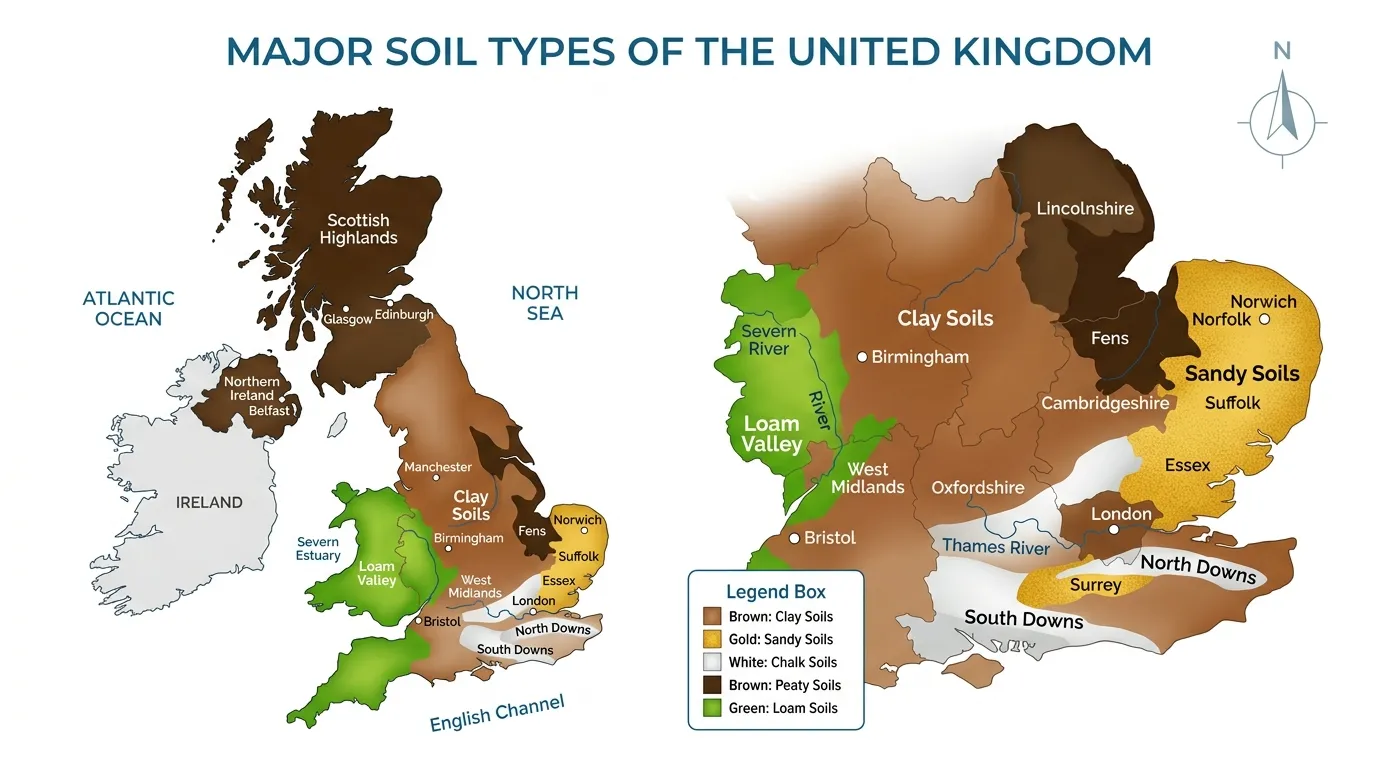
UK soil distribution follows geology: clay dominates the Midlands and South East, sandy soil covers heathland and coastal areas, chalk underlies the Downs and Wolds, and peat fills the Fens and upland bogs.
How to test soil pH at home
pH is the second critical measurement after soil type. It determines which nutrients are available to plant roots and which plants will thrive or fail. The scale runs from 0 (most acidic) to 14 (most alkaline), with 7.0 as neutral.
What the numbers mean
| pH Range | Classification | Common UK Locations | Best Suited Plants |
|---|---|---|---|
| 3.5-4.5 | Very acidic | Raw peat bogs, upland moors | Sphagnum moss, heather, sundew |
| 4.5-5.5 | Acidic | Heathland, conifer woodland | Rhododendrons, blueberries, camellias |
| 5.5-6.5 | Slightly acidic | Most woodland, sandy areas | Most ornamentals, potatoes, soft fruit |
| 6.0-7.0 | Near neutral | Well-managed garden soil | Vegetables, roses, lawns, most plants |
| 7.0-7.5 | Neutral to mildly alkaline | Many UK gardens, light clay | Clematis, lavender, brassicas |
| 7.5-8.5 | Alkaline | Chalk Downs, limestone areas | Box, yew, dianthus, scabious |
Home pH testing methods
Colour-change liquid kits cost £5-£8 and give results in 10 minutes. Take soil samples from 15cm depth, mix with the provided solution, and compare the colour to the chart. Accuracy is within 0.5 pH units — good enough for plant selection decisions.
Digital pH meters cost £15-£40. Push the probe into moist soil and read the number on the display. Calibrate with buffer solutions before each session. Cheap meters under £10 are unreliable — spend at least £15 for consistent readings.
Professional lab analysis costs £25-£50 and measures pH, nitrogen, phosphorus, potassium, and trace elements. Labs like the RHS soil analysis service provide specific amendment recommendations. Worth doing once to establish a baseline for your garden.
Test soil every 2-3 years. UK rainfall is naturally slightly acidic (pH 5.0-5.6) and gradually lowers soil pH over time. Test more often if you are actively adjusting pH with lime or sulphur. Our detailed guide to soil testing and pH adjustment covers the full process.
Quick soil tests at a glance
| Test | Cost | Time | Accuracy | What It Measures |
|---|---|---|---|---|
| Colour-change liquid kit | £5-£8 | 10 minutes | ±0.5 pH units | pH only |
| Litmus paper strips | £3-£5 | 5 minutes | ±1.0 pH unit | pH only (least accurate) |
| Digital pH meter | £15-£40 | 2 minutes | ±0.2 pH units | pH only |
| NPK test kit | £8-£15 | 20 minutes | Approximate | pH, nitrogen, phosphorus, potassium |
| Professional lab test | £25-£50 | 2-3 weeks | ±0.1 pH units | pH, NPK, trace elements, organic matter |
How to improve clay soil
Clay soil is the most common type in UK gardens and the one that causes the most frustration. It waterlogs in winter, cracks in summer, and sticks to everything in between. But clay is naturally the most fertile soil type, and improving its structure is straightforward with the right approach.
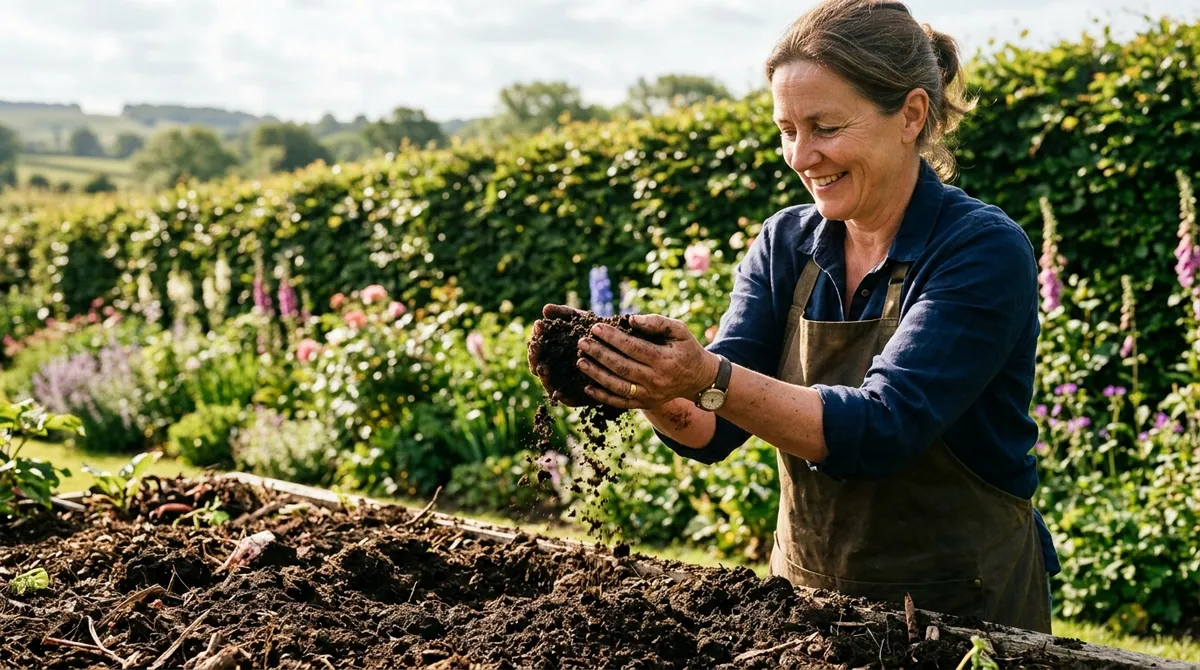
Add organic matter annually. Spread 5-10cm of garden compost, well-rotted manure, or composted bark over the surface every autumn. Do not dig it in on heavy clay — let worms pull it down naturally. This is the single most effective improvement. Each year of mulching loosens the top 5-10cm of soil. Our guide to making compost explains how to produce your own.
Add horticultural grit. Work sharp grit (not builder’s sand) into the top 20cm at a rate of one barrow-load per 3-4 square metres. This opens drainage channels that organic matter alone cannot create. Grit does not decompose, so it is a permanent improvement.
Never walk on wet clay. Foot traffic on waterlogged clay compresses it into a dense, airless mass. Lay scaffold boards across beds in winter. Create permanent paths between growing areas. One muddy shortcut across a border can undo a season of soil improvement.
Dig in autumn only. Autumn is the only safe time to turn heavy clay. Rough-dig it into large clods and leave the surface exposed over winter. Frost breaks the clods apart through freeze-thaw cycles, naturally creating the crumb structure that clay soils lack. Never dig clay when it is waterlogged or bone dry.
Consider no-dig methods. No-dig gardening avoids the compaction problem entirely. Spread 15cm of compost on the surface and plant directly into it. Worms and soil biology incorporate the organic matter over time. This approach works particularly well on heavy clay.
How to improve sandy soil
Sandy soil drains too fast and loses nutrients within 48-72 hours of application. The fix is the opposite of clay: you need to slow water down and hold nutrients in the root zone.
Mulch heavily with organic matter. Apply 10-15cm of garden compost, well-rotted manure, or leaf mould every year. Organic matter acts like a sponge in sandy soil, increasing water-holding capacity by up to 30%. It also raises the CEC, meaning nutrients stick around longer. Mulching is the most effective single improvement for sand.
Use slow-release fertilisers. Quick-release fertilisers wash straight through sandy soil. Choose controlled-release granules that feed over 3-6 months, or use organic fertilisers like blood, fish, and bone which release nutrients slowly as soil bacteria break them down. Our guide to feeding garden plants covers application rates.
Grow green manures. Sow green manures like phacelia, crimson clover, or field beans on bare sandy soil over winter. Their roots bind the soil, prevent nutrient leaching, and add organic matter when dug in. Leguminous green manures also fix nitrogen from the air — worth 50-100g of ammonium nitrate per square metre.
Water little and often. Sandy soil cannot store large volumes of water. Drip irrigation or soaker hoses on a timer deliver small amounts frequently, keeping the root zone moist without waste. A 30-minute soak twice a week beats a single heavy watering that drains straight through.
Choose plants that suit sand. Mediterranean species like lavender, rosemary, and cistus evolved in fast-draining conditions and need no amendment at all. Our guide to plants for sandy soil lists over 20 proven species.
How to improve chalk and limestone soil
Chalky soil presents two challenges: high pH that locks up iron and manganese, and shallow depth over bedrock that limits root space. Both are manageable.
Add organic matter to build depth. Spread 5-8cm of garden compost or well-rotted manure every autumn. This gradually builds topsoil depth over chalk bedrock. On very shallow chalk (under 20cm), consider raised beds filled with imported topsoil.
Avoid fighting the pH. Trying to acidify chalk soil is futile. The calcium carbonate bedrock buffers pH changes within months. Sulphur applications give temporary results at best. Instead, grow the 120+ species that thrive on chalk — lavender, clematis, dianthus, beech, and yew all love alkaline conditions.
Grow ericaceous plants in containers. If you want rhododendrons, camellias, or blueberries on chalk, grow them in large containers with ericaceous compost. Rainwater (pH 5.0-5.6) keeps the compost acidic. Tap water in chalk areas is often hard (pH 7.5-8.0) and gradually raises container pH — test annually and repot every 2-3 years.
Address iron chlorosis. Yellow leaves with green veins on chalk soil usually indicate iron deficiency caused by high pH. Apply sequestered iron (chelated iron) as a foliar spray for quick results, or water it into the root zone. This treats the symptom, not the cause — long-term, choose chalk-tolerant species.
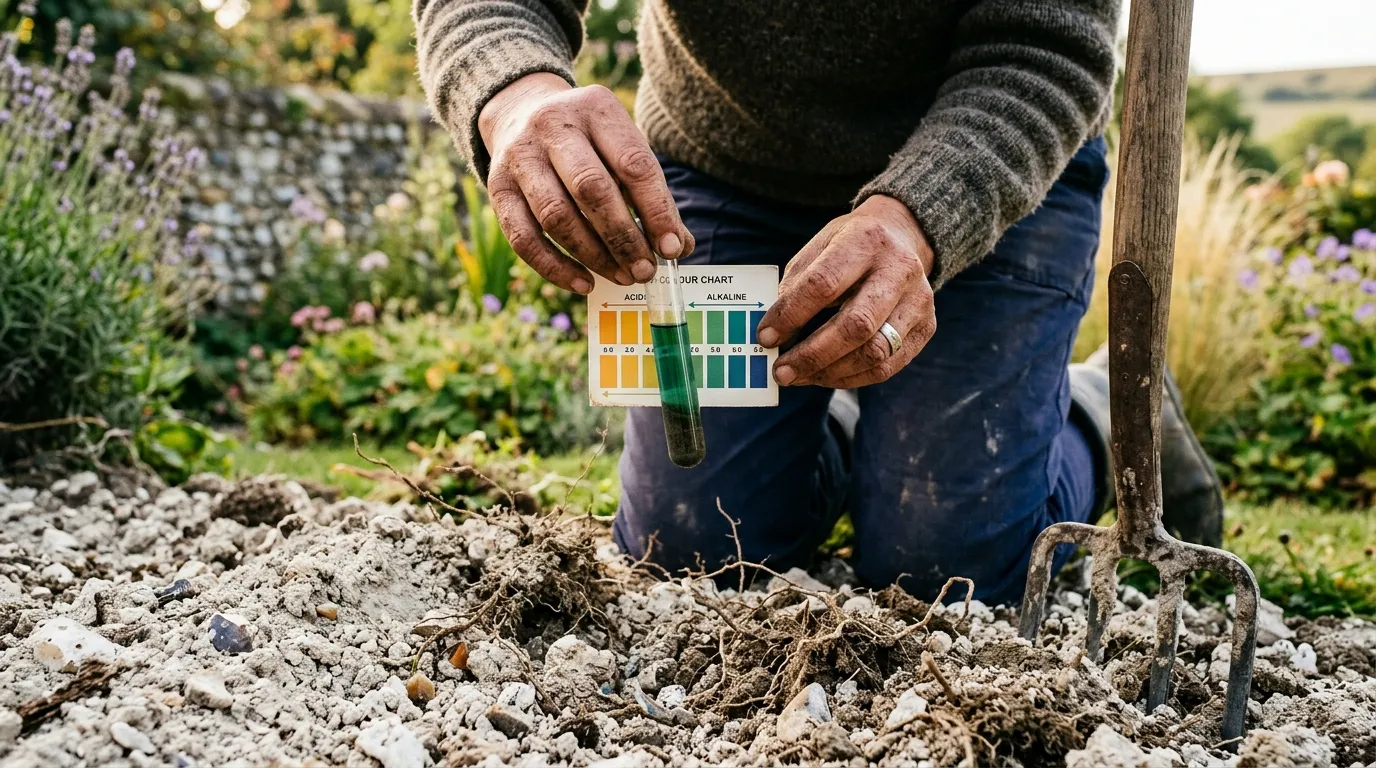
A colour-change pH testing kit costs £5-£8 and identifies whether your soil is acid, neutral, or alkaline in 10 minutes. Test at 15cm depth for accurate results.
How to improve peat soil
Peat soil is rare in most UK gardens but common in the Fens, Somerset Levels, and parts of Scotland. It is extremely acidic, very moisture-retentive, and high in organic matter but often low in available nutrients.
Add lime to raise pH. Raw peat can sit at pH 3.5-4.0, which is too acidic for most garden plants. Apply garden lime at 200-400g per square metre to raise pH by roughly one point. Retest after 3 months and repeat if needed. Most vegetables need pH 6.0-7.0.
Improve drainage. Peat holds water like a sponge. Install land drains or dig drainage channels if the water table is high. Raised beds with added grit improve surface drainage without major earthworks. Avoid compacting peat when it is waterlogged — it is almost impossible to restore structure once compressed.
Add mineral content. Pure peat lacks the clay and silt particles that provide structure and mineral nutrients. Work in sharp sand or grit at one barrow-load per 4 square metres. Add a balanced fertiliser because peat’s nutrients are locked in organic form and release slowly.
Choose acid-loving plants for unimproved peat. If you prefer not to lime, peat soil suits heathers, blueberries, cranberries, and bog plants naturally. The best plants for acid soil include rhododendrons, camellias, and Japanese maples — all of which perform superbly in peaty conditions at pH 4.5-5.5.
What is the difference between soil structure and soil type?
Soil type describes the mineral particle sizes in your soil — clay, sand, silt, or a combination. You cannot change your soil type without importing entirely new material. Soil structure describes how those particles group together into aggregates (crumbs), and this is what you can improve.
Good soil structure means particles are bound into small, stable crumbs with air gaps between them. Water drains through the gaps while the crumbs hold moisture and nutrients. Roots push through easily. Worms and bacteria thrive.
Poor soil structure means particles are either compacted into a dense mass (common in clay) or completely unbound (common in sand). Water either pools on the surface or drains straight through. Roots struggle. Soil biology declines.
What improves soil structure
| Action | Effect | Best For | How Often |
|---|---|---|---|
| Adding organic matter | Binds particles into crumbs, feeds biology | All soil types | Annually (5-10cm) |
| Avoiding compaction | Preserves existing air gaps and crumbs | Clay and silt | Always — never walk on wet soil |
| Green manures | Roots break up soil, add organic matter | Sandy and clay | Every bare soil period |
| Mycorrhizal fungi | Connect roots to nutrients, improve structure | All soils | At planting time |
| Worm activity | Creates drainage channels, mixes organic matter | All soils | Encourage by mulching |
| Frost action | Breaks clay clods into crumbs | Clay only | Leave rough-dug over winter |
What are the best plants for each UK soil type?
Choosing plants that suit your soil saves money, reduces maintenance, and produces better results than fighting your natural conditions. Here are proven performers for each type.
Clay soil: the nutrient-rich powerhouse
Clay holds moisture and nutrients that other soils lose. Over 200 species thrive in unimproved clay. Top performers include Rosa rugosa, Cornus sanguinea (dogwood), Astilbe, hardy geraniums, Japanese anemones, and Viburnum. Fruit trees on semi-vigorous rootstocks crop heavily in clay because moisture is always available. Brassicas and beans produce bigger yields on clay than on sand. See our full list of plants for clay soil.
Sandy soil: Mediterranean paradise
Fast-draining sand suits plants that evolved in dry, nutrient-poor conditions. Lavender, rosemary, cistus, echinacea, agapanthus, and verbena bonariensis all thrive without amendment. Silver birch and Scots pine are the best native trees for sand. Root vegetables like carrots and parsnips grow long and straight in loose sandy soil. Our guide to sandy soil plants covers 20+ proven species.
Silt soil: the fertile floodplain
Silt is naturally fertile and easy to work. Most vegetables produce excellent crops without amendment. Willows, alders, and moisture-loving perennials like ligularia and astilbe suit silt’s moisture retention. Avoid waterlogging by adding organic matter to improve structure.
Loam: grow almost anything
True loam supports the widest range of plants. Roses, herbaceous perennials, vegetables, fruit trees, and lawns all perform at their best in loam. If you have it, maintain it with annual organic matter additions and crop rotation for vegetables.
Chalk: sun-loving lime-lovers
Chalk suits plants that tolerate or prefer alkaline conditions. Lavender, clematis, dianthus, scabious, buddleia, beech, yew, and box all thrive. Brassicas and beetroot crop well in alkaline soil. Avoid ericaceous plants — they develop iron chlorosis above pH 7.5. See our guide to chalk soil plants.
Peat: acid specialists
Unimproved peat suits heathers, rhododendrons, camellias, blueberries, cranberries, and bog plants. Japanese maples and magnolias perform well in sheltered positions. With liming, peat supports vegetables and a wider ornamental range. Our acid soil plants guide covers the full range.
How much does soil testing cost in the UK?
Professional soil testing gives you exact data on pH, nutrients, and soil composition. Here is what to expect at each price point.
| Service | Cost | Turnaround | What You Get |
|---|---|---|---|
| Home pH kit (colour-change) | £5-£8 | 10 minutes | pH reading (±0.5 units) |
| Home NPK kit | £8-£15 | 20 minutes | pH, nitrogen, phosphorus, potassium |
| Digital pH meter | £15-£40 (one-off) | 2 minutes | pH reading (±0.2 units), reusable |
| RHS soil analysis | £27 (members), £35 (non-members) | 2-3 weeks | pH, NPK, magnesium, organic matter, recommendations |
| Private lab analysis | £30-£50 | 1-3 weeks | Full nutrient profile, particle-size analysis, specific recommendations |
| Specialist contamination test | £50-£150 | 2-4 weeks | Heavy metals, hydrocarbons (for new allotments or suspected contamination) |
For most gardeners, a £5-£8 colour-change pH kit provides all the information needed to select the right plants. A one-off professional lab test is worth the investment when establishing a new garden, converting a lawn to vegetable beds, or diagnosing persistent plant failures.
Frequently asked questions
How do I find out what soil type I have?
Use the squeeze test to identify your soil type in 30 seconds. Take a moist handful from 15cm depth and squeeze it. Clay holds its shape and feels sticky. Sand crumbles immediately. Loam forms a ball that breaks apart under pressure. Silt feels smooth and silky. For exact percentages, use the jar test or send a sample to a laboratory for particle-size analysis at £25-£50.
What is the most common soil type in the UK?
Clay soil is the most common type, found in around 40% of UK gardens. It dominates the Midlands, Thames Valley, South East England, and parts of Yorkshire. Sandy soil covers roughly 15-20% of English gardens, concentrated in Norfolk, Suffolk, and the Surrey heathlands. Chalk underlies the Downs, Chilterns, and Wolds.
Is clay soil good or bad for gardening?
Clay is the most naturally fertile soil type in the UK. Its high cation exchange capacity (20-40 meq/100g) holds 3-5 times more nutrients than sand. Over 200 species thrive in unimproved clay. The challenge is drainage — clay drains at just 1-5mm per hour, making it waterlogged in winter and hard-baked in summer. Annual organic matter additions solve both problems within 2-3 seasons.
How do I test my garden soil pH?
Buy a colour-change pH testing kit for £5-£8 from any garden centre. Take soil samples from 15cm depth, mix with the provided solution, and compare the colour against the chart. Results take 10 minutes and are accurate to within 0.5 pH units. Digital meters (£15-£40) give faster readings. Professional lab tests (£25-£50) provide the most accurate data plus nutrient analysis.
Can I change my soil type?
No, you cannot change your underlying soil type. Clay particles measure under 0.002mm and cannot be converted to sand or loam. But you can dramatically improve soil structure by adding organic matter annually. Five to 10cm of compost each autumn loosens clay, binds sand, and improves nutrient retention in all soils. For a completely different growing medium, raised beds filled with imported topsoil are the practical solution.
What soil pH do most plants prefer?
Most garden plants prefer pH 6.0-7.0, which is slightly acidic to neutral. Vegetables generally need pH 6.0-7.0. Ericaceous plants like rhododendrons require pH 4.5-5.5. Brassicas prefer pH 6.5-7.5, which also suppresses club root disease. Lavender and clematis tolerate alkaline conditions up to pH 8.0.
What is the best soil type for a vegetable garden?
Loam is the best soil for vegetables, combining good drainage with moisture and nutrient retention. If you do not have natural loam, improve what you have: add grit to clay, organic matter to sand, and lime to acid soils. Most vegetables produce good yields on any well-managed soil type with annual compost additions and correct pH adjustment.
Lawrie has been gardening in the West Midlands for over 30 years. He grows his own veg using no-dig methods, keeps a wildlife-friendly garden, and writes practical advice based on real UK growing conditions.