Best Plants for Acid Soil UK
Best plants for acid soil in UK gardens. 30+ ericaceous shrubs, trees, perennials, and fruit for pH 4.5-6.5, tested in Staffordshire over 10 years.
Key takeaways
- Acid soil (pH 4.5-6.5) covers 35% of UK gardens, mainly in the Highlands, Wales, New Forest, and Pennines
- Over 30 shrubs, trees, perennials, and fruit crops thrive in acid conditions without amendment
- Rhododendrons, camellias, pieris, and azaleas all need a pH below 6.0 for healthy growth
- Blueberries yield 2-4kg per bush annually on acid soil with a pH of 4.5-5.5
- Sulphur chips lower soil pH by 0.5-1.0 units over 6-12 months when applied at 100-150g per square metre
- The vinegar test identifies acid soil in 30 seconds: no fizz means your pH is below 7.0
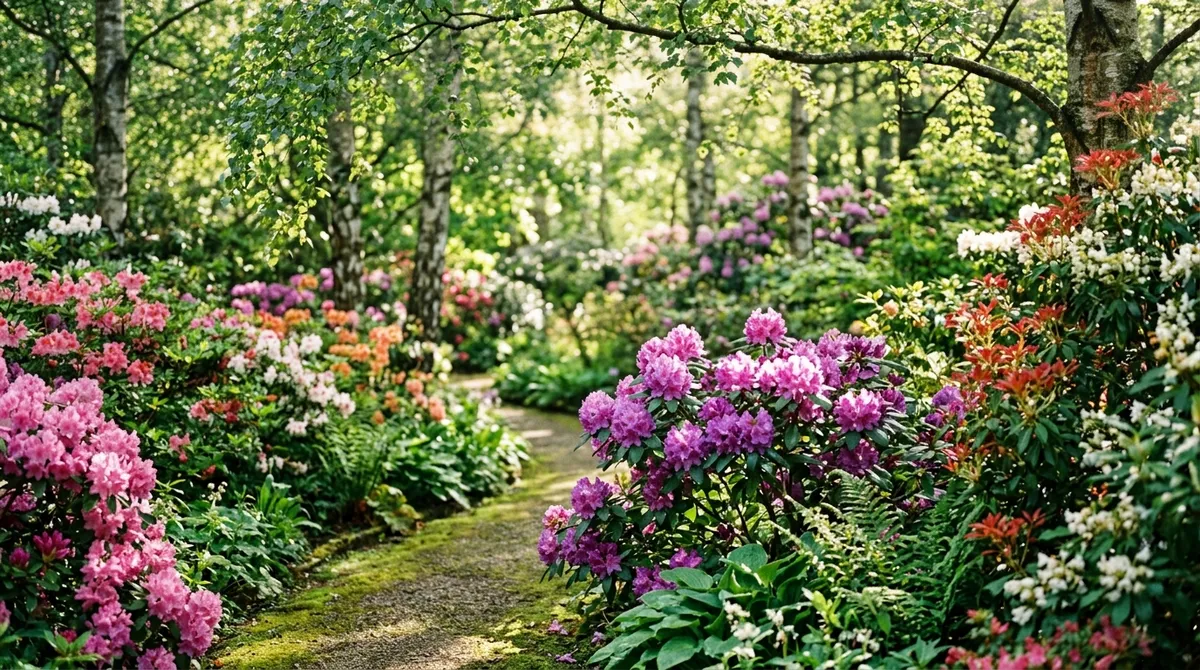
Acid soil is one of the most productive soil types in British gardens, yet most guides treat it as a problem. The opposite is true. If your soil pH sits between 4.5 and 6.5, you can grow a group of plants that gardeners on chalk can only dream about: rhododendrons, camellias, blueberries, Japanese maples, and magnolias. These ericaceous species are among the most spectacular flowering plants available in UK nurseries, and they all demand acid conditions.
Around 35% of UK gardens sit on naturally acid soil. After 10 years of growing ericaceous plants on sandy loam at pH 4.8-5.5 in Staffordshire, I can confirm that the range of acid-loving species is broader than most gardeners realise. This guide covers the best performers across shrubs, trees, perennials, fruit, and ground cover, with tested pH preferences, planting advice, and the soil science that explains why these plants need acidity to survive.
For the opposite end of the pH scale, see our guide to plants for chalky alkaline soil.
Why some plants need acid soil
The chemistry of acid soil determines which nutrients are available to plant roots. Understanding this explains why ericaceous plants fail on chalk and thrive on acid ground.
Iron and manganese availability
In acid soil (pH 4.5-6.5), iron exists in its soluble ferrous form (Fe2+), which plant roots absorb easily. Above pH 7.0, iron converts to insoluble ferric oxide (Fe3+) and becomes locked in the soil. Ericaceous plants evolved without the ability to extract locked-up iron. They rely on it being freely available, which only happens below pH 6.5. This is why a rhododendron planted in chalk develops yellow leaves with green veins within a single growing season. That yellowing is iron chlorosis, a direct result of pH-related nutrient lock-up.
Manganese follows the same pattern. It is freely available below pH 6.0 and progressively locked up above pH 7.0. Ericaceous plants use manganese for photosynthesis at higher rates than most other plant groups.
Aluminium tolerance
Below pH 5.5, aluminium becomes soluble in soil water. Most garden plants find soluble aluminium toxic. It damages root tips and blocks phosphorus uptake. Ericaceous plants tolerate aluminium through specialised root chemistry. Rhododendrons, for example, bind aluminium in their root cell walls, preventing it from entering the plant’s vascular system. This tolerance gives acid-loving plants a competitive advantage on very acid soils where other species struggle.
Hydrangeas use aluminium differently. On acid soil (pH 4.5-5.5), hydrangea macrophylla absorbs aluminium through its roots and deposits it in the flower sepals, turning them blue. The same plant on alkaline soil produces pink flowers because aluminium is locked up. For a full growing guide, see our hydrangea article.
-->Where acid soil occurs in the UK
Acid soil forms over specific rock types and in areas of high rainfall. Knowing your geology tells you what to expect.
Regional acid soil map
- Scottish Highlands and Islands - granite and metamorphic rock produce highly acid soils, pH 3.5-5.5. Peat blankets add further acidity. Heather moorland dominates.
- Welsh uplands - Ordovician and Silurian slates create acid soils at pH 4.0-5.5 across Snowdonia, the Brecon Beacons, and Mid Wales.
- Pennines - millstone grit and carboniferous sandstone give acid soils at pH 4.5-6.0 from the Peak District to the Scottish Borders.
- New Forest, Hampshire - sandy acid soils at pH 4.0-5.5 over Barton and Bracklesham Beds. Ancient heathland with native heather, gorse, and birch.
- Surrey and Hampshire heathlands - Bagshot Sands formation produces acid sandy soils at pH 4.5-5.5. This is prime rhododendron country, as Kew Gardens’ recommendations confirm.
- Cornwall and Devon - granite moorlands (Dartmoor, Bodmin Moor) produce very acid soils at pH 4.0-5.5. Lower slopes have milder acidity at pH 5.5-6.5.
- East Anglia Breckland - patches of acid sandy soil at pH 5.5-6.5 over glacial deposits.
If you are unsure of your soil pH, our soil testing and pH adjustment guide covers the full testing process.
How to test and lower soil pH
Before planting ericaceous species, confirm your soil pH and learn how to adjust it if needed.
Testing soil pH
The simplest method is a liquid pH testing kit from any garden centre, costing under £8. Take soil samples at 15cm depth from at least five spots across the planting area. Mix the samples, add the testing solution, and compare the colour to the chart. Digital pH meters (£15-£30) give more precise readings but need calibrating before each use. For accurate baselines, send a sample to a soil laboratory (around £25-£35 per sample through the RHS soil analysis service).
The vinegar test (quick field check)
Pour a tablespoon of white vinegar onto a soil sample. If it fizzes, your soil contains free calcium carbonate and is alkaline. No fizz means your pH is below 7.0. This does not tell you the exact pH, but it rules out chalk.
Lowering soil pH with sulphur
Flowers of sulphur is the most effective long-term pH reducer. Soil bacteria convert sulphur to sulphuric acid over 6-12 months. Apply at these rates:
| Starting pH | Target pH | Sulphur (g per m2) | Time to effect |
|---|---|---|---|
| 7.0 | 6.0 | 100-150 | 6-12 months |
| 7.0 | 5.5 | 150-200 | 8-14 months |
| 6.5 | 5.5 | 70-100 | 4-8 months |
| 6.0 | 5.0 | 50-80 | 4-8 months |
Work sulphur into the top 15cm of soil in autumn. Retest pH after 12 months and repeat if necessary. Sulphur works best in warm, moist soil where bacterial activity is highest.
Maintaining acidity
Once you reach the target pH, maintain it with:
- Pine bark mulch (5-8cm annually) - decomposes to produce mild organic acids
- Composted pine needles - pH 3.5-4.5 when fresh, 5.0-5.5 when composted
- Ericaceous compost for container plants and top-dressing
- Rainwater for irrigation (mains water in hard-water areas is pH 7.5-8.5 and gradually raises soil pH)
Avoid mushroom compost (contains chalk), wood ash (highly alkaline), and lime. All of these will raise your pH and undo your work. For feeding acid-loving plants, see our plant feeding guide.
-->Best shrubs for acid soil
Shrubs form the backbone of an acid soil garden. These are the species I have grown successfully at pH 4.8-5.5.
Rhododendrons and azaleas
Rhododendrons are the signature acid soil plant. Over 1,000 species exist, from 15cm alpine dwarfs to 10m tree forms. In UK gardens, the most reliable include R. yakushimanum (compact, 1m, pink fading to white), R. augustinii (3m, lavender-blue), and R. luteum (deciduous azalea, 3m, yellow, heavily scented). All need pH 4.5-5.5 and dappled shade. Full sun scorches leaves. Heavy clay waterlogging kills roots within 18 months.
pH preference: 4.5-5.5 Size: 0.5m-10m depending on species Flowering: April to June Position: Dappled shade, sheltered from cold winds
Camellias
Camellias flower from January to April, providing colour when little else is in bloom. Camellia japonica and C. x williamsii are the hardiest for UK gardens. C. x williamsii ‘Donation’ (pink, semi-double, 3-4m) is the single best camellia for British acid gardens. It drops spent flowers cleanly, unlike C. japonica varieties that hold brown blooms. For a full growing guide, see our camellia article.
pH preference: 5.0-6.5 Size: 2-5m Flowering: January to April Position: West or north-facing wall (avoids morning sun thawing frozen buds too quickly)
Pieris
Pieris produces dramatic red or bronze new growth in spring, followed by cascading white or pink flower panicles. Pieris japonica ‘Forest Flame’ is the most widely planted, reaching 3m with vivid red young leaves. P. japonica ‘Little Heath’ stays compact at 60-80cm for smaller gardens. Pieris needs the same conditions as rhododendrons: acid soil, dappled shade, and shelter from cold spring winds that damage new growth.
pH preference: 4.5-6.0 Size: 0.6-3m depending on variety Flowering: March to May Position: Sheltered, dappled shade
Heathers (Calluna and Erica)
Heathers carpet acid soil with year-round colour. Calluna vulgaris (ling heather) flowers July to November and needs acid soil below pH 6.0. Erica carnea (winter heather) is the exception in the heather family, tolerating alkaline conditions up to pH 7.5. For pure acid soil gardens, Calluna vulgaris ‘Firefly’ (terracotta foliage), C. vulgaris ‘Dark Star’ (crimson flowers), and Erica cinerea ‘Purple Beauty’ (bell heather) are outstanding choices. For a dedicated growing guide, see our heather article.
pH preference: 4.0-6.0 (Calluna), 4.5-7.5 (Erica carnea) Size: 15-60cm Flowering: July to November (Calluna), December to April (Erica) Position: Full sun, open ground
Best trees for acid soil
Trees give an acid garden structure and height. These species are proven in acid conditions across the UK.
Japanese maples (Acer palmatum)
Japanese maples are the premium small tree for acid soil gardens. They tolerate pH 4.5-6.5 and produce extraordinary autumn colour. A. palmatum ‘Bloodgood’ (dark red leaves, 5-8m) and A. palmatum ‘Sango-kaku’ (coral bark, 6m) are the two most reliable for UK conditions. Japanese maples hate wind exposure. Plant in a sheltered spot with dappled shade. The root system is shallow and fibrous, so mulch annually with 5-8cm of composted pine bark to keep roots cool and moist.
pH preference: 4.5-6.5 Size: 2-8m depending on variety Autumn colour: October to November Position: Sheltered, dappled shade, away from east-facing exposure
Magnolias
Magnolias perform best at pH 5.0-6.5. Magnolia stellata (star magnolia, 3m) is the best choice for smaller gardens, flowering in March with white star-shaped blooms. Magnolia soulangeana (tulip magnolia, 6-8m) produces the classic pink-and-white goblet flowers in April. Both dislike late spring frosts, so avoid frost pockets. Magnolias resent root disturbance. Plant as small specimens and avoid underplanting within 1m of the trunk.
pH preference: 5.0-6.5 Size: 3-8m Flowering: March to May Position: Sheltered, full sun to dappled shade
Birch (Betula)
Silver birch (Betula pendula) and Himalayan birch (B. utilis var. jacquemontii) both thrive in acid to neutral soil at pH 4.5-6.5. They are native to UK heathland and moorland, growing naturally alongside heather on acid ground. Birch trees are fast-growing (60-90cm per year) and cast light shade that suits underplanting with rhododendrons and ferns. Their shallow roots do compete for moisture, so water new underplantings in dry spells.
pH preference: 4.5-6.5 Size: 10-18m Bark interest: Year-round white bark Position: Full sun, any aspect
-->Best perennials and ground cover for acid soil
Fill gaps between shrubs and trees with these acid-tolerant perennials.
Ferns
Ferns are the natural ground cover for acid woodland. Dryopteris filix-mas (male fern, 90cm) tolerates drier shade than most ferns. Athyrium filix-femina (lady fern, 60cm) prefers damper spots. Dicksonia antarctica (tree fern, 2-4m) makes a dramatic statement in sheltered gardens from USDA zone 8 upward. All ferns thrive at pH 4.5-6.5 and prefer consistent moisture. They pair beautifully with rhododendrons and camellias under a birch canopy. For shade planting ideas, see our guide to plants for shade.
Trillium
Trilliums are woodland jewels for acid soil. Trillium grandiflorum (white wake-robin) flowers in April-May with three-petalled white blooms above broad leaves. They need pH 5.0-6.0, humus-rich soil, and deep shade. Growth is slow. A single rhizome takes 5-7 years to form a flowering clump. Do not dig from the wild. Buy nursery-propagated plants and be patient.
Primroses and foxgloves
Native primroses (Primula vulgaris) and foxgloves (Digitalis purpurea) both thrive on acid soil. Primroses colonise shaded banks at pH 5.0-6.5, flowering February to April. Foxgloves are biennial, self-seeding freely on acid ground. They grow to 1.2-1.5m and attract bumblebees throughout June and July. Both are native UK woodland plants and establish easily without amendment.
Lily of the valley
Convallaria majalis spreads vigorously in acid to neutral soil at pH 4.5-6.5. The white bell-shaped flowers in May are intensely fragrant. Plant in shade or partial shade. Once established, lily of the valley forms dense ground cover that suppresses weeds. It can become invasive in ideal conditions, so use a root barrier or plant in a contained area.
Best fruit for acid soil
Acid soil is the ideal growing medium for several high-value fruit crops.
Blueberries
Blueberries are the star fruit crop for acid soil. They need pH 4.5-5.5 and refuse to produce on anything higher. A single established bush yields 2-4kg of fruit per season from July to September. The best UK varieties include ‘Bluecrop’ (reliable mid-season, 1.5m), ‘Duke’ (early, frost-tolerant), and ‘Chandler’ (very large berries). Plant in full sun, mulch with pine bark, and water with rainwater only. Mains water in hard-water areas raises soil pH over time. For the complete growing guide, see our blueberry article.
pH preference: 4.5-5.5 Yield: 2-4kg per bush per year Size: 1.2-1.8m Harvest: July to September
Cranberries
Cranberries (Vaccinium macrocarpon) need the same acid conditions as blueberries but prefer wetter soil. They grow as ground-hugging evergreen plants (15-20cm tall) and produce red berries in October. Cranberries are native to acid bogs and perform best at pH 4.0-5.5 in consistently moist ground. They make unusual but productive ground cover under blueberry bushes.
Raspberries and strawberries
Both raspberries and strawberries prefer mildly acid soil at pH 5.5-6.5. They tolerate lower pH better than most soft fruit. Autumn-fruiting raspberry varieties like ‘Autumn Bliss’ are the easiest for acid gardens. Strawberries in raised beds with ericaceous compost produce excellent crops. For general fruit growing advice, see our guide to growing fruit in containers.
Comparison table: acid soil plants by type
This table summarises the best performers across all plant groups, with tested pH ranges and key characteristics.
| Plant | Type | pH range | Height | Flowering period | Key feature |
|---|---|---|---|---|---|
| Rhododendron yakushimanum | Shrub | 4.5-5.5 | 1m | April-May | Compact, pink to white |
| Camellia x williamsii ‘Donation’ | Shrub | 5.0-6.5 | 3-4m | Feb-April | Drops spent flowers cleanly |
| Pieris ‘Forest Flame’ | Shrub | 4.5-6.0 | 3m | March-May | Red new growth |
| Calluna vulgaris ‘Dark Star’ | Ground cover | 4.0-6.0 | 25cm | Aug-Oct | Crimson double flowers |
| Acer palmatum ‘Bloodgood’ | Tree | 4.5-6.5 | 5-8m | Oct-Nov (leaf) | Deep red autumn colour |
| Magnolia stellata | Tree | 5.0-6.5 | 3m | March-April | Star-shaped white blooms |
| Betula pendula | Tree | 4.5-6.5 | 12-18m | Year-round (bark) | White bark, fast-growing |
| Blueberry ‘Bluecrop’ | Fruit | 4.5-5.5 | 1.5m | July-Sept (fruit) | 2-4kg yield per bush |
| Cranberry | Fruit | 4.0-5.5 | 15-20cm | Oct (fruit) | Evergreen ground cover |
| Dryopteris filix-mas | Fern | 4.5-6.5 | 90cm | Non-flowering | Tolerates dry shade |
| Trillium grandiflorum | Perennial | 5.0-6.0 | 30-40cm | April-May | Three-petalled white flowers |
| Hydrangea macrophylla | Shrub | 4.5-6.5 | 1.5-2m | July-Sept | Blue on acid, pink on alkaline |
| Primula vulgaris | Perennial | 5.0-6.5 | 15cm | Feb-April | Native woodland primrose |
| Digitalis purpurea | Biennial | 4.5-6.5 | 1.2-1.5m | June-July | Self-seeds on acid soil |
Ericaceous compost and container growing
If your soil is alkaline, you can still grow acid-loving plants in containers filled with ericaceous compost.
Choosing ericaceous compost
Modern peat-free ericaceous composts use composted pine bark, coir, and sulphur to achieve pH 4.5-5.5. The best brands maintain this pH for 12-18 months before the buffering agents deplete. Refresh the top 5cm annually and repot every 2-3 years. For broader guidance on peat-free growing media, see our peat-free compost guide.
Water container acid-lovers with rainwater. Mains water in chalk and limestone areas has a pH of 7.5-8.5 and gradually raises compost pH. A water butt solves this problem permanently. If you must use mains water, add 5ml of white vinegar per litre to bring it to around pH 6.0.
Best acid-loving plants for containers
Blueberries, camellias, and compact rhododendrons (R. yakushimanum hybrids) are the three best choices for pots. Use containers at least 40cm wide with drainage holes. Place crocks over the holes and fill with ericaceous compost. Feed with a specialist ericaceous fertiliser (sulphur-coated slow release) in March and June.
Common mistakes with acid soil
Avoid these errors that I see gardeners make repeatedly.
Over-amending the planting hole
The most common failure. Filling a planting hole with ericaceous compost when the native soil is already acid creates a textural boundary. Roots stay in the loose compost and never enter the surrounding soil. The rootball dries out in summer because the compost drains faster than the native ground. Use your existing acid soil for backfill. Mulch the surface instead.
Ignoring drainage
Ericaceous plants tolerate acid conditions but not waterlogging. Rhododendrons, camellias, and pieris all have fine, fibrous root systems that rot in standing water. If your acid soil sits on heavy clay, improve drainage by planting on a slight mound or building raised beds. A 15-20cm raised planting area makes the difference between success and root rot.
Using the wrong water
Hard mains water (pH 7.5-8.5) gradually raises soil pH in containers and beds close to the house. Over two years of mains water irrigation, I measured a pH rise from 5.0 to 6.2 in a blueberry bed. Switching to rainwater reversed the drift within a season. If you only take one piece of advice from this guide: install a water butt.
Liming vegetable beds near acid shrubs
Liming a vegetable patch next to a rhododendron bed allows calcium to leach sideways through the soil over several years. Keep a 2m buffer between limed areas and acid-loving plantings. Better still, use raised beds for vegetables to contain the lime.
-->Planting calendar for acid soil
Timing matters. These are the optimal planting windows tested in Staffordshire.
| Plant group | Best planting time | Why |
|---|---|---|
| Rhododendrons, azaleas | October-November or March-April | Autumn planting allows root establishment before winter |
| Camellias | March-April | Avoids winter root stress on exposed sites |
| Blueberries | November-March | Bare-root plants establish best during dormancy |
| Heathers | September-October or March-April | Warm soil, adequate moisture |
| Japanese maples | November-March | Dormant planting avoids leaf scorch |
| Ferns | March-May | New fronds establish in warming soil |
| Magnolias | March-April | Avoid autumn planting, fleshy roots rot in cold wet soil |
Plant in the morning or evening, never in full midday sun. Water thoroughly after planting. Apply 5-8cm of composted pine bark mulch around each plant, keeping it 5cm from the stem to prevent collar rot.
Frequently asked questions
What plants like acid soil in the UK?
Rhododendrons, azaleas, camellias, and pieris are the top acid soil performers. Blueberries, cranberries, heathers, Japanese maples, magnolias, and ferns also thrive. Over 30 ornamental and fruiting species prefer a pH below 6.5. Most woodland wildflowers, including foxgloves and primroses, also tolerate acid conditions well.
How do I know if my soil is acid?
Use a pH testing kit from any garden centre for under £8. Take samples at 15cm depth from several spots. A reading below 7.0 is acid. Wild heather, bracken, foxgloves, and Scots pine growing nearby are strong visual indicators. The vinegar test gives a quick result: pour white vinegar on a soil sample and listen for fizzing. No fizz means pH below 7.0.
Can you make soil more acidic?
Yes, with sulphur chips or aluminium sulphate. Sulphur chips applied at 100-150g per square metre lower pH by 0.5-1.0 units over 6-12 months. Ericaceous compost, composted pine bark, and pine needle mulch maintain acidity over time. Avoid lime, mushroom compost, and wood ash, which all raise pH.
Is acid soil good or bad for gardening?
Acid soil is excellent for specific plant groups. Ericaceous shrubs, blueberries, and woodland perennials perform better on acid soil than any other type. The only real limitation is that brassicas and most legumes prefer pH 6.5-7.5, and grass lawns can thin below pH 5.5. Lime individual vegetable beds rather than changing the whole garden.
What vegetables grow in acid soil?
Potatoes are the best vegetable for acid soil. They produce cleaner tubers with less scab below pH 5.5. Rhubarb, radishes, sweet corn, turnips, and soft fruit (strawberries, raspberries, gooseberries) all tolerate pH 5.5-6.5. Avoid brassicas, beetroot, and asparagus below pH 6.0 without liming.
Can you grow roses in acid soil?
Roses tolerate mildly acid soil at pH 5.5-6.5 and perform well. Below pH 5.0, nutrient availability drops and growth suffers. If your soil is very acid, raise the pH to 6.0-6.5 with garden lime at 200g per square metre before planting roses. Most hybrid teas and David Austin varieties prefer pH 6.0-7.0.
Where in the UK has acid soil?
The Scottish Highlands, Welsh uplands, and Pennines have the most acid soils in the UK. The New Forest, Surrey and Hampshire heathlands, Cornwall, Devon, and parts of East Anglia also sit on acid ground. Areas of sandstone, granite, millstone grit, and peat all produce acid soil. Chalk and limestone regions are alkaline.
Lawrie has been gardening in the West Midlands for over 30 years. He grows his own veg using no-dig methods, keeps a wildlife-friendly garden, and writes practical advice based on real UK growing conditions.