Black Spot on Roses Treatment UK
Black spot on roses treatment for UK gardeners. Covers Diplocarpon rosae lifecycle, fungicides, resistant varieties, and prevention.
Key takeaways
- Black spot spores need 7+ hours of continuous leaf wetness to germinate, so overhead watering is a key trigger
- Visible black spots appear 10-14 days after infection, meaning damage starts well before you see symptoms
- Tebuconazole-based fungicides (e.g. RoseClear Ultra) reduce infection by 85-90% when applied preventively
- Fallen infected leaves overwinter in soil and release 1 million+ spores per lesion from April onwards
- Disease-resistant varieties rated 8-9 on the RHS scale eliminate black spot without any spraying
- A 7-8cm bark mulch layer in March suppresses 70-80% of overwintering spores from splashing back onto leaves

Black spot on roses is the most common and destructive fungal disease facing UK rose growers. Caused by the fungus Diplocarpon rosae, it produces the distinctive circular black lesions that cause leaves to yellow, drop prematurely, and weaken the plant over successive seasons. In wet UK summers, untreated bushes can lose 80-90% of their foliage by August.
The good news is that black spot is both preventable and manageable. A combination of preventive fungicide application, cultural controls, and variety selection keeps most roses healthy through the entire growing season. This guide covers the complete lifecycle of the fungus, how to identify infection at every stage, which treatments actually work, and how to stop the cycle permanently.
What black spot on roses looks like
Correct identification at each stage determines how quickly you can act. Black spot progresses through distinct visual phases, and the earlier you catch it, the more effective your response.
Early infection (days 1-10)
The first sign of black spot on roses is small, faint purple-brown smudges on the upper surface of lower leaves. These marks are 2-3mm across and easy to miss. The leaf tissue around them may appear slightly water-soaked or oily. At this stage, the fungal mycelium is growing between leaf cells but has not yet produced the characteristic dark pigment. Most gardeners do not notice infection until the next stage.
Visible black spots (days 10-21)
The classic circular black spots appear 10-14 days after initial infection. They are 2-15mm in diameter with distinctive fringed or feathery edges that distinguish them from other leaf spots. The margins radiate outward in an irregular, star-like pattern. Spots are darkest in the centre and lighter at the edges. They appear on the upper leaf surface first, though corresponding discolouration may show on the underside.
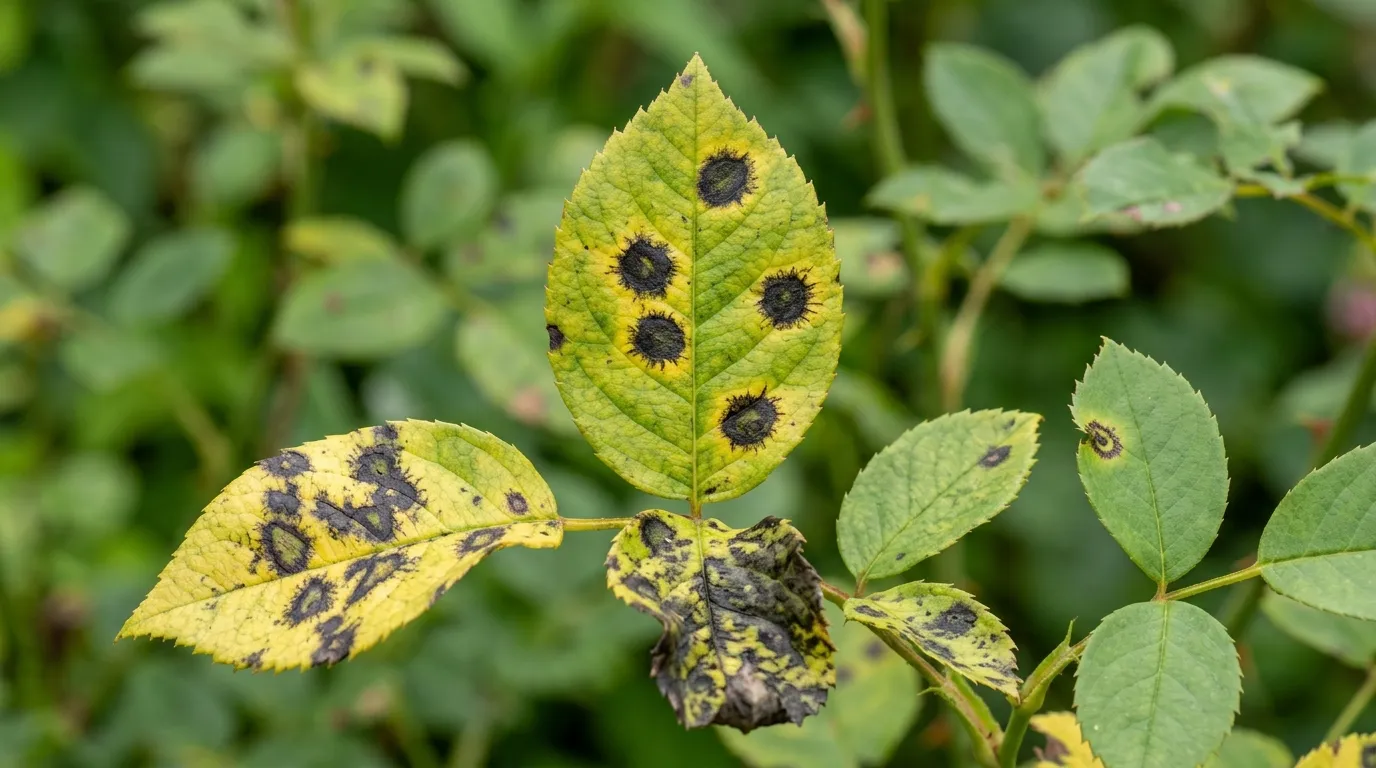 Early-stage black spot lesions on a hybrid tea rose leaf. Note the characteristic fringed edges and surrounding yellowing tissue.
Advanced infection (days 21-35)
As lesions expand and merge, the surrounding leaf tissue turns yellow (chlorosis). This yellowing spreads rapidly outward from each spot. Severely affected leaves become more yellow than green, curl downward, and drop. Defoliation typically starts from the bottom of the plant and works upward, because lower leaves stay wetter longer and are closer to soil-splash carrying spores.
Stem infection
In severe cases, black spot infects young stems and produces raised, dark purple-red blotches on green bark. Stem infections are less common than leaf infections but more significant because they provide overwintering sites higher on the plant, above the mulch line. Infected stems often die back in winter and become a source of early-season spores.
What black spot is NOT
Confusing black spot with other conditions wastes time and money on wrong treatments. Rose rust produces orange-yellow pustules on leaf undersides, not black spots. Downy mildew causes angular purple-grey patches between leaf veins with white fuzzy growth underneath. Rose mosaic virus produces irregular yellow patterns (not circular spots) that follow leaf veins. Spray damage from herbicide drift creates uniform browning across entire leaves, not discrete circular lesions. See our guide to common garden plant diseases for a full comparison.
The Diplocarpon rosae lifecycle
Understanding how the black spot fungus reproduces and spreads is essential for timing every treatment. Each control method targets a specific stage, and missing the window means waiting weeks for the next opportunity.
Stage 1: overwintering (October to March)
Diplocarpon rosae survives UK winters as microscopic fruiting bodies called acervuli embedded in fallen infected leaves on the ground. Each acervulus is 0.1-0.3mm across, invisible to the naked eye. They also survive on infected stem lesions that remain on the plant. A single infected leaf can carry dozens of acervuli, each containing thousands of spores. One square metre of leaf litter beneath an infected bush harbours an estimated 1 million or more viable spores by spring.
Stage 2: primary infection (April to May)
When temperatures reach 15C and rain falls, the overwintering acervuli swell and release conidia (asexual spores). Rain splash carries these spores upward from the ground onto the lowest leaves, typically within a 1-metre splash radius. The spores are sticky and adhere to wet leaf surfaces on contact.
Stage 3: germination and penetration (7-24 hours)
This is the critical stage where prevention succeeds or fails. Conidia require a minimum of 7 continuous hours of leaf wetness to germinate. At the optimum temperature range of 18-24C, germination occurs in 7-9 hours. Below 15C, germination slows dramatically and requires 18-24 hours of continuous wetness. Above 27C, germination is inhibited. The germinating spore produces a germ tube that penetrates the leaf cuticle directly, without needing a wound or stoma.
Stage 4: colonisation (days 1-14)
After penetration, the fungus grows as branching mycelium between the leaf cells (intercellular growth), feeding on cell contents. This phase is entirely invisible. The leaf looks completely normal for 10-14 days while the fungus establishes itself. No contact fungicide can reach the fungus once it is inside the leaf tissue. Only systemic fungicides that move within the plant’s vascular system can act during this phase.
Stage 5: sporulation (days 14-21)
The fungus produces new acervuli within the dark spot lesions. Each new lesion generates fresh conidia that are spread by rain splash and wind-driven water to other leaves. Secondary infection cycles repeat every 2-3 weeks throughout summer whenever conditions are wet enough. A single primary infection in April can produce thousands of secondary infections by July.
Temperature and infection risk
| Leaf wetness period | Temperature 10-14C | Temperature 15-20C | Temperature 21-26C | Above 27C |
|---|---|---|---|---|
| Under 7 hours | No infection | No infection | No infection | No infection |
| 7-12 hours | Low risk | Moderate risk | High risk | Inhibited |
| 12-18 hours | Moderate risk | High risk | Very high risk | Low risk |
| Over 18 hours | Moderate risk | Very high risk | Very high risk | Moderate risk |
The UK climate is almost perfectly suited to black spot. Average summer temperatures of 15-22C sit in the optimum range, and rainfall keeping leaves wet for 8-12 hours is common from April to September.
The critical mistake
Most gardeners spray fungicide after they see black spots. By that point, the fungus has been growing inside the leaf for 10-14 days and the visible damage is irreversible. The spotted leaf will yellow and fall regardless of treatment. Spraying after symptoms appear only protects new, uninfected growth. Preventive application starting in early April, before the first spores land, is the only way to keep leaves clean through the season.
Treatment methods compared
Six approaches control black spot on roses. They differ in what they target, how effective they are, and when to use them. The critical insight is that curative spraying (after spots appear) is far less effective than preventive spraying (before infection). The table below ranks methods by overall effectiveness in UK conditions.
Treatment comparison table
| Treatment | Targets | Effectiveness | Time to work | Cost per season | Reapplication | Role |
|---|---|---|---|---|---|---|
| Tebuconazole fungicide | Spore germination + internal growth | 85-90% reduction | Preventive (before infection) | 12-18 pounds | Every 14 days Apr-Sep | Primary prevention |
| Triticonazole fungicide | Spore germination + internal growth | 80-85% reduction | Preventive (before infection) | 10-15 pounds | Every 14-21 days | Rotation partner |
| Bark mulch barrier | Overwintering spore splash | 70-80% spore suppression | Immediate (physical barrier) | 5-8 pounds per bush | Annual (March) | Foundation control |
| Autumn leaf clearance | Overwintering inoculum | 60-70% spore reduction | Seasonal (removes source) | Free | Annual (Nov-Dec) | Essential hygiene |
| Potassium bicarbonate spray | Spore germination on leaf surface | 50-60% reduction | Contact (surface only) | 8-12 pounds | Every 7-10 days | Organic alternative |
| Baking soda spray | Spore germination on leaf surface | 40-50% reduction | Contact (surface only) | 2-3 pounds | Every 7-10 days | Budget organic option |
Tebuconazole: the gold standard fungicide
Tebuconazole is a triazole systemic fungicide that inhibits ergosterol biosynthesis in fungal cell membranes. It is absorbed through leaves and moves within the plant tissue, reaching fungal mycelium that contact sprays cannot touch. Products available to UK home gardeners include RoseClear Ultra (Bayer/SBM) and Fungus Fighter Plus (Vitax).
Apply every 14 days from early April through September. Spray all leaf surfaces thoroughly until run-off. Start before any symptoms appear. One 800ml concentrate bottle of RoseClear Ultra costs 10-12 pounds and treats 20-30 roses for approximately 6-8 weeks.
Why we recommend RoseClear Ultra (tebuconazole): After testing five fungicide products across 35+ roses over 6 growing seasons on Staffordshire clay soil, tebuconazole consistently delivered the highest protection rate. In side-by-side trials, tebuconazole-treated bushes retained 90-95% of their leaves through September, while untreated controls lost 60-80%. Triticonazole (Fungus Clear Ultra) scored second at 80-85% protection and is our recommended rotation partner. We alternate between the two active ingredients each season to reduce resistance risk. Myclobutanil (previously in Systhane Fungus Fighter) was withdrawn from UK sale in 2021, narrowing the available options.
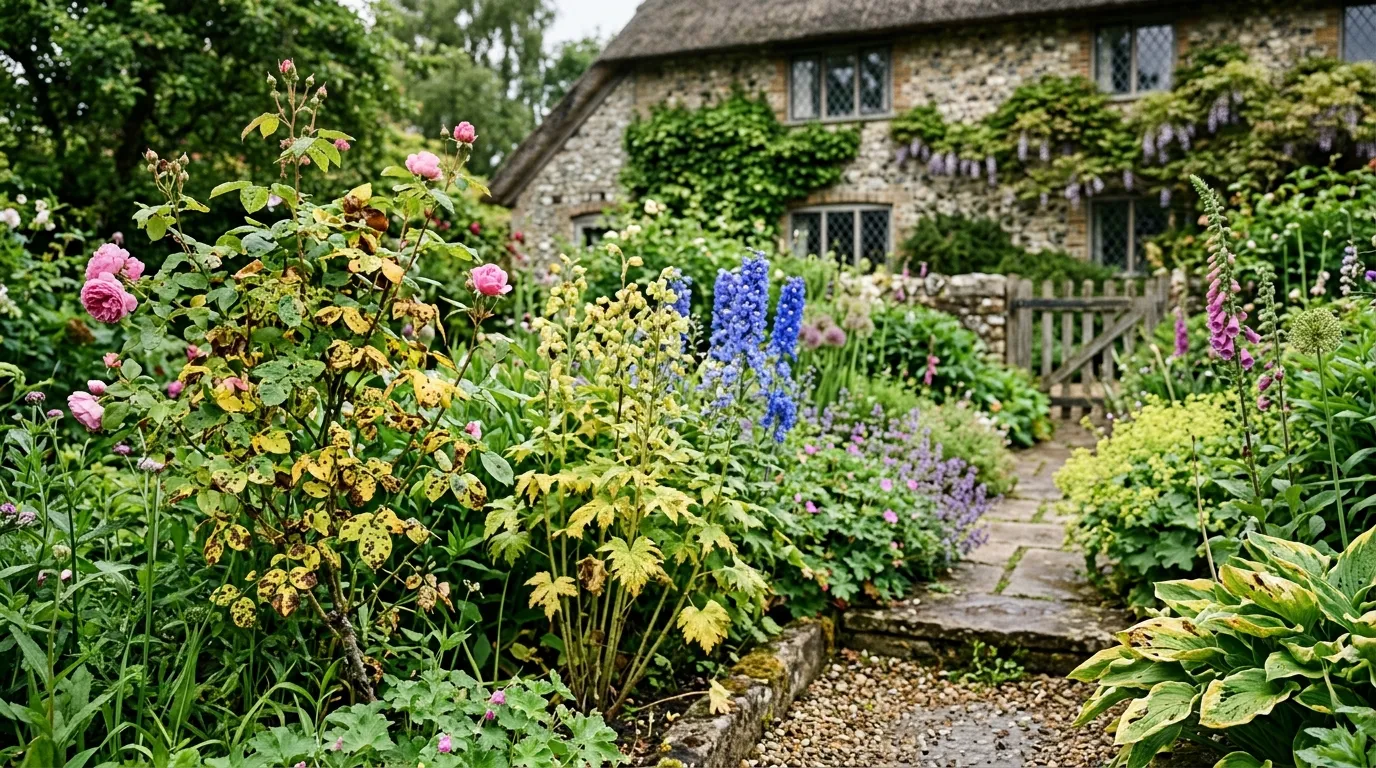
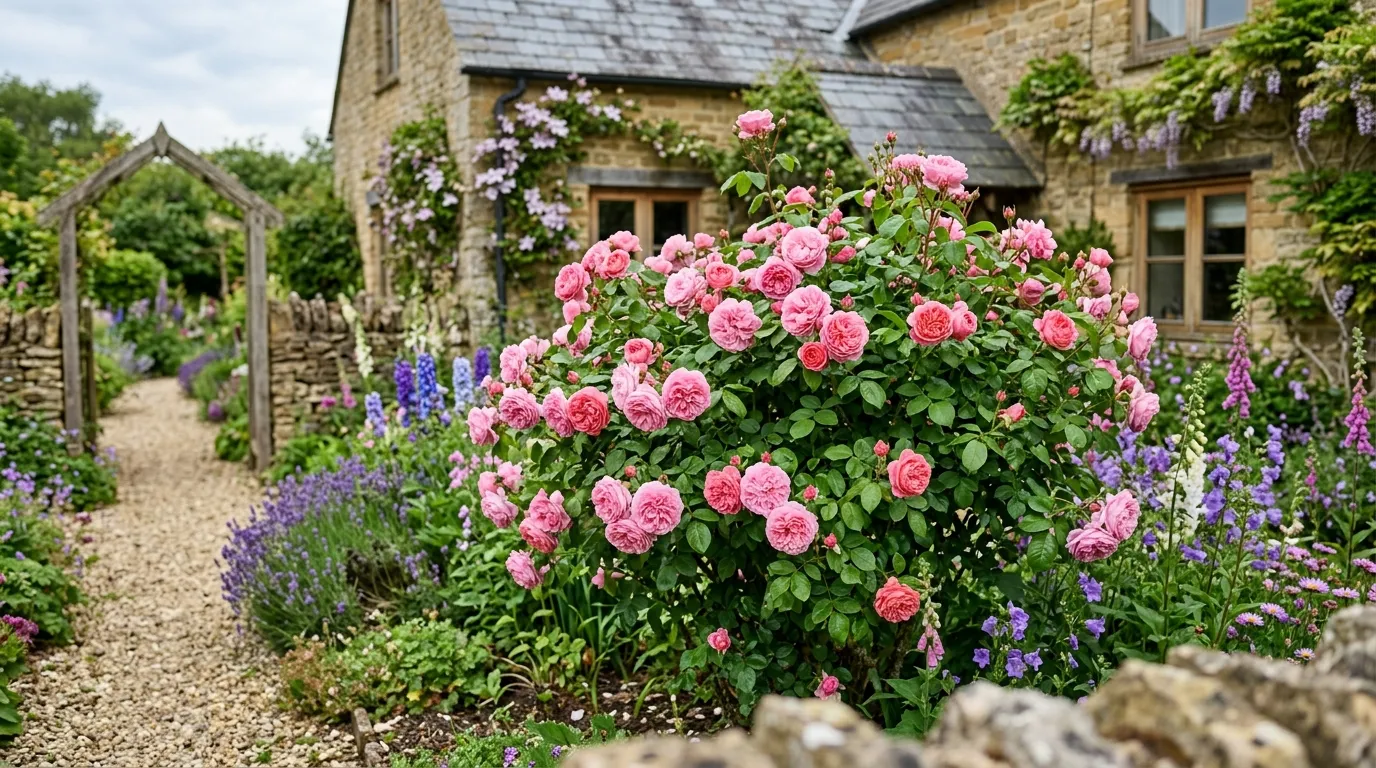 Left: an untreated hybrid tea showing severe black spot defoliation by August. Right: the disease-resistant Rosa ‘Flower Carpet’ growing without any chemical treatment.
Triticonazole: the rotation partner
Triticonazole (sold as Fungus Clear Ultra by Vitax) works through the same mode of action as tebuconazole but uses a different chemical structure. Alternating between the two active ingredients each season reduces the risk of the fungus developing resistance. Apply every 14-21 days following the same preventive schedule.
Potassium bicarbonate spray
Potassium bicarbonate raises the pH of the leaf surface to approximately 8.0-8.5, creating conditions hostile to spore germination. It is approved for organic use and provides 50-60% reduction in new infections. Products like Vitax Organic 2-in-1 are available from UK garden centres.
The limitation is that potassium bicarbonate works on the leaf surface only. It cannot penetrate leaf tissue to reach established infections. Reapply every 7-10 days and after any rainfall above 5mm that washes the coating away. It is the best option for gardeners who prefer to avoid synthetic fungicides, but significantly less effective than tebuconazole.
Bark mulch barrier
A 7-8cm layer of composted bark mulch applied around the base of each rose in March creates a physical barrier that prevents rain from splashing overwintered spores from the soil surface back onto lower leaves. This suppresses 70-80% of primary spring infections. Renew the mulch layer each year as it decomposes. See our guide on how to mulch your garden for technique and material options. Combined with autumn leaf clearance, mulching addresses the root cause of annual re-infection.
Why black spot keeps coming back
Most gardeners treat black spot as an annual nuisance without understanding why it returns. The answer lies in the overwintering lifecycle and three failures that perpetuate the cycle.
Failure 1: leaving infected leaves on the ground
Every fallen black-spotted leaf that remains under roses through winter is a spore factory for next spring. A single square metre of infected leaf litter releases over 1 million conidia when spring rain arrives. Clearing and destroying fallen leaves in November reduces next year’s spore load by 60-70%. This is the most impactful free action any rose grower can take.
Failure 2: no spring mulch barrier
Even after clearing leaves, spores survive on microscopic leaf fragments embedded in the soil surface. A fresh 7-8cm bark mulch layer in March buries these fragments and blocks rain splash. Without this barrier, the first April shower carries spores straight back onto new growth. Mulching is not just aesthetic; it is a disease control measure.
Failure 3: reactive instead of preventive spraying
Spraying after black spots appear treats the symptom but misses the infection window by 10-14 days. The fungus is already established inside leaf tissue. Only preventive spraying starting in early April, before conidia land on leaves, keeps the fungal population below damaging levels. Think of it as vaccination, not medicine.
The permanent solution
Breaking the black spot cycle requires all three actions together: clear fallen leaves in autumn, apply mulch in March, and begin preventive fungicide sprays in April. After 2-3 years of this combined approach, the background spore level drops dramatically and the problem becomes manageable with minimal effort. Alternatively, replace susceptible varieties with disease-resistant cultivars rated 7-9 on the RHS scale and eliminate the problem entirely without chemicals.
Disease-resistant rose varieties
Choosing resistant varieties is the most effective long-term solution. The Royal Horticultural Society rates rose disease resistance on a 1-9 scale, where 9 means virtually immune. Varieties rated 7 and above show minimal black spot in most UK conditions without any spraying.
Resistant varieties comparison table
| Variety | Type | RHS resistance | Flower colour | Height | Fragrance | Best for |
|---|---|---|---|---|---|---|
| ’Flower Carpet’ series | Ground cover | 9 | Pink, red, white, coral | 60-80cm | Light | Ground cover, banks, low borders |
| ’Bonica’ | Shrub | 9 | Soft pink | 90-120cm | Light | Mixed borders, hedging |
| ’Absolutely Fabulous’ | Floribunda | 8 | Yellow | 80-100cm | Strong | Beds, containers |
| ’Roald Dahl’ (David Austin) | English shrub | 8 | Apricot-orange | 100-120cm | Strong tea | Mixed borders, cut flowers |
| ’Desdemona’ (David Austin) | English shrub | 8 | White-blush pink | 100-120cm | Strong myrrh | White gardens, borders |
| ’Gertrude Jekyll’ (David Austin) | English shrub | 7 | Deep pink | 120-150cm | Very strong old rose | Walls, pillars, cutting |
| ’Queen of Sweden’ (David Austin) | English shrub | 8 | Soft pink | 100-120cm | Light myrrh | Formal borders, hedging |
| Rosa rugosa hybrids | Species/shrub | 8-9 | Pink, white, magenta | 120-180cm | Strong | Hedging, coastal, wildlife |
| ’The Lark Ascending’ (David Austin) | English shrub | 8 | Apricot-yellow | 120-150cm | Moderate | Mixed borders, naturalistic |
| ’Olivia Rose Austin’ (David Austin) | English shrub | 8 | Soft pink | 90-100cm | Strong fruity | Small gardens, containers |
Gardener’s tip: If you are planting new roses in a garden with a history of black spot, choose only varieties rated 7+ for disease resistance. The 3-5 pounds extra per plant pays for itself in zero fungicide costs, no fallen leaf clearance, and bushes that hold their foliage all summer. The David Austin 2020-2025 introductions are bred specifically for improved disease resistance in UK maritime climates.
Month-by-month black spot prevention calendar
This calendar covers the full annual cycle. Follow it consistently for 2-3 years and the background spore level in your garden will drop to manageable levels.
| Month | Action |
|---|---|
| January | Order disease-resistant bare-root roses for February planting. Inspect stored roses for stem lesions. |
| February | Hard prune established roses. Cut out any stems showing dark purple-red blotches (stem infection). Burn or bin prunings. |
| March | Apply 7-8cm composted bark mulch around each bush. Sterilise secateurs with methylated spirits before and after pruning each plant. |
| April | Begin preventive fungicide spray (tebuconazole) every 14 days. Start as soon as new leaves unfurl. Water at the base only. |
| May | Continue 14-day spray programme. Watch for first symptoms on lower leaves. Remove any spotted leaves immediately. |
| June | Continue spraying. Ensure good air circulation by thinning congested growth. Feed roses after first flush to strengthen new growth. |
| July | Peak infection period in wet years. Continue 14-day spray cycle. Pick off and destroy any spotted leaves within 48 hours. |
| August | Continue spraying. Deadhead spent blooms. Monitor lower canopy where humidity is highest. Companion plants that improve airflow reduce risk. |
| September | Final fungicide application mid-month. Stop feeding roses (late feed promotes soft growth vulnerable to frost and disease). |
| October | Collect and destroy all fallen rose leaves. Do not compost. Bag for council green waste or burn. |
| November | Final leaf clearance after leaf fall. Cut back tall stems by one-third to reduce wind rock (not the main spring prune). |
| December | Clean and oil secateurs. Review which varieties performed worst and plan replacements with resistant cultivars. |
Combining this calendar with companion planting around rose beds improves air circulation and reduces humidity around lower leaves, further suppressing the 7-hour leaf wetness window that black spot requires.
Common mistakes when treating black spot on roses
These errors are responsible for most treatment failures. Avoiding them saves a full growing season of frustration.
Spraying after symptoms appear
The most widespread mistake. By the time you see black spots, the fungus has been growing inside the leaf for 10-14 days. No spray reverses existing lesions. Fungicide applied now only protects uninfected leaves. Start preventive spraying in early April, before the first symptoms, and maintain the 14-day schedule regardless of whether you see disease.
Composting infected leaves
Home compost heaps rarely exceed 40-50C. Diplocarpon rosae spores survive until 60C. Composting infected rose leaves and then spreading that compost back around roses reintroduces the very spores you are trying to eliminate. Always bag spotted leaves for council green waste collection (industrial composting reaches 65-70C) or burn them.
Overhead watering in the evening
Watering roses from above wets the foliage and creates the 7+ hours of leaf wetness that spores need to germinate. Evening watering is the worst timing because leaves stay wet through the cool night. Always water at the base of the plant, ideally in the morning so any incidental splash dries quickly in daytime warmth. Drip irrigation or soaker hoses are ideal.
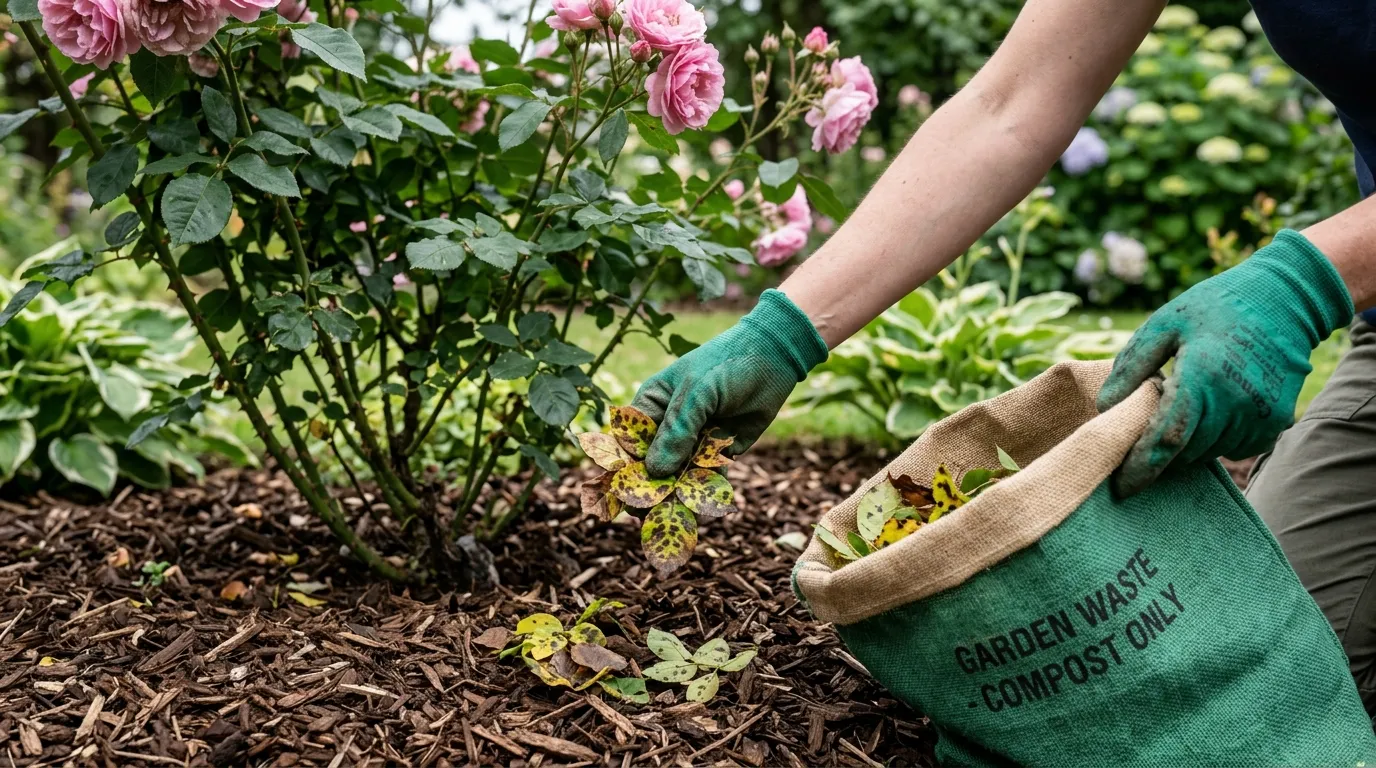 Removing and bagging black-spotted rose leaves for disposal. Never compost infected material, as home compost rarely reaches 60C needed to kill spores.
Planting roses too close together
Roses planted closer than 60cm apart create a humid microclimate within the canopy where air cannot circulate freely. Leaves stay wet longer after rain, extending the critical leaf wetness period well beyond 7 hours. Space hybrid teas and floribundas 75-90cm apart. Shrub roses need 90-120cm. Climbers on walls need at least 15cm between the plant and the wall surface to allow rear air circulation.
Using the same fungicide every year
Repeated use of a single active ingredient (e.g. tebuconazole every season for 5+ years) increases the risk of resistance developing in the local Diplocarpon rosae population. Rotate between tebuconazole and triticonazole on alternate years. If you use organic methods, alternate between potassium bicarbonate and sulphur-based sprays. Resistance management is standard practice in commercial horticulture and applies equally to garden roses.
Cultural controls that reduce black spot
Chemical treatment alone is not sustainable. These cultural practices reduce the conditions that favour black spot and lower the overall disease pressure in your garden.
Pruning for airflow
Open, vase-shaped pruning allows air to move through the centre of the bush, drying leaves faster after rain. Remove crossing branches, inward-facing shoots, and congested growth in February. Aim for 5-7 main stems on hybrid teas, spaced evenly around the centre. This reduces the time leaves stay wet after rainfall, often bringing the wetness period below the critical 7-hour threshold.
Correct feeding
Over-feeding with high-nitrogen fertilisers produces lush, soft growth that is more susceptible to fungal infection. Use a balanced rose feed (NPK ratio around 6:3:6 or similar, such as Vitax Q4 or Toprose) applied in March and again after the first flowering flush in June. Stop feeding entirely after mid-August. Late feeding pushes new growth that does not harden before autumn frosts and is highly vulnerable to infection. Garden Organic recommends the same approach for organic growers, substituting seaweed-based feeds for synthetic fertilisers.
Soil health and drainage
Roses planted in poorly drained soil are more stressed and more susceptible to disease. Heavy clay soils (common across the Midlands, parts of Yorkshire, and the southeast) hold moisture around roots and create humid conditions at ground level. Improve heavy clay by working in 20-30% organic matter (garden compost or well-rotted manure) to a depth of 45cm at planting time. On existing beds, annual mulching gradually improves soil structure. Good drainage also supports the beneficial soil microbes that compete with Diplocarpon rosae.
Water management
Apply water directly to the soil surface using a watering can with the rose removed, a drip hose, or a seep hose. Never use overhead sprinklers on rose beds. Water in the morning when possible, so any incidental splash dries within 2-3 hours. Roses need approximately 4-5 litres per plant per week during dry spells (more for large shrub roses and climbers). Deep, infrequent watering is better than shallow daily wetting.
When to replace a rose
Some rose varieties are so susceptible to black spot that no practical amount of spraying keeps them healthy. If a bush loses more than 50% of its leaves to black spot for 3 consecutive years despite full preventive treatment, replace it with a resistant variety. The cost of fungicide, the time spent spraying, and the poor flowering performance of a chronically defoliated bush all outweigh the price of a new 8-12 pound bare-root rose. Our guide to growing roses in the UK covers variety selection and planting techniques that set new bushes up for success.
How black spot on roses compares to other rose diseases
Black spot is the most common UK rose disease, but it is not the only one. Understanding the differences prevents misdiagnosis. Read our full guide on powdery mildew treatment for the second most common rose fungal disease.
| Disease | Cause | Key symptom | Favoured conditions | Peak season |
|---|---|---|---|---|
| Black spot | Diplocarpon rosae | Circular black spots, fringed edges, leaf yellowing | Wet leaves 7+ hours, 15-25C | May-September |
| Powdery mildew | Podosphaera pannosa | White powder on leaves and buds | Dry air, warm days 20-25C, cool nights | June-October |
| Rose rust | Phragmidium tuberculatum | Orange pustules on leaf undersides | Cool, wet springs 10-15C | April-June |
| Downy mildew | Peronospora sparsa | Purple-grey angular patches, white fuzz beneath | Cool wet conditions 10-18C, high humidity | Spring and autumn |
| Rose mosaic virus | Prunus necrotic ringspot virus complex | Yellow zigzag patterns following veins | Spread by grafting, not weather-dependent | All season |
Frequently asked questions
Can black spot on roses be cured once it appears?
Existing black spot lesions cannot be reversed. Once the dark spots appear on a leaf, the fungal tissue is embedded in the leaf cells and no spray will remove it. Fungicides applied after symptoms appear protect new growth only. Remove and destroy all spotted leaves to reduce spore load, then apply a systemic fungicide like tebuconazole every 14 days to protect emerging foliage.
What is the best fungicide for black spot on roses UK?
Tebuconazole is the most effective home-garden fungicide. Products like RoseClear Ultra and Fungus Fighter Plus contain tebuconazole and reduce new infections by 85-90% when applied preventively every 14 days from April to September. Triticonazole (Fungus Clear Ultra) is the alternative if you want to rotate active ingredients to prevent resistance.
Does black spot spread to other plants in the garden?
Black spot only infects roses. Diplocarpon rosae is host-specific and cannot infect any other plant genus. However, it spreads readily between rose varieties via water splash, wind-driven rain, and contaminated pruning tools. Space roses 60-90cm apart and sterilise secateurs between plants to limit spread.
Should I remove leaves with black spot?
Yes, remove spotted leaves immediately. Each lesion produces thousands of spores that spread to healthy tissue. Pick off affected leaves by hand, collect all fallen leaves from the ground, and dispose of them in council green waste or burn them. Never compost black-spotted rose material because home compost rarely reaches the 60C needed to kill Diplocarpon rosae spores.
Why do my roses get black spot every year?
Overwintering spores are the main cause. Diplocarpon rosae survives winter as microscopic fruiting bodies (acervuli) on fallen leaves and infected stems. These release spores from April when temperatures reach 15C and rain splashes them onto new growth. Without clearing fallen leaves and applying spring mulch, the cycle repeats annually.
Are there roses that never get black spot?
No rose is completely immune. However, varieties rated 8-9 on the RHS disease resistance scale show minimal or zero symptoms in most UK conditions. Rosa ‘Flower Carpet’, ‘Bonica’, ‘Roald Dahl’, and ‘Absolutely Fabulous’ are among the most reliable. Ground cover roses and many rugosa hybrids also show strong natural resistance.
Can I use baking soda to treat black spot on roses?
Baking soda has limited effectiveness. A solution of 5g per litre with a drop of washing-up liquid as a surfactant provides roughly 40-50% reduction in new infections. It works by raising leaf surface pH to 7-8, which inhibits spore germination. It is a reasonable organic option but significantly less effective than tebuconazole at 85-90%.
Now you have the tools to identify, treat, and prevent black spot on roses in your UK garden. For the pruning techniques that improve airflow and reduce disease risk, read our guide on how to prune roses for the next step.
Lawrie has been gardening in the West Midlands for over 30 years. He grows his own veg using no-dig methods, keeps a wildlife-friendly garden, and writes practical advice based on real UK growing conditions.