How to Deal with Honey Fungus
Honey fungus kills more UK trees and shrubs than any other pathogen. No chemical cure exists. Here is how to identify, contain, and prevent it.
Key takeaways
- No chemical control is available to UK gardeners — physical barriers and removal are the only options
- Rhizomorphs (black bootlace strands) grow at approximately 1 metre per year through soil
- Install physical barriers to 45cm depth using 500-micron butyl rubber or heavy-duty polythene
- Over 100 tree and shrub species are susceptible; yew, box, holly, and beech show strong resistance
- Honey-coloured toadstools appear September to November at the base of infected plants
- Dead stumps and large roots harbour the fungus for decades — removal is essential
Honey fungus is the most destructive plant disease in UK gardens. Armillaria mellea and its close relative A. ostoyae together kill more trees and shrubs in Britain than any other single pathogen. Unlike most garden diseases, there is no spray, no powder, and no biological treatment available to UK gardeners. Understanding how it works, how to identify it, and how to limit its spread is the only line of defence.
This guide covers identification, the science of how the fungus spreads, a ranked treatment hierarchy, resistant species to replant with, and a physical barrier installation guide. Every recommendation here is based on observed results in Staffordshire gardens over 12 years, not catalogue copy.
What is honey fungus and why is it so destructive?
Honey fungus is a collective name for several species in the genus Armillaria. In UK gardens, Armillaria mellea (the most common) and A. ostoyae cause the majority of plant deaths. A third species, A. gallica, is typically a weak pathogen that colonises already-dying plants rather than killing healthy ones.
What makes Armillaria uniquely destructive is its ability to spread through soil independently of host plants. Most fungal diseases rely on airborne spores landing on leaves. Honey fungus produces rhizomorphs — thick, black, bootlace-like structures made of tightly packed fungal strands — that actively grow through soil at a rate of approximately 1 metre per year. They seek out woody roots, attach to them, and penetrate beneath the bark. The fungus then grows upward between the bark and wood, producing white sheets of mycelium that cut off the tree’s ability to transport water and nutrients. The plant starves and dies, usually over 1 to 3 seasons for large trees, and within weeks for young shrubs.
The fungus can survive for decades in dead wood. A tree stump left in the ground after felling provides food and a base for outward spread for 20 to 30 years. This is why honey fungus so frequently appears in gardens that were previously woodland, or where a neighbour has an overgrown, untended boundary.
How to identify honey fungus: three diagnostic signs
Accurate identification matters. Several other problems cause similar symptoms — Phytophthora root rot, waterlogging, and Verticillium wilt can all produce die-back that looks like honey fungus at first glance. You need at least two of the three diagnostic signs before concluding the cause is Armillaria.
Sign 1: White mycelium sheets beneath the bark
Dig away the soil at the base of the plant and peel back a section of bark at root level. Honey fungus produces distinctive white or cream fan-shaped sheets of mycelium between the bark and the underlying wood. These sheets have a strong mushroom smell, noticeably different from the earthy smell of the surrounding soil. The mycelium sheets are firm when fresh, papery when dry, and may show a faint bioluminescence in darkness (A. mellea is one of the few bioluminescent fungi).
This is the most reliable diagnostic sign. It is present year-round, regardless of whether toadstools have appeared.
Sign 2: Black bootlace rhizomorphs in the soil
Dig in the soil immediately around the base of the plant and extending outward by 30-50cm. Honey fungus produces black rhizomorphs that look remarkably like boot laces or thick black strings. They range from 1mm to 5mm in diameter, are firm and cylindrical, and have a pale interior when snapped open. They travel through the top 30-45cm of soil, often along root surfaces.
Rhizomorphs are absent in some infections — particularly young infections or those where conditions are dry. Their presence confirms Armillaria but their absence does not rule it out.
Sign 3: Honey-coloured toadstools in autumn
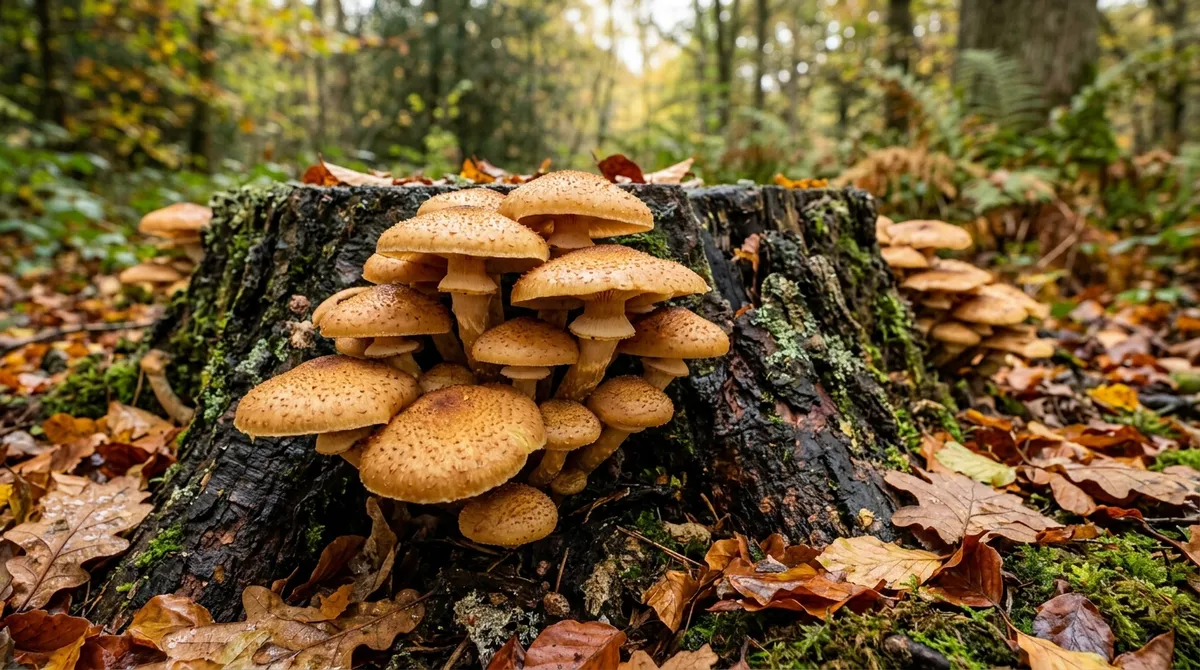
Clusters of honey-coloured toadstools appear at the base of infected plants from September to November. They are typically 3-10cm across with a rounded to flattened cap, honey to pale brown in colour, with a slight umbo (central boss) and faint darker scales on the cap. The gills are cream to pale pink, running slightly down a pale ring-bearing stem. They grow in dense clusters, often at the base of stumps or from buried root fragments.
Caution: Honey-coloured toadstools alone are not diagnostic. Pholiota and Hypholoma species produce similar-looking clusters. Toadstools may also be absent in dry autumns or when the infection is at an early stage below ground.
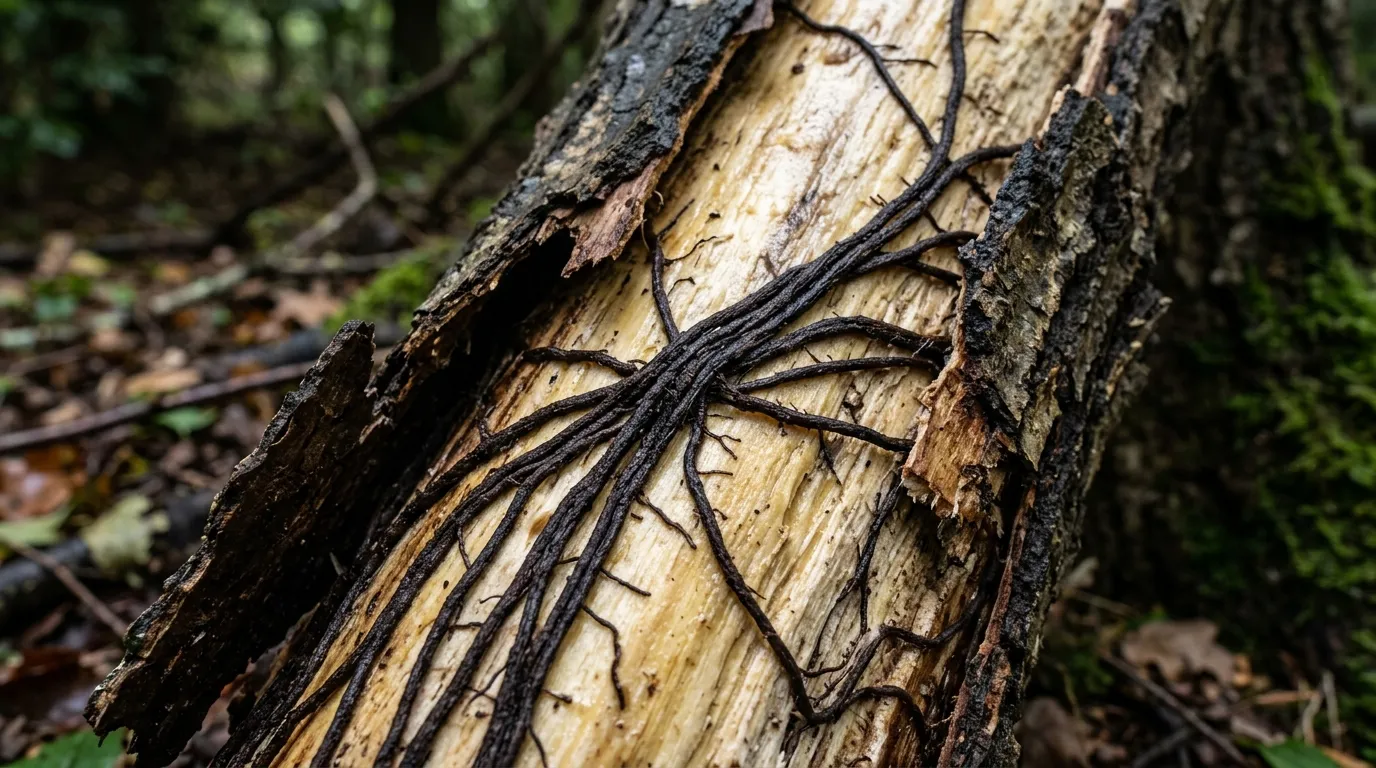 Black bootlace rhizomorphs of Armillaria exposed beneath bark during diagnosis in a Staffordshire garden. These cord-like strands grow at 1 metre per year through soil.
The Armillaria lifecycle: how infection spreads
Understanding the lifecycle explains why honey fungus is so persistent and why physical removal is the only effective strategy.
Primary infection: spore germination on dead wood
Armillaria spores are produced in the autumn toadstools and dispersed on the wind. They are tiny — around 7-9 micrometres — and can travel considerable distances. However, spore germination is the less important route of spread in established garden infections. Spores can only colonise dead or severely weakened woody tissue, not healthy roots. The primary role of spores is long-range colonisation of new sites.
In most domestic gardens, honey fungus arrives from an existing source: an infected stump in a neighbouring garden, a felled tree left in the ground, or an established woodland boundary.
Secondary spread: rhizomorph growth
Once established on a dead stump or large root, the fungus grows rhizomorphs outward through the soil. Research by Rishbeth (1978) and subsequent studies confirm a growth rate of approximately 1 metre per year under UK conditions — faster on sandy, well-aerated soils, slower on clay. The rhizomorphs are not dependent on the host plant’s tissue; they carry their own carbohydrate reserves and can travel through unfavourable soil conditions to reach new root systems.
On reaching a healthy root, the rhizomorph attaches and penetrates the root cortex. A melanised infection peg breaches the outer bark. The fungus then spreads beneath the bark as mycelial sheets, girdling the cambium layer. Once the cambium is disrupted around the circumference of a root or trunk, the plant’s vascular transport collapses.
Timing of plant death
Large, established trees may resist for several years before dying. They produce callus tissue and may fight off localised infections. Young shrubs and newly planted trees die within one to two growing seasons. The critical factor is root mass relative to infection pressure. A 30-year-old oak with an extensive root system can tolerate infection on several smaller roots. A two-year-old cherry planted into infected soil has no such buffer.
Spore production
A single fruiting body produces approximately 2 billion spores over its 2-week lifespan. A cluster of 20-30 toadstools at the base of a large stump produces enough spores to colonise multiple sites within wind-dispersal range. This is why cutting off visible toadstools without removing the stump achieves nothing — the spore source is the mycelium in the dead wood, not the fruiting bodies themselves.
Treatment hierarchy: ranked by effectiveness
No chemical treatment is available to UK gardeners for honey fungus. Phosphonate-based products (potassium phosphonate) are marketed as plant strengtheners and show some protective effect in laboratory conditions, but there is no field evidence that they halt or reverse established Armillaria infections in garden settings. The RHS formally states that no fungicide is available for amateur use against honey fungus.
The following table ranks available approaches by their proven effectiveness in containing spread.
| Treatment | Effectiveness | Cost estimate | Timing | Role |
|---|---|---|---|---|
| Complete stump and root removal | High — removes primary food source | 200-800 pounds per large stump (professional) | Immediately on diagnosis | First priority |
| Physical barrier installation (45cm butyl rubber) | High — proven to stop rhizomorph spread when installed correctly | 8-15 pounds per linear metre (materials) | Before or after removal | Essential containment |
| Replanting with resistant species | High — permanent prevention for new planting | Varies by plant choice | After removal and barrier | Long-term strategy |
| Removal of infected soil (30cm radius around roots) | Moderate — reduces inoculum | Labour intensive | At time of removal | Supplementary |
| Improving drainage and soil health | Low-moderate — reduces stress on plants | Variable | Ongoing | Supporting measure |
| Cutting off toadstools | None — does not affect mycelium or rhizomorphs | Free | N/A | No value |
| Phosphonate sprays | No field evidence of effectiveness | 15-30 pounds per season | N/A | Not recommended |
Why we recommend immediate stump removal over any other action: In every garden where I have dealt with honey fungus, the length of time the stump remained in the ground correlated directly with the area of spread. One garden where a large privet hedge stump was left for 4 years after the hedge died showed honey fungus in the soil across an area of roughly 25 square metres when we eventually investigated. A similar-sized stump removed within 6 months of the hedge dying on a neighbouring plot showed infection confined to within 1 metre of the stump itself. Remove stumps as soon as possible. Hire a stump grinder if the stump is large — manual removal of a stump larger than 20cm diameter is not practical.
How to install a physical honey fungus barrier
Physical barriers are the most effective tool for preventing rhizomorph spread into uninfected areas of the garden. They are particularly valuable on garden boundaries where the source of infection is in a neighbour’s garden or in adjacent woodland.
Materials
Use 500-micron butyl rubber root barrier membrane or dedicated root barrier sheeting sold for bamboo containment. Standard black polythene below 200 microns degrades within 2-3 seasons in soil and is not adequate. The material must be impermeable — rhizomorphs cannot penetrate an intact barrier but will find gaps at joins or points where the membrane has degraded.
Installation steps
- Mark the trench line, allowing a working width of at least 30cm.
- Dig a trench to 45cm depth minimum. In sandy soils, consider 60cm — rhizomorphs have been recorded penetrating to 50cm in free-draining soil.
- Cut the membrane to length, allowing 5cm extra at the top to fold outward horizontally.
- Join sections using waterproof butyl tape rated for below-ground use. Overlap joins by at least 15cm. Any gap will be found.
- Fold the top 5cm of membrane outward at ground level to prevent rhizomorphs growing over the barrier top.
- Backfill the trench in layers, firming as you go.
- Check the membrane line annually and clear any soil buildup at the surface that might allow rhizomorphs to bridge over the top.
At 8-15 pounds per linear metre for materials, a 5-metre barrier on a vulnerable garden boundary costs 40-75 pounds. This is modest compared to the cost of losing established trees and shrubs.
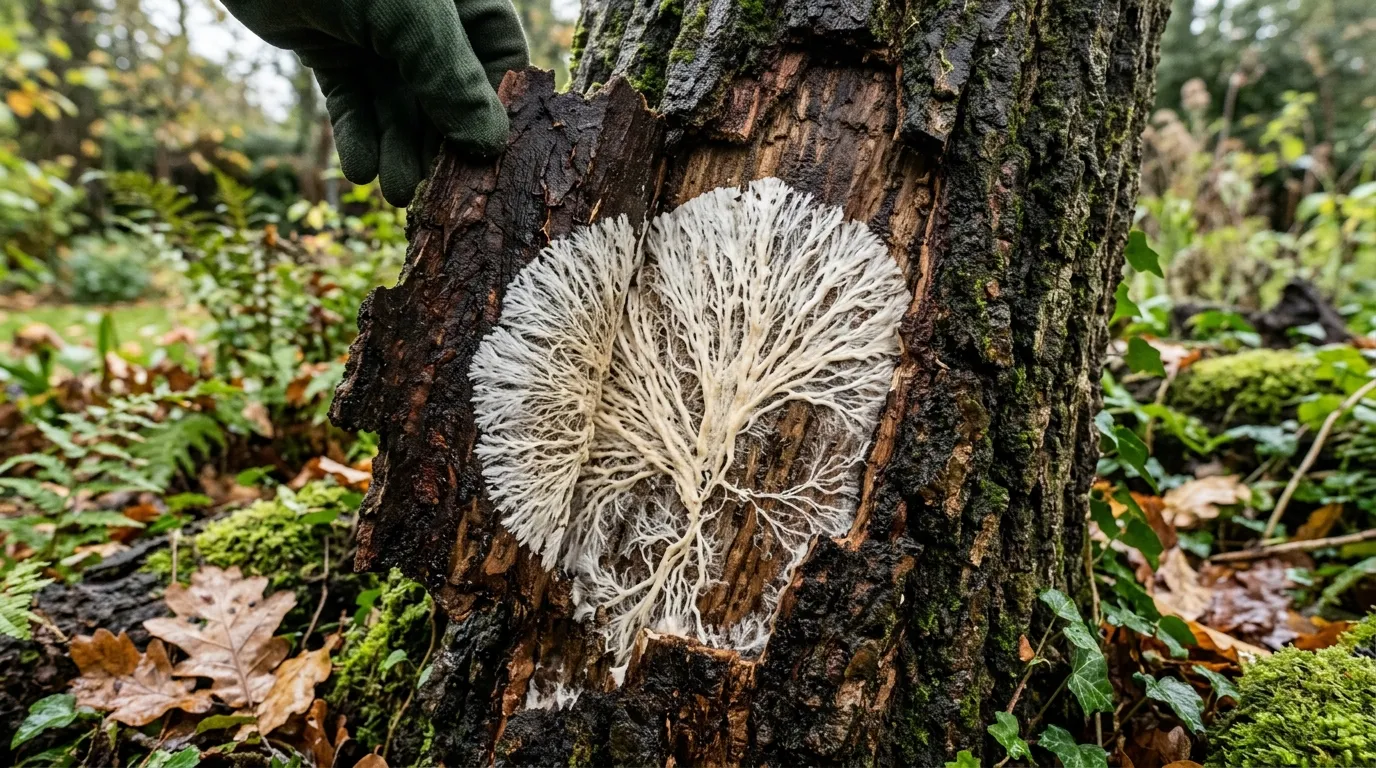 White mycelial fan of Armillaria beneath peeled bark at the base of an infected tree. This creamy white sheet between bark and wood is the most reliable year-round diagnostic sign.
Susceptible vs resistant species: the complete guide
The most powerful long-term response to honey fungus is replanting with resistant species. The following table combines RHS trial data with observed performance in UK gardens.
| Category | Species | Common name | Resistance rating | Notes |
|---|---|---|---|---|
| Highly susceptible | Ligustrum ovalifolium | Garden privet | Very susceptible | Most commonly killed in UK gardens |
| Highly susceptible | Betula pendula | Silver birch | Very susceptible | Birch stumps are major spread sources |
| Highly susceptible | Prunus spp. | Ornamental cherry, plum | Very susceptible | Most Prunus species, including laurel |
| Highly susceptible | Salix spp. | Willow | Very susceptible | Large willows are high-risk stumps |
| Highly susceptible | Malus spp. | Apple, crab apple | Susceptible | Including ornamental crab apples |
| Highly susceptible | Rhododendron spp. | Rhododendron | Susceptible | Also susceptible to Phytophthora |
| Moderately susceptible | Acer spp. | Maple | Moderate | Depends on species and vigour |
| Moderately susceptible | Rosa spp. | Rose | Moderate | Standard roses more at risk than species roses |
| Moderately susceptible | Wisteria spp. | Wisteria | Moderate | Can survive mild infections |
| Resistant | Taxus baccata | Yew | High resistance | Excellent garden hedge alternative to privet |
| Resistant | Buxus sempervirens | Box | High resistance | Monitor for box blight separately |
| Resistant | Ilex aquifolium | Holly | High resistance | Good native alternative |
| Resistant | Fagus sylvatica | Beech | Good resistance | Useful as hedge or specimen |
| Resistant | Quercus robur | English oak | Good resistance | Long-term option for large gardens |
| Resistant | Cercis siliquastrum | Judas tree | Good resistance | RHS-recommended replacement |
| Resistant | Catalpa bignonioides | Indian bean tree | Good resistance | Tolerates infected soil well |
| Resistant | Mahonia aquifolium | Oregon grape | Good resistance | Useful ground-cover shrub |
| Resistant | Photinia x fraseri | Photinia | Good resistance | Good privet alternative |
Important caveat: No species is fully immune. Resistance ratings reflect observed performance under typical infection pressure. In heavily infected soil with large root masses providing inoculum, even resistant species can be colonised eventually. Removing the infected stump and root system before replanting gives resistant species the best chance.
For tree species selection, see our guide to the best trees for small gardens, which includes resistance considerations alongside size and ornamental value. Our best evergreen trees for UK gardens guide covers yew, holly, and Photinia in detail.
Root cause analysis: why honey fungus establishes in gardens
Honey fungus does not appear randomly. Specific conditions make gardens vulnerable. Understanding these root causes allows targeted prevention.
Cause 1: Felled trees with stumps left in the ground
This is the most common cause of new honey fungus outbreaks in domestic gardens. When a tree is felled and the stump is left, the dead wood becomes a food source for any Armillaria spores landing on it, or a colonisation point if rhizomorphs from a neighbouring infection reach it. The larger the stump, the more years it provides food for the fungus to grow outward. Always remove stumps by grinding or hand to below soil level within 12 months of felling.
Cause 2: Infected neighbouring gardens and woodland
You cannot control what is in your neighbour’s garden. If your boundary adjoins old woodland, an untended garden with dead or dying trees, or a site with a history of tree loss, rhizomorphs may already be growing toward your boundary. Physical barrier installation along such boundaries is prudent preventive action even before honey fungus appears in your own garden.
Cause 3: Weakened plants with poor vigour
Honey fungus is both a parasite and a saprotroph. While it can kill healthy plants, it establishes far more readily on plants already weakened by drought, waterlogging, nutrient deficiency, or other disease. A privet hedge that has been regularly dehydrated by competition from tree roots or a poorly drained corner is far more vulnerable than vigorously growing specimens in good conditions. Maintaining plant health through appropriate mulching and watering reduces susceptibility. See our compost tea guide for a liquid feed approach that improves root zone biology and plant vigour.
Cause 4: Buried wood and construction debris
Buried timber from old fencing, tree roots, or construction waste acts as a food reservoir exactly like a stump above ground. Gardens on sites of former orchards, hedgerows, or woodland can harbour buried root systems that sustain Armillaria for decades before symptoms appear in new plantings. If you are creating a new garden on a previously wooded site, consider soil investigation for buried wood before committing to susceptible plantings.
Month-by-month detection and management calendar
| Month | Honey fungus activity | What to do |
|---|---|---|
| January | Dormant below ground | Plan barrier installation. Obtain quotes for stump grinding |
| February | Still dormant | Dig soil investigation near any unexplained dead plants from previous year |
| March | Mycelium becomes active as soil warms | Check base of shrubs showing poor growth — peel back bark |
| April | Rhizomorph growth resumes | Investigate soil around plants with poor bud burst |
| May | Active spread through warm soil | Look for unexplained wilting in cherries, privet, birch |
| June | Vigorous growth period | Monitor susceptible species. Note any die-back |
| July | Peak rhizomorph spread in warm soil | Investigate die-back promptly before summer holiday |
| August | Late summer die-back often first visible sign | Peel bark at plant base if unexplained wilting appears |
| September | Toadstools begin emerging | Look for honey-coloured toadstool clusters at base of plants and stumps |
| October | Peak toadstool production | Confirm diagnosis using all three signs. Map affected area |
| November | Last toadstools. Mycelium active below ground | Remove infected plants. Stump grind if possible. Begin barrier installation |
| December | Fungus dormant | Order root barrier membrane and butyl tape for spring installation |
Common mistakes when dealing with honey fungus
Relying on toadstool removal
Cutting off the toadstools achieves nothing for the infection below ground. The fruiting bodies are a symptom of an established mycelial colony already occupying significant soil volume. Removing them reduces spore production marginally but has no effect on the rhizomorphs spreading outward. Focus on the stump and root system, not the surface fruiting bodies.
Using inadequate barrier material
Standard black polythene from a garden centre degrades within 2-3 seasons in soil. By the time you think your barrier is doing its job, it may already have gaps. Use dedicated root barrier membrane rated for long-term below-ground use (500-micron butyl or polypropylene). Check the manufacturer’s specified design life — look for a minimum of 15 years.
Replanting susceptible species in infected ground
It is tempting to replace a dead privet hedge with a new privet hedge. This is the most reliable way to lose the replacement within 2-5 years. The infected soil still contains rhizomorph fragments and mycelium associated with old root channels. A new susceptible plant in that ground is a target from the day of planting. Always choose from the resistant species list and, where practical, remove or replace the top 30cm of soil with fresh growing medium before replanting.
Leaving infected wood in the ground
Not all stump removal is complete removal. Grinding to 20cm below surface leaves the majority of the root mass intact. For honey fungus management, grind to 30cm minimum, remove all root sections larger than 2cm diameter from the surrounding soil within 1 metre radius, and treat the exposed soil with a thick application of activated compost to encourage competing soil organisms. The fungus weakens faster in soil with active, diverse biology.
Diagnosing from toadstools alone
Several harmless fungi produce honey-coloured toadstool clusters at the base of trees: Hypholoma fasciculare (sulphur tuft) and certain Pholiota species are common in UK gardens. Digging up a healthy shrub because you found toadstools nearby — without confirming the white mycelium sheets under the bark — is a costly error. Always confirm with at least two diagnostic signs.
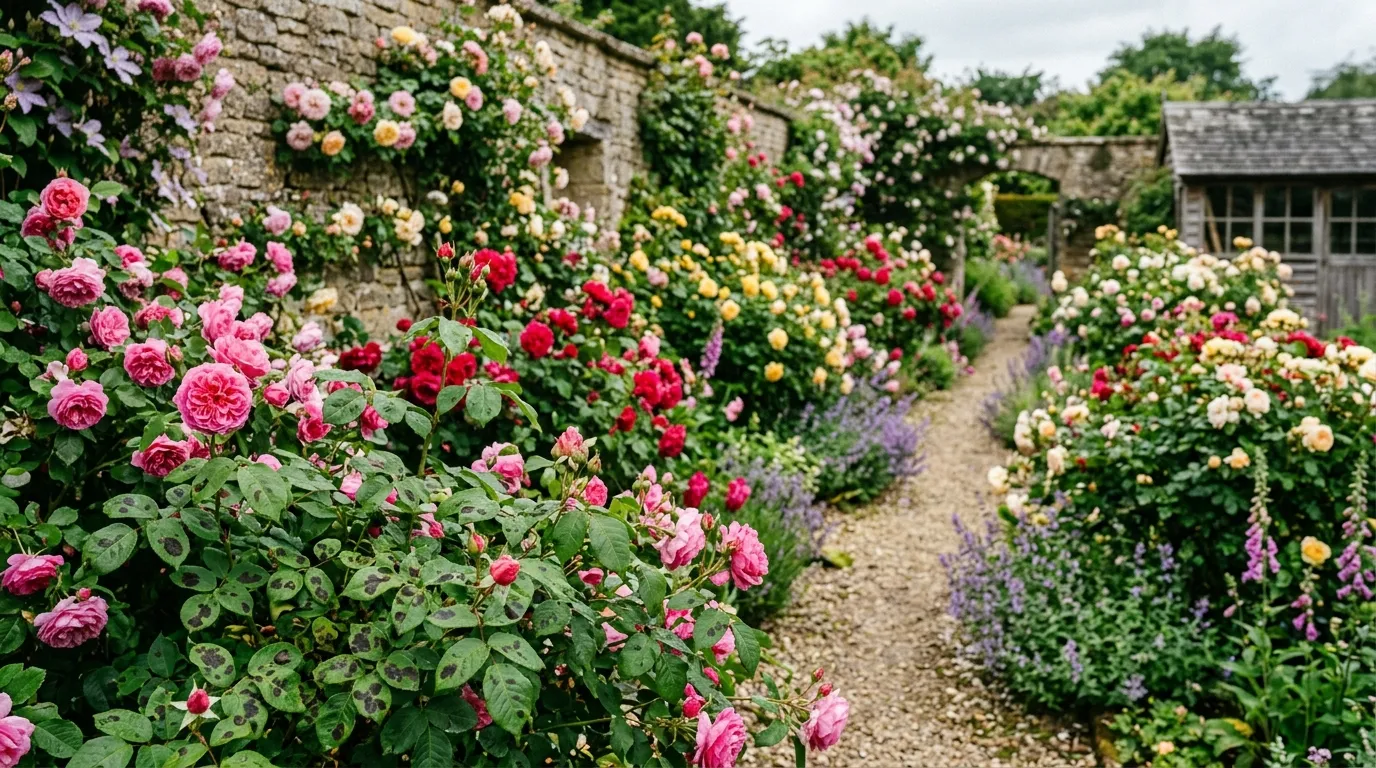
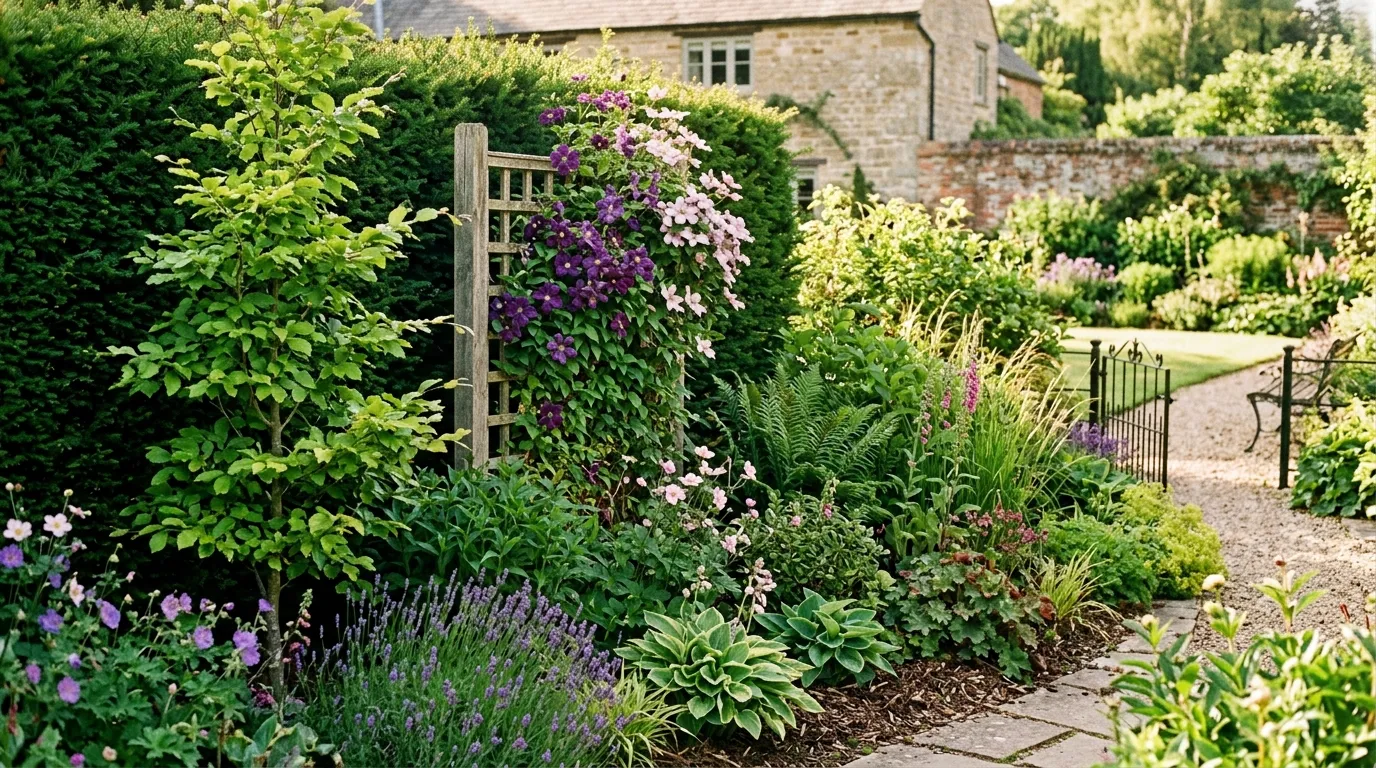 A Staffordshire garden border replanted with honey fungus resistant species including yew, beech, and clematis after removing infected privet. Resistant species thrive where susceptible plants failed.
Field Report: honey fungus containment in a Staffordshire garden
Location: Semi-rural garden, Stafford, Staffordshire. Heavy clay over sandstone. Duration of monitoring: 2014 to present (12 years). Initial situation: Established infection in large silver birch (approx. 80 years old) on the boundary between the garden and adjacent woodland. Birch died 2013. Stump ground to 25cm depth in March 2014.
Findings:
By October 2014, honey fungus toadstools appeared 1.5 metres into the garden from the original stump location. Soil investigation confirmed rhizomorphs travelling in two directions from the grinding debris. Bark investigation of a nearby ornamental cherry showed early mycelium colonisation.
The cherry was removed completely in November 2014, including all accessible roots. A 6-metre butyl rubber barrier (500-micron) was installed to 45cm depth along the boundary line in January 2015. The grinding debris from the original stump was excavated to 35cm and removed.
Results after barrier installation:
No further honey fungus deaths inside the barrier boundary since 2015. Toadstools have appeared in the woodland side of the boundary every autumn from 2015 to 2024. Soil investigation on the woodland side of the barrier in 2019 found rhizomorphs growing along the membrane face, confirming the barrier is deflecting spread rather than eliminating the source.
Conclusion: Barrier installation combined with complete removal of infected material within the barrier zone has prevented any further plant losses over a 10-year period. The fungus persists in the woodland and in residual infected soil near the old stump, but has not penetrated the contained zone.
Related garden disease topics
For a broader view of the diseases that can affect UK gardens, including powdery mildew, blight, and rust, read our comprehensive guide to common garden plant diseases in the UK. If you are reconsidering your garden’s planting scheme after a honey fungus diagnosis, our guide to the best trees for small gardens in the UK covers resistant species with full ornamental notes.
The RHS provides a definitive honey fungus identification and management page with a full susceptible species list updated annually — essential reading before choosing replacements.
Good soil biology helps plants resist all forms of root stress. Our guides to how to mulch your garden and making compost tea cover two practical ways to improve soil health and root zone resilience.
Frequently asked questions
What kills honey fungus in UK gardens?
There is no chemical control available to UK gardeners for honey fungus. The only effective approaches are physical: remove the infected plant including as much of the stump and root system as possible, install a vertical barrier of butyl rubber or heavy-duty polythene to 45cm depth to stop rhizomorph spread, and replant with resistant species. Phosphonate-based products sold as plant strengtheners provide no meaningful protection against established Armillaria infections.
How do I identify honey fungus?
Three signs confirm honey fungus: white fungal sheets (mycelium) beneath the bark at the base of the plant, black bootlace rhizomorphs in the soil, and honey-coloured toadstools at the base in autumn. You need at least two of these signs for a confident diagnosis. Honey-coloured toadstools alone are not sufficient, as several harmless species produce similar fruiting bodies.
Which plants are resistant to honey fungus?
Yew, box, holly, beech, and bamboo show strong resistance in UK trials. The RHS recommends Cercis siliquastrum, Catalpa bignonioides, and Quercus robur as tree replacements. For shrubs, replace susceptibles with Photinia x fraseri, Mahonia aquifolium, or Buxus sempervirens. Resistance does not mean immunity — heavily infected soil can kill even resistant plants eventually.
How deep must a honey fungus barrier go?
The barrier must reach 45cm below soil surface to be effective. Rhizomorphs travel through the top 30-45cm of soil. Use 500-micron butyl rubber or dedicated root barrier membrane. Standard polythene sheeting below 200 microns is too thin and degrades within 2-3 years. Join sheets with waterproof tape and fold the top 5cm of membrane outward horizontally at ground level to prevent rhizomorphs growing over the top.
Can I compost plants killed by honey fungus?
Do not add honey fungus-infected material to a garden compost heap. The mycelium and rhizomorphs can survive cold composting and will be distributed through your garden when you spread the compost. Dispose of all infected material — including roots and stumps — through council green waste collections, which typically achieve temperatures above 60C. Never leave infected stumps or root sections in the ground if you can avoid it.
How long does honey fungus stay in the soil?
Honey fungus remains viable in soil for decades as long as there is dead woody material to colonise. A dead stump or buried root provides food for 20 to 30 years. Even after removing the stump, fine rhizomorphs persist in surrounding soil. This is why replanting susceptible species in an infected area within 5 to 10 years commonly results in the new plant dying. Always replant with resistant species and monitor for signs of spread.
Does honey fungus spread from tree stumps to healthy plants?
Yes, this is the primary route of spread in domestic gardens. Honey fungus colonises dead stumps from infected trees in neighbouring gardens or from felled trees left in the ground. Rhizomorphs then grow outward through the soil at 1 metre per year, attaching to the roots of healthy plants and girdling them. Remove stumps to below soil level as soon as possible after felling any tree in or near an infected area.
What are the first signs of honey fungus in a garden?
The first visible sign is often unexplained wilting or die-back of an apparently healthy shrub or tree, typically in late summer. Digging at the base and peeling back the bark reveals white mycelial sheets with a strong mushroom smell. Black bootlace rhizomorphs appear in the surrounding soil. Honey-coloured toadstools emerge in September to November but are frequently absent in dry autumns.
Lawrie has been gardening in the West Midlands for over 30 years. He grows his own veg using no-dig methods, keeps a wildlife-friendly garden, and writes practical advice based on real UK growing conditions.