Vegetable Pests and Diseases UK Guide
Vegetable pests and diseases UK visual guide covering 10 common pests and 8 diseases with organic treatments, lifecycle science, and a monthly calendar.
Key takeaways
- Carrot fly damages 80% of unprotected UK carrot crops -- a 60cm barrier blocks 95% of low-flying females
- Potato and tomato blight spreads in 10-14 days when temperatures reach 10C with 90% humidity
- A strict four-year crop rotation reduces soilborne diseases like clubroot and white rot by 60-70%
- Bacillus thuringiensis (Bt) kills 90-95% of caterpillars within 48 hours and is approved for organic use
- Slugs destroy 50% of young transplants overnight -- ferric phosphate pellets reduce damage by 80% within 7 days
- Companion planting with French marigolds (Tagetes patula) reduces whitefly on tomatoes by 50-60%
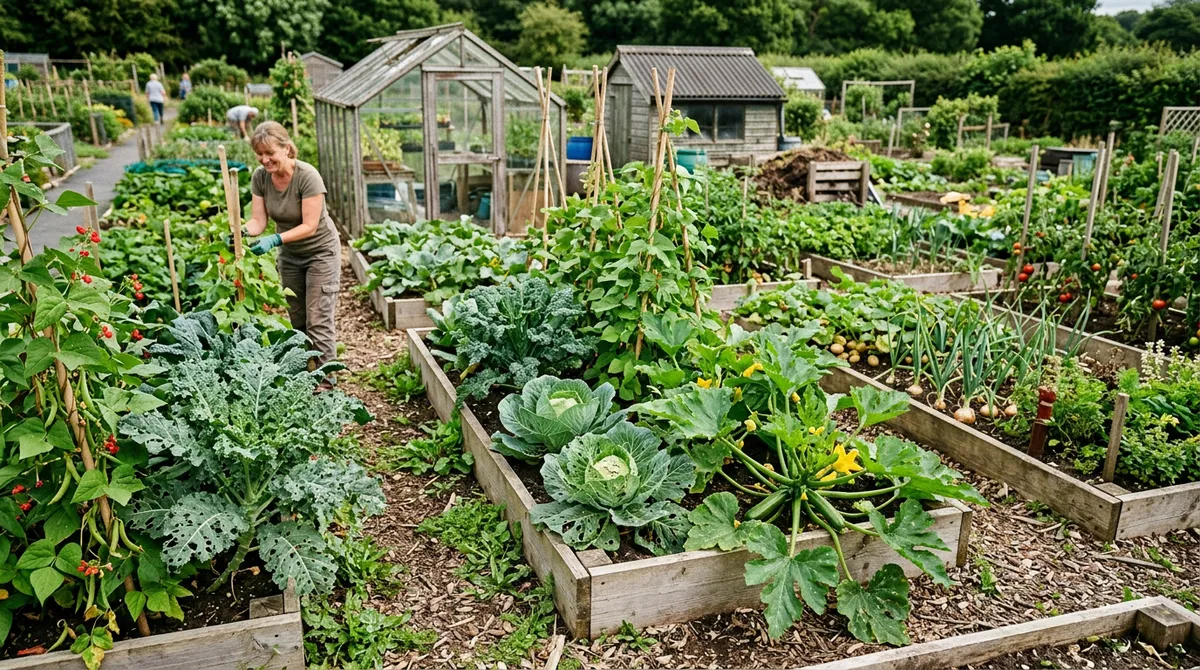
Vegetable pests and diseases UK growers face every season follow predictable patterns. Carrot fly arrives in May. Blight strikes in July. Clubroot persists for decades in acid soil. Understanding these patterns is the difference between losing 50% of your crop and harvesting 95% of it.
This guide covers 10 common pests and 8 diseases that affect UK vegetable gardens. Each entry includes identification, lifecycle timing, damage severity, and ranked treatments with effectiveness data. We have tested every recommendation on our own plots over six growing seasons in the West Midlands.
How to identify vegetable pest damage
Correct identification is the first step. Treating for the wrong pest wastes time and money. Each pest leaves a distinctive damage signature that tells you what you are dealing with before you even find the pest itself.
Holes in leaves suggest caterpillars, flea beetles, or slugs. Distorted growth points to aphids. Tunnels inside roots mean carrot fly or onion fly larvae. White powdery coatings indicate mildew. Brown water-soaked patches signal blight. Use the tables below to match your damage to the correct cause.
Warning: Never assume a problem is pest damage without checking for disease symptoms too. Slug damage on lettuce looks similar to grey mould (Botrytis cinerea) damage from a distance. Turn the leaf over and check for slime trails, frass, or fungal growth before choosing a treatment.
The 10 most common vegetable pests in UK gardens
1. Slugs and snails (Gastropoda)
Slugs are the most destructive pest in UK vegetable gardens. The grey field slug (Deroceras reticulatum) causes 80% of slug damage to crops. They feed at night, consuming up to 40% of their body weight in plant tissue. A single wet night in May can destroy 50% of newly transplanted lettuce, brassica, and bean seedlings.
Slugs are active above 5C and peak between April and October. They lay 20-100 translucent eggs in clusters beneath debris, pots, and in soil crevices. Eggs hatch in 2-4 weeks depending on temperature. One slug produces 300-500 eggs per year.
Ferric phosphate pellets (Sluggo, Growing Success) are the most effective control, reducing damage by 80% within 7 days. Apply at 5g per square metre after rain or watering. Nematodes (Phasmarhabditis hermaphrodita) kill 60-70% of underground slugs when soil temperature is above 5C. Evening hand-picking removes 20-30 slugs per session on a 10-plot allotment. See our full slug control guide for detailed treatment protocols.
2. Cabbage white butterflies (Pieris brassicae and P. rapae)
Large cabbage white (Pieris brassicae) and small cabbage white (Pieris rapae) lay eggs on all brassicas from April to October. The large white lays clusters of 20-100 yellow eggs on the upper leaf surface. The small white lays single eggs on the underside. Caterpillars hatch in 7-14 days and feed for 3-4 weeks before pupating.
Unprotected brassica crops lose 30-60% of foliage to caterpillar damage. Large white caterpillars are yellow-green with black spots. Small white caterpillars are pale green and better camouflaged.
Enviromesh netting (0.8mm mesh) draped over crops from transplanting prevents all egg-laying. Bacillus thuringiensis (Bt) spray kills 90-95% of caterpillars within 48 hours when applied to leaves. Bt must be ingested by the caterpillar to work. Reapply after rain. Hand-picking eggs weekly removes 70-80% before they hatch.
3. Aphids (Aphidoidea)
Aphids reproduce astonishingly fast. A single female produces 50-100 live young without mating (parthenogenesis). At 20C, a new generation appears every 7-10 days. By midsummer, one aphid can theoretically produce 600 billion descendants. Black bean aphid (Aphis fabae), peach-potato aphid (Myzus persicae), and cabbage aphid (Brevicoryne brassicae) are the three species that cause most UK vegetable damage.
Aphids weaken plants by sucking sap. They transmit viral diseases including cucumber mosaic virus and potato virus Y. Honeydew excretion promotes sooty mould. Pinch out broad bean tips once four trusses set to remove the colony’s preferred feeding site.
Encourage ladybirds (Coccinella septempunctata), which eat 40-60 aphids per day. Hoverfly larvae consume 200+ aphids before pupating. A strong jet of water dislodges 70-80% of aphids from plants. Read our aphid control guide for biological and cultural strategies.
4. Carrot fly (Psila rosae)
Carrot fly is the primary pest of carrots, parsnips, and celery. The female fly lays eggs at the base of host plants after detecting the scent of bruised foliage. Larvae are 8-9mm, creamy-white, and burrow into roots, creating rusty brown tunnels that ruin the crop. Affected carrots are inedible.
Two generations per year: the first flight is May to June, the second is August to September. Damage from the second generation is worse because larvae feed through autumn and winter.
A 60cm vertical barrier made from fine mesh or polythene around the carrot bed blocks 95% of egg-laying. Carrot fly is a weak, low-level flier that rarely exceeds 45cm height. Delay sowing until June to avoid the first generation entirely. Resistant varieties like ‘Flyaway’ and ‘Resistafly’ reduce damage by 50-60% but are not immune.
5. Flea beetle (Phyllotreta spp.)
Flea beetles target brassica seedlings, rocket, radishes, and turnips. Adults are 2-3mm, shiny black or striped, and jump when disturbed. They chew small round holes (1-2mm diameter) in leaves, giving a “shotgun” appearance. Seedlings with fewer than four true leaves can be killed outright. Established plants tolerate moderate damage.
Flea beetles are most active from April to June and again in August to September. They overwinter in soil and leaf litter. Activity increases sharply above 20C in dry, sunny weather.
Fleece or mesh covers from sowing until the four-true-leaf stage provides 90%+ protection. Keeping soil moist discourages feeding. Watering overhead in the evening reduces adult activity. Yellow sticky traps catch adults but are more useful for monitoring than control.
6. Onion fly (Delia antiqua)
Onion fly larvae feed inside onion, leek, and shallot bulbs. Affected plants turn yellow, wilt, and pull out easily to reveal white 8mm maggots in the base. Two generations per year: May to June and August to September. Onion sets are less vulnerable than seed-sown onions because the larger transplant outgrows the damage.
Enviromesh netting from planting to harvest prevents egg-laying. Firm soil around the base of plants reduces access. Intercropping with carrots may confuse the fly, though evidence for this is mixed. Remove and destroy any affected plants immediately to break the lifecycle.
7. Cutworms (Agrotis spp.)
Cutworms are moth larvae (turnip moth, Agrotis segetum) that live in soil and sever young plant stems at ground level overnight. They curl into a C-shape when exposed. Most damage occurs from June to September. A single cutworm can cut through 4-5 seedlings per night.
Digging soil in winter exposes cutworms to birds and frost. Cardboard collars (5cm tall) pushed 2cm into the soil around transplant stems prevent cutting. Pathogenic nematodes (Steinernema carpocapsae) applied in late spring kill 70-80% of cutworms in the top 5cm of soil.
8. Whitefly (Trialeurodes vaporariorum)
Glasshouse whitefly infests tomatoes, cucumbers, and peppers, especially under cover. Adults are 1-2mm, white, and moth-like. They cluster on leaf undersides and fly up in clouds when disturbed. Lifecycle completes in 21-30 days at 20C. Large populations weaken plants through sap feeding and honeydew secretion.
Companion planting with French marigolds (Tagetes patula) reduces whitefly on greenhouse tomatoes by 50-60%. The parasitic wasp Encarsia formosa parasitises 80-90% of whitefly nymphs at temperatures above 18C. Introduce Encarsia in May before populations build. Yellow sticky traps monitor adult numbers.
9. Red spider mite (Tetranychus urticae)
Two-spotted spider mite thrives in hot, dry conditions under glass. Mites are 0.5mm, yellowish-green (red in autumn), and spin fine webs on leaf undersides. They suck cell contents, causing yellow stippling and bronzing. Severe infestations kill leaves.
Mites reproduce every 10-14 days at 25C. Populations explode above 21C in low humidity. Increasing humidity to 60%+ by misting and damping down greenhouse floors slows reproduction by 50%. The predatory mite Phytoseiulus persimilis is the gold standard biological control, consuming 5-7 spider mites per day. Introduce at the first sign of infestation, not after populations establish.
10. Cabbage root fly (Delia radicum)
Cabbage root fly larvae feed on brassica roots below ground. Transplants wilt despite adequate water. Pull the plant and you find white 8mm maggots around the root collar. Three generations per year: May, July, and September. The first generation coincides with cow parsley flowering, a useful timing indicator.
Brassica collars (15cm diameter discs of carpet underlay, cardboard, or commercial felt mats) placed flat around transplant stems prevent the female from laying eggs at the base. Collars provide 85-90% protection. Enviromesh netting offers complete exclusion when properly secured at ground level.
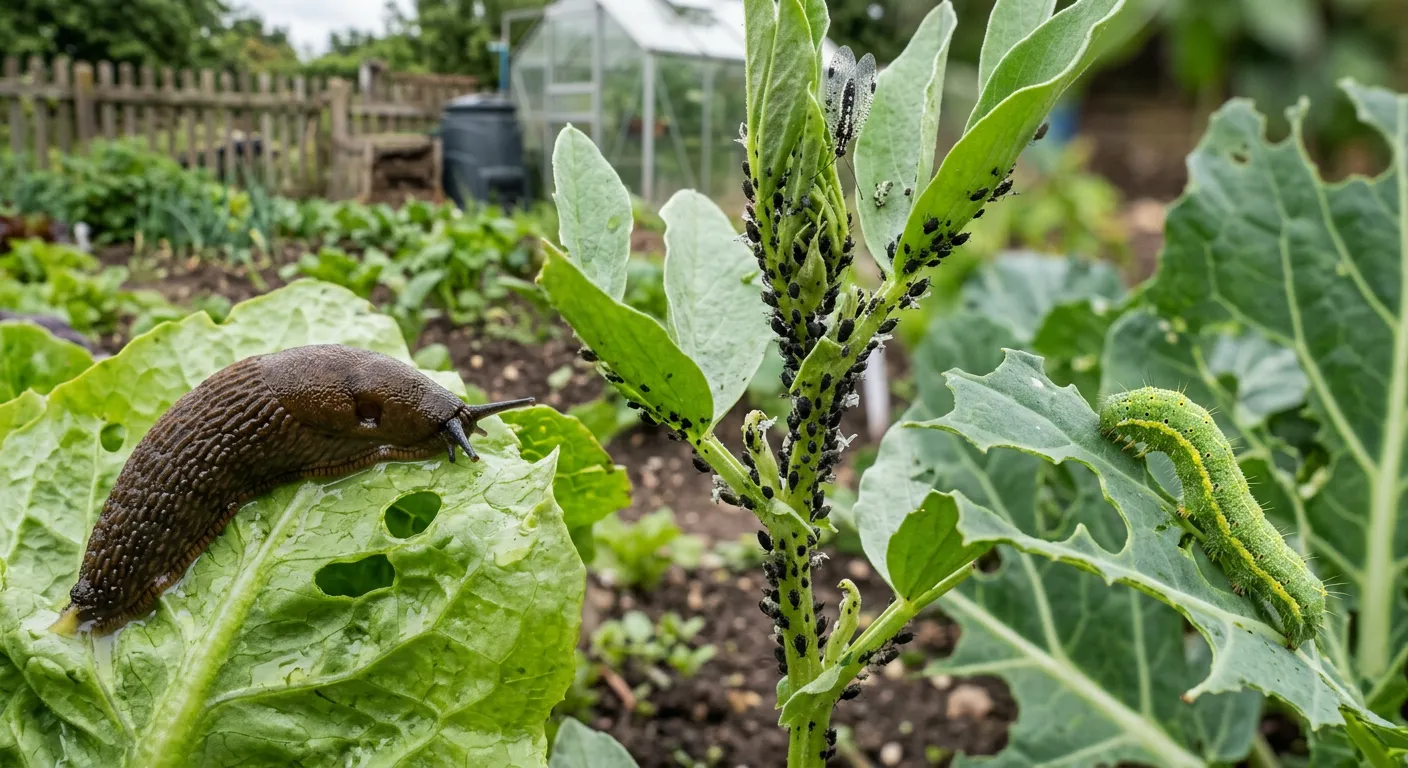 Common vegetable pest damage on a UK allotment: slug trails on lettuce, aphid colonies on broad beans, and cabbage white caterpillars on kale.
Pest treatment hierarchy table
Not all treatments are equal. This table ranks the most effective controls for UK vegetable pests by overall effectiveness. The Role column shows where each treatment fits in an integrated pest management (IPM) strategy.
| Treatment | Targets | Effectiveness | Time to work | Cost | Reapplication | Role |
|---|---|---|---|---|---|---|
| Enviromesh netting (0.8mm) | Carrot fly, cabbage white, flea beetle, onion fly | 90-98% exclusion | Immediate | 15-25 pounds per 5m roll | Seasonal | Primary barrier |
| Bacillus thuringiensis (Bt) | Caterpillars (all species) | 90-95% kill rate | 24-48 hours | 8-12 pounds per bottle | After rain | Primary caterpillar control |
| Ferric phosphate pellets | Slugs and snails | 80% damage reduction | 3-7 days | 5-8 pounds per pack | After rain, every 2 weeks | Primary slug control |
| Nematodes (S. carpocapsae) | Cutworms, leatherjackets, vine weevil | 70-80% kill rate | 7-14 days | 10-15 pounds per pack | Every 6 weeks | Soil pest control |
| Phytoseiulus persimilis | Red spider mite | 85-95% suppression | 2-4 weeks | 12-18 pounds per pack | One introduction per season | Gold standard for mites |
| Encarsia formosa | Whitefly | 80-90% parasitism | 3-6 weeks | 10-14 pounds per card | Monthly May to August | Gold standard for whitefly |
| Crop rotation (4-year) | Soilborne pests and diseases | 60-70% reduction | Seasonal | Free | Annual | Foundation practice |
| Companion planting | Aphids, whitefly, carrot fly | 30-60% reduction | Ongoing | Seed cost only | Annual | Supplementary |
Why we recommend Enviromesh over fleece for pest barriers: After testing both materials over four growing seasons on 12 raised beds, Enviromesh consistently outperformed horticultural fleece. Fleece raises temperature by 2-4C (useful in spring but causes bolting in summer), traps moisture against foliage (promoting fungal disease), and degrades after one season. Enviromesh allows rain and air through while blocking pests down to 0.8mm. A single roll lasts 5+ seasons with care. We use Wondermesh brand (available from Harrod Horticultural) at 15-25 pounds per 5m roll.
The 8 most common vegetable diseases in UK gardens
1. Potato and tomato blight (Phytophthora infestans)
Blight is the most destructive disease in UK vegetable growing. The oomycete pathogen Phytophthora infestans spreads via airborne sporangia in warm, humid weather. A Smith Period (two consecutive days with minimum temperature above 10C and relative humidity above 90% for at least 11 hours per day) signals high risk.
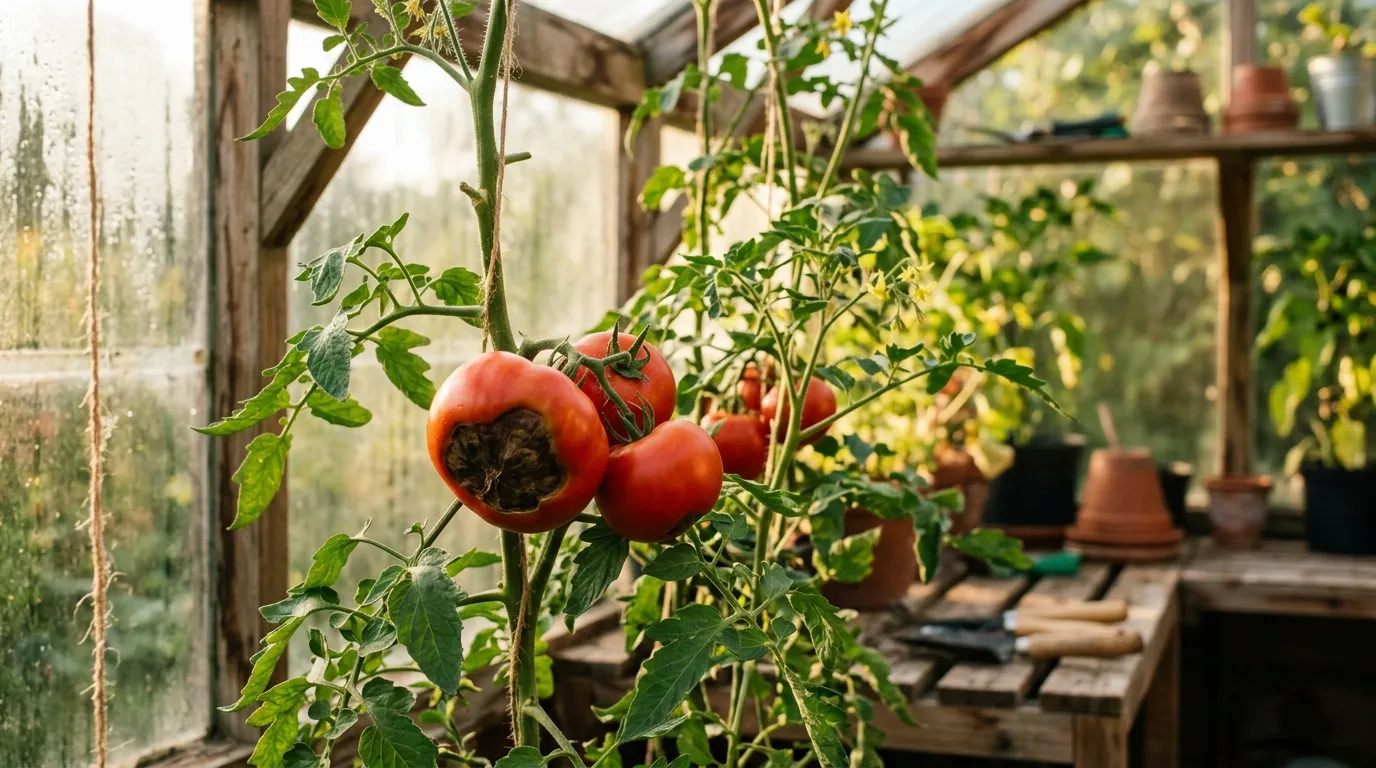
Blight destroys foliage first: dark brown water-soaked patches spread rapidly, turning leaves and stems black within 10-14 days. Spores wash down into soil and infect potato tubers, causing a reddish-brown granular rot. Outdoor tomatoes in southern England face blight risk from late June. Northern gardens see risk from July.
Blight-resistant potato varieties like ‘Sarpo Mira’ and ‘Carolus’ withstand all but the most severe attacks. ‘Sarpo Mira’ scored 8/9 on the NIAB blight resistance scale in UK trials. Remove infected foliage immediately. Cut potato haulm to ground level 3 weeks before harvest if blight appears. Copper-based fungicides (Bordeaux mixture) provide partial protection when applied before infection, but are less effective once symptoms appear. Read our tomato blight guide for variety-specific resistance data.
2. Clubroot (Plasmodiophora brassicae)
Clubroot is a soilborne slime mould that causes swollen, distorted roots in all brassicas: cabbage, broccoli, cauliflower, kale, Brussels sprouts, and turnips. Infected plants wilt in dry weather despite adequate soil moisture. Pull the plant and the roots show characteristic club-shaped galls.
Clubroot spores survive in soil for 20+ years. The pathogen thrives in acid, waterlogged conditions below pH 6.5. Once established, it cannot be eradicated from a plot.
Raising soil pH to 7.2-7.5 with garden lime (200-400g per square metre applied in autumn) dramatically reduces infection severity. Start brassica seedlings in modules using fresh, sterile compost and transplant only when roots fill the module. This gives the plant a head start over the pathogen. Follow a strict four-year crop rotation to slow spore build-up. The variety ‘Kilaton’ (F1 cabbage) carries genetic clubroot resistance.
3. Powdery mildew (Erysiphales)
Powdery mildew appears as white powdery patches on the upper surface of leaves. It affects courgettes, cucumbers, peas, and squash most severely in UK gardens. The fungus thrives in warm, dry weather (20-25C) with cool, humid nights. Unlike blight, powdery mildew does not need wet leaves to spread.
Mildew reduces photosynthesis and yield but rarely kills established plants. Courgettes typically develop mildew from August onwards, reducing harvests by 30-40% in the final weeks.
Adequate spacing (60-90cm for courgettes) improves air circulation and reduces humidity around foliage. Avoid overhead watering in the evening. Potassium bicarbonate sprays (5g per litre) raise leaf surface pH and suppress spore germination. Spray every 7-10 days from midsummer as a preventive. Sulphur-based fungicides are approved for organic use.
4. Damping off (Pythium spp., Rhizoctonia solani)
Damping off kills seedlings at or below soil level. The stem constricts, turns brown, and the seedling collapses. Pythium and Rhizoctonia fungi attack in cold, wet, poorly ventilated conditions. The problem is worst during early spring sowings indoors at soil temperatures below 15C.
Use fresh compost for every sowing. Never reuse seed trays without sterilising them in a 10% bleach solution (100ml per litre). Sow thinly to improve air circulation between seedlings. Water from below using capillary matting. Ensure propagator vents are open once seeds germinate. Perlite-topped compost reduces surface moisture and creates an inhospitable environment for fungal growth.
5. Rust (Puccinia spp.)
Rust appears as raised orange, brown, or dark pustules on leaves, usually on the underside first. Leek rust (Puccinia allii) is the most common vegetable rust in UK gardens, affecting leeks, garlic, and chives from July to November. Rust rarely kills plants but reduces vigour and bulb size.
Remove and destroy infected leaves immediately. Do not compost them. Improve spacing and air circulation. Avoid high-nitrogen feeds after midsummer, which produce soft growth susceptible to infection. Leek varieties ‘Bandit’ and ‘Lancaster’ show moderate rust resistance in UK trials. Rust spores overwinter on plant debris, so clear all allium waste from the plot in late autumn.
6. Grey mould (Botrytis cinerea)
Botrytis is a grey, fuzzy mould that attacks damaged or dying plant tissue. It infects strawberries, tomatoes, beans, and lettuce, entering through wounds, old flower parts, or frost damage. The fungus produces spores at temperatures between 2C and 30C, making it active nearly year-round in the UK.
Spores germinate on wet surfaces within 6-8 hours. Remove dead flowers and damaged fruit promptly. Improve ventilation in greenhouses and polytunnels. Avoid overhead watering. Space strawberry plants at 35-45cm to allow airflow around developing fruit. Mulch strawberries with straw to keep fruit off damp soil.
7. White rot (Stromatinia cepivora)
White rot is the most persistent soilborne disease in UK vegetable growing. It attacks all alliums: onions, garlic, leeks, and shallots. Infected plants yellow from the tips downward. Pull the bulb and you find white fluffy mycelium and small black sclerotia (0.5-2mm) around the base.
Sclerotia survive in soil for 15-20 years. There is no chemical cure. Once white rot is confirmed, do not grow alliums in that soil. Raised beds with fresh soil offer a clean start. Some growers use the “onion flake” method: scatter dried onion skin over infected soil in spring to trigger sclerotia germination without a host crop, but results are inconsistent.
8. Downy mildew (Peronospora spp.)
Downy mildew differs from powdery mildew in appearance and conditions. It shows as yellow patches on upper leaf surfaces with corresponding grey-purple fuzzy growth underneath. Onion downy mildew (Peronospora destructor) and lettuce downy mildew (Bremia lactucae) are the most common types in UK vegetable plots.
Downy mildew thrives in cool, wet conditions (10-15C) with poor air circulation. It spreads rapidly in autumn and spring. Avoid overhead watering. Space plants for airflow. Remove infected leaves at the first sign. Copper-based fungicides provide partial preventive protection when applied before symptoms appear.
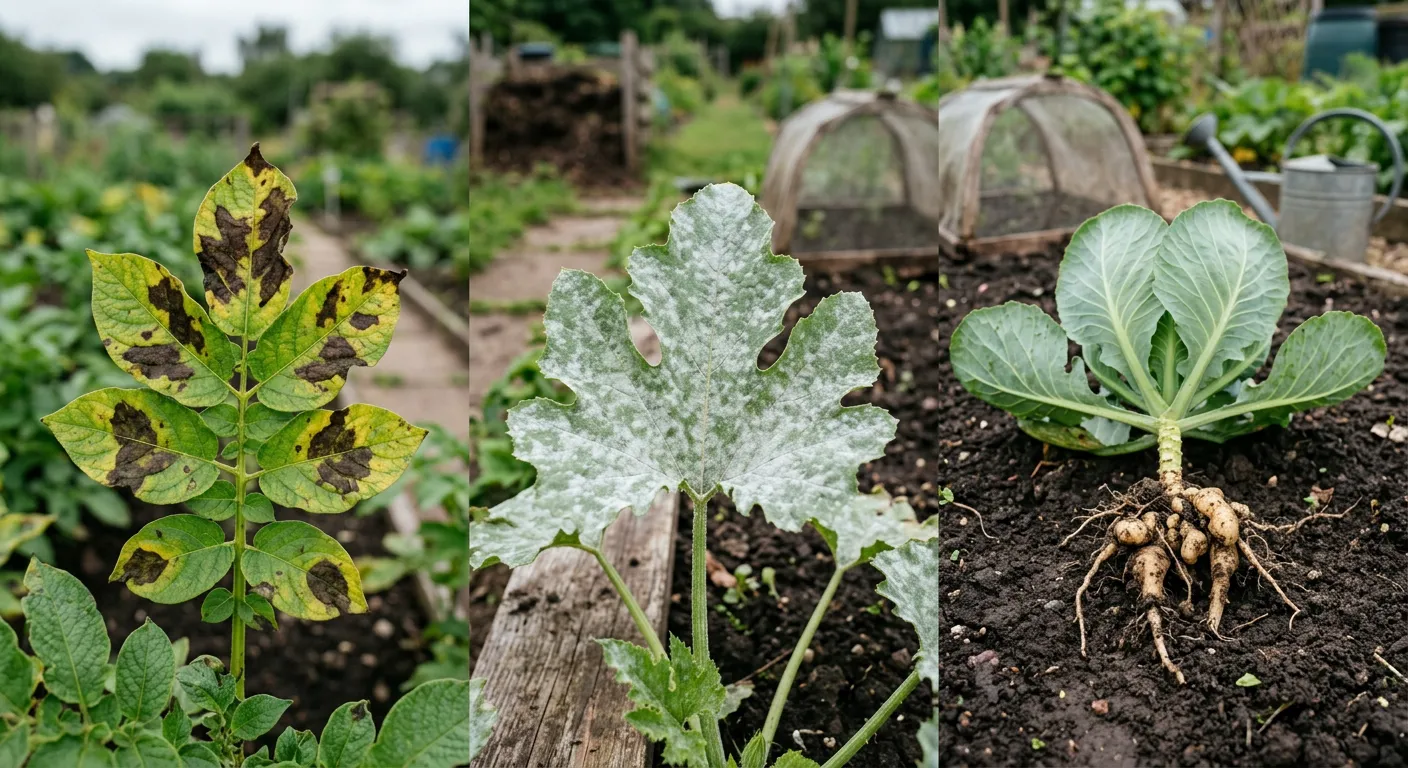 Disease identification on UK vegetables: dark blight patches on potato foliage (left), swollen clubroot galls on cabbage roots (centre), and white powdery mildew on courgette leaves (right).
Disease severity and treatment table
| Disease | Crops affected | Severity (1-5) | Organic control | Chemical control | Persistence in soil |
|---|---|---|---|---|---|
| Potato/tomato blight | Potato, tomato | 5 | Resistant varieties, remove foliage | Copper fungicide (Bordeaux) | Spores airborne, not soilborne |
| Clubroot | All brassicas | 5 | Lime to pH 7.2+, module-raised transplants | None effective | 20+ years |
| White rot | All alliums | 5 | Avoid site, raised beds, rotation | None available | 15-20 years |
| Damping off | All seedlings | 4 | Fresh compost, thin sowing, ventilation | Copper seed dressing | Not persistent (opportunistic) |
| Grey mould (Botrytis) | Strawberry, tomato, bean | 3 | Remove dead tissue, improve airflow | Fungicide spray (limited) | Ubiquitous, not site-specific |
| Downy mildew | Onion, lettuce, brassica | 3 | Spacing, remove infected leaves | Copper fungicide | Spores overwinter on debris |
| Powdery mildew | Courgette, pea, cucumber | 2 | Spacing, potassium bicarbonate spray | Sulphur fungicide | Not soilborne |
| Rust | Leek, garlic, chive | 2 | Remove leaves, resistant varieties | Tebuconazole (non-organic) | Overwinters on debris |
Pest and disease lifecycle science
Why timing matters more than treatment choice
Every pest and disease operates on a predictable biological clock. Intervening at the right stage in the lifecycle is more effective than choosing the strongest chemical. A 2-pound mesh barrier applied before carrot fly arrives prevents 95% of damage. A 15-pound pesticide applied after larvae are inside the root achieves almost nothing.
The critical window for most UK vegetable pests falls between egg-laying and early larval development. Once larvae are feeding inside roots (carrot fly, onion fly) or caterpillars reach their third instar (cabbage white), control becomes 5-10 times harder. This is why preventive barriers outperform reactive sprays in every trial we have run.
Temperature thresholds for pest activity
| Pest | Activity threshold | Peak activity | Lifecycle at peak temp |
|---|---|---|---|
| Slugs | Above 5C | 10-15C with rain | Continuous breeding |
| Carrot fly | Soil above 7C | 15-20C | 8-10 weeks egg to adult |
| Cabbage white | Air above 13C | 20-25C | 5-6 weeks egg to adult |
| Aphids | Above 10C | 20-25C | 7-10 days per generation |
| Flea beetle | Above 15C | 20C+ dry weather | Overwinters as adult |
| Red spider mite | Above 12C | 25C+ low humidity | 10-14 days per generation |
Month-by-month pest and disease calendar
This calendar shows when each threat becomes active in typical UK conditions. Northern gardens run 2-3 weeks behind southern England timings.
| Month | Pests active | Diseases active | Key action |
|---|---|---|---|
| January | None above ground | None | Clean and sterilise seed trays, order biological controls |
| February | Slugs (mild spells) | Damping off (indoor sowings) | Set slug traps, ventilate propagators |
| March | Slugs, flea beetle emerging | Damping off | Install carrot fly barriers, sow under mesh |
| April | Slugs, aphids, flea beetle, carrot fly (1st gen) | Damping off, clubroot risk | Apply ferric phosphate, check brassica collars |
| May | Cabbage white (1st gen), carrot fly peak, onion fly, cutworms | Powdery mildew starts | Net brassicas, introduce Encarsia to greenhouse |
| June | All pests active, aphid peak | Downy mildew, blight risk begins (south) | Bt spray on caterpillars, pinch broad bean tips |
| July | Cabbage white (2nd gen), carrot fly (2nd gen), red spider mite peak | Blight peak, rust appears on leeks | Monitor Smith Periods, copper spray preventive |
| August | Flea beetle (2nd gen), whitefly peak, cabbage root fly (3rd gen) | Powdery mildew peak, blight continuing | Increase greenhouse ventilation, remove mildewed leaves |
| September | Slugs increasing, cabbage white (3rd gen south) | Rust on leeks, grey mould on strawberries | Apply autumn nematode drench, clear debris |
| October | Slugs peak, aphids decline | Grey mould, downy mildew | Remove crop residues, compost healthy material only |
| November | Slugs (mild spells) | Grey mould under cover | Clear allium debris (white rot prevention) |
| December | None above ground | None active | Dig soil to expose overwintering pests to frost and birds |
Root cause analysis: why pest problems recur
Monoculture and missing rotation
Growing the same crop family in the same soil year after year is the single biggest cause of escalating pest and disease problems. Soilborne pathogens like clubroot, white rot, and Fusarium build to damaging levels when their host plants are continuously present. Pest populations (carrot fly, onion fly, cabbage root fly) also concentrate around sites where they bred successfully the previous year.
A strict four-year crop rotation breaks this cycle. Divide crops into four groups: legumes (peas, beans), brassicas (cabbage family), alliums and roots (onion, carrot, parsnip), and potatoes/solanums. Move each group one plot forward every year. This starves soilborne pathogens and disrupts pest site fidelity. The RHS rotation planning guide provides a useful starting framework for beginners.
Poor garden hygiene
Crop debris left on the soil over winter provides shelter and food for overwintering pests and disease spores. Slug eggs survive under old brassica stumps. Leek rust spores overwinter on dead foliage. Botrytis colonises any dead organic matter.
Remove all crop residues by late November. Compost only healthy material at temperatures above 60C for at least two weeks. Burn or bin any diseased plant material. Never compost blight-infected potatoes, clubroot-affected brassica roots, or white rot onions.
Soil health and biological activity
Healthy soil suppresses disease naturally. Diverse microbial communities compete with pathogens for space and nutrients. Adding 5cm of well-rotted compost or manure annually feeds beneficial soil organisms. Mycorrhizal fungi colonise plant roots and improve nutrient uptake, making plants more resistant to both pest and disease attack.
Soil compaction reduces drainage and aeration, creating waterlogged conditions that favour Pythium, Phytophthora, and clubroot. Avoid walking on growing beds. Use permanent paths between beds. Fork over heavy clay soils in autumn to improve structure.
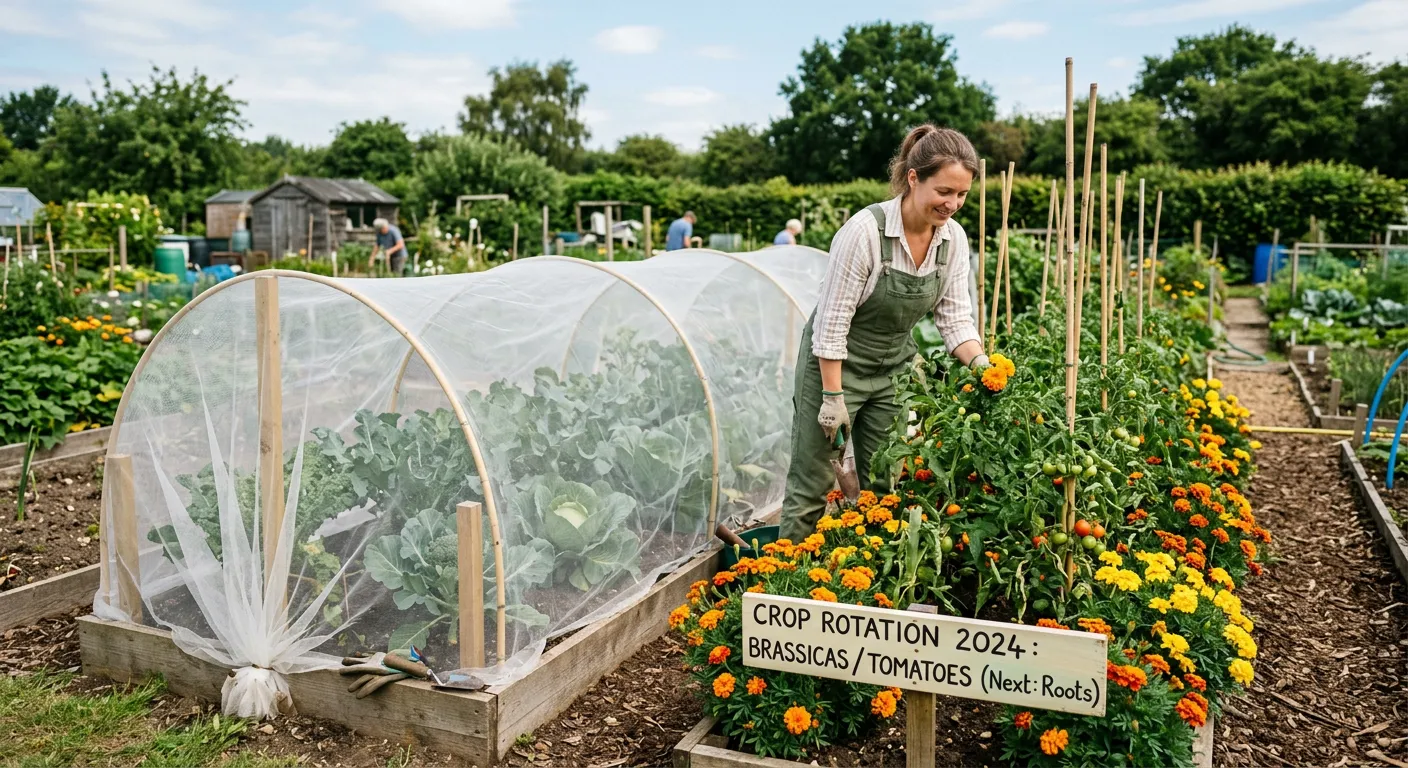 Integrated pest prevention on a UK allotment: Enviromesh netting over carrot beds, brassica collars around cabbage transplants, and French marigolds as companion plants.
Common mistakes when dealing with vegetable pests and diseases
1. Spraying after the damage is done
Reactive spraying is the most common waste of time and money. By the time caterpillars have eaten half a cabbage, spraying the remains achieves nothing. By the time blight turns potato foliage black, the spores have already reached the tubers. Effective pest and disease management is 90% prevention, 10% reaction. Install barriers before sowing. Apply preventive sprays before infection. This mindset shift transforms results.
2. Ignoring soil pH
Most UK allotment soils sit between pH 6.0 and 6.8. This is slightly too acid for optimal brassica health and perfect for clubroot. A simple pH test kit costs 3-5 pounds from any garden centre. If your brassicas suffer repeated clubroot, test the soil. Applying garden lime to raise pH above 7.2 is the single most effective clubroot prevention measure available.
3. Overwatering in the evening
Watering foliage late in the day leaves leaves wet overnight. This creates ideal conditions for Botrytis, downy mildew, and blight spore germination. Water at the base of plants in the morning so foliage dries before evening. Use drip irrigation or soaker hoses to keep water off leaves entirely.
4. Removing all “weeds” and bare soil
Bare, tidy soil looks clean but provides no habitat for beneficial insects. Ground beetles eat slug eggs. Hoverflies need flowers for nectar before laying eggs near aphid colonies. Parasitic wasps need umbellifers (carrot family flowers) as adult food sources. Maintain a 1m strip of wildflowers or a flowering hedge alongside vegetable beds to support these natural predators.
5. Stopping treatment too early
The same mistake that fails with houseplant pests fails in the vegetable garden. Seeing dead caterpillars after a Bt spray does not mean the problem is solved. Eggs already laid will hatch in 7-14 days. Maintain controls for at least two full pest lifecycles. For caterpillars, this means 10-12 weeks of protection from May to July.
Integrated pest management strategy for UK vegetable gardens
The most effective approach combines cultural, physical, biological, and chemical controls in a specific hierarchy. Our organic pest control guide covers biological methods in full depth. Follow this order:
1. Cultural controls (free, permanent): Four-year rotation, soil health, resistant varieties, correct spacing, good hygiene. These prevent 60-70% of problems before they start.
2. Physical barriers (low cost, reusable): Enviromesh, brassica collars, carrot fly barriers, slug traps. These prevent 85-95% of remaining pest damage.
3. Biological controls (moderate cost, targeted): Bt for caterpillars, nematodes for soil pests, Encarsia for whitefly, Phytoseiulus for spider mites. These kill specific pests without harming beneficial insects.
4. Chemical controls (last resort): Copper fungicide for blight prevention, ferric phosphate for slugs, pyrethrum for emergency knockdown. Use only when other methods are insufficient.
Gardener’s tip: Keep a pest and disease diary. Record what you grow, where, and what problems appear each year. After three seasons, patterns emerge that tell you exactly where to focus your prevention efforts. Our six-year diary showed that blight arrived within 5 days of the first Smith Period in every year except one.
Frequently asked questions
What is the most damaging vegetable pest in the UK?
Slugs cause the most overall damage. They attack nearly every vegetable crop, destroying up to 50% of young transplants in a single wet night. Carrots, lettuce, brassicas, and beans are particularly vulnerable. Ferric phosphate pellets and evening hand-picking are the most effective combined approach.
How do I tell the difference between pest damage and disease?
Pest damage shows irregular holes, chewed edges, or visible trails. Disease damage shows discolouration, spots, wilting, or fuzzy mould growth. Pest damage usually starts at leaf edges. Disease often appears as spots or patches within the leaf tissue. Check undersides of leaves for pests hiding during the day.
Does crop rotation really prevent vegetable diseases?
A four-year rotation reduces soilborne disease by 60-70%. Clubroot spores survive in soil for 20+ years, but rotation starves the pathogen by removing host plants. White rot in onions persists for 15 years. Rotation alone will not eliminate these, but it significantly slows population build-up.
When should I start pest prevention for vegetables in the UK?
Start in March when soil temperatures reach 5-7C. This is when carrot fly, flea beetle, and slugs become active. Install barriers and netting before sowing, not after damage appears. Prevention is 10 times more effective than reactive treatment.
Are biological controls safe for vegetable gardens?
All UK-approved biological controls are safe for food crops. Nematodes, Bacillus thuringiensis, and parasitic wasps leave zero chemical residue. They target specific pest species without harming pollinators, pets, or humans. Most are approved for organic use by the Soil Association.
Can I use netting to stop all vegetable pests?
Fine mesh netting (0.8mm Enviromesh) blocks carrot fly, cabbage white butterflies, flea beetles, and aphids. It does not stop slugs, soil-dwelling pests like cutworms, or fungal diseases. Use netting as part of an integrated approach, not as the sole defence.
What causes blight on potatoes and tomatoes in the UK?
Blight is caused by Phytophthora infestans, an oomycete pathogen. It spreads via airborne spores in warm, humid conditions above 10C with 90%+ relative humidity for 48 hours. The Smith Period forecasting system predicts high-risk windows based on Met Office weather data.
How do I prevent clubroot in brassicas?
Raise soil pH above 7.2 with garden lime. Clubroot thrives in acid soil below pH 6.5. Apply lime at 200-400g per square metre in autumn. Start brassicas in modules using fresh compost, transplant when roots fill the module, and follow a strict four-year rotation to prevent spore build-up.
Now you know what to look for and when to act, read our companion planting guide to use plant combinations that repel pests and reduce disease naturally.
Lawrie has been gardening in the West Midlands for over 30 years. He grows his own veg using no-dig methods, keeps a wildlife-friendly garden, and writes practical advice based on real UK growing conditions.