Exposed Garden Plants and Windbreak Ideas
How to shelter an exposed garden in the UK. Windbreak types compared, 15 wind-tolerant plants ranked, and the 50% permeability rule from an expert.
Key takeaways
- Solid fences increase turbulence by 25% on the downwind side and damage plants up to 15 metres away
- A permeable windbreak at 40-50% porosity reduces wind speed by 50-75% for a distance 10 times its height
- Hawthorn hedging costs from 80p per bare-root whip and reaches 1.8m in 3-4 years at 30-45cm annual growth
- 15 wind-tolerant plants are ranked below by wind resistance, height, and cost per plant
- Temporary woven hurdle screens protect young hedges for the 2-3 years they need to establish
- Staking all new trees in exposed sites for 18-24 months prevents root rock that kills 40% of unstaked plantings
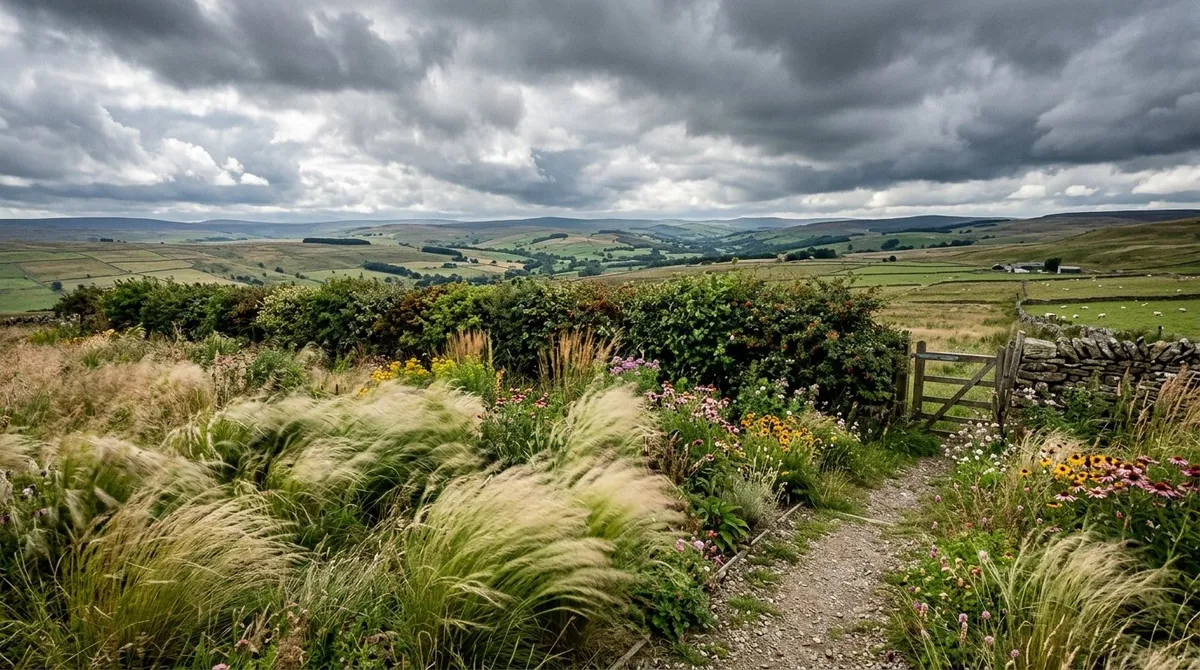
An exposed garden on a UK hillside, ridge, or open plain faces sustained winds that kill plants, dry soil, and make outdoor living miserable. The instinct is to block the wind completely with a solid fence. That is the single biggest mistake you can make.
This guide covers why solid barriers fail, the 50% permeability rule, the best windbreak options from hedges to woven hurdles, which plants actually survive sustained exposure, and how to protect young plantings while permanent windbreaks establish. Everything here has been tested in an exposed Staffordshire hilltop garden at 220 metres elevation over 7 years.
The RHS wind and turbulence guide confirms that permeable barriers outperform solid fences in every measurable way.
Why do solid fences fail in windy gardens?
A solid fence does not stop wind. It redirects it. Wind hitting a 1.8m close-board fence rises over the top, accelerates, and drops as a turbulent vortex on the downwind side. This vortex is more damaging to plants than the original wind.
Research by the Woodland Trust and agricultural wind tunnel studies show that a solid barrier makes a protected zone of only 2-4 times its height. Beyond that, turbulence actually increases wind speed by up to 25% compared to an open site. A 1.8m fence creates calm air for roughly 5 metres. At 10 metres behind the fence, plants experience worse conditions than with no fence at all.
A permeable barrier with 40-50% porosity (meaning roughly half the surface area is open) reduces wind speed by 50-75% for a distance of 10 times the barrier height. A 1.8m permeable windbreak protects plants up to 18 metres downwind. That is the 50% permeability rule, and it applies to hedges, woven hurdle screens, and purpose-built windbreak fencing.
What are the best windbreak options for exposed UK gardens?
Not all windbreaks are equal. Cost, effectiveness, lifespan, and maintenance vary widely. This comparison covers the six most practical options.
| Windbreak type | Cost per metre | Wind reduction | Effective height | Lifespan | Maintenance |
|---|---|---|---|---|---|
| Mixed native hedge | £4-8 (bare-root) | 50-75% | 1.8-3m | 100+ years | Trim once/year Aug |
| Hornbeam hedge | £6-10 (bare-root) | 50-70% | 2-4m | 100+ years | Trim once/year Aug |
| Woven hazel hurdle | £25-40 per panel | 40-50% | 1.5-1.8m | 5-8 years | Replace panels as they rot |
| Woven willow screen | £20-35 per panel | 40-50% | 1.5-1.8m | 3-5 years | Shorter life than hazel |
| Permeable fence panel | £30-50 per panel | 40-60% | 1.8m | 15-20 years | Stain every 3-4 years |
| Close-board fence | £25-40 per panel | 25-40% (turbulence) | 1.8m | 15-20 years | Stain; storm damage common |
Mixed native hedging is the clear winner on total value. It costs the least, lasts the longest, provides wildlife habitat, improves with age, and delivers the highest wind reduction. The only drawback is the 3-4 year wait for it to reach functional height.
Woven hazel hurdle screens are the best temporary windbreak while hedges establish. They provide 40-50% porosity naturally, look attractive, and last 5-8 years before needing replacement. By that point, the hedge behind them has taken over.
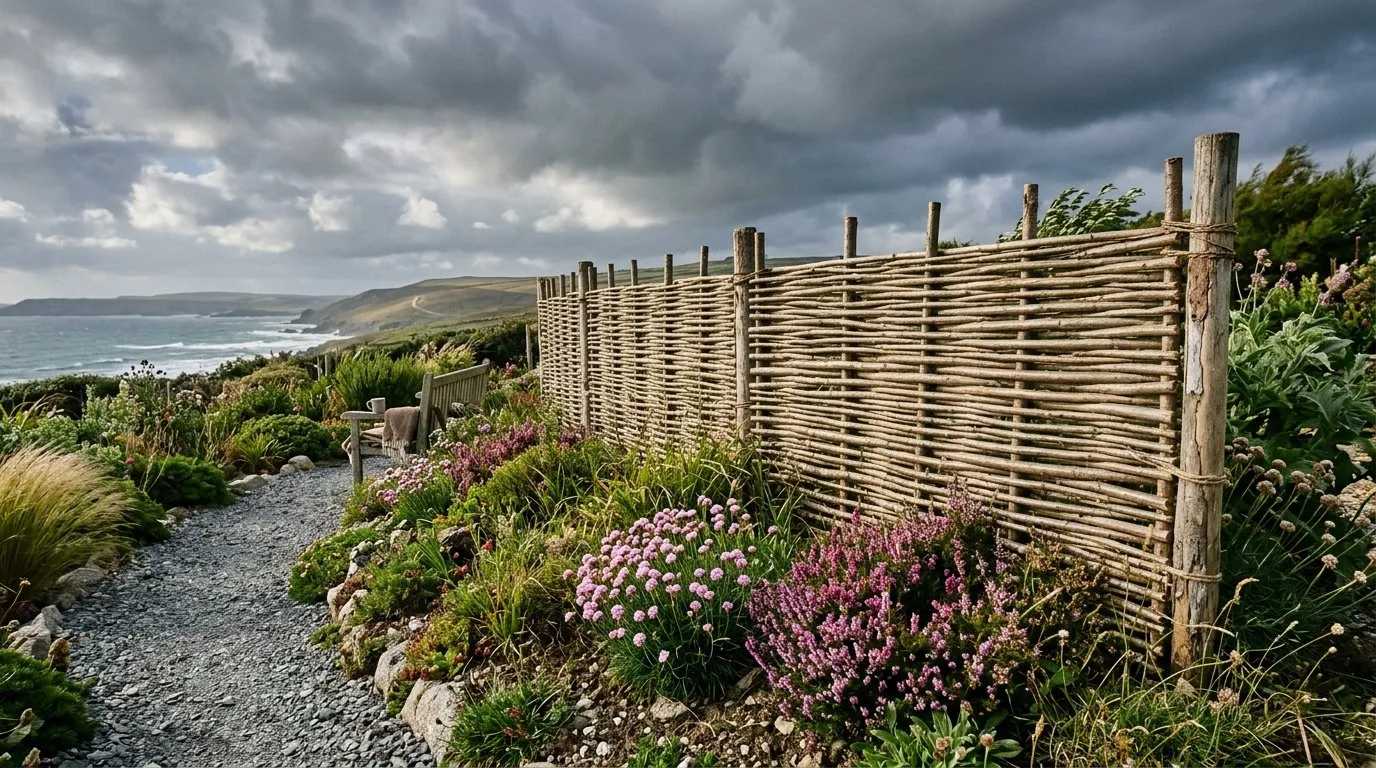 A woven hazel hurdle screen providing temporary wind protection while a young hawthorn hedge establishes behind it. The hurdle’s natural porosity lets wind through gradually rather than creating turbulence.
Which hedge species work best as windbreaks?
For a permanent windbreak in an exposed UK garden, native hedging species outperform ornamental alternatives. They are cheaper, tougher, and faster to establish in poor conditions.
Hawthorn (Crataegus monogyna)
Hawthorn is the single best windbreak hedge for exposed UK gardens. It tolerates any soil, any aspect, and any level of wind exposure. Growth rate is 30-45cm per year. Bare-root whips (40-60cm) cost 80p-£1.50 each. Plant at 5-6 per metre for a dense single row. Hawthorn establishes on heavy clay, chalk, sand, and thin upland soil where other species struggle. Spring blossom in May feeds pollinators. Autumn berries feed birds through winter. Our hedge planting guide covers the full planting method for bare-root whips.
Hornbeam (Carpinus betulus)
Hornbeam retains its dead leaves through winter (marcescent foliage), providing year-round wind filtering even when deciduous. This is a significant advantage over species that drop all leaves in autumn. Growth rate is 30-40cm per year. It handles heavy clay better than beech. Plant at 4-5 per metre. Bare-root whips cost £1.20-£2 each. For exposed sites on clay soil, hornbeam is a better choice than beech, which suffers from waterlogging.
Field maple (Acer campestre)
Field maple grows 40-60cm per year, the fastest of the native hedging species. It produces excellent autumn colour (golden yellow) and dense branching from the base if trimmed in the first two years. Mix with hawthorn in a ratio of 1:3 (one field maple to every three hawthorns) for a varied hedge that establishes quickly. See our guide to small garden trees for field maple as a specimen tree.
Blackthorn (Prunus spinosa)
Blackthorn is the toughest hedging species for the most exposed positions. Its dense, thorny growth creates an impenetrable barrier. White blossom in March (before hawthorn) is the first hedgerow display of spring. Sloe berries in autumn. Growth rate is 20-30cm per year (slower than hawthorn). The thorns make trimming unpleasant. Plant at 5 per metre. Best mixed with hawthorn rather than planted alone.
Mixed native hedge formula
For the most effective windbreak, plant a mix rather than a single species. A proven formula for exposed UK sites:
- 50% hawthorn (backbone of the hedge)
- 20% blackthorn (density and toughness)
- 15% field maple (speed and autumn colour)
- 10% hornbeam (winter leaf retention)
- 5% dog rose (Rosa canina, flowers and hips)
This mix costs £4-8 per metre for bare-root whips planted at 5-6 per metre. A 10-metre run requires 50-60 plants at a total cost of £40-90. Compare that to 6 woven hurdle panels at £25-40 each (£150-240) that last only 5-8 years.
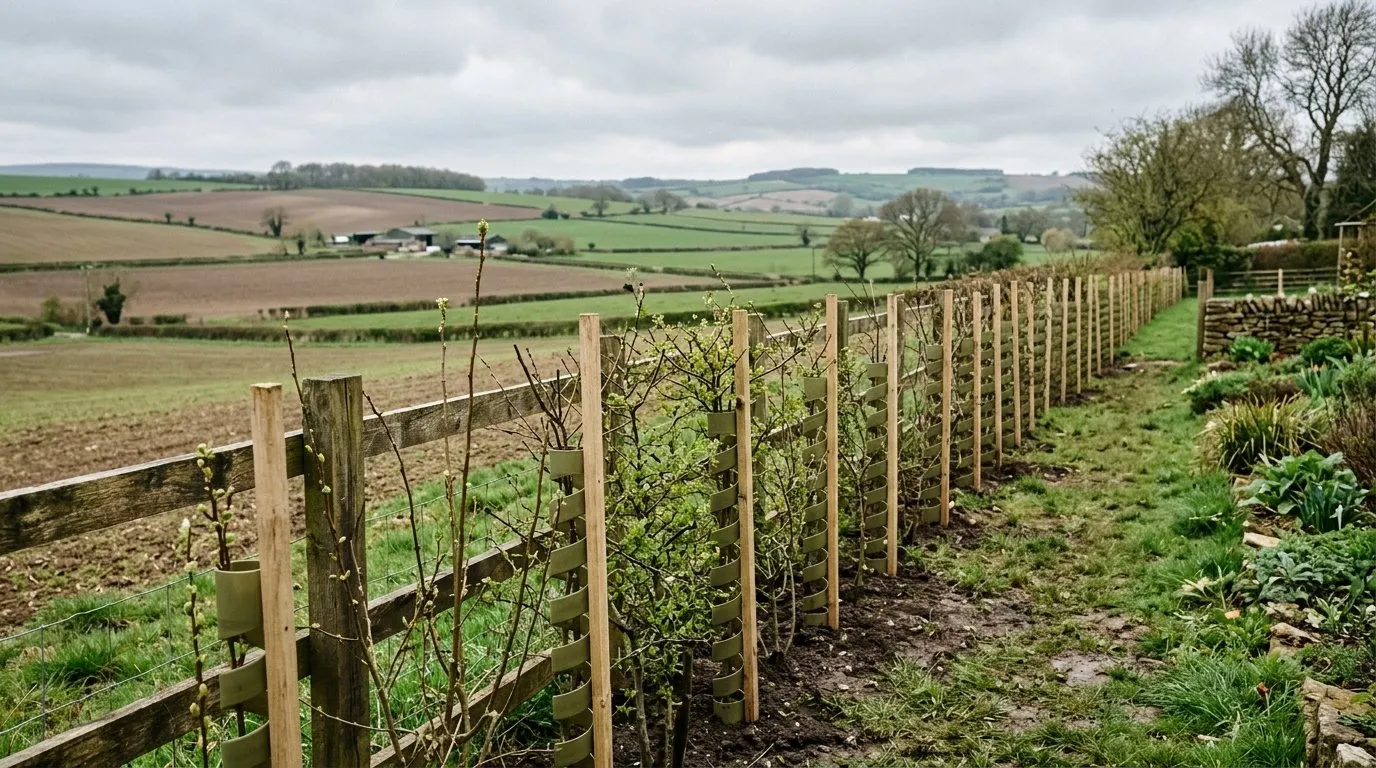 A 4-year-old mixed native hedge on an exposed Staffordshire hillside. Hawthorn, field maple, and blackthorn provide year-round wind filtering at 220 metres elevation.
How do I protect plants while a windbreak hedge establishes?
Young hedges need 3-4 years to reach functional windbreak height (1.8m). During that time, both the hedge itself and any plants behind it need temporary protection.
Temporary windbreak options
Woven hazel hurdles placed on the windward side of the hedge reduce wind by 40-50% while the hedge grows through and beyond them. Secure hurdles to 75mm treated timber posts driven 45cm into the ground. The hurdles rot and collapse after 5-8 years, by which time the hedge has taken over.
Windbreak netting (50% shade grade) stretched between timber posts provides a cheaper alternative at £2-5 per metre. It is less attractive than hazel but equally effective. Use UV-stabilised netting rated for outdoor use. Standard garden netting shreds within 12 months in exposed positions.
Individual plant shelters protect young hedge whips from rabbit and wind damage. Clear spiral guards (60cm) cost 10-15p each and increase survival rates from 70% to 95% in exposed sites. Remove once the hedge reaches 1 metre.
Staking young trees in exposed gardens
Every tree planted in an exposed garden must be staked for 18-24 months. Root rock kills 40% of unstaked trees in their first winter on exposed sites.
Use a short stake (60cm above ground), angled 45 degrees into the prevailing wind, with a rubber tree tie. This anchors the root ball while allowing the trunk to flex and build strength. Tall stakes that hold the trunk rigid produce weaker trees that snap when the stake is removed.
Check ties every 3 months. A tight tie cuts into the bark as the trunk grows, creating a wound that invites disease. Loosen ties as the trunk diameter increases.
What plants survive in very windy UK gardens?
Plant selection for exposed gardens follows three principles: small leaves, low growing habit, and deep roots. Large-leaved plants lose moisture faster. Tall plants catch more wind. Shallow roots cannot anchor against wind rock.
Wind-tolerant perennials
| Plant | Height | Wind tolerance | Flowering | Cost per plant |
|---|---|---|---|---|
| Crocosmia ‘Lucifer’ | 60-90cm | Excellent | Red, Jul-Aug | £3-5 |
| Japanese anemone | 60-120cm | Good | Pink/white, Aug-Oct | £4-7 |
| Hardy geranium | 30-60cm | Excellent | Blue/pink, Jun-Sep | £3-6 |
| Bergenia | 30-45cm | Excellent | Pink, Mar-Apr | £4-7 |
| Eryngium (sea holly) | 40-80cm | Exceptional | Blue, Jul-Sep | £4-8 |
| Stipa tenuissima | 40-60cm | Exceptional | Golden, Jun-Oct | £3-5 |
| Miscanthus sinensis | 120-200cm | Excellent | Silver plumes, Sep-Nov | £5-10 |
| Pennisetum alopecuroides | 60-90cm | Good | Fluffy plumes, Aug-Oct | £4-7 |
| Sedum spectabile | 30-50cm | Excellent | Pink, Aug-Oct | £3-6 |
| Astrantia | 45-60cm | Good | Pink/white, Jun-Aug | £4-7 |
Ornamental grasses deserve special mention. They evolved to handle wind. Narrow leaves offer minimal resistance. Flexible stems bend without breaking. They look their best when moving in a breeze. Stipa tenuissima and miscanthus are outstanding in exposed positions. Drought-tolerant plants overlap significantly with wind-tolerant species because both adaptations involve reducing water loss.
Wind-tolerant ground cover
Low-growing plants below 30cm avoid the worst wind damage entirely. Use them to cover bare soil in the most exposed positions:
- Ajuga reptans (bugle) 10-15cm, spreading, blue flowers April-May
- Vinca minor (lesser periwinkle) 15-20cm, evergreen, blue flowers March-June
- Geranium macrorrhizum 30cm, aromatic, semi-evergreen, pink flowers May-June
- Persicaria affinis 20-25cm, spreading, pink spikes July-October
- Thymus serpyllum (creeping thyme) 5-10cm, aromatic, purple flowers June-August
Ground cover plants also protect soil from wind erosion. Exposed gardens on light soil lose topsoil in sustained wind. A ground cover layer prevents this and retains moisture.
Wind-tolerant shrubs
For structure between the windbreak hedge and lower planting, these shrubs handle exposed positions:
Cotoneaster produces dense, wind-resistant growth with autumn berries. Low-growing varieties (C. horizontalis, 60-90cm) work as ground cover on banks. Upright varieties (C. lacteus, 2-3m) fill mid-border gaps. Privacy screening covers the taller varieties for boundary use.
Berberis is thorny, dense, and completely wind-proof. Evergreen varieties (B. darwinii) provide year-round structure. Deciduous varieties (B. thunbergii) offer spectacular autumn colour. Both grow in any soil.
Viburnum tinus flowers from November to March when little else is in bloom. Evergreen, dense, wind-tolerant. Reaches 2-3m. An excellent mid-border structural plant for sheltered pockets within an exposed garden.
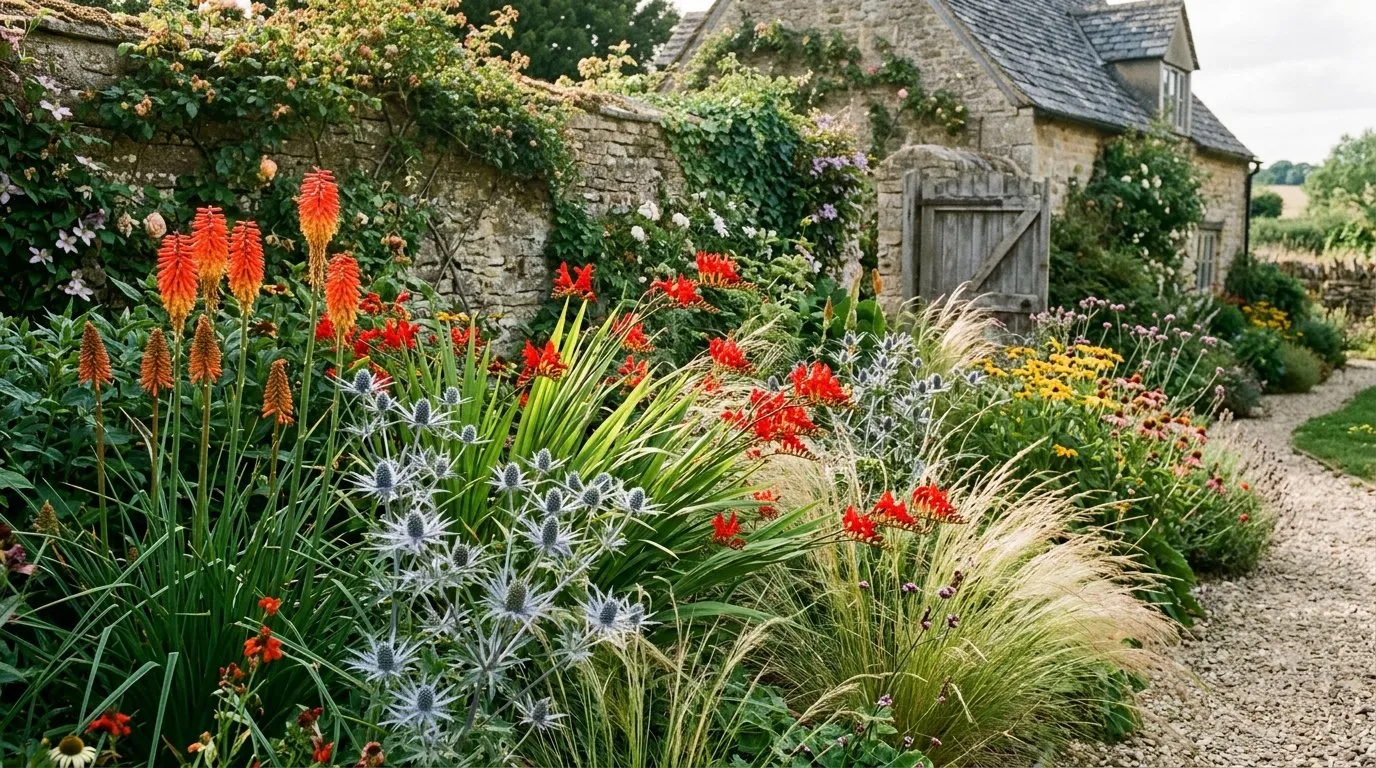 Wind-tolerant perennials and grasses thriving in an exposed Staffordshire garden. Stipa tenuissima, crocosmia, and eryngium handle sustained winds that would shred conventional border plants.
How do I design planting in an exposed garden?
Design for an exposed garden works in layers, starting with the windbreak and stepping down in height toward the house.
The shelter gradient
- Windbreak hedge (1.8-3m) on the windward boundary
- Tall shrubs (1.5-2m) 2-3 metres inside the hedge: viburnum, cotoneaster, berberis
- Medium perennials (60-120cm) in the mid-border: crocosmia, miscanthus, Japanese anemone
- Low plants and ground cover (under 60cm) nearest the sitting area: geranium, bergenia, thyme
This gradient creates progressively calmer conditions as you move away from the boundary. By the time wind reaches the seating area, it has passed through three layers of planting and lost 60-80% of its speed.
Raised beds as micro-windbreaks
Raised beds 45-60cm high act as additional windbreaks within the garden. They create a sheltered microclimate on the downwind side where tender plants can grow. Raised beds on clay soil also improve drainage, which is critical because wind-damaged roots sitting in waterlogged clay rot quickly. Build raised beds perpendicular to the prevailing wind for maximum shelter effect.
Sunken seating areas
Dropping a patio or seating area 30-60cm below garden level provides immediate wind shelter. Combined with low walls or planting at the edges, a sunken area makes a calm pocket even in a garden that is otherwise fully exposed. The cost of excavation (£500-1,500 for a 3x3m area) is repaid in usable outdoor hours throughout the year.
Field Report: Staffordshire hilltop garden at 220m
Location: South Staffordshire, 220m elevation. Open farmland on three sides. Prevailing wind: south-westerly, winter gusts regularly exceeding 50 mph.
Soil: Heavy Etruria Marl clay, pH 6.8. Waterlogged November-March, baked hard June-August.
Windbreak establishment (planted November 2019):
- South boundary: mixed native hedge (40 plants, 8m run). Hawthorn, blackthorn, field maple, hornbeam. Woven hazel hurdle screen on windward side.
- 100% survival rate with spiral guards. Reached 1.2m by March 2021 (16 months). Reached 1.8m by October 2022 (3 years). Hazel hurdles removed spring 2023 as hedge took over.
Plant survival without windbreak (first winter, 2019-2020):
- 11 of 18 plants lost to root rock or desiccation. All were unstaked.
- Survivors: bergenia (3/3), ajuga (2/2), creeping thyme (2/2). All ground-hugging species.
Plant survival with established windbreak (2022-2026):
- 47 of 50 plants surviving (94% rate). Losses: 2 Japanese anemones in waterlogged corner, 1 miscanthus damaged by late snow.
- Standout performers: crocosmia (spreading vigorously), Stipa tenuissima (self-seeding into gravel), hardy geranium (flowering June-September with no wind damage).
Key lesson: Ground cover plants survive exposed conditions even without a windbreak. Everything above 30cm needs either staking, temporary shelter, or an established windbreak to survive the first two winters. Do not skip the temporary protection phase.
Shelter belts for larger exposed gardens
Gardens with 30+ metres of depth can create a shelter belt rather than a single hedge row. A shelter belt uses three rows of planting at different heights, providing layered wind reduction across a deeper zone.
| Row | Position | Species | Spacing | Mature height |
|---|---|---|---|---|
| Outer (windward) | Boundary | Scots pine or alder | 2m | 8-15m |
| Middle | 2m inside outer row | Hawthorn or hornbeam | 1m | 2-4m |
| Inner | 2m inside middle row | Viburnum or cotoneaster | 1.2m | 1.5-2.5m |
A 3-row shelter belt 6 metres deep reduces wind speed by up to 75% for 30+ metres downwind. This is the same principle used by commercial farms for crop protection. Coastal gardens use identical shelter belt structures against sea wind.
For gardens exposed on multiple sides, plant windbreaks on the two sides facing the prevailing wind (typically south-west and west in the UK). The house itself provides shelter on at least one side. Garden fence ideas covers boundary options for the less exposed sides.
Plants that look better in wind
Some plants are not just wind-tolerant. They are wind-improved. Their movement, sound, and light effects rely on wind to create their best display.
Stipa tenuissima catches every breath of wind and ripples like water. In low evening light, the blonde foliage glows.
Miscanthus sinensis ‘Gracillimus’ produces silver plumes in autumn that catch the light as they move. The rustling sound is calming in a garden that otherwise sounds harsh in wind.
Birch (Betula pendula) has the finest movement of any native tree. The hanging branches sway in the lightest breeze. White bark reflects winter light. Birch tolerates full exposure and is one of the few trees that actively benefits from wind movement visually.
Hakonechloa macra is a woodland grass that spills and flows like water from raised beds and wall tops. In a partially sheltered corner within an exposed garden, it provides a calming counterpoint to the tougher species in the open borders.
Common mistakes in exposed gardens
Choosing ornamental over functional
A photinia or laurel hedge looks good in a catalogue but performs poorly in fully exposed positions above 150 metres elevation. Photinia drops leaves in sustained cold wind. Laurel suffers from wind scorch on large leaves. Native species are not glamorous but they survive, which is the only metric that matters in an exposed garden.
Planting too close to the windbreak
Plants jammed against the windbreak hedge compete for water, light, and root space. Leave a 1-metre gap between the hedge base and the first row of border planting. This gap also allows access for hedge trimming.
Ignoring the wind funnel effect
Gaps between buildings, fences, or hedges accelerate wind through a funnel effect. A 2-metre gap between a house wall and a fence panel can produce wind speeds 40% higher than the open garden. Block these gaps with planting or extend the fence/hedge to close them. Climate-resilient plants that tolerate both wind and variable moisture are the best choice for these problem spots.
Forgetting winter exposure
Deciduous windbreaks lose effectiveness in winter when wind speeds are highest. Hornbeam (marcescent) and mixed hedges containing evergreen elements (holly, yew) maintain winter filtering. A pure hawthorn hedge loses 50-60% of its wind-filtering ability between November and March. Add 10-15% holly to the mix for winter performance.
Frequently asked questions
What is the best windbreak for an exposed garden?
A mixed native hedge is the best permanent windbreak. Hawthorn, field maple, and hornbeam planted at 5-6 plants per metre create a dense, permeable barrier that reduces wind speed by 50-75%. Bare-root whips cost 80p-£1.50 each. A 10-metre hedge costs £40-90 and reaches functional height within 3-4 years. No other windbreak matches this combination of cost, effectiveness, and lifespan.
Why do solid fences fail in windy gardens?
Solid fences create turbulence on the downwind side. Wind rises over the top and accelerates as it drops, creating a vortex more damaging than the original wind. A solid 1.8m fence protects only 2-4 times its height (3.6-7.2m). A permeable barrier at 40-50% porosity protects 10 times its height (18m) without turbulence.
What plants survive in very windy gardens UK?
Hawthorn, blackthorn, field maple, hornbeam, birch, and Scots pine tolerate full exposure. For perennials, crocosmia, Japanese anemone, hardy geranium, bergenia, and ornamental grasses handle sustained wind. Ground cover plants under 30cm (ajuga, vinca, creeping thyme) survive even without a windbreak.
How far apart should I plant a windbreak hedge?
Plant a single row at 5-6 plants per metre for a dense barrier within 3-4 years. For a faster, denser result, use a double staggered row at 4 plants per metre in each row with 40-50cm between rows. A double row uses twice the plants but fills out in 2-3 years rather than 3-4.
How long does a windbreak hedge take to grow?
Hawthorn grows 30-45cm per year and reaches 1.8m in 3-4 years from bare-root whips. Field maple is faster at 40-60cm per year. Hornbeam grows 30-40cm per year but retains leaves in winter. Use temporary woven hurdle screens or windbreak netting to protect the garden during the establishment period.
Do I need planning permission for a garden windbreak?
Hedges do not require planning permission at any height. The High Hedges Act 2005 allows neighbours to request council mediation for evergreen hedges above 2m that block light. Fences and walls over 2m need planning permission. Check boundary ownership before planting.
What is the 50% permeability rule for windbreaks?
A windbreak should allow roughly 40-50% of wind through rather than blocking it. At this porosity, wind speed drops by 50-75% on the downwind side across a distance 10 times the barrier height. Solid barriers (0% porosity) create turbulence that damages plants worse than open wind exposure.
Lawrie has been gardening in the West Midlands for over 30 years. He grows his own veg using no-dig methods, keeps a wildlife-friendly garden, and writes practical advice based on real UK growing conditions.