Key takeaways
- 14 perennial vegetables grow reliably across all UK climate zones, from Cornwall to northern Scotland
- Established perennial beds need 60-70% less labour than annual vegetable plots with no annual sowing or soil preparation
- Asparagus, rhubarb, and sea kale produce harvestable crops for 15-25 years from a single planting
- Perennial root systems store carbon, improve soil structure, and support mycorrhizal networks that annual crops destroy
- A 3m x 6m dedicated bed provides fresh perennial harvests from February through November
- Most perennial vegetables tolerate heavy clay, partial shade, and neglect better than annual crops
Perennial vegetables are food crops that return year after year from the same root system. Plant them once and they produce harvests for a decade or more without annual sowing, soil preparation, or seed buying. At least 14 species grow reliably across every UK climate zone, from mild coastal Cornwall to the Scottish Highlands.
The concept is not new. Victorian kitchen gardens relied heavily on perennials like sea kale, good King Henry, and nine-star broccoli. These crops fell out of fashion when supermarket supply chains made annual vegetables available year-round. But they never stopped growing. Today, with rising seed costs and less time for plot maintenance, perennial vegetables offer a practical route to growing your own food with far less effort.
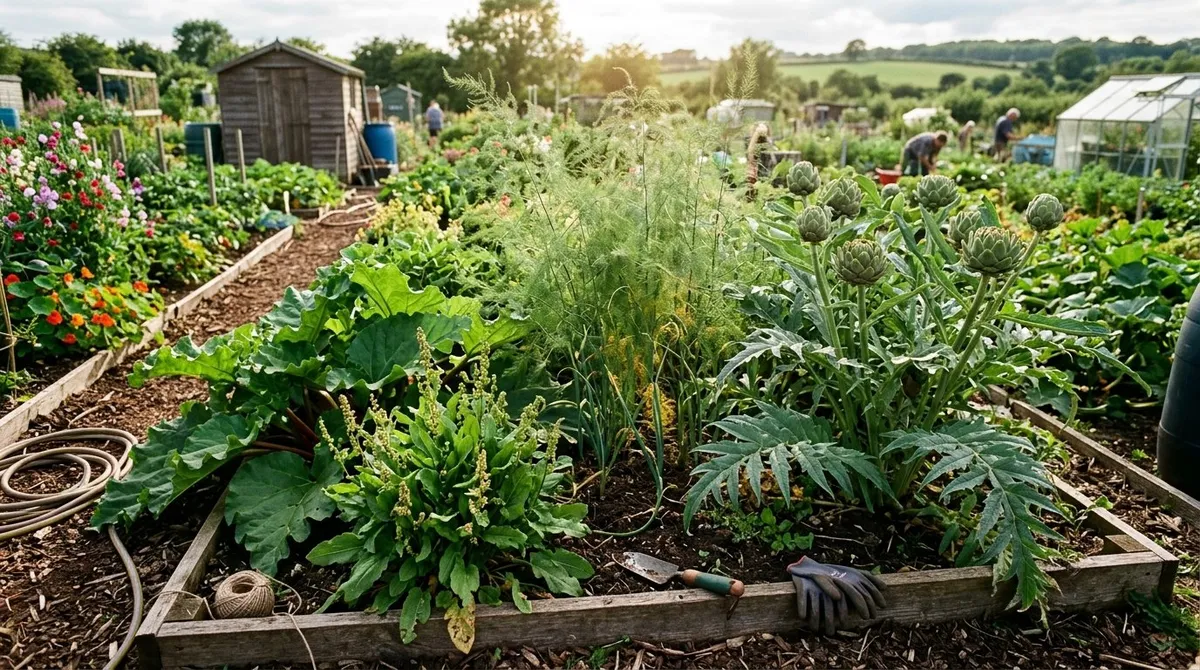
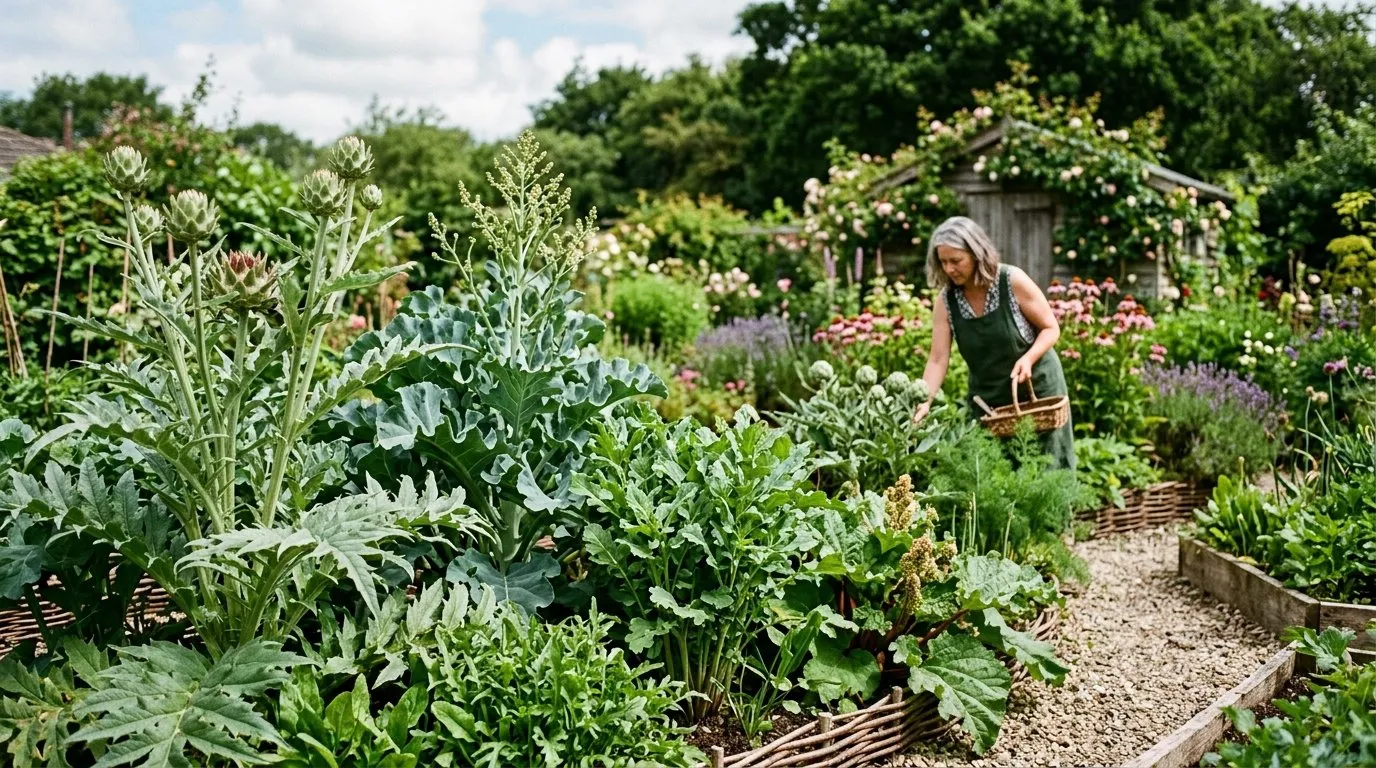 A mixed perennial vegetable bed in a UK allotment producing food from spring through autumn with minimal maintenance.
Why grow perennial vegetables instead of annuals?
Perennial vegetables save 60-70% of the labour that annual crops demand. There is no annual digging, no seed sowing, no pricking out, no hardening off, and no transplanting. The root systems stay in the ground permanently, rebuilding soil structure and supporting mycorrhizal fungi networks that annual cultivation destroys.
The environmental case is equally strong. Perennial root systems store carbon in the soil rather than releasing it through annual tillage. A study by the Land Institute in Kansas found perennial crop systems sequester 50-100g of carbon per square metre per year more than annual systems. Their deeper roots (often 1-2m) access water and nutrients that shallow-rooted annuals cannot reach.
Financially, the savings add up. A packet of annual vegetable seeds costs between 2 and 4 pounds. Sowing every year for 20 years totals 40-80 pounds per crop type. A single asparagus crown costs 3-5 pounds and produces for 20-25 years. Rhubarb crowns cost 6-10 pounds and last indefinitely. The investment pays for itself within three seasons.
Perennial beds also extend the harvest window. While most annual vegetables produce from June to October, a well-planned perennial bed delivers food from February (forced rhubarb) through November (Jerusalem artichoke tubers). That is nine months of fresh produce from plants that largely look after themselves.
The 14 best perennial vegetables for UK gardens
Asparagus (Asparagus officinalis)
Asparagus is the crown jewel of perennial vegetables. A single planting produces tender spears every spring for 20-25 years. Plant one-year crowns in April in trenches 30cm wide and 20cm deep, spaced 45cm apart. Do not harvest for the first two years while the root system establishes.
The harvest window runs for eight weeks from mid-April to mid-June. After that, let the fern grow unchecked to feed the crowns for the following year. All-male varieties like Gijnlim and Backlim outyield mixed-sex types by 20-30%. A bed of 20 crowns feeds a family of four through the season.
For the full growing method, see our detailed guide to growing asparagus in the UK.
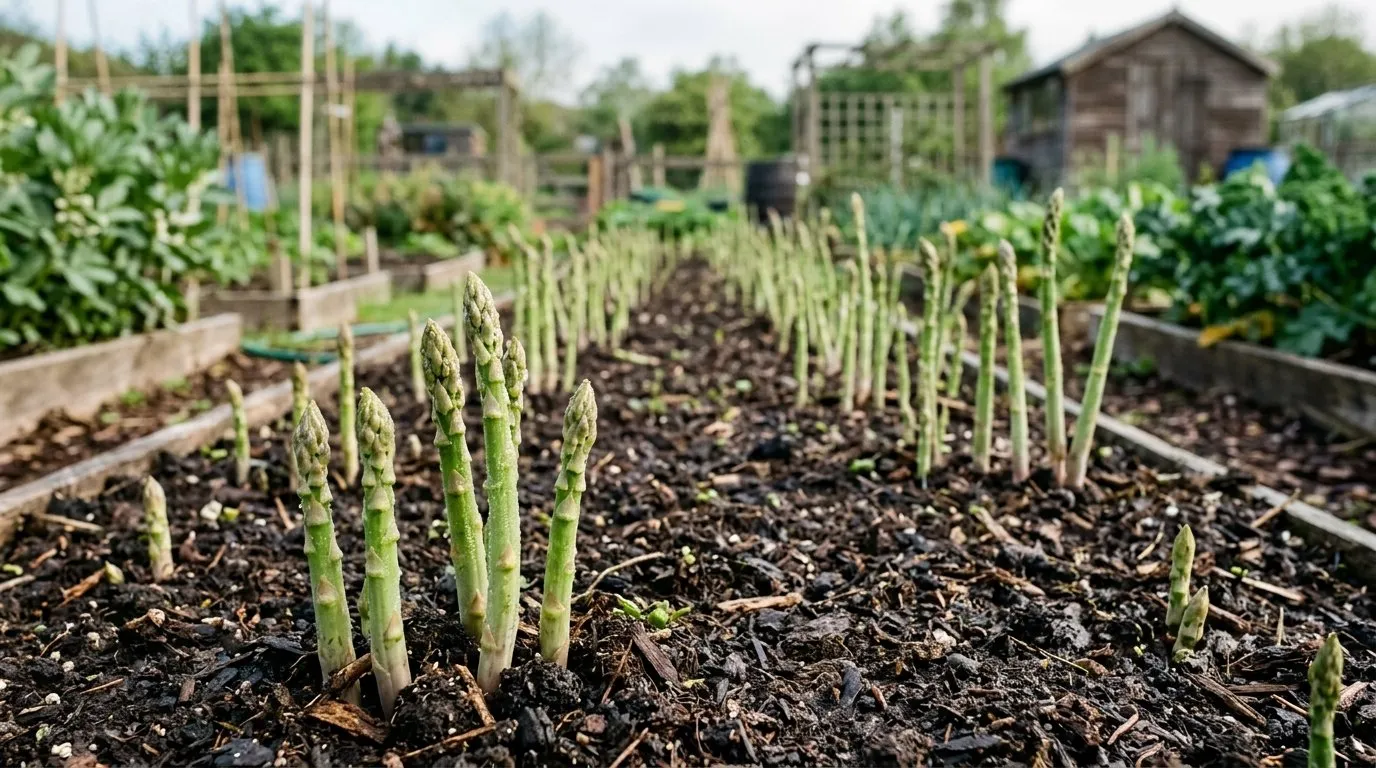 Asparagus spears pushing through the soil in April. The eight-week harvest season is one of the great rewards of perennial growing.
Rhubarb (Rheum x hybridum)
Rhubarb is the most forgiving perennial vegetable in UK gardens. It tolerates heavy clay, partial shade, and outright neglect. Plant crowns in autumn or winter with the bud 2.5cm below the soil surface. Space plants 90cm apart in rich, well-drained soil.
Harvest stalks from March to July by twisting and pulling at the base. Never cut with a knife as the remaining stump rots and invites disease. Timperley Early produces the earliest stalks, ready by February when forced under a lightless pot. Victoria is the standard garden variety with thick, deep red stems. A single mature crown produces 2-4kg of stalks per season for 15-20 years.
Forced rhubarb provides the earliest perennial harvest of the year. Cover crowns with a tall, lightless forcer from January. The stalks grow tall, pale pink, and tender in the darkness, ready to pick 6-8 weeks later. Our full rhubarb growing guide covers forcing in detail.
Globe artichoke (Cynara cardunculus var. scolymus)
Globe artichokes are dual-purpose perennials providing both food and architectural garden structure. The silvery, deeply cut leaves grow to 1.5m tall. The edible flower buds appear from June to September. Each plant produces 6-12 heads per season once established.
Plant offsets in April, spaced 90cm apart in full sun. Cut heads when they are tight and firm, about the size of a tennis ball. If you miss the window, the buds open into spectacular purple thistle flowers that bees adore. Globe artichokes are hardy to minus 10C but benefit from a 15cm straw mulch over the crowns in exposed northern gardens.
Plants crop for 4-5 years before declining. Replace by dividing suckers from the base in April. Our globe artichoke growing guide covers propagation from suckers and seed.
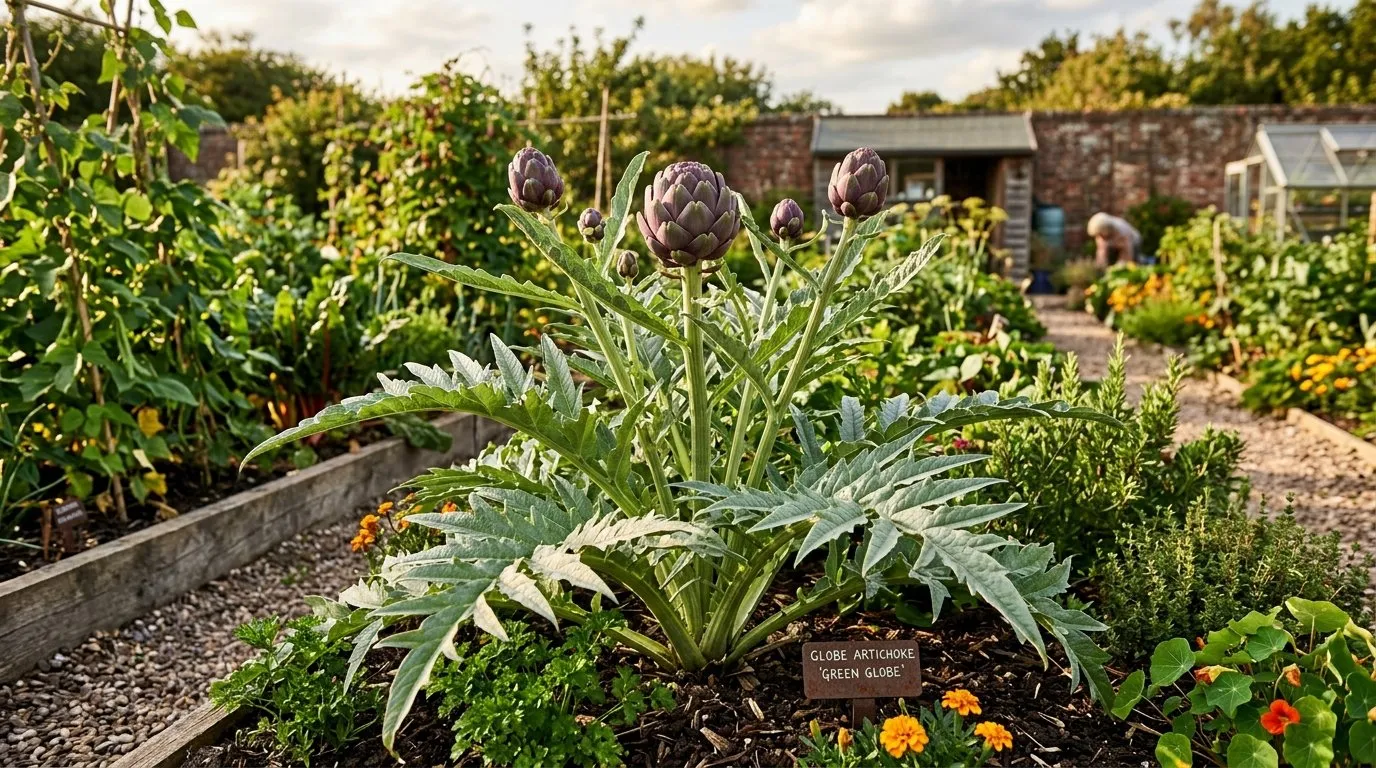 Globe artichoke plants combine striking architectural foliage with edible flower buds from June to September.
Jerusalem artichoke (Helianthus tuberosus)
Jerusalem artichokes are the easiest perennial root crop. Plant tubers 10-15cm deep and 30cm apart in February or March. They grow to 2-3m tall and produce knobbly tubers from November onwards. Each plant yields 1.5-2.5kg of tubers per season.
Harvest tubers as needed through winter by lifting with a fork. They store better in the ground than in a fridge. Leave a few tubers in place each spring and the crop regenerates automatically. Fuseau is the smoothest-skinned variety, making peeling easier. Gerard produces the highest yields on heavy soils.
The main challenge is containment. Jerusalem artichokes spread aggressively through missed tubers. Grow them in a dedicated corner or against a fence where spreading matters less. Our Jerusalem artichoke guide covers containment strategies.
Sea kale (Crambe maritima)
Sea kale is a native British coastal plant that was once a common kitchen garden crop. The young shoots are blanched under forcers in spring, producing pale, crisp stems with a mild, nutty flavour. Each plant produces 200-400g of blanched shoots per season.
Raise from seed sown in autumn (they need a cold period to germinate) or plant thong cuttings in March. Space plants 60cm apart in well-drained, sandy or chalky soil. Sea kale tolerates coastal exposure and salt spray. Cover crowns with a lightless pot or bucket from January. Harvest the blanched shoots when they reach 15-20cm, about 6-8 weeks later.
Sea kale takes 2-3 years to reach harvestable size. Once established, plants crop for 8-10 years. The RHS profile on Crambe maritima covers cultivation in detail.
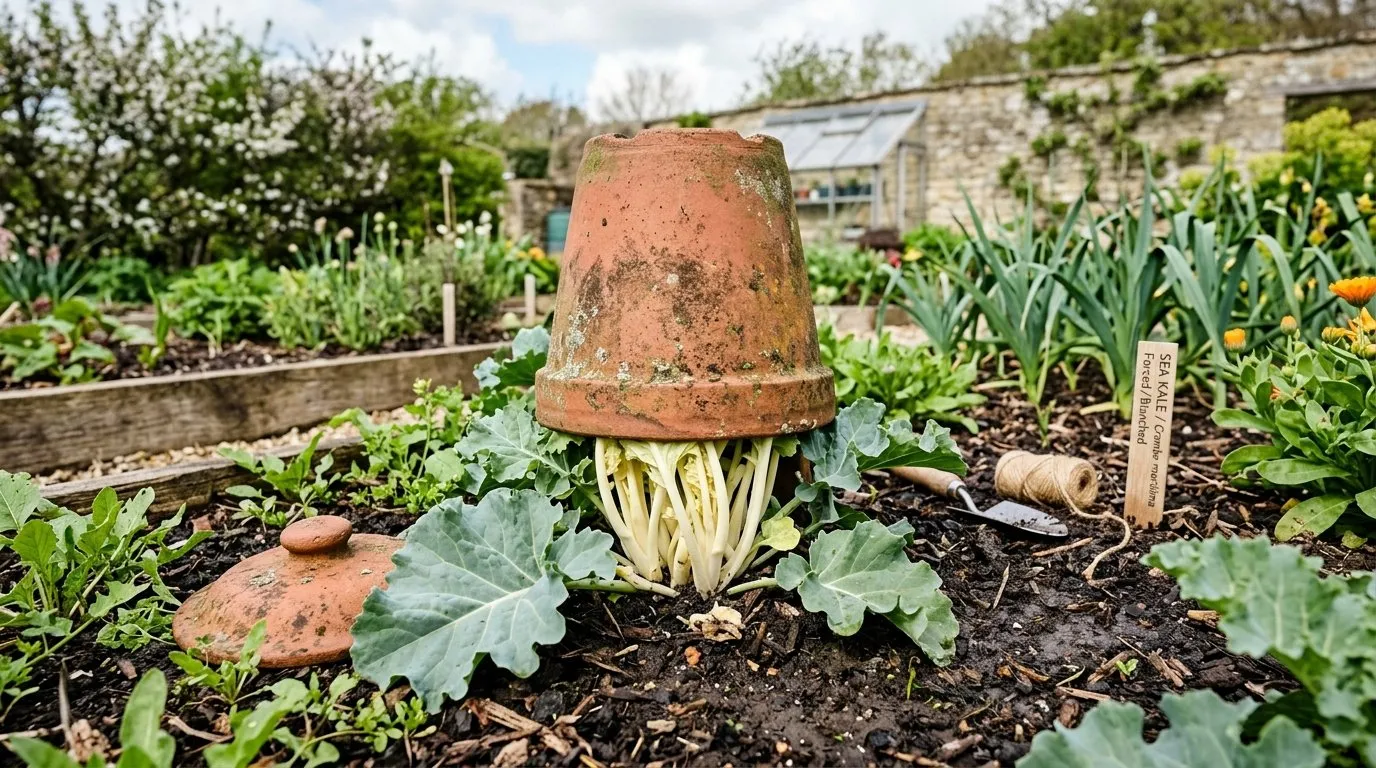 Sea kale forced under a terracotta pot produces pale, tender shoots from February. A forgotten British delicacy making a comeback.
Sorrel (Rumex acetosa)
Sorrel produces sharp, lemony leaves year-round in UK gardens. It is one of the few perennial vegetables that crops in every month, even through mild winters. The leaves add acidity to salads, soups, and sauces. French sorrel (Rumex scutatus) has a milder flavour with rounder, fleshy leaves.
Sow seed directly in March or September. Space plants 25-30cm apart in any reasonable soil. Sorrel tolerates partial shade and heavy clay. Cut flower stems as they appear in summer to keep leaf production going. Divide clumps every 3-4 years to maintain vigour.
A single plant produces enough leaves for regular kitchen use. Six plants provide a household with salad greens from March to November. Sorrel is a natural companion in a no-dig garden bed where permanent plantings thrive.
Good King Henry (Blitum bonus-henricus)
Good King Henry was once the most common pot herb in English cottage gardens. The young shoots are eaten like asparagus in spring. The leaves are cooked like spinach through summer. The flower spikes are steamed and served like broccoli. One plant, three harvests.
Sow seed in March or plant divisions in autumn. Space 30cm apart in rich, moist soil in partial shade. Good King Henry is native to the UK and completely hardy. Cut the first asparagus-like shoots when they reach 15-20cm in April. Pick young leaves through summer and remove flower spikes before they open.
Plants take 2 years to reach full productivity. Once established, they self-seed gently and crop for 10+ years. This is a genuine heritage crop: records show it was grown in British gardens before the 16th century.
Welsh onion (Allium fistulosum)
Welsh onions form permanent clumps of hollow, chive-like stems with a mild onion flavour. Despite the name, they originate from east Asia, not Wales. The “Welsh” derives from the old German “walsch” meaning foreign. Use them as a spring onion substitute year-round.
Plant seed or divisions in spring or autumn. Space 20cm apart in any well-drained soil. Welsh onions tolerate cold to minus 20C and produce usable stems even in December. Divide clumps every 3-4 years when they become congested. Each division establishes quickly and reaches full size within a season.
Welsh onions pair well with wild garlic in a dedicated allium corner. Both provide permanent allium harvests without annual planting.
Nine-star perennial broccoli
Nine-star perennial broccoli produces multiple small white cauliflower-like heads on a single plant each spring. Left to grow without cutting, each head opens into clusters of yellow flowers. The key is to harvest every head before it flowers, which triggers the plant to produce more the following year.
Sow seed in a nursery bed in April. Transplant to the final position in autumn, spacing 90cm apart. Nine-star needs rich, firm soil and full sun. Each plant produces 6-12 heads per spring from the second year onwards. If even one head goes to flower, the plant often dies, treating its lifecycle as complete.
Plants crop for 3-5 years. The flavour sits between broccoli and cauliflower, mild and sweet. This is a Victorian variety that deserves wider planting.
Oca (Oxalis tuberculosa)
Oca produces small, colourful tubers that taste like a lemony, waxy potato. Originally from the Andes, it grows well in southern and central UK gardens. The tubers form late in the season, from October onwards, triggered by shortening day length.
Plant tubers 10cm deep and 30cm apart in April after the last frost. The foliage is attractive, clover-like, and spreads to 30cm. Harvest after the first light frost blackens the foliage, usually in November. Yields range from 500g to 1.5kg per plant depending on the growing season length.
Oca is not fully hardy in the UK. Lift tubers before hard frosts and store in a cool, dry, frost-free place over winter. Replant the following April. In mild coastal areas, tubers sometimes overwinter in the ground under a thick mulch.
Skirret (Sium sisarum)
Skirret produces clusters of thin, white, sweet-flavoured roots. It was a staple root vegetable in medieval English gardens before the carrot and parsnip replaced it. The roots grow 15-20cm long and 1-2cm thick, with a sweet, parsnip-like taste.
Sow seed in spring (germination is slow, 3-6 weeks) or plant root divisions in autumn. Space plants 30cm apart in rich, moist soil. Skirret tolerates partial shade and heavy clay. Harvest roots from November onwards. Leave the central woody core of each root cluster in the ground and it regenerates the following year.
Each plant produces 100-300g of roots annually. The flavour is sweeter than parsnip, with no bitter core when harvested young. Skirret deserves revival as a low-maintenance winter root crop.
Perennial kale (Brassica oleracea var. ramosa)
Daubenton’s perennial kale is a non-flowering kale that lives for 5-8 years. It produces tender leaves year-round without ever bolting to seed. The leaves sweeten after frost, making winter the peak harvest season. Each plant yields 3-4kg of leaves annually.
Take cuttings in spring or autumn, as Daubenton’s rarely produces viable seed. Root 15cm stem cuttings in pots of gritty compost. Plant out at 60cm spacing along a fence or at the back of a border. The plant grows into a sprawling bush 60-90cm tall. Pick leaves regularly to keep the plant compact and productive.
Horseradish (Armoracia rusticana)
Horseradish produces thick, pungent roots used fresh as a condiment. Once established, it is virtually indestructible. Plant root cuttings (thongs) 30cm deep and 30cm apart in early spring. The roots reach harvestable size within one season. Dig roots from October to February.
The challenge with horseradish is not growing it but controlling it. Every fragment of root left in the soil regenerates into a new plant. Grow it in a sunken container or a dedicated corner where spreading does not matter. Our horseradish growing guide covers containment strategies that actually work.
Fresh horseradish has 10-20 times more pungency than shop-bought jars. Grate the root within minutes of lifting for maximum heat. The flavour compounds (isothiocyanates) break down rapidly once the root is cut and exposed to air.
Wild garlic (Allium ursinum)
Wild garlic is a native British woodland plant that colonises shady, damp ground. The broad, bright green leaves appear in February and carry a mild garlic flavour. The white flower clusters bloom in April and May. Both leaves and flowers are edible.
Plant bulbs 5cm deep and 10cm apart in autumn under deciduous trees or along shady hedgerows. Wild garlic needs moist, humus-rich soil and dappled shade. It spreads by bulb division and self-seeding, forming dense carpets over 3-5 years. Harvest leaves from February to May, taking no more than one-third of each clump per season.
Wild garlic is a natural fit for forest garden and no-dig systems. The leaves are best used fresh in pesto, butter, and salads.
Perennial vegetable comparison table
| Vegetable | Hardiness | Years to first harvest | Productive lifespan | Annual yield per plant | Spacing | Difficulty |
|---|---|---|---|---|---|---|
| Asparagus | Minus 20C | 3 years | 20-25 years | 500g-1kg | 45cm | Moderate |
| Rhubarb | Minus 20C | 2 years | 15-20 years | 2-4kg | 90cm | Easy |
| Globe artichoke | Minus 10C | 2 years | 4-5 years | 6-12 heads | 90cm | Moderate |
| Jerusalem artichoke | Minus 15C | 1 year | Indefinite | 1.5-2.5kg | 30cm | Easy |
| Sea kale | Minus 15C | 2-3 years | 8-10 years | 200-400g | 60cm | Moderate |
| Sorrel | Minus 20C | Same year | 10+ years | 300-500g leaves | 25cm | Easy |
| Good King Henry | Minus 15C | 2 years | 10+ years | 200-400g | 30cm | Easy |
| Welsh onion | Minus 20C | Same year | Indefinite | 100-200g | 20cm | Easy |
| Nine-star broccoli | Minus 10C | 2 years | 3-5 years | 6-12 heads | 90cm | Moderate |
| Oca | Minus 5C | 1 year | Annual lift | 500g-1.5kg | 30cm | Moderate |
| Skirret | Minus 15C | 2 years | 10+ years | 100-300g | 30cm | Easy |
| Daubenton’s kale | Minus 15C | Same year | 5-8 years | 3-4kg leaves | 60cm | Easy |
| Horseradish | Minus 20C | 1 year | Indefinite | 500g-1kg root | 30cm | Easy |
| Wild garlic | Minus 20C | 2 years | Indefinite | 100-200g leaves | 10cm | Easy |
How to plan a perennial vegetable bed
A dedicated perennial bed of 3m x 6m (18 square metres) comfortably holds 8-10 species. Place tall plants (globe artichoke, Jerusalem artichoke, nine-star broccoli) at the north end so they do not shade shorter crops. Edge the bed with sorrel, Welsh onions, and wild garlic.
Soil preparation matters most in the first year. Perennials stay in the same ground for a decade or more, so prepare thoroughly. Spread 10-15cm of well-rotted garden compost over the bed and fork it into the top 20cm. If your soil is heavy clay, add horticultural grit at 1 bucketful per square metre to improve drainage. Check soil pH and aim for 6.5-7.0. Our composting guide covers producing your own.
Avoid mixing perennial vegetables into annual beds. The permanent plantings get in the way of annual digging, crop rotation, and green manure management. Give perennials their own dedicated space.
Month-by-month perennial vegetable calendar
| Month | Tasks |
|---|---|
| January | Force rhubarb and sea kale under lightless pots. Order asparagus crowns |
| February | Harvest forced rhubarb. Pick first wild garlic leaves. Plant Jerusalem artichoke tubers |
| March | Plant asparagus crowns, sorrel seed, skirret seed. Divide Welsh onion clumps |
| April | Harvest asparagus spears (year 3+). Plant globe artichoke offsets. Sow nine-star broccoli |
| May | Continue asparagus harvest. Pick sorrel and wild garlic. Mulch all beds with compost |
| June | Stop asparagus harvest by mid-month. Harvest globe artichoke heads. Pick perennial kale |
| July | Harvest rhubarb (final month). Take Daubenton’s kale cuttings. Water globe artichokes |
| August | Propagate perennial kale from stem cuttings. Remove bolted sorrel flower stems |
| September | Plant Welsh onion divisions. Sow sea kale seed in pots for cold stratification |
| October | Harvest Jerusalem artichoke tubers. Lift oca after first frost. Dig horseradish roots |
| November | Mulch all perennial beds with 5-8cm compost. Plant rhubarb crowns. Cut asparagus fern |
| December | Harvest Jerusalem artichoke and horseradish as needed. Plan next year’s additions |
Common mistakes with perennial vegetables
Harvesting too soon
The most common mistake is harvesting perennial vegetables before the root system has fully established. Asparagus needs two full years with no harvest at all. Rhubarb needs one year. Sea kale and good King Henry need two. Cutting shoots or stalks too early weakens the crown and reduces yields for years afterwards. Be patient. The wait is the whole point of perennial growing.
Planting in annual vegetable beds
Perennials planted among annual crops get disturbed by digging, hoed accidentally, and compete with fast-growing annuals for light and nutrients. They belong in a dedicated permanent bed. Mixing them in causes frustration on both sides.
Ignoring containment
Horseradish, Jerusalem artichoke, and wild garlic spread aggressively if not contained. Every root fragment of horseradish regenerates. Every missed Jerusalem artichoke tuber sprouts. Plant invasive perennials in sunken containers, raised beds with solid bases, or isolated corners. Failing to plan for containment means spending years removing unwanted plants.
Letting nine-star broccoli flower
Nine-star perennial broccoli only stays perennial if you harvest every single head before it opens into flower. Missing even one head often triggers the plant to complete its lifecycle and die. Check plants daily during the spring harvest period and cut heads while they are still tight.
Skipping the autumn mulch
Perennial vegetables deplete soil nutrients over many years. An annual mulch of 5-8cm of garden compost or well-rotted manure in November feeds the soil, insulates crowns from frost, and suppresses weeds. Skip this step for two or three years and yields decline noticeably.
Building soil health with perennial roots
Perennial vegetable roots improve soil over time. Annual cultivation breaks up soil aggregates, destroys mycorrhizal networks, and releases stored carbon. Perennial root systems do the opposite.
Asparagus roots reach 1.5-2m deep. Horseradish taproots penetrate compacted subsoil that no spade reaches. Globe artichoke roots create deep channels that improve drainage for decades. These root networks feed soil fungi that transport nutrients between plants, the so-called wood-wide web that annual digging destroys.
After 5 years without cultivation, perennial beds develop a dark, crumbly topsoil layer 10-15cm deep. This is the result of root exudates feeding soil bacteria and fungi, fallen leaves decomposing in place, and earthworm populations increasing in undisturbed ground. Soil organic matter rises by 0.5-1.0% over a decade in a well-managed perennial bed.
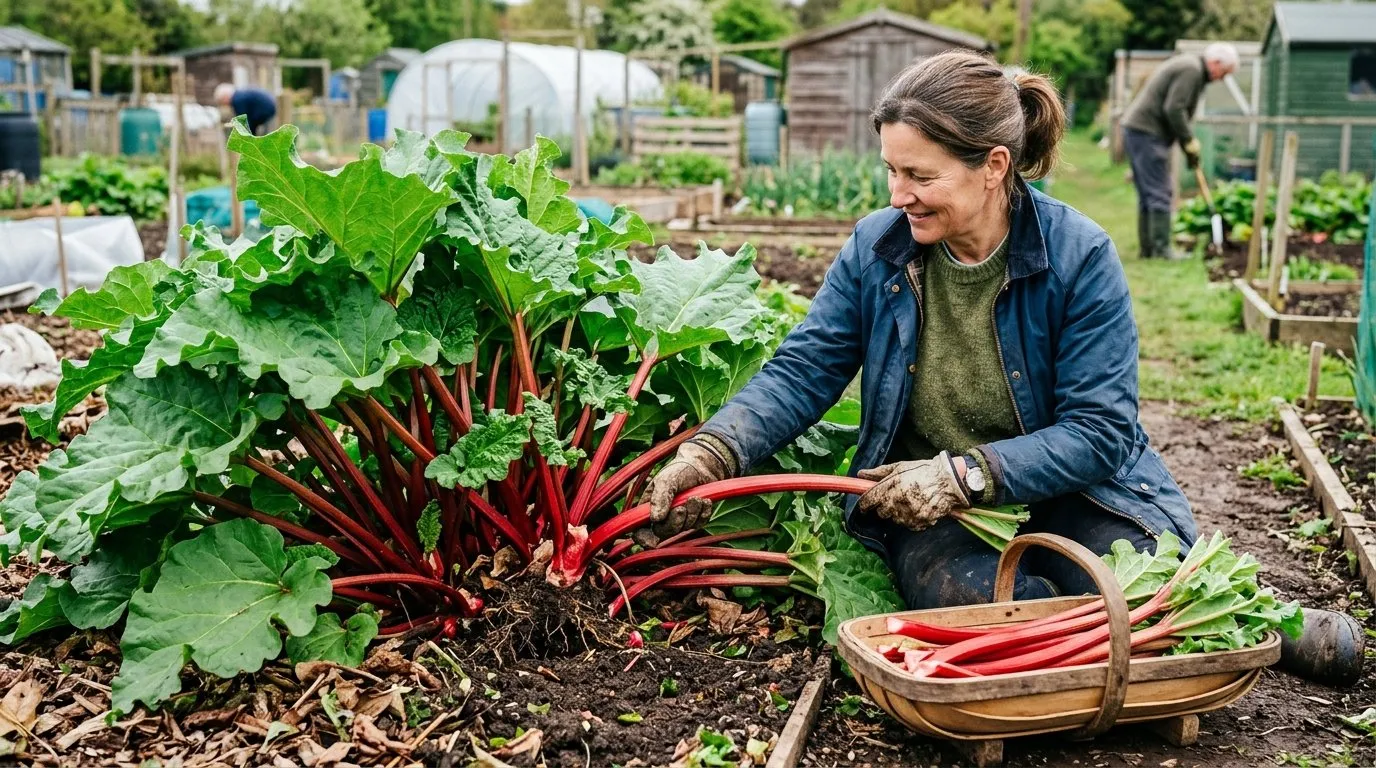 Rhubarb crowns produce 2-4kg of stalks per season for 15-20 years. Twist and pull stalks at the base rather than cutting.
What experienced growers plant first
Start with three species: rhubarb, sorrel, and Welsh onions. All three produce a harvest in the first year, tolerate most soil types, and need virtually no maintenance. This gives you confidence and fresh food while longer-term crops like asparagus and sea kale establish.
In the second year, add asparagus crowns and globe artichoke offsets. These take 2-3 years to reach full production but reward the wait with decades of cropping. In the third year, experiment with heritage species like skirret, good King Henry, and nine-star broccoli.
Gardener’s tip: Keep a simple yield diary. Weigh harvests from each perennial crop and record the date. After three years, you will know exactly which species perform best on your soil and which are not worth the space. Data beats guesswork every time.
Frequently asked questions
What are the easiest perennial vegetables to grow in the UK?
Rhubarb, sorrel, and Welsh onions are the easiest. All three tolerate poor soil, partial shade, and complete neglect. Rhubarb produces harvestable stalks from the second year with zero maintenance beyond an autumn mulch. Sorrel self-seeds freely and provides year-round salad leaves. Welsh onions form permanent clumps that never need replanting.
Do perennial vegetables taste as good as annual ones?
Most taste equal or better than annual equivalents. Home-grown asparagus, sea kale, and globe artichoke are genuinely superior to shop-bought because they reach the kitchen within minutes of picking. Sorrel has a sharp lemony flavour unavailable in any annual salad crop. Perennial kale leaves sweeten after frost, developing a nuttier taste than annual varieties.
Can I grow perennial vegetables in containers?
Sorrel, Welsh onions, and herbs grow well in containers. Use pots at least 30cm deep with drainage holes. Asparagus and globe artichoke need ground planting because their root systems are too extensive for pots. Rhubarb can survive in a 50-litre container but produces smaller stalks than ground-planted crowns.
How much space do perennial vegetables need?
A dedicated bed of 3m x 6m fits 8-10 different species. Globe artichokes need the most room at 90cm spacing. Sorrel, Welsh onions, and wild garlic fit into gaps of 20-30cm. Asparagus needs a permanent 1.2m-wide bed. Vertical growers like Daubenton’s kale work along fences and boundaries.
When should I plant perennial vegetables in the UK?
Plant most perennials between October and March. Asparagus crowns go in during April. Container-grown plants can go in any time the soil is workable. Autumn planting gives roots a full winter to establish before the first growing season. Avoid planting in waterlogged or frozen ground.
Do perennial vegetables need much feeding?
Less than annual crops. An annual mulch of 5-8cm of garden compost in autumn provides enough nutrition for most species. Globe artichokes and asparagus benefit from a spring feed of blood, fish, and bone at 70g per square metre. Avoid high-nitrogen feeds in late summer as they encourage soft growth vulnerable to frost.
Will perennial vegetables survive a harsh UK winter?
All 14 species covered here are hardy to at least minus 10C. Asparagus, rhubarb, horseradish, and sorrel survive minus 20C without protection. Globe artichoke crowns need a 15cm mulch in exposed northern gardens. Oca tubers must be lifted before the first hard frost and stored like dahlias.
Our team produces practical UK gardening guidance from source research, contributor records and established horticultural practice. Editorial standards are overseen by Matt W.