Key takeaways
- Pollinator strips along bed edges increase bean and courgette fruit set by 20-30%
- A 13cm fence gap creates a hedgehog highway that provides free slug control overnight
- Log piles attract 40+ beetle species and cost nothing to build from prunings
- No-dig methods preserve soil life including earthworms, fungi, and ground beetles
- An old washing-up bowl sunk into the ground creates a mini pond for frogs and newts
- Companion planting with French marigolds and nasturtiums controls whitefly and aphids without chemicals
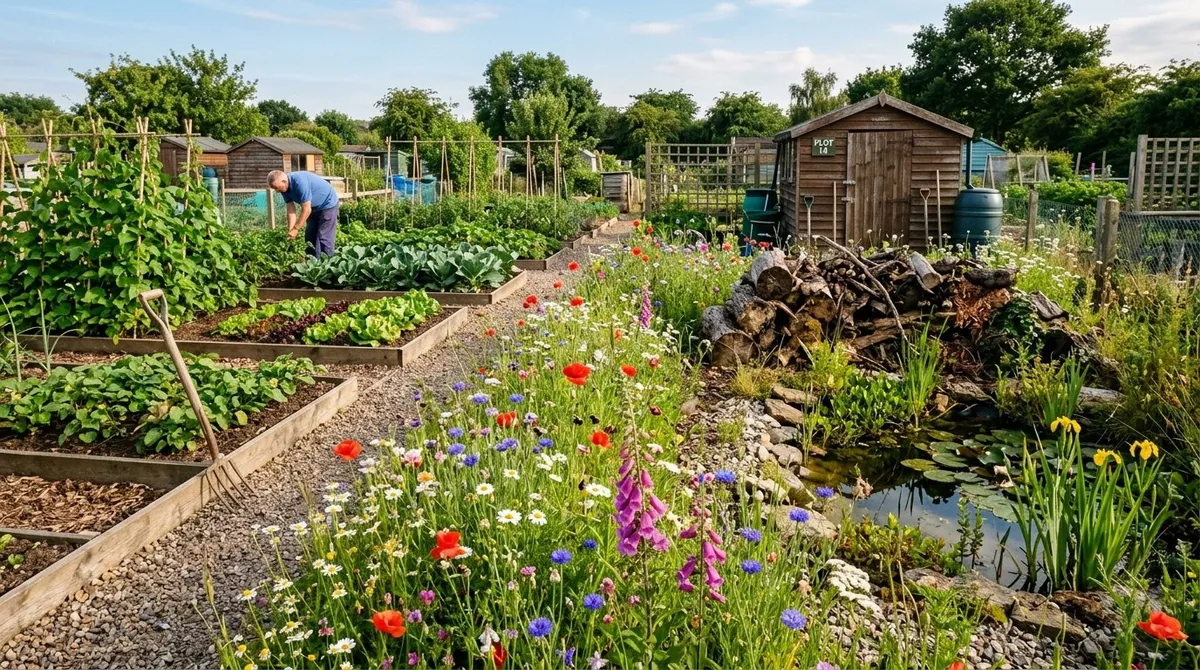
A wildlife-friendly allotment is not a compromise between growing food and helping nature. The two work together. Pollinator strips along your beds mean more bees on your bean flowers. Hedgehog highways through your boundary fence mean fewer slugs on your lettuce. Log piles from winter prunings attract the ground beetles that eat cabbage root fly larvae. Every wildlife feature on a well-managed plot pays its way in higher yields and fewer pest problems.
Why do wildlife-friendly allotments produce more food?
The connection between wildlife and yield is direct. Pollinating insects increase fruit set in runner beans, courgettes, squash, and broad beans. Without bees, these crops drop flowers and produce fewer fruits. Research from the University of Reading found that plots within 50m of wildflower strips showed 20-30% higher fruit set in pollinator-dependent crops.
Predatory insects and mammals provide pest control that no chemical can match. A single hedgehog eats 40-80 slugs per night. Ground beetles consume caterpillar eggs, aphids, and root fly larvae. Hoverfly larvae each eat 400-800 aphids before pupating. Encouraging these species costs nothing and works every night without reapplication.
The Royal Horticultural Society campaigns for wildlife-friendly gardening across the UK. Their research confirms that gardens and allotments managed for wildlife show measurably higher biodiversity without sacrificing productivity.
What are the best pollinator strips for allotment edges?
Pollinator strips are narrow bands of flowering plants sown along bed edges, path margins, or fence lines. They provide nectar and pollen from early spring through late autumn, keeping beneficial insects on your plot rather than miles away.
Three seed mixes that work on allotments
Not all wildflower mixes suit allotment conditions. You need flowers that tolerate the rich, fertile soil of a vegetable plot and do not spread aggressively into beds.
| Seed Mix Type | Best Flowers | Sowing Time | Flowers From | Cost per 10m Strip |
|---|---|---|---|---|
| Cornfield annual | Poppy, cornflower, corn marigold, corn chamomile | March-April | June year 1 | £3-5 |
| Perennial pollinator | Red clover, bird’s-foot trefoil, ox-eye daisy, knapweed | Sept-Oct | May year 2 | £5-8 |
| Annual/perennial blend | All of the above plus yarrow and wild carrot | March or Sept | June year 1, better year 2+ | £6-10 |
Sow a strip 30-50cm wide along one edge of each bed. This is narrow enough to avoid losing growing space but wide enough for bees to find. Emorsgate Seeds and Landlife Wildflowers sell UK-origin mixes suited to fertile soil. Avoid mixes designed for poor chalk grassland, they fail on rich allotment ground.
For more on creating wildflower areas, see our guide to sowing wildflower seeds and our mini meadow guide.
How do I create a hedgehog highway on my allotment?
Hedgehogs need to roam 1-2km per night to find enough food. Solid fences and walls block their routes and confine them to small areas. A hedgehog highway is a 13cm square hole cut at the base of a fence panel, allowing hedgehogs to pass through.
Positioning the highway
Cut the hole at ground level on the boundary between your plot and the neighbouring one, or between your plot and the site perimeter. One hole per fence panel is ideal but even a single gap makes a difference. Talk to neighbouring plot holders and encourage them to add matching holes on their boundaries.
How do log piles and brash heaps boost biodiversity?
A log pile is the single easiest wildlife feature to add to any allotment. Stack thick logs at the base, thinner branches on top, and leave the pile in a shaded corner. Within weeks, beetles, woodlice, centipedes, spiders, and fungi colonise the wood. Within a year, the pile supports a complete food web.
What lives in a log pile?
Stag beetle larvae spend 3-5 years feeding on decaying wood before emerging as adults. Ground beetles shelter under logs by day and hunt slug eggs at night. Toads use log piles as daytime refuges during summer and hibernation sites in winter. Solitary bees nest in beetle holes in older logs.
A single log pile of 1m x 1m x 50cm attracts over 40 invertebrate species. Position it in partial shade to keep the wood damp. Avoid treated or painted timber. Fruit tree prunings, elder, and willow decay fastest and attract colonisers within the first season.
Can you make a wildlife pond from a washing-up bowl?
You can. A sunken washing-up bowl or large plastic tub makes a micro-pond that attracts frogs, newts, dragonflies, and water beetles within the first summer. You do not need a liner, pump, or filter. Dig a hole the size of the bowl, sink it to ground level, and add a few centimetres of soil to the bottom.
Setting up an allotment micro-pond
Fill with rainwater, not tap water. Add a native oxygenating plant such as hornwort or starwort. Place a half-submerged stone or piece of wood as a ramp so wildlife can climb in and out. Frogs and newts arrive without being introduced, they find water by scent and humidity.
Even this small body of water supports a breeding population of common frogs, whose tadpoles grow into adults that eat slugs across your entire plot. For larger projects, our wildlife pond guide and container pond guide cover construction, planting, and maintenance.
How does no-dig growing protect soil wildlife?
No-dig growing means adding compost or mulch to the soil surface and never turning it with a spade or fork. This preserves the underground ecosystem that makes soil fertile: earthworm tunnels, mycorrhizal fungal networks, and the burrows of ground-nesting beetles and solitary bees.
The numbers behind no-dig
Healthy allotment soil contains over 1,000 earthworms per square metre. Each worm pulls organic matter down, aerates the soil, and deposits nutrient-rich casts. Digging destroys these tunnels and kills worms directly. Research from the Garden Organic trial grounds found 60-70% more earthworms in no-dig beds compared to conventionally dug plots after three years.
Mycorrhizal fungi form networks that connect plant roots and transport nutrients across distances. Digging severs these networks. On a no-dig plot, plants access phosphorus and micronutrients more efficiently, reducing the need for added fertiliser. Our full no-dig gardening guide covers bed construction, mulching, and weed control.
Should I avoid peat on a wildlife-friendly allotment?
Yes. Peat extraction destroys lowland bogs that are among the UK’s most important wildlife habitats. Peat bogs store twice as much carbon as all the world’s forests combined. They also support rare species including sundews, sphagnum mosses, and large heath butterflies.
Peat-free alternatives work just as well on an allotment. Home-made compost, well-rotted manure, leaf mould, and municipal green waste compost all improve soil structure and fertility. For seed sowing, peat-free composts from Melcourt, Dalefoot, and SylvaGrow perform as well as peat-based mixes in independent trials. Our peat-free compost guide compares every major brand.
What companion planting controls pests without chemicals?
Companion planting uses the natural properties of certain plants to repel, confuse, or trap pest insects. It replaces chemical pesticides with biological interactions that support the wider food web rather than destroying it.
Conventional allotment vs wildlife-friendly allotment
| Practice | Conventional Approach | Wildlife-Friendly Alternative | Benefit to Wildlife |
|---|---|---|---|
| Slug control | Metaldehyde pellets | Hedgehog highways + beer traps | Hedgehogs thrive, no poison in food chain |
| Aphid control | Synthetic pyrethroid spray | Nasturtium trap crops + hoverfly strips | Hoverflies, ladybirds, and lacewings breed |
| Whitefly on tomatoes | Chemical fumigation | French marigold interplanting | Parasitic wasps establish naturally |
| Carrot fly | Insecticide drench | Onion/leek interplanting + 60cm barriers | Ground beetles and rove beetles survive |
| Cabbage caterpillars | Netting only | Netting + log piles for beetle shelter | Ground beetles eat eggs at night |
| Weed control | Glyphosate paths | Woodchip paths + cardboard mulch | Soil life preserved under mulch |
| Soil fertility | Synthetic NPK fertiliser | Compost + green manure + legume rotation | Earthworms, fungi, and bacteria thrive |
| Pest monitoring | Calendar spraying | Daily walkabout + trap inspection | Spraying only if threshold reached |
French marigolds (Tagetes patula) are the most effective companion plant for allotments. Their roots exude alpha-terthienyl, which kills soil nematodes. Their flowers attract hoverflies, whose larvae consume aphids. Plant them at the end of every tomato, bean, and brassica row. Our companion planting guide covers 30+ proven combinations.
How do I set up bird boxes on an allotment shed?
Bird boxes on allotment sheds attract blue tits, great tits, and robins, all of which feed caterpillars to their young. A single blue tit family consumes an estimated 10,000 caterpillars during the breeding season. That is free pest control targeting the exact species that eat your brassicas.
Box placement
Fix boxes at 2-3m height on the shady side of the shed, facing north or east to avoid direct afternoon sun. Use a 25mm entrance hole for blue tits or 28mm for great tits. Position boxes in October so birds find them during winter territory scouting. Space multiple boxes at least 10m apart, as most small birds are territorial.
What are wildflower headlands and do they work?
A wildflower headland is a strip of permanent wildflower planting around the perimeter of your plot. Farm headlands have been studied by the Centre for Ecology and Hydrology, and results translate directly to allotments. A 1m-wide headland around a half plot provides continuous forage for pollinators from April to October.
Establishing a headland
Mark out a 1m strip along one or more edges of your plot. Scrape back the top 5cm of soil to reduce fertility, wildflowers thrive on poorer ground. Sow a perennial meadow mix in September. Do not cut until late August the following year, then cut and remove the cuttings to keep fertility low.
Plants to include: knapweed, field scabious, yarrow, ox-eye daisy, bird’s-foot trefoil, and self-heal. These all tolerate the clay soils common on allotment sites across the Midlands and support specialist pollinators including long-tongued bumblebees. For identification help, see our wildflower identification guide.
How do I avoid peat and still make good compost?
Build two or three compost bays from pallets. Fill with a mix of green waste (kitchen peelings, grass clippings, annual weeds) and brown waste (cardboard, straw, woody prunings). Turn monthly for fast results or leave for 12 months for a hands-off approach.
Good allotment compost feeds the soil and the organisms living in it. Worms, woodlice, brandling worms, and thousands of microbial species break down raw materials into humus. A well-made heap reaches 60-70 degrees Celsius internally, killing weed seeds and pathogens. Our composting guide covers bay design, ratios, and troubleshooting. For composting that directly supports wildlife, our composting for wildlife guide explains how to manage heaps as habitat for slow worms, toads, and grass snakes.
Frequently asked questions
Does a wildlife-friendly allotment produce less food?
No, yields are equal or higher on a wildlife-friendly plot. Pollinator strips increase fruit set in beans, courgettes, and squash by 20-30%. Hedgehogs and ground beetles consume slugs and caterpillars overnight. Healthy soil life from no-dig methods improves root development and water retention. The only trade-off is slightly untidier edges, which most allotment committees accept.
What is the best pollinator seed mix for an allotment?
A mix of cornfield annuals and perennial wildflowers works best. Look for UK-origin seed containing field poppy, cornflower, ox-eye daisy, red clover, and bird’s-foot trefoil. Emorsgate and Landlife sell allotment-suitable mixes. Sow a 30cm strip along bed edges in March or September. Annual mixes flower in the first year. Perennial mixes establish by year two.
How do I make a hedgehog highway on an allotment?
Cut a 13cm square hole at the base of your boundary fence. Use a jigsaw or panel saw. Position it at ground level so hedgehogs can pass through at night. One hole per fence panel is ideal. Hedgehogs eat 40-80 slugs per night, making them the best organic pest control on any plot.
Will a mini pond attract mosquitoes to my allotment?
Not if you add a few aquatic plants and leave it for wildlife. Frogs, newts, and dragonfly larvae eat mosquito larvae faster than they can breed. A pond with barley straw and native oxygenating plants stays balanced. Stagnant water in open containers breeds mosquitoes. A planted pond does not.
Can I use companion planting instead of pesticides on an allotment?
Yes, companion planting reduces pest damage significantly. French marigolds repel whitefly from tomatoes. Nasturtiums lure aphids away from beans and brassicas. Carrots grown alongside onions confuse carrot fly. Tagetes patula produces a root compound that kills soil nematodes. These methods work best as part of a broader wildlife-friendly approach.
What should I do with prunings and hedge clippings on an allotment?
Stack them in a quiet corner as a log or brash pile. Dead wood supports over 40 beetle species, provides shelter for hedgehogs and toads, and breaks down into rich humus over 3-5 years. Keep log piles shaded and damp. Stack thick logs at the base and thinner branches on top. Never burn allotment prunings if you can stack them instead.
Is no-dig growing better for wildlife than conventional digging?
No-dig preserves soil structure and protects underground life. Digging destroys earthworm tunnels, fungal networks, and ground beetle habitat. A no-dig bed mulched with compost supports 60-70% more earthworms than a dug bed. Earthworms pull organic matter down, aerate soil, and improve drainage naturally.
Our team produces practical UK gardening guidance from source research, contributor records and established horticultural practice. Editorial standards are overseen by Matt W.