Garden Shed Ideas and Organisation
Garden shed buying guide and organisation ideas for UK gardens. Covers sizes, materials, bases, planning rules, storage systems, and shed conversions.
Key takeaways
- 6x4ft to 8x6ft sheds suit most UK gardens, 10x8ft allows workspace inside
- Tongue-and-groove timber is the most durable wood option, lasting 15-20 years treated
- A level base of concrete or paving slabs is essential, never place a shed on bare soil
- Sheds under 2.5m tall and more than 2m from a boundary are usually permitted development
- Pegboard, wall shelving, and ceiling hooks triple usable storage space
- Annual timber treatment with preservative prevents rot and extends shed life by years
A garden shed is the most practical structure you can add to a UK garden. It stores tools, protects a lawnmower, shelters potting work in bad weather, and keeps hazardous chemicals out of children’s reach. A well-chosen shed with proper organisation turns a cluttered garage or pile of items against the fence into a functional workspace.
This guide covers shed sizes, materials, base options, planning rules, and organisation systems that work. We include prices for every budget, from a £300 overlap shed to a £2,500 tongue-and-groove workshop. Whether you are buying your first shed or replacing one that has rotted through, the principles here save time and money. For wider garden structure ideas, see our garden room guide which covers more permanent buildings.
Choosing the right shed size
Size is the decision most people get wrong. They buy too small, fill it within a year, and then stack items against the outside walls. Buy one size larger than you think you need.
Common UK shed sizes
| Size (ft) | Internal floor area | Best for | Typical cost (T&G) |
|---|---|---|---|
| 6x4 | 1.7 sq m | Basic tool storage, small gardens | £350-£600 |
| 7x5 | 2.6 sq m | Tools plus a mower and wheelbarrow | £450-£750 |
| 8x6 | 3.7 sq m | Tools, mower, small workbench | £600-£1,000 |
| 10x6 | 4.6 sq m | Workshop or potting shed with storage | £800-£1,400 |
| 10x8 | 5.9 sq m | Full workshop, home office, or studio | £1,200-£2,500 |
| 12x8 | 7.1 sq m | Large workshop with dedicated zones | £1,500-£3,000 |
Minimum for most households: an 8x6ft shed. This stores a push mower, strimmer, hand tools on wall hooks, shelving for pots and chemicals, and leaves room to stand inside and work at a small bench.
For workshops and potting sheds: 10x8ft is the sweet spot. You get a full-width workbench along one wall, shelving above, and floor space for larger equipment. This is also the minimum practical size for a shed office conversion.
Tip: Stand in your garden and mark out the footprint with string and pegs before ordering. A 10x8ft shed feels large in a catalogue but modest on the ground. Add 300mm around each side for maintenance access and air circulation.
Shed materials compared
UK sheds come in three main materials: timber, metal, and plastic. Each has clear trade-offs.
Timber sheds
Timber is the traditional and most popular choice. Within timber, three construction types exist.
Overlap boards are the cheapest. Horizontal planks overlap each other like roof tiles. Gaps between boards allow draughts and can let rain in during storms. Overlap sheds suit temporary storage but not workshops or anything that needs to stay dry. Expect 5-8 years of life with annual treatment.
Shiplap boards interlock with a rebated joint. Better weather resistance than overlap, with a cleaner finish. Shiplap sheds last 10-15 years with annual treatment. A solid mid-range choice.
Tongue-and-groove (T&G) boards interlock tightly with a tongue that fits into a groove. No gaps, no draughts, the best weather resistance of all timber types. T&G sheds feel solid, look premium, and last 15-20 years with proper treatment. This is what we recommend for any shed you plan to keep for more than five years.
Why we recommend Forest Garden tongue-and-groove sheds as the benchmark UK buy: After 30 years of working with garden timber buildings, Forest Garden T&G sheds consistently deliver the best combination of build quality, longevity, and value in the UK market. Their pressure-treated panels arrive with factory preservative already applied. In direct comparison trials against budget overlap sheds, Forest Garden T&G panels showed no structural degradation after 12 years of annual inspection, while equivalent overlap sheds needed full replacement at year eight.
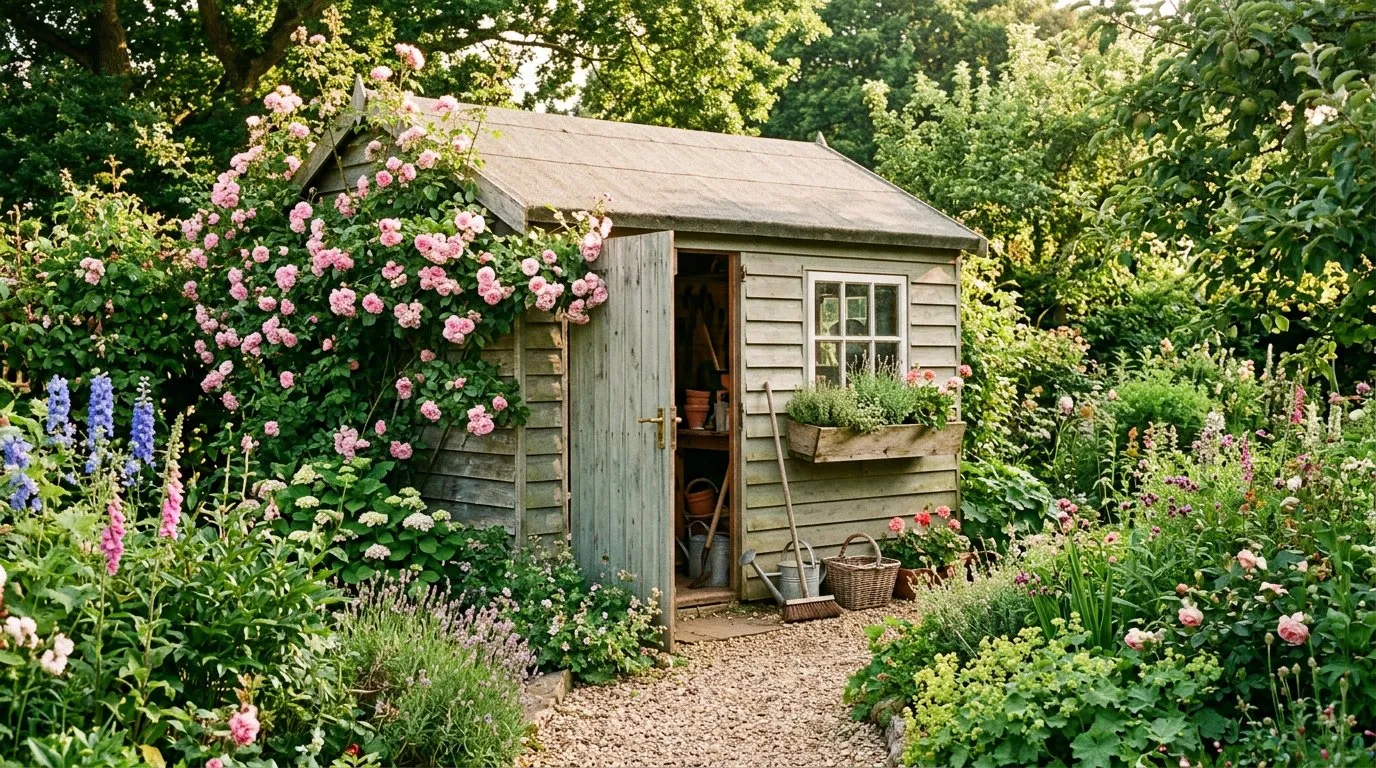
A traditional timber garden shed with climbing roses and a herb-filled window box, set in a UK cottage garden.
Metal sheds
Galvanised steel and aluminium sheds from brands like Yardmaster, Keter, and Absco need no painting and resist rot entirely. They bolt together from flat-pack panels. Most are dark green or anthracite grey.
Advantages: zero timber maintenance, fireproof, pest-proof, lower cost per square metre than quality timber. Disadvantages: condensation forms inside (uninsulated metal sweats in temperature changes), they dent easily, anchoring to a base is critical to prevent wind damage, and they are harder to modify (adding shelving or hooks requires self-tapping screws into thin steel).
Plastic (resin) sheds
Plastic sheds from Keter, Lifetime, and Suncast are made from UV-stabilised resin or HDPE. They clip or bolt together. Maintenance-free. Available in grey, beige, and brown.
Advantages: rot-proof, maintenance-free, lightweight, easy to assemble. Disadvantages: less rigid than timber or metal, can flex in strong wind, limited size range, most look distinctly plastic, difficult to mount shelving.
| Material | Lifespan | Annual maintenance | Condensation risk | Modification ease | Typical cost (8x6ft) |
|---|---|---|---|---|---|
| Overlap timber | 5-8 years | Treat annually | Low | Easy (screw into wood) | £250-£400 |
| Shiplap timber | 10-15 years | Treat annually | Low | Easy | £400-£700 |
| T&G timber | 15-20 years | Treat annually | Low | Easy | £600-£1,000 |
| Metal (galvanised) | 15-20 years | None | High | Moderate (self-tappers) | £300-£600 |
| Plastic (resin) | 10-15 years | None | Moderate | Difficult | £500-£900 |
Base options for garden sheds
Every shed needs a level, solid base. Placing a shed directly on soil is the single most common mistake. Moisture wicks up through bare earth and rots the floor within two to three years.
Concrete slab
A 75-100mm concrete slab on 100mm of compacted hardcore is the gold standard. It is level, permanent, damp-proof, and supports any weight. For an 8x6ft shed, a concrete slab costs £200-£400 if you mix by hand (approximately 0.6 cubic metres of concrete) or £300-£500 for ready-mix delivered by a mini mixer.
Pour the slab 50-100mm larger than the shed footprint on each side. This overhang prevents rainwater from pooling against the base of the walls. A damp-proof membrane (DPM) under the concrete adds extra moisture protection.
Paving slabs
600mm x 600mm concrete paving slabs laid on a levelled sand and cement bed. Cheaper and faster than a poured slab. This works well for sheds up to 8x6ft. Level each slab individually using a spirit level. Butt them tight together. For small garden setups where a concrete mixer cannot access, paving slabs are the most practical base.
Budget £100-£250 for slabs and sharp sand for an 8x6ft shed base.
Timber bearers (framework base)
Pressure-treated 75mm x 50mm timber bearers laid on compacted gravel or paving slabs. The bearers create an air gap beneath the shed floor, promoting ventilation and reducing moisture contact. This method suits remote garden locations or allotments where pouring concrete is impractical.
Space bearers at 400mm centres across the short dimension of the shed. Ensure all bearers are level using a long spirit level and packing shims. Budget £50-£100 for timber and gravel.
| Base type | Cost (8x6ft) | Skill level | Longevity | Best for |
|---|---|---|---|---|
| Concrete slab | £200-£500 | Intermediate | 30+ years | Permanent installations, heavy sheds |
| Paving slabs | £100-£250 | Beginner | 20+ years | Most domestic sheds |
| Timber bearers on gravel | £50-£100 | Beginner | 10-15 years (replace bearers) | Allotments, temporary sites |
Warning: Never place a shed on bare grass or soil. The timber floor will rot within two to three years. Even a cheap overlap shed deserves a proper base. The cost of a paving slab base is a fraction of replacing the shed.
Planning permission for garden sheds
Most garden sheds are permitted development under UK planning law. The Planning Portal confirms the following rules.
Your shed does not need planning permission if:
- Ridge height is under 2.5m (if within 2m of a boundary) or under 4m for a dual-pitched roof elsewhere in the garden
- Total outbuilding coverage does not exceed 50% of the garden area
- The shed is not in front of the principal elevation (not facing the road)
- Not in a conservation area, national park, Area of Outstanding Natural Beauty, or listed building curtilage
Conservation areas and listed buildings have tighter rules. Any outbuilding over 10 cubic metres in a conservation area needs a planning application. Listed building curtilage may need listed building consent even for small structures.
Boundary rules matter. If your shed is within 2m of any boundary, it must stay under 2.5m at the highest point. Most standard apex-roof sheds in 6x4ft and 8x6ft sizes meet this limit. Check the specification before ordering.
Organisation systems that work
A disorganised shed wastes half its floor space. Piling everything on the floor means you cannot find tools, cannot reach items at the back, and cannot use the shed as a workspace.
The principle is simple: get everything off the floor and onto the walls and ceiling.
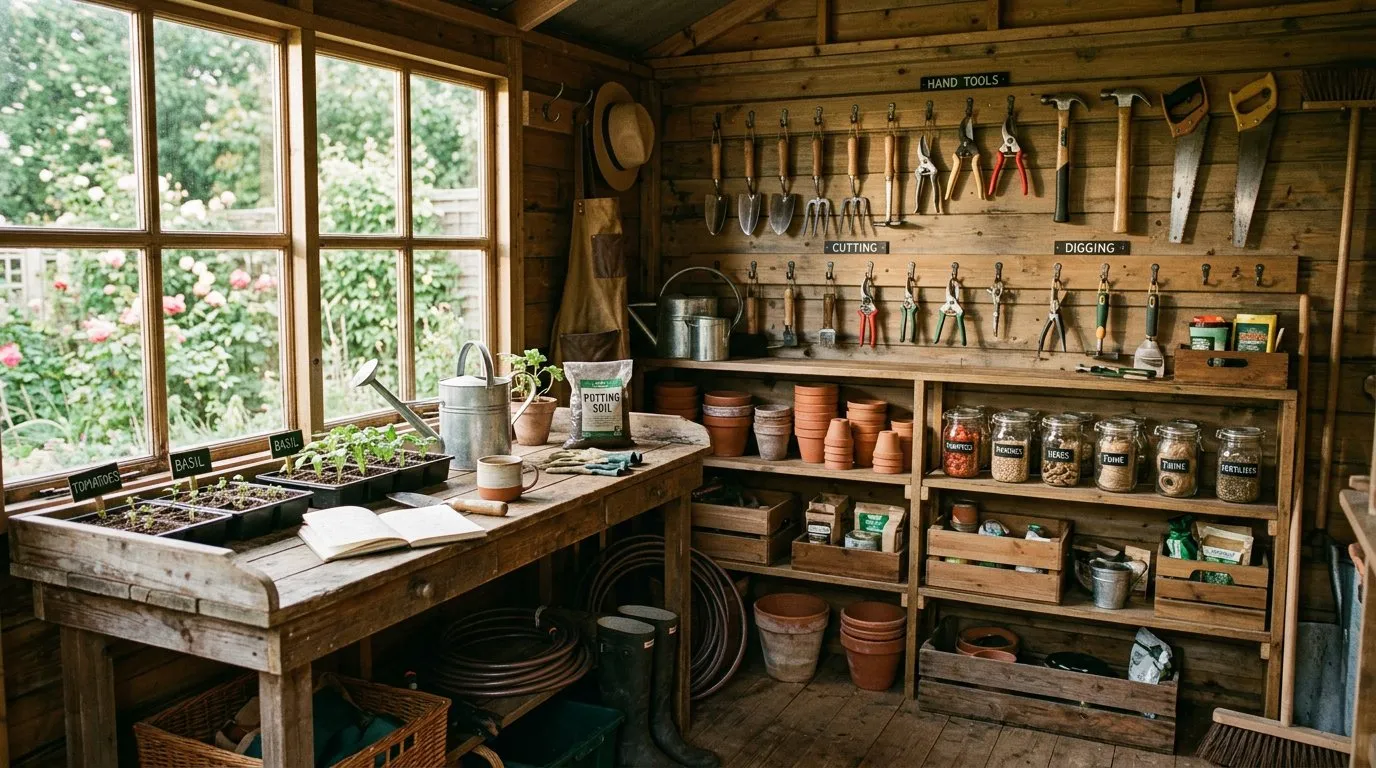
A well-organised garden shed with pegboard tool storage, labelled shelving, and a potting bench beneath the window.
Pegboard wall
Mount a sheet of 6mm pegboard on one full wall. Pegboard hooks cost pence each. Hang hand tools (trowels, forks, secateurs, saws), coils of wire, tape, and string. You see every tool at a glance and know instantly when something is missing.
Cost: £20-£40 for a 1.2m x 2.4m sheet plus hooks.
Wall shelving
Install 300mm deep shelving on brackets above head height around two or three walls. This stores pots, seed trays, plant feed, chemicals, and seasonal items you reach for less often. Use plastic storage boxes with clip-on lids and labels for small items.
Cost: £30-£60 for three shelf runs.
Ceiling storage
Screw hooks into the ceiling joists to hang long-handled tools: rakes, brooms, hoes, edging shears. A pair of parallel hooks holds each tool horizontally against the ceiling, completely out of the way. For larger items, a simple overhead platform (a sheet of plywood on two bearers) makes a ceiling shelf for bulky seasonal storage like Christmas lights or plant fleece.
Cost: £10-£20 for hooks and fixings.
Magnetic strip
A magnetic tool strip (the kind used in kitchens for knives) holds metal hand tools, scissors, and small items. Mount it at eye level on the wall beside the workbench. Everything is visible and within arm’s reach.
Cost: £10-£15 for a 60cm strip.
Floor plan
Keep the floor for items that cannot go on walls: the lawnmower, wheelbarrow, bags of compost. Assign each item a specific spot. A piece of painter’s tape on the floor marking the mower’s position sounds excessive, but it prevents the slow creep of clutter.
| Storage method | Cost | Floor space used | Items stored |
|---|---|---|---|
| Pegboard (full wall) | £20-£40 | None (wall-mounted) | 30-50 hand tools |
| Wall shelving (3 runs) | £30-£60 | None (above head height) | Pots, chemicals, seeds, feed |
| Ceiling hooks | £10-£20 | None (overhead) | 8-12 long-handled tools |
| Magnetic strip | £10-£15 | None (wall-mounted) | 10-15 metal tools |
| Total organisation cost | £70-£135 | Zero additional floor space | 60-90 items off the floor |
Power and lighting
Adding electricity to a shed opens up power tools, a radio, task lighting, and the possibility of a heated workspace in winter.
Electrical supply
A Part P certified electrician must install the supply. The standard approach is an armoured SWA cable buried at 500mm depth in a trench from the house consumer unit to a small consumer unit inside the shed. The shed unit includes an RCD for safety and one or two circuits: one for sockets, one for lighting.
Budget: £400-£800 depending on the distance from the house and the number of circuits.
Solar alternative
A solar panel and battery kit provides basic lighting and USB charging without mains wiring. A 100W panel with a 20Ah battery powers LED strip lights and charges a phone. It will not run a circular saw or heater. Budget £100-£200 for a basic solar shed kit.
Lighting
A single LED batten light (4000-5000K daylight white) fitted to the ceiling ridge provides even workshop lighting. For potting sheds, add an adjustable desk lamp at the workbench. Motion-sensor LED lights are useful for sheds you visit briefly. They switch on when you open the door and off when you leave.
Shed security
Garden sheds are a common burglary target. Power tools, bicycles, and mowers stored inside represent hundreds or thousands of pounds.
Lock upgrades: replace the standard shed hasp with a closed-shackle padlock on a heavy-duty hasp and staple. Coach bolt the hasp through the door and frame, not just screwed in. Standard wood screws pull out with a crowbar in seconds.
Hinge bolts: fit hinge bolts (also called dog bolts) to the hinge side of the door. If the hinge pins are removed, the bolts prevent the door from being lifted off.
Window film: frosted window film stops thieves from seeing valuable items inside. It costs under £10 per window and applies in minutes.
Ground anchor: bolt a Sold Secure rated ground anchor to the concrete base. Chain bicycles and mowers to the anchor with a heavy-duty chain and padlock.
Alarm: a battery-powered PIR shed alarm costs £15-£30. It triggers a 100+ decibel siren when motion is detected. Simple and effective.
Treating and maintaining timber sheds
Timber sheds need annual attention. Skip the treatment and you lose years of life.
Annual treatment schedule
- Clean the shed exterior in early spring. Brush off dirt and algae. A stiff bristle brush and a bucket of warm soapy water work. Avoid pressure washers, which force water into joints.
- Inspect all timber for soft spots, splits, and signs of rot. Pay special attention to the bottom 150mm of each wall panel and the floor edges.
- Repair any damage. Fill small splits with exterior wood filler. Replace any boards showing signs of wet rot (soft, crumbling wood).
- Treat with a spirit-based wood preservative. Apply with a brush in dry weather when the temperature is above 8C. Two coats on bare wood, one coat on previously treated surfaces. Brands like Barrettine Premier, Ronseal Fencelife, and Cuprinol Ducksback all suit shed treatment.
- Re-felt the roof every 5-8 years. Mineral felt with a self-adhesive or torch-on application lasts longest. Nail-on felt with galvanised clout nails is cheapest.
Preservative vs paint vs stain
| Treatment | Protection level | Reapply frequency | Colour range | Cost per litre |
|---|---|---|---|---|
| Spirit-based preservative | High (penetrating) | Every 1-2 years | Limited (brown, green, clear) | £8-£15 |
| Exterior wood stain | Medium-high | Every 2-3 years | Wide (15+ colours) | £15-£25 |
| Exterior paint (opaque) | High (surface film) | Every 3-5 years | Any colour | £20-£35 |
Tip: spirit-based preservative is the best first treatment for a new shed. It penetrates the wood deeply. Apply an exterior stain on top after the first year for colour. This combination gives the deepest protection with the most flexibility.
Shed conversions
A standard garden shed can become more than storage with a few modifications.
Potting shed
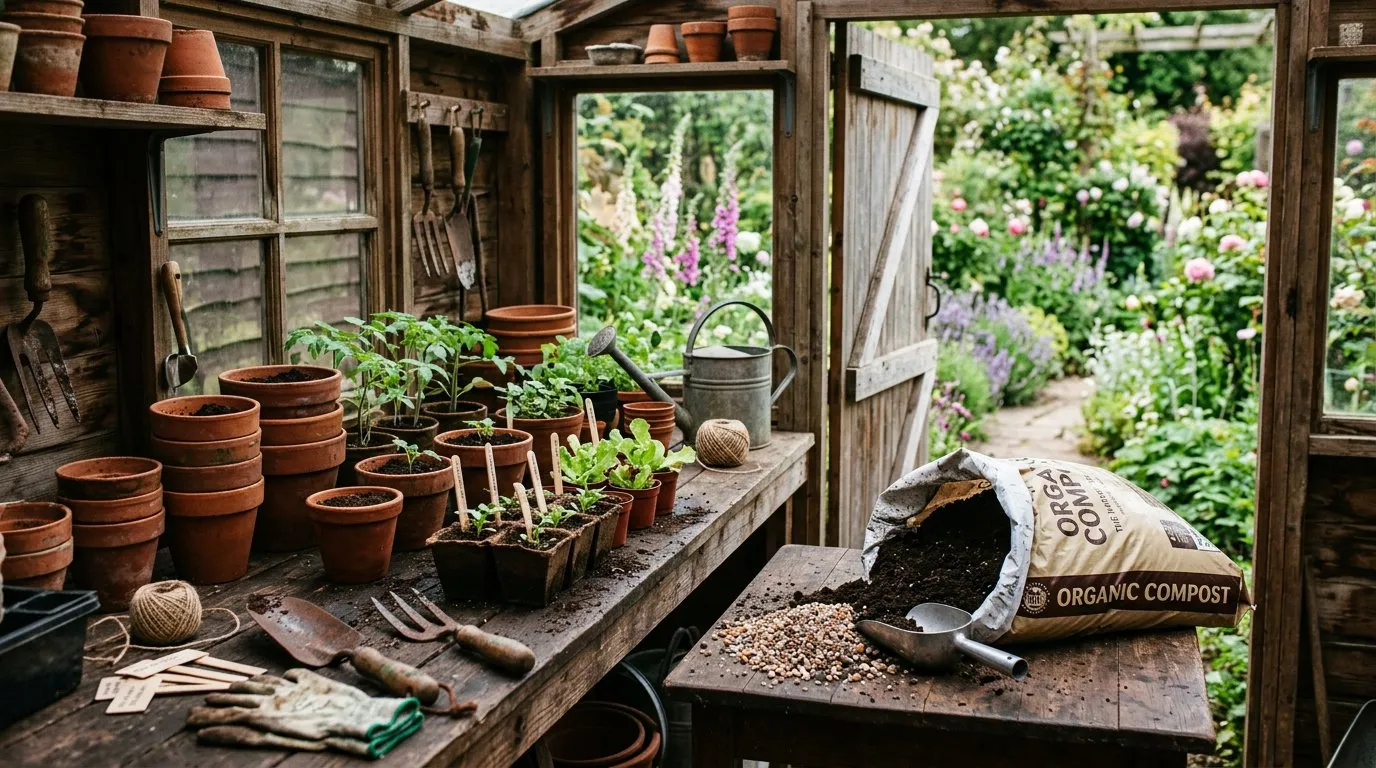
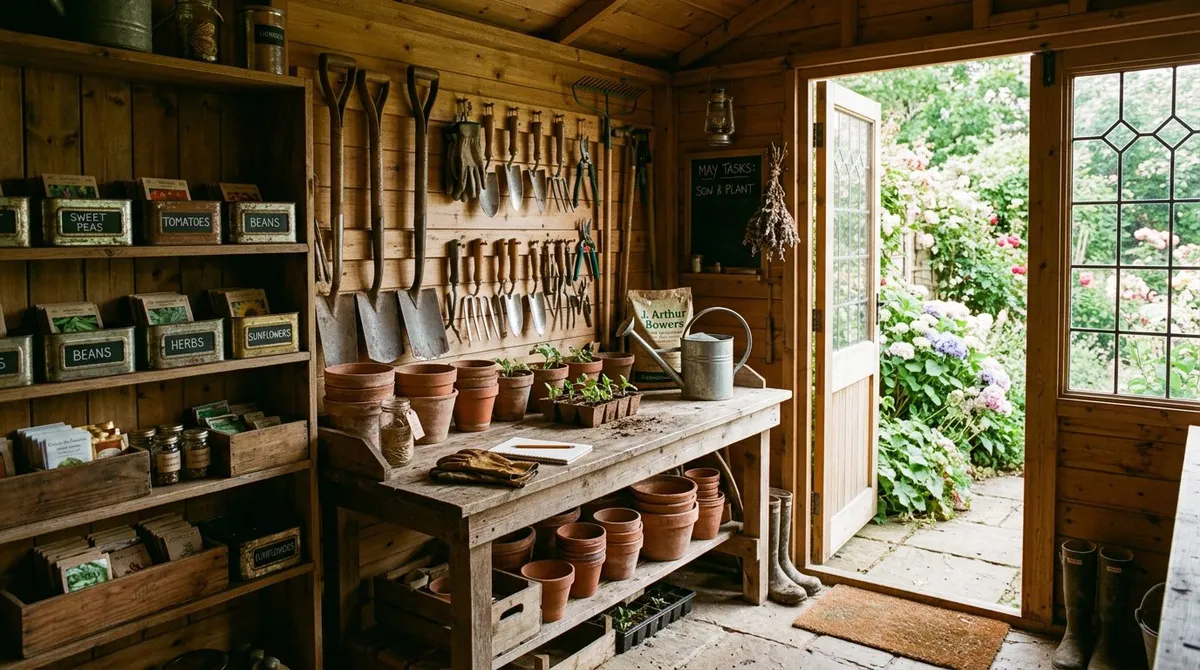
A rustic potting station with terracotta pots, compost, and seedlings ready for transplanting.
Add a sturdy workbench at waist height (900mm) along one wall. Install shelving above for pots, seed trays, and labels. Mount a pegboard for dibbers, trowels, and plant labels. A window above the bench provides natural light. Add a cold water tap if you can run a supply from the house. A potting shed pairs perfectly with a compost area nearby.
Workshop
Install mains power for a workbench light, circular saw, drill, and router. A 10x8ft shed gives a 2.4m workbench plus floor space for a mitre saw stand. Add a vice to the bench edge. Good overhead LED lighting (4000K minimum) is essential for accurate work. Insulate the walls with 50mm PIR board and line with 9mm OSB if you plan to work in winter.
Home office (shed office)
Insulate walls, floor, and ceiling with 50mm PIR boards. Line with plasterboard or tongue-and-groove cladding. Install a 1kW-2kW electric panel heater or small oil radiator. Fit a proper door with a lock and a window that opens for ventilation. Mains power provides lighting, sockets for a computer, and phone charging. A 10x8ft insulated shed provides a comfortable single-person office. For a more permanent solution, see our garden room ideas.
Conversion cost estimates
| Conversion | Key additions | Budget |
|---|---|---|
| Potting shed | Workbench, shelving, pegboard, cold tap | £100-£400 |
| Workshop | Mains power, workbench, vice, LED light | £500-£1,200 |
| Home office | Insulation, lining, heater, power, desk | £1,000-£3,000 |
Popular UK shed brands
| Brand | Material | Price range (8x6ft) | Known for |
|---|---|---|---|
| Forest Garden | T&G timber | £600-£1,200 | Pressure-treated as standard, wide range |
| Mercia | Shiplap and T&G | £400-£900 | Good mid-range, popular online |
| Shire | T&G timber | £500-£1,000 | Traditional designs, UK-made panels |
| Keter | Resin/plastic | £500-£900 | Maintenance-free, modern look |
| Yardmaster | Metal | £200-£400 | Budget metal sheds, bolt-together |
| Tiger Sheds | T&G timber | £500-£1,100 | Heavy-duty framing, long warranty |
| Waltons | All types | £300-£1,200 | Wide range, frequent online offers |
Common mistakes when buying a shed
1. Buying too small
The single most common mistake. A 6x4ft shed fills up in months. If you own a lawnmower, strimmer, and basic garden tools, start at 8x6ft minimum. Allow space for future items.
2. Skipping the base
Placing a shed on bare soil or grass guarantees a rotten floor within two to three years. Even a layer of paving slabs on levelled sand prevents ground moisture from destroying the floor timbers. This is the one step you must not skip.
3. Choosing overlap to save money
An overlap shed costs 40-50% less than tongue-and-groove. It also lasts 5-8 years instead of 15-20 years. The total cost of two overlap sheds over 15 years exceeds the cost of one T&G shed. Invest in T&G from the start.
4. Ignoring ventilation
A sealed shed traps moisture. Condensation forms on tools and causes rust. Garden chemicals give off fumes. Fit louvre vents on opposite walls to create airflow. Two 150mm x 150mm louvre vents cost under £10 and prevent a range of problems.
5. Forgetting security
The factory-fitted hasp and padlock on most new sheds offers almost no security. Replace with a closed-shackle padlock and coach-bolted hasp on the first day. The cost of a proper lock (£20-£40) is nothing compared to the cost of replacing stolen tools.
Now you’ve mastered garden shed ideas and organisation, read our guide on garden storage solutions for the next step.
Frequently asked questions
What size garden shed do I need?
A 6x4ft shed stores hand tools, a push mower, and basic garden supplies. An 8x6ft shed adds room for a small workbench, potting table, or extra equipment. A 10x8ft shed is the minimum for a functional workshop or home office with storage alongside. For most UK households, 8x6ft is the practical starting point.
Do I need planning permission for a garden shed UK?
Most garden sheds fall under permitted development. The shed must stay under 2.5m at the ridge if within 2m of a boundary. It must not cover more than 50% of your total garden area. It cannot be in front of the principal elevation of the house. Properties in conservation areas, national parks, or listed building curtilages have stricter rules. Check the Planning Portal for current guidance.
What is the best base for a garden shed?
A concrete slab of 75-100mm thick on compacted hardcore is the most durable option. It suits any shed size and lasts decades. Paving slabs on a levelled sand and cement bed work well for sheds up to 8x6ft and cost less. Pressure-treated timber bearers on compacted gravel suit allotments and sites where concrete is not practical.
How do I stop my shed from rotting?
Treat all exposed timber with a spirit-based wood preservative every year. Apply in dry weather between May and September when temperatures exceed 8C. Ensure the shed sits on a raised base with an air gap beneath, never on bare soil. Clear leaves and debris from the roof and base regularly. Replace roof felt at the first sign of cracking or lifting.
What is the difference between overlap and tongue-and-groove sheds?
Overlap sheds use horizontal boards where each plank overlaps the one below. They are cheap but allow draughts and moisture through the gaps. Tongue-and-groove boards interlock with a precision joint that makes a tight, weatherproof wall. T&G sheds cost 30-50% more but last roughly twice as long. For any shed you plan to keep beyond five years, T&G is the better investment.
Can I put electrics in a garden shed?
A Part P certified electrician must install the supply. The standard method runs armoured SWA cable underground from the house consumer unit to a shed-mounted consumer unit with RCD protection. This provides sockets for power tools, lighting, and heating. Budget £400-£800. A solar panel and battery kit (£100-£200) provides basic lighting without mains wiring.
How do I organise a small garden shed?
Get everything off the floor. Mount pegboard on one wall for hand tools. Install shelving above head height on two or three walls. Screw hooks into ceiling joists to hang rakes, brooms, and long-handled tools horizontally. Use labelled plastic boxes on shelves for small items. Keep the floor clear for the mower, wheelbarrow, and bags of compost.
Is a metal shed better than a timber shed?
Metal sheds win on maintenance: no painting, no rot, no pest damage. However, they suffer from internal condensation, dent easily, are harder to modify, and look less attractive. Timber sheds insulate naturally, are easy to adapt with shelving and hooks, and look at home in a garden setting. Metal suits pure storage in budget-conscious gardens. Timber suits any shed you will spend time inside.
Lawrie has been gardening in the West Midlands for over 30 years. He grows his own veg using no-dig methods, keeps a wildlife-friendly garden, and writes practical advice based on real UK growing conditions.