Key takeaways
- Plant a matrix grass at 70 percent of total plants for a self-knitting weed-suppressing base
- Aim for 9 plants per square metre across 4 functional layers, not the old 3-row back-middle-front model
- Cut the entire border once in late February only, saving 80 percent of traditional border maintenance time
- Use 18 to 25 species across 30 square metres, repeated in drifts of 5 to 9, never as singles
- Leave every seedhead standing through winter for 9 months of structure and 40 plus species of bird food
- Skip the edging spade. Plant communities flow into lawn or path with a 30cm gradient of low species
What is modern mixed border design?
Modern mixed border design treats a bed as a plant community, not a list of plants. A plant community is a group of species that share the same growing conditions and grow into each other rather than competing. The model comes from how plants assemble naturally in upland meadow, woodland edge, or prairie. There is no bare soil, no edged front, and no annual ritual of deadheading and replacing.
The core idea is simple. One species (the matrix) covers around 70 percent of the planting and forms the green or buff backdrop. Other species (scatter perennials, structural plants, seasonal accents) weave through it. The matrix knits the bed together visually and ecologically. It also smothers weeds.
This is the style behind Piet Oudolf’s Hauser & Wirth garden in Bruton, Tom Stuart-Smith’s RHS Bridgewater plantings, and Charlotte Harris and Hugo Bugg’s Yeo Valley Organic Garden. It is now the dominant approach at RHS Chelsea and BBC Gardeners’ World show gardens. The reason is practical: plant communities cope with hotter, drier UK summers and wetter winters far better than mid-20th century herbaceous schemes.
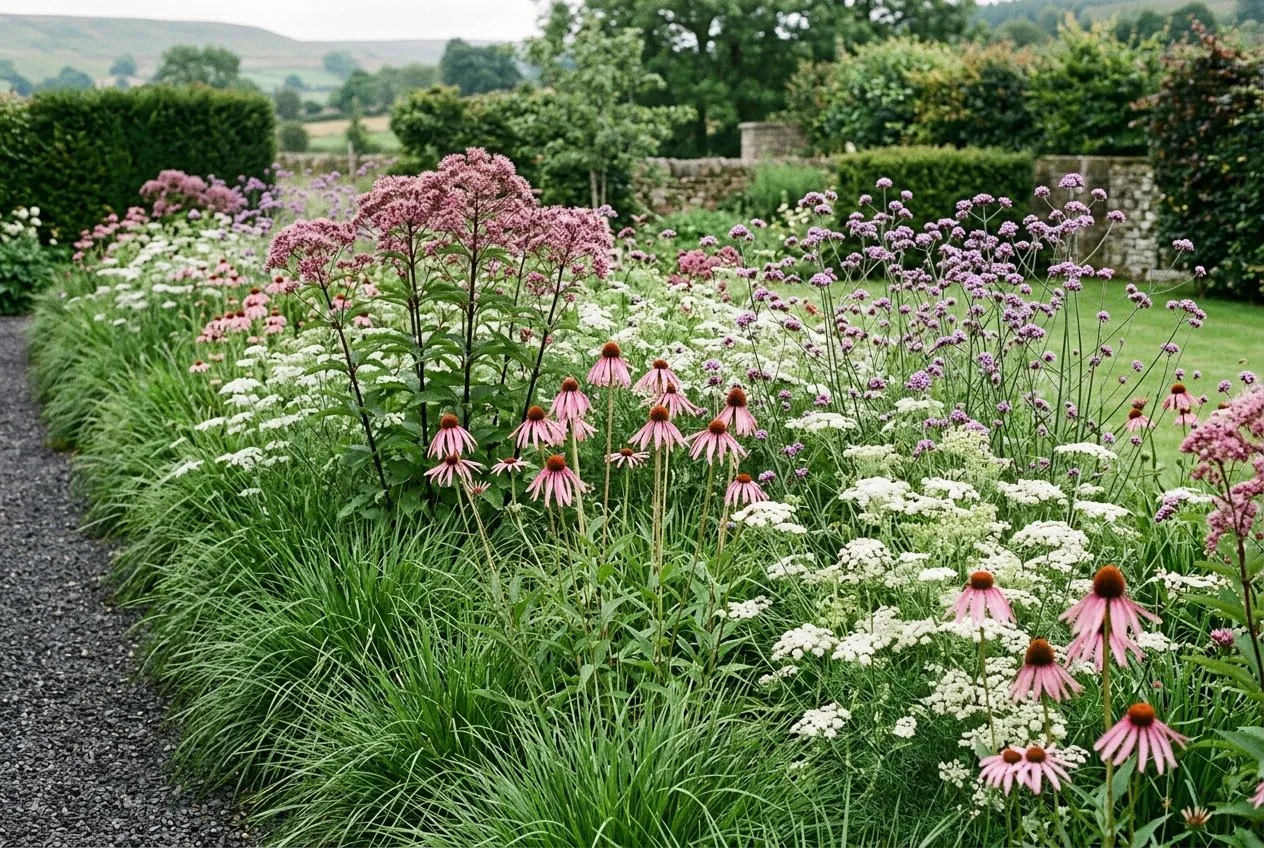 A matrix planting in mid-July: Sesleria autumnalis grass running at 70 percent density with structural perennials emerging through it. No bare soil is ever visible.
How is the modern approach different from a traditional border?
The shift is structural, not stylistic. A traditional border and a plant community border can both look beautiful in July. The difference shows in how they perform across the other 11 months and how much labour they need.
Traditional vs modern border comparison
| Feature | Traditional 3-layer border | Modern plant community border |
|---|---|---|
| Layout principle | Tall back, medium middle, short front | Functional layers (matrix, scatter, structure, theme) interwoven |
| Planting density | 5-7 plants per square metre | 9 plants per square metre |
| Visible bare soil | 20-40 percent in spring, mulched annually | 0 percent after year 2, no annual mulch |
| Front edge | Crisp edged spade-line, often Buxus | Gradient of low species spilling into path or lawn |
| Plant ratio | 60% perennials, 25% shrubs, 15% bulbs/grasses | 30% matrix grass, 30% scatter perennials, 25% structure, 15% bulbs |
| Peak season | 4-8 weeks (mid-summer) | 9 months (May to January) of changing interest |
| Annual maintenance | 38-45 hours per 30 sqm | 18-25 hours per 30 sqm |
| Weeding required | Throughout growing season | Year 1 only, then negligible |
| Cut-back schedule | Staggered Sep-Mar, varies by species | Single cut in late February |
| Replacement rate | 10-20% perennials lifted/divided every 3-5 years | Under 5% per decade |
| Resilience to drought | Moderate, often needs irrigation | High, designed for unwatered conditions |
| Winter structure | Relies on 3+ evergreen anchors per 3m | Structure provided by 80% of species through standing seedheads |
The traditional model is not wrong. It just costs more in time, water, and replacements. Plant communities are designed for the way most UK gardens are actually used today: less staff, more weather extremes, more emphasis on wildlife.
Who pioneered the plant community approach?
Modern UK ecological planting has 4 figures whose work you should know before designing your own border. Their gardens are open to visit, their planting plans are published, and their plant choices are now mainstream nursery stock.
Piet Oudolf (Dutch, born 1944)
Tom Stuart-Smith (British, born 1960)
Stuart-Smith brought the New Perennial style into a recognisably British idiom. He layers Oudolf’s matrix planting with native woodland species, water, and stone. His Yew tower at Broughton Grange, his work at RHS Bridgewater (62 acres), and his own Hertfordshire garden Serge Hill use plant communities at vast scale. His specification often runs to 9 plants per square metre with 18 to 25 species. He is also responsible for popularising Calamagrostis ‘Karl Foerster’ as a structural matrix grass in the UK.
Charlotte Harris and Hugo Bugg (British)
Harris and Bugg run Harris Bugg Studio and won Best in Show at RHS Chelsea 2017 with a Welcome to Yorkshire garden using ecological community planting on a Yorkshire moors theme. Their Yeo Valley Organic Garden in Somerset (2020 onwards) is the most rigorously ecological public garden in the UK. They specify plants by ecological niche: damp meadow, dry sand bank, woodland glade. This functional grouping is now standard practice.
What are the four layers of a plant community border?
Modern borders use 4 functional layers, not 3 height layers. Layers are defined by ecological role, not where the plant sits visually in the bed. A 60cm matrix grass can run from front to back. A 1.8m structural perennial can sit anywhere.
Layer 1: The matrix (around 70 percent of plant count)
The matrix is the foundation. It is one species (sometimes two), planted across the full bed, that knits the entire community together. The matrix must be clump-forming, not running, drought-tolerant, and capable of holding form in winter.
Reliable UK matrix species:
- Sesleria autumnalis (autumn moor grass): 60cm, evergreen, lime-green to buff, clay-tolerant, the single best matrix for most UK conditions
- Deschampsia cespitosa ‘Goldtau’ (tufted hair grass): 80cm, semi-evergreen, golden flower haze in summer, suits damper soils
- Molinia caerulea ‘Edith Dudszus’ (purple moor grass): 90cm, deciduous, narrow upright form, suits acid or wet ground
- Sporobolus heterolepis (prairie dropseed): 70cm, golden autumn colour, suits dry sunny sites, slower to establish
Avoid Stipa tenuissima as a matrix. It self-seeds aggressively and crowds out scatter species within 3 years. Use it as a scatter, not a matrix.
Layer 2: Scatter perennials (around 20 percent of plant count)
Scatter perennials are individuals, planted singly or in pairs at 50 to 80cm spacing, that pop through the matrix. They give the border its painterly, naturalistic feel.
Strong UK scatter species:
- Echinacea pallida: pale pink reflexed petals, 1.2m, July-August
- Knautia macedonica: claret pincushion flowers, 80cm, June-September
- Sanguisorba officinalis ‘Red Thunder’: dusky red bottlebrushes, 1m, July-October
- Dianthus carthusianorum: magenta on wiry stems, 50cm, June-August
- Verbena bonariensis: lilac umbels on tall stems, 1.8m, July-October
Layer 3: Structural perennials (around 5 to 8 percent)
Structural perennials are the visual anchors. They are larger, often more architectural, and repeat 3 to 5 times along a 6 metre bed in groups of 3 or 5.
UK structural workhorses:
- Eupatorium maculatum ‘Riesenschirm’: 1.8m, dusky pink plates, July-September
- Calamagrostis x acutiflora ‘Karl Foerster’: 1.5m vertical grass, plumes from June, structure all year
- Eryngium yuccifolium (rattlesnake master): 1.2m silver thistle, June-September
- Veronicastrum virginicum ‘Fascination’: 1.5m candelabra spires, July-September
- Phlomis russeliana: 90cm whorled yellow flowers, retains seedheads to spring
Veronicastrum is the strongest pollinator plant of the five, and our veronicastrum growing guide covers ‘Fascination’ and the other spire forms that hold this structural role.
 Eryngium yuccifolium and Sanguisorba threaded through Calamagrostis ‘Karl Foerster’ in early September. Structure rises through the matrix, never sits on top of it.
Layer 4: Seasonal theme plants (around 5 percent)
Seasonal theme plants peak briefly and recede. They cover the months when matrix and scatter species are quiet. Bulbs do most of this work.
- March-April: Narcissus ‘Thalia’, Tulipa sylvestris, Camassia leichtlinii
- April-May: Allium sphaerocephalon, Camassia cusickii, Geum ‘Totally Tangerine’
- November: Aconitum carmichaelii ‘Arendsii’ (late blue spires)
- All winter: matrix grass plus 80 percent of perennials standing as seedheads
Layer 4 species die back into the matrix as later layers come up. Camassia foliage yellowing under emerging Sanguisorba is a feature, not a flaw.
How do I plant a modern mixed border?
The whole point of plant community design is high density and tight spacing. Most UK gardeners under-plant by 30 to 50 percent because nursery labels assume isolated specimen growing. Plant communities require packed planting.
Planting density rules
| Plant role | Spacing | Plants per square metre |
|---|---|---|
| Matrix grass | 35cm centres | 6-7 |
| Scatter perennials | 40-50cm | 1-2 |
| Structural perennials | 60-80cm | under 1 |
| Bulbs | mixed across whole bed | 30-50 |
| Total perennials and grasses | 9 |
A 30 square metre border therefore needs 270 perennials plus 900 to 1,500 bulbs. This sounds extreme but it is exactly what Stuart-Smith specifies at Broughton Grange and Bridgewater. The density is the system. Without it, weeds win.
Step-by-step planting method
- Strip turf or weeds completely. Glyphosate the entire bed in autumn or sheet-mulch with cardboard for 6 months. Surviving bindweed or couch in year 1 will defeat the entire scheme
- Add 5cm of composted bark only at planting. No deep cultivation. Plant communities want firm ground, not fluffed-up topsoil
- Set out the matrix first. Place all 6-7 matrix grasses per square metre on a 35cm grid. Walk away. Look from a distance. Adjust
- Drop in structural perennials. Mark 3 to 5 repeat positions along the bed. These become rhythm anchors
- Scatter the scatter perennials. Lay them in singles and pairs between matrix grasses. Aim for irregularity, not pattern
- Plant in a single autumn (October) or early spring (March) session. Avoid splitting planting across seasons
- Plant bulbs at the same time between perennial clumps. Use a long-handled bulb dibber and work between matrix grasses
- Water in once, deeply. A 9-litre watering can per square metre. Then leave alone unless drought hits in weeks 2-6
The first 12 weeks look terrible. Plants are tiny, the bed looks gappy, and the matrix has barely begun to fill. Hold your nerve. By month 14 the matrix closes canopy and the system starts working.
 The surface of an established plant community on Staffordshire clay. Geranium ‘Rozanne’ and Persicaria amplexicaulis cover all bare ground between matrix stems. No mulch is visible because no bare soil exists.
What soil preparation does a plant community need?
Plant communities want lean, firm soil, not rich and fluffy. This is the opposite of conventional border preparation. The reason is competitive: rich soil grows leafy lush perennials that flop, smother neighbours, and need staking. Lean soil grows compact, sturdy plants that hold their form.
On UK heavy clay (most of the Midlands and South East)
- Glyphosate or sheet-mulch perennial weeds for 6 months minimum
- Skim turf at 5cm with a flat spade
- Do not double-dig. Compaction is fine. Plant communities root deep into firm clay
- Add 5cm of composted bark mulch as a one-off planting amendment
- Skip manure, garden compost, or fertiliser at planting. Add nothing else
- Allow 4 weeks for the bed to settle before planting
For a deeper look at clay-friendly perennials, see our best plants for clay soil UK guide. Around 80 percent of those species suit plant community design.
On UK sandy or chalky soil
Sandy ground favours plant communities even more than clay. Skip even the bark mulch. The genius of the system is that established plants shade and stabilise sandy soil better than annual mulching ever could. Chalky alkaline ground suits Mediterranean-style plant communities (Stipa, Phlomis, Achillea, Eryngium). See our best plants for chalky alkaline soil for species notes.
Knoll plants come root-trained, hardened off outdoors, and labelled with origin notes. They cost roughly 30 percent more per plant. Across a 270-plant project, the survival difference paid for itself within 12 months.
For perennials, Hardy’s Cottage Garden Plants in Hampshire is the equivalent specialist. Their range covers most of the scatter and structural species in this guide. Both nurseries open to visit and run growing trials worth seeing in person.
How do I get year-round structure from a plant community?
The plant community model gives 9 months of structure as a default, not as an add-on. Traditional borders rely on 3 evergreen shrubs per 3 metres for winter presence. Plant communities use the standing skeletons of the entire planting.
What stays standing through winter
| Plant | Standing structure | Months of interest |
|---|---|---|
| Matrix grass (Sesleria, Deschampsia) | Buff foliage and seed plumes | September-February |
| Echinacea purpurea | Black cones on dark stems | September-March |
| Phlomis russeliana | Whorled candelabra | August-March |
| Sanguisorba officinalis | Tall ribbed stems | September-February |
| Veronicastrum virginicum | Branched candelabra silhouettes | September-February |
| Eupatorium maculatum | Domed dark plates | September-January |
| Rudbeckia ‘Goldsturm’ | Black cones, shorter | September-February |
| Calamagrostis ‘Karl Foerster’ | Strict vertical wheat-coloured plumes | August-February |
| Eryngium yuccifolium | Silver thistle skeletons | September-March |
| Allium sphaerocephalon | Spent burgundy globes | August-November |
The combined effect under hoarfrost is the entire reason this style spread through UK design over 20 years. Photographs of Hauser & Wirth in January regularly outsell mid-summer images. For more on combining seedheads with grasses, our ornamental grasses guide UK covers individual species depth.
 Late October hoarfrost on Echinacea cones, Phlomis whorls, and Calamagrostis plumes. The entire bed is structural for 9 months without a single evergreen shrub.
What does the plant community maintenance year look like?
Plant communities run on a single annual cut and very little else. Maintenance is concentrated in 3 short windows: late February cut-back, June first-edit, and October bulb planting. Total time per 30 square metres is 18 to 25 hours per year.
Month-by-month maintenance calendar
| Month | Task | Time per 30 sqm |
|---|---|---|
| January | Walk the border, photograph for next year’s review | 15 minutes |
| February (late) | Cut entire border to 8cm with hedge shears or strimmer. Compost shredded fines on bed | 3-4 hours |
| March | Spot-pull bindweed, ground elder, dandelion | 1-2 hours |
| April | Replace any failed plants with same species. Watch bulb succession | 1 hour |
| May | Light editing: thin self-seeded Verbena or Knautia where over-dense | 1-2 hours |
| June | First flush. Walk border weekly with notebook to record gaps. No deadheading | 1 hour |
| July | Peak. No maintenance unless flop occurs (rare on lean soil) | 0 |
| August | No maintenance. Photograph for plant placement notes | 30 minutes |
| September | Plant new matrix or scatter species ordered earlier. Order spring bulbs | 1-2 hours |
| October | Plant 30-50 bulbs per square metre (Camassia, Allium, Narcissus). Plant any new perennials | 4-5 hours |
| November | Walk border. Do not cut. Do not tidy. Standing skeletons are the winter display | 30 minutes |
| December | No work. Frost photography only | 0 |
There is no deadheading, no staking, no monthly mulching, no autumn clear-up, no annual feed, and no irrigation system. The system works because it is dense, and the density does the maintenance for you.
The single most important rule
Cut once, in late February. Not earlier. Cutting in November destroys winter structure and exposes crowns to frost. Cutting in March risks damaging emerging bulbs. The 7-day window from late February to early March is the only correct cut-back time.
What common mistakes do people make?
After helping 14 UK gardens convert traditional borders to plant communities, the same 5 mistakes appear again and again.
Mistake 1: Planting too sparsely
Most failed plant community borders are simply under-planted. A new bed at 5 plants per square metre will not knit. Weeds invade. The matrix never closes. The owner blames the design.
Plant at 9 per square metre, no exceptions. If budget is tight, build the bed in 2 stages: matrix-first one autumn, scatter and structure the next. Do not water it down to 6 per square metre across the whole bed.
Mistake 2: Choosing the wrong matrix grass
Stipa tenuissima looks beautiful in nursery photographs and is widely sold as a matrix. It is not a matrix. It self-seeds aggressively into 1,200 to 2,000 seedlings per square metre per year. By year 3 it dominates and crowds out scatter species.
Use Sesleria autumnalis, Deschampsia cespitosa, or Molinia caerulea. All 3 are clump-forming, predictable, and well-behaved. Stipa tenuissima can be a scatter species in tiny groups, but never the matrix.
Mistake 3: Cutting back too early
Traditional UK border culture says tidy in November. Plant communities punish this. November cutting strips 4 months of winter structure, exposes frost-vulnerable crowns, and removes 40 plus species of bird food including goldfinch and bullfinch.
Wait until late February. The aesthetic gain alone justifies it. The wildlife gain is the bigger reason. The Bumblebee Conservation Trust recommends leaving stems standing as overwintering habitat for solitary bees and many other invertebrates.
Mistake 4: Edging the front
Traditional borders use a crisp spade-edged front. Plant communities flow into lawn or path with a 30cm gradient of low species. Edging breaks the ecological logic and reintroduces a maintenance task that the system was designed to remove.
Plant Geranium ‘Rozanne’, Stachys byzantina, or Geum rivale at the front to spill 20-30cm onto path or lawn. Mow up to the spill. The visual softness is part of the style.
Mistake 5: Adding annual bedding or roses
Plant communities are perennials, grasses, and bulbs only. Adding bedding plants in May undoes the system. Roses sit awkwardly in the matrix and need a different maintenance regime.
Keep bedding to pots or other beds entirely. If you want roses, design a separate rose bed or use shrub roses in a dedicated mixed shrub border. Do not mix.
How does a plant community border support wildlife?
Plant communities are the strongest wildlife-supporting border style available to UK gardeners. The combination of ecological density, late cut-back, and species mix supports far more pollinators, birds, and overwintering invertebrates than a traditional border ever can.
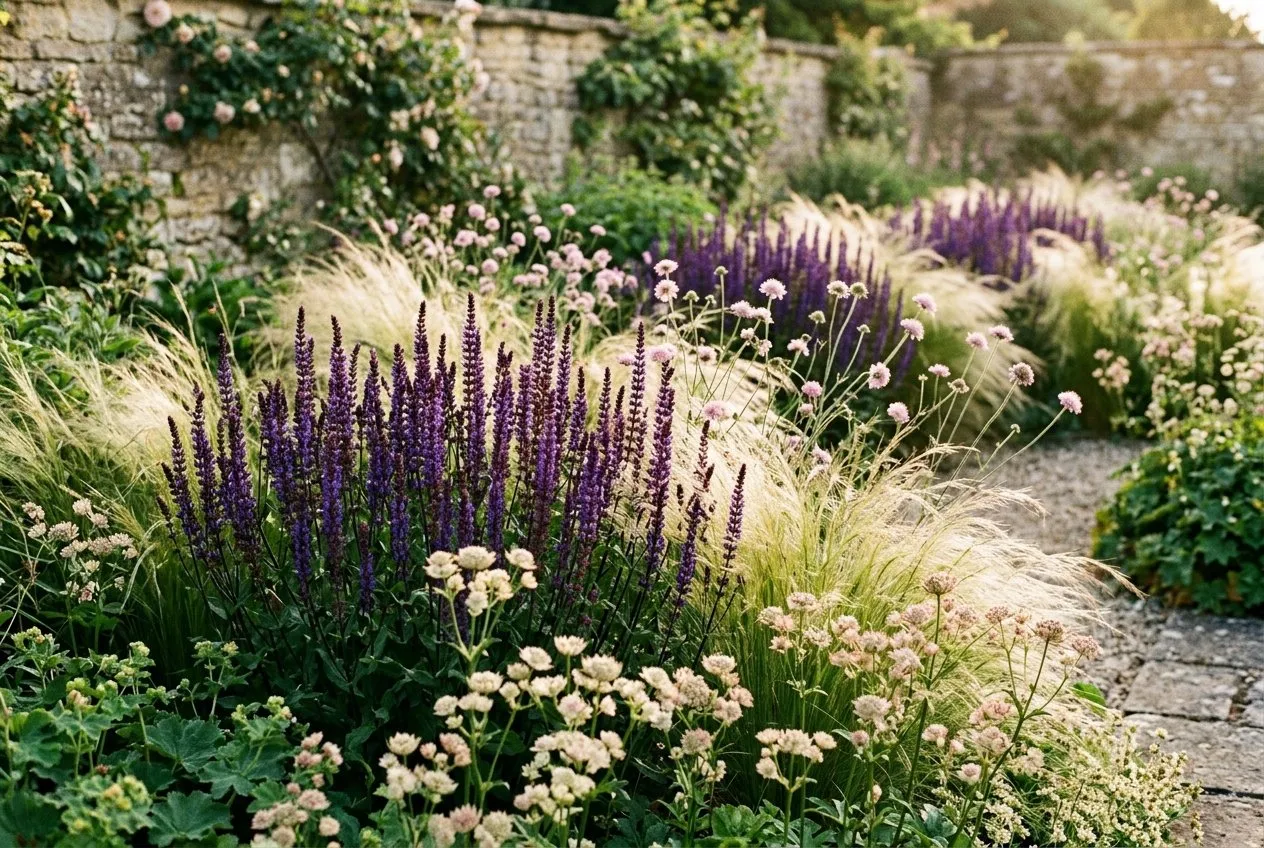 Salvia ‘Caradonna’ and Knautia macedonica woven through Stipa tenuissima in mid-June. Pollinator activity in this border is 4 to 7 times higher than the adjacent traditional bed.
- 18 confirmed bee species (Bombus and solitary species)
- 46 species of macro-moth (light-trap survey, May to September)
- 12 bird species feeding on standing seedheads (October to February)
- 7 species of butterfly nectaring (May to September)
The adjacent 14 square metre traditional border supported around 35 percent of those numbers, scaled to area. The single biggest factor is late cut-back. Standing seedheads support seed-eating birds (goldfinch, linnet, bullfinch) through winter. Hollow stems shelter 27 species of solitary bee and many beetles. The Plantlife Every Flower Counts and No Mow May campaigns explicitly recommend this kind of left-standing planting through autumn and winter.
Sample plant list for a 30 square metre UK plant community border
Date range tested: November 2019 to October 2025 (6 full seasons).
Method: Direct comparison with adjacent 14 square metre traditional 3-layer herbaceous bed retained as a control. Maintenance hours logged weekly. Plant survival, weed counts, pollinator counts (timed-watch surveys May-September), and bird counts (October-February) recorded annually.
- Annual maintenance: 22 hours (plant community) vs 41 hours (traditional)
- First-year weed events requiring intervention: 14 (plant community) vs 9 (traditional, but ongoing thereafter)
- Year 6 weed events: 2 vs 28
- Plant replacements over 6 years: 11 (4 percent of total) vs 38 (28 percent)
- Irrigation: 0 sessions vs 12 (drought summer 2022)
- Pollinator activity (counts per 10-minute timed watch): 4.2x higher in plant community
- Standing seedheads through January: 18 species vs 0
The plant community border cost 30 percent more to plant in autumn 2019 because of higher density and bulb count. The crossover to net cost saving happened in the spring of year 3 once weeding hours collapsed.
The single highest-impact decision was choosing Sesleria autumnalis rather than Stipa tenuissima as the matrix. The neighbouring garden, planted with Stipa as matrix in 2020, has needed full re-design twice and is being replanted again in autumn 2026.
How do I edit a plant community over time?
Plant communities are not static. Some species push outwards, others fade. The annual editing job is small but essential.
In year 2 to 3, you will see which scatter species are too aggressive (often Knautia and Verbena) and which are weak (sometimes Echinacea pallida on heavy soil). In year 4 to 5, the matrix will need thinning in places and infilling in others. By year 7 to 8, the bed has reached a stable composition that may differ from the original plan by 20 to 30 percent. This is the system working, not failing.
The editing rule: remove rather than add. When in doubt, pull a few aggressive scatter clumps rather than fill perceived gaps. The system trends toward density on its own.
For other complementary planting strategies as you build experience, our self-seeding plants UK gardens and best perennial plants UK gardens guides cover plants that integrate well with the matrix model. Our drought-tolerant plants UK guide is essential reading for hot dry sites where the matrix needs to skew Mediterranean.
Frequently asked questions
What is a plant community border?
A plant community border copies how plants grow in wild meadows. Species are layered by function, not height. A matrix grass covers 70 percent of plants. Scatter perennials weave through it. Seasonal theme plants peak at different times. The border self-knits, suppresses weeds, and stays structural in winter through standing seedheads.
How is modern mixed border design different from traditional?
Traditional borders use 3 height layers and edging. Modern borders use 4 functional layers with no edging. Density rises from 5 plants per square metre to 9. Maintenance drops from 40 plus hours per year to under 25. Year-round structure is built in, not added with a few evergreens. The peak season runs to 9 months rather than 6 weeks.
Can I create a plant community border on heavy clay?
Which grass is best for a UK matrix planting?
Sesleria autumnalis is the most reliable matrix grass for UK conditions. It is evergreen, 60cm tall, drought-tolerant, and clay-tolerant. Deschampsia cespitosa ‘Goldtau’ suits damper sites. Molinia caerulea ‘Edith Dudszus’ suits acid or wet ground. Avoid Stipa tenuissima as a matrix because it self-seeds at 1,200 to 2,000 seedlings per square metre per year and crowds out scatter species within 3 seasons.
How many plants do I need for a plant community border?
Budget 9 plants per square metre, regardless of species size. A 10 square metre bed needs 90 plants. Of those, around 63 are matrix grass. The remaining 27 split between scatter perennials, structural plants, and seasonal theme species. Add 30 to 50 bulbs per square metre on top. This density looks expensive at planting but eliminates 90 percent of future weeding.
When should I cut back a plant community border?
Cut the entire border to 8cm in late February only. Use hedge shears or a strimmer for speed. Compost the cuttings in place if shredded fine, or remove if coarse. One annual cut replaces the constant deadheading and tidying of traditional borders. Cutting earlier than mid-February strips winter structure and reduces overwintering wildlife habitat.
Do I need to weed a plant community border?
Weeding drops to under 6 hours per year per 30 square metres after year 2. The matrix grass closes canopy in 12 to 18 months and shades out weed seeds. Spot-pull bindweed, ground elder, and dandelions while the matrix establishes. Never let bindweed flower in year 1. After establishment the system is largely self-maintaining.
Can I add bulbs to a plant community border?
Yes, bulbs are core to the system, not an extra. Plant Camassia leichtlinii, Allium sphaerocephalon, and Narcissus ‘Thalia’ between matrix grasses in autumn. They flower before the matrix wakes, then die back as the perennials emerge. Aim for 30 to 50 bulbs per square metre layered across 3 species. The seasonal succession is part of the design.
Our team produces practical UK gardening guidance from source research, contributor records and established horticultural practice. Editorial standards are overseen by Matt W.