Sloped Garden Ideas: Terracing and Drainage
Sloped garden ideas for UK plots. Covers terracing methods, retaining walls, drainage solutions, planting on slopes, and honest cost breakdowns.
Key takeaways
- Slopes steeper than 1:10 need terracing or drainage to prevent topsoil loss of 2-3mm per year
- Railway sleeper retaining walls cost 80-120 pounds per linear metre and suit slopes up to 1:4 gradient
- French drains at 450mm depth with 20mm gravel and perforated pipe handle most UK slope drainage
- Deep-rooted ground cover plants like Vinca, Cotoneaster, and Geranium macrorrhizum stabilise banks within 2 seasons
- Gabion basket walls at 150-250 pounds per linear metre are the most durable option at 50+ years
- Every 1m of height change needs a retaining wall or 3-4 stepped terraces to be safe and usable
A sloped garden is one of the most common challenges in UK landscaping, and one of the most rewarding to solve. Over 60 percent of UK plots have some degree of gradient, from gentle rolls to steep banks that lose topsoil every time it rains.
This guide covers practical solutions for every gradient: terracing methods, retaining wall options, drainage systems, planting for slope stabilisation, and paths that work on hills. All costs and measurements come from real projects on Staffordshire clay. The RHS guide to gardening on slopes covers the design principles well. Whether you have a gentle 1:10 incline or a steep 1:3 bank, the approach is the same: assess the gradient, manage the water, then build or plant.
How do I assess my garden slope?
Before spending anything, measure the gradient. This determines which solutions work and which are overkill.
The simplest method: place a 2m spirit level horizontally from the top of the slope with one end resting on the ground. Measure the gap between the free end and the ground below. Divide the height by the length.
| Gradient | Height per 2m | Description | Action needed |
|---|---|---|---|
| 1:20 | 100mm | Gentle slope | Planting alone may suffice |
| 1:10 | 200mm | Moderate slope | Ground cover plus drainage |
| 1:6 | 333mm | Steep slope | Terracing needed |
| 1:4 | 500mm | Very steep | Engineered retaining walls |
| 1:3 | 667mm | Severe slope | Structural engineer recommended |
On clay soils across the West Midlands, slopes steeper than 1:10 lose 2-3mm of topsoil per year without intervention. That adds up to 30mm per decade of your best growing medium washing downhill.
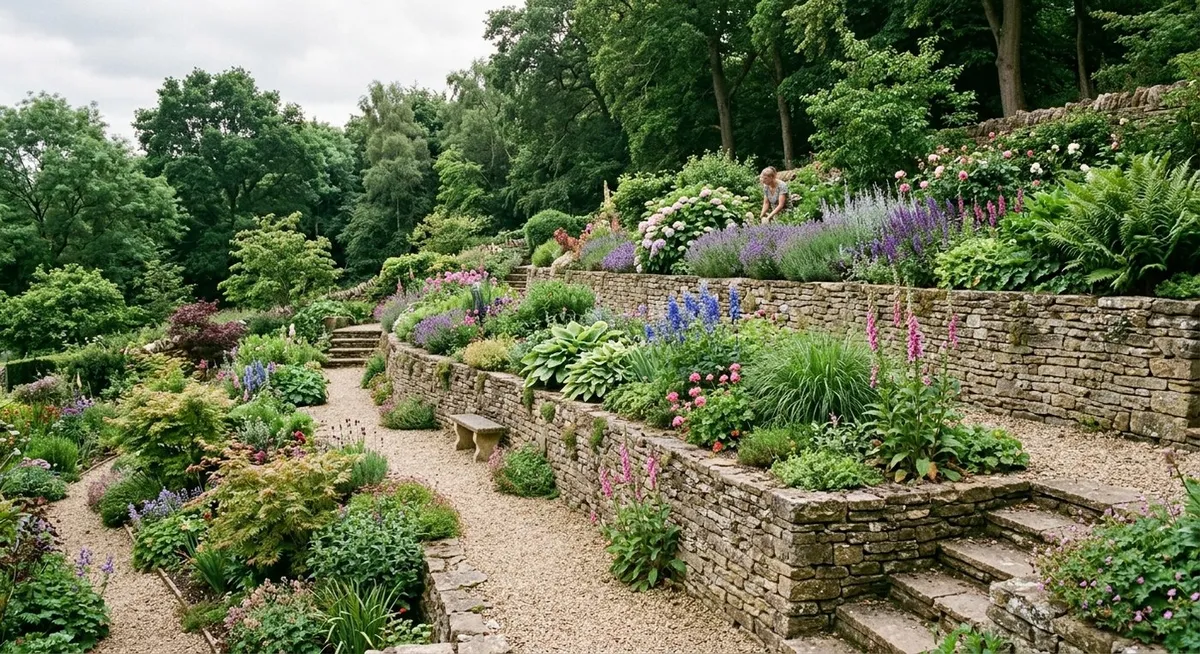
Field Report: Stafford clay hillside, 2017-2026. A south-facing 1:5 slope on heavy Staffordshire clay, 18m long with a 3.6m total height drop. Original state: bare clay with annual mudslides into the lower garden. We cut three terraces at 1.2m height intervals using 200mm x 100mm green oak sleepers, two courses high per wall. Each wall sits on a 300mm concrete strip foundation with 150mm of 20mm drainage gravel backfill and a 110mm perforated land drain running to a soakaway at the base. Total project cost: 4,200 pounds for materials, completed over two weekends. Nine years on, zero wall movement, zero drainage failures. The terraces now hold productive vegetable beds, a cutting garden, and a seating area with views across the valley.
What are the best terracing methods for a sloped garden?
Terracing converts a slope into a series of level platforms connected by retaining walls or planted banks. The method depends on your gradient, budget, and the look you want.
Terracing methods compared
| Method | Cost per linear metre | Max wall height | Lifespan | Drainage | Best for |
|---|---|---|---|---|---|
| Railway sleepers | 80-120 | 900mm (2 courses) | 15-20 years | Add gravel backfill | Budget terracing, vegetable beds |
| Gabion baskets | 150-250 | 2m+ (engineered) | 50+ years | Built-in (free-draining) | Modern gardens, steep slopes |
| Natural stone walls | 200-350 | 1.2m (dry stone) | 100+ years | Good (dry stone gaps) | Cottage gardens, rural settings |
| Timber crib walls | 100-180 | 1.5m | 20-25 years | Good (open structure) | Large slopes, planted walls |
| Planted banks | 15-30 (plants only) | Any gradient | Permanent | Moderate (root network) | Gentle slopes, wildlife gardens |
Railway sleeper terraces
The most popular DIY option. New softwood sleepers cost 25-40 pounds each (2.4m x 200mm x 100mm). Reclaimed oak sleepers cost 40-60 pounds each and look better from day one.
For walls up to 450mm (single course): lay the sleeper on a 50mm bed of compacted sand, pin it with 600mm steel rods driven through pre-drilled holes into the ground. No concrete foundation needed.
For walls 450-900mm (two courses): pour a 300mm x 300mm concrete strip foundation. Stack sleepers with 12mm steel threaded rods connecting the courses. Backfill with 150mm of 20mm gravel and a 110mm perforated drain at the base.
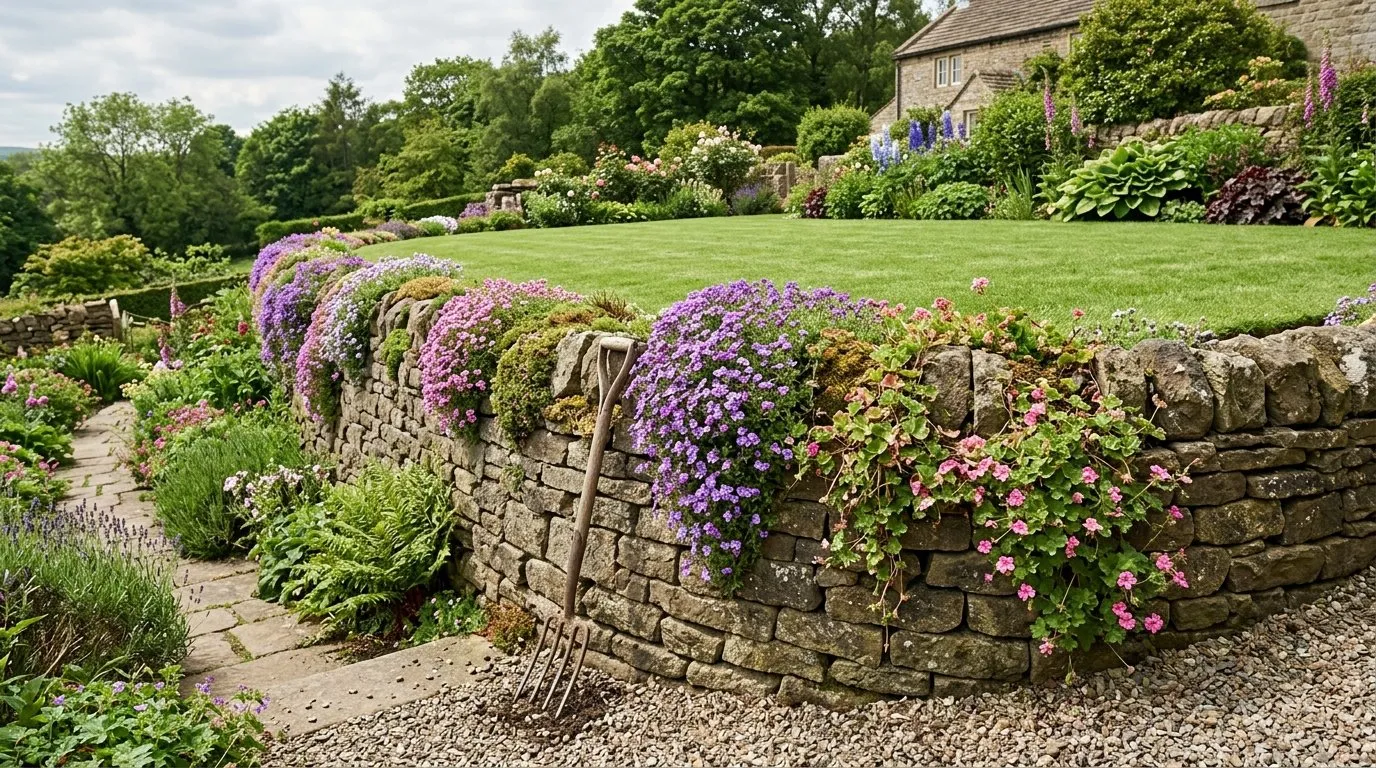 Railway sleeper terraces on a Staffordshire clay slope. The gravel backfill behind each wall is the key to long-term stability.
Never stack more than two courses without engineering advice. Each additional course multiplies the lateral pressure from soil and water behind the wall.
Gabion basket walls
Wire mesh cages filled with stone. Gabion walls are self-draining, incredibly strong, and suit modern and industrial garden styles. A 1m x 0.5m x 0.5m basket filled with local stone costs 60-80 pounds.
Gabion walls flex slightly rather than cracking, which makes them ideal for clay soils that expand and contract seasonally. They also provide habitat for insects, frogs, and small mammals in the gaps between stones.
Natural stone retaining walls
Dry stone walls need no mortar and drain naturally through the gaps. They suit rural and cottage gardens perfectly. A skilled dry stone waller charges 200-350 pounds per linear metre for a wall up to 1.2m high. The Setting Institute can help you find qualified professionals for larger projects.
Mortared stone walls cost 150-300 pounds per linear metre but need weep holes every 1.5m to prevent water pressure building behind them. Without weep holes, a mortared retaining wall on clay soil will crack and lean within five years.
How do I drain a sloped garden?
Water management is the difference between a slope that works and one that collapses. Every terracing project needs a drainage plan.
French drains
The standard solution for slope drainage. A French drain is a gravel-filled trench with a perforated pipe that intercepts water moving through the soil and redirects it to a soakaway or storm drain.
Installation method:
- Dig a trench 450mm deep and 300mm wide across the slope
- Line with geotextile membrane (prevents soil clogging the gravel)
- Lay 100mm of 20mm clean gravel
- Place 110mm perforated land drain pipe on the gravel bed
- Backfill with gravel to within 100mm of the surface
- Fold membrane over the top
- Cover with topsoil and turf or planting
Cost: 25-40 pounds per linear metre for materials. A 10m French drain costs 250-400 pounds in materials and takes one day to dig and install.
Soakaways
A soakaway collects water from drains and allows it to percolate into the subsoil. Dig a pit 1m x 1m x 1m at the lowest point of the garden, fill with clean rubble or purpose-made soakaway crates, wrap in geotextile membrane, and connect your land drains to it.
On heavy Staffordshire clay, soakaways work slowly. A percolation test is essential before relying on one. Pour water into a 300mm x 300mm hole and time how long it takes to drain. If it takes more than 60 minutes to drop 100mm, you need a larger soakaway or a connection to the surface water drain.
Surface water channels
For paths, patios, and hard surfaces on slopes, install ACO-style channel drains across the slope at each level change. These catch surface runoff before it picks up speed and erodes lower areas. A 1m channel drain unit costs 15-25 pounds.
What plants stabilise a sloped bank?
Planting is the most natural and cost-effective way to hold a slope together. Deep-rooted ground cover plants bind the soil, reduce runoff, and look far better than bare earth or membrane.
Best plants for slopes and banks
| Plant | Spread rate | Root depth | Sun/shade | Evergreen | Notes |
|---|---|---|---|---|---|
| Cotoneaster horizontalis | 2m in 3 years | Deep | Full sun to part shade | Semi-evergreen | Red berries for birds |
| Vinca minor | 1.5m in 2 years | Moderate | Part shade to full shade | Evergreen | Blue flowers March-May |
| Geranium macrorrhizum | 1m in 2 years | Deep | Sun to part shade | Semi-evergreen | Aromatic foliage |
| Hypericum calycinum | 2m in 2 years | Deep | Any | Semi-evergreen | Yellow flowers June-Sept |
| Pachysandra terminalis | 1m in 3 years | Shallow-moderate | Full shade | Evergreen | Best for deep shade banks |
| Hedera helix | 3m+ in 3 years | Deep | Any | Evergreen | Fast but needs managing |
| Juniperus horizontalis | 2m in 4 years | Deep | Full sun | Evergreen | Low-growing, 30cm max |
Planting method for slopes: cut X-shaped slits in a pegged weed membrane, plant through the membrane at 30-45cm centres, and mulch around each plant with bark chip. The membrane prevents soil erosion while the plants establish. Remove the membrane after two growing seasons when root cover is complete.
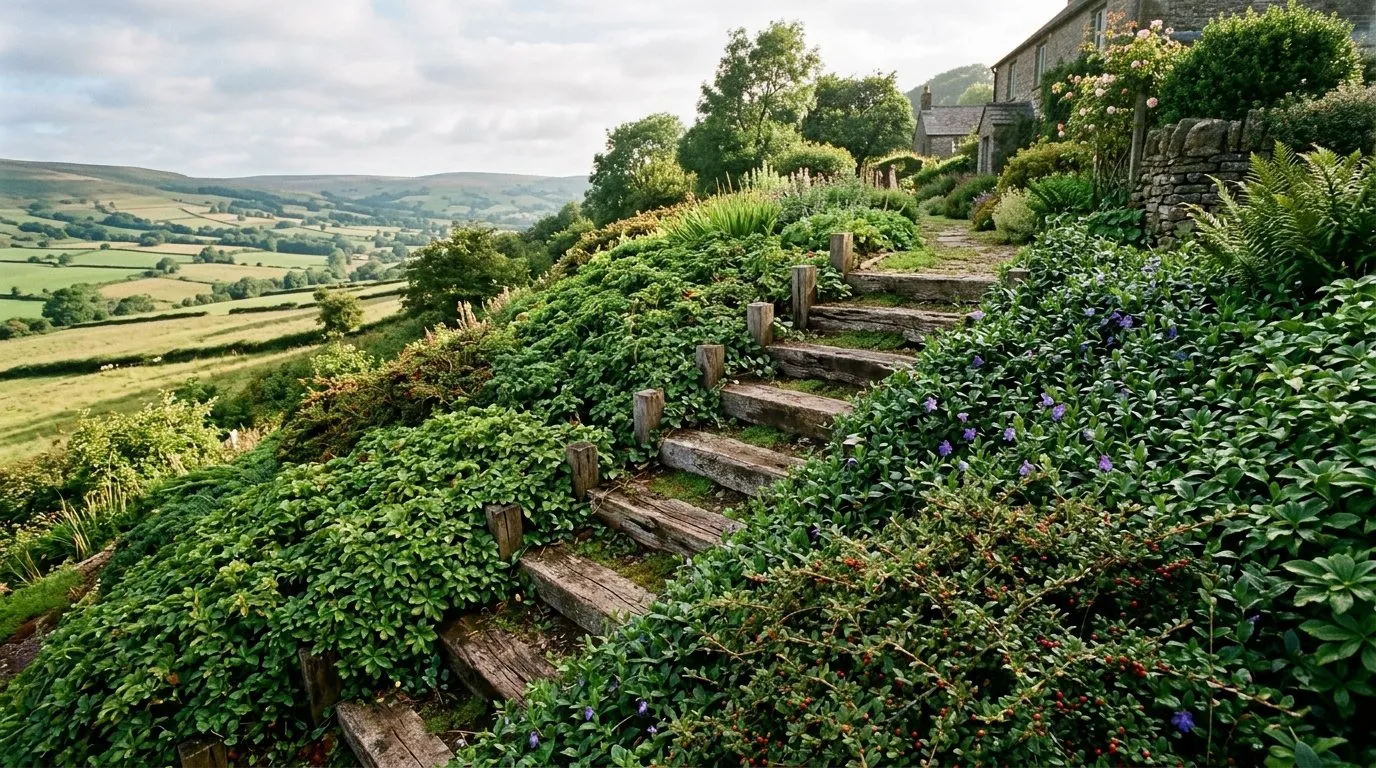 A planted bank in its second season. Cotoneaster and Vinca have knitted together to hold the clay soil firm.
For more ground cover options, creeping thyme and Ajuga work well on sunny, well-drained slopes. On heavier clay, Geranium macrorrhizum and Vinca minor are the most reliable choices.
How do I build steps and paths on a slope?
Steps and paths on slopes need careful construction. A poorly built slope path becomes a mudslide in November.
Steps
The ideal step dimensions for garden use: 150mm riser height, 400mm tread depth. This gives a comfortable climbing angle without feeling steep.
Materials and costs:
- Railway sleeper steps: 30-50 pounds per step. Lay sleepers as risers with compacted gravel treads
- Stone slab steps: 50-80 pounds per step. Natural stone treads on a mortar bed
- Brick steps: 40-60 pounds per step. Frost-proof engineering bricks with a non-slip finish
Pin every step into the slope with steel rods or rebar. On clay, add 100mm of compacted gravel behind and beneath each riser to prevent water pooling and frost heave.
Sloped paths
Paths running across a slope (traversing) work better than paths running straight up. A zigzag path on a steep slope is more comfortable and less prone to erosion than a direct route.
For paths running downhill, use textured materials with grip. Smooth stone and decking become dangerous on slopes. Bark chip, gravel with timber edging, and textured stone flags are the safest options. If you are considering a raised deck to create a level area at the top of a slope, factor in the retaining structure needed below it.
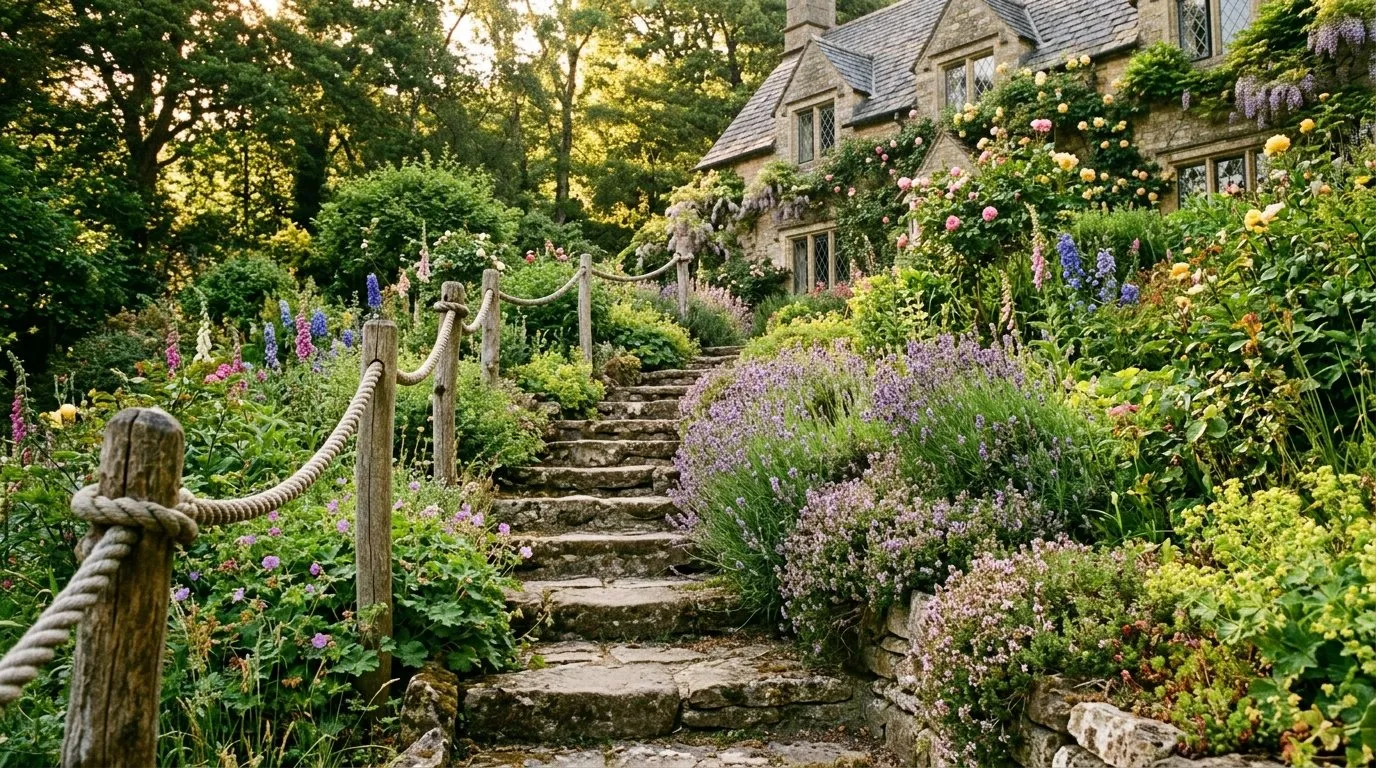 Stone steps with creeping thyme planted in the joints. The gravel landing between flights prevents water from running straight down.
Always install a channel drain or French drain at the base of any slope path. Water follows the path of least resistance, and a smooth path surface becomes a stream during heavy rain.
Should I flatten or work with a sloped garden?
This is the first decision, and most people get it wrong.
Full levelling with a mini digger costs 1,500-4,000 pounds and makes a single flat surface. It works for small slopes where you want a lawn or patio. But it generates huge quantities of spoil (soil removal), destroys the existing soil profile, and often creates drainage problems by removing the natural fall.
Terracing preserves the slope character while creating usable level areas. It costs less, keeps the topsoil in place, and creates more visual interest. A terraced garden with raised beds on the upper levels, a seating area in the middle, and a planted bank at the base is far more interesting than a flat rectangle.
Working with the slope is cheapest of all. Plant the bank with ground cover, add informal steps, and let the gradient become a feature. Slopes catch more sun on south-facing aspects, drain faster than flat ground, and create natural microclimates.
For wider design inspiration on making the most of your space, see our garden ideas guide and small garden design ideas.
Lawn alternatives for slopes
Mowing a slope steeper than 1:6 is difficult and dangerous. A ride-on mower cannot operate safely, and a push mower on wet grass risks slipping.
Replace steep slope lawns with ground cover plants. Micro-clover and creeping thyme both handle slopes well, need no mowing, and look better year-round than a patchy, scalped hillside lawn. Wildflower meadow mixes work on thin, poor slope soils where grass struggles.
For slopes too steep for any living surface, use a combination of terracing and planting. Break the slope into level terraces for functional space, and plant the retaining wall faces and bank sections between them.
Cost summary: sloped garden projects
| Project | Materials cost | DIY time | Professional cost |
|---|---|---|---|
| French drain (10m) | 250-400 | 1 day | 600-900 |
| Sleeper retaining wall (5m, single course) | 400-600 | 1 day | 800-1,200 |
| Sleeper retaining wall (5m, double course) | 700-1,000 | 2 days | 1,400-2,000 |
| Gabion wall (5m, 1m high) | 750-1,250 | 2 days | 1,500-2,500 |
| Stone retaining wall (5m, dry stone) | 1,000-1,750 | Professional only | 1,500-2,500 |
| 6 garden steps (sleeper) | 180-300 | 1 day | 500-800 |
| Slope planting (20 sqm ground cover) | 150-300 | Half day | 400-600 |
| Full terracing (3 levels, 10m wide) | 2,500-4,000 | 3-4 weekends | 5,000-8,000 |
All costs are 2026 prices for the Midlands. London and the South East add 20-30 percent. Scotland and the North tend to be 10-15 percent lower.
A sloped garden is not a problem to solve. It is an opportunity to create something more interesting than a flat lawn. The best sloped gardens I have worked on in Staffordshire have more character, better views, and more growing variety than any level plot. Start with drainage, add structure where you need it, plant everything else, and let the slope do what flat gardens never can.
Lawrie has been gardening in the West Midlands for over 30 years. He grows his own veg using no-dig methods, keeps a wildlife-friendly garden, and writes practical advice based on real UK growing conditions.